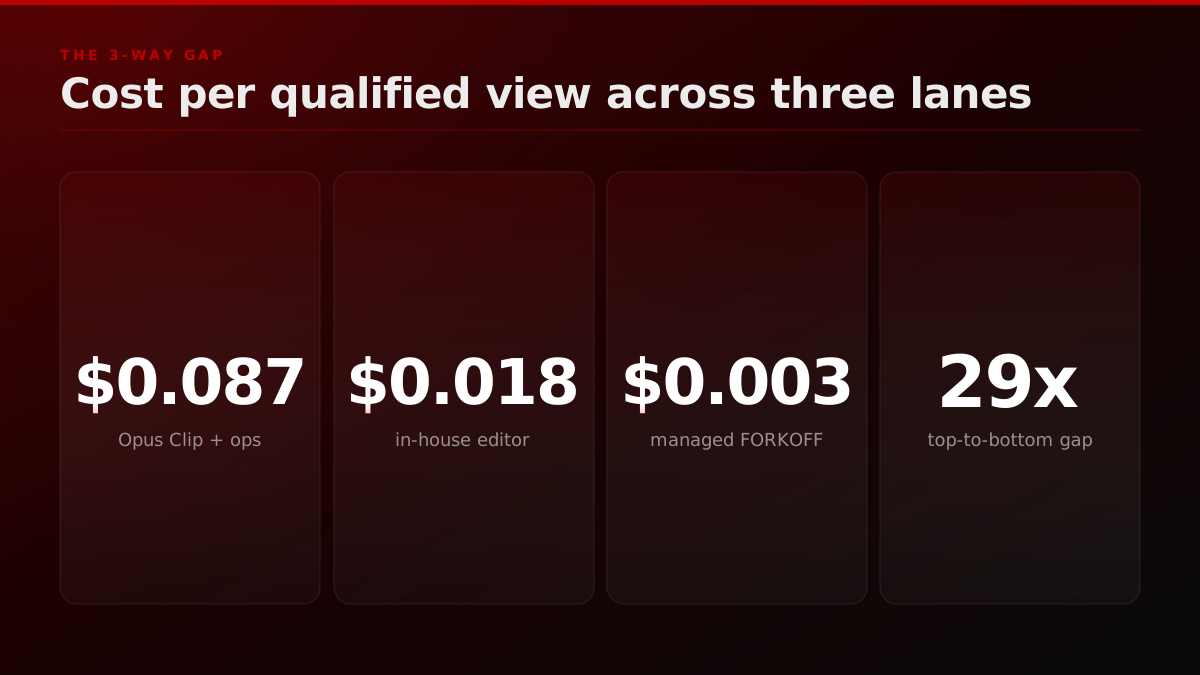
The cost comparison across the three main clipping lanes (in-house editor, Opus Clip Business, and a managed agency) looks simple on sticker price and gets complicated the moment you price operator hours, payroll and attribution. This post works through that comparison using published Opus Clip pricing, aggregated US salary data, and FORKOFF's own managed lane at $0.003 per qualified view. The goal is a framework you can run against your own cost structure before you commit to a lane.
3 lanes, 3 cost structures, 1 decision map
Opus Clip at $29 to $99 per month puts the operator hours on you. A US in-house video editor loads in at an estimated $78K to $99K a year and breaks on utilization. Managed clipping on a CPQV outcome contract bills $0.003 per qualified view with the hours and the audit ledger included. Light volume favors Opus, steady high volume can justify in-house, and attribution or multi-platform needs favor managed. The middle is the in-house-editor trap.
About these numbers
Salary figures come from aggregated data published by PayScale, Salary.com, ZipRecruiter, and Glassdoor (May 2026). Opus Clip pricing is from the published Opus Clip tiers (opus.pro/pricing). The managed-lane rate is FORKOFF's $0.003 per qualified view. Loaded-cost bands are operator estimates built on those inputs; individual results vary by content type, platform mix, and niche.
Should you hire a clipping agency, an in-house editor, or run Opus Clip?
Three clipping lanes show up on every founder call that touches short-form video: hire an in-house video editor, run Opus Clip Business at $99 per month plus your own operator hours, or pay a managed clipping vendor. The sticker prices sit far apart. The real comparison is a different shape, because each lane puts the hours, the attribution and the risk in a different place. Cost per qualified view is the only output metric that ties clipping spend back to pipeline, and only one of the three lanes bills on it. Before working through the comparison, calculate your current CPQV to see where you already sit.
Most posts on the cost question compare two of the three lanes, and most compare on sticker price, not on CPQV. This post puts all three in one ledger, names the inputs that decide between them, and shows which lane wins under which constraint. The macro pressure forcing the question comes from the AI-tool side; @adiix_official framed it bluntly on X.
AdiiX
@adiix_official
someone just replaced an entire clipping agency with one Claude Opus 4.7 prompt > feed it a 3 hour podcast > Opus 4.7 finds every viral moment > writes the captions > drafts the hooks > spits out 40 clips before lunch agencies are charging $5k/month for this Claude charges $0… Show more
The framing is accurate at the cutting layer. It is wrong at the audit-ledger and attribution layer, which is where the real difference between the lanes sits. Read the managed clipping playbook 2026 for the full 6-block operating system behind the managed lane. This post focuses on the cost decision across all three lanes against an output unit, not a vendor-input unit.
Operator noteThe $99 Opus sub looks cheap next to any retainer. Load your operator hours at your own rate and the comparison changes.
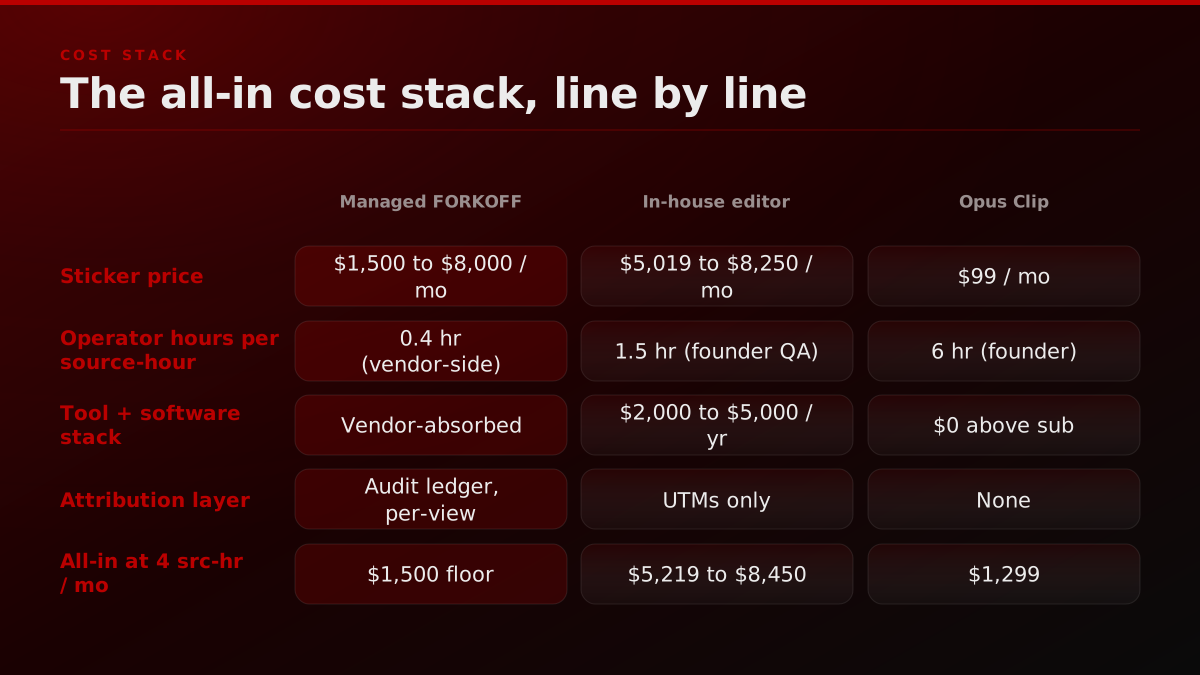
3-lane all-in cost stack, 2026-Q2 snapshot
| Cost line | Clipping agency (managed) | In-house editor (loaded) | Opus Clip Business plus ops |
|---|---|---|---|
| Sticker price | $0.003 per qualified view | $5,019 to $8,250 / mo | $99 / mo |
| Operator hours | Vendor-side | Founder QA | Founder QA, hooks, variants, UTMs |
| Tool + software stack | Vendor-absorbed | $2,000 to $5,000 / yr | $0 above sub |
| Attribution layer | Audit ledger, per-view | UTMs only, no audit | None |
| Multi-platform variants | 4 platforms native | 2 platforms typical | 1 base vertical export |
| Who carries the hours | Vendor | Your payroll | You |
Salary aggregator data from PayScale, Salary.com, ZipRecruiter, Glassdoor (May 2026); loaded multiplier 30 to 40 percent.
Lane 1, Opus Clip Business plus operator hours
Opus Clip ships three paid tiers. Free at $0 with watermark and 60-minute monthly cap. Pro at $29 per month (opus.pro/pricing) with 3,600 annual upload minutes (about 5 hours of source video per month) and 50 captioned exports. Business at $99 per month with 10,000 annual upload minutes (about 14 hours per month), unlimited exports, 1080p, and brand-kit support per opus.pro/pricing. The 14-hour cap clears 3 to 4 weekly podcasts.
The sticker price covers the cutting tool only. The operator-side hours fall into four buckets: cut QA (reframe drift on multi-speaker footage, brand-name caption corrections, brand-safety drops), hook iteration (Opus AI titles ship as bucketed templates that read generic next to founder-voice hooks), platform-native variant cuts across YouTube Shorts, TikTok, Instagram Reels and X, and manual UTM tagging, since Opus does not ship an attribution layer.
Price those hours at your own rate, multiply by your monthly source-hours, and add the subscription. That is the all-in cost of the Opus lane, and it grows in a straight line with every episode you clip. The OpusClip Review 2026 deep dive and the opus-clip-vs-managed-clipping-cost-2026 spoke walk through the 2-lane head-to-head; this post drops the third lane in.
The cutting tool is real; the audit layer is not. The cut start, cut end, caption corrections, and brand-safety checks are operator-side. The Josue Mejia video on hiring a video editor vs an agency walks through the 2-lane decision this ledger extends.
Hiring a Video Editor vs. Agency: Which Makes More Sense?
Josue Mejia
Josue Mejia, Hiring a Video Editor vs Agency: Which Makes More Sense? Direct head-to-head walkthrough of the 2-lane decision the 3-lane CPQV ledger extends.
Operator noteOpus plus ops puts the hours on you, in-house puts them on payroll, managed bills $0.003 per qualified view with the hours included.
Lane 2, In-house full-time video editor
The in-house editor lane sticker-prices as a single line item (salary) and loads in across six. PayScale lists US video editor at $60,455 average; Glassdoor at $70,742 (about $34 per hour); ZipRecruiter at $65,728; Salary.com at $60,247 ($29 per hour). The 25th to 75th percentile band sits at $44,500 to $82,500. Top 10 percent crosses $101,000 (Glassdoor). The senior-track editor who runs multi-platform distribution and audit-attribution work in-house lives in the $100K-plus band.
Loaded cost adds 30 to 40 percent for payroll tax (7.65 percent employer FICA plus state unemployment), benefits at roughly 18 percent of salary (health, 401K match, PTO), equipment refresh at $1,000 to $2,000 per year amortized (M-series Mac, monitor, storage), software stack at $2,000 to $5,000 per year (Adobe Creative Cloud $660, Frame.io $300, CapCut Pro $96, Descript $360, captioning credit pool $400, miscellaneous plugins), and management overhead. The all-in number lands at an estimated $78,000 to $99,000 per year, or $6,500 to $8,250 per month, against a $60K to $70K base. The Salary.com video editor page and the Glassdoor video editor page anchor the base numbers. The two r/podcasting threads below anchor the per-episode rate spread the in-house lane sits inside.
Cost of hiring an editor?
I'm sure this varies a lot and depends on the length of a show but what's considered reasonable to charge? I've always gone my own editing...
My rate is $750 an episode for a full service edit, and a reduced rate of $300 an episode for a leaner pass. Hourly is mostly a guess because the cleanup load varies so much per show; per-episode pricing makes the cost predictable on both sides.
Advice on hiring a podcast editor / producer
For example, I am a full time producer/editor. My rate is $750 an episode for a full service edit, and a reduced rate of $300 an episode for a leaner pass...
Industry Context
PayScale lists US video editor at $60,455 average. Glassdoor pegs it at $70,742, or $34 per hour. ZipRecruiter reports $65,728. Salary.com lists $60,247, or $29 per hour. The 25th to 75th percentile band sits at $44,500 to $82,500; top 10 percent crosses $101,000. Senior-track editors who run multi-platform distribution and audit-attribution work in-house cross into the $100K-plus band.
Source: PayScale, Glassdoor, ZipRecruiter, Salary.com aggregated 2026-05
Operator note$78K to $99K all-in for one editor. Tool stack $2K to $5K per year. Adobe + Frame.io + Descript + captioning credits + hardware refresh.
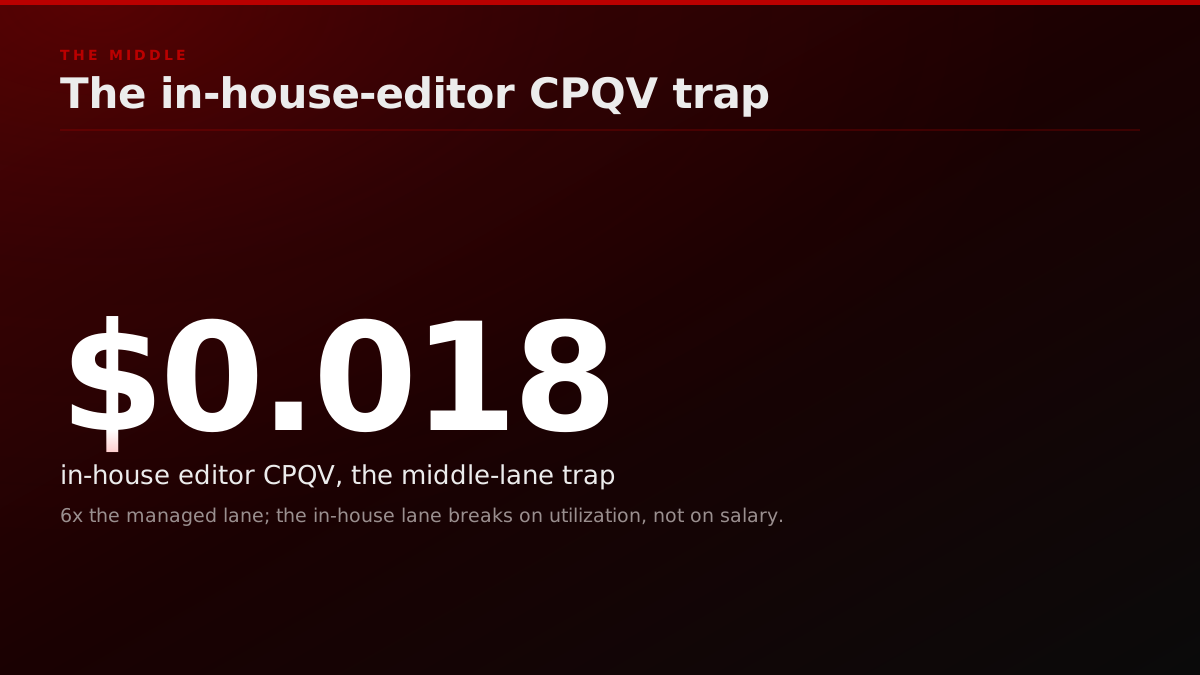
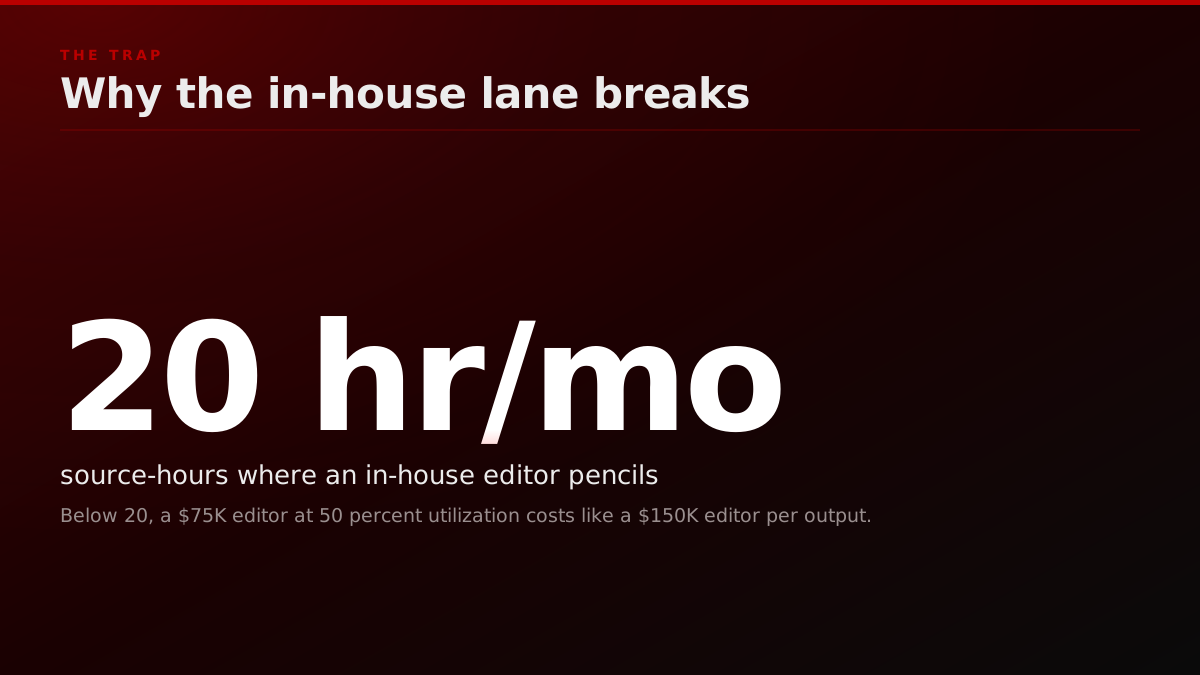
The in-house lane breaks on utilization, not on salary. Take an editor at $75,000 a year: at half utilization, that editor costs $150,000 a year per unit of output. Recording schedules slip, guests reschedule, podcast cadence dips, and the salary keeps flowing while the output does not. The @VadimStrizheus thread on the social media salary band shift captures the macro context.
Vadim
@VadimStrizheus
Kevin O’Leary said the $48k social media job is now a $250k job. Not because companies suddenly love posting motivational clips. Because short-form video became customer acquisition. the old model: - brand pays agency - agency makes creative - agency buys attention - everyone… Show more
Operator noteUtilization is the silent killer: a $75K editor at 50 percent runs at $150K per output. Steady volume is the load-bearing input.
Industry Context
The in-house editor lane breaks on utilization, not on salary. A $75,000 per year editor at 50 percent utilization is a $150,000 per year editor at the per-output level. When a recording schedule slips, the per-source-hour cost rises silently while the salary keeps flowing. Steady volume is the load-bearing input the salary band cannot recover from.
Source: FORKOFF Clipping ops
Lane 3, Managed clipping on a CPQV outcome contract
The managed clipping lane prices three ways: marketplace (per-clip bounties, often $5 to $15 per accepted clip, plus a pool fee), retainer (a flat monthly fee for a fixed clip volume), and outcome-priced (a CPQV contract billed against audit-ledger-passing qualified views; FORKOFF bills $0.003 per qualified view). The CPQV lane is what aligns the vendor with the operator's pipeline economics. A vendor on a CPQV contract has the same incentive the operator does: drive qualified-view volume up. A vendor on per-clip bounties or a flat retainer has the opposite incentive: more clips is more revenue, and qualified-view yield is somebody else's problem. The podcast clipping agency pricing breakdown walks through the three sub-bands. Whichever lane you land in, a provider quoting a total in the billions is making a capacity claim rather than a quality one, and which clipping networks have processed billions of views covers how to verify one before it reaches a contract.
The marketplace lane has a separate structural problem that pushes founders toward the in-house or managed lane: a race to the bottom on clipper pay. @FoxyhitsW broke down the economics on X: entry into the niche is easy, every new clipper pulls the per-CPM rate lower, and at $1 per 1,000 views the large majority of clippers never clear $1,000. The marketplace lane scales for the agency, but the clippers (and indirectly the operator paying per clip) absorb the cost of misaligned incentives.
Foxy
@FoxyhitsW
hot take: 99% of the clippers will never make even $1000 from clipping its just waste of time and your personal growth $1 per 1000 views, wtf is this rate 😭 the biggest problem here is, its super easy to get in this niche the more clippers join = the lesser the pay per cpm
Blaze
@browomo
This 22-year-old guy from Los Angeles runs a TikTok account with a virtual podcast host and earns $1,400 a day without ever appearing in the frame himself. Inside he runs a pipeline of 7 agents on N8N and Claude Sonnet 4.6 that every morning finds a trending topic in the tech ne… Show more
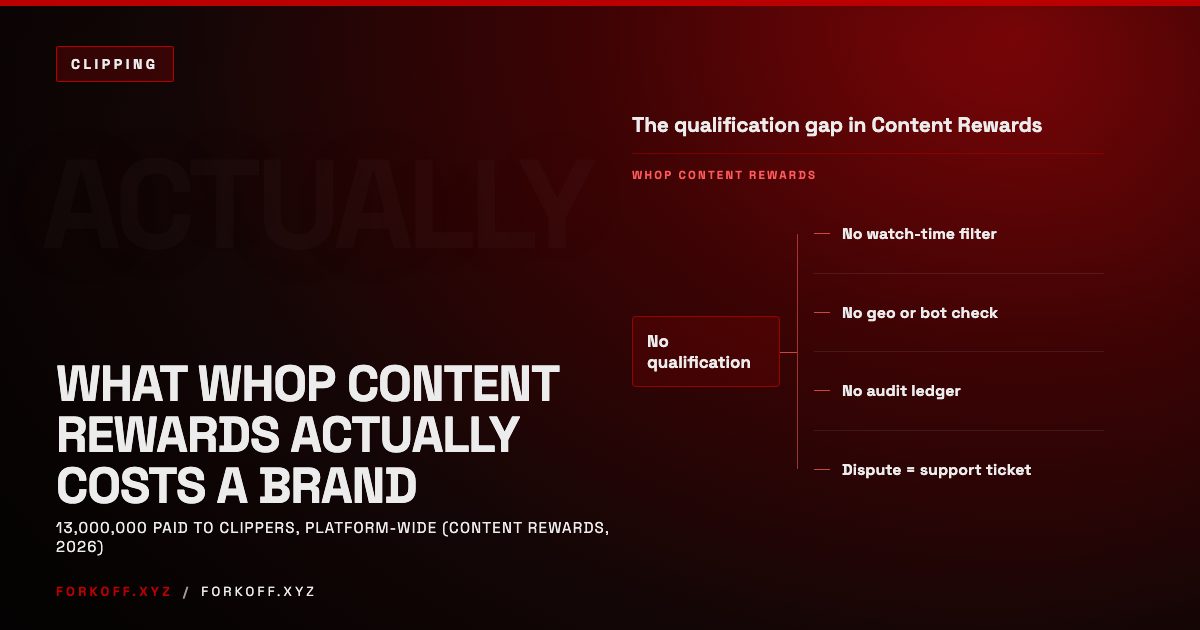
The audit ledger is what makes the CPQV contract billable. Every clip carries a UTM tag, a per-view reason code, and a gate sequence: geo-match (does the viewer match the target geography), watch-time threshold (did the view clear the per-platform retention floor), brand-safety (do the clip and the viewer-side context pass), and non-bot (is the view from a real human, not a data-center proxy or pod farm). The non-bot gate runs through a three-layer bot detection system covering network, behavioral, and reconciliation signals, which is how qualified views separate from raw views.
Under a CPQV contract, whatever fails the gates is the vendor's problem; the operator pays only for qualified views. FORKOFF's reference campaign ran 3,085 clips and 1.19M views in 13 days at $0.003 per qualified view. The structural difference Opus Clip's tier model and the in-house lane both miss: a tool can produce cuts and an in-house editor can ship UTMs, but neither can ledger qualified views against an audit gate. The audit gate is the contract.
Operator noteGeo-match, watch-time, brand-safety, non-bot. 4 gates. A view that fails any one of them is not billed.
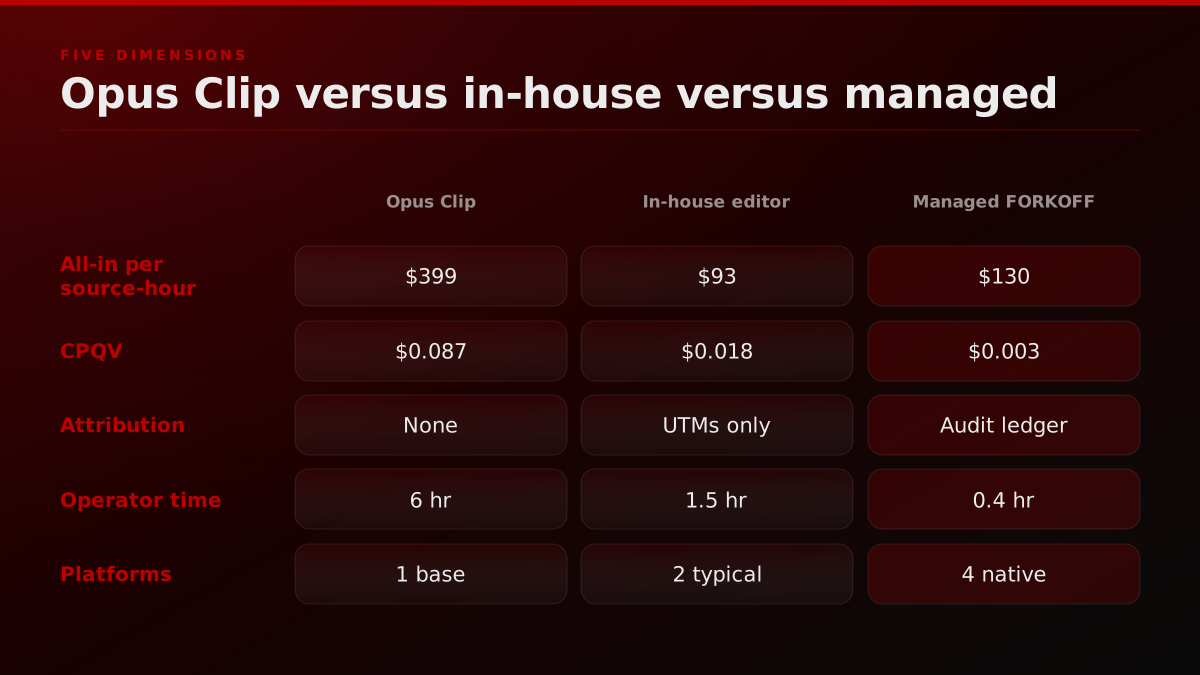
Operator noteOpus ships zero UTM. In-house ships UTM but rarely audit. Managed CPQV contract ships per-view audit ledger. Attribution is the contract.
How does the CPQV gap between lanes change with production volume?
Each lane responds to volume differently. On the Opus lane the subscription is fixed, but the dominant cost, operator hours, scales with every source-hour. On the in-house lane the salary is fixed, so the cost per output falls as the editor gets busier and rises sharply when the schedule thins out. On the managed lane the vendor's fixed costs spread across more qualified views as volume grows.
The managed lane improves with volume for three reasons. First, the vendor's fixed costs (audit-ledger infrastructure, attribution stack, multi-platform routing) amortize across more qualified views. Second, the re-cut loop (top clips by qualified-view yield get re-cut into the next source-week) gets sharper with more source weeks of input data. Third, the founder-voice profile gets richer as the vendor learns which hook templates land with the operator's audience. The in-house lane improves with volume too, but it cannot add the audit ledger. The Opus lane improves slowly because the dominant cost is linear with volume.
Industry Context
Opus Clip Business at $99 per month leaves QA, hooks, platform variants and UTMs on the operator. An in-house editor carries those hours on payroll but produces no audit ledger. Managed clipping on a CPQV outcome contract bills $0.003 per qualified view with the hours and the audit ledger included.
Source: FORKOFF Clipping ops
Where are the break-even thresholds between the three lanes?
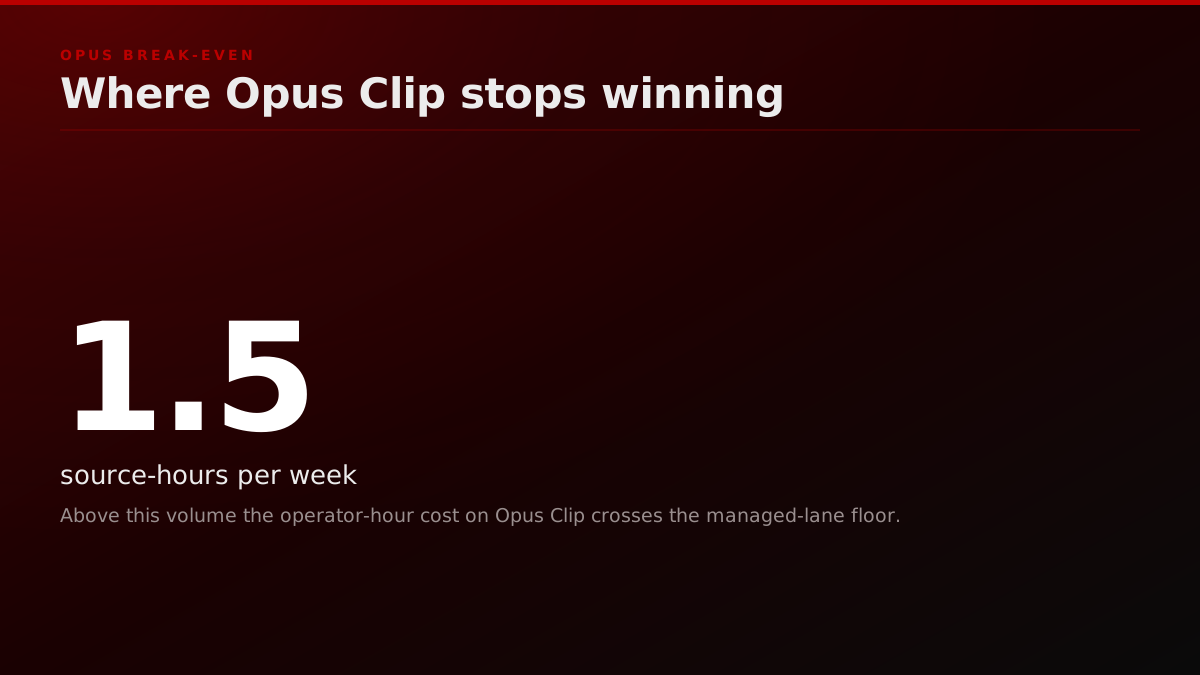
The crossover points depend on inputs only you know, and each one flips a different pair of lanes. Your hourly rate and weekly source-hours decide when Opus Clip stops winning: as your hours on QA, hooks and variants pile up, the managed lane's included operator time becomes cheaper. The subscription cap and operator drag decide when an in-house editor overtakes Opus: once you are clipping several episodes a week, a salaried editor starts to look cheaper than your own time. Steady volume decides whether an in-house editor pays off at all: below it, the editor sits idle and the per-output cost balloons. The managed clipping revenue case study walks through the managed lane end to end.
Operator noteThree inputs decide the lane: your hourly rate, your weekly source-hours, and your deal value. Each one can flip which lane wins.
The deal-value axis matters just as much. When a closed deal is small, the clipping motion is brand presence at best and CPQV is not load-bearing on revenue, so Opus Clip is the right call. When deals are large, the clipping motion is pipeline-tied and the attribution receipts become the point. Scale is the last input: at high monthly view volume the managed lane's infrastructure spreads across every qualified view, while an in-house team has to add headcount to keep up. The qualified views metric explainer defines the output unit that anchors CPQV.
Which clipping lane wins for your production volume and deal size?
Opus Clip wins for a specific operator profile: solo creators, hobby podcasters, low-ACV businesses, and founders with light weekly volume. At that volume the $29 or $99 subscription is the right cost frame because operator hours are sunk (the founder is doing cuts on Saturday afternoons and not pricing the time). The Pro tier is competitive with Submagic and Vidyo on the AI-clipping axis; the Submagic deep-dive review and the best clipping software 2026 listicle walk through the tool-by-tool comparison.
The in-house editor lane wins for one narrow profile: high, steady source volume, daily on-call editing tied to a founder voice that needs hands-on direction, attrition risk priced in up front, and a $100K-plus all-in budget the founder can deploy without forcing utilization rescue moves at quarter end. Outside that profile, the in-house lane underperforms managed on attribution depth and underperforms Opus on hard cost at low volume.
The managed lane wins when at least one of the following is true: deal value per closed customer is high, attribution is required, multi-platform distribution is required across YouTube Shorts, TikTok, Instagram Reels and X, operator hours carry a real opportunity cost (which is the entire founder population), or weekly volume has outgrown what one person can QA. For the head-to-head against Opus Clip specifically, see the FORKOFF vs OpusClip comparison page.
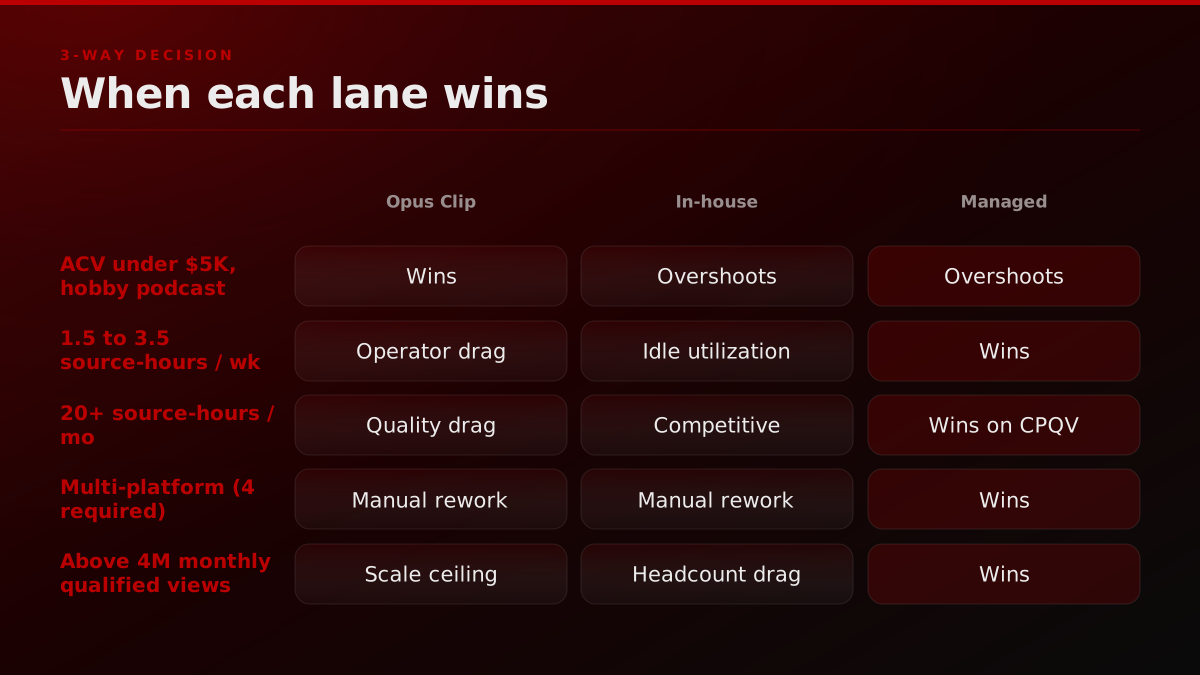
When each lane wins, 3-way decision grid
| Situation | Opus Clip Business | In-house editor | Managed FORKOFF |
|---|---|---|---|
| Low deal value, hobby podcast | Wins | Overshoots | Overshoots |
| Solo creator, one episode a week | Wins | Overshoots | Overshoots |
| Several episodes a week | Operator drag | Idle utilization | Wins |
| Daily founder-voice cadence | Quality drag | Competitive | Wins on CPQV |
| Multi-platform required (4 platforms) | Manual rework | Manual rework | Wins |
| Audit ledger required (non-bot) | No support | No support | Wins |
| Founder paid-pipeline-tied | Quality drag | Attribution thin | Wins |
| Large monthly view volume | Scale ceiling | Headcount drag | Wins |
"Wins" means the better fit for the operator constraint set once operator time is priced in, not CPQV alone.
What to do with this ledger
Run the math on three inputs: your hourly operator cost, your production volume in source-hours per week, and your deal value per closed customer. Light volume, small deals and a modest hourly rate point to Opus Clip Pro at $29 per month. A bit more volume with the same profile points to Opus Clip Business at $99 per month plus your hours. Once your hours are expensive and you clip several episodes a week, the managed CPQV lane wins, and an in-house editor would sit idle at that volume.
At high, steady volume with large deals, the decision is in-house versus managed, not Opus. In-house wins on hard cost only if utilization holds and attribution depth is not load-bearing on revenue. Managed wins on attribution depth at every volume, and on cost once your own hours are priced in.
The marketplace lane sub-decision, before signing a managed contract
Managed clipping is not a single lane. It splits into three sub-bands the cost decision rides on. The marketplace sub-band (per-clip bounties plus a monthly pool fee) optimizes for raw clip count, not qualified views. The retainer sub-band (a flat monthly fee for a fixed clip volume) optimizes for predictable cadence, not pipeline impact. The outcome sub-band (a CPQV contract billed against audit-ledger-passing views) optimizes for qualified-view yield against an audit gate. The three look similar at the sticker-price level and behave very differently at the unit-economic level.
The marketplace sub-band is the lane most founders try first because its floor reads cheap. The structural problem is the bounty incentive. A clipper paid per accepted clip ships volume against the agency's acceptance gate, not against the operator's qualified-view target. The race-to-the-bottom pattern the X post above flags is the predictable outcome: clippers race for accepted-clip volume, agencies extract margin on the per-clip spread, and the operator pays for clip count, not pipeline.
The retainer sub-band is the lane most agencies push because the flat monthly fee gives them margin predictability. The retainer protects the agency from production-volume swings; it does not align the agency with qualified-view outcomes. Agencies on a retainer have no incentive to drive CPQV down once the monthly clip count is hit.
The outcome sub-band is the only sub-band where the vendor is paid against the operator's pipeline metric. The CPQV contract is asymmetric: the vendor absorbs every view that fails the gates and the operator pays only for qualified views. The vendor's incentive matches the operator's: drive qualified-view volume up against a fixed CPQV rate. This is the only sub-band the managed clipping playbook 2026 runs against, and the only one where the 3-layer bot detection system becomes load-bearing on revenue rather than vanity.
What the 3-lane CPQV ledger does not solve
The CPQV ledger gives a clean, auditable answer on cost per output, but the in-house math only beats a managed clipping agency on the CPQV dimension until you price in the bot-detection overhead, settlement delays, and quality-variance lines the ledger already covers. Two dimensions remain outside CPQV regardless of which lane you are on.
The first is brand voice. An in-house editor working daily with the founder for months absorbs voice patterns, brand vocabulary, recurring product references, and recurring guest names in a way a managed vendor needs time to replicate. Founders for whom voice is the load-bearing input (high-touch B2B podcasts, founder-led sales motions tied to per-episode pipeline) often keep an in-house editor on the basis of voice fit even when the CPQV math says managed wins.
The second is daily edit velocity. A founder who ships a daily founder-voice podcast or a daily LinkedIn video clip needs same-day turnaround on cuts. The managed lane runs on a multi-day cadence by default, and same-day cuts need a premium SLA. An in-house editor on a daily cadence delivers same-day turnaround inside the existing salary. For daily-velocity operators, the in-house lane wins on speed even when it loses on CPQV.
The Opus Clip lane does not solve the audit-ledger problem at any volume. No combination of operator hours, hook iteration, or platform-native variants closes the attribution gap. Operators who need qualified-view attribution for vendor-aligned reporting (CFO-facing dashboards, board-level pipeline attribution, paid-channel ROI calibration) cannot stay on Opus Clip past the prototype phase regardless of volume. The cost frame inverts the moment attribution becomes load-bearing on a revenue conversation.
The sticker price is not the comparison. The CPQV is. For the 6-block clipping operating system behind the managed lane (Source, Cut, Hook, Distribute, Attribute, Compound), see the managed clipping playbook 2026. For the Opus Clip head-to-head, see the opus-clip-vs-managed-clipping-cost-2026 spoke. For the managed lane end to end, see the managed clipping revenue case study. For the broader podcast clipping pricing matrix that anchors the agency sub-bands, see the podcast clipping agency pricing breakdown.
Operator note8 FAQs anchor 3-lane decision under volume, salary, CPQV, attribution, hire-trigger. CPQV is the output unit; the rest are vendor inputs.