

Zach Roseman
@zachrose51 · 775 followers
We just killed cold email: Introducing Draftboard. The world’s first AI Sales Director that outperforms any human. Comment your website and we’ll find you intros to 10 dream prospects for free.
Draftboard launchReconstructed reading
Draftboard is a real product by a real founder (@zachrose51). RADAR has tracked 987.3K views on this launch, according to the source post linked below. RADAR measures how the launch reach was built, not whether the product works or whether anyone was honest. This reading is reconstructed confidence and every input is public.
By Simba, Launch Intelligence Analyst · Reviewed by JK · Published 29 Jun 2026 · Confidence: reconstructed
Independent, methodology-derived signal, not a statement of fact about any person. RADAR reads how reach was built, a signature, not an accusation. See the methodology.
Did the Draftboard launch go viral organically, or was the reach amplified?
The Draftboard launch by @zachrose51 drew 987.3K views on 1.2K likes, which is 821 views per like, above the roughly 500 organic ceiling. RADAR reads a reconstructed reading in how that reach was built, a signature of the mechanics and not a claim about the product or the founder. This is a reconstructed reading and every input is public and reproducible.
New here? Start with the product
What is RADAR, and what does this grade mean?
RADAR is FORKOFF's launch authenticity rating system. It reads whether a product launch earned its reach through real engagement or bought it through paid distribution, using only public signals anyone can pull from the launch post. Every reading carries a letter grade, a confidence label, and the date it was last checked, and links back to a published method you can reproduce. Draftboard is a real product by a real founder (@zachrose51). RADAR measures how the reach was built, not whether the product works or whether anyone was honest.
Reconstructed reading
Independent, methodology-derived signal, not a statement of fact about any person. RADAR reads how reach was built, a signature, not an accusation. See the methodology.
What this grade means
RADAR reads this launch from its views-to-likes ratio alone, without a full amplification trace, so the grade is labeled reconstructed and held at lower confidence. The read is a signature of how the reach was built, not a claim about the product or the founder.
The signals RADAR reads
Views-to-likes ratio
Organic reach tops out near 500 views per like. When views climb far past that without the likes to match, the extra reach is arriving without the engagement organic reach produces.
Amplification wave shape
Organic amplification spreads over hours and days. A coordinated launch fires a synchronized burst of quote posts in the first few hours, read from each post's own timestamp.
Posting-time fingerprint
A post that fires exactly top of the hour on a weekday is scheduled. On its own it is weak, but it corroborates a coordinated launch alongside the other two signals.
Those three public signals sit on top of RADAR's five-component forensic read. The full method, the bands, and the confidence model are on the RADAR methodology page.
This launch in the data
Where does this reach sit against the tracked corpus?
Where it sits in the corpus
Rank 16 of 30 tracked launches by views per like, lowest (most organic) first. A lower ratio is the favorable end.
Against the benchmark
This launch's views per like next to the organic median (354) and the amplified median (1,441) across the tracked set.
A real founder, a real product, and reach that modestly outran the likes while real conversation held underneath it.
Here is the tension that makes this launch worth reading in full. Almost every public signal says the product and the person are legitimate: a long-tenured founder with a prior exit, a live product with a public help center and named competitors, and a $4.1M seed raise on the record. None of that is in doubt. What RADAR measures is narrower. When a post collects 987,311 views on only 1,203 likes, the views arrived modestly faster than the likes that organic coupling would predict. That is the soft signature of a distribution lift sitting on top of a real post. It is not the 2,265:1 gap of a heavy distribution buy, and it is nowhere near the 5,000:1 fraud-tier of a like-farm. It is a light lift, and the costly reply and quote layers underneath confirm a genuine conversation was happening at the same time.
The rest of this teardown walks the reading first, then steps back to the product, the founder, the funding, and the market, so a reader can audit the read and understand the launch in full. RADAR exists to separate the marketing layer (what a launch claims) from the data layer (what the public signals actually show). Both layers matter. This page documents both.
Engagement coupling, with the reach a step ahead
The thing that often hides a buy is mostly absent here, and that is what keeps this read light rather than heavy. The costly engagement layers, the ones a like-farm cannot cheaply manufacture, came in strong: 616 written replies against 1,203 likes is roughly one reply for every two likes, an unusually deep reply layer for a launch at this reach. A bought-view operation typically inflates views far faster than it can buy proportionate replies and quotes, so the classic tell is reach that outruns every engagement layer at once. That is not what happened. The views outran the likes by a modest margin, but the replies and quotes held. RADAR reads the gap as a distribution lift on the impression count, not a fabricated conversation.
Signal one: the views-to-likes gauge sits just above the organic ceiling
The load-bearing signal is V:L, views divided by likes. On X, the feed that surfaces a post also makes it easy to like, so under organic distribution reach and likes rise together up to roughly 500 views per like. When views climb but likes do not keep pace, some of the views are arriving from a channel that does not also produce a like. The Draftboard launch shows 987,311 views divided by 1,203 likes, which is 820.7 views per like, a like rate near 0.12 percent. That is below the like rate organic coupling would predict and above the 500:1 ceiling, which places the gauge in the soft distribution-lift zone rather than the organic zone.
Signal two: the costly layers came in heavy, which keeps the read light
Likes are the cheapest action to fake. Replies and quotes are not, because each one is a written post that a real person had to compose. Fake-engagement detection guidance describes the bought pattern as a ratio mismatch, high views with thin written engagement, often arriving in unnatural waves. The Draftboard launch is close to the inverse of that on the written layers: 1,203 likes, 76 reposts, 616 replies, and 156 quotes. Total engagement of 2,051 actions sits near 0.21 percent of views, inside the normal band, and the reply count is the standout. A reply layer running at roughly half the like count is a depth most launches at this reach do not show. Public coverage of the launch also references roughly 1,800 bookmarks, a private save signalling real intent, which is consistent with a genuine product people wanted to come back to. The picture is a real conversation under a reach figure that ran a step ahead of it.
Views per like
About 1.6x the 500 organic ceiling. A light lift, far below the 2,000:1 heavy distribution band and the 5,000:1 like-farm line.
Replies
Written posts, the costliest action to fake at scale. Roughly one reply for every two likes, an unusually deep reply layer for a launch at this reach.
Quotes
Each quote is an original post amplifying with commentary. Present and proportionate, consistent with a genuine two-sided launch conversation.
Total coupling
Likes plus reposts plus replies plus quotes (2,051) against 987,311 views. Inside the normal engagement band; the reply count is the standout depth.
Signal three: no per-account wave was traced
This is a reconstructed read, so RADAR did not page the quote-tweets to exhaustion or derive each one's publish time to chart an amplification wave. A launch only earns a wave chart when the full quote-tweet roster is pulled and timestamped. Here the read rests on the ratio band and the engagement-layer shape, which is enough to place the signature as a light distribution lift but not enough to characterize how that lift was delivered. RADAR does not name any amplifying account or describe any specific third party. The light gap between reach and likes is what the data supports, stated plainly and no further.
Read together, the signals tell one story. The product and the founder are real, the conversation under the post is real, and the reach ran a modest step ahead of the likes. That step is the distribution lift. It is small, the written engagement is genuine, and nothing in the public data points to bought conversation or bot inflation. A light signature, honestly labeled.
What Draftboard actually is
Roseman announced it from his own account. The launch video tweet opened "We just killed cold email: Introducing Draftboard" (x.com/zachrose51, 23 April 2026). The tweet's second line went further still, calling it "the world's first AI Sales Director that outperforms any human," a bolder self-description than the warm-intro framing the product site and press coverage settle on. RADAR notes the gap between the post's biggest marketing claim and the more grounded product positioning because that is exactly the marketing-versus-data split this teardown exists to separate. Either way, the opening is a contrarian hook: a category-killing claim aimed at the most worked-over channel in B2B sales. It is the kind of opinionated framing that drives replies and quotes rather than passive likes, which is consistent with the heavy reply layer RADAR read above.
The positioning is explicit and adversarial toward cold outbound, framed in coverage and on the product's own surfaces as the argument that cold outbound has become a spam arms race and that a warm introduction routed through a real relationship converts where a cold email does not. The product's website materials lead on path-finding into target accounts, with the privacy policy page carrying the "See Every Path Into Your Target Accounts" framing (draftboard.com). A syndicated launch release ran under the headline "Cold Outbound Is Dead: Draftboard Launches Warm Intro Agent for Modern GTM Teams" (News Channel Nebraska), and the launch was also posted to Product Hunt as "Warm (intros) greater than cold (outbound)" (Product Hunt).
Who it is for, and the human-in-the-loop design
Draftboard targets go-to-market teams in sales, plus founders raising capital and recruiters sourcing candidates, anyone whose job depends on reaching a specific person through a warm path rather than a cold list. The relationship-strength scoring is the core mechanic: it ranks each possible introducer by how strong the underlying relationship looks across work history overlap, shared schools, how recently the two interacted, the gap in seniority, department match, and other interaction signals, then drafts the intro-request message for a human to review and send. The human-in-the-loop step is part of the pitch, the agent proposes, the user approves.
The pivot behind the launch
One fact belongs up front because it shapes the funding section below. The Draftboard that launched this warm-intro agent is a pivot. The original Draftboard, the one the public funding backed, was a referral-bonus marketplace where employers posted bounties and referrers competed to fill roles, with the company taking roughly a 20 percent cut. The company has since pivoted, a move Roseman has discussed publicly under "The Hard Pivot," to the AI warm-intro sales agent that this April 2026 video launched (The Hard Pivot, on Spotify). RADAR notes the discontinuity because it is the reason the seed raise predates the launched product.
Zach Roseman, founder and CEO of Draftboard
Roseman's prior seat as CEO of Mosaic Group, a mobile app developer acquired by Bending Spoons, is the credibility marker that most directly explains an audience and press relationships at launch. His founder profile and history are corroborated across his LinkedIn profile, the company's Crunchbase and PitchBook entries, and founder-interview appearances including the Chad and Cheese "Firing Squad" segment (chadcheese.com) and The POZcast, where he discussed solving hiring with Draftboard (thepozcast.com). The mission narrative has been consistent through the pivot: the friction of reaching the right person, first framed as referral hiring and now as warm-intro go-to-market. That continuity supports an authentic-message read rather than a manufactured one. The founder, the product description, and the seed raise are all multi-source corroborated.
What is behind Draftboard, and how it is financed
The seed was reported by TechCrunch on 15 April 2024 under "Draftboard lets companies list referral bonuses for anyone," with the $4.1M figure, the roughly $13M valuation, and Founder Collective plus Twelve Below named, alongside Ground Up Ventures (techcrunch.com, crunchbase.com). That round financed the marketplace product. The warm-intro agent that this video launched arrived after the pivot, and no fresh raise was paired with the 23 April 2026 launch in any source reviewed.
| Structural fact | Reading |
|---|---|
| Warm-intro product round | None public as of launch |
| Confirmed public raise | $4.1M seed, April 2024 |
| Valuation at seed | ~$13M (aggregator-sourced, cross-check) |
| Named seed investors | Founder Collective, Twelve Below, Ground Up Ventures |
| What the seed backed | The original referral-bonus marketplace, pre-pivot |
That the last confirmed raise (April 2024) predates the launched product by about two years matters for the read. The light distribution lift cannot be attributed to a fresh funding-news cycle, because there was no new raise to ride. A founder with a prior exit and an existing seed-backed company has a legitimate audience and press relationships that plainly explain most of the launch reach on their own.
Where this launch sits, and the category it argues with
The clearest competitive signal comes from the product itself: Draftboard's own help center publishes a "How is Draftboard different than Sales Navigator?" comparison, which names LinkedIn Sales Navigator as a direct point of reference (intercom.help/draftboard). Beyond that named competitor, the broader relationship-intelligence and go-to-market tooling category includes well-known peers such as Clay and Common Room. RADAR names Clay and Common Room as category adjacents for context only, not from any Draftboard-specific source, and does not assert a head-to-head positioning against either. A dense, funded category means a contrarian "cold email is dead" launch lands in front of buyers and operators who hold strong views and reply, which fits the engagement shape under this post.
Comparable RADAR launches
RADAR has profiled a library of launches. Draftboard sits between the poles: above the organic ceiling like the distribution-amplified peers, but only by a light margin, and with a written-engagement layer closer to the organic reads. That is the precise meaning of the distribution-amplified (light) label. Compare the Draftboard reading against these peers:
Methodology, and what we are not saying
RADAR does not output a pass or fail on a person. It outputs a signature and a confidence label, both built from public metrics anyone can pull, so the reader can check the work. For Draftboard, the distribution-amplified (light) signature rests on the gap between reach and likes, tempered by a genuine written-engagement layer:
- The views-per-like ratio (821:1) sat above the 500:1 organic ceiling, so the views ran a modest step ahead of the likes.
- The gap is light: about 1.6x the ceiling, far below the 2,000:1 heavy distribution band and the 5,000:1 like-farm line.
- The costly engagement layers came in heavy and proportionate: 616 replies and 156 quotes, the hardest actions to fake at scale, alongside 1,203 likes and 76 reposts. A reply layer near half the like count is the depth of a real conversation.
- No per-account amplification wave was traced, so the read is labeled reconstructed and stays at the level the ratio band supports.
Confidence and how to reproduce it
Confidence is labeled reconstructed: built from the live metric snapshot and the engagement-ratio reading, not a full forensic trace of every engager. Every input is public. Pull the anchor post's view, like, repost, reply, and quote counts; divide views by likes for the gauge; and check whether the costly written layers (replies, quotes) are present and proportionate. The light gap between reach and likes, and the heavy reply layer that keeps the read light, both fall out of the data. See the full method at the RADAR methodology.
Questions readers ask about this launch
Is Draftboard real?
+
Who is Zach Roseman?
+
What is a healthy views-to-likes ratio on X, and where did Draftboard land?
+
Why is this a light distribution-amplified read and not a bought-views call?
+
Did Draftboard raise money for this product?
+
Sources
Primary citation: x.com/zachrose51/status/2047367142367191224. Every number traces to a public pull; reads re-checked over time.
- x.com/zachrose51/status/2047367142367191224 (launch tweet, video, 23 April 2026)
- linkedin.com Zach Roseman founder profile (Draftboard, ex-Mosaic Group)
- crunchbase.com Draftboard company profile and funding
- techcrunch.com Draftboard $4.1M seed (15 April 2024)
- producthunt.com Draftboard launch
- themediamix.co Draftboard Whisper List
- startuphub.ai Draftboard startup profile
- intercom.help/draftboard Sales Navigator comparison
- chadcheese.com Firing Squad founder interview
- pitchbook.com Draftboard 2026 company profile
- tracxn.com Draftboard funding rounds and investors
- cbinsights.com Draftboard products, competitors, financials
- thepozcast.com Zach Roseman on hiring with Draftboard
- draftboard.com product site (privacy policy)
- The Hard Pivot (Spotify) Zach Roseman on Draftboard's pivot
How RADAR read this launch, component by component
Each named component carries a plain-English definition and a directional read where the public data supports one. RADAR publishes the component names, never the weights or the formula.
View-velocity signature
Not publishedWhether the view curve grew the way organic spread does, or spiked like an injected burst.
Per-launch read not published in the public dataset. This component needs the forensic engine output.
Engagement coupling
NeutralWhether likes, replies, and reposts grew in step with views (the organic signature), or the views ran out ahead.
At 821 views per like, reach runs a step ahead of the likes: a light lift above the roughly 500 organic ceiling.
Reply-network authenticity
Not publishedWhether the accounts replying are real, distributed people or a coordinated cluster posting together.
Per-launch read not published in the public dataset. This component needs the forensic engine output.
Amplifier-cluster pattern
Not publishedWhether the quote-tweet amplification looks like organic word of mouth or a known activation cluster.
Per-launch read not published in the public dataset. This component needs the forensic engine output.
Smart-follower activation
Not publishedWhether genuinely influential reference accounts engaged, or the reach was only low-quality volume.
Per-launch read not published in the public dataset. This component needs the forensic engine output.
Are you the founder of Draftboard? You can claim or contest this read. RADAR attaches a founder response to the launch and re-examines any component you dispute.
Authorship
Simba
Co-founder, FORKOFF
Reviewed by: Kshitij JK
Last reviewed:
Published:
Methodology
RADAR reconstructed reading of the Draftboard launch from public metrics: the views-to-likes ratio against the roughly 500 organic ceiling and the posting-time slot, framed as a signature of how reach was built, not an accusation.
Sources cited
- RADAR methodology , FORKOFF
- Draftboard source post , X
Where to go next
Understand launch authenticity
Three ways in, depending on what brought you here: learn how the score works, get a launch read or built, or get the plain answer on this launch.
Learn the score
What a launch authenticity score is
A launch authenticity score reads whether a launch earned its reach or bought it, from public signals. Start with the definitions and the checks you can run yourself.
Verify or build
Launch authenticity verification
Want a launch read by the same method, or a launch video made and distributed on the outcome? RADAR reads any public launch, and FORKOFF builds the launch behind the reach.
The skeptic's question
Is the Draftboard launch legit?
If you are checking whether the Draftboardlaunch was real users or bots, here is the honest read: RADAR's reading is Reconstructed reading, at reconstructed confidence, computed from public metrics and reproducible from the source post. It measures how the reach was built, not whether the product works.
Peer launches
Launches with a similar read
MaveHealth launch
@thatssodhawal
2.6M views · 825 per likeRead
Runable launch
@itsumeshk
408.0K views · 754 per likeRead
Slash (Series C) launch
@victorcardenas
1.9M views · 724 per likeRead
Ollie launch
@blennon_
2.0M views · 958 per likeRead
Durable launch
@jamesclift
3.6M views · 651 per likeRead
Helena launch
@SeijinJung
3.7M views · 643 per likeRead
The benchmark behind every reading
- The organic vs amplified benchmark. What a healthy launch ratio looks like, side by side.
- RADAR methodology. The bands, the confidence model, and how to reproduce a read.
- The Launch Authenticity Report 2026. The aggregate study across the tracked corpus.
- The X Launch Authenticity Study 2026. Two in three tracked launches show a bought-amplification signature.
- Verified-organic leaderboard. The launches RADAR reads as genuinely organic.
- Best product launch videos. The editorial cut of every tracked launch, ranked by views.
- Product launch video service. Get a launch video made and distributed, priced on the outcome.
Want a launch read by RADAR's method?
RADAR reads whether a launch's reach was earned or bought from public data, with the confidence label and the source citation on every reading.
Receipts, deep dives, and playbooks.
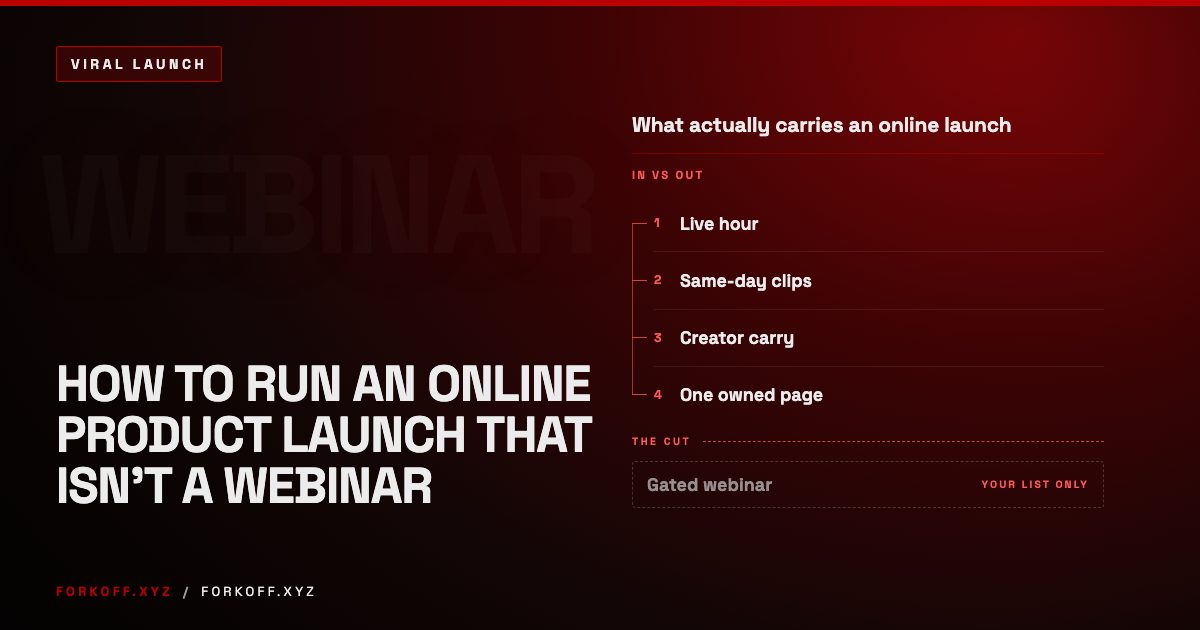
How to Run an Online Product Launch That Isn't a Webinar
An online product launch is a live moment cut into clips that creators carry, not a gated webinar. Here is the livestream, clip and creator stack for 2026.
 Read
Read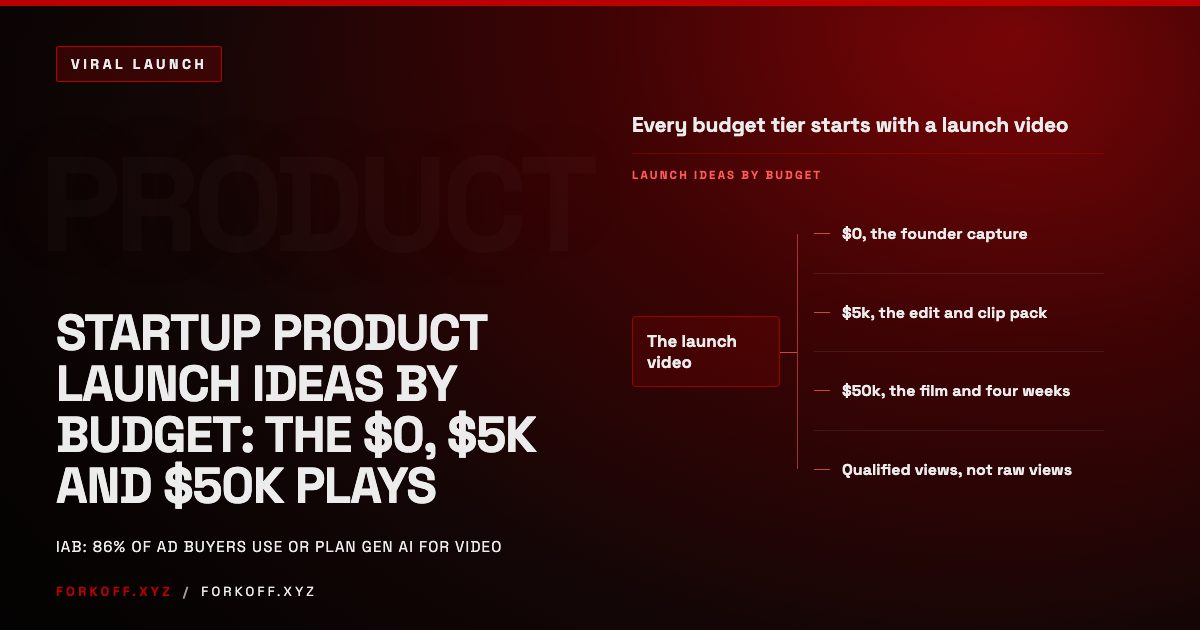
Startup Product Launch Ideas by Budget: The $0, $5k and $50k Plays
Product launch ideas for a SaaS startup sorted by budget: what the launch video should be at $0, $5k and $50k, and the distribution around it.
Read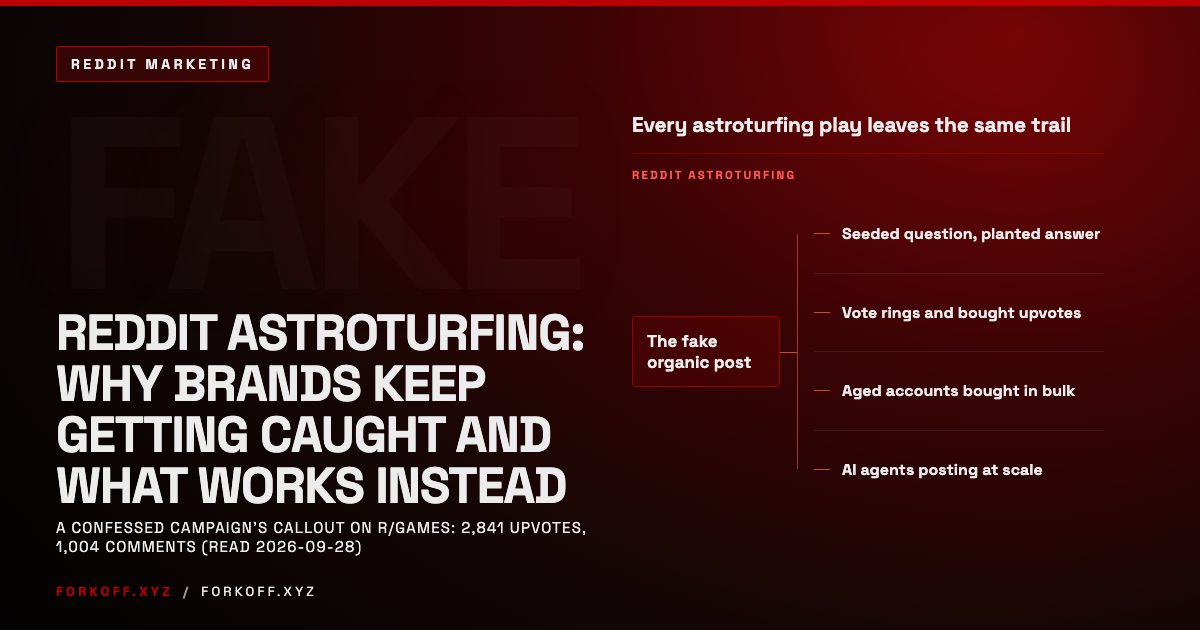
Reddit Astroturfing: Why Brands Keep Getting Caught and What Works Instead
Reddit astroturfing is paid promotion dressed up as organic talk. Why brands keep getting caught, what exposure costs, and the legitimate way to show up.
Read