

Dhawal Jain
@thatssodhawal · 6.2K followers
We've raised $2.1M to fix your focus. Our wearable headset @mavehealth improves attention & stress regulation in just 20 minutes a day for users at @Google, @ufc, @ycombinator. Backed by @BlumeVentures, alongside existing and new investors. Order now at
MaveHealth launchReconstructed reading
MaveHealth is a real product by a real founder (@thatssodhawal). RADAR has tracked 2.6M views on this launch, according to the source post linked below. RADAR measures how the launch reach was built, not whether the product works or whether anyone was honest. This reading is reconstructed confidence and every input is public.
By Simba, Launch Intelligence Analyst · Reviewed by JK · Published 29 Jun 2026 · Confidence: reconstructed
Independent, methodology-derived signal, not a statement of fact about any person. RADAR reads how reach was built, a signature, not an accusation. See the methodology.
Did the MaveHealth launch go viral organically, or was the reach amplified?
The MaveHealth launch by @thatssodhawal drew 2.6M views on 3.2K likes, which is 825 views per like, above the roughly 500 organic ceiling. RADAR reads a reconstructed reading in how that reach was built, a signature of the mechanics and not a claim about the product or the founder. This is a reconstructed reading and every input is public and reproducible.
New here? Start with the product
What is RADAR, and what does this grade mean?
RADAR is FORKOFF's launch authenticity rating system. It reads whether a product launch earned its reach through real engagement or bought it through paid distribution, using only public signals anyone can pull from the launch post. Every reading carries a letter grade, a confidence label, and the date it was last checked, and links back to a published method you can reproduce. MaveHealth is a real product by a real founder (@thatssodhawal). RADAR measures how the reach was built, not whether the product works or whether anyone was honest.
Reconstructed reading
Independent, methodology-derived signal, not a statement of fact about any person. RADAR reads how reach was built, a signature, not an accusation. See the methodology.
What this grade means
RADAR reads this launch from its views-to-likes ratio alone, without a full amplification trace, so the grade is labeled reconstructed and held at lower confidence. The read is a signature of how the reach was built, not a claim about the product or the founder.
The signals RADAR reads
Views-to-likes ratio
Organic reach tops out near 500 views per like. When views climb far past that without the likes to match, the extra reach is arriving without the engagement organic reach produces.
Amplification wave shape
Organic amplification spreads over hours and days. A coordinated launch fires a synchronized burst of quote posts in the first few hours, read from each post's own timestamp.
Posting-time fingerprint
A post that fires exactly top of the hour on a weekday is scheduled. On its own it is weak, but it corroborates a coordinated launch alongside the other two signals.
Those three public signals sit on top of RADAR's five-component forensic read. The full method, the bands, and the confidence model are on the RADAR methodology page.
This launch in the data
Where does this reach sit against the tracked corpus?
Where it sits in the corpus
Rank 17 of 30 tracked launches by views per like, lowest (most organic) first. A lower ratio is the favorable end.
Against the benchmark
This launch's views per like next to the organic median (354) and the amplified median (1,441) across the tracked set.
A real founder, a real product, and reach that ran ahead of the engagement.
Read this verdict precisely, because the framing is the whole point. RADAR reads a modest distribution lift here, not a heavy bot wave. The decoupling is real but modest. A views-to-likes ratio of 825 sits above the 500 ceiling, not in the thousands, and the written layers (replies and quotes) exist rather than being absent. That combination reads as a genuine launch given a distribution lift, some real interest plus amplified reach, not a hollow buy with no conversation underneath it. The exact dollar mechanism is unknowable from public metrics, and RADAR does not assert one.
This launch also sat on top of fresh funding news. The tweet announced a $2.1M seed round on the day the round was made public, and a funding announcement is exactly the kind of event that draws coordinated reposting, press syndication, and investor and team amplification. Some of the distance between the reach and the engagement is the ordinary shape of a funding-news cycle, where a post is pushed in front of many eyes who scroll past without liking. RADAR reads the coupling, names the signature, and leaves the cause to the people who ran the launch.
The rest of this teardown walks the reading first, then steps back to the product, the founder, the funding, and the market, so a reader can audit the read and understand the launch in full. RADAR exists to separate the marketing layer (what a launch claims) from the data layer (what the public signals actually show). A distribution-amplified read is a statement about how the reach was built. It is not, and we will say this plainly later, a claim that anyone did anything improper, and it is not a judgment of the product.
Engagement coupling: the reach ran ahead of the layers
The thing that hides a distribution lift is the gap between reach and engagement, and here it is visible. Dhawal Jain's personal account is a real founder handle, not a fresh one, and the post reached 2.61M views. Under organic distribution the likes, replies, and quotes rise with the reach. When the reach instead outruns those layers, some of the views are arriving from a channel that does not also produce engagement. RADAR went looking for that gap and found it: the engagement did not scale with the reach.
Signal one: the views-to-likes gauge above the organic ceiling
The load-bearing signal is V:L, views divided by likes. On X, the feed that surfaces a post also makes it easy to like, so under organic distribution reach and likes rise together up to roughly 500 views per like. X's 2026 ranking treats engagement types as interconnected signals and rewards them together, with written replies weighted heavily for authenticity because a reply is costly effort. When views climb but likes do not keep pace, the views are arriving from a channel that does not also produce engagement. The Mave Health launch shows exactly that: 2,613,305 views divided by 3,167 likes is 825.2 views per like, a like rate near 0.12 percent, which is below the normal band for a post that has reached this far. The needle sits right of the 500:1 ceiling tick, in the distribution-amplified zone.
Signal two: the costly layers are thin
Likes are the cheapest action to fake. Replies and quotes are not, because each one is a written post that a real person had to compose. A heavy, proportionate reply and quote layer is the fingerprint of real conversation; a thin one against very high reach is the fingerprint of reach that traveled past people who did not engage. The Mave Health launch carries 3,167 likes, 468 reposts, 427 replies, and 172 quotes. Total engagement of 4,234 actions sits near 0.16 percent of views, below the band a mega-viral organic post tends to hold. The layers are present, which is why this is not read as a hollow buy, but they did not scale with the reach, which is why the read is distribution-amplified rather than organic.
Views per like
Above the 500 organic ceiling. Likes lagged a 2.61M-view reach instead of keeping pace with it.
Replies
Written posts, the costliest action to fake at scale. Present but thin against 2,613,305 views, a reply layer that did not scale with the reach.
Quotes
Each quote is an original post amplifying with commentary. A light quote layer for a post that traveled this far.
Total coupling
Likes plus reposts plus replies plus quotes (4,234 actions) against 2,613,305 views. Below the normal engagement band for very high reach.
Signal three: a funding-news shape
The post announced a $2.1M seed round on the day it became public. Funding announcements are syndicated: investors, the team, and the founder's network repost them, and press pickup carries them to readers who view without engaging. That shape can push reach ahead of engagement without any purchased views at all, and RADAR cannot, from public metrics alone, separate ordinary funding-cycle amplification from any paid push. What the data supports is the signature, reach that ran ahead of the costly layers, and not a specific cause. Where RADAR describes the amplifying reach, it describes it only by what the public metrics show: impressions that arrived without the proportionate likes, replies, and quotes beneath them. RADAR names no account, no coordinated group, and no tool.
Read together, the three signals tell one story. The reach ran ahead of the engagement. A genuine founder posted real funding news to his own audience; the reach crossed the organic ceiling at 825:1; the costly engagement layers came in thin; and the event was a funding announcement, the kind that is amplified by design. There is a decoupled view layer here, and RADAR reads it as a distribution lift on a real launch, not as a fabricated one.
What Mave Health actually is
The launch tweet announced the raise rather than the device: "We've raised $2.1M to fix your focus" (x.com/thatssodhawal, 18 March 2026). The framing is a contrarian promise, fixing focus, attached to a funding milestone, which is the kind of opinionated hook that draws reposts and press pickup. The product itself is described across coverage as a brain-stimulating headset that aims to improve attention and mood, positioned in the consumer neurotech category (TechCrunch, Business Wire, Inc42).
How it works
tDCS applies a low electrical current through the scalp to modulate cortical excitability. Mave positions tDCS as resting on a 25-plus year, 10,000-plus paper research base, applied here to a consumer focus device rather than a clinical one. The headset is worn for short daily sessions, around 20 minutes, and is paired with an app that structures the routine (Business Wire, Mave Health product site). RADAR notes that the strength of the underlying research base for clinical tDCS does not, on its own, establish efficacy for this specific consumer focus claim, and RADAR makes no efficacy judgment; that is downstream of this read.
Who it is for, and availability
The device targets consumers seeking better focus and stress regulation, sold direct at $495 with pre-orders open and shipping targeted for April 2026 across the US and India (Mave Health pre-order page). The company frames the mission around mental health, with coverage tying it to India's mental health gap (Inc42, Digital Health News). That the product is a physical device with a hardware price and a shipping date, rather than a free app, is part of the context: the launch was a funding and pre-order moment, which shapes both who amplified it and how the reach reads.
Dhawal Jain, founder and CEO of Mave Health
Jain's public credibility markers are dated and checkable. His bio cites a Forbes 30 Under 30 recognition, and he is named as founder and CEO across the funding coverage and the company's own channels (Business Wire, Crunchbase, LinkedIn, YourStory). The company was founded in 2023 and operates across two hubs, San Francisco and Bengaluru, which is consistent with the US-and-India go-to-market for the device (Crunchbase, Tracxn, LinkedIn). RADAR treats the founder and the company as real and verifiable; the distribution-amplified read is about how this one post traveled, not about the founder's legitimacy.
That a real, funded founder ran this launch is exactly why the read is a modest lift rather than something harsher. A legitimate founder with investors, a team, and press relationships has a built-in amplification base for funding news. The reach running ahead of the engagement is consistent with that base being activated, which is ordinary and legal, and RADAR says so plainly rather than implying anything else.
What is behind Mave Health, and how it is financed
The round was reported across Business Wire, TechCrunch, Yahoo Finance, Inc42, Digital Health News, YourStory, and BioSpectrum, all carrying the same $2.1M figure and the Blume Ventures lead (Business Wire, TechCrunch, Yahoo Finance). The capital is earmarked to launch the focus and stress-regulation wearable, consistent with the $495 device and the April 2026 shipping target.
| Structural fact | Reading |
|---|---|
| Round | $2.1M seed, announced 18 March 2026 |
| Lead | Blume Ventures |
| Named participants | All In Capital (follow-on), Inuka Capital, Stanford Angels, Aureolis Ventures, founders of Groww, Raymond Russell, Dhaval Shroff, Juhi Bhatnagar (Forj Capital) |
| Company | Founded 2023, San Francisco and Bengaluru |
| Launch event | The funding announcement itself |
Where this launch sits, and the peers around it
The peers prove the category is real and unsettled. Named comparables in consumer brain stimulation include Flow Neuroscience, whose tDCS headset targets depression, and Halo Neuroscience, whose Halo Sport tDCS headset is now defunct, a direct cautionary data point that consumer tDCS hardware has failed to hold a market before. Adjacent neuro-wearables include Muse (Interaxon), an EEG headband for meditation rather than stimulation. Mave positions its tDCS approach on a 25-plus year, 10,000-plus paper research base applied to a consumer focus device. A category with a live clinical pedigree, a notable failed predecessor, and active new entrants is exactly the kind of arena where a funded launch lands in front of an attentive, opinionated audience, and where reach can be amplified beyond the engagement the post earns on its own.
Comparable RADAR launches. Compare the Mave Health reading against two distribution-amplified peers and two reads-organic contrasts:
Methodology, and what we are not saying
RADAR does not output a pass or fail on a person. It outputs a signature and a confidence label, both built from public metrics anyone can pull, so the reader can check the work. For Mave Health, the distribution-amplified signature rests on the gap between reach and engagement:
- The views-per-like ratio (825:1) sat above the 500:1 organic ceiling, so the likes lagged a 2.61M-view reach instead of keeping pace with it.
- The costly engagement layers came in thin: 427 replies and 172 quotes, the hardest actions to fake at scale, present but not proportionate to the reach, alongside 3,167 likes and 468 reposts.
- Total engagement of 4,234 actions is roughly 0.16 percent of views, below the band a 2.61M-view organic post usually holds.
- The event was a funding announcement, a syndicated, amplified-by-design moment, so RADAR reads the lift as a distribution lift on a real launch and does not assert a paid mechanism.
Confidence and how to reproduce it
Confidence is labeled reconstructed: built from the live metric snapshot and the engagement-ratio reading, not a full forensic trace of every engager. There is no quote-tweet wave in this read, only the views-to-likes band and the engagement-coupling layers. Every input is public. Pull the anchor post's view, like, repost, reply, and quote counts; divide views by likes for the gauge; and check whether the costly layers (replies, quotes) scaled with the reach. Here they did not. See the full method at the RADAR methodology.
Questions readers ask about this launch
Is Mave Health real?
+
What does a distribution-amplified read mean here?
+
Does this mean Mave Health or its investors bought views?
+
What is a healthy views-to-likes ratio on X?
+
How confident is this read?
+
Sources
Primary citation: x.com/thatssodhawal/status/2034276417530151200. Every number traces to a public pull; reads re-checked over time.
- x.com/thatssodhawal/status/2034276417530151200 (launch post, 18 March 2026)
- x.com/thatssodhawal (verified founder account)
- businesswire.com Mave Health $2.1M seed
- techcrunch.com Mave Health brain-stimulating headset
- inc42.com Mave Health India mental health
- finance.yahoo.com Mave Health raises $2.1M
- crunchbase.com/organization/mave-health
- tracxn.com Mave Health company profile
- linkedin.com Mave Health company page
- linkedin.com Dhawal Jain profile
- digitalhealthnews.com Mave Health seed funding
- yourstory.com Mave Health company
- mavehealth.com official product site
- mavehealth.com pre-order ($495)
- magzter.com BioSpectrum Mave Health $2.1M
How RADAR read this launch, component by component
Each named component carries a plain-English definition and a directional read where the public data supports one. RADAR publishes the component names, never the weights or the formula.
View-velocity signature
Not publishedWhether the view curve grew the way organic spread does, or spiked like an injected burst.
Per-launch read not published in the public dataset. This component needs the forensic engine output.
Engagement coupling
NeutralWhether likes, replies, and reposts grew in step with views (the organic signature), or the views ran out ahead.
At 825 views per like, reach runs a step ahead of the likes: a light lift above the roughly 500 organic ceiling.
Reply-network authenticity
Not publishedWhether the accounts replying are real, distributed people or a coordinated cluster posting together.
Per-launch read not published in the public dataset. This component needs the forensic engine output.
Amplifier-cluster pattern
Not publishedWhether the quote-tweet amplification looks like organic word of mouth or a known activation cluster.
Per-launch read not published in the public dataset. This component needs the forensic engine output.
Smart-follower activation
Not publishedWhether genuinely influential reference accounts engaged, or the reach was only low-quality volume.
Per-launch read not published in the public dataset. This component needs the forensic engine output.
Are you the founder of MaveHealth? You can claim or contest this read. RADAR attaches a founder response to the launch and re-examines any component you dispute.
Authorship
Simba
Co-founder, FORKOFF
Reviewed by: Kshitij JK
Last reviewed:
Published:
Methodology
RADAR reconstructed reading of the MaveHealth launch from public metrics: the views-to-likes ratio against the roughly 500 organic ceiling and the posting-time slot, framed as a signature of how reach was built, not an accusation.
Sources cited
- RADAR methodology , FORKOFF
- MaveHealth source post , X
Where to go next
Understand launch authenticity
Three ways in, depending on what brought you here: learn how the score works, get a launch read or built, or get the plain answer on this launch.
Learn the score
What a launch authenticity score is
A launch authenticity score reads whether a launch earned its reach or bought it, from public signals. Start with the definitions and the checks you can run yourself.
Verify or build
Launch authenticity verification
Want a launch read by the same method, or a launch video made and distributed on the outcome? RADAR reads any public launch, and FORKOFF builds the launch behind the reach.
The skeptic's question
Is the MaveHealth launch legit?
If you are checking whether the MaveHealthlaunch was real users or bots, here is the honest read: RADAR's reading is Reconstructed reading, at reconstructed confidence, computed from public metrics and reproducible from the source post. It measures how the reach was built, not whether the product works.
Peer launches
Launches with a similar read
Draftboard launch
@zachrose51
987.3K views · 821 per likeRead
Runable launch
@itsumeshk
408.0K views · 754 per likeRead
Slash (Series C) launch
@victorcardenas
1.9M views · 724 per likeRead
Ollie launch
@blennon_
2.0M views · 958 per likeRead
Durable launch
@jamesclift
3.6M views · 651 per likeRead
Helena launch
@SeijinJung
3.7M views · 643 per likeRead
The benchmark behind every reading
- The organic vs amplified benchmark. What a healthy launch ratio looks like, side by side.
- RADAR methodology. The bands, the confidence model, and how to reproduce a read.
- The Launch Authenticity Report 2026. The aggregate study across the tracked corpus.
- The X Launch Authenticity Study 2026. Two in three tracked launches show a bought-amplification signature.
- Verified-organic leaderboard. The launches RADAR reads as genuinely organic.
- Best product launch videos. The editorial cut of every tracked launch, ranked by views.
- Product launch video service. Get a launch video made and distributed, priced on the outcome.
Want a launch read by RADAR's method?
RADAR reads whether a launch's reach was earned or bought from public data, with the confidence label and the source citation on every reading.
Receipts, deep dives, and playbooks.
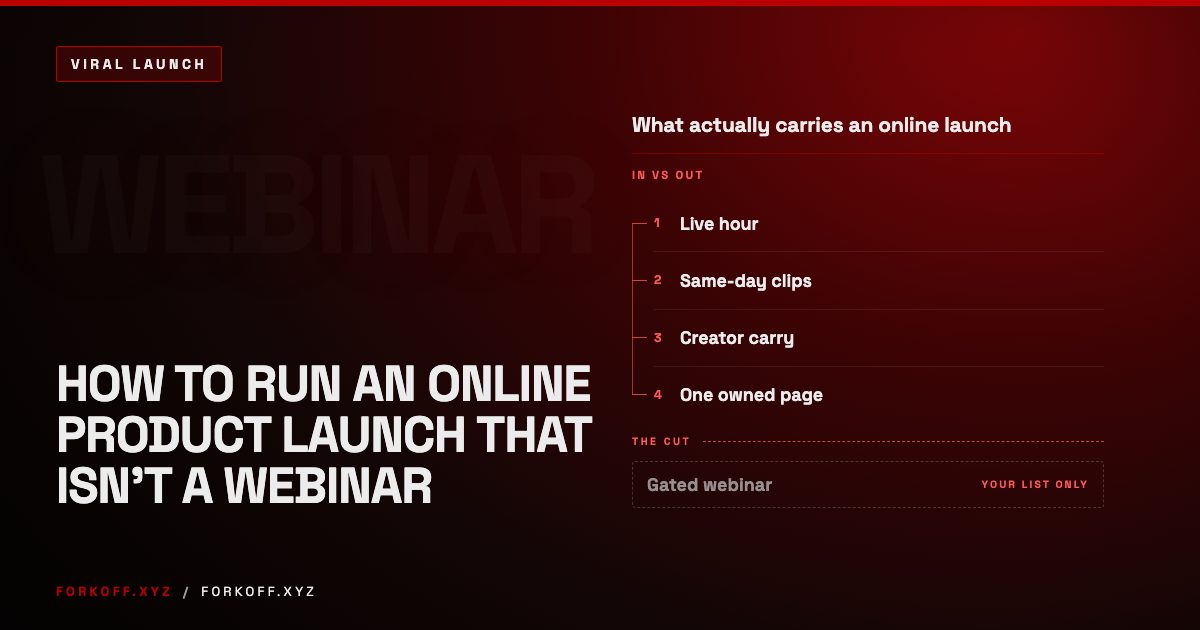
How to Run an Online Product Launch That Isn't a Webinar
An online product launch is a live moment cut into clips that creators carry, not a gated webinar. Here is the livestream, clip and creator stack for 2026.
 Read
Read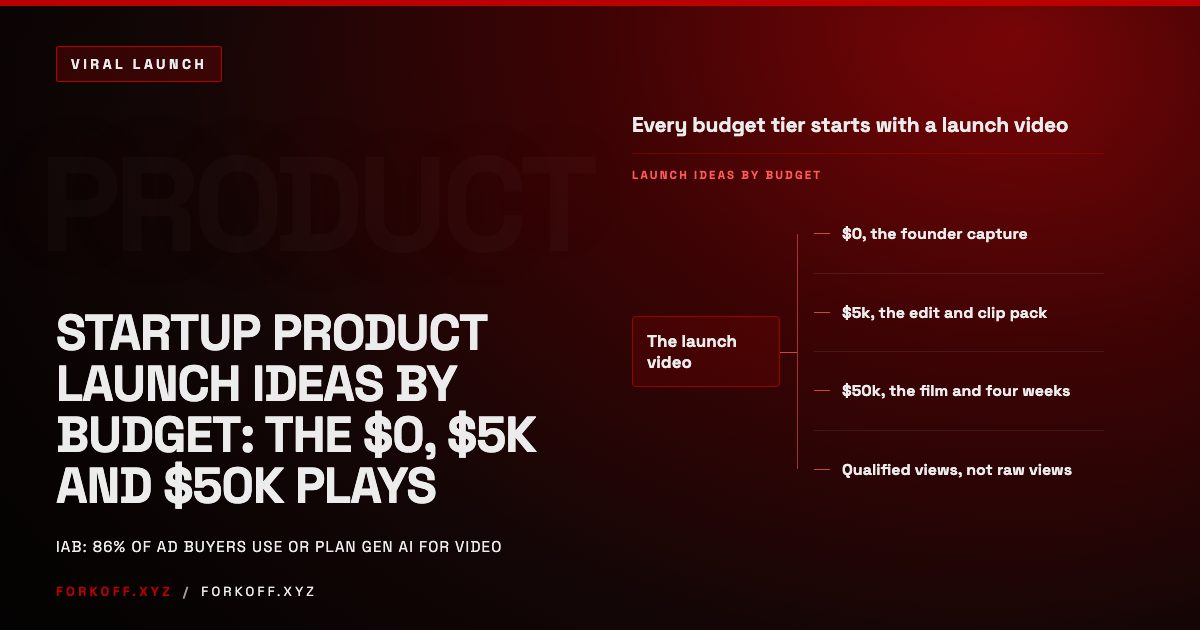
Startup Product Launch Ideas by Budget: The $0, $5k and $50k Plays
Product launch ideas for a SaaS startup sorted by budget: what the launch video should be at $0, $5k and $50k, and the distribution around it.
Read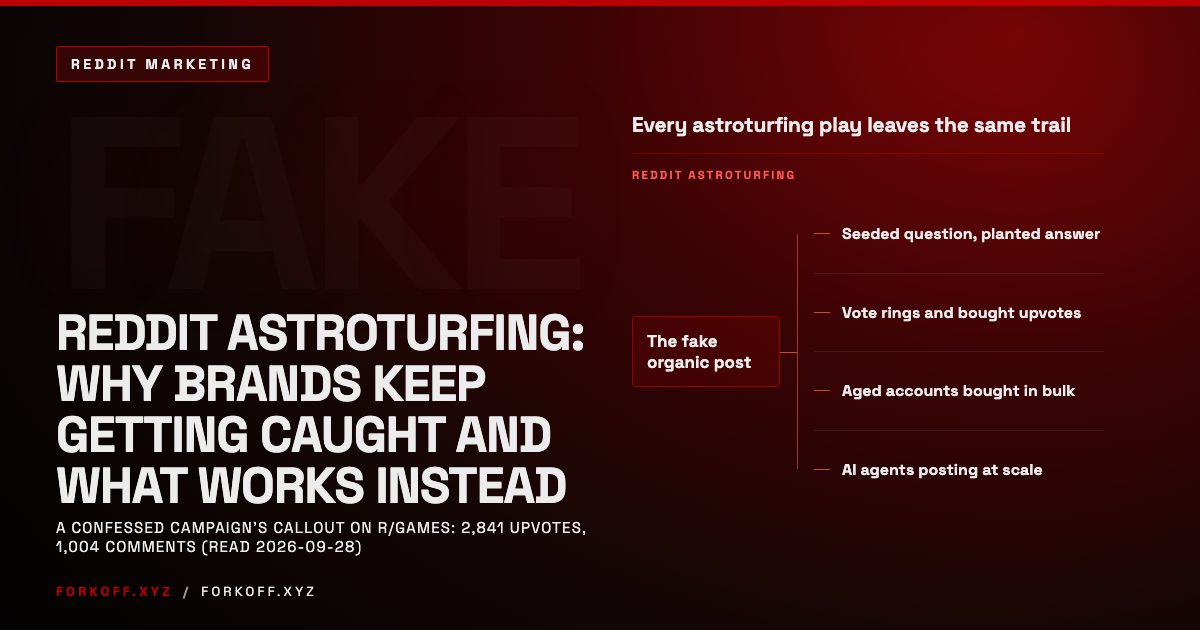
Reddit Astroturfing: Why Brands Keep Getting Caught and What Works Instead
Reddit astroturfing is paid promotion dressed up as organic talk. Why brands keep getting caught, what exposure costs, and the legitimate way to show up.
Read