


Distribution as core vsa flat asset fee
Honest comparison for founders launching on X who are choosing between a distribution event priced on the outcome and a flat-fee produced asset with distribution sold as a paid add-on.
Last updated: June 2026
FORKOFF vs Flowjam: which is better and how do they differ?
FORKOFF and Flowjam both serve X launches but sequence the offer differently. Flowjam is a launch-video packager whose strength is a published price, roughly $5,000 to $10,000 for the produced asset, with distribution sold as a separate paid add-on. FORKOFF makes the distribution event the core deliverable, priced on the outcome (views then pipeline) with a weekly proof of every qualified view. Pick Flowjam for a known asset price, FORKOFF when the launch has to move a number you can defend.

Flat-fee shops sell the produced asset as the core. Distribution arrives as a separate add-on you buy on top. FORKOFF makes the distribution event the product, priced on the outcome.
Two products. Different problems.
Honest summary. Flowjam's price transparency is a real strength; the sequencing is the gap.
The launch event is the product.
Distribution as core + outcome contract
Done-for-you product launch videos for X. The 14-day cluster warm-up, debate-principal tagging, recap seeding, and launch-day wave-ride monitoring are the core deliverable. The produced asset is one component inside it. Priced on views, then pipeline, by application.
- Distribution is the core deliverable, not an add-on
- Outcome-priced by application, model published
- Produced asset cut for X-native autoplay, inside the event
- Views + pipeline attribution in the weekly report
- Forensically audited launches: MaveHealth 2.58M, Composio 2.03M, Lica 1.44M
A flat-fee produced launch asset.
Produced asset + distribution add-on
A produced launch film at a published, scope-dependent price. Per its public surface, the asset is the core deliverable and distribution is sold as a separate paid add-on, with the launch-day mechanics left to the founder.
- Price published (genuine transparency strength)
- Publicly-referenced ~$5k-$10k for the asset
- Distribution sold as a paid add-on (per their site)
- No outcome contracted on asset or add-on
- Launch-day mechanics left to the founder
Flat asset fee, ~$5k-$10k (publicly referenced)
10 axes.Side by side.
No spin. Where each operating model wins, where they overlap, and where they solve genuinely different problems for a founder launching on X.
← scroll horizontally to see more →
| Feature | FORKOFFdistribution as core + outcome contract | Flowjamproduced asset + distribution add-on |
|---|---|---|
| Core Deliverable | The distribution event (5 levers) | The produced launch asset |
| Distribution | Owned + named in the contract | Sold as a paid add-on (per their site) |
| Pricing Model | Outcome-anchored, by application | Flat asset fee, ~$5k-$10k (publicly referenced) |
| Outcome Tie | Views then pipeline, contracted | None contracted on asset or add-on |
| Proof Surface | Audit ledger (views + pipeline attribution) | Produced video deliverable |
| Launch-Day Judgment | Live wave-ride monitoring | Fixed package, founder runs launch day |
| Cluster Warm-Up | 14-day named ICP cluster | Not part of the core deliverable |
| Hook Discipline | 1-second pain + promise, engineered | Produced asset (production-first) |
| Price Transparency | Model published (outcome unit stated) | Asset price published (genuine strength) |
| Public 1M+ Launches Audited | MaveHealth 2.58M · Composio 2.03M · Lica 1.44M | Not publicly referenced |
Three axeswhere the operating modelsdiverge.
What sits at the centre of the offer, how it is priced, and who runs launch day. This is where a distribution-as-core outcome contract pulls ahead of a flat-fee asset with a bolt-on.

Pay forthe outcome,not a flat asset fee.
Flat-fee shops price the asset and bill distribution separately. FORKOFF publishes the model and anchors the engagement on views, then pipeline. Premium positioning, premium proof.

FORKOFF
The distribution event as the product. Verified weekly proof.
- Distribution is the core deliverable, not an add-on
- 14-day cluster warm-up across a named ICP list
- Debate-principal tagging + recap seeding + wave-ride monitoring
- Produced asset cut for X-native autoplay, inside the event
- Views + pipeline attribution in the weekly report
- Forensically audited launches: MaveHealth 2.58M, Composio 2.03M, Lica 1.44M
Flowjam
A flat-fee produced asset. Distribution sold separately.
- Produced launch film at a published price
- Price transparency is a genuine strength
- Distribution sold as a paid add-on (per their site)
- No outcome contracted on asset or add-on
- Launch-day mechanics left to the founder
- Scope-dependent band, subject to change
Note ·Premium positioning is intentional. FORKOFF competes on operating model and proof, anchored on the outcome, never on the lowest sticker.
The numbers behindthe distribution engine.
How Flowjam operates vs FORKOFF
Flowjam is a packager in the launch-video category, and its defining strength is that it publishes a price. Flowjam's launch-video band is publicly referenced at roughly $5,000 to $10,000 for the produced asset. We treat that as a publicly-referenced range rather than a hard number, since it is a read of a public surface, scope-dependent, and subject to change.
The structural gap is the sequencing. Flowjam sells the produced asset as the core deliverable and, per its public surface, sells distribution as a separate paid add-on. That puts the least decisive variable (the film polish) at the centre and the most decisive one (the launch-day distribution event) on the side. Founder communities who have launched and missed are near-unanimous that this is backwards: the asset was rarely the bottleneck, the cold start was.
FORKOFF makes the distribution event the core deliverable. The 14-day cluster warm-up, debate-principal tagging, recap-account seeding, and launch-day wave-ride monitoring are the product, the produced asset is one component inside the event, and the engagement is priced on the outcome (views, then pipeline) by application rather than a flat asset fee with amplification billed separately. Flowjam is honest about asset cost; FORKOFF is honest about the model and the outcome unit.
For the fuller picture behind this comparison, read how to get 100k views on a launch video.
Frequently asked questions
What is the difference between FORKOFF and Flowjam?
Flowjam sells a produced launch asset at a publicly-referenced flat band (roughly $5,000 to $10,000 per its site) and, per its public surface, sells distribution as a separate paid add-on. FORKOFF sells the distribution event as the core deliverable: the 14-day cluster warm-up, debate-principal tagging, recap seeding, and launch-day wave-ride monitoring, with the produced asset as one component inside the event, priced on the outcome (views, then pipeline) by application. Flowjam prices the asset and makes distribution optional. FORKOFF prices the outcome and makes distribution the core.
Is Flowjam a bad option?
No. Flowjam's price transparency is a genuine strength relative to studios that hide pricing, and its production is real. The gap is the sequencing of the offer: the asset is the core line item and distribution is the add-on, with no outcome contracted on either. For a founder who just wants a produced film at a known price and who already has distribution, Flowjam is in lane. For a founder who wants the launch contracted on an outcome, the variable Flowjam sells as optional is the one that decides whether the launch works.
How much does FORKOFF cost compared to Flowjam's $5k to $10k?
FORKOFF is outcome-anchored and by application, not a flat fee. The page is not making a cheaper-than-Flowjam claim; launch scope genuinely varies, so FORKOFF publishes the pricing model rather than a single sticker. Flowjam's publicly-referenced $5,000 to $10,000 band buys the produced asset, with amplification as a separate add-on. FORKOFF's engagement is anchored on views, then pipeline, with the weekly report as the accountability mechanism. Different unit: a flat asset price versus a contracted outcome. The positioning is premium, never framed on the lowest sticker.
Why is distribution the core deliverable instead of an add-on?
Because the distribution event, not the render budget, decides the ceiling on X. X's ranking rewards early-window engagement velocity: a post that earns a high reply, quote, and repost rate in its first 30 to 90 minutes gets sampled into larger audiences, and a post that lands flat almost never recovers. A polished asset posted into a cold cluster dies in the first hour. Selling the asset as the core and the distribution as the add-on inverts the variable that actually determines the outcome, which is why FORKOFF contracts on the distribution layer.
Are viral views guaranteed?
Yes. FORKOFF guarantees a view tier, 1.2M, 3M, or 5M, and backs it with a make-good: if a launch misses the tier it keeps distributing and re-runs the play until it lands, or refunds. The distribution runs a repeatable mechanism, the 14-day warm-up, the 1-second hook discipline, debate tagging, recap seeding, and wave-ride monitoring. The difference from Flowjam is proof: FORKOFF audits every view on RADAR with the views-per-like method, so a buyer can verify the guaranteed reach was earned, not bought and self-reported. Guaranteed and audited, not promised and screenshotted.
What proof does FORKOFF have that the distribution mechanism works?
Three public launches FORKOFF forensically audited on X: MaveHealth at 2.58M views (newsworthy funding plus medical-cluster activation), Composio at 2.03M (debate-principal tagging plus wave-ride on live hype), and Lica at 1.44M (an exact pain-point hook). The common thread is that the distribution context, not the production budget, carried each ceiling. On a FORKOFF engagement, views and pipeline attribution land on an audit ledger rather than a flat deliverable with a view-count screenshot.
Does FORKOFF still produce the video, or only run distribution?
FORKOFF produces the asset and runs the distribution as one event. The script and creative are engineered against the 1-second and 5-second retention curve, built from the founder's actual launch claim, and cut for X-native autoplay rather than repurposed from a YouTube edit. The difference from a flat-fee asset shop is that the produced film is a component inside the distribution event, not the whole deliverable, and it is sized and timed to feed the first-window velocity rather than to win on production polish alone.
Compare FORKOFF againstthe rest of the field.
Other agencies we've audited
- FORKOFF alternativesThe alternatives hub: 10 named competitors across four lanes, each linked to its full head-to-head.
- Clipping Culture alternativesHonest field of managed clipping shops ranked on the qualified-view denominator.
- Launch video agency alternativesRepresent Studio, Flowjam, and TLVC compared against the one alternative whose launch reach is independently audited on RADAR, not proved with a screenshot.
- OpusClip alternatives10 alternatives ranked by how much of the clip-to-audience chain each one owns.
- Top AI marketing agencies 2026Aggregator listicle. n=20 gpt-5 probes mapped to FORKOFF-owned surface for the AEO citation gap.
- Best AEO agenciesAnswer Engine Optimization specialists. LLM citation share vs Google rank as the success metric.
- Best GEO agenciesGenerative Engine Optimization shops. Schema-rich entity graph + citation-bait pages.
- Best clipping agenciesManaged clipping rosters. Per-qualified-view pricing vs flat retainer.
- Best crypto marketing agenciesWeb3-native shops. Audit ledger vs influencer black box.
- Best event marketing agenciesConference activation + side-event execution. Attribution to qualified meetings.
- Best fintech marketing agenciesFintech agencies ranked on trust-first distribution, regulated-channel read, and funded-account proof vs signup volume.
- Best launch video agenciesLaunch video ranked by distribution model + verified view proof, not just the asset.
- Best viral video marketing agency 202610 viral video marketing agencies ranked on outcome accountability, audited reach proof, and distribution ownership. Guaranteed and audited vs promised and self-reported.
- Best fractional CMO agenciesOperator-CMO models vs advisory CMOs. Outcome-priced execution layer.
- Best demand generation agenciesDemand creation vs capture, ranked across SaaS, AI, fintech, and enterprise. Outcome-priced vs retainer.
- Best B2B marketing agencies10 B2B marketing agencies ranked on pricing model, pipeline attribution, and ICP fit for tech, SaaS, deep tech, and Web3 and AI buyers.
- Best influencer marketing agenciesMainstream cross-vertical influencer agencies ranked on creator vetting, outcome pricing, and audited qualified views.
- Best UGC agenciesUGC video ad agencies ranked on creator-vs-AI routing, authenticity screening, and outcome pricing.
- Best SaaS marketing agencies7 SaaS marketing agencies ranked by motion, pricing, pipeline-vs-MQL measurement, and buyer-LLM citation across B2B, AI-native, and vertical SaaS.
- Best KOL marketing agenciesWeb3 KOL rosters. Wallet-verified buyers vs follower count.
- Best podcast marketing agenciesPodcast booking + production + AEO citation strategy.
- Best Reddit marketing agenciesReddit-native operators. Sub-by-sub lead generation, not spammy automation.
- Best Twitter marketing agenciesX/Twitter growth operators. Reply-guy autopost stacks + KOL access vs ad spend.
- FORKOFF vs AI Media GroupAI-cluster operators vs PR-led narrative shop. Audit ledger vs press-release pipeline.
Flowjam ships a produced asset. FORKOFF ships distribution muscle.
The comparison above turns on one thing: Flowjam sells the launch film as the core deliverable, while FORKOFF sells the distribution event. The reason FORKOFF can put distribution at the center is that it operates a real clipping and short-form network, not a render pipeline. A produced asset is one component inside that machine. The machine itself, the vetted operators who cut and place short-form across platforms, is the part that actually moves a launch.
That network has processed 5B+ views to date, and it is the same distribution muscle that carries a launch, billed on views that qualified rather than a flat asset fee. A packager that sells a film has no comparable distribution record, because its deliverable ends at the render. FORKOFF's managed short-form work carries a documented per-view distribution record across 5B+ views processed, and a launch is outcome-priced against it, scoped per engagement, which is what a distribution-first model can price against and an asset-first model cannot.
Why the qualified-view record matters on a launch
A launch view is only worth counting if it was a real watch-through. Across the network, FORKOFF bills a view only after a device check, a watch-time floor, a traffic-legitimacy pass, and an audience-geo match, and logs the reason for every filtered view. The output is an append-only ledger you can reconcile against pipeline, not a view-count screenshot on a delivered file, and the method is documented in our qualified-views methodology.
Which model your launch needs
If you want a produced film at a known price and already own distribution, Flowjam's asset is in lane. If the launch has to move a number you can defend, the distribution-first model with an audited view record is the fit. The same short-form network runs the ongoing managed clipping service, and you can see how FORKOFF stacks against other operators in the best clipping agency comparison.
Reviewed by the FORKOFF clipping team, the operators who run the short-form network behind the launch.
Stop paying for the asset
and bolting on the distribution.
Contract the distribution event as the core deliverable, priced on views then pipeline, with the produced asset as one component inside it. By application, premium, anchored on the outcome.
Browse all FORKOFF comparisonsReceipts, deep dives, and playbooks.
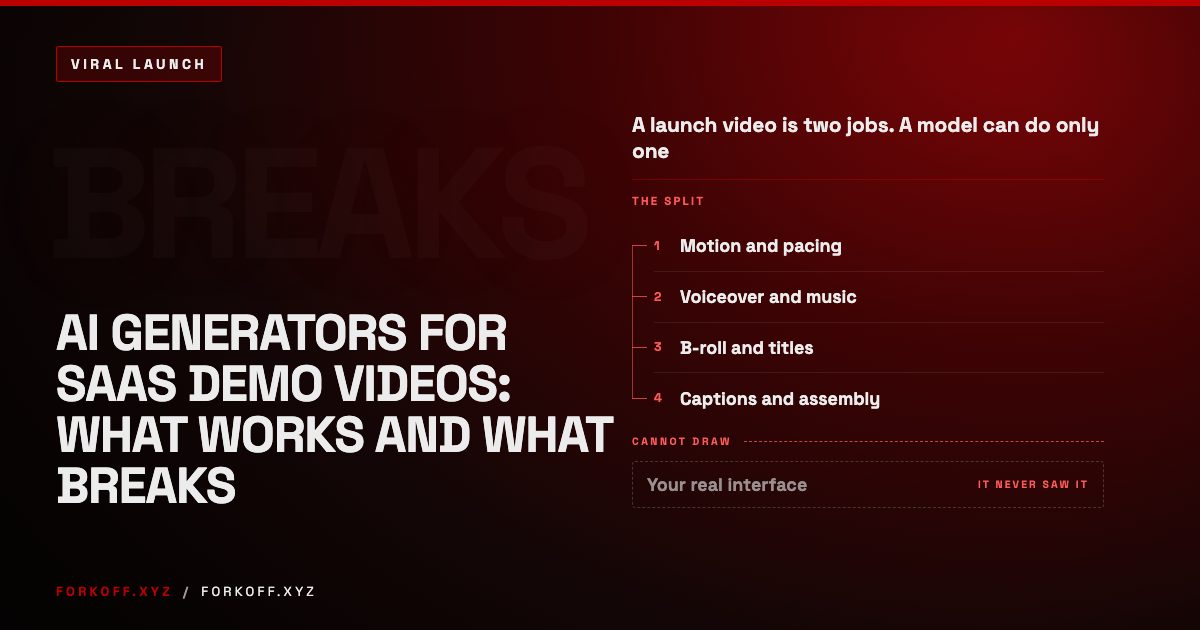
AI Generators for SaaS Demo Videos: What Works and What Breaks
AI video generators handle motion, voiceover and pacing well and draw your interface badly. Which half of a launch video to give a model, which half to keep.
 Read
Read
Why Sora Went Viral in 5 Days, and Dead in 6 Months
OpenAI's Sora beat ChatGPT to 1M downloads, then shut down 6 months later. The public download, revenue, and moderation data behind both halves.
Read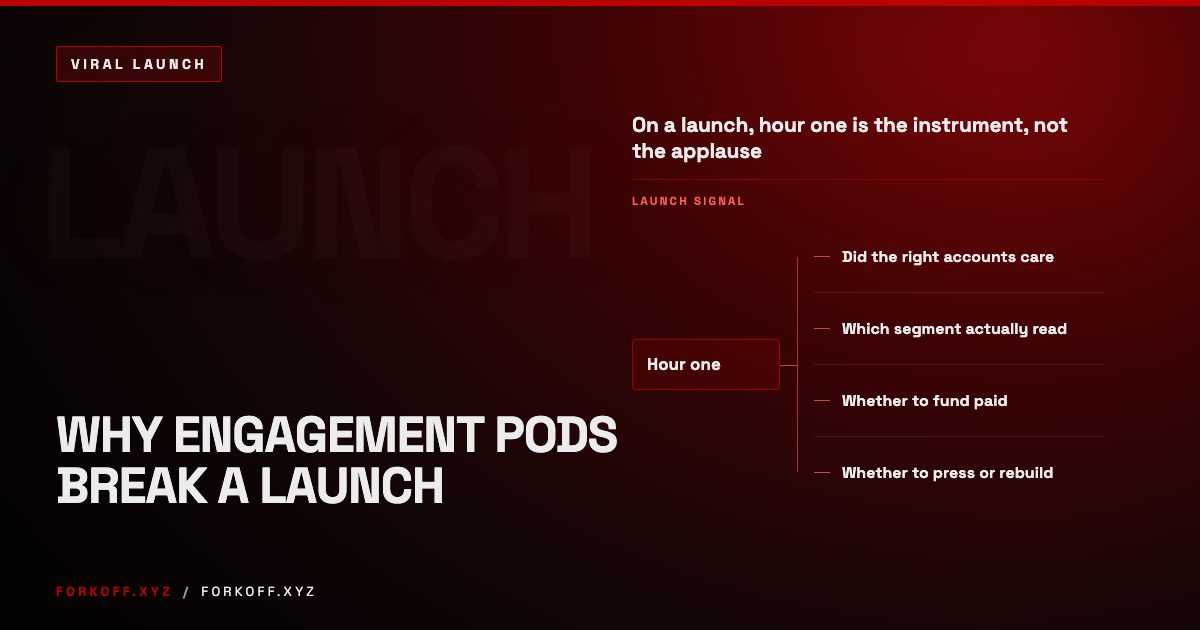
Why Engagement Pods Break a Launch
On an ordinary post a pod costs you some reach. On a launch it costs you the only measurement you had. LinkedIn's own trust VP explains where the penalty lands.
Read