
A LinkedIn launch window is the fourteen days before you post that your launch actually depends on. The post itself is the smallest part of it. What decides whether anyone sees it is how many of the specific people who matter to your company already know you, already know what you are building, and are already in the habit of reading you when you show up in their feed.
We run a fourteen-day warm-up before a launch tweet on X. This is that same protocol, rebuilt for LinkedIn, and the rebuild is not cosmetic. One substitution changes every day of the calendar, and if you port the X version across unchanged you will do fourteen days of work that produces nothing.
The short version
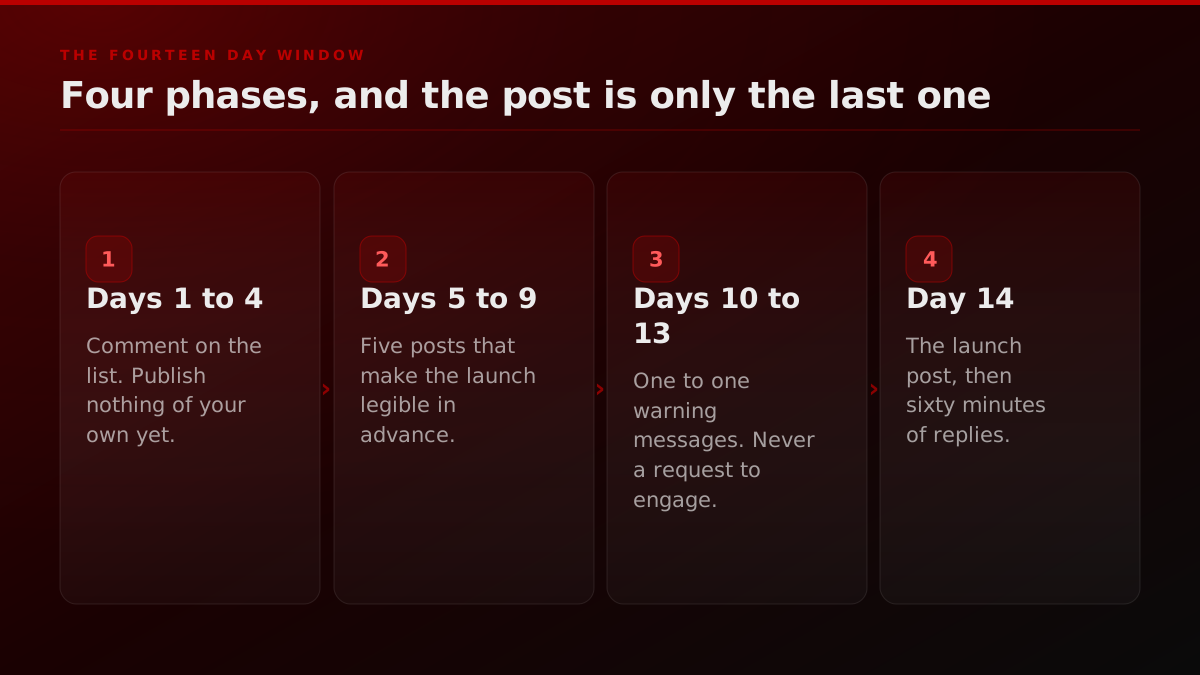
A LinkedIn launch window is the fourteen days before you post that your launch actually depends on. We run a fourteen day cluster warm up before a launch tweet on X, and on X that warm up targets a conversation cluster and a live argument, because reach travels through public quote tweets and recap accounts. LinkedIn has neither of those surfaces. Reach there travels through a professional graph of identifiable people, so the same fortnight has to target named individuals instead: the specific operators, investors and customers whose presence in hour one would change who else sees the post. That single substitution is the adaptation, and everything else follows from it. The calendar runs in four phases. Days one to four are spent commenting on the list and publishing nothing of your own. Days five to nine are five posts on the fixed weekday slots, whose job is to make the launch legible in advance rather than to tease it. Days ten to thirteen are one to one messages telling each person what is coming and when, which is information and stays inside LinkedIn's rules, as distinct from asking them to engage, which does not. Day fourteen is the post, and Sprout Social's published LinkedIn windows put the peak at late morning on Tuesday or Thursday, opening at 11am rather than first thing, so a founder's ordinary 8am slot is the wrong slot for a launch. The launch link goes in your own first comment because off platform links suppress distribution. Then you reply to every comment for sixty minutes and publish nothing else that day. Measure impression to dwell above 4 percent, click through above 0.8 percent, and how many of the four tiers on your named list actually showed up. Two hundred likes and nobody from the list is a failed launch that looks like a successful one.
The rest of this is the calendar, the list, the launch-day sequence, and the four ways founders break it. Everything here assumes you are launching something real to a professional audience: B2B software, developer tools, an agency, a fund. If you are launching to consumers, LinkedIn is the wrong channel and no amount of warm-up fixes that.
One note on why this page exists at all. We pulled the live results for "linkedin launch strategy" on 5 August 2026 and read all ten. Four of them are LinkedIn's own properties, three are general LinkedIn marketing pillar guides from Sprout Social, Cognism and Sprinklr, and one is a PDF sitting on a content delivery network. LinkedIn's own contribution, How to Create a Market Launch Strategy, is generic go-to-market advice that says nothing LinkedIn-specific at all. Exactly one result on that page is a person asking how to launch something on LinkedIn, and it is a thread in r/linkedin getting peer answers. A forum post ranking on a commercial-guide page is the standard tell that the commercial answers are not satisfying anybody. That is the gap this is written into.
What is a LinkedIn launch window?
A LinkedIn launch window is a fixed fourteen-day block, ending on the day you publish your launch post, in which you deliberately build reach with a named list of individuals so that your launch post lands inside an audience rather than in front of one. It has three phases: four days of commenting before you publish anything of your own, five days of publishing that makes the launch legible in advance, and four days of private one-to-one conversations with the people on the list. Day fourteen is the post.
The word window matters. A launch window is bounded and it has a date at the end of it, which makes it a different animal from an always-on posting cadence. Our LinkedIn distribution cadence playbook covers the always-on half: five posts a week, fixed weekday slots, an impression-to-dwell floor of 4 percent, a click-through floor of 0.8 percent. That is the steady state and this post does not restate it. A launch window borrows those slots for a fortnight and points them at one date.
The only path a stranger has to your launch post
Here is the whole calendar in one place, so the rest of this post is detail on a shape you have already seen.
The fourteen day window, day by day
| Days | Phase | What you actually do | Why it is in this position |
|---|---|---|---|
| 1 to 4 | Comment only | Comment on the list, publish nothing | A post into strangers has no signal to use |
| 5 to 9 | Publish the pattern | Five posts on the problem, not the launch | The launch must read as the next sentence |
| 10 to 13 | The messaging round | One message each, ending in a question | A reply now is recognition on day 14 |
| 14 | The post and the hour | Post 11am Tue or Thu, link in comment one | The first hour is the last input you own |
Ten working days. The phases are sequential and the first one is the one everybody skips.
The reason to run a window at all is that LinkedIn gives you no mechanism for reaching strangers on demand. There is no equivalent of a quote-tweet carrying you into somebody else's timeline, and there is no recap account that will pick up your launch and broadcast it. What you have is a graph of identifiable people, and the only way a stranger sees your launch post is because somebody in that graph engaged with it first. That constraint is the whole reason the fourteen days exist.
Why does the X warm-up not transfer to LinkedIn unchanged?
Because the two platforms move reach through different machinery. On X, a launch travels through public quote-tweets, reply threads, and recap accounts, all of which are open surfaces where a stranger can amplify you to their own audience without any prior relationship. So the X warm-up targets a conversation cluster and a live argument: you spend two weeks becoming a recognised voice inside a debate that is already running, and on launch day the argument's existing audience carries you. Our guide to how a founder goes viral on Twitter documents that engine in full, including debate-principal tagging and recap-account seeding, and this post does not repeat its mechanics.
LinkedIn has none of those surfaces. A repost on LinkedIn is a weak signal and rarely travels. There are no recap accounts. There is no argument with a public audience attached to it that you can join and inherit. What LinkedIn has instead is a professional graph made of people with names, job titles and employers, where one comment from the right person puts your post in front of their first-degree network.
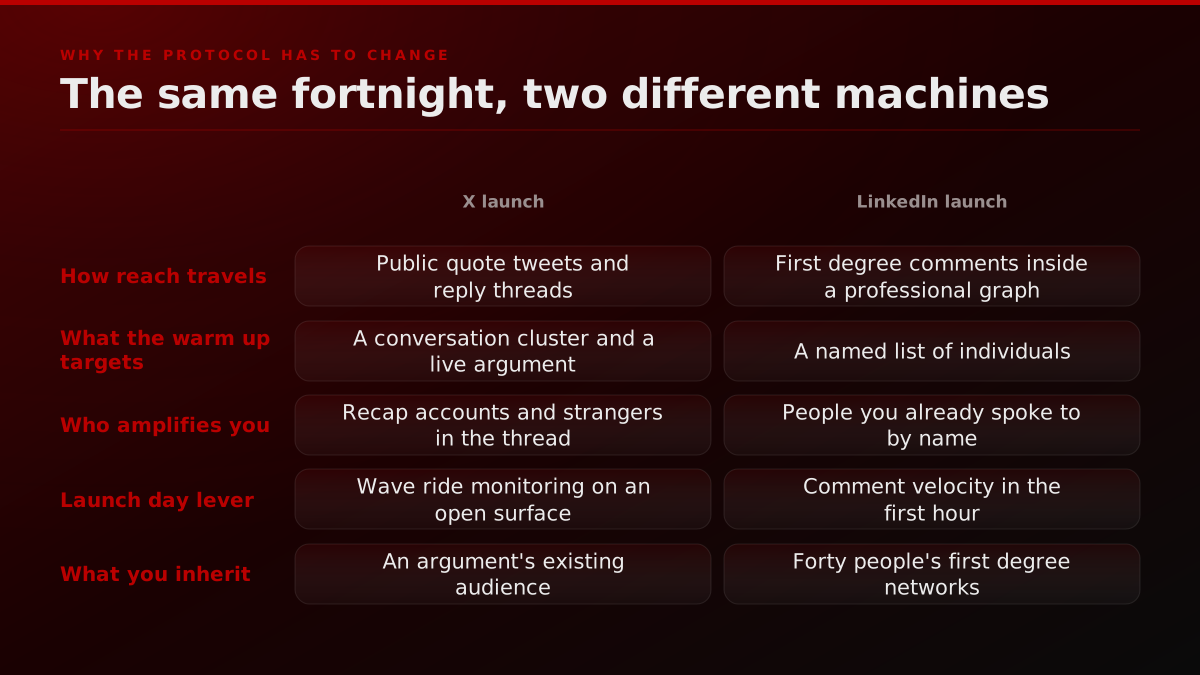
So the substitution is this: on X you warm up a topic, and on LinkedIn you warm up a list. Everything downstream follows. You cannot pick a fight on LinkedIn and inherit its audience, because the audience is not attached to the fight. You have to go and get the people one at a time, in advance, by name.
The corollary is that an audience does not travel between the two. A founder with a real following on X put it this way on the day he posted to LinkedIn for the first time:
just launched on linkedin. post is gonna get no views bc no one knows me as the resident eunice simp over there
Nineteen thousand followers on one network, and he correctly predicted nothing on the other, for the plain reason that nobody there knew who he was. That is the case for running the window rather than assuming your existing reach covers you.
The comparison above is the short version of a question founders ask constantly, and we have a standalone answer for the channel-choice half at LinkedIn or X for a product launch. The two are not mutually exclusive; the service component this post documents runs standalone or paired with the X launch for a two-channel first window.
David Perell
@david_perell
Here's what I've learned about launching online products. 1. Give tons of free stuff away. The Internet rewards people who teach. Share your best ideas for free, and you will attract an audience of like-minded people. Build an audience before you launch your first product.
Who belongs on the named account list?
Between thirty and fifty individuals, chosen because their presence in the first hour of your launch would change who else sees it. Not companies. Individuals, by name, with a reason written next to each one. LinkedIn is large enough that this feels like the wrong order of magnitude, and Sprout's platform figures put it well past a billion members, but the size of the platform is irrelevant to a launch. What matters is the forty people whose first-degree networks you are borrowing. The list has four tiers and every tier does a different job on launch day, which is why a list made entirely of one tier fails even when it is long.
The four tiers:
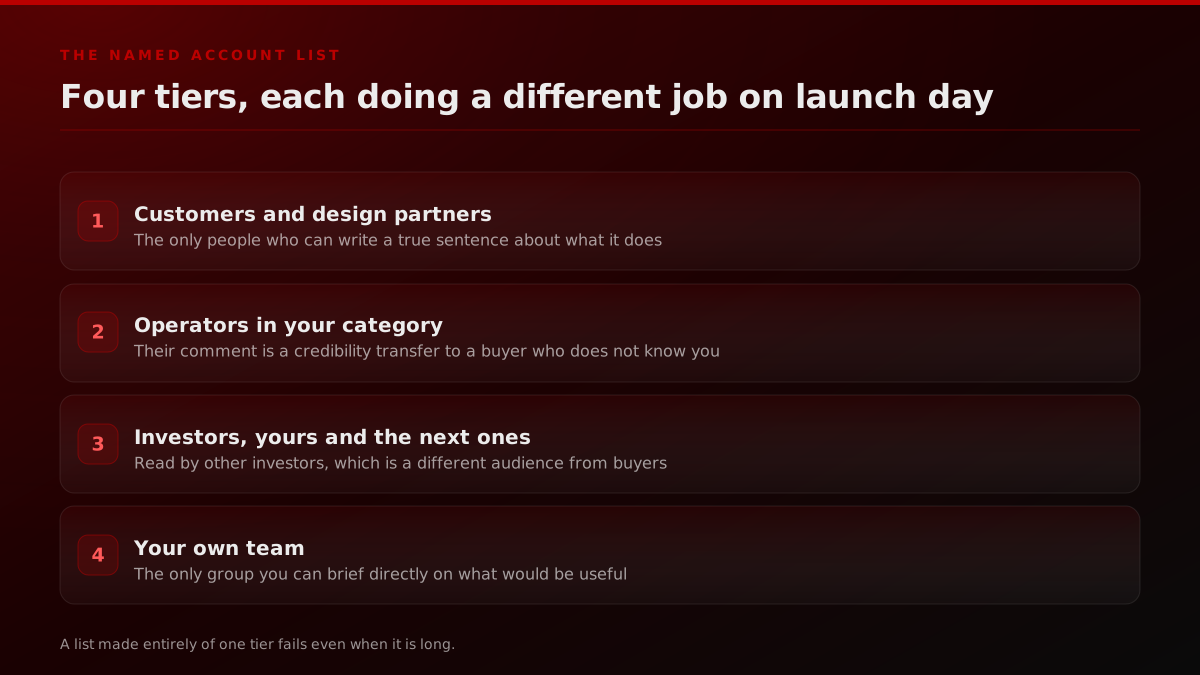
Tier one, customers and design partners. People already using the thing. They are the only people on the list who can write a true sentence about what it does, and a specific comment from a real user is the single most valuable object in a launch post's comment section.
Tier two, operators in your category. Founders, heads of engineering, heads of growth at companies your buyers recognise. Their comment is a credibility transfer to a buyer who does not know you yet.
Tier three, investors. Yours, and the ones you would like next. An investor comment is read by other investors, which is a different audience from your buyers and worth having on launch day for reasons that have nothing to do with pipeline.
Tier four, your own team. The only people on the list you can ask directly, because they work for you and their interest is not manufactured.
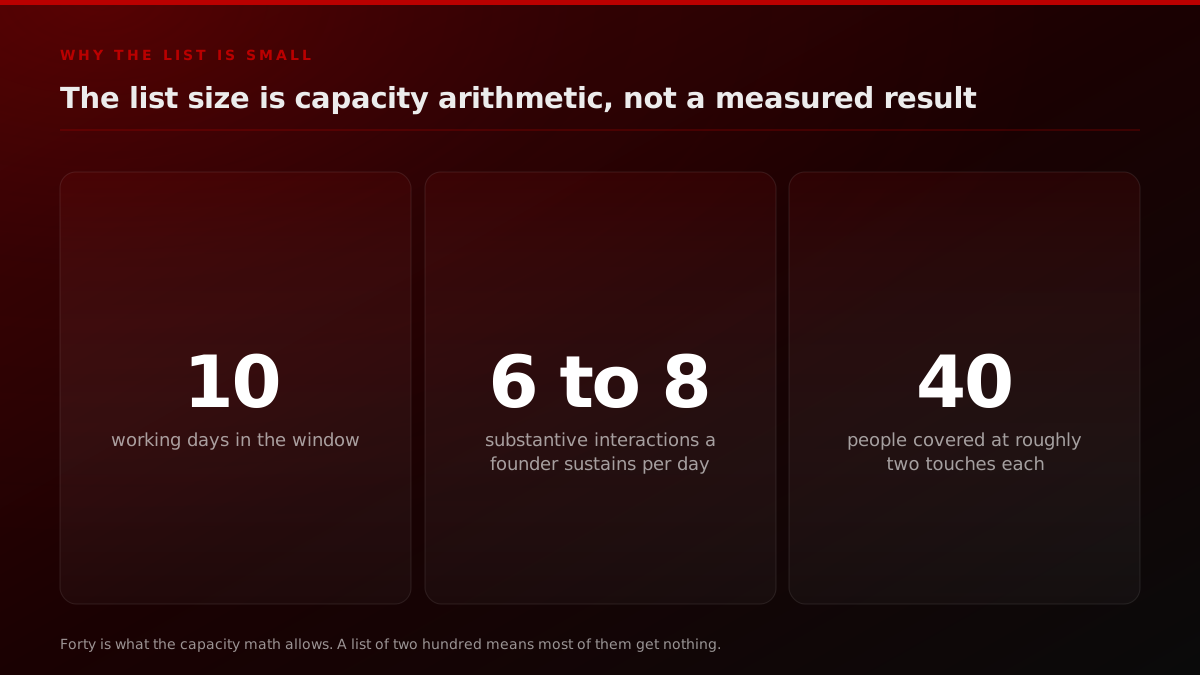
Why thirty to fifty and not two hundred: this is arithmetic from a capacity assumption, not a measured result, and it is worth showing the working. The window has ten working days. Six to eight substantive interactions a day is roughly what a founder can sustain while also shipping the thing they are launching. That is sixty to eighty interactions total, which covers a list of forty people at about two touches each. Forty is not a target we measured. It is the number the capacity math allows, and a list of two hundred means either two hundred people get one thin touch or a hundred and sixty get none.
The always-on account-based amplification list in our cadence playbook is much larger, because coverage is the right objective when you have quarters rather than a fortnight. A launch window is not a coverage exercise.
How to Actually Get Buzz on LinkedIn?
Days one to four: comment before you publish anything
Spend the first four days of the window commenting on other people's posts and publishing nothing of your own. This feels wrong and it is the step almost everybody skips. The reason it comes first is that on day one you are a stranger to the list, and a launch post pushed into a graph of strangers has no signal to work with. Commenting is the only move that both puts your reasoning in front of somebody else's audience with your name attached and stays cleanly inside LinkedIn's rules.
That compliance point is worth being precise about, because it is where founders get nervous. LinkedIn's Professional Community Policies, under the heading "Be professional" and specifically under "Do not spam members or the platform", say this, verbatim:
Please make the effort to create original, professional, relevant, and interesting content in order to gain engagement. Don't do things to artificially increase engagement with your content. Respond authentically to others' content and don't agree with others ahead of time to like or re-share each other's content.
Read what it actually bans. It bans agreeing with others ahead of time to like or re-share each other's content. It does not ban commenting on someone's post because you have something to say about it. Commenting substantively, deliberately, and on a schedule is distribution work. A reciprocal arrangement to inflate a counter is the thing the sentence names. If you want the full treatment of that line, including why we refuse to quote a reach-penalty percentage for pods, it is at going viral on LinkedIn without engagement pods, and the short answer lives at do LinkedIn engagement pods work.
What a comment has to do in these four days: add a fact, an objection, or a number the original post did not have. Three sentences is plenty. Agreement adds nothing and is invisible. The test is whether somebody reading the thread would click your name, and the only comments that pass it are the ones that disagree usefully or contribute something the author did not know.
Commenting is the compliant lever, and the policy text says so
Most founders assume any deliberate engagement work sits in a grey area, which is why they either avoid it or go straight to a pod. LinkedIn's Professional Community Policies are narrower than that. The clause bans agreeing with others ahead of time to like or re-share each other's content, and asks that you respond authentically to others' content. Commenting substantively on somebody's post, deliberately and on a schedule, is responding authentically. It is the one distribution lever in this whole protocol that is both effective and explicitly inside the rules as written.
Source: LinkedIn Professional Community Policies
This is also the advice the community gives itself, without anybody selling anything. A founder posted in r/linkedin that his launch had earned impressions and literally zero engagement, and the top answer he got was not about his hook:
A lot would depend on your purpose, connections and content but please remember that you can't just post randomly and expect it to blow up. If you're not actively and genuinely communicating with others, leaving authentic comments and building relationships, a random post won't help much no matter how good it is. It's a long game and you need to show up.
Cover the whole list in these four days if you can, and prioritise tier two, because those are the people whose audience you most need and who owe you the least.
5-Minute Daily System to Warm Up Your LinkedIn Network
Christopher Knight
A five minute daily routine for keeping a LinkedIn network warm in the weeks before you need anything from it.
Days five to nine: publish the pattern that makes the launch legible
Now you publish, five days of it, using the fixed weekday slots from the cadence playbook. The job of these five posts is not to tease the launch. It is to make the launch legible in advance, so that on day fourteen the announcement reads as the obvious next sentence in something the reader has already been following rather than as an advertisement arriving out of nowhere.
Our house cadence assigns each weekday a format and a reason: Monday 9am is a carousel on the prior week's operating pattern, Tuesday 8am is a text post under two hundred words, Wednesday 12pm is native video of 45 to 90 seconds, Thursday 8am is a text post carrying a customer or operator receipt, and Friday 11am is a carousel built for saves. Those slots and the reasoning behind each are documented in the cadence playbook and are not restated here.
What the five publishing slots do differently inside a launch window
| Slot | Its job in steady state | Its job in the launch window |
|---|---|---|
| Monday carousel | The prior week operating pattern | The pattern that produced the launch |
| Tuesday text | A take or a pattern, under 200 words | The problem, in a buyer sentence |
| Wednesday video | Native video, 45 to 90 seconds | The problem shown, not described |
| Thursday text | A customer or operator receipt | Proof, five days before you need it |
| Friday carousel | Synthesis or framework, for saves | The frame the launch lands in |
The slots and the reasoning behind each are the cadence playbook's, not this post's. Only the subject matter changes.
What changes inside a launch window is the subject matter, not the schedule. Each of the five posts should describe the problem your launch solves, from a different angle, without announcing the launch. The Thursday receipt slot is the most important one in the window: a customer or operator proof published five days before you launch does more for launch-day credibility than anything you can say about yourself on the day.
Operator noteSkip the countdown post. Three days to go asks the reader to care about your calendar.
Resist the countdown. A "three days to go" post asks the reader to care about your calendar, which they do not, and it spends attention you need on day fourteen. If you want the announcement copy itself worked out in advance, we keep a product launch announcement template that you can adapt rather than write from scratch on the morning.
One more thing about volume: do not push to seven posts a week because the launch feels important. Our own measurement is that seven posts a week trips the audience fatigue line on a single-operator account and impression-per-post drops 30 to 45 percent. Buffer's analysis of over two million posts from more than ninety-four thousand accounts found the opposite pattern at high frequency, with eleven or more posts a week averaging about 16,946 more impressions per post and 1.40 percentage points more engagement, and Buffer concluded that LinkedIn does not cap reach for frequency. Both things can be true: a large multi-account dataset and a single founder's account are different objects. Hootsuite, for its part, recommends one to two posts a day. The frequency question is genuinely contested and we treat it at length in the pods post and at how often should a founder post on LinkedIn. Inside a launch window, hold five.
Do not raise your posting frequency because the launch feels important
Our own measurement is that seven posts a week trips the audience fatigue line on a single operator account and impression per post drops 30 to 45 percent. Buffer's analysis of over two million posts from more than ninety four thousand accounts points the other way at high frequency, with eleven or more posts a week averaging about 16,946 more impressions per post and 1.40 percentage points more engagement, and Buffer concluded that LinkedIn does not cap reach for frequency. Hootsuite recommends one to two posts a day. Both readings can hold, because a large multi account dataset and one founder's account are different objects. Inside a launch window, hold five.
Source: Buffer over 2 million posts, Hootsuite, and FORKOFF house cadence
The founders who get this phase wrong almost always get it wrong by doing more rather than less. Five posts in five days, each one about the problem and none of them about the launch, is a harder brief than ten posts and it is the one that works.
Did you notice 2 big changes in your LinkedIn feed?
Days ten to thirteen: the private warning round
Four days of one-to-one messages, one per person, to everyone on the list. You tell them what is coming and when. You do not ask them to like it, comment on it, or share it. That is the entire mechanic and the distinction in that second sentence is the one that keeps the whole protocol compliant.
Here is the line, stated once so it cannot be misread. Telling somebody what you are building is information. Asking somebody to engage with a post before it exists is an agreement made ahead of time, which is the clause LinkedIn wrote. You can send the first message to four hundred people and stay inside the rules. You cannot send the second one to anybody.
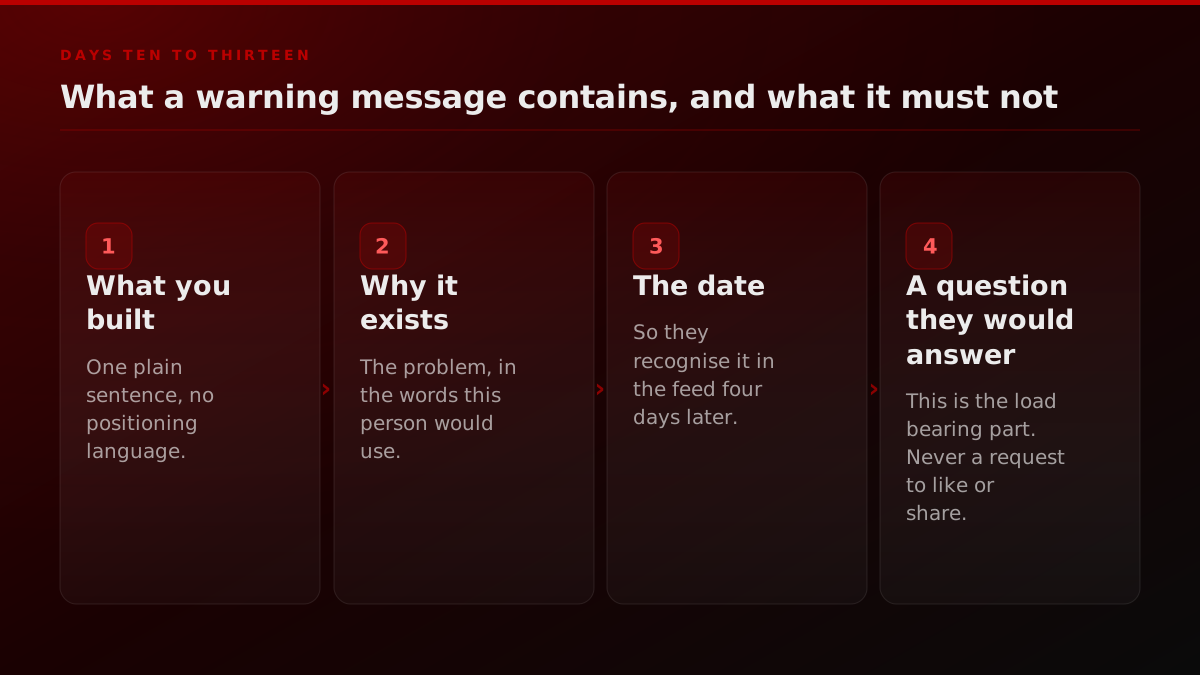
What a good warning message contains: what you built, one sentence on why it exists, the date, and a question they would want to answer. The question is the load-bearing part. A message that ends in a question gets a reply, and a person who has replied to you about the thing is a person who recognises it in their feed four days later. A message that ends in "would love your support" is asking for engagement and you should not send it.
A solo founder who sold in his first week described the same mechanism from the other end, and it is worth reading as a description of what the messaging round is actually for:
Post before you launch. Build an audience while you build the product. By the time you're ready to sell, some of those people already trust you.
Already trust you is the operative phrase. That trust is what days one to nine build and what days ten to thirteen cash in.
Tier order for the four days: customers first, because their replies often become the sentences you use in the launch post itself. Then operators. Then investors. Your team last, and they get a different message, because they are the only group you can brief directly on what would be useful.
The messaging round is one sentence away from a policy breach
The same four days of one to one messages can be run compliantly or not, and the difference is a single clause at the end of the message. Telling somebody what you built and when it ships is information. Adding a request that they like, comment on or share the post converts the message into an agreement made ahead of time, which is the exact mechanism LinkedIn's policy names. There is no version of the second message that is safe because it was sent privately, and the founders who get this wrong almost always do it in the last sentence of an otherwise good message.
Source: LinkedIn Professional Community Policies, read 2026-08-06
If somebody replies with an objection, that is the most valuable outcome of the whole window. Answer it, and if the objection is good, address it in the launch post. A launch post that pre-empts the top objection reads as confidence and cuts the comment section's most common derailment before it starts.
How To Promote Your Product Launch on LinkedIn - Jenn Herman Interview
Entrepreneurs HQ with Liam Austin
Jenn Herman walks through how to plan and time a product launch announcement on LinkedIn, including what to do with your network before the post goes out.
Day fourteen: what the launch post has to do
The launch post has one job, which is to make a specific person on your list want to say something in the comments. Everything else about it is subordinate to that, including how comprehensive it is. A launch post that explains the product completely leaves nobody anything to add, and a comment section is the mechanism by which LinkedIn decides whether to show your post to anybody outside your first degree.
Structure that works: the problem in the first two lines, before the see-more fold, in the words a buyer would use. Then what you built, in one sentence. Then the specific thing that is different, with a number if you have one. Then a question, aimed at the operators on your list, that a person with real experience of the problem would find hard not to answer.
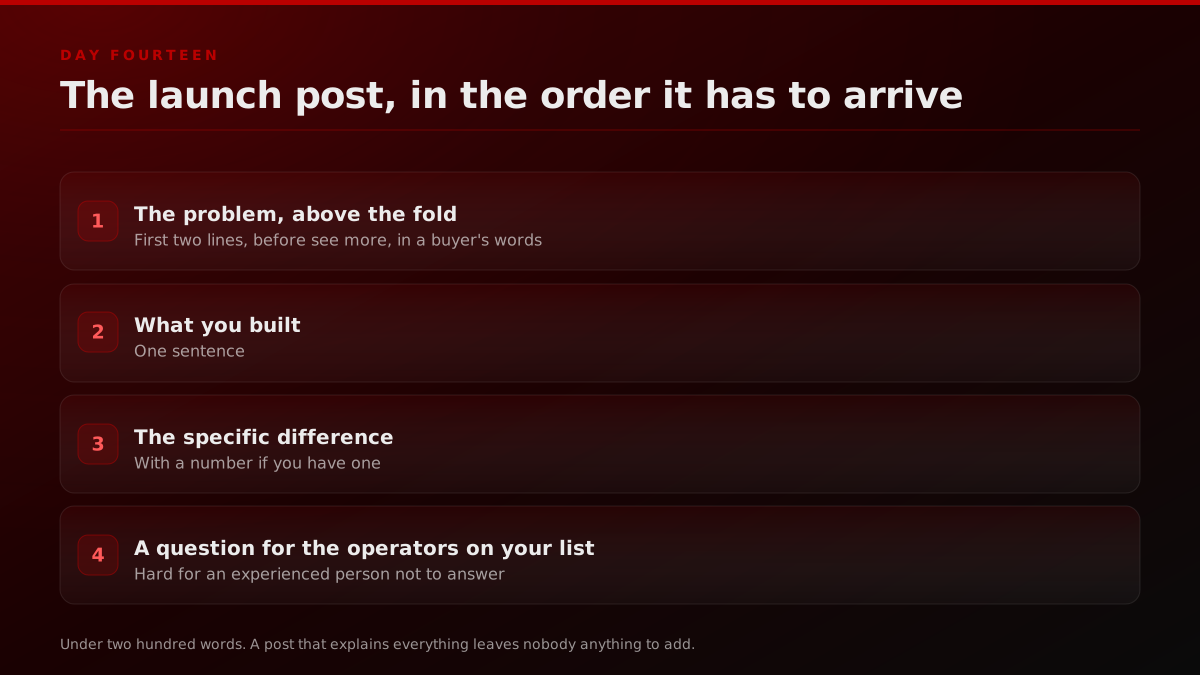
Keep it under two hundred words, the same ceiling the house cadence puts on a text post. Native video works on launch day too, and if you have a launch video, this is where it goes, cut for LinkedIn rather than reposted from X. The production side of that sits in our launch video playbook and the sequencing question across a launch week is covered in launch week video sequencing.
Do not tag people who are not expecting it. Tagging somebody who has not been through the warning round is a request for engagement made in public, and it reads that way to everybody who sees it. Tag the people who replied to you, and only where the tag is genuinely relevant to what you wrote.
On who writes it: the launch post is the one post in the window that should not be ghostwritten, and we argue that case in LinkedIn ghostwriter versus founder voice. A ghostwriter can draft the five days of pattern posts. They cannot answer an objection in your comment section at 11
.What time should the launch post go out?
Late morning on a Tuesday or a Thursday, at 11am local. Not first thing, which is the mistake, and not on a Monday or a Friday if you can avoid it. This is one of the few parts of a LinkedIn launch where there is published third-party data worth reading, and it disagrees with the intuition most founders have.
Sprout Social publishes per-weekday LinkedIn windows from an analysis of nearly two billion engagements across roughly 307,000 social profiles. We re-read that page live on 5 August 2026 rather than quoting it from a summary, which matters because a paraphrase of this particular source has already hardened into a claim it never made once before. Their LinkedIn numbers, as published:
Sprout Social's published LinkedIn windows, by weekday
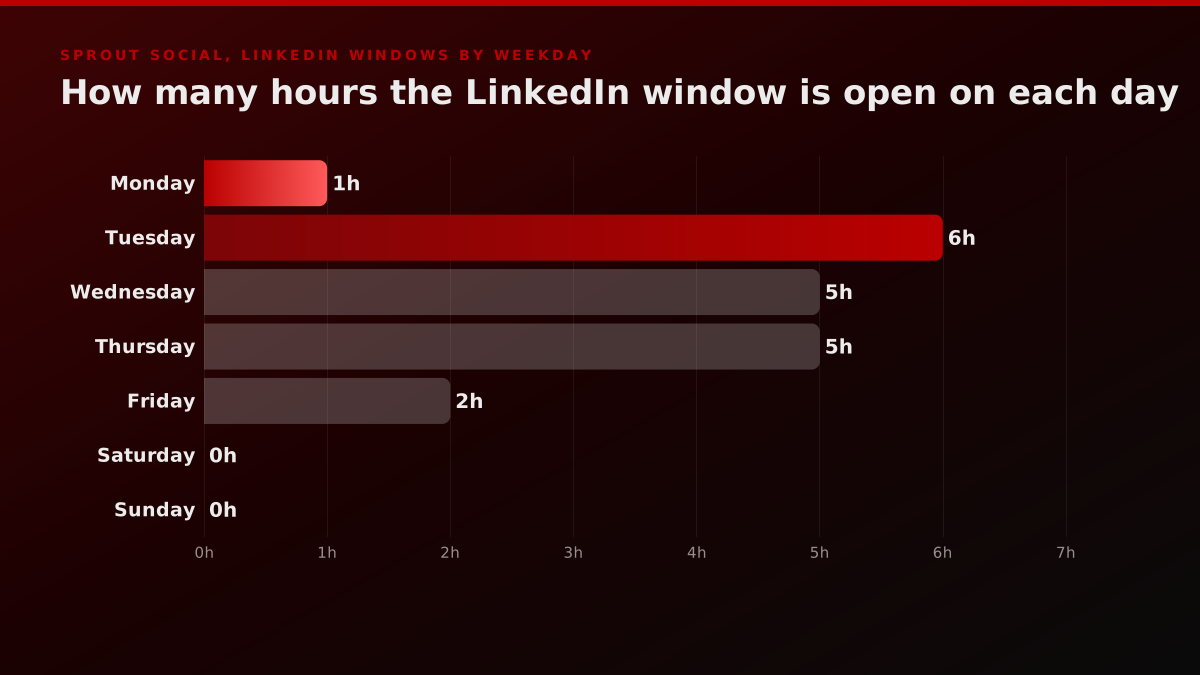
| Day | Published window | Hours open | Use for a launch |
|---|---|---|---|
| Monday | 1 to 2pm | 1 | No. Opens late and closes immediately |
| Tuesday | 11am to 5pm | 6 | Yes. Longest window, and a Sprout best day |
| Wednesday | 11am to 4pm | 5 | Workable second choice |
| Thursday | 11am and 1 to 5pm | 5 | Yes. Sprout other named best day |
| Friday | 11am and 1 to 2pm | 2 | No. Attention is already leaving |
| Saturday | none listed | 0 | No. Sprout names weekends the worst days |
| Sunday | none listed | 0 | No |
Windows are Sprout's, verbatim from nearly 2 billion engagements across roughly 307,000 profiles, re-verified live 2026-08-06. The hours column is our arithmetic on those windows, counting a single named hour as one hour.
Two things in that table matter for a launch. First, the window opens at 11am on Tuesday, Wednesday and Thursday, and Monday does not open until 1pm. That is our reading of Sprout's published windows rather than a sentence Sprout wrote, and it has a direct operational consequence: the founder's ordinary Tuesday 8am text slot is not the launch slot. An 8am launch post spends its critical first hour before the audience is there.
Second, Sprout's own conclusion about which days are best names two of them. Their sentence, verbatim: "Tuesdays and Thursdays late mornings are your best days for reaching decision-makers and professionals before they log off for the weekend." And on the other end of the week they are blunt: "Worst days to post on LinkedIn: Weekends". Their weekday list runs Monday to Friday and contains no Saturday or Sunday window at all.
The LinkedIn window opens at 11am, which makes the founder's usual slot wrong
Sprout Social publishes per weekday LinkedIn windows from nearly 2 billion engagements across roughly 307,000 profiles, and on Tuesday, Wednesday and Thursday every one of those windows opens at 11am. Monday does not open until 1pm. Reading those published windows, rather than quoting a sentence Sprout wrote, the consequence for a launch is direct: an 8am launch post spends its critical first hour before the audience arrives. That matters far more for a one shot launch than for a Tuesday text post, because the first hour is the only hour whose comment velocity you can still influence.
Source: Sprout Social, Best Times to Post on Social Media, re-verified live 2026-08-06
That is Sprout's data and Sprout's conclusion, attributed to them alone. Other published timing studies reach different conclusions about which weekday wins, and we deal with that disagreement in the pods post rather than pretending the sources agree. For a launch you need one decision, and Tuesday or Thursday at 11am local is the decision that Sprout's own dataset supports.
DPM.LOL
@dpmlol
quick post - we launched on LinkedIn. Great way to support the project is to follow the company ❤️ https://t.co/IN4GyLk07l
Where does the link go?
In your own first comment, posted by you, within seconds of the post going live. Not in the post body. LinkedIn suppresses distribution on posts carrying off-platform links, because the platform's interest is in keeping the session on the platform, and a launch post is by definition a post whose entire purpose is to send somebody somewhere else. That tension is the single most awkward constraint in a LinkedIn launch and the first comment is how you resolve it.
We do not attach a percentage to the suppression, and you should be suspicious of anybody who does. LinkedIn publishes no figure for it. What is well attested is the direction, reported consistently by operators over years, and the direction is enough to make the decision.
There is a more precise version of this claim in circulation and it deserves airing, because it makes the rule conditional rather than absolute. An operator who publishes an annual LinkedIn algorithm report, this one across thirty clients, puts it this way:
If a post earns at least 10 likes in the first 15 minutes, including a link only creates a small performance penalty of around 2 percent. When a post fails to hit that early engagement threshold, the same link can dramatically weaken distribution.
Take that as a practitioner's model rather than as platform behaviour, because he calls his own report partly speculation and no outside party can measure it. But the shape of it is useful, and it is consistent with everything else in this post: the link only costs you when the first fifteen minutes are weak. If you have done the fourteen days and forty people are expecting the post, you have bought yourself the option. If you have not, the first comment is the hedge that stops a cold post from being punished twice.
The other honest objection is about how the tactic reads. It has been in wide use long enough that some readers see it as a tell:
Clickbait tactics on LinkedIn are reaching new heights. I saw two LKD posts speaking of personal topics (one was cancer and the other death of a close one) with all the classic tricks (emoji, several lines) and ending with "To read more, link in the first comment". This is sad.
That is a fair hit, and the answer is not to abandon the mechanic but to make the first comment carry real information rather than a tease. A comment that says what is behind the link is not clickbait. A comment that says "link in comments" with nothing else is exactly what he is describing.
The numbers we deliberately left out
Two figures get quoted constantly in this topic and neither appears here. The first is a percentage reach penalty for using an engagement pod. The second is a percentage suppression figure for posts carrying an outbound link. Every trace we could follow on either ended at a vendor selling a competing engagement or automation product, and LinkedIn publishes no detection figures, no penalty figures and no link suppression figures at all. A precise number attached to an untraceable source reads as stronger evidence than an honest description of a mechanism, which is exactly what makes it worse.
Source: FORKOFF sourcing pass, 2026-08-06
So the practical rule is a sequence rather than a number, and it takes about ten seconds to execute if you have the comment text written before you publish.
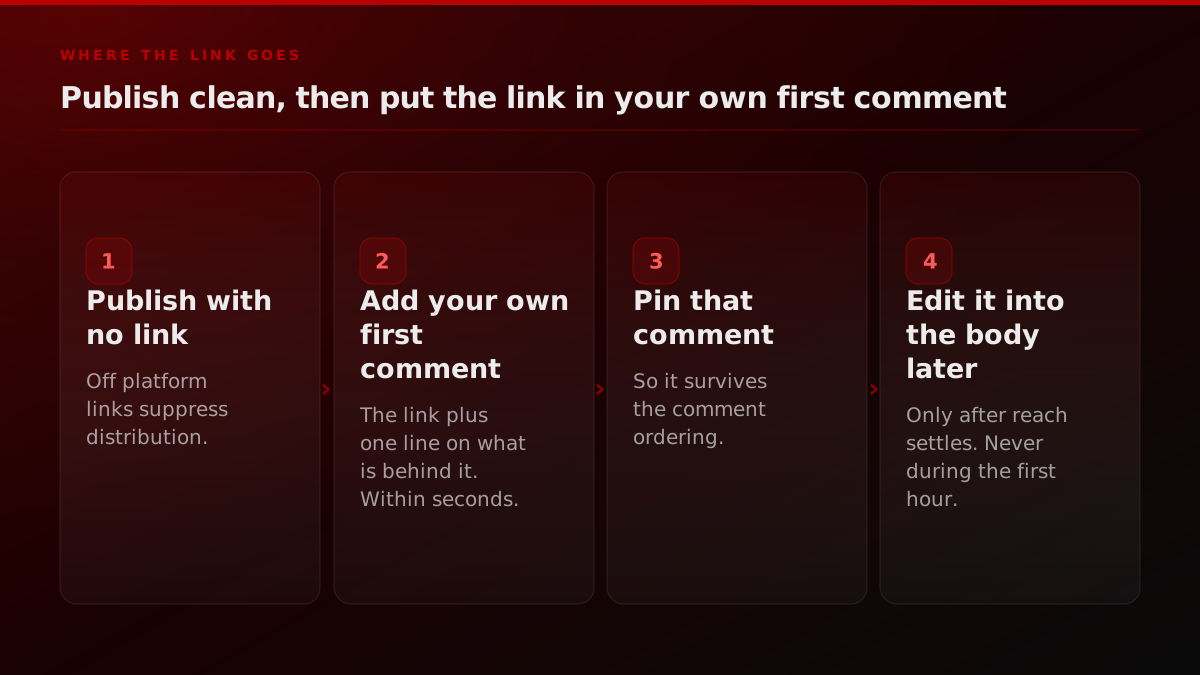
The sequence: publish the post with no link. Immediately add a comment from your own account containing the link and one line saying what is on the other side of it. Pin that comment if you can. Then, once reach has settled after a day or two, you can edit the link into the post body if you want the durable version to carry it, at which point the distribution cost no longer matters because the distribution has already happened.
Operator notePublish clean, then comment the link within seconds. Edit it into the body only after reach settles.
One caveat, stated because it is the honest version: editing a post after publishing is itself sometimes reported to affect reach, which is why the edit belongs at the end of the window and not during the first hour.
Logan Gott
@LoganTGott
R.I.P 2026 LinkedIn Algorithm. No more wondering what works. Most people right now are: Posting more Adding hashtags Dropping external links And wondering why impressions disappear. But something dramatically changed: LinkedIn stopped rewarding activity. It now rewards ht… Show more
The first hour: what you actually do
You sit on the post and reply to every comment, in full sentences, for sixty minutes. Nothing else. The first hour is when LinkedIn decides how far the post travels, and comment velocity plus reply depth in that window is the input you can still influence after publishing. This is the only part of a launch day that requires the founder to be physically unavailable for anything else, and treating it as optional is how a well-warmed launch still fails.
Our cadence playbook sets the standing rule at replying within sixty minutes across normal posting. On launch day, treat it as sixty seconds. A reply that adds a new fact restarts the thread; a reply that says "thanks so much" closes it.
Do not publish anything else that day. A second post competes with the first one for the same audience's attention and splits the comment velocity across two objects.
Operator noteSixty minutes on the post, replying in full sentences, and nothing else published that day.
Watch who is commenting, not how many. A launch post with two hundred likes and no comments from anybody on your named list is a post that reached your existing followers and nobody new. That looks like success in the notification tab and is a failure in the graph.
Linkedin is still best social media for business (750k/year revenue)
What do you measure, and what do you ignore?
Measure impression-to-dwell above 4 percent and click-through above 0.8 percent, which are our two house floors, and then measure the one thing that is specific to a launch: how many of the four tiers on your named list actually showed up in the comments. Ignore likes, ignore follower count, and ignore total impressions taken on their own.
The two floors come from our cadence playbook and they are worth understanding as a pair. Dwell tells you the content held somebody. Click-through tells you it moved them. A post can clear one and fail the other, and each failure has a different fix: low dwell is a writing problem in the first two lines, low click-through is a problem with what you promised in the first comment.
What to measure on launch day, and what to ignore
| Signal | Read it or ignore it | What it tells you | The fix when it fails |
|---|---|---|---|
| Impression to dwell rate | Read it. Floor 4 percent | Whether the content held somebody past the fold | A writing problem in the first two lines |
| Click through rate | Read it. Floor 0.8 percent | Whether it moved somebody | The first comment oversold what is behind it |
| Tier coverage on the named list | Read it. This is the launch specific one | Whether the fourteen days worked at all | The messaging round went out as a broadcast |
| Total likes | Ignore | Almost nothing. It moves with follower count | Not a fixable signal because it is not a signal |
| Follower count | Ignore on launch day | Lags dwell by months | Nothing to do here |
| Total impressions alone | Ignore in isolation | Reach, with no read on who was reached | Pair it with dwell or do not quote it |
The first three are the report. The last three are the numbers a founder checks anyway at 11:20am.
The clearest published statement of why likes are the wrong number came from a builder who checked his own analytics the morning after:
I launched a product last month. 100 likes. 30 congratulations comments. Opened Google Search Console the next day. 2 visitors. That's LinkedIn in one image. A room full of applause and nobody actually showed up.
A room full of applause and nobody actually showed up is the failure this whole protocol exists to prevent, and note that he only found it because he looked at something other than the post.
The tier-coverage number is the launch-specific one and it is the reason the named list exists. Count comments by tier. If tier one and tier two are absent, the fourteen days did not work regardless of what the impression count says, and the diagnosis is almost always that the warning round went out as a broadcast instead of forty individual conversations.
Operator noteCount launch comments by tier. Two hundred likes and nobody from the list is a failed launch.
For the longer-horizon view of what a launch should produce past day one, we track it in product launch metrics in the first thirty days. On whether the channel is worth the effort for your company at all, there is a direct answer at does LinkedIn marketing work for B2B SaaS.
What breaks a LinkedIn launch window?
Five failure modes account for almost all of it, and four of them are compressions of the calendar rather than mistakes of judgement. The most common is starting the window three days before the launch instead of fourteen, which turns the whole protocol into a warning round with no relationship behind it.
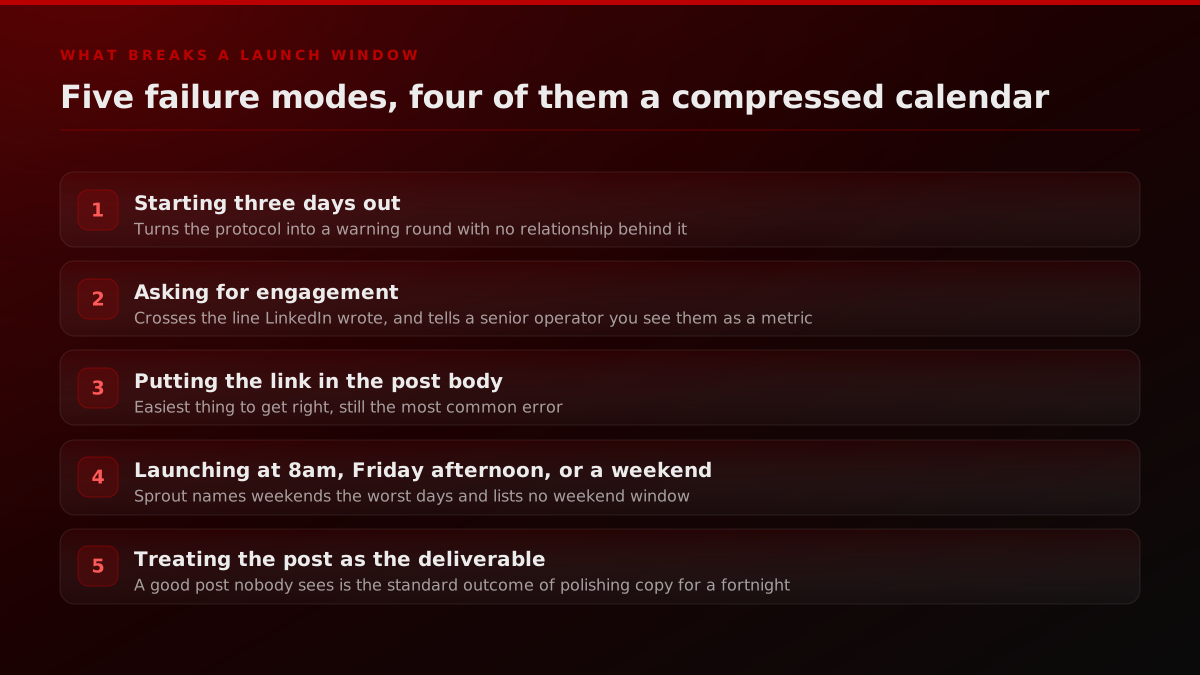
Starting late. Four days of commenting and five days of publishing cannot be compressed into a weekend. If you have three days, do not run a launch window; run the warning round only, launch, and accept a smaller first day.
Asking for engagement. The moment a message says "please like this", you have crossed the line LinkedIn wrote, and you have also told a senior operator that you see them as a metric. Both costs are real and the second one lasts longer.
Putting the link in the post body. Discussed above. It is the single easiest thing to get right and it is still the most common error.
Launching at 8am, or on a Friday afternoon, or on a weekend. Sprout's own data says weekends are the worst days on LinkedIn and lists no Saturday or Sunday window at all.
Treating the launch post as the deliverable. The post is fourteen days of output. A founder who spends the fortnight polishing copy and none of it talking to the list has built a good post nobody will see. This is the same failure we documented on the video side in the startup launch video distribution gap, where the asset is finished and the distribution was never planned.
Operator noteA team can compress this window because the constraint is founder capacity. A founder cannot.
There is a legitimate compressed version of this, for what it is worth. Our own service compresses the standard fourteen-day protocol when the scouting, the list build and the monitoring are run by a team rather than by the founder, because the constraint being relieved is the founder's capacity rather than the calendar. That is a different thing from a founder trying to do fourteen days of work in three.
What if you think building an audience is the problem?
Then you are making an argument this post has to answer rather than dismiss, and there are two versions of it worth taking seriously. The first is that deliberate audience building is itself corrosive. The second, and harder one, is that a LinkedIn audience is decoupled from whether your work is any good, so the reach you buy proves nothing to anybody.
Here is the first, stated bluntly by an engineer on Hacker News:
It's cancerous how important "building an audience" and "engagement" has become to chronically-online people, and how it's seeping into meatspace, even into job applications. I hereby swear to never set out to "build a personal brand" in my life. Total toxic waste.
And the second, from a working engineer describing a former colleague who had become a LinkedIn influencer:
They single-handedly killed the illusion that having an audience on LinkedIn is in any way connected with competence or expertise. Doing good work is absolutely NOT a prerequisite for winning on LinkedIn.
Both land. The honest reply is not that they are wrong but that they are describing a different activity. What both are attacking is performance for an undifferentiated feed, where the goal is a number and the audience is whoever can be induced to clap. That is a real and common thing and it is worth refusing.
The protocol in this post is not that. It is forty people you can name, most of whom you could help with something today, being told about a thing you built before it ships. The output is not a follower count. It is that when a specific head of engineering sees your launch, they have already read three things you wrote about the problem and had one conversation with you about it. That is closer to sales groundwork than to personal branding, and the second contrarian's point is precisely why the measurement in this post is tier coverage rather than reach: because reach with the wrong people is exactly the decoupled, meaningless number he is describing.
One more thing, and it belongs here rather than buried. We went looking for operators publicly describing a defined multi-week LinkedIn warm-up aimed at a named list of individuals, and we did not find one. Plenty of founders say build an audience before you launch, and several describe the failure state of not having done it. Nobody we could find has written down this specific mechanism. So treat the fourteen-day calendar as an argument we are making from how the platform demonstrably works and from what we run, not as a consensus we are reporting. The parts that rest on somebody else's published data are attributed to them by name, and the parts that are ours are labelled as ours.
The verdict
A LinkedIn launch is decided before you post it, and the thing that decides it is a list of names. That is the whole finding. The fourteen days are not a warm-up in the sense of getting yourself ready; they are the mechanism by which a post that would have reached four hundred existing followers instead reaches the second-degree networks of forty people who matter.
If you take one thing from this: on X you warm up a topic and inherit an argument's audience. On LinkedIn there is no argument to inherit, so you warm up a list and inherit forty people's first-degree networks instead. Every other difference between the two protocols is downstream of that.
The cost of skipping it was put best by a builder who had run the alternative:
Build an audience before you launch! Launching to the void is worse than posting to the void, trust.
Launching to the void is the accurate description, and it is what happens by default. The fourteen days are the only thing standing between a good product and a post that four hundred people scroll past.
And if you are choosing between the two channels rather than running both, the honest answer depends on who buys from you: X for velocity and for developer or consumer audiences, LinkedIn when your buyer sits on a committee and needs to be seen taking the decision. We wrote that up separately at LinkedIn or X for a product launch, and for the Reddit comparison, at Reddit versus LinkedIn for B2B distribution.
If the launch also has a video attached to it, the sequencing across the week is worked out in launch week video sequencing, and the whole category sits under our launch video playbook.
We run this as one of four components of a launch engagement, and it runs standalone or paired with the X launch. If you want the vetting criteria for hiring somebody else to do it, they are at how to choose a LinkedIn marketing agency. Real accounts, never a pod, is the line we hold on both channels, and it is the reason the fourteen days are not optional.
Why Is Early LinkedIn Engagement So Important For Post Reach?
Get Linked Together
An explainer on why the reactions a LinkedIn post collects in its first minutes decide how far the feed will carry it afterwards.