

Youn Hwang
@YounchanHwang · 679 followers
We raised $5.4M to make paid ads run themselves. Introducing Playad, the world's first AI marketing team. First up: paid ads, run by AI.
Playad launchDistribution-amplified (light)
Playad is a real product by a real founder (@YounchanHwang). RADAR has tracked 1.7M views on this launch, according to the source post linked below. RADAR measures how the launch reach was built, not whether the product works or whether anyone was honest. This reading is verified confidence and every input is public.
By Simba, Launch Intelligence Analyst · Reviewed by JK · Published 26 Aug 2026 · Confidence: verified
Independent, methodology-derived signal, not a statement of fact about any person. RADAR reads how reach was built, a signature, not an accusation. See the methodology.
Did the Playad launch go viral organically, or was the reach amplified?
The Playad launch by @YounchanHwang drew 1.7M views on 1.3K likes, which is 1,359 views per like, above the roughly 500 organic ceiling. RADAR reads a distribution-amplified (light) in how that reach was built, a signature of the mechanics and not a claim about the product or the founder. This is a verified reading and every input is public and reproducible.
New here? Start with the product
What is RADAR, and what does this grade mean?
RADAR is FORKOFF's launch authenticity rating system. It reads whether a product launch earned its reach through real engagement or bought it through paid distribution, using only public signals anyone can pull from the launch post. Every reading carries a letter grade, a confidence label, and the date it was last checked, and links back to a published method you can reproduce. Playad is a real product by a real founder (@YounchanHwang). RADAR measures how the reach was built, not whether the product works or whether anyone was honest.
Distribution-amplified (light)
Independent, methodology-derived signal, not a statement of fact about any person. RADAR reads how reach was built, a signature, not an accusation. See the methodology.
What this grade means
RADAR reads a distribution-amplified (light) on this launch: the reach ran ahead of the engagement that organic reach produces. The grade describes how the reach was built, not whether the product works or whether anyone was honest. Paying for distribution is legal and common.
The signals RADAR reads
Views-to-likes ratio
Organic reach tops out near 500 views per like. When views climb far past that without the likes to match, the extra reach is arriving without the engagement organic reach produces.
Amplification wave shape
Organic amplification spreads over hours and days. A coordinated launch fires a synchronized burst of quote posts in the first few hours, read from each post's own timestamp.
Posting-time fingerprint
A post that fires exactly top of the hour on a weekday is scheduled. On its own it is weak, but it corroborates a coordinated launch alongside the other two signals.
Those three public signals sit on top of RADAR's five-component forensic read. The full method, the bands, and the confidence model are on the RADAR methodology page.
This launch in the data
Where does this reach sit against the tracked corpus?
Where it sits in the corpus
Rank 19 of 30 tracked launches by views per like, lowest (most organic) first. A lower ratio is the favorable end.
Against the benchmark
This launch's views per like next to the organic median (354) and the amplified median (1,441) across the tracked set.
 The product
What is Playad?
Playad competes in one of the most automated corners of marketing software. The incumbent alternatives are the ad platforms' own automation, Meta Advantage Plus and Google Performance Max, which already hand targeting and budget allocation to a model. Around them sit the creative-automation vendors that generate and version ad assets at scale, and a newer set of AI agents that try to own the whole media-buying loop rather than one step of it. Playad's stated position is the second of those, the loop rather than the asset.
The company's public record is unusually well documented for a launch this size. GIGR announced a $5.4M pre-seed in late January 2026, led by BRV Capital Management and Mirae Asset Venture Investment, with participation from Krew Capital and angel investors including a Krafton board member and the founder of Hyprsense, a company acquired by Epic Games. In that announcement the company named Jay Jaeyeon Cho as chief executive and listed several co-founders, Youn Hwang among them, so the launch analysed here was posted by a co-founder rather than by the chief executive. The same release described customers reporting production-cost reductions of as much as 90 percent. That figure is the company's own, cited here as its stated claim rather than as an independently verified result.
What it does
- Runs paid advertising through AI agents rather than through a human media buyer working a dashboard.
- Covers the full creative lifecycle as a multi-agent workflow: briefing, production, experimentation, measurement and iteration.
- Generates and versions ad creative, so a team can put many variants into test instead of a handful.
- Feeds performance signals back into the next round of creative, which is the loop the product is built around.
- Started in interactive and playable ad formats before widening to image and video creative.
Those are the company's own stated capabilities, drawn from its funding announcement and its launch post, cited here as the claims made rather than as tested results. This reading is only about how the launch's reach was built.
How the Playad launch worked
The launch was a single announcement carrying a 139-second product video, posted at 9:00 AM Pacific, on the hour, on Tuesday 26 May 2026, from co-founder Youn Hwang's own account.
The copy is four lines and it leads with money. "We raised $5.4M to make paid ads run themselves." Then the name and the category claim, "Introducing Playad, the world's first AI marketing team." Then the narrowing, "First up: paid ads, run by AI." That is a well-built structure: the funding line borrows credibility before the product has to earn any, the category claim stakes a position, and the third line immediately shrinks the promise to something specific enough to believe.
One honest note on the money. The $5.4M is real and independently reported, but it was not new on launch day: the round was announced roughly four months earlier, in late January 2026. Reusing a previously announced round as the opening line of a product launch is a normal and legitimate move, and RADAR flags it only so a reader is not left thinking the launch post carried a funding scoop.
The founder behind the account
Youn Hwang is a real co-founder of a real, funded company. His X account was created in June 2021, carries the bio "Automate your paid ads @playadai (GIGR Inc.) | @stanford" with a San Francisco location, and held 678 followers at the time of this read. The Stanford reference in the bio is corroborated by the company's own funding announcement, which describes engineering training at Stanford and POSTECH across the founding team. This is a credible founder launch story, and RADAR says so plainly before saying anything else.
What GIGR did during the launch
This is a tight launch with very few moving parts. Four lines of copy, one video, one scheduled slot, and a follow-up post carrying the free-trial link. Every asset does exactly one job.
| Asset | What it did |
|---|---|
| Funding line as the hook | $5.4M stated in the first sentence, borrowing credibility before the product has to earn any |
| 139-second product video | The demonstration layer, and the object the launch was built to move |
| A category claim | The "world's first AI marketing team" framing, staking a position rather than listing features |
| An immediate narrowing | "First up: paid ads, run by AI" shrinks the claim to something a reader can test |
| Follow-up post with the trial link | The conversion step, kept out of the announcement so the announcement stays clean |
| Timing: Tuesday 9:00 AM PT | Top of the hour, inside the US-morning working window, a planned slot |
Nothing here is exotic, and that is the point. The structure of the copy is the most transferable thing about this launch: money, position, narrowing. It gets a reader from nothing to a testable claim in three lines.
How the launch performed
The launch post reached 1,730,831 views on 1,239 likes, with 125 reposts, 244 replies, 83 quotes and 1,450 bookmarks. These are matured public metrics, re-pulled directly from the source post on 26 August 2026, not a launch-minute snapshot.
The bookmark layer is the real signal here
Start with the number that is genuinely good, because it is the most interesting thing on this page. Bookmarks came in at 1,450 against 1,239 likes, a ratio of 1.17. Bookmarks exceeding likes is uncommon and hard to manufacture, because a bookmark is a private action with no social payoff: nobody bookmarks a post to be seen bookmarking it. When bookmarks outrun likes, the honest reading is that a meaningful slice of the audience intended to come back and use the thing. RADAR credits that without qualification.
The ratio tells a different half of the story. 1,397 views for every like is about 2.8 times the roughly 500 views-per-like ceiling that organic reach holds, which puts this in RADAR's light band rather than the heavy one. Total public engagement was 1,239 likes plus 125 reposts plus 244 replies plus 83 quotes, or 1,691 actions, about 0.098 percent of views. The structural signal is the follower base: 1,730,831 views arrived at an account carrying 678 followers, roughly 2,553 times its own following. A launch does not reach that multiple of its follower count on its own.
Views per like (matured)
About 2.8 times the roughly 500 organic ceiling, and well under the 2,000 line where RADAR's heavy band starts. A light lift, not a heavy one.
Bookmarks against likes
1,450 bookmarks on 1,239 likes. Bookmarks exceeding likes is the save-intent fingerprint of an audience that genuinely meant to come back to the product.
Reach against the follower base
1,730,831 views from an account carrying 678 followers. A multiple that size is not an organic shape on its own.
Amplifier roster
RADAR's forensic trace records a 21-account roster classified as a scheduled amplification cohort, with a single roster breadcrumb tying the reply layer to a known amplification cohort. No account is named on this page.
RADAR's forensic trace records a 21-account amplifier roster on this launch, classified as a scheduled amplification cohort, with a single roster breadcrumb tying the reply layer to a known amplification cohort. RADAR reports the size and the shape and stops there: no account, cohort or vendor is named on this page.
Did the reach get earned or bought?
The distinction between the light band and the heavy one matters, so it is worth stating in plain terms. A heavy read is one where the reach ran far ahead of every engagement layer at once and the amplification machinery is extensive. Here the roster is small, the ratio sits closer to the organic ceiling than to the heavy line, and the save-intent layer is strong enough to carry weight on its own. What the trace records is enough amplification to manufacture roughly 1.7 million views from a 678-follower base, without the fuller roster machinery RADAR sees on the heavier reads.
RADAR does not read a launch off the ratio alone. The verdict is a five-signal read that weighs the velocity curve, whether engagement layers stayed coupled to reach, whether the reply network looks like a real audience, and whether the amplification clusters. On this launch the reply layer skewed toward low-tier micro accounts, which is what pulls the read out of organic, while the bookmark layer pulls it back toward light rather than heavy. Both are in the record, and both are reported here.
What a founder can take from this launch
Playad is the cleanest example in RADAR's set of a paid push landing on something that deserved it. The bookmark count outran the like count, which means the video did the job it was built to do: people who saw it wanted to come back and use the product. That is the number a founder should be watching on launch day, and it is the one distribution cannot move.
The copy is the other transferable piece. Money, position, narrowing, in that order, in four lines. The funding line buys attention, the category claim tells a reader what shelf the product sits on, and the narrowing gives them something specific enough to argue with. Most launch posts skip the third step and stay at the level of the promise, which is why most launch posts get scrolled past.
FORKOFF builds launch videos that earn the save, so the distribution behind them lands on something an audience actually wants. See how we approach it on the viral launch video service, or read the best product launch videos we track for more real examples.
Questions readers ask about this launch
What is Playad?
+
Did the Playad launch go viral organically?
+
How many views did the Playad launch get?
+
Who is behind Playad and did they really raise $5.4M?
+
What does a light distribution-amplified signature mean?
+
Sources
Primary citation: x.com/YounchanHwang/status/2059303622824034418. Every number traces to a public pull; reads re-checked over time.
How RADAR read this launch, component by component
Each named component carries a plain-English definition and a directional read where the public data supports one. RADAR publishes the component names, never the weights or the formula.
View-velocity signature
Not publishedWhether the view curve grew the way organic spread does, or spiked like an injected burst.
Per-launch read not published in the public dataset. This component needs the forensic engine output.
Engagement coupling
NeutralWhether likes, replies, and reposts grew in step with views (the organic signature), or the views ran out ahead.
At 1,359 views per like, reach runs a step ahead of the likes: a light lift above the roughly 500 organic ceiling.
Reply-network authenticity
Not publishedWhether the accounts replying are real, distributed people or a coordinated cluster posting together.
Per-launch read not published in the public dataset. This component needs the forensic engine output.
Amplifier-cluster pattern
Not publishedWhether the quote-tweet amplification looks like organic word of mouth or a known activation cluster.
Per-launch read not published in the public dataset. This component needs the forensic engine output.
Smart-follower activation
Not publishedWhether genuinely influential reference accounts engaged, or the reach was only low-quality volume.
Per-launch read not published in the public dataset. This component needs the forensic engine output.
Are you the founder of Playad? You can claim or contest this read. RADAR attaches a founder response to the launch and re-examines any component you dispute.
Authorship
Simba
Co-founder, FORKOFF
Reviewed by: Kshitij JK
Last reviewed:
Published:
Methodology
RADAR verified reading of the Playad launch from public metrics: the views-to-likes ratio against the roughly 500 organic ceiling and the posting-time slot, framed as a signature of how reach was built, not an accusation.
Sources cited
- RADAR methodology , FORKOFF
- Playad source post , X
Where to go next
Understand launch authenticity
Three ways in, depending on what brought you here: learn how the score works, get a launch read or built, or get the plain answer on this launch.
Learn the score
What a launch authenticity score is
A launch authenticity score reads whether a launch earned its reach or bought it, from public signals. Start with the definitions and the checks you can run yourself.
Verify or build
Launch authenticity verification
Want a launch read by the same method, or a launch video made and distributed on the outcome? RADAR reads any public launch, and FORKOFF builds the launch behind the reach.
The skeptic's question
Is the Playad launch legit?
If you are checking whether the Playadlaunch was real users or bots, here is the honest read: RADAR's reading is Distribution-amplified (light), at verified confidence, computed from public metrics and reproducible from the source post. It measures how the reach was built, not whether the product works.
Peer launches
Launches with a similar read
Meridian launch
@alexmdees
5.3M views · 1,523 per likeRead
Co-Invest launch
@liquidtrading
3.8M views · 1,545 per likeRead
Ollie launch
@blennon_
2.0M views · 958 per likeRead
MaveHealth launch
@thatssodhawal
2.6M views · 825 per likeRead
Draftboard launch
@zachrose51
987.3K views · 821 per likeRead
Merge Gateway launch
@shensi
3.7M views · 1,953 per likeRead
The benchmark behind every reading
- The organic vs amplified benchmark. What a healthy launch ratio looks like, side by side.
- RADAR methodology. The bands, the confidence model, and how to reproduce a read.
- The Launch Authenticity Report 2026. The aggregate study across the tracked corpus.
- The X Launch Authenticity Study 2026. Two in three tracked launches show a bought-amplification signature.
- Verified-organic leaderboard. The launches RADAR reads as genuinely organic.
- Best product launch videos. The editorial cut of every tracked launch, ranked by views.
- Product launch video service. Get a launch video made and distributed, priced on the outcome.
Want a launch read by RADAR's method?
RADAR reads whether a launch's reach was earned or bought from public data, with the confidence label and the source citation on every reading.
Receipts, deep dives, and playbooks.
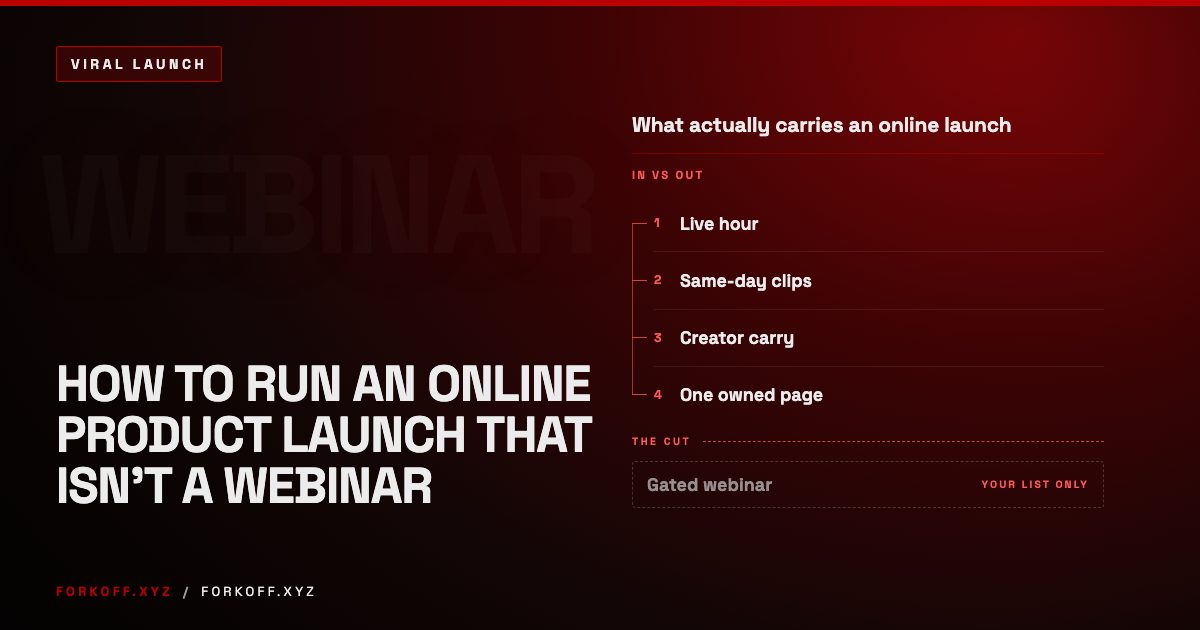
How to Run an Online Product Launch That Isn't a Webinar
An online product launch is a live moment cut into clips that creators carry, not a gated webinar. Here is the livestream, clip and creator stack for 2026.
 Read
Read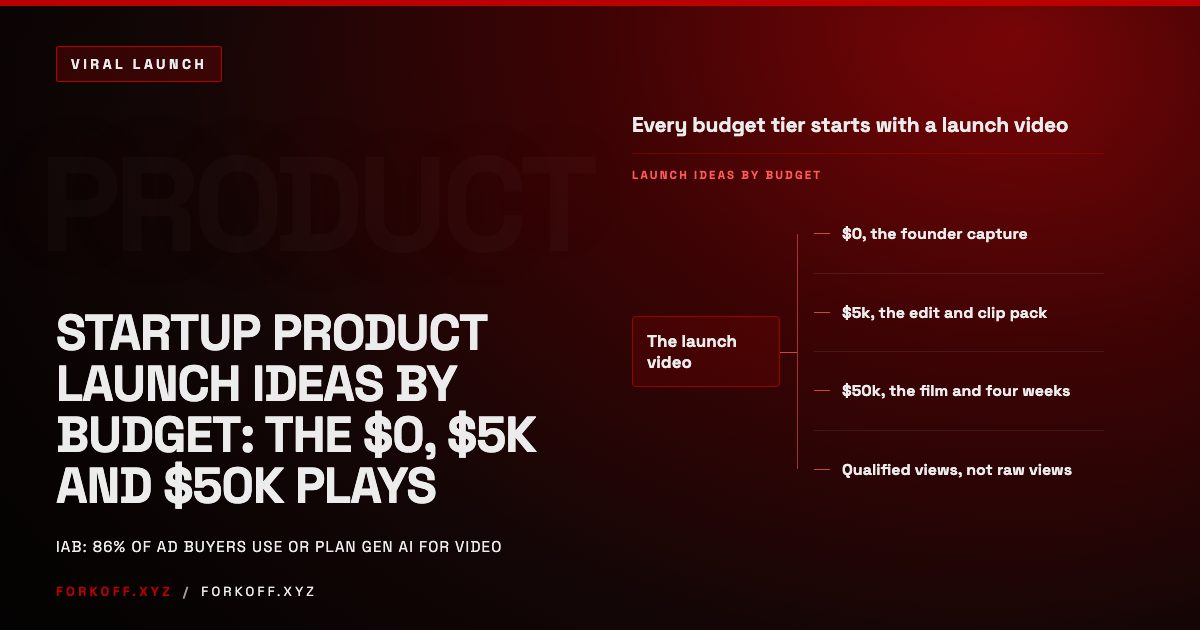
Startup Product Launch Ideas by Budget: The $0, $5k and $50k Plays
Product launch ideas for a SaaS startup sorted by budget: what the launch video should be at $0, $5k and $50k, and the distribution around it.
Read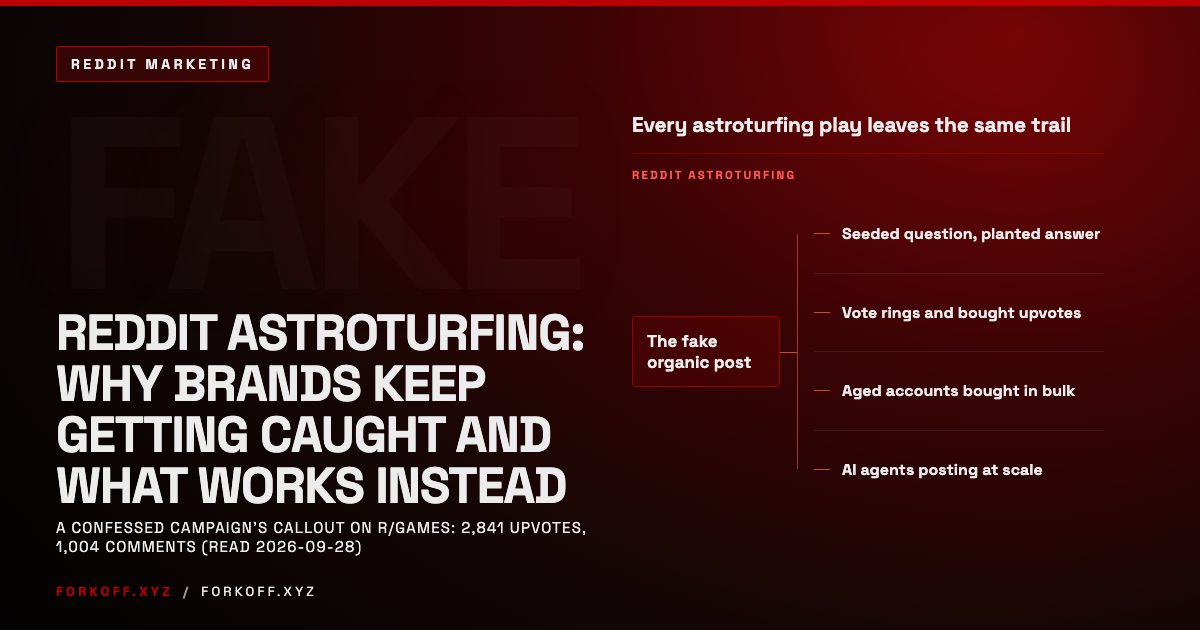
Reddit Astroturfing: Why Brands Keep Getting Caught and What Works Instead
Reddit astroturfing is paid promotion dressed up as organic talk. Why brands keep getting caught, what exposure costs, and the legitimate way to show up.
Read