
Podcast clipping for B2B SaaS podcasts · pipeline-grade attribution
Founder-led SaaS shows, customer-led case-study podcasts, and category-defining B2B narratives. clipped, qualified, and routed to the buyer-committee cohorts your pipeline tracks. The strategist briefs against your three buyer-committee personas (economic buyer, technical evaluator, end-user champion), and the qualification engine grades each cut against the cohort that pulled it, so the RevOps reconciliation joins clip activity to pipeline progression in the CRM.
What is B2B SaaS podcast clipping?
B2B SaaS podcast clipping is cutting founder-led and customer-led SaaS podcast episodes into vertical clips graded against the buyer-committee cohorts that move deals: economic buyer, technical evaluator, end-user champion. FORKOFF runs it as a managed campaign across a network that has processed 5B+ views, pricing at $0.0024 to $0.0038 per qualified view with a cohort-tagged ledger exporting to HubSpot, Salesforce, and Customer.io. One vertical-SaaS founder show shipped 9 cuts in a quarter, landing 38 percent economic-buyer watch-through.
- Pricing
- $0.0024 to $0.0038 per qualified view (CPQV)
- Model
- Managed clipping network, outcome-priced
- Legitimacy
- Sustained and audited (real, in-region, bot-filtered)
B2B SaaS clip distribution succeeds when it lands inside the buyer-committee.
Agencies sell effort. Bounty boards sell volume. FORKOFF sells qualified outcomes.
What outcome-priced clipping looks like in production.
Brief to live in three steps.
Show audit
Strategist audits the back catalog and live-show pipeline. flags founder beats, narrative arcs, controversy moments, and quotable B-roll suitable for vertical short-form clipping. Episode-level briefs locked at acceptance.
Clipper roster pick
Podcast clippers screened on prior narrative-format qualification rates. Vertical-format clippers chosen by destination platform (TikTok, Shorts, Reels, X) and by audience-fit history with comparable shows.
Episode-level ledger
Per-clip ledger ties qualified views back to the source episode and timestamp. Brand sees which beats qualified, which underperformed, and which platforms over-indexed for that episode arc.
Narrative beats, not face-to-camera energy.
Podcast clipping fails when treated like generic short-form. Founder shows live or die on narrative arcs and quotable insight. not on jump-cut energy or dance trends. The clip that pulls qualified watch-time from a 90-minute interview is rarely the loudest moment. it is the controversial frame, the data-driven counter-take, or the founder-vulnerability beat that earns rewatch.
FORKOFF runs podcast clipping as a managed agency precisely because the pattern-match between long-form audio narrative and 12-second vertical visual is non-trivial. Strategist audits the catalog, flags candidate beats per episode, briefs the clipper on narrative payoff, then the qualification engine grades each cut against per-platform watch-time gates. TikTok needs a 12 to 15 second hold. Reels rewards a 14 to 18 second arc. Shorts behaves like a hybrid. X favours an 8 to 10 second hook with a thread continuation.
The wedge is the audit ledger maps qualified views back to the source episode and timestamp. Brand teams see which guests, beats, and topics produced clips that cleared the qualification gate. and which underperformed. That feedback loop reshapes the editorial calendar (which guests to re-book, which segments to lead with) and tightens the clip brief on the next batch.
Most podcast operators ship raw view counts and stop there. FORKOFF ships the per-episode qualification rate plus a CSV/JSON export the brand can hand to a finance reviewer or listing partner. Pricing on raw CPM rewards loud clips that loop fast and lose interest fast. CPQV rewards clips that earn the watch-through, which is exactly the behaviour podcast IP needs to compound.
Brand-safety on podcast clips is reputational, not regulatory in most categories. No fabricated win-rate testimonials. No client-name disclosure without sign-off. No internal-ops disclosure that breaks confidentiality. The strategist locks brand-safety at acceptance. the audit ledger gives compliance a paper trail per view. A Clipping Foundation campaign is billed at $0.0024 to $0.0038 per qualified view and routed to the show's ICP geos. Brief to live in under 48 hours, back-catalog campaigns scoped at intake.
For the deeper background behind this page, read our podcast clipping pricing breakdown.
From one SaaS podcast episode to a week of distribution
Most SaaS podcasts publish an episode a week and then let it sit. The work here starts from the episode you already publish and ends with cuts posted on accounts your buyers scroll.
Upload your episode
Send the full recording, the transcript if you have one, and the product moments that matter. A 45 to 60 minute episode usually yields 8 to 15 cuts, each captioned and sized for vertical feeds, and the brief decides how many ship.
Podcasts and X Spaces, without the slow edit
Editing a podcast by hand is slow and expensive. The strategist pulls the moments, the clipper network cuts and captions them, and a recorded X Space is handled the same way as an episode.
Clippers post and distribute every cut
Cuts do not sit in a folder. The clipper network posts them from accounts that already reach founders, operators and developers, and only views that pass the four checks bill.
Use cases for SaaS podcast clips
A SaaS episode carries more than one job. The strategist tags each beat by the job it can do before the clipper roster cuts it, so the same recording feeds the pipeline, the sales team and the category story at once.
Demo-request beats
Moments where the guest names the exact pain the product removes. Cut to 30 to 45 seconds, captioned, and routed to the technical-evaluator and end-user cohorts, these are the clips RevOps most often joins to demo requests in the ledger export.
Customer proof in the customer's words
Customer-led episodes produce the strongest proof clips a SaaS team can post: a named role explaining why they bought. Each one ships only with the guest's clip-distribution sign-off, and the cuts double as sales follow-up material.
Category narrative for the economic buyer
The founder's thesis on where the category is going, cut short and posted on LinkedIn and X during business hours, where the economic-buyer cohort is most active. These are the beats that keep a category-creation show in the buyer's feed between episodes.
FORKOFF vs the alternative.
← scroll horizontally to see more →
| Feature | FORKOFF Clippingoperator-grade | Generic alternativethe rest of the market |
|---|---|---|
| Operating model | Managed agency. Strategist briefs founder-led customer narrative, picks buyer-committee-aware clippers, qualifies economic-buyer + technical + end-user-champion cohort views per platform threshold. | DIY tools (OpusClip, Vizard, Klap) or open bounty boards (Whop). qualification on the brand. |
| Pricing denominator | $0.0024 to $0.0038 per qualified view (CPQV) with buyer-committee cohort grading at platform watch threshold. ▸ CPQV vs raw | Tool subscription or raw CPM. no qualification denominator. |
| Brief fit | Customer-narrative + category-defining beats with B2B watch threshold per platform. | Generic founder-PR templates that miss buyer-committee resonance. |
| Audit trail | Per-cohort ledger by buyer-committee role; CSV/JSON export for RevOps + finance review. | Dashboard counts with no buyer-committee attribution. |
| CRM pipeline integration | Per-cohort ledger CSV exports carry cohort tags that map cleanly to HubSpot, Salesforce, and Customer.io schemas. RevOps teams reconcile clip activity against pipeline-stage progression in the standard SaaS funnel model. ▸ RevOps-joinable | Dashboard-only counts without exportable cohort tags. No clean RevOps reconciliation path. |
9 cuts shipped over Q3. 38% landed economic-buyer cohort watch-through.
▸ Vertical SaaS founder podcast · NDA handle SAS-07
Vertical-SaaS founder running quarterly clip distribution into pipeline. Strategist locked the buyer-committee cohort at acceptance and shipped 9 cuts across Q3. RevOps joined the per-view ledger to HubSpot via the CSV export and tracked which cohorts pulled qualified watch-through against pipeline movement. The brand's RevOps lead used cohort tags to attribute clip-sourced demo-requests against marketing-sourced pipeline ahead of the Q3 board review, and the team re-cut the next batch toward the technical-evaluator beats that earned the strongest demo-conversion rate.
▸ FORKOFF case archive · retainer tier · NDA-safe handle
Who this is for. Who it isn't.
- B2B SaaS founder-led podcasts with a confirmed 10+ episode catalogue and buyer-committee personas locked in HubSpot or Salesforce
- Customer-led case-study podcast formats where each episode features a named buyer-committee role explaining purchase rationale
- Category-defining narrative shows for vertical SaaS verticals (legal-tech, healthcare-SaaS, dev-tools, RevOps tooling)
- Brands tracking buyer-committee progression through pipeline-stage transitions inside CRM with cohort attribution
- RevOps teams reconciling qualified-view volume against pipeline movement on a quarterly basis for board reviews
- Pre-PMF SaaS without a defined buyer-committee or stable persona map across economic / technical / champion roles
- B2C SaaS optimising on consumer entertainment-mode watching rather than evaluation-mode buyer-committee engagement
- SaaS brands unwilling to ship per-cohort brief input or define which buyer-committee persona each episode targets
- Confidential-customer-disclosure shows where customer interviewees have not signed off on clip-distribution rights
- Below-floor budgets that cannot fund a three-campaign Clipping Foundation term
Calculator coming to forkoff.xyz soon. Use the dedicated tool at /tools/cpqv-calculator for the full cost-per-qualified-view math.
Frequently asked
What is B2B SaaS podcast clipping?
B2B SaaS podcast clipping is the discipline of cutting founder-led or customer-led SaaS podcast episodes into vertical short-form distribution clips tuned for buyer-committee resonance. Unlike consumer clip distribution that optimises for impression aggregates, SaaS clipping grades each cut against economic-buyer, technical-evaluator, and end-user-champion cohort gates. FORKOFF runs the workflow end-to-end as a managed agency priced per qualified view, with the per-cohort attribution ledger RevOps teams reconcile against pipeline progression inside HubSpot or Salesforce.
How do you pick which SaaS podcast beats to clip?
Strategist audits the back-catalogue at acceptance and tags beats by buyer-committee resonance: economic-buyer narrative beats, technical-evaluator depth beats, and end-user-champion outcome beats. Beat-selection bias is toward moments that surface champion-resistance unlocks, technical-specificity payoffs, or category-defining frames the buyer-committee cites during competitive evaluation. Episode-level briefs lock against the funnel-stage map and the clipper roster runs against those briefs, not against ad-hoc selection or generic founder-PR templates.
Which platforms do SaaS clips distribute to?
LinkedIn, X, YouTube Shorts, and TikTok are the default destination surfaces for B2B SaaS clip distribution. LinkedIn skews economic-buyer cohort during business hours; X reaches the technical-evaluator and category-creator audience; YouTube Shorts produces durable demo-discovery surface area; TikTok increasingly captures end-user-champion mindshare in product-led SaaS categories. Each surface carries its own buyer-committee cohort watch-threshold, and the qualification engine grades cuts against the platform-specific gate before billing.
How does FORKOFF qualify a SaaS clip view?
Every view passes a four-stage gate before billing. (1) Buyer-committee cohort watch-duration: the platform plus cohort threshold defined in the brief. (2) Platform-policy: clip and clipper cleared the platform creative-policy review. (3) Geo consistency: playback originated in a brief-locked geo. (4) Traffic validity: anti-bot enforcement on per-view inputs including swipe-under-1s, repeat-IP playback, and pattern-match bot signatures. Filtered views log with reason codes and surface in the CSV export so RevOps reconciles only billable qualified views against pipeline-stage progression.
What does SaaS pricing look like? Is there a bounded entry campaign?
Entry is Clipping Foundation, a three-campaign minimum term priced per qualified view at $0.0024 to $0.0038. After it, the next B2B SaaS campaign is scoped per brief at intake, including multi-product or category-creation campaigns. Brief to live in under 48 hours on Clipping Foundation; larger campaigns run their own onboarding window with the RevOps lead to lock the funnel-stage map and cohort tag enrichment ahead of first clip ship.
How does buyer-committee routing work for SaaS podcasts?
The clipper roster routes against the brand's defined buyer-committee personas: economic buyer, technical evaluator, end-user champion. Watch-threshold is tuned for B2B evaluation behaviour vs entertainment-mode watching. The qualification engine grades each cut against the cohort gate before billing.
Does the ledger join to a CRM or RevOps stack?
Yes. The CSV/JSON export carries cohort tags that map to standard SaaS personas (economic buyer, technical evaluator, end-user champion). RevOps teams have joined it to HubSpot, Salesforce, and Customer.io exports for pipeline reconciliation.
How do buyer-committee personas map to the watch-threshold gate?
Economic buyers behave differently than technical evaluators or end-user champions on short-form. Economic buyers tend to skim the first 6 to 8 seconds before deciding to commit; technical evaluators watch for specificity payoff in the middle of the clip; end-user champions watch through for outcome resolution. The watch-threshold gate is tuned per cohort, so a clip qualifies on economic-buyer cohort at a different watch duration than on end-user-champion cohort. The cohort tag in the ledger reflects which gate that view cleared.
Can RevOps reconcile clip activity against demo-conversion or pipeline-stage progression?
Yes. The CSV export carries cohort-tagged rows that join cleanly to demo-request events and pipeline-stage timestamps inside HubSpot or Salesforce on standard SaaS funnel schemas. RevOps teams have used the join to attribute clip-sourced demo-requests against marketing-sourced pipeline, track which clip cohort produced the highest economic-buyer to closed-won conversion ratio, and re-cut the next batch toward beats that surfaced champion-resistance unlocks during evaluation.
Can we review and customize the clips before they publish?
Yes. The brief sets the rules every cut follows (caption style, brand colours, the product names and claims that are allowed, and any topics the guest has asked to keep off feeds), and the first batch of cuts goes to your team for review before anything posts. Once the first batch is approved, later batches follow the same brief, and you can pull any individual cut before it ships. Customer-led episodes never ship a clip without the guest's sign-off.
Where are the clips exported and published?
Cuts are exported vertical and captioned for LinkedIn, X, YouTube Shorts and TikTok, and the clipper network publishes them natively on each platform from accounts that already reach founders, operators and developers. Your own team also receives the finished files to post on the company and founder accounts. Every published cut is logged in the per-cohort ledger, which exports as CSV or JSON for HubSpot, Salesforce or Customer.io.
Does the per-cohort signal help category-creation podcasts position against alternatives?
Yes, this is a recurring use case for SaaS shows in category-creation or category-redefinition mode. The cohort export reads which beats pulled economic-buyer watch-through against alternatives-comparison content versus which pulled technical-evaluator watch-through against implementation-detail beats. Category-creation shows use the signal to retune the alternatives-comparison framing for the next batch, then track whether the redefinition language landed better with the buyer-committee economic-buyer cohort or with the technical-evaluator cohort.
Start with Clipping Foundation.
Three-campaign minimum. Paid only on qualified views. Audit-ready ledger from day one.
The qualification ledger changed how we report to the board. Real attention, verified weekly, not dashboard vanity.
Growth lead
Series A, 2026, AI infrastructure startup
We went from guessing pipeline attribution to seeing it in a weekly audit ledger. Finance signed off on the next quarter before the first one ended.
Marketing director
Mid-market, 2026, B2B SaaS platform
FORKOFF ran our conference activation across three cities in one quarter. Side events, content capture, post-event distribution. One operator, one ledger.
Head of events
Three cities, one quarter, DevTools company
As Featured In
Full press shelf- DA 55 · 2026-08Keep a Customer Community Engaged Without Over-Promotion

- CFO DriveDA 35 · 2026-08How Finance Teams Align Pricing With Sales Without Eroding Margins
- DA 94 · 2026-07Clipping Agency FORKOFF Crosses 5 Billion View Milestone

- DA 74 · 2026-06Five Things SaaS Founders Get Wrong About Short-Form, and Why Their Best Moments Die in 48 Hours

- LinkedInDA 56 · 2026-06The 2026 DevOps Maturity Test: 11 Engineering Orgs Failed and the One Metric That Replaced the Checklist
- IHDA 75 · 2026-06Most indie products do not fail on the build. They fail on distribution.
- DA 56 · 2026-06The Schema-Match Audit That Lifted Our AI Overview Citation Share From Zero to 23 Percent in 90 Days

- DA 42 · 2026-0525 Country-Specific Considerations for International IP Protection for Your Startup

- DA 68 · 2025-11RedStone, FailSafe, Nibiru and ForkOff Announce The Capital Layer at Devconnect Buenos Aires 2025

- DA 62 · 2025-11RedStone, FailSafe, Nibiru and ForkOff Announce The Capital Layer at Devconnect Buenos Aires 2025

- DA 50 · 2025-11RedStone, FailSafe, Nibiru and ForkOff Announce The Capital Layer at Devconnect Buenos Aires 2025

Receipts, deep dives, and playbooks.
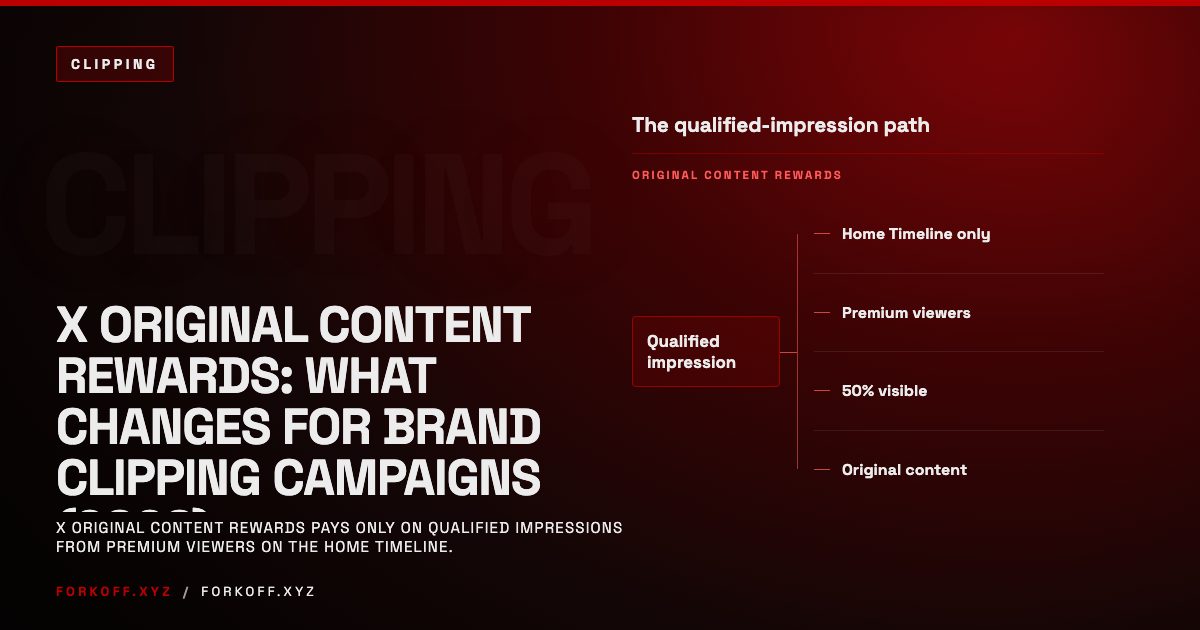
X Original Content Rewards: What Changes for Brand Clipping Campaigns (2026)
X swapped Creator Revenue Sharing for Original Content Rewards, so recycled-clip payouts are gone. What brands running clipping campaigns change now.
 Read
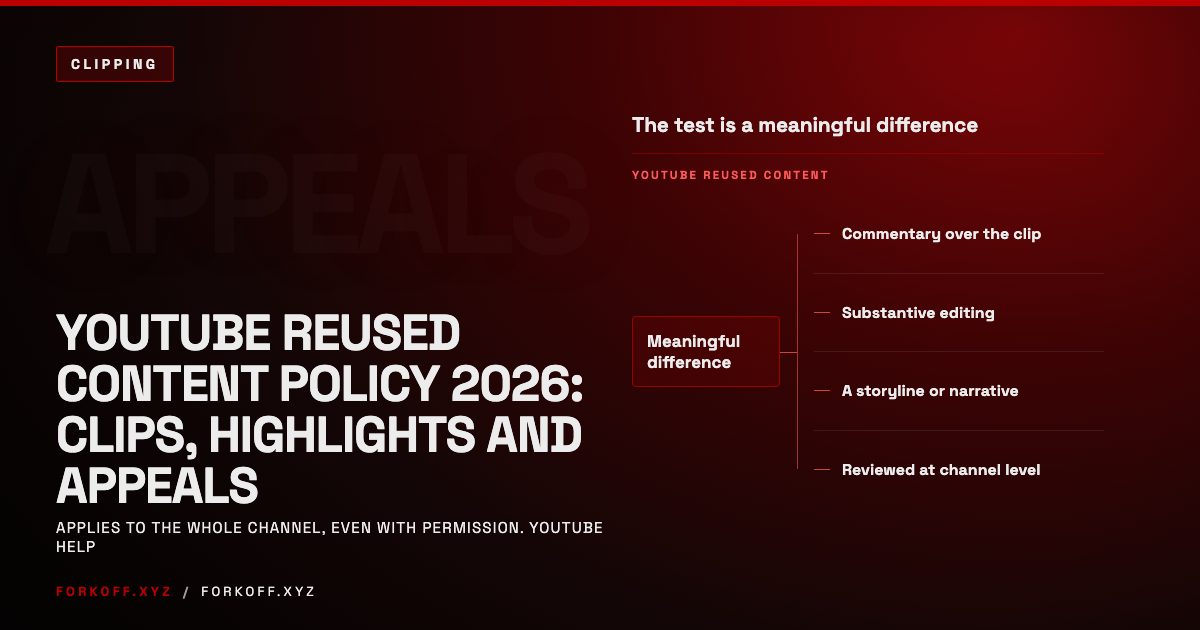
YouTube Reused Content Policy 2026: Clips, Highlights and Appeals
What YouTube's reused content policy actually says, how it treats clips, stream re-uploads and compilations, how to appeal, and how brand clipping stays clean.
Read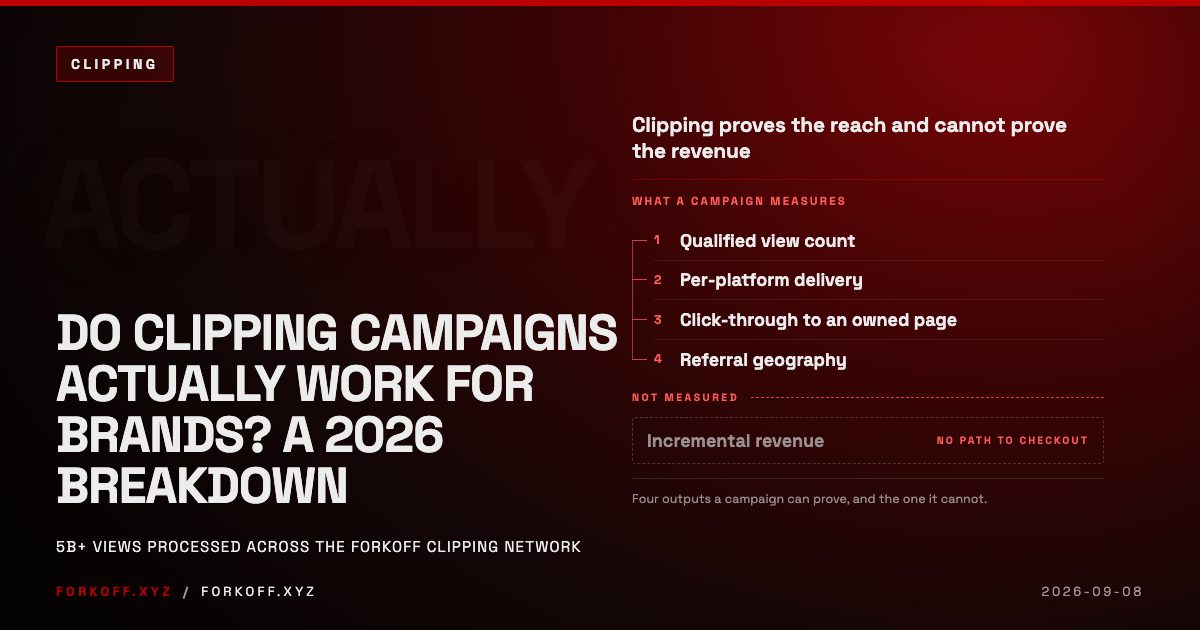
Do Clipping Campaigns Actually Work for Brands? A 2026 Breakdown
Clipping campaigns buy reach at a low unit price and cannot prove revenue. The 2026 breakdown of CPM by content signal, attribution and vendor diligence.
Read