Service · Crypto Influencer + KOL Marketing · By application
Crypto influencer and KOL placements for SaaS and AI founders that earnthebuyer.
FORKOFF runs crypto influencer marketing and crypto KOL marketing for AI, Web3, and crypto brands, outcome-priced on qualified-view share, not roster brokering. Cluster-mapped KOL set, 5-signal bot-screen before the buy, founder-narrative briefs on every approved placement, weekly proof that names each KOL by qualified views and qualified inbound, layered on an owned founder spine. The full model is in the crypto KOL marketing framework. Running a mainstream SaaS, AI, or consumer brand instead of a token? Start on the cross-vertical influencer marketing track.
KOL test campaign · 1-3 placementsRetainer plus media-spend pass-through · By application5 engagements per quarter · Selective on ICP
The short answer
What is crypto influencer marketing and KOL marketing, and how does a KOL marketing agency work?
Crypto influencer marketing and KOL marketing are the same motion in Web3: paid or earned promotion through Key Opinion Leaders, the trusted niche voices (called influencers in consumer markets) that a specific crypto or AI audience already follows, so a brand reaches buyers through a credible co-sign instead of an ad. A KOL marketing agency maps the right opinion leaders to a brand's buyer cluster, screens every account for fake followers and bot engagement, negotiates the placement, briefs the creative from the brand's own narrative, and reports what each placement actually returned. FORKOFF runs it outcome-priced on qualified-view share: cluster-mapped KOLs, a 5-signal bot-screen before every buy, and weekly proof that names each KOL by qualified views and qualified inbound.
The bench behind that screen runs a documented range of 5,000 to 1M+ creators per our internal roster ledger. That span is network reach measured across engagements, not a static bench-size claim.
By applicationRetainer plus media-spend pass-through
By applicationKOL test campaign budget (1 to 3 placements)
DA 50 · 2025-11RedStone, FailSafe, Nibiru and ForkOff Announce The Capital Layer at Devconnect Buenos Aires 2025
KOL marketing is measured reach, not a list of names and a flat fee.
We place a client's message inside trusted creators' audiences and report qualified views per placement, per creator, never raw impressions.
By the numbers
KOL and influencer marketing, in numbers.
Why a credible co-sign moves buyers, why the fraud screen is the whole game, and where FORKOFF sits. Every figure below is a published benchmark with a named source and a checkable link.
Influencer and KOL marketing grew into a market worth roughly $24 billion by the end of 2024, up from just $1.7 billion in 2016. (Influencer Marketing Hub, 2024)
88% of consumers trust a recommendation from a person they know above every other form of advertising, the exact mechanic a KOL co-sign borrows. (Nielsen, 2021)
63% of consumers aged 18 to 34 are more trusting of influencers than a brand's own advertising. (Edelman Trust Barometer, 2019)
Fake followers and bot engagement cost brands an estimated $1.3 billion in a single year, which is why FORKOFF bot-screens every KOL before the buy. (CHEQ + University of Baltimore, 2019)
About 22% of the followers behind a typical Instagram influencer are suspicious or fake accounts, so raw reach without a fraud screen overstates the real audience. (HypeAuditor, 2019)
FORKOFF has processed more than 5 billion qualified views across its clipping network, the first-party base behind the qualified-view screen every KOL placement is measured against. (FORKOFF, 2026)
Pre-engagement diagnostic
Why most KOL campaigns fail before they ship.
Five patterns we see when a brand shops a KOL agency and the campaign reads as renting attention, not buying proof. Each row is the FORKOFF fix. Read it before you book the discovery call.
fk_audit · kol_marketing_reject_log.csv
#Reject reasonAudit detailFORKOFF fix
Row 0101
Reject reasonRoster-led flat-fee placements
Audit detail
Generic KOL agency sells access to 300-account roster at list rate. No engagement-quality data, no negotiated rate, no link to ICP fit. Brand pays 100 percent of list rate for an audience that may or may not overlap with the buyer set. Renewal pitched on volume, not pipeline.
FORKOFF fix
Fix
Cluster mapping per engagement (a16z portfolio, YC AI, crypto-Twitter Layer 2, AI-agent builders, ecosystem partners). 12-KOL shortlist scored by ICP-fit plus engagement-quality. Negotiated 20 to 40 percent off list rate using engagement-quality data. Roster only matters when it overlaps with the buyer cluster.
Row 0202
Reject reasonZero fraud screen on the host account
Audit detail
Median KOL on the open market runs 30 to 60 percent bot followers and farmed engagement. Brand pays for a viewership that does not exist. Generic agency does not audit follower quality before the buy, so the placement ships and the engagement number prints high while qualified inbound stays at zero.
FORKOFF fix
Fix
5-signal qualified-view auditor on every KOL before the buy. Reply velocity, account-age distribution, semantic match, sentiment bias, watch-time decay. Composite fraud score with a hard 25 percent reject floor. KOLs above 25 percent fraud cut from the shortlist before the brand sees the rate card.
Row 0303
Reject reasonGeneric ad copy disconnected from founder narrative
Audit detail
KOL writes their own script or runs a brand-supplied generic ad copy. Post lands in a different voice than the founder's owned channels. Audience reads it as paid promo and tunes out. Recall does not compound back to the brand because the wedge does not match what the founder has been saying on Twitter, LinkedIn, or the podcast.
FORKOFF fix
Fix
Every KOL placement briefed from the founder narrative spine. Same wedge, same vocabulary, same audit-ledger framing. KOL is the amplifier, the spine is the source. Placement reads as a co-sign of an owned narrative, not a paid endorsement of a generic claim.
Row 0404
Reject reasonNo per-post tracking back to qualified inbound
Audit detail
Reporting stops at total views and estimated reach (often inflated by the platform). Brand cannot tell which KOL drove qualified inbound, which one drove cluster signal, which one wasted budget. Renewal pitch lands on raw view count even though the buyer count was zero on three of the five placements.
FORKOFF fix
Fix
Per-post tracking: total views, qualified-view share post bot-screen, link clicks, cluster overlap with your ICP, qualified inbound surfaced. Ledger reports each KOL by name with the dollar amount paid, the qualified-view count, and the qualified inbound attributed. The brand sees which placement worked and which did not, every Friday.
Row 0505
Reject reasonNo kill-and-recompound loop on underperformers
Audit detail
Once the KOL roster is locked, generic agency runs the same 5 KOLs across the engagement window even when 2 of them have under-delivered for 3 weeks straight. Capital flows to the wrong accounts. Top performers stay under-allocated because the budget is pinned to the underperformers.
FORKOFF fix
Fix
Weekly Slack ledger flags underperformers. Cut from the rotation, capital re-allocated to the top 1 to 2 performers on the same total spend. Net qualified-view lift typically runs plus 35 percent on a recompounded engagement versus the original allocation.
Roster-led KOL agencies sell access. FORKOFF screens every KOL plus outcome-prices the placement.
Generic KOL agencies broker access to a fixed 300-account roster at list rate with no fraud audit and no kill-and-recompound loop. FORKOFF maps the cluster per engagement, runs the 5-signal qualified-view auditor on every shortlisted KOL, briefs every approved placement from the founder narrative spine, and reports qualified inbound by name every Friday. Pairs cleanly with the KOL rate calculator on the upfront pricing surface.
Three numbers that decideif a KOL engagement compounds.
280K / 7d
Qualified views over a 12-KOL launch cascade
Mid-stage Web3 protocol launch. Bot-screened 24, ran 12, cut 6 underperformers in real-time.
AI-agent SaaS. Week-2 audit cut 2 underperformers, capital re-allocated to top 2 performers.
Qualified-view lift on the same total spend after recompound
+35%
DeFi protocol. X plus Telegram paired versus single-channel KOL test from prior quarter.
Qualified-inbound multiplier on paired-channel KOL placements
3x inbound
Application-only · selective on ICPAI plus Web3 plus crypto lane · pre-launch through post-launchProof of outcomes every FridayCluster map plus screening dossier owned at engagement end
What plugs into the engagement
KOL Marketing doesn't run alone.
PHASE 01[WEEK 1]
01
Cluster
12-KOL shortlist scored by ICP-fit plus engagement quality.
Deliverables (5)
▸Cluster map (a16z, YC, crypto-Twitter, AI agents)
Weekly proof of outcomes plus kill-and-recompound loop.
Deliverables (5)
▸Weekly Slack qualified-view proof
▸Underperformer cut from the rotation
▸Capital re-allocated to top performers
▸Cluster-saturation report per cohort
▸Quarterly cohort review and scale call
What clears the KOL screen
What every KOL clearsbefore the buy.
A KOL placement only ships when four signals hold. 5-signal fraud screen below the 25 percent reject floor, cluster-overlap above 30 percent against your buyer list, brief sourced from the founder narrative spine, and per-post tracking back to qualified views plus qualified inbound. KOLs above 25 percent fraud cut from the shortlist before the brand sees the rate card. Underperformers cut weekly.
Active check · BOT
1 / 4Signals every KOL clears before the placement runs. Bot, ICP, narrative, attribution.
01 BOT
5-signal fraud screen passes the 25 percent reject floor.
01
BOT
Reply velocity, account-age distribution, semantic match, sentiment bias, watch-time decay. Composite score logged per candidate. KOLs above 25 percent fraud cut from the shortlist before any rate card moves. The hard floor is what stops capital flowing into farmed audiences.
Host audience cross-referenced against your ICP cluster (a16z portfolio, YC AI, crypto-Twitter Layer 2, AI-agent builders, ecosystem partners). KOLs below 30 percent overlap get cut even if the fraud screen passes. Reach without ICP fit is renting attention that never converts.
fk_audit · qv_check_02
rule · Cluster-overlap with your buyer list above 30 percent.
03
NARRATIVE
Same wedge, same vocabulary as your owned channels. KOL post reads as a co-sign of an owned narrative, not a paid endorsement of a generic claim. Voice integrity is the difference between a KOL placement that lifts cluster recall and one that prints a view number with no compounding effect.
fk_audit · qv_check_03
rule · Placement briefed from the founder narrative spine.
04
ATTRIBUTION
Per-post tracking: total views, qualified-view share post bot-screen, link clicks, cluster-overlap with your ICP, booked discovery calls and partnership conversations attributed by name. Proof reports each KOL with dollars paid, qualified views, qualified inbound. Underperformers cut weekly.
fk_audit · qv_check_04
rule · Qualified view plus qualified inbound traced to the placement.
Counts in the weekly report
›5-signal fraud screen below the 25 percent reject floor
›Cluster-overlap above 30 percent against your ICP buyer list
›Placement briefed from the founder narrative spine, founder approved
›Per-post qualified-view share logged after bot-screen filters
›Qualified inbound traced to the placement by name in the weekly report
Doesn't count
·Roster placement at list rate with no engagement-quality data
·Generic ad copy disconnected from the founder owned-channel wedge
·Total-view inflation without cluster-overlap or attribution receipt
·Underperformer kept in rotation past the weekly cut threshold
·Bot-farm host account with reply velocity outside organic range
Outcomes from the engagement
Qualified views, cluster activation, and recompounded yield.
Three engagements across a Web3 protocol launch, an AI-agent SaaS, and a DeFi protocol. KOL engagements that locked the cluster map, ran the 5-signal screen, briefed every approved placement from the founder spine, and shipped the weekly report the brand could read in two minutes. Read the longer write-ups inside our case-study hub.
280K / 7d
Qualified views over a 12-KOL launch cascade on a mid-stage Web3 protocol. Bot-screened 24, ran 12, cut 6 underperformers in real-time. 14 partnership conversations attributed by name.
+35% / 5
Qualified-view lift on the same total spend after weekly recompound. AI-agent SaaS started 5-KOL flat allocation; week-2 audit cut 2 underperformers, capital re-allocated to the top 2 performers.
3x inbound
Qualified-inbound multiplier on a DeFi protocol running paired X plus Telegram KOL placements versus a single-channel KOL test from the prior quarter.
OWNED
Cluster map, KOL screening dossier, founder-spine brief library, and 90 days of attribution data all stay with the brand at engagement end.
First-party data
What a bot-screened KOL cascade actually returns
280K
qualified views over 7 days across a 12-KOL launch cascade
24 to 12
KOLs bot-screened, then run after clearing the fraud floor
14
partnership conversations attributed to named placements
On a mid-stage Web3 protocol launch, FORKOFF bot-screened 24 KOLs on a five-signal fraud check, ran the 12 that cleared, and cut 6 underperformers in real time on the weekly recompound. The cascade returned 280,000 qualified views over 7 days and 14 partnership conversations attributed by name, with qualified views counted only after the per-post bot-screen rather than from platform-reported reach.
Each engagement below names the company, the window the work ran in, and the numbers it returned. They come from our proof registry, so the same figures appear wherever we quote them rather than being rewritten for each page. Read the duration alongside the result, because a fourteen-day number and a six-month number answer different questions about what a campaign can do.
ElevenLabs
60 days, Q3 2026
creators activated
16
creators activated
creator reach
5.6M
creator reach
median engagement
2.1%
median engagement
conversions per 100k
7
conversions per 100k
16 creators activated against one product use case rather than a follower tier
5.6M creator reach at a 2.1% median engagement rate
7 conversions per 100k views, measured on the creator's own link
Chainlink
60 days, Q3 2026
creators activated
30
creators activated
creator reach
10.6M
creator reach
median engagement
3.9%
median engagement
conversions per 100k
14
conversions per 100k
30 creators activated against one product use case rather than a follower tier
10.6M creator reach at a 3.9% median engagement rate
14 conversions per 100k views, measured on the creator's own link
Splice
60 days, Q3 2026
creators activated
16
creators activated
creator reach
5.8M
creator reach
median engagement
2.2%
median engagement
conversions per 100k
7
conversions per 100k
16 creators activated against one product use case rather than a follower tier
5.8M creator reach at a 2.2% median engagement rate
7 conversions per 100k views, measured on the creator's own link
The qualification ledger changed how we report to the board. Real attention, verified weekly, not dashboard vanity.
G
Growth lead
Series A, 2026, AI infrastructure startup
Brand
We went from guessing pipeline attribution to seeing it in a weekly audit ledger. Finance signed off on the next quarter before the first one ended.
M
Marketing director
Mid-market, 2026, B2B SaaS platform
Brand
FORKOFF ran our conference activation across three cities in one quarter. Side events, content capture, post-event distribution. One operator, one ledger.
H
Head of events
Three cities, one quarter, DevTools company
Partner
Geo-routing pulled the campaign out of single-market mode. India and Southeast Asia carried the qualified attention count. The unit cost dropped by two thirds.
C
Campaigns lead
India + SEA launch, Q1 2026, Consumer tech brand
Brand
AuditedSustained legitimacy rate
3.4xRetained attention vs prior agency
250+Qualified introductions
4.2MQualified views in 14 days
Featured engagements
Comparison
FORKOFF KOL vs roster-led agency vs in-house influencer ops.
Three routes to KOL distribution. Match the engagement to your stage, your willingness to outcome-anchor reporting, and your appetite for weekly recompound before picking.
Flat-fee per placement at list rate. Bundled markup. Margin hidden inside the placement quote.
Salaried lead plus freelance script + edit + report fees. Fixed cost, variable yield.
Fraud screening
5-signal qualified-view auditor on every KOL before the buy. Hard 25 percent reject floor.
No fraud audit. Roster sold as-is. Engagement-quality data not collected.
Manual sniff test by the in-house lead. No standardized 5-signal score.
Brief mechanic
Every placement briefed from the founder narrative spine. KOL amplifies the owned wedge.
Generic ad copy or KOL-discretion script. Voice does not pair with founder owned channels.
Brief depends on whoever drafted the script that week. Voice consistency drops on travel weeks.
Tracking
Per-post: total views, qualified-view share, cluster-overlap, qualified inbound. verified proof every Friday.
Total views and estimated reach (often platform-inflated). No cluster-overlap report.
Spreadsheet proof with hand-pulled numbers. Friday cadence collapses on busy weeks.
Failure mode
Underperformer cut from rotation. Capital recompounded weekly.
Underperformer stays in rotation. Renewal pitch arrives before the report does.
Underperformer stays in rotation because the in-house lead has a relationship with the KOL.
Cluster fit
Cluster mapped per engagement. Roster does not exist as a fixed list; KOLs picked per ICP.
Roster is the product. Cluster fit is a coincidence, not a design constraint.
Whoever the in-house lead already knows. Coverage outside personal network is thin.
Time-to-first-placement
14 days from kickoff (cluster + screen) to live placement with founder-approved shortlist.
7 days (faster) but skipping the cluster + screen layers entirely.
30 to 60 days while the in-house lead ramps and pulls vendor invoices.
Reporting surface
Weekly Slack proof: KOL by name, dollars paid, qualified views, cluster-overlap, qualified inbound attributed.
Monthly PDF dashboard: total views, total spend, total reach. Names not attributed to outcomes.
Internal slide deck quarterly. No weekly cadence.
After the shortlist
Running a KOL campaign: sourcing, disclosure, tools and the mistakes that waste budget.
The questions buyers ask once they have picked a route. Each answer is how FORKOFF runs a KOL wave.
Creator sourcing and creator management
Sourcing starts from the buyer, not from a roster. We lock one narrative anchor first, then build a shortlist matched to the audience segment and the platform it lives on (X, YouTube, TikTok, Instagram, Telegram, Farcaster), ranked on audience fit before follower count. Every account on the shortlist is screened for bot-inflated followings, engagement quality and audience geography before any spend, and about one in four is cut at that step.
Managing creators after the placement runs on a weekly wave review: placements live, qualified views per creator, the best creators and why, the underperformers and why, and the actions for the next wave. A creator who ships off brief or under the qualified-view floor is cut in that review, and the budget moves to the creators who cleared it.
Disclosure rules for paid KOL posts
A paid placement has to say it is paid. In the US, the FTC Endorsement Guides (16 CFR Part 255, revised in 2023) require a clear and conspicuous disclosure of any material connection between a brand and the person endorsing it, and a disclosure buried in a stack of hashtags does not count. In the UK, the CAP Code expects an upfront label such as #ad, and since October 2023 a post promoting a cryptoasset to UK consumers falls under the FCA financial promotions regime. X, YouTube, Instagram and TikTok each add their own paid partnership label on top.
What to require from any KOL agency: the disclosure written into each creator's brief for that creator's market, the platform's paid label switched on where one exists, and no price, return or listing promises in creator copy. A placement that hides the deal puts the creator's account and the brand's name at risk together, which is the opposite of what a KOL buy is for.
Common mistakes that waste KOL budgets
Most wasted KOL spend traces back to five decisions made before the first post goes live.
Buying on raw follower count. A padded following bills exactly like a real one. Screen for audience quality and bot inflation before the buy, not after the report.
One big name, no measurement. A screened wave reported on qualified views beats a single placement nobody can audit.
Reporting raw impressions. Qualified views and the inbound they produce are the numbers that tie spend to an outcome.
A different message from every creator. Lock the narrative anchor before the first brief goes out, so the audience sees one pattern across trusted voices instead of scattered shoutouts.
Every placement on the same day. Sequence the wave so repeat exposure across voices builds over the week, instead of one spike that fades by the weekend.
KOL management tools: what actually runs a campaign
Most influencer platforms list creators and track posts; few screen the audience before the buy, which is the step that decides whether the spend reaches people. A FORKOFF campaign runs on four pieces: a creator database holding each account's audience and screening history, the 5-signal qualified-view audit (reply velocity, account-age spread, semantic match, sentiment bias, watch-time decay) run before every buy, a tracked link per creator, and the wave review above. The KOL rate calculator further down this page is the same rate logic, scoped to one creator.
Community management of your own channels is a different job and not part of this service; the FAQ below covers where the founder's own posting sits.
KOL marketing case studies and related services
Engagement write-ups with the numbers attached are on the case studies page, and the proof block above lists the KOL results we can publish. KOL marketing rarely runs alone. It pairs with Twitter (X) marketing for the founder's own feed, clipping to carry the same narrative into short video, events for the in-person moments creators post about, and answer engine optimization so the claims the creators make are the ones AI search repeats.
KOL Marketing fit diagnostic
Strong fit when 4+ are true. Skip when any disqualifier fires.
Who you are
›Brands where a creator can credibly show or recommend the product, in the order the brain ranks them: consumer apps and prosumer software; consumer DTC in identity categories such as beauty, fitness, supplements, gadgets and outdoors; games; crypto, trading and iGaming with a compliance lane; marketplaces; events and media brands; B2B software with a genuine practitioner community
›Brands already running an owned-channel narrative on Twitter, LinkedIn, or the podcast that KOL can amplify
›Pre-launch and post-launch teams that need cluster activation plus ecosystem co-sign on top of organic founder content
›Outbound or ABM team that can act on qualified inbound surfaced by KOL placements within 48 hours
›Brands willing to outcome-anchor on per-post qualified views and qualified inbound, not flat-fee placement reach
›Voice-aligned founders: the KOL placement is a co-sign of the founder spine, not a generic paid endorsement
What FORKOFF delivers
›Cluster mapping plus 12-KOL shortlist scored by ICP-fit and engagement quality
›5-signal qualified-view audit on every KOL before the buy, with a hard 25 percent fraud reject floor
›Negotiated placement fees 20 to 40 percent off list rate using engagement-quality data
›Founder-narrative-spine briefs on every approved KOL across X, Telegram, YouTube, and paired channels
›Weekly Slack proof of outcomes naming each KOL by qualified views, cluster-overlap, qualified inbound
›Kill-and-recompound loop: underperformers cut weekly, capital re-allocated to top performers, +35 percent yield typical
Not the right fit
×Brands without an owned-channel narrative spine. KOL spend amplifies a wedge; it does not invent one.
×Roster shoppers expecting a flat-fee KOL list at list rate. Wrong agency.
×Celebrity-rate-card bookings. We do not broker mass-market influencer rate cards.
×Enterprise B2B with committee buying and a demo-call product. A creator placement does not move a six-month cycle.
×Brands unwilling to act on qualified inbound. Without an SDR or partnership lead, the placement runs hot but never closes.
Run the test campaign
KOL test campaign · 1-3 placements
FORKOFF runs the KOL test campaign as the proof step. Cluster mapped, 1 to 3 KOLs bot-screened and briefed from your founder spine, placements run, weekly proof delivered. If qualified views miss the engagement floor, you keep the engagement-quality dossier. Ongoing engagement is a retainer plus media-spend pass-through (by application), capped at 5 founders per quarter.
Enter a creator's follower count, niche, and platform to get a defensible rate range built on FORKOFF first-party crypto-KOL campaign data, so you walk into the conversation knowing what the post is actually worth.
The same rate logic FORKOFF uses to vet creator quotes inside a managed KOL campaign, scoped to one creator so you can sanity-check a number fast.
FORKOFF KOL Marketing is an outcome-priced retainer that runs paid plus barter KOL placements on top of an owned-channel narrative spine. Four layers: (1) cluster mapping plus 12-KOL shortlist scored by ICP fit and engagement quality, (2) 5-signal qualified-view audit on every KOL before the buy with a hard 25 percent fraud floor, (3) founder-narrative-spine briefs on every approved KOL across X, Telegram, YouTube, and paired channels, (4) weekly Slack proof of outcomes plus kill-and-recompound loop. Underperformers cut weekly, capital re-allocated to the top 1 to 2 performers on the same total spend.
How is this different from a roster-led KOL agency?
Three differences. First, no roster: every engagement starts with a cluster map matched to your ICP, not a fixed 300-account list the agency pushes regardless of fit. Second, every KOL gets bot-screened before the buy via the 5-signal qualified-view auditor. Median fraud rate on the open KOL market runs 30 to 60 percent; we reject above 25 percent. Third, weekly recompound: underperformers cut from the rotation, capital re-allocated to the top performers. Roster agencies pin the budget to the original allocation regardless of performance.
What does it cost?
KOL test campaign budget, by application, for the first 1 to 3 placements (you keep the engagement-quality dossier even if you do not move forward). Ongoing engagement runs as a retainer plus media-spend pass-through, sized by application. List-rate KOL placements run a wide spread per post depending on follower count and cluster prestige; we negotiate 20 to 40 percent off list rate using the engagement-quality data the audit just generated. By application, capped at 5 founders per quarter.
How do you screen KOLs for bot followers?
Five signals in our qualified-view review: reply velocity (bot accounts cluster around minutes-after-post), account-age distribution (bot pools cluster around recent), semantic match (do replies relate to the post topic), sentiment bias (manufactured positivity), watch-time decay (bot views drop off in seconds). Composite fraud score per host account. KOLs above 25 percent fraud cut from the shortlist before the brand sees the rate card.
Do you have a KOL roster?
We have working relationships with 200 plus KOLs across AI, Web3, crypto, and DePIN, but we do not run a flat-fee roster. Each engagement starts with a cluster map matched to your ICP, so the KOL set varies. Roster-based KOL agencies have a structural conflict: they push their roster regardless of fit. We pick the KOL set per buyer cluster, not per agency relationship.
What is outcome-priced KOL marketing?
Fee anchored to per-post qualified views (post bot-screen) and qualified inbound (booked discovery calls or partnership conversations attributable to a placement). Ongoing engagement reports outcomes weekly: each KOL named, qualified views, cluster-overlap, qualified inbound. Underperformers cut weekly.
Which channels for KOL marketing?
X for AI plus crypto plus Web3 (cluster-native primary surface). Telegram for L1, L2, and DeFi launches (channel-mod KOLs). YouTube for long-form review, walkthrough, and podcast guest-spot placements. TikTok and Reels for consumer-AI fits (rare for B2B). LinkedIn for founder-adjacent industry-voice KOLs. Discord for community-mod KOLs (high signal, low scale). Paired-channel placements (X plus Telegram) typically 3x qualified inbound versus single-channel.
Can you guarantee a KOL placement performance?
No agency can guarantee per-post performance. The platform algorithm is the wildcard. What we guarantee: 5-signal bot-screen on every KOL before the buy, founder-spine brief on every approved placement, weekly proof of outcomes. The KOL test campaign is the proof point: if qualified views miss the floor, you keep the engagement-quality dossier.
Where can I see client testimonials for FORKOFF's KOL marketing?
Direct operator quotes sit in the testimonials section on this page, and the full write-ups with numbers attached live at /case-studies. Every quote there ties to a named engagement, not a generic pull-quote, so you can check the claim against the underlying campaign.
How does FORKOFF ensure quality content from KOLs?
Every approved KOL gets briefed from the founder narrative spine before posting, not handed a generic talking-points sheet, so the post reads as the creator's own take rather than an ad read. Drafts on paid placements get a review pass against the brief before they go live. A KOL who repeatedly ships off-brief or low-engagement content gets cut in the weekly recompound, same as one that fails the bot-screen.
Does FORKOFF handle crypto social media management?
Not as a standalone always-on service; FORKOFF's KOL engagement is placement and briefing on other creators' channels, not community management of your own. Where it touches your own social presence is the founder-narrative spine itself, which feeds both the KOL briefs here and the founder's own X posting cadence on /services/twitter-marketing.
Does FORKOFF handle Web3 branding as part of KOL marketing?
Not as a logo-and-guidelines exercise. Every KOL brief is built from the founder's own narrative spine, the recorded story of what the project is and why it matters, so the branding a buyer sees across placements is consistent because every KOL is briefed from the same source, not because a style guide was enforced after the fact.
Questions buyers ask
How do you choose a KOL marketing agency?
Choosing a KOL marketing agency (the same service as influencer marketing) comes down to one question the portfolio never answers: can it prove the reach it sells is real. The category has a fraud problem. Amra and Elma's 2026 review puts 36 percent of influencer accounts as affected by fraud and 49 percent of Instagram influencers as having used fake followers. So the checks that decide a good hire are not creative taste, they are screening, measurement, and fee transparency. Six things separate a real operator from a rolodex: does the agency screen creators for bot-inflated audiences before spend; does it report qualified views you can audit, not raw impressions; can it name results in your vertical; is its fee structure readable (retainer, project fee, or a 15 to 30 percent commission on creator spend); does it disclose whether it represents the creators it proposes; and will it start on a bounded pilot. FORKOFF runs KOL marketing as screened placement plus qualified-view reporting on an audit ledger, outcome-priced rather than a flat retainer.
Per our own campaign records, a 60-day FORKOFF KOL program for an AI voice and dubbing company activated 16 creators against one product use case rather than a follower tier, reached 5.6M people at a 2.1% median engagement rate, and converted 7 per 100k views measured on each creator's own link. FORKOFF KOL Marketing campaign records, Q3 2026
Read the full answer
01
Confirm it screens creators before spend Ask exactly how the agency vets a creator's audience for bots and fake followers, and whether that screen happens before or after you pay. With 36 percent of accounts affected by fraud and 49 percent of Instagram influencers having used fake followers (Amra and Elma, 2026), an agency that buys on raw follower count is buying you padding. Screening before spend is the single most important control.
02
Demand measurement you can audit Raw impressions are a number the platform hands out and nobody can verify after the fact. Ask what the agency reports and whether you can audit it. A real operator reports qualified views (a view that cleared a bot, duplicate, and geo check) with a reason code per view, not a screenshot of gross reach. FORKOFF reports on an exportable qualified-view audit ledger, the same integrity layer behind its 5B+ processed views.
03
Check track record in your vertical Look for named campaigns in your category (crypto, AI, SaaS, or consumer), not a generic client wall. An agency that has run screened crypto KOL waves understands token-launch timing and bot-heavy Telegram clusters, which a generalist DTC shop does not. Ask for the qualified-reach outcome of a recent campaign, not just the creator names.
04
Read the fee structure Agencies bill three ways: a flat retainer of about $2,000 to $15,000 a month, a project fee of $5,000 to $50,000 per campaign, or a management commission of 15 to 30 percent of creator spend (InfluencerFee, 2026). A commission model rewards spending more, so confirm what the percentage is a percentage of. A defined, narrow brief prices better than an open do-everything retainer.
05
Ask who owns the creator relationships Before you accept a shortlist, ask directly whether the agency manages or represents any of the creators it is proposing, and whether it earns a margin on their fees (Pulse Advertising, 2026). An agency selling you creators it also profits from has an incentive that is not your reach. Independent sourcing plus disclosed economics is the green flag.
06
Start on a bounded pilot Never commit a year of retainer to an unproven fit. Ask for a small first wave with a qualified-view target and a report you can read before scaling. A pilot lets you verify the screening and the measurement on real spend, which is the only proof that survives the category's fraud problem.
Is KOL marketing just influencer marketing?
KOL marketing is influencer marketing with the emphasis on expertise rather than audience size: a key opinion leader is someone a specific community trusts on a specific subject, while an influencer is anyone with a following. In practice the two overlap and most agencies sell both. The difference shows up in who you pick. A KOL for a developer tool might be an engineer with 30,000 followers whose code reviews people read closely, while an influencer for the same tool might be a tech personality with 2 million followers who has never shipped software. The first moves a buying decision; the second moves awareness.
The term comes from Asian markets, where KOL is the standard word for paid creator partnerships, and from crypto, where KOLs on X, YouTube and Telegram drive most launch attention. Whatever the label, the job of an agency is the same: find the people whose recommendation an audience acts on, verify that audience is real, brief them well, and measure what happened. Our explainer on what KOL marketing is covers the definition in full.
Are micro influencers better than large KOLs?
Micro influencers are better for trust, niche reach and cost per engaged viewer, and large KOLs are better for fast awareness and moments that need one loud signal; most programs that work use a mix. The industry's common tiers run from nano (about 1,000 to 10,000 followers) through micro (10,000 to 100,000), mid-tier (100,000 to 500,000) and macro (500,000 to 1 million) to mega (over 1 million). Engagement tends to fall as following grows, and smaller creators usually cost far less per post, so a wave of credible micro voices often outperforms one expensive macro post on qualified reach.
Large KOLs still have a role. A launch, a funding announcement or a category-defining moment can need a few big voices to set the narrative that smaller creators then pick up. The risk sits at the top too: large accounts carry more bot inflation in crypto and consumer niches, and a single post is a single point of failure. Ask any agency how it would split your budget across tiers and why. A plan that puts everything on one celebrity post is a bet, not a program.
Which platforms suit Web3 influencer campaigns?
Web3 influencer campaigns run mainly on X, YouTube, Telegram and Discord, because that is where crypto audiences discuss, research and coordinate, while Instagram and TikTok play a smaller role. X carries the fastest narrative: launches, threads, quote-post debates and X Spaces. YouTube carries depth, with explainers and reviews that keep collecting views for months. Telegram and Discord are where communities live, so a KOL with an active channel or server can move people from interest to action in the same day. Podcasts and newsletters reach the more patient, research-heavy part of the audience.
Each platform has its own fraud surface. X engagement can be padded with reply bots, Telegram member counts with dead accounts, YouTube views with low-quality traffic. An agency running Web3 campaigns should screen per platform and report per platform, not blend everything into one reach number. Campaign length differs too: a token or product launch usually needs a coordinated window of a week or two, while education and community growth programs run for months. Ask which platforms the agency has run your kind of campaign on, and what it measured there.
What KOL content strategy works?
The KOL content strategy that works gives every creator the same core narrative and the freedom to say it in their own voice. Start by locking one message: what the product does, who it is for, and the single claim you want repeated. Then brief each creator on that message, the facts they may state, the claims they must not make, and the disclosure they must use, and let them choose the format and the words. A creator forced into a script sounds like an ad and their audience scrolls past.
Formats should match the creator and the stage. Early in a program, explainers, honest first impressions and build-along posts introduce the category. Around a launch, a coordinated wave of posts over a few days creates the sense that everyone is talking about it. After launch, tutorials, comparisons and follow-ups keep it alive and give search and AI answers something to cite. Plan the sequence before the first post: who goes first, who follows, and which posts get amplified with paid once they prove themselves. Repurpose the best creator content, with permission, into ads and owned channels.
What disclosure rules apply to paid KOL posts?
Paid KOL posts must be clearly labeled as paid in every major market, and crypto promotions carry extra financial-promotion rules on top. In the US, the FTC's Endorsement Guides require a clear and conspicuous disclosure of any material connection, such as payment, free product or equity, placed where people will see it, in the post itself rather than a bio. Platform tools such as paid-partnership labels help but do not replace a plain disclosure. In the UK, the advertising regulator and the competition authority expect ads to be obviously identifiable, usually with an upfront 'ad' label. EU consumer protection law treats undisclosed paid promotion as an unfair commercial practice.
Crypto adds a layer. In the US, anyone paid to promote a security must disclose the nature, source and amount of the payment. In the UK, cryptoasset promotions to consumers have fallen under the financial promotions regime since October 2023, so an unapproved promotion can be a criminal offence for the person who posts it. A competent KOL agency writes disclosure into every brief and contract, checks every post before it counts the placement as delivered, and refuses to run undisclosed paid posts.
How do you measure KOL campaign ROI?
You measure KOL campaign ROI by tying every placement to a qualified reach figure, a trackable action and a cost, then comparing cost per outcome across creators. Give each creator a unique link and, where it fits, a unique code, so signups, purchases or wallet connections can be attributed to the person who drove them. Count qualified views rather than raw impressions, meaning views that passed bot, duplicate and geography checks. Then calculate the numbers that let you compare creators fairly: cost per qualified view, conversions per 100,000 views, and cost per conversion.
Per our own campaign records, a 60-day FORKOFF KOL program for an AI voice and dubbing company activated 16 creators against one product use case, reached 5.6M people at a 2.1% median engagement rate, and converted 7 per 100k views measured on each creator's own link. Those are the units to ask any agency for: creators activated, reach, engagement and conversions per 100k on attributable links. Beyond direct attribution, watch branded search, direct traffic and community joins during the campaign window, since a share of KOL impact always shows up there rather than on a tracked link.
What should accurate reporting deliver?
Accurate reporting should deliver a per-creator record you can check yourself, not a summary slide. For each placement: the live post URL, the publish date, views and qualified views, engagement, clicks, conversions on the creator's link, the fee paid, and the result of the audience screen run before the deal. Rolled up, the report should show cost per qualified view and cost per conversion by creator and by tier, so the next wave can move budget toward the people who performed.
Three signs separate accurate reporting from decoration. The links are live, so you can open every post. The raw data is exportable, so your team can recompute the totals. And the report includes the posts that underperformed, with a reason, rather than only the winners. Agencies that report reach as one blended number across platforms, or that send screenshots without links, make verification impossible, and in a category where more than a third of accounts carry some fraud, unverifiable reporting is the same as no reporting.
The category's real problem is not taste, it is fraud
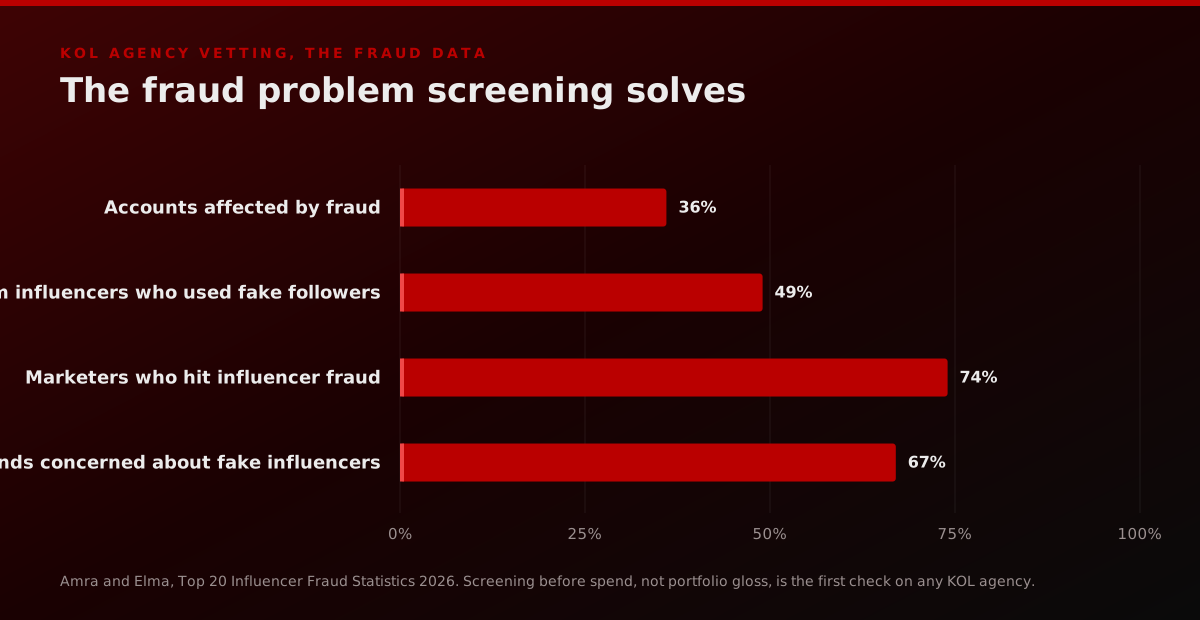
Most guides tell you to judge an influencer agency on creativity and case studies. That misses the structural risk. Amra and Elma's 2026 fraud review puts 36 percent of influencer accounts as affected by fraud, 49 percent of Instagram influencers as having used fake followers at some point, and 74 percent of marketers as having encountered influencer fraud directly, with 67 percent of brands worried about fake influencers specifically. When more than a third of the market is padded, the agency's job stops being who has good taste and becomes who can prove an audience is real before your money reaches it. Every other check on this page is downstream of that one.
The fraud problem screening solves
Statistic
Figure
What it means for a buyer
Influencer accounts affected by fraud
36%
More than a third of the market carries some inflation; screening before spend is not optional
Instagram influencers who have used fake followers
49%
Nearly half; a raw follower count is not evidence of a real audience
Marketers who have encountered influencer fraud
74%
Fraud is the base case, not the edge case; assume it until an audit proves otherwise
Brands concerned about fake influencers
67%
The worry is near-universal; an agency that cannot answer the screening question is a liability
Figures are from Amra and Elma, Top 20 Influencer Fraud Statistics 2026. They are the reason the first question to any KOL agency is how it screens audiences before spend, not what its portfolio looks like.
The fraud problem screening solves, 36 percent of influencer accounts affected by fraud, 49 percent of Instagram influencers have used fake followers, 74 percent of marketers have hit fraud directly, and 67 percent of brands concerned (Amra and Elma, 2026).
Screening and measurement are the two questions that separate operators from rolodexes
A rolodex agency sells access: it has creator contacts and it books them. An operator sells verified reach: it screens each creator for bot inflation before the placement and reports on something a buyer can audit afterward. The fastest way to tell them apart is to ask two questions and watch the answers. First, how do you screen a creator's audience for fake followers, and does it happen before I pay. Second, what do you report, and can I audit it. A rolodex answers both with follower counts and impressions. An operator answers with a screening method and a qualified-view ledger. FORKOFF built its KOL work on exactly these two, the same bot and geo integrity layer that runs on its clipping network, because in a market with a 36 percent fraud rate the receipts are the product.
Green flags and red flags before you sign
You do not need to take a pitch on faith. A credible agency screens creators for real audiences before spend, reports qualified views you can audit rather than raw impressions, can name campaigns it ran in your vertical, prices with a readable structure, discloses whether it represents the creators it proposes, and will start on a bounded pilot. The warning signs are the mirror image: buying on raw follower count with no bot screen, reporting only impressions and reach, a generic client wall with no vertical proof, an opaque management fee that grows when spend grows, an undisclosed stake in the creators on the shortlist, and a demand for a long retainer with no trial. Run any shortlist through the table below before the call, not after.
Green flags versus red flags before you sign
What to check
Green flag
Red flag
Screening
Vets each creator for bot inflation before spend
Buys on raw follower count, no audience check
Measurement
Qualified views on an auditable ledger
Reports raw impressions and reach only
Track record
Named campaigns in your vertical
Generic client wall, no category proof
Fee structure
Readable retainer, project fee, or disclosed commission
Opaque fee that grows only when spend grows
Independence
Discloses whether it represents the creators it proposes
Undisclosed stake in the shortlist it sells you
Commitment
Starts on a bounded pilot with a reach target
Long retainer, no trial, no measurable target
Clean answers across all six rows signal an operator, not a rolodex. FORKOFF runs KOL marketing as screened placement plus qualified-view reporting on an audit ledger, outcome-priced rather than a flat retainer, tied into the distribution stack behind 5B+ processed views.
How FORKOFF runs KOL marketing
FORKOFF runs KOL marketing as one motion: lock the single narrative first, source creators matched to the audience segment, screen every one for bot-inflated followings and engagement quality before spend, sequence the placements as a coordinated wave rather than scattered shoutouts, and report qualified views on an exportable audit ledger. Pricing is on the outcome, not a flat retainer or a commission on creator spend, so the incentive sits on verified reach rather than on booking more placements. The distribution muscle is the same one behind 5B+ processed views and the RADAR and clipping stack, and it is cross-vertical across SaaS, AI, and Web3 rather than tied to a single crypto cycle. The result is the thing the category's fraud rate makes scarce: reach a brand can trust because it was screened and audited, not self-reported.
What should I consider when choosing a KOL marketing agency?
Six things, in order: does it screen creators for bot-inflated audiences before spend; does it report qualified views you can audit instead of raw impressions; can it name campaigns in your vertical; is its fee structure readable (retainer, project, or a 15 to 30 percent commission); does it disclose whether it represents the creators it proposes; and will it start on a bounded pilot. With 36 percent of influencer accounts affected by fraud (Amra and Elma, 2026), screening and measurement matter more than creative taste.
How do I know if an influencer agency's reach is real?
Ask how it screens a creator's audience for fake followers and whether that happens before you pay, then ask what it reports and whether you can audit it. A real operator screens for bots and geo before spend and reports qualified views with a reason code per view. An agency that answers with follower counts and impression screenshots is selling reach it never verified, in a market where 49 percent of Instagram influencers have used fake followers.
Is a KOL or influencer marketing agency worth it?
It is worth it when it removes the work of sourcing, screening, negotiating, and measuring, and can prove the audience is genuine. It is not worth it when it books creators on raw follower count and bills a percentage of spend, because 36 percent of accounts are affected by fraud and you carry that risk. The deciding factor is whether the agency can hand you an audit of the reach you paid for, not a slide of impressions.
What questions should I ask before hiring a KOL agency?
Five: how do you screen a creator's audience for bots before spend; what do you report and can I audit it; can you name a campaign you ran in my vertical and its qualified-reach outcome; how is your fee structured and what is any percentage a percentage of; and do you manage or represent any of the creators you are proposing. Clean answers to all five signal an operator. Vague answers or impressions-only reporting signal a rolodex sold as more.
How much do KOL marketing agencies charge?
The creator placements run from about $5 a post for a nano creator to $50,000 or more for a celebrity, and the agency adds its own fee: a flat retainer of roughly $2,000 to $15,000 a month, a project fee of $5,000 to $50,000 per campaign, or a management commission of 15 to 30 percent of creator spend (InfluencerFee and Socially Powerful, 2026). See the full breakdown on the influencer marketing agency cost answer page. FORKOFF prices on the outcome instead of a flat retainer.
How long does a KOL campaign take?
A launch wave usually runs one to two weeks of coordinated posts, with two to four weeks of sourcing, screening and briefing before it. Education and community programs run for months, with creators posting on a steady schedule. Ask for the timeline in writing, including when the screening results arrive, before any fee is paid.
Should I hire a crypto KOL agency or a generalist influencer agency?
Match the agency to the vertical. Crypto and web3 launches run on different timing, different platforms (Telegram and X over Instagram), and heavier bot inflation, so a screened crypto KOL operator understands the fraud surface a generalist DTC shop does not. The label matters less than the proof: ask for a named campaign in your category and the qualified reach it delivered. FORKOFF runs KOL marketing cross-vertical across SaaS, AI, and Web3 with the same screening layer.
What is KOL marketing?
KOL marketing is paid or earned promotion through Key Opinion Leaders, the trusted niche voices a specific audience already follows, so a brand reaches buyers through a credible co-sign instead of an ad. KOL is the crypto and Web3-native term for what consumer markets call influencer marketing, the same underlying motion: mapping a brand to the right voices, screening those accounts, negotiating the placement, briefing the creative, and reporting what it returned. The category has a real fraud problem: independent research puts 36% of influencer accounts as affected by some form of fraud and roughly half of Instagram influencers as having used fake followers at some point. That is why a KOL marketing agency's real job is screening, not roster size. FORKOFF runs it outcome-priced: cluster-mapped KOLs matched to a brand's actual buyer, a 5-signal bot-screen before every buy, and weekly proof naming each KOL by qualified views and qualified inbound, scoped to tech, SaaS, deep tech and Web3/AI brands where FORKOFF's own network concentrates.
FORKOFF screens every KOL through a 5-signal bot-screen before the buy and uses the resulting engagement-quality data to negotiate 20 to 40 percent off list-rate pricing. FORKOFF KOL Marketing service terms
Read the full answer
01
KOL means Key Opinion Leader Key Opinion Leader is the term crypto and Web3 communities use for the same role a consumer brand calls an influencer: a voice a specific audience already trusts, whose recommendation functions as a credible co-sign rather than an ad.
02
The category has a real fraud problem Independent research puts 36 percent of influencer accounts as touched by some form of fraud and about half of Instagram influencers as having used fake followers. A KOL agency that does not screen for this is selling you a roster, not a result.
03
Screening is the actual product Mapping the right KOLs to a brand's buyer cluster and running a bot-screen before the buy, not after, is what separates a real KOL agency from a list of names and a flat fee.
04
Negotiation happens off real engagement data, not list rate List-rate pricing varies wildly by follower count and cluster prestige. A screened engagement audit is what gets a real discount off that list rate, rather than paying the sticker price.
05
Reporting names each placement, not an aggregate Weekly proof by KOL, not a single blended number, is what lets you see which placements are working and cut the ones that are not before the budget is spent.
06
Fit matters more than roster size KOL marketing fits buyers who already follow creators they trust: consumer apps and prosumer software first, then consumer DTC in identity categories, games, and crypto or trading products with a compliance lane. A brand selling to a buyer who does not follow KOL-style accounts needs a different channel, and a fit check should say so plainly, even when the honest answer disqualifies the fit.
KOL marketing vs influencer marketing, same motion, different vocabulary
KOL and influencer marketing are the same underlying discipline: paid or earned promotion through a trusted voice a specific audience already follows. The vocabulary split exists because crypto and Web3 communities adopted the finance-world term Key Opinion Leader before consumer marketing's influencer language crossed over, and the two words now signal different scenes more than different mechanics. A KOL marketing agency operating in AI, Web3, or crypto and an influencer marketing agency operating in consumer or lifestyle brands are running the identical process: mapping the right voice to the right buyer, screening for authenticity, negotiating, briefing, and reporting. The distinction that actually matters when hiring one is not the label, it is whether the agency's network and screening concentrate in the audience your buyer follows.
Why the fraud screen is the whole job
The reason KOL marketing has a trust problem is structural: a placement's value depends entirely on the audience actually being real people who trust the voice, and that is exactly the thing bot farms, follower purchases, and engagement pods fake. Amra and Elma's 2026 review puts 36 percent of influencer accounts as affected by fraud in some form, 49 percent of Instagram influencers as having used fake followers at some point, and 74 percent of marketers as having encountered influencer fraud directly. A roster-led agency that sells at list rate off follower count has no defense against this, because follower count is exactly what the fraud inflates. FORKOFF screens every KOL through a 5-signal bot-screen before the buy, the same qualified-view discipline the clipping network runs, and uses the resulting engagement-quality data to negotiate 20 to 40 percent off list rate rather than paying the sticker price.
Is KOL marketing the right channel for your buyer?
The honest fit question is the one that gets skipped most often: does your buyer follow the kind of voice a KOL campaign amplifies. FORKOFF's KOL network is investor, founder, and crypto-native adjacent, so it is a strong fit for AI, Web3, and deep-tech brands selling to a technical or crypto-fluent buyer, and a poor fit for a brand selling to, for example, enterprise CMOs who do not follow those accounts. Answering that question honestly, including when it disqualifies the fit, is what separates a real screening conversation from a sales call that keeps a mismatched deal open. Where the fit is real, FORKOFF runs a KOL test campaign, by application, for the first one to three placements before any ongoing retainer.
Is KOL marketing the same as influencer marketing?
Yes. KOL, Key Opinion Leader, is the crypto and Web3-native term for the same role consumer marketing calls an influencer: a trusted voice a specific audience already follows. The mechanics, mapping, screening, negotiating, briefing, and reporting, are identical.
How much influencer fraud actually exists?
Independent research (Amra and Elma, 2026) puts 36 percent of influencer accounts as affected by some form of fraud, 49 percent of Instagram influencers as having used fake followers, and 74 percent of marketers as having hit influencer fraud directly. That is why screening, not roster size, is the real differentiator between agencies.
How is a KOL screened before a buy?
FORKOFF runs a 5-signal bot-screen on every KOL before the placement is bought, checking for fake followers and inflated engagement, and uses the resulting engagement-quality data to negotiate off list rate rather than paying sticker price.
Who is KOL marketing a bad fit for?
A brand whose buyer does not follow crypto, Web3, or AI-native voices. FORKOFF's KOL network concentrates in that audience, so a brand selling to a buyer who does not follow those accounts needs a different channel, and a real screening conversation should say so. For SaaS, AI and tech launches the same work runs as influencer marketing, built around the tech creators who carry a launch.
Can I test a KOL agency before an ongoing retainer?
Yes. FORKOFF runs a KOL test campaign, by application, for the first one to three placements, each bot-screened before the buy, before any ongoing engagement is agreed.
The brand line
Stop renting KOL rosters. Buy outcome-priced amplification.
Cluster mapped in week one. Every KOL bot-screened in week two. First placements live by week four. Outcome-anchored on per-post qualified views and qualified inbound, reported through the audit proof every Friday. Pair KOL with Twitter Marketing, Podcast, LinkedIn Marketing, Clipping, or Founder Funnel depending on the channel that carries your spine. Aimed at Web3 protocols and AI startups by default. Use the KOL rate calculator to scope upfront.