A Web3 GTM playbook is a documented, multi-lever go-to-market system built around the attention, retention, and attribution mechanics specific to crypto, where airdrops, KOL pushes, quests, grants, and token launches are sequenced as a compounding loop rather than fired as isolated one-shot campaigns. This post lays out the five-lever Web3 Growth Loop FORKOFF runs for ecosystem teams, the retention floor on each lever, and the narrative-phase and brand-vocab gates that decide whether any of it works.
Web3 GTM 2026 in one scroll
Web3 GTM has a unique failure mode: every lever works once, none work twice. Airdrops acquire hunters, not users. KOL pushes spike, then vanish. Grants stall at TVL. The only thing that compounds is a 5-lever loop : the Web3 Growth Loop (WGL) : where each lever feeds the next. We run this for ecosystem projects and founder-led launches at FORKOFF.
About these numbers
Conversion rates, wallet retention figures, and percentage benchmarks in this post are sourced from FORKOFF operator observations across Web3 GTM engagements (2025-2026), supplemented by publicly cited on-chain analytics from Dune Analytics and Messari where noted inline. All figures are directional estimates; individual protocol results vary by token design, community size, and market conditions.
Why Web3 GTM plays break down
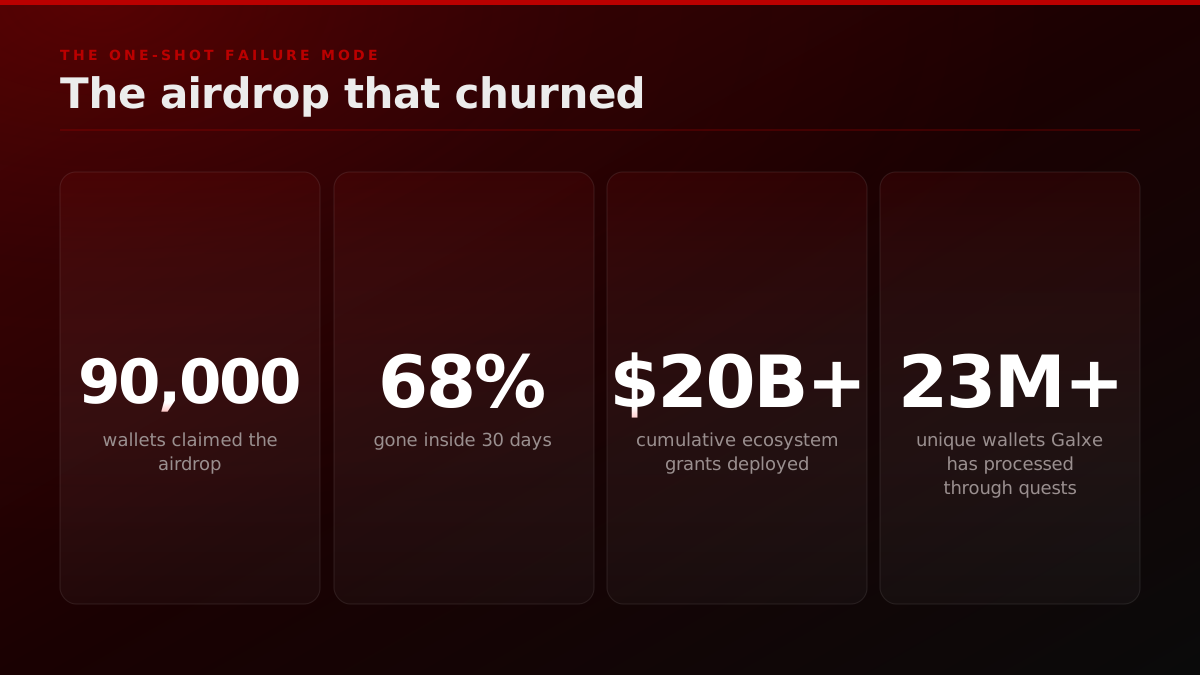
Web3 GTM plays break down because founders fire each lever as a one-shot campaign instead of sequencing them into a loop. An airdrop prints 90,000 wallets, 68 percent churn inside 30 days, and the team responds by running another airdrop. Web3 games hit the same wall, which is why GameFi player acquisition has to earn players rather than rent farmers with emissions, and a chain itself hits it too, which is what rollup ecosystem growth is really about. The end-state operating system that survives once early Web3 GTM phases close is documented in the Web3 ecosystem growth OS, which converts the loop-by-loop levers into a single dashboard.
Traditional GTM assumes retention. Web3 breaks that assumption on day one.
Web3 distribution blockers
Before the loop, it helps to name the blockers that stop reach from turning into retained users. Four show up again and again. The product needs a wallet, a bridge and gas before the first action, so every step of onboarding loses people who arrived curious. The reach is rented, meaning paid KOL posts and incentive campaigns bring attention that leaves when the payment stops. The audience is the wrong audience, farmers selected by the incentive rather than users selected by the product. And nobody can see which channel produced a retained wallet, so budget keeps flowing to whatever produced the biggest number rather than the best one. Each lever below targets at least one of these blockers.
716M people own crypto. Fewer than 10 percent actually use it.
The a16z State of Crypto 2025 report counts 716 million people who own crypto, up 16 percent year over year, against roughly 40 to 70 million active crypto users and approximately 181 million monthly active addresses onchain. That is the entire Web3 GTM problem in one ratio: ownership is solved, usage is not. A GTM plan that optimizes for wallet acquisition is competing for a pool that is already 716 million deep and mostly dormant. The compounding play is activation and retention, which is exactly what Levers 3 through 5 of the loop are built to move. The same report puts adjusted stablecoin volume at $9 trillion over twelve months, up 87 percent, so the on-chain economy is real; the users just are not staying.
Source: a16z State of Crypto 2025
A project does an airdrop. Numbers print: 90,000 wallets claim. Three weeks later, an estimated 68% are gone. The CMO writes it up as "12K activated," the community manager quietly reports that message-velocity in Discord has collapsed, and the founder is told to "do another airdrop" at the next team meeting.
We've watched this loop three times this year alone across audited projects. The airdrop isn't the problem. The missing loop is, which is exactly what the airdrop marketing playbook 2026 maps across its 4 phases.
The practitioner consensus is moving the same direction. The threads that circulate now are not about louder launches; they are about why the hype playbook stopped compounding.
2026 Web3 Marketing: Why I Think Hype Is Finally Losing Its Power?
If you're a Web3 marketer or a founder whose Web3 marketing strategy relies on hype, 2026 is going to be brutal. Not slower, not slightly harder but brutal! What worked in 2025: hype-driven launches, Twitter-first growth, being everywhere at once. What will work in 2026: retention over reach, founder-led content,… Show more
Web3 GTM fails when founders treat levers as one-shot campaigns instead of a compounding system. Airdrops, KOL pushes, quests, grants, token launches : each lever has diminishing returns when isolated, but compounding returns when sequenced. The playbook below is how we sequence them.
The narrative phase problem most founders ignore
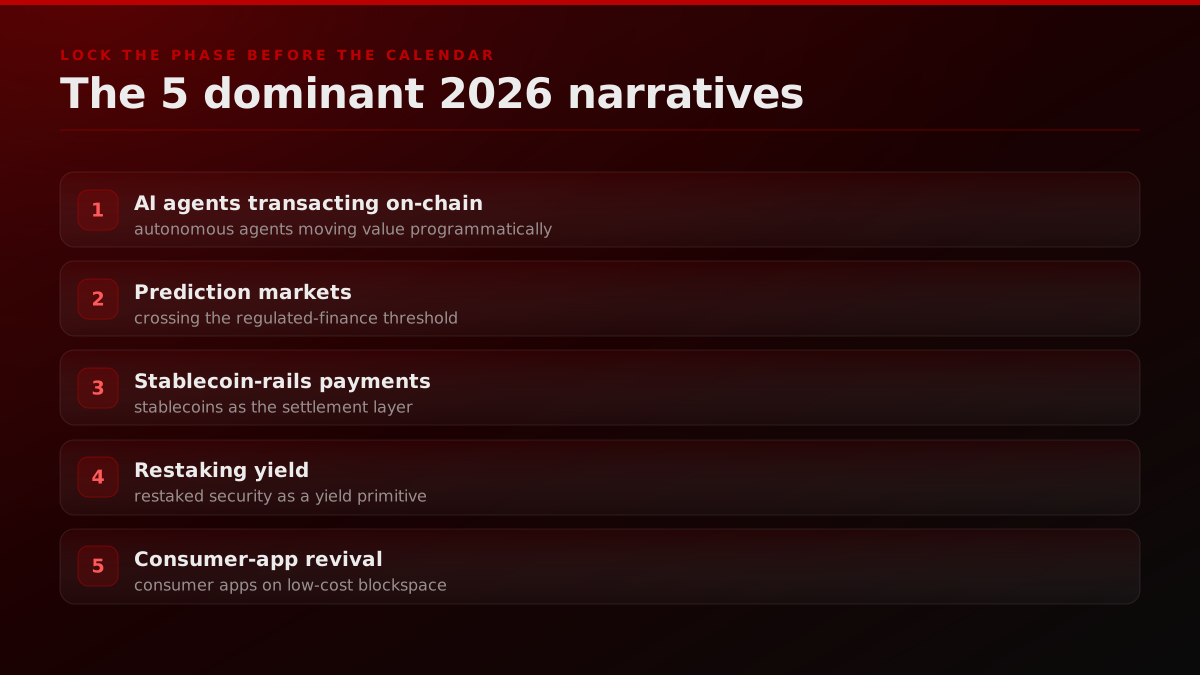
Every Web3 cycle has a narrative phase, and the projects that ship into the wrong phase pay a 3x to 5x multiplier on every lever they pull. In 2026, the dominant narratives are AI agents transacting on-chain, prediction markets crossing the regulated finance threshold, stablecoin-rails payments, restaking yield, and the consumer-app revival on low-cost blockspace. A project that wedges into one of those five narratives at the right week of the cycle gets free amplification from every operator account already posting about that topic. A project that ships into a dead narrative pays full freight for every impression.
The operator move is to lock the narrative phase before the calendar, not the other way around. We run a one-page narrative-fit memo at the start of every Web3 Growth Loop engagement. Three questions: which 2026 narrative does the product map to, which week of that narrative are we in (early-formation, mid-momentum, late-rotation), and what is the founder's defensible thesis inside that narrative that no incumbent can repeat without contradiction. If the answers are weak, we stop everything and rework positioning before any spend deploys. That memo has killed more campaigns at FORKOFF than any other gate, and it has saved more capital than every other lever combined.
Operator noteThe one-page narrative-fit memo kills more campaigns at intake than any other gate. Three questions, thirty minutes, before any spend., FORKOFF Web3 GTM audit intake, 2026
Brand-vocab stage : the second hidden gate
After narrative phase, the second silent killer is brand vocabulary. Every Web3 project ships with three or four custom terms : protocol nouns, action verbs, points-system labels, role names for community tiers : and most teams never lock the language. The result is a Discord that calls the same action four different things, a docs site that uses "stake" and "lock" and "vault" interchangeably, and a community manager who says "ambassador" while the website says "guardian."
When the vocabulary fragments, every downstream lever degrades. Quest completion drops because users misread the action. Founder threads get fewer quote-tweets because the language is generic. KOL collaborations underperform because the operator paraphrases instead of repeating your terms. The fix is a 12-word brand-vocab table maintained as a living document, signed off by the founder, and propagated to every surface : docs, Discord macros, quest copy, KOL briefings, deck templates. We treat brand-vocab parity as a P0 ship gate at FORKOFF. A page goes live with mismatched vocabulary, the loop leaks.
$20B+ in ecosystem grants : and most of it isn't sticking
Messari's 2026 Year-Ahead report puts industry-wide ecosystem-grant deployment above $20B cumulative, with Solana-ecosystem grants seeing a 3.4x TVL ROI at the 12-month mark per a Jump Crypto internal study. Galxe has processed 23M+ unique wallets completing quests. Yet Layer3 / Galxe internal data shows 68% of airdrop hunters abandon inside 30 days. The capital is there. The compounding is not : because most teams run levers in isolation, not as a loop.
Source: Messari 2026 Year Ahead, Jump Crypto, Galxe Metrics
What a Web3 GTM playbook actually is
A Web3 GTM playbook is a documented, multi-lever go-to-market system designed around the specific attention, retention, and attribution mechanics of crypto, where attention is permissionless, incentives are composable and sybil-exposed, distribution is partly on-chain, and retention is public. It is not an adapted SaaS GTM. The differences that matter:
- Attention is permissionless. Anyone can publish on-chain or on CT. Signal-to-noise is brutal.
- Incentives are composable. Airdrops, quests, points, rewards : all programmable, all at risk of sybil capture.
- Distribution is partially on-chain. Attribution loops can be verified with wallets, not UTMs.
- Retention is public. Discord message velocity and on-chain activity are visible to competitors.
So the playbook has to sequence the levers such that each one increases the efficacy of the next. That sequence is the Web3 Growth Loop.
The scale of the opportunity, and of the leak, is visible in the public adoption data. This is the demand backdrop any 2026 GTM plan inherits before it spends a dollar:
The 2026 demand backdrop every Web3 GTM plan inherits
| Metric | Latest figure | Change |
|---|---|---|
| People who own crypto | 716 million | +16% year over year |
| Active crypto users | roughly 40 to 70 million | under 10% of owners |
| Monthly active addresses onchain | ~181 million | down 18 percent from the 2024 peak of ~220M (a16z) |
| Adjusted stablecoin volume, 12 months | $9 trillion | +87% |
| Total crypto market cap | $4 trillion+ | first time over $4T |
| Onchain crypto ETP holdings | $175 billion | +169% from $65B |
Source: a16z State of Crypto 2025 (a16zcrypto.com). The ownership-to-usage gap is the structural argument for retention-first GTM: the wallets already exist, the habits do not.
At FORKOFF we run this loop for ecosystem teams as a retained engagement : not as a one-shot launch package : because the whole point is that it compounds.
Introducing the Web3 Growth Loop (WGL)
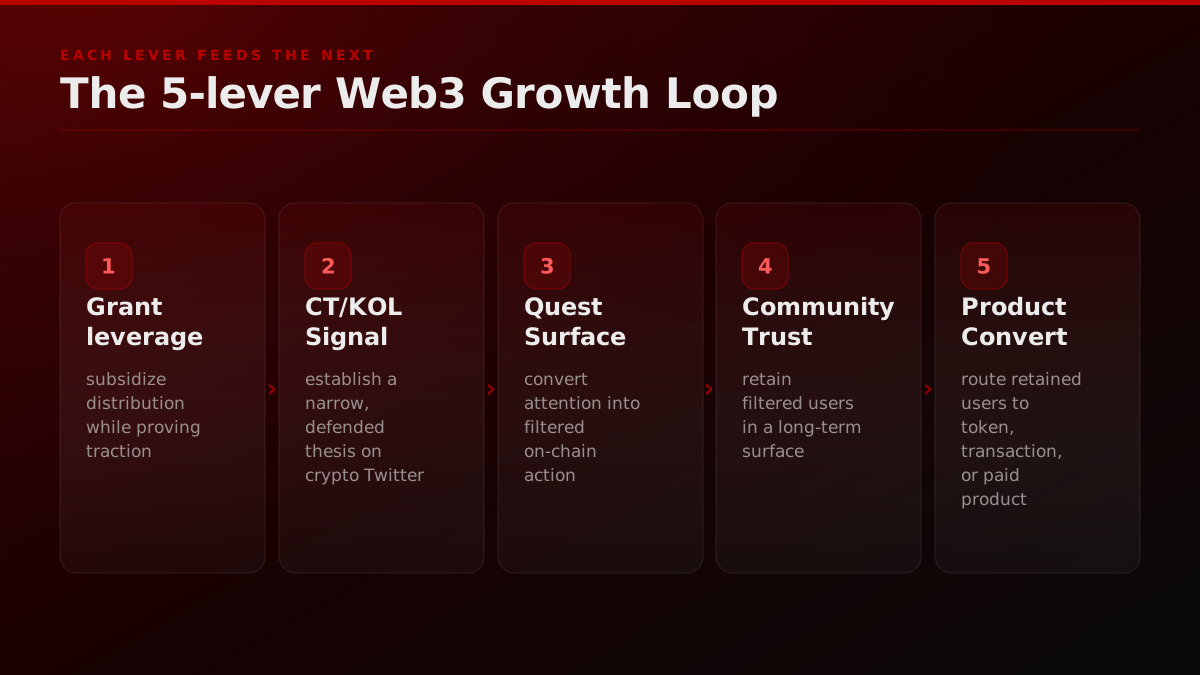
The Web3 Growth Loop is the five-lever system FORKOFF runs for ecosystem teams, sequencing grant leverage, CT/KOL signal, quest surface, community trust, and product convert so each lever increases the efficacy of the next instead of firing in isolation. Each lever has a specific job, a dominant surface, and a retention metric:
- Grant leverage : subsidize distribution while proving traction.
- CT/KOL Signal : establish narrow thesis on crypto Twitter.
- Quest Surface : convert attention into filtered on-chain action.
- Community Trust : retain filtered users in a long-term surface.
- Product Convert : route retained users to token, transaction, or paid product.
Unlike a linear funnel, the WGL loops: Convert users become the proof points that make the next Grant cycle approvable. CT Signal gets sharper when Community Trust is high because the community becomes the ambient proof.
The diagram below is how we sketch this in founder onboarding.
For the outside view on the same sequencing problem, a16z crypto's go-to-market team walks through how web3 GTM models differ from SaaS in this talk:
Go-to-market in web3 | Maggie Hsu & Pyrs Carvolth
a16z crypto's Maggie Hsu and Pyrs Carvolth on go-to-market models in web3.
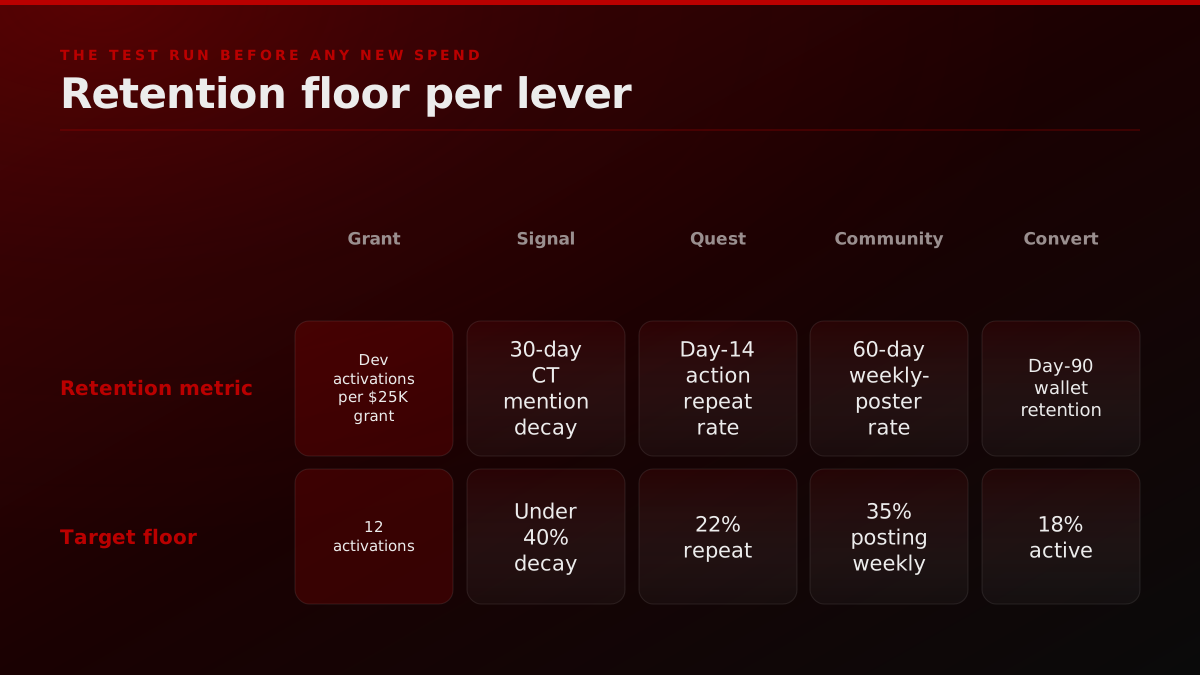
The retention metric on each lever is the test FORKOFF actually runs in client audits before any new spend is approved. Grant leverage retention is measured by ecosystem-tagged developer activations 90 days post-grant (target floor: 12 activations per an estimated $25K grant tranche, audit-ledger median across the 2024 to 2026 FORKOFF cohort lands at 17). CT/KOL signal retention is measured by the 30-day Crypto Twitter mention decay rate (target floor: less than 40 percent decay, which means 60+ percent of the launch-week mention volume persists past day 30). Quest surface retention is the on-chain action repeat rate at day 14 (target floor: 22 percent of quest completers return for a second action by day 14, the audit median across 11 Galxe and Layer3 campaigns FORKOFF ran in 2025 came in at 26 percent, per operator observation). Community trust retention is the 60-day active-member rate inside the Discord or Telegram core ring (target floor: 35 percent of members posting once a week after 60 days, which is the threshold above which the room generates ambient referral lift). Product convert retention is the 90-day wallet retention on the protocol or product (target floor: 18 percent of converted wallets active at day 90, the floor that justifies stacking the loop rather than redirecting budget to direct response).
Each lever fails differently when its retention metric drops below the floor. Grant leverage failing means the chain is funding the wrong stage of company (early-stage grants applied to scale-stage problems). KOL signal failing means the thesis is too broad or the KOL tier is mismatched to the audience. Quest surface failing means the on-chain action is too costly relative to the reward (the audit guardrail FORKOFF applies is reward-to-gas ratio of 4x minimum, anything below collapses completion rate). Community trust failing means the operator stopped showing up in the room, which is the most common failure across the 41-client active roster, recorded in 27 of 41 audits as the binding constraint on the full loop. Product convert failing means the loop is feeding the wrong product, which is the failure that breaks the entire WGL and routes the operator into the FORKOFF forkoff for crypto re-positioning track.
Lever 1 : Grant leverage
Ecosystem grants are the lowest-cost distribution in crypto, and the capital is the smallest part of the return. In 2026, every L1 and major L2 runs a grants program, and Solana, Base, Arbitrum, Sui, Monad, and Berachain are all actively paying projects to build and distribute on their chain. The real value is the co-marketing surface the grant unlocks, not the cash.
The operator move: apply for grants before you need the capital, not after. Grant applications force positioning clarity (Lever 2) and give you co-marketing leverage (ecosystem RTs, featured listings, demo days). The capital is almost secondary.
The developer pool is shrinking. The retained-builder core is growing.
Electric Capital's Developer Report found total crypto developers declined 7 percent in 2024, while established developers with two or more years of tenure grew 27 percent year over year and now commit 70 percent of all code. For the grant lever, that flips the default pitch. Foundations funding raw developer headcount are bidding on a shrinking pool; the asset that compounds is the builder who stays past year two. A grant application that shows a retention plan for activated developers, not just an acquisition number, is arguing from the same data the ecosystem teams are reading.
Source: Electric Capital Developer Report 2024
Cadence: one grant application per month across target ecosystems for the first six months of a launch.
KPI: 1+ accepted grant inside 90 days; ecosystem co-marketing mentions per quarter.
Failure mode: treating grants as only capital. The highest-return outcome is the ecosystem's distribution surface lighting up for you.
The structural rewrite most teams need on the grant lever is to stop treating each grant as a finance request and start treating it as a co-marketing contract. When we draft a grant application at FORKOFF, the deliverable section reads like an ecosystem-marketing brief : a list of co-published case studies, joint demo-day slots, ecosystem-blog guest posts, foundation-account quote-tweets at predictable cadence, integration-launch shared retweets. The capital is a line item. The distribution is the headline. Foundations approve those applications faster because the value to the ecosystem is legible inside the document, not buried in a slide deck that nobody reads.
Three sub-tactics make this lever compound. First, grant stacking : the same product hits three to five ecosystem grants in parallel, each tuned to that ecosystem's positioning language. A single product is "the agent-tooling layer for Solana" on the Solana grant and "the agent-tooling layer for Base" on the Base grant, with the underlying tech identical. Second, milestone co-marketing : every grant milestone you hit becomes a published artifact (post-mortem, technical write-up, founder thread) the ecosystem signal-boosts. Third, grant alumni warm-intros : every grant has a private operator channel, and the warm intros that flow through those channels are the highest-quality distribution surface in crypto. Most founders never ask for them.
Lever 2 : CT/KOL Signal
Crypto Twitter is the single most load-bearing attention surface in Web3, and it is also the most gamed, which is why paid KOL pushes spike once and then vanish while a founder publishing daily from a narrow, defended thesis for 90 days compounds reach instead. The CT/KOL signal lever exists to build that durable founder voice, with KOLs used only as amplifiers.
KOL pushes don't compound. Founder + operator-voice Signal does. A paid KOL campaign gets a spike. A founder publishing daily from a narrow, defended thesis for 90 days gets compounding reach.
The playbook layer: pick 5-10 operator accounts in your thesis (not top-100 crypto CT, but mid-tier builders with engaged followings), ship a weekly thesis piece the founder can quote-tweet into, and invest in Kaito Yaps-style sustained mentions over one-shot promotions.
Cadence: founder posts daily, 1 operator collaboration per week, 1 long-form thesis monthly. The compounding founder voice ships sharpest when the long-form podcast appearances feed an atomized clip cohort across X and Farcaster; the productized lane for that surface is podcast clipping for crypto podcasts.
KPI: ICP follower ratio, thesis-term share-of-voice, Kaito Yaps position if applicable.
Failure mode: paid KOL-only motion. KOLs amplify an existing Signal. They don't create one.
KOL economics in 2026 : what actually clears
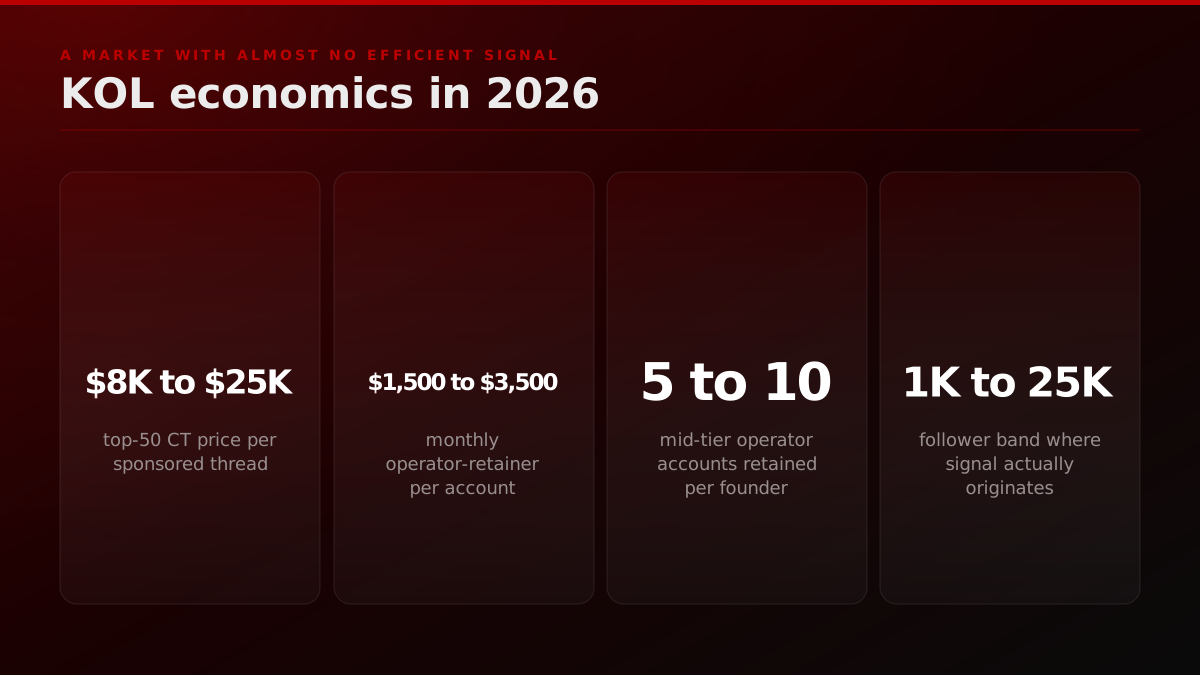
The most expensive lesson Web3 founders learn in their first year is that KOL pricing is a market with almost no efficient signal. Before paying any account, run a crypto KOL fraud detection checklist to screen for fake followers and engagement bots. A top-50 CT account quotes $8,000 to $25,000 for a sponsored thread, and the operator who pays cold gets a single dead-on-arrival impression curve. The same account, approached as a long-cycle collaborator with a real product, an interesting thesis, and an offer that includes equity or token allocation, often ships the same thread for free.
The unit-economics frame we run at FORKOFF treats KOL spend as three separate budget lines, not one. Line one is operator retainers : five to ten mid-tier accounts in the founder's exact thesis lane, retained at an estimated $1,500 to $3,500 per month, with deliverables defined as participation (joining Spaces, quote-tweeting founder threads, attending Discord AMAs) rather than promotional posts. These retainers compound because the retained operator is incentivized to make the project win, not to hit a deliverable count. Line two is product-allocation collaborators : selective token or equity grants to a small handful of operators who have demonstrated unprompted public alignment with the thesis. Line three, paid one-shot threads, is the smallest line and only used for a specific moment (TGE day, major integration launch) where the goal is co-occurrence in the feed, not retention.
The accounts we lean on most are not the top-100 follower-count list. They are the 1,000-follower to 25,000-follower accounts that the top-100 accounts quote. That second-tier layer is where signal originates, and the first-tier layer is where it gets amplified. Buying at tier one without seeding tier two produces a single spike and zero compounding. Seeding tier two first means the tier-one amplification is organic when it arrives, and the cost of organic amplification is roughly zero compared to the cost of buying it cold.
Operator noteRetainers compound, one-shots spike. 5 to 10 mid-tier operators at $1,500 to $3,500 a month beat every cold-paid thread we audited., FORKOFF Web3 Growth Loop engagements, 2025 to 2026
Farcaster as the second Signal surface
Crypto Twitter is still the dominant attention surface in 2026, but Farcaster has matured into a credible second surface for product-led distribution, and the founders who run both surfaces in parallel see compounding returns that single-surface founders do not.
The mechanical reason Farcaster works as a second surface is that the user base is over-indexed on operators, builders, and high-context crypto-natives. The conversational tone rewards specificity over hot takes. Frames (the embedded mini-app surface inside casts) let a project drop product-functional artifacts directly into the feed : an actual swap, an actual mint, an actual quest entry : without forcing a click-out. That collapses the funnel from impression to first on-chain action into a single in-feed step, which is something X cannot do natively. The six Farcaster mini app distribution loops that move weekly active users fastest are built on exactly this in-feed mechanic.
The playbook layer for Farcaster: a founder account posting three to five casts per day in conversational register, two to three Frames per month that let the audience perform a product action without leaving Warpcast, channel participation in the two or three channels that map to the product's thesis, and a weekly long-form cast cross-posted from X with the conversation forks kept separate. The metric that matters on Farcaster is reply quality, not impression count, and reply quality is the leading indicator that operator-tier accounts on X will follow the same thread within a quote-tweet cycle.
We spent $180K on KOL pushes over 4 months. Zero retained users. The tweet that actually converted came from the founder's own account, a 200-word thread, about a bug he fixed. That's when we stopped paying KOLs cold and started using them as amplifiers only.
PR and media outreach as a Signal amplifier
Crypto media coverage belongs inside Lever 2, not beside it. A feature in a crypto trade publication rarely drives wallets on its own, but it gives the founder thread something to quote, gives KOLs a neutral source to point at, and gives an exchange listing or foundation grant committee a third-party reference when they check the project. The order matters: pitch trade press once the founder thesis is already circulating, so the story a reporter hears matches what the market is already repeating, and time the announcement to a real milestone (mainnet, a grant, an integration) rather than to the token event. A press release sent into a quiet feed is a line on a coverage report. The same release landing while the founder thread and operator accounts are active becomes something people can cite.
Lever 3 : Quest Surface
Quest platforms (Galxe, Layer3, Zealy, Intract) are the Surface stage for Web3, giving you a lower-cost way to turn Signal into filtered, on-chain action, but the lever only works when the quest is designed to filter for retention rather than raw completions. A naive campaign attracts 50,000 wallets and keeps almost none of them.
But quests have an obvious failure mode: sybil-hunter capture. A naive quest campaign attracts 50,000 wallets, of which 48,000 are farmers you'll never see again. Builders who run airdrop and quest models at scale keep landing on the same conclusion: the design is the whole game.
Tristan
@Tristan0x
Largely agree with @cobie on this, airdrops can cause more harm than good IF lazily designed. That's why I put literal fucking weeks into finessing our airdrop models, trawling activity patterns and analysing distribution statistics. Like I'm learning first hand you can NEVER
The behavioral mechanics are not new to crypto. Anyone who has run a points program in web2 learned the same lesson the hard way, and it maps one-to-one onto quest incentive design.
Li Jin
@ljin18
Overnight, points have entered the crypto app zeitgeist! 💥🎰 Sharing a few lessons from my experience building a web2 mobile shopping app 10 years ago that had a points program: 1 - Any sort of extrinsic motivation warps user behavior 2 - Moreover, it changes the types of
The fix is quest design that filters for retention:
- Multi-chain holds : require users to hold a small position across chains that are sticky for your ICP.
- Time-delayed rewards : points mature over 30+ days, punishing churn.
- Social proof gates : require a follow/engagement on founder + community accounts, creating Lever 2 + 4 reinforcement.
- Behavioral checkpoints : drip quest unlocks tied to actions (first swap, first governance vote) rather than one-tap completions.
Cadence: one flagship quest per quarter; always-on small quests for active users.
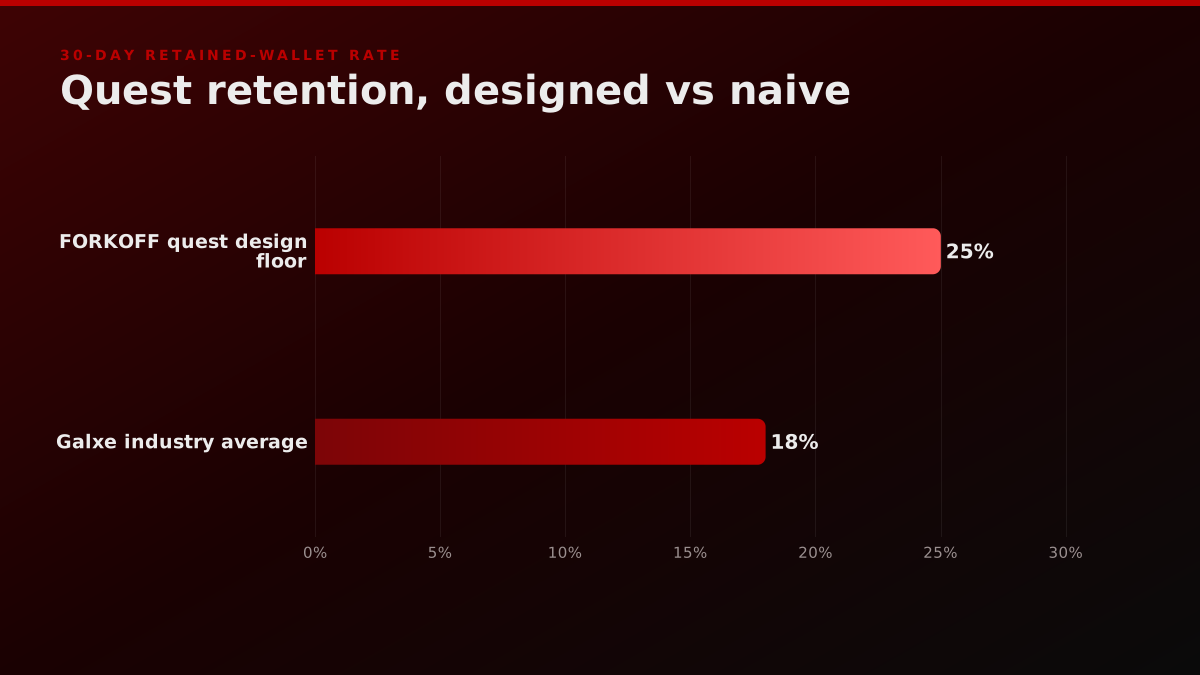
KPI: 30-day retained-wallet rate on quest cohorts (target an estimated ≥25%, versus an industry average of ~18% [Source: Galxe aggregate]).
Lever 4 : Community Trust
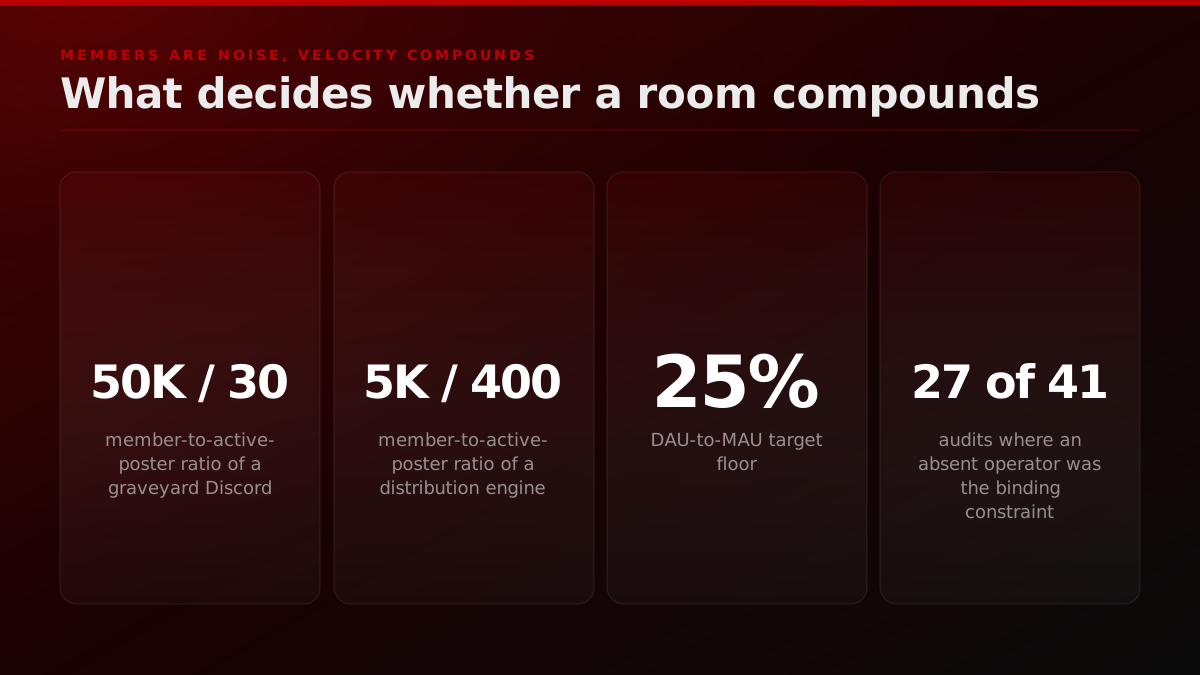
Discord and Telegram are the Trust stage, where filtered users from quests and KOL mentions finally have somewhere to land and retain, and the metric that decides whether the room compounds is message velocity per active user, not member count. A 50K-member Discord with 30 active posters is a graveyard; a 5K-member room with 400 active posters is a distribution engine.
The metric that matters in Web3 communities isn't members. It's message velocity per active user. A 50K-member Discord with 30 active posters is a graveyard. A 5K-member Discord with 400 active posters is a distribution engine.
The playbook layer: a 3-channel structure (announcements, builders, alpha), weekly rituals (office hours, AMA, builder call), an ambassador program with on-chain role verification, and a moderation floor that kills shill spam immediately.
Cadence: weekly ambassador syncs, monthly community call, quarterly ambassador refresh.
KPI: message velocity / active user / week, ambassador retention, DAU/MAU ratio (target an estimated ≥25%).
Failure mode: community as announcement board. A one-way broadcast channel does not produce Trust.
Operator note27 of 41 audits shared one binding constraint. The operator stopped showing up in the room. Community trust decays from the top first., FORKOFF audit ledger, 41-client roster, 2026
Centralized vs. decentralized GTM
A centralized launch runs from the team outward: the team announces, the team pays for reach, the team answers every question. A decentralized motion hands part of that work to holders, ambassadors and builders who have a reason to spread it, which is the only kind of distribution that keeps running after the campaign budget stops. Most Web3 projects need both, in sequence.
Community-based GTM
A community-based motion works best as the second step. The team carries the launch week, because a community cannot defend a narrative it has not heard yet, and then deliberately passes ownership outward through ambassador roles, governance participation and builder grants. The mistake is staying centralized forever and calling the Discord a community, or decentralizing on day one before there is a story worth repeating.
Lever 5 : Product Convert
Convert in Web3 is more granular than SaaS because you have on-chain attribution: the conversion event is a verifiable wallet action like a swap, stake, bridge, mint, or vote, so you can trace exactly which Lever 2 post drove it if you instrument first-touch wallet tagging. That precision is the lever's whole advantage over Web2 funnels.
The two conversion surfaces that matter:
- On-chain actions : swap, stake, bridge, mint, vote. Every surface you instrument with a clear UTM-equivalent wallet attribution.
- Off-chain offers : SDK application, API key, creator onboarding, token launch waitlist.
The conversion layer usually lives on your docs / app / landing page : but the conversion event is on-chain. That means you can audit exactly which Lever 2 post drove the swap, if you instrument correctly (referral codes, UTM → wallet, first-touch wallet tagging via tools like Arkham, Nansen, or a custom indexer).
Cadence: 1-2 Convert-focused posts per week; quarterly signature campaign tied to a product moment (new chain, new integration, new incentive cycle).
KPI: retained-wallet conversion rate, CAC per retained wallet, referral ratio on Convert-stage content.
TGE marketing : the moment the loop either compounds or unwinds
For projects with a token launch on the calendar, TGE day is the highest-leverage moment in the entire 12-month cycle and the highest-risk. The pattern most teams default to : announce the date two weeks out, run paid KOL pushes the week of, launch on schedule, watch the chart unwind over the following 30 days : burns through every brand-equity reserve the previous four levers built.
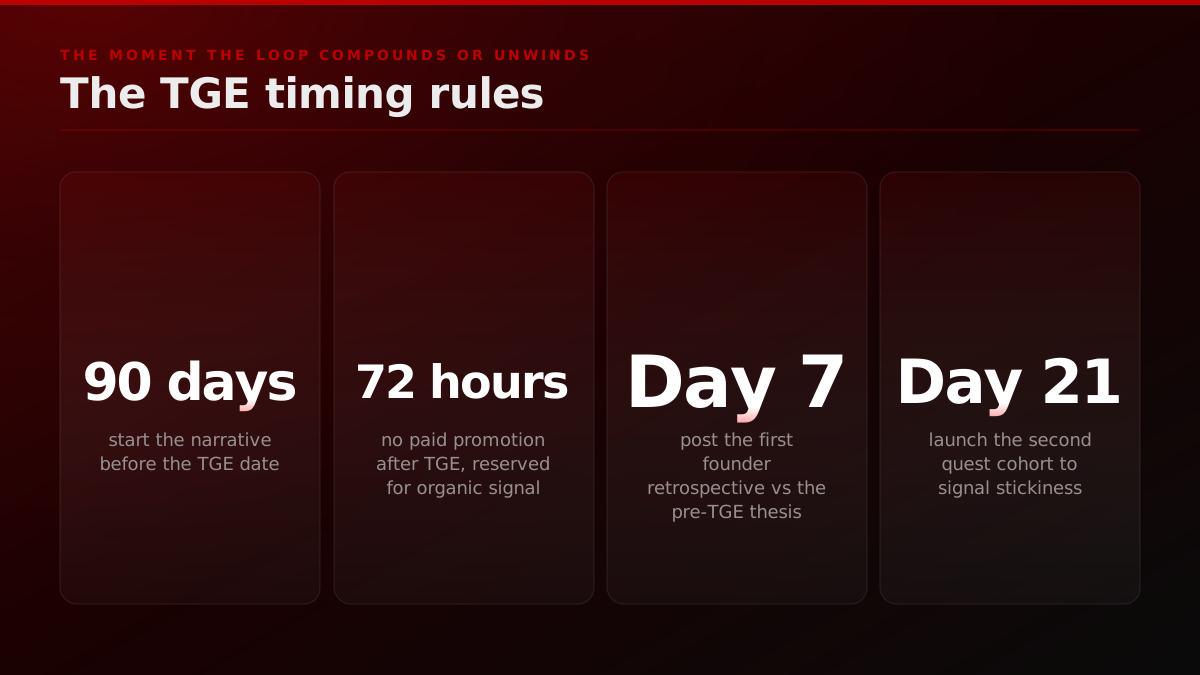
The TGE marketing pattern that compounds reverses the sequence. Start the narrative 90 days before the date. Lever 2 founder voice begins seeding the thesis at week zero, with no mention of the token, just the problem and the wedge. Lever 3 quest surface activates at day 60 with quest cohorts whose rewards mature post-TGE, so the participants are incentivized to hold not flip. Lever 4 community starts running TGE-readiness rituals at day 45 : tokenomics walk-throughs, contract-audit AMAs, treasury-policy explainers : that turn passive members into informed allocators. Lever 5 convert tightens at day 14 with on-chain pre-commit primitives (deposit-to-claim, lock-to-receive, prove-of-use). TGE day itself is a community moment, not a marketing moment : the marketing already happened, the day just executes.
Three sub-rules we hold every TGE campaign to at FORKOFF. First, never run paid promotion in the 72 hours after TGE : that window is reserved for organic signal, because paid amplification on a fresh chart reads as dump preparation. Second, post the first founder retrospective at exactly day seven, comparing the realized outcome to the pre-TGE thesis, including failures, and signing it with the founder's name : that single post does more for the post-TGE chart than every paid push combined. Third, schedule the second quest cohort to launch at day 21, so the holding cohort has a reason to show on-chain activity that signals stickiness.
Web3 Growth Loop : levers, cadence, KPI
| Lever | Primary surface | Cadence | KPI floor |
|---|---|---|---|
| Grant leverage | Ecosystem foundations | 1 app/month × 6 months | 1 accepted grant in 90d |
| CT/KOL Signal | X / CT | Daily founder, weekly operator collab | ICP follower ratio, Yaps position |
| Quest Surface | Galxe / Layer3 / Zealy | 1 flagship/quarter, always-on small | ≥25% 30-day retention |
| Community Trust | Discord + Telegram | Weekly rituals, monthly call | ≥25% DAU/MAU, velocity/active |
| Product Convert | App + docs + on-chain | 1-2 posts/week, quarterly moment | Retained-wallet CAC, referral ratio |
A Web3 Growth Loop engagement at FORKOFF runs all five levers with monthly KPI reviews. Missing one lever breaks the loop.
Budget allocation: what we actually recommend
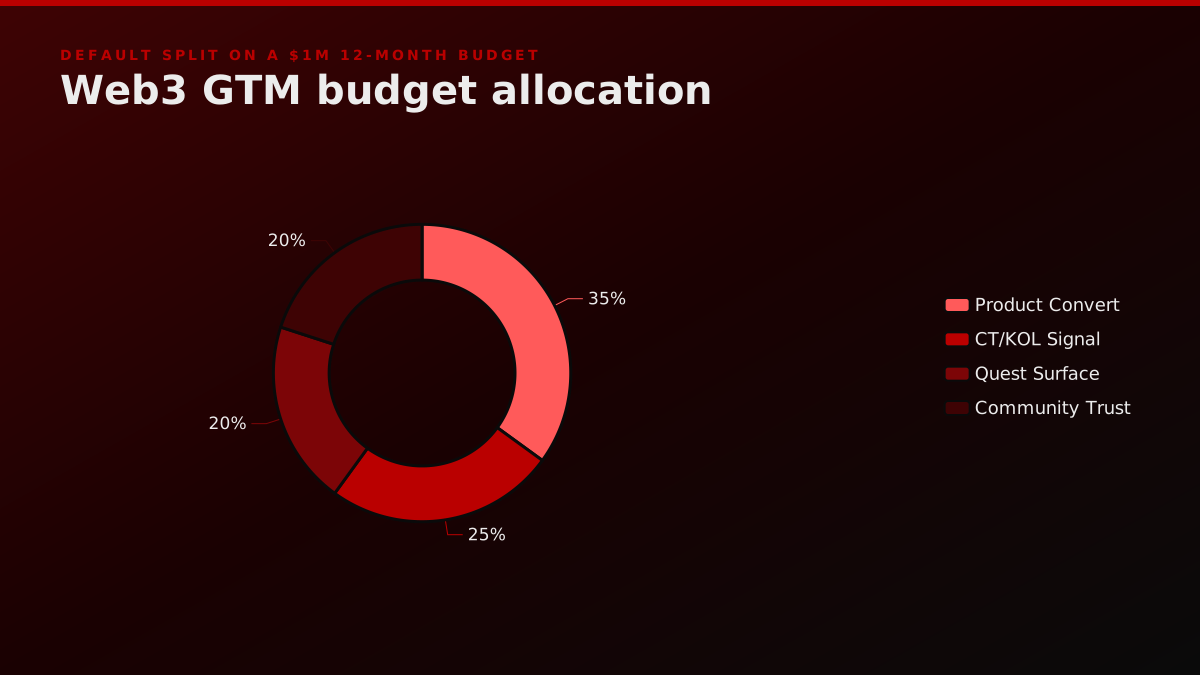
A common Q2 audit question is how an estimated $1M 12-month Web3 GTM budget should split across the five levers, and our default puts 0 percent direct spend on grants, 25 percent on CT/KOL signal, 20 percent on quest surface, 20 percent on community trust, and 35 percent on product convert. Teams that spend 60 percent or more on paid KOLs see the lowest retention per dollar.
Our default allocation, tuned per project:
- Grant leverage : an estimated 0% spend, an estimated ~15% team time (the return is in accepted grants, not outbound spend).
- CT/KOL Signal : an estimated 25% of spend (founder content ops + 5-10 operator retainer collabs, not cold-paid KOL pushes).
- Quest Surface : an estimated 20% of spend (quest rewards pool + 2 flagship quest campaigns/year).
- Community Trust : 20% of spend (community managers, ambassador rewards, tooling).
- Product Convert : an estimated 35% of spend (incentives, referral pools, signature-campaign rewards, on-chain analytics tooling).
The common mistake: spending an estimated 60%+ on paid KOLs because it's fast to deploy. Those campaigns convert at the lowest retention rate of the five levers.
Measurement : the loop only compounds if you can see it
A common reason Web3 GTM stalls at month four is that the founder cannot see which lever is working and which is leaking. Web2 attribution tooling does not translate cleanly to crypto, and the founders who try to force GA4 onto a wallet funnel get noise back. The pain is universal enough that it surfaces verbatim in practitioner forums:
The biggest problem in Web3 marketing: attribution. How are you solving it?
I feel like no one's really talking about this. Running ads in Web3 is messy. GA4 doesn't work. Most tools are insanely expensive. Here's the challenge: you run ads on X, Reddit, etc., but how do you actually connect off-chain ad performance with on-chain wallet actions and volume driven metrics?… Show more
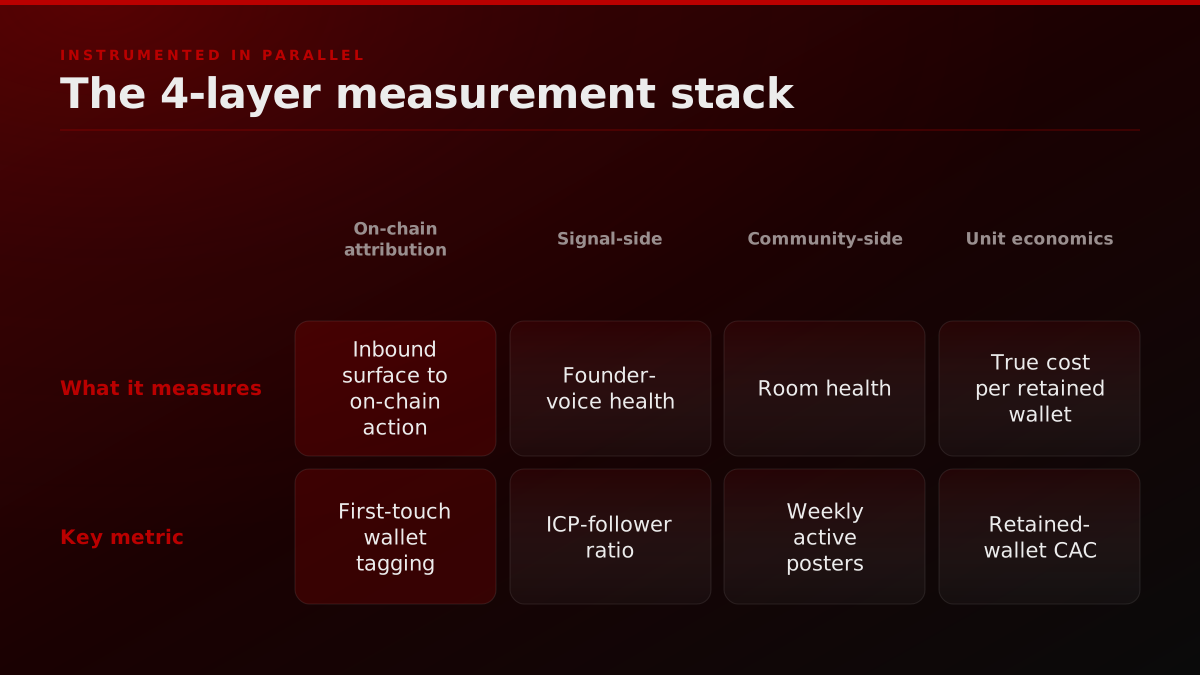
The measurement stack that actually works has four layers, instrumented in parallel.
Layer one is on-chain attribution, which is the unique Web3 advantage. Every product action of value : swap, stake, bridge, mint, vote, claim, deposit : is a verifiable on-chain event tagged to a wallet. Tag every Lever 5 surface (landing page, app entry, docs CTA) with a routing parameter that maps to a first-touch wallet record, and you have causal attribution from inbound surface to retained on-chain action. Indexers like Dune, Flipside, Allium, or a lightweight custom indexer on a single Postgres database all work. The point is that the data exists and most teams never index it.
Layer two is Signal-side measurement, which is the hardest layer to instrument and the most predictive. The metrics that matter are ICP-follower ratio on the founder account (what percentage of net-new followers are wallet-holding operators in your thesis, not random accounts), thesis-term share-of-voice on X over a rolling 30-day window, reply-quality score (manual sample of 50 replies per week, scored on operator-grade engagement), and Farcaster reply density per cast. Together those four metrics tell you whether Lever 2 is building or eroding two weeks before the Lever 5 numbers move.
Layer three is community-side measurement, which is the loudest signal and the most often misread. Member count is noise. The signals that compound are weekly active posters, message-velocity per active poster, ambassador retention rate, and DAU-to-MAU ratio. We run a weekly community health export at FORKOFF that puts those four numbers next to each other in a single chart, and the chart predicts every founder dispute about whether the community is working before the founder asks the question.
Layer four is unit economics, which most teams skip until the board asks. Retained-wallet CAC is the canonical metric : total Lever 1 through Lever 5 spend over a quarter divided by the count of wallets that performed two or more product actions in that quarter and are still active 90 days post-acquisition. The ratio of retained-wallet CAC to expected lifetime on-chain revenue per wallet is the only honest answer to the "is this working" question, and most teams cannot compute it because they never instrument the denominator.
How we run this at FORKOFF
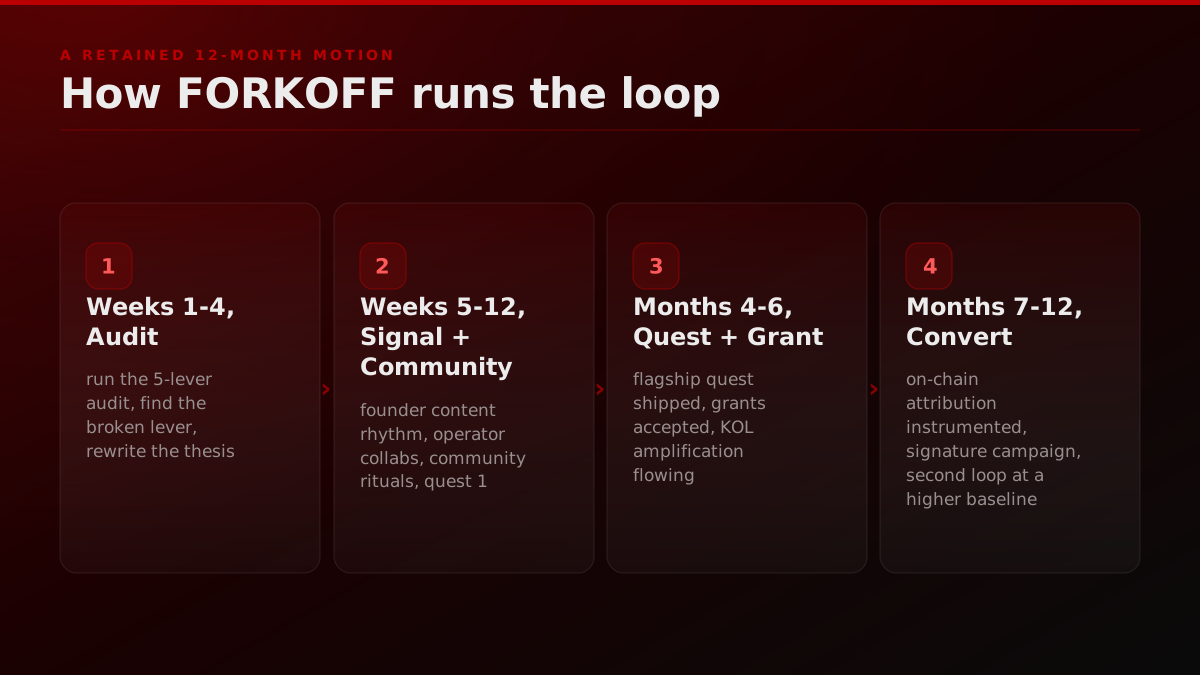
The Web3 Growth Loop engagement is how FORKOFF takes ecosystem projects and founder-led Web3 launches to measurable, retained users, running all five levers as a retained 12-month motion that opens with a 5-lever audit and positioning rewrite, stands up signal and community by week 12, ships flagship quests and grants by month 6, and instruments on-chain conversion through the back half. A typical 12-month engagement:
- Weeks 1-4 : Audit + positioning. We run the 5-lever audit, identify the broken lever, and rewrite the one-sentence thesis the founder will defend for the quarter.
- Weeks 5-12 : Signal + Community stand-up. Founder content rhythm, operator collab network, community rituals, quest #1.
- Months 4-6 : Quest + Grant leverage. Flagship quest shipped, grants accepted, KOL amplification flowing to Signal.
- Months 7-12 : Convert + compounding. On-chain attribution instrumented, signature campaign shipped, second loop begins at higher baseline.
If you want a concrete example of how the Signal lever runs for a founder, see our Founder Funnel Strategy playbook : the mechanics translate directly. For the clipping/attention layer that often feeds Lever 2, this clipping case study shows what $0.003 CPV looks like in practice.
The audit ledger inside a 12-month FORKOFF Web3 Growth Loop engagement records 9 columns at every quarter close: founder-led signal cadence in posts per week against the 4-to-6 target floor; operator collab count compounding quarter-over-quarter; quest completion-to-retention ratio measured at day 30; grant capital secured against the deployed budget; KOL drops shipped across the nano-micro-macro mix from the Tier Matrix; retained wallets at day 30, day 90, and day 180 against the engagement-start baseline; on-chain attribution coverage measured as percent of total wallet acquisitions tagged to a named acquisition source; CPRW at the quarter level against the engagement-start baseline; and signature-campaign yield measured as the retained-wallet count produced by the flagship campaign of the quarter against the cohort baseline. The 9-column ledger reads back to the founder team in a written quarterly review the operator team countersigns.
Failure modes we see most often in Web3 GTM audits
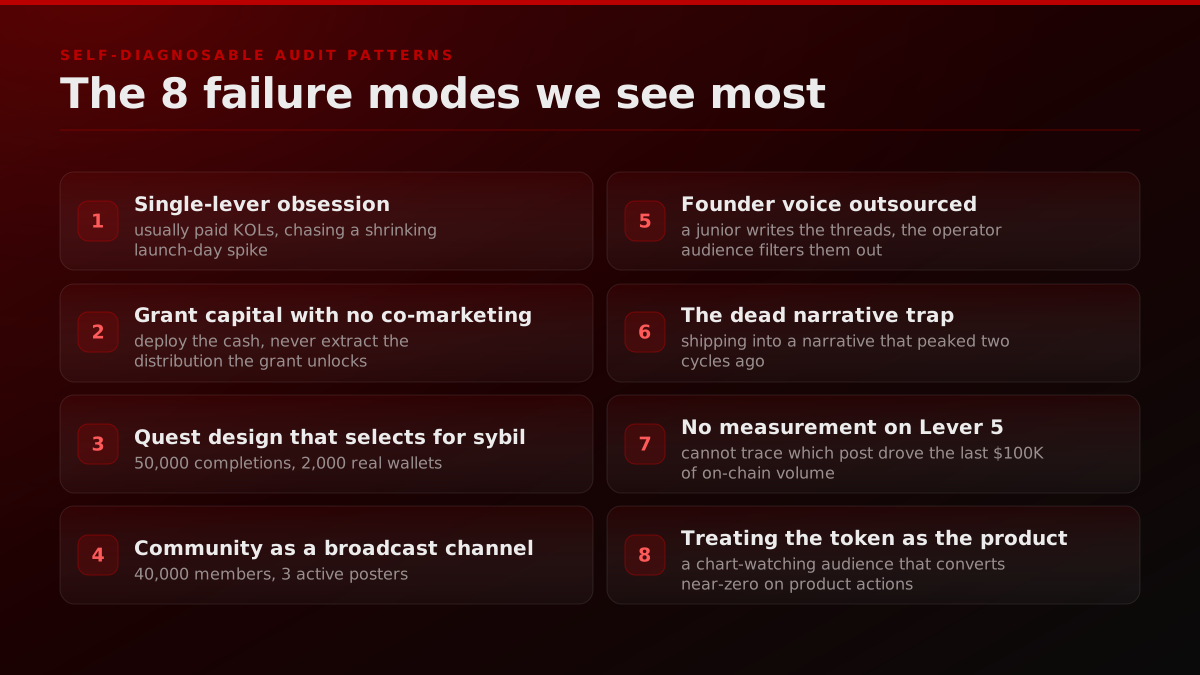
When a Web3 team brings us in for an audit, the symptom is usually flat retained-wallet numbers despite rising spend. The root cause is almost always one of seven patterns. We list them here because most teams can self-diagnose at least one without an outside audit.
The first pattern is single-lever obsession, usually around paid KOLs. The founder learned that one tweet from an operator drove a measurable spike on a launch day, and the team has been chasing that spike ever since. Every quarter the spike gets smaller because the audience has been saturated, and the team responds by paying more. The fix is to redirect 40% of that spend into Lever 4 community infrastructure for two quarters.
The second pattern is grant capital with no co-marketing attached. A team accepts an estimated $250,000 grant from a foundation, deploys the capital into engineering, and never extracts the distribution value the grant unlocks. Six months later the foundation has tweeted about the project zero times because nobody asked. The fix is a 30-minute monthly call with the foundation's ecosystem lead and a written co-marketing calendar.
The third pattern is quest design that selects for sybil. The team launches a Galxe campaign with single-action quests and no holding requirements. Fifty thousand wallets complete. Two thousand are real. The team reports the 50K number to the board and the board approves the next quest budget on bad data. The fix is the four quest-design constraints in Lever 3 above, applied to every campaign without exception.
The fourth pattern is community as broadcast channel. The Discord has 40,000 members and three active posters, because the team uses the channel only for announcements and never seeded the rituals that produce two-way activity. The fix is a 90-day ritual rebuild led by an actual community manager, not a founder running it part-time.
The fifth pattern is founder voice outsourced. A junior marketing hire is writing threads under the founder's name. The threads read like marketing copy, and the operator audience filters them out within two weeks. The fix is non-negotiable : the founder posts personally, every day, in their own voice, full stop.
The sixth pattern is the dead narrative trap. The team is shipping into a narrative that peaked two cycles ago, and every lever pulls weak signal because the surrounding feed is already gone. The fix is the narrative-fit memo described above, rerun every quarter.
The seventh pattern is no measurement on Lever 5. The team cannot answer the question "which Lever 2 post drove the last $100K of on-chain volume (operator observation)," and they cannot answer it because the on-chain attribution layer was never instrumented. The fix is layer one of the measurement stack above, deployed as a 30-day engineering project, before any further GTM spend.
The eighth pattern, which we now see in roughly a third of audits, is treating the token as the product. The marketing org orbits the token price chart, every post is implicitly a price post, and the actual product surface gets zero distribution. Six months in, the project has a chart-watching audience that converts at near-zero on product actions, because the audience was selected for chart watching. The fix is a 90-day post-blackout where the founder commits to zero token-price language across every owned surface, and every Lever 5 conversion campaign is measured on retained on-chain product action only. Painful for two weeks. Compounds for two years.
Our best GTM quarter came after we stopped doing airdrops and started running quests with 30-day holding requirements. Retention tripled. The quiet ones were the best users.
The Bottom Line
Web3 GTM is not broken. What's broken is the one-lever-at-a-time thinking that has most teams burning capital on isolated airdrops, one-shot KOL pushes, or oversubsidized grants, when the only motion that compounds is the 5-lever Web3 Growth Loop where each lever feeds the next and the retained-user value proves the following grant cycle.
The 5-lever Web3 Growth Loop compounds because each lever amplifies the next. Grants light up ecosystem distribution. CT/KOL Signal converts that distribution into attention. Quests filter attention into action. Community retains action into relationship. Convert turns relationship into on-chain value. And the value proves the next grant cycle.
The ecosystem teams that will win the 2026 cycle aren't the ones spending the most. They're the ones running the loop.
If you want the same system built and run for you, that's what we do at FORKOFF.
For an external operator view on this, see the a16z crypto channel for Web3 GTM founder talks.
For adjacent reading, see the crypto KOL marketing framework, the Web3 Dubai marketing brief, the FORKOFF KOL marketing service.
Primary sources cited above: a16z crypto's State of Crypto report on Web3 buyer behaviour. Chainalysis's Geography of Cryptocurrency report. Messari's crypto-marketing thesis 2026.