A UGC ad campaign is a paid social campaign built from user-generated-style video, real people talking to camera, run as a system rather than a single hero clip. Running one well is not a production problem, it is an operating problem: the brief, the creator pipeline, usage rights, hook testing, paid amplification, and attribution back to signups all have to work together. Funded startups stall because they commission one beautiful video and skip the system underneath it. This post is the operator playbook for the whole thing.
TL;DR
Running a UGC ad campaign is a system, not a single video. The teams that win treat it as six linked stages: a tight brief, sourcing creators at volume, clearing usage rights, testing hooks in paid and killing losers fast, amplifying the winning cut across accounts, and attributing spend to signups rather than views. Funded startups stall because they buy one polished hero video and skip the pipeline underneath it. This playbook walks each stage, with the brief as the highest-leverage document and attribution to qualified pipeline as the only scoreboard that pays rent.
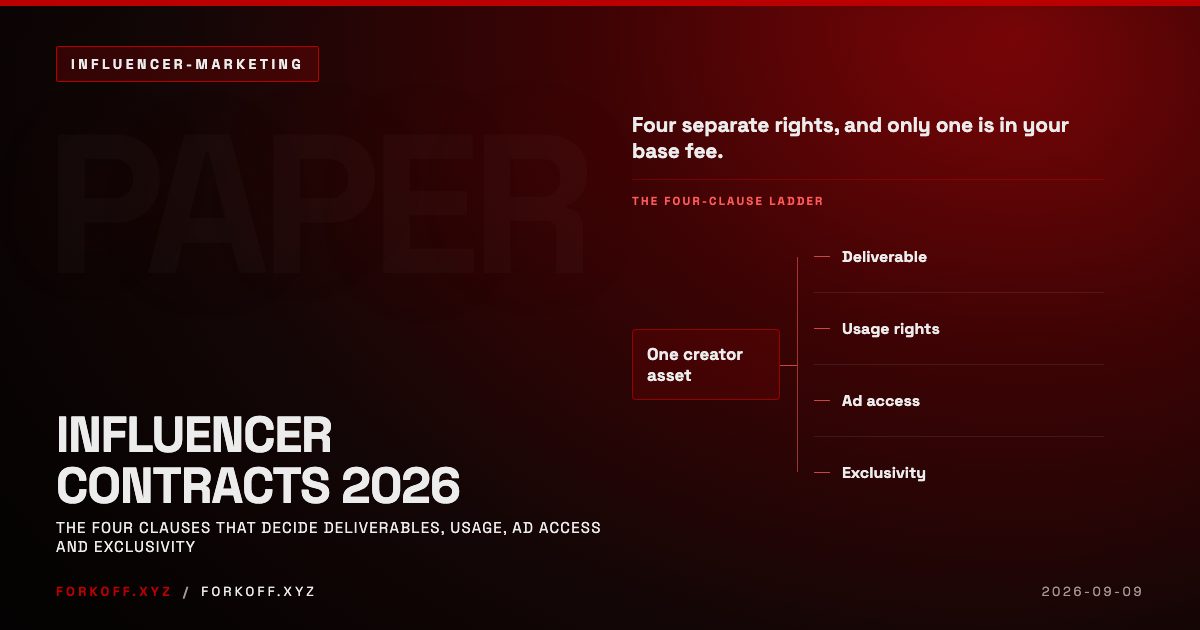
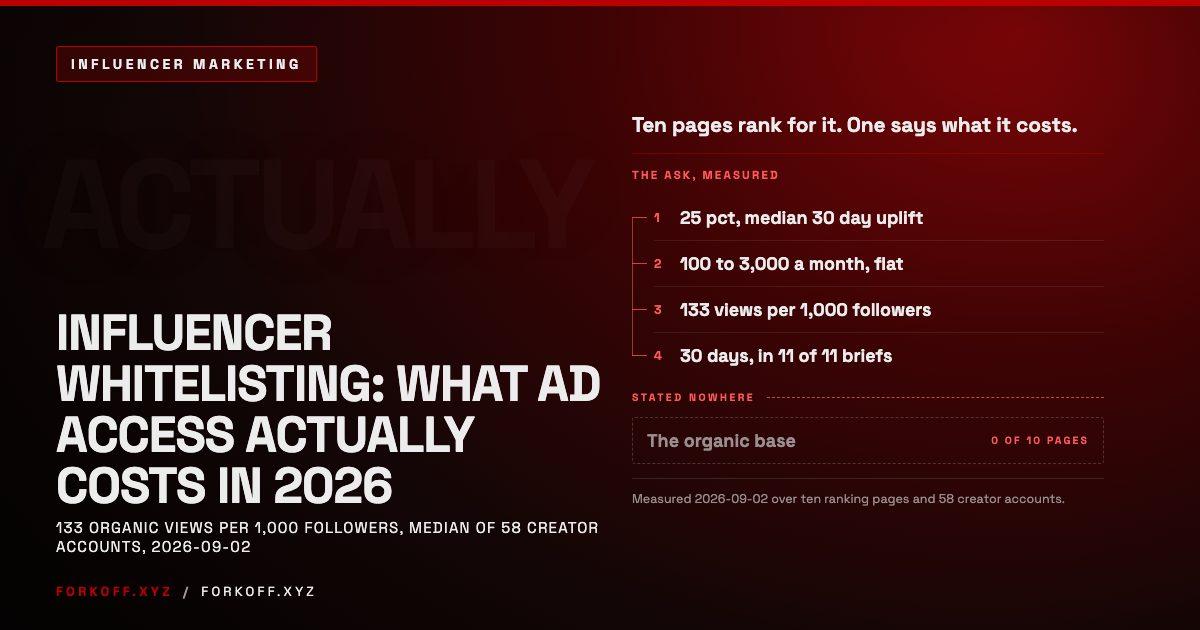
A UGC ad campaign, part of creator and influencer marketing, is won or lost across six stages: the brief, sourcing creators at volume, clearing usage rights, testing hooks in paid, amplifying the winner, and attributing spend to signups. Usage rights and ad access are not the same purchase, and the second one is where the money goes: what whitelisting actually costs prices the window rather than the post. The sections below define what a UGC campaign actually is, why funded teams get it wrong, then walk each of the six stages in order, cover what a campaign costs, compare running it in-house versus with a managed pipeline, address the 2026 shift to AI-assisted UGC, and close with how FORKOFF runs the engine. It pairs with the clipping distribution half of a three-ring SaaS product launch distribution model.
About this guidance
This post draws on FORKOFF first-party operator experience running creator and distribution campaigns, plus publicly cited practitioner commentary from operators on X and Reddit and the production-focused guides that rank for these terms. Numbers framed as ranges, splits, or thresholds are directional and typical rather than benchmarks, and any figure attributed to an operator is their reported number, not an independently audited one. The one hard figure asserted as fact is that FORKOFF's clipping network has processed 5B+ views. Individual outcomes vary by product, audience, and offer.
What running a UGC ad campaign actually means
A UGC ad campaign is paid social creative built from user-generated-style video instead of polished studio production. The format is a real person talking to camera about a product, shot on a phone, paced for a feed, and the reason brands run it is simple: on feed platforms, content that looks like a person beats content that looks like an ad. That is the whole thesis behind influencer and creator marketing as a paid channel.
The mistake is thinking the campaign is the video. It is not. The video is one output of a system with six stages: write the brief, source the creators, clear the rights, test the creative, amplify the winner, and attribute the result. Skip any stage and the campaign underperforms in a way that looks like a creative problem but is actually a process problem. Most teams execute stage one, produce a video, and then wonder why it did not work.

Definitional guides get you this far and stop. The Coursera UGC campaigns explainer, the Hootsuite user-generated content guide, and Greenfly's UGC campaign examples are good on what UGC is and why it works. Digital Marketing Institute's UGC examples and a step-by-step guide to creating a UGC campaign are good on inspiration and process, and even an academic primer on using UGC to grow social media covers the basics. The vendor how-tos get closer: a walkthrough on how to create a successful UGC campaign covers tips and tricks, and a step-by-step guide to UGC-style ads covers paid creative. But every one of them stops at production. None runs sourcing, rights, testing, amplification, and attribution as one connected system. This playbook does, starting with why funded teams, who can afford anything, so often get the worst result.
Why funded startups get UGC wrong (the deliverable gap)
Funding buys production capacity, and a good in-house team buys production quality, but neither buys campaign performance, because performance is not a production output. It is a system output. A well-funded team defaults to what it knows how to buy: a polished asset. So it commissions one hero video, runs it, and treats the campaign as done. The video is often excellent. The campaign still stalls, because a single asset has nowhere to go and nothing to test against.
The most expensive version of this lesson gets documented in public constantly. One operator broke down 84,000 dollars of spend over three months on award-winning cinematography that returned a 0.7 percent click-through rate and a cost per acquisition nearly double the target. The creative was not bad. It was expensive, and nobody stopped scrolling. That is the deliverable trap in one line: a beautiful ad and a working ad are different objects, and production budget buys the first, not the second.
Production Value Is Not Performance
The most expensive lesson in paid social is that a beautiful ad and a working ad are different objects. One operator documented 84,000 dollars spent over three months on award-winning cinematography that returned a 0.7 percent click-through rate, because nobody stopped scrolling. Native, user-generated-style creative wins on feed platforms not despite looking unpolished but because looking unpolished is what reads as trustworthy in a feed of real people.
Source: Operator commentary, r/dropshipping
I tested 10,000+ Meta ads to find which creative elements actually drive results. 93% of brands are ignoring most of them
The system path looks different from the first dollar. Instead of one hero, it funds a brief, a bench of creators, and a batch of native variations built to be tested against each other. The two paths diverge the moment the budget is set, so it helps to see them side by side.
The Deliverable Path vs The System Path
| Dimension | Deliverable path (why funded teams stall) | System path (how operators win) |
|---|---|---|
| What gets bought | One polished hero video | A brief, a creator bench, a batch of native cuts |
| Number of creatives | 1 to 2 | 8 to 20 variations per test round |
| Who sources creators | A one-off hire for this campaign | A standing pipeline with a vetted bench |
| Usage rights | Often unconfirmed until after the shoot | Cleared in the brief, before filming |
| How it is tested | Post and hope | Hooks tested in paid, losers killed fast |
| The scoreboard | Views and likes | Signups and cost per acquisition |
| Typical outcome | One expensive video that stalls | A repeatable creative engine that compounds |
Illustrative comparison of the two common approaches, not a benchmark. Outcomes vary by product, audience, and offer.

This is the same pattern FORKOFF has written about across launches: single events decay, systems compound. The launch video distribution gap is the same failure mode in a different channel, and the fix is the same, fund the system, not just the asset. The rest of this playbook is the system, stage by stage.
Stage 1: Write the brief (the highest-leverage document)
The brief is where a UGC campaign is actually won. Every creator you hire reads it, so a tight brief compounds across your entire batch and a vague one multiplies your problems by the number of creators you booked. Experienced operators treat briefing as the core skill of the whole discipline, ahead of editing, ahead of media buying.
A strong brief names one audience, one core problem, and one call to action, then gets specific about the parts creators actually get wrong: the hook in the first three seconds, the talking points in order, a do-not-say list, the required shots, the aspect ratio, the runtime, and the usage rights. It reads like a text to a friend, not a landing page. When a UGC ad fails, it is usually because the brief let the creator write ad copy instead of talking like a person.

The Brief Is The Highest-Leverage Document
Experienced UGC operators treat the brief, not the edit, as the place a campaign is won or lost. A vague brief returns unusable footage and a dozen revision rounds. A brief that names one audience, one problem, one hook, and a do-not-say list returns creative you can actually run. This is why the creators who scale ads teach briefing as the core skill, and why a strong brief compounds across every creator you hand it to.
Source: Nick Theriot, how to brief UGC creators
Walk the brief element by element, because each one prevents a specific failure. The audience line stops the creator from talking to everyone and reaching no one. The problem line keeps the video anchored to a real pain rather than a feature tour. The hook line, the single most important, specifies the first three seconds word for word, because that is the window the platform uses to decide whether to show the video at all. The talking points give order without a rigid script, so the creator sounds like a person. The do-not-say list kills the compliance risks and the off-brand phrasing before they happen. The shot list and the aspect ratio make the footage usable in the edit. The rights line, covered next, decides whether you can run it as paid at all. Miss any one line and you pay for it in revisions or in a clip you cannot use.
The failure modes are predictable enough to check for. One creator listed the tells that a UGC ad still feels like an ad: too polished with zero personality, a hook that sells instead of relates, a creator who does not match the audience, and copy written like a landing page. Every one of those is a brief problem, which is good news, because it means they are all fixable upstream for free, before you spend a dollar on paid. A useful discipline is to write three different hooks into every brief and ask the creator to film all three, so the test starts inside a single shoot rather than waiting for a second booking.
Operator noteThe tightest brief wins. One audience, one problem, one hook, one CTA, and a do-not-say list beat a budget increase for usable footage.
How to Brief UGC Creators to get ADS THAT SCALE! *UPDATED 2025 METHOD*
Nick Theriot
Nick Theriot on briefing UGC creators to get ads that scale. The title names the real lever: the brief, not the shoot, is where the campaign is won.
Stage 2: Source creators at volume (build a bench)
The second stage is where most founders feel the pain directly. Finding the right creator is hard, and finding a new one for every campaign is a tax you pay over and over. The operators who scale solve this once by building a bench: a standing roster of vetted creators they can brief repeatedly, so sourcing becomes a pipeline instead of a scramble.
Source from four places at once: creator marketplaces, platform search on TikTok and Instagram by hashtag and audio, your own customers who already like the product, and inbound applications from a public brief. Match on niche fit, audience overlap, past brand work, and native style, not follower count, because for paid UGC the creator is a performer, not a distribution channel. Their job is to make the ad, your paid budget does the distributing.

Vet each creator against a short, consistent checklist before they join the bench. Watch three of their recent brand videos with the sound on and ask whether you would stop scrolling. Check that their organic content matches the register you need, since a creator whose own posts feel like a person will make an ad that feels like a person. Confirm they can hit a deadline by starting with one paid test video before a bigger commitment. Note their turnaround time and how they take direction on the first revision, because a creator who argues the brief on video one becomes expensive by video five. The red flags are the mirror of that: an all-polished feed with no personality, a follower count that dwarfs their engagement, and a portfolio of ads that all sound like the same script.
The matching problem is real enough that founders are building tools to solve it. One posted on r/SideProject about an AI agent that searches the market and matches creators by content, niche, style, audience fit, and past brand work, exactly the criteria a good sourcing pipeline uses by hand. Whether you automate it or run it manually, the principle holds: a bench you can rebrief beats a one-off hire every single time. The goal is to always have three to five vetted creators you can hand a new brief to this week, so a campaign never waits on sourcing from zero.
A Creative Pipeline Beats A One-Off Video
At real ad spend, single videos fatigue faster than a team can replace them, so the operators who scale build a pipeline instead of commissioning one hero. A standing bench of vetted creators plus clear briefs turns creative from a project into a supply chain. The unit of work stops being the video and becomes the system that produces a fresh batch of tested variations every week.
Source: Clay, nine-figure founder, on X
Clay
@clayyroy
Going from $1M to $10M months. Here's exactly what changed: Creative: 20-30 tests a month works at $1M/month. At multiple Ms of spend per month, the winners fatigue before you can replace them. Build a proper creative pipeline: a strong UGC creator network, clear briefs,
This is also the cleanest place to decide between running it yourself and using a managed creator and influencer marketing pipeline, because a bench is exactly what an agency maintains between campaigns and an in-house team usually rebuilds from scratch each time. More on that split below.
Stage 3: Lock usage rights and whitelisting
This stage is mundane and it kills campaigns. Usage rights govern whether you can run a creator's video as a paid ad, for how long, on which platforms, and whether you can run it from the creator's own handle. Skip it, and your best-performing clip becomes legally unusable the moment it starts working, which is the worst possible time to discover a rights gap.
There are three tiers to decide between, and the brief should name which one you are buying before the shoot. Organic-only rights let you post the video on your own channels but not run it as paid. Whitelisting, sometimes run as Spark Ads on TikTok or partnership ads on Meta, lets you run the ad from the creator's handle, which usually lifts trust and performance because it looks native. Full licensing buys the footage outright for a set term so you can cut, remix, and repost it across accounts.

Operator noteUsage rights are mundane and they kill campaigns. Clear the right to run and repost the footage before the shoot, not after it works.
Whitelisting is worth calling out because it is the tier most founders do not know exists and the one that most often moves numbers. Running the ad from the creator's own profile, rather than your brand page, keeps the native feel that made UGC work in the first place. Decide the tier per creator, write it into the brief, and get it signed before anyone films.
Stage 4: Ship a batch, test hooks, kill fast
You do not run a UGC campaign with a video. You run it with a batch. Ship eight to twenty variations into paid, built off the same brief with deliberately different hooks, and let the platform tell you which one earns attention. The single most common reason UGC underperforms is that the team fell in love with one cut instead of testing a spread.
Measure creative at the funnel it controls. Hook rate, the share of viewers still watching past three seconds, is the first gate, and operators target roughly 30 percent or higher. Hold rate, viewers past fifteen seconds over three-second views, is the second, targeting the 20 to 30 percent range. A cut that fails the hook gate never gets a chance to convert, so kill it fast and move budget to the ones that clear. The media-buyer framing treats these as the vital signs of an ad, checked daily, not admired.

UGC Creative Test Scorecard
| Metric | What it measures | Rough threshold to beat |
|---|---|---|
| Hook rate (3s views / impressions) | Did the first three seconds stop the scroll | Around 30 percent or higher |
| Hold rate (15s views / 3s views) | Did the middle keep them watching | Around 20 to 30 percent or higher |
| Click-through rate | Did the ad earn the click | Benchmark to your account, not a global number |
| Cost per acquisition | What a signup or sale actually cost | Below your payback threshold |
| Signups / qualified pipeline | The only number that pays rent | Up and to the right versus the control |
Thresholds are directional, sourced from operator commentary, not fixed rules. Benchmark against your own account history.
The rule practitioners repeat is to test native against polished and let the data decide rather than your taste. Raw, unpolished UGC often beats studio ads on feed platforms because authenticity signals trust faster than production value, but the point is not that polish is banned. The point is that you do not know which wins until you test both in the same account, on the same offer, in the same week.
Stage 5: Amplify the winners (paid plus distribution)
Once a cut clears the creative gates, the job changes from testing to amplification. This is where paid spend scales the winner and where a distribution layer, if you have one, multiplies it. The mistake here is treating the winning organic-style clip as finished when it should become the seed for a much larger push across accounts and formats.
Amplification has two moves. The first is straightforward paid scaling: pour budget into the winning cut, watch for fatigue, and keep a fresh batch in the pipeline because winners decay. The second is distribution beyond your own ad account, taking the best cut and reposting it across a network of accounts to reach cold audiences that paid alone would price out. That second move is a real machine, not a posting habit, and it is exactly what managed clipping does at scale.

The Distribution Half Is Real Infrastructure
Creative is only half the campaign. The other half is putting the winning cut in front of cold audiences at volume, which is an operational discipline, not a posting habit. FORKOFF's clipping network has processed 5B+ views, which is what the after-the-creative half looks like when it is run as infrastructure: many accounts, many cuts, measured by qualified views rather than raw impressions.
Source: FORKOFF clipping network
MacCoy Merkley
@MacCoyMerkley
Tiktok has completely changed the creative in our Meta account for the better. Of our 10 spending ads last 30 days 6/10 of them came from TikTok affiliates. This is the UGC creative that every agency in the world aspires to create for you but rarely provide.
Fund the amplification as its own line item and measure it against qualified views rather than raw impressions, so the budget chases reach that belongs to your audience instead of vanity counts. The economics are public, including CPM rates for clipping, so you can model the amplification line before you commit to it. This is the same wave structure as the three ring distribution model: native creative first, paid second, network distribution third.
Stage 6: Attribute to signups, not views
The final stage is the one that decides whether you scale the right thing. Views are a vanity metric. A clip can rack up millions of views and drive zero signups, and another can do a fraction of the views and carry the whole campaign. If you optimize to views, you scale the clip that travels instead of the clip that sells, which is how teams end up famous and broke.
Attribute spend down the funnel to the number that pays rent: signups, or for a longer sales cycle, qualified pipeline. One operator drove 255,000 new users for a consumer app with UGC and was candid that most campaigns convert at a lower rate than that, which is exactly the honesty the attribution stage forces. Set your target cost per acquisition first, then read every creative and every channel against it.

Colin Madden
@ColinMaddenUGC
We drove 255k+ new users in a couple months for a consumer app with UGC. The crazy thing is we did it with ~16.3M views. Most UGC campaigns will typically convert way lower than that. So I made a guide on what we'd tell a founder starting a UGC organic campaign.
Operator noteViews are a vanity metric. Measure UGC against qualified views and signups, or you scale the clip that travels, not the one that sells.
Attribution on UGC is harder than on a search ad because so much of the effect is view-through rather than click-through: someone watches the video, does not click, and searches your brand two days later. Use a stack of imperfect signals rather than one perfect one. Ad-platform reporting gives you the click-based baseline. A post-purchase or post-signup survey that asks how did you hear about us catches the view-through demand that platform reporting misses. Unique promo codes or landing pages per creator isolate individual performers. For steady spend, a simple holdout, turning UGC off in one region or audience for a period, shows the real incremental lift. No single method is clean, so triangulate and trust the direction, not the decimal.
The practical setup is to keep creative metrics and outcome metrics on the same dashboard, so you can see that a high-hook-rate cut with a bad cost per acquisition is a trap and a middling-hook cut with a great cost per acquisition is your real winner. Hook rate gets a clip into the test. Cost per acquisition decides whether it graduates to scale.
What a UGC ad campaign costs
Budget a UGC campaign as two separate line items: creator fees and paid amplification. Conflating them hides which lever is working. Creator rates vary widely, but operators posting real numbers put raw UGC videos commonly in the 150 to 500 dollar range per video, with SaaS and app brands paying toward the top of that band, a useful real-world anchor for what a single asset costs to source.

The batch, not the single video, is the real creative line. If you are testing eight to twenty variations, your creator cost is a multiple of that per-video rate, and that is money well spent because the batch is what makes the test valid. Then the paid budget is a separate decision sized to your target cost per acquisition and payback window. For a fuller model, FORKOFF has published influencer marketing pricing tiers and a real influencer marketing cost breakdown from 30 founders you can benchmark against.
In-house or managed: who runs the pipeline
The honest question is not whether UGC works, it is whether your team can run all six stages, every week, on top of their existing job. Sourcing, briefing, rights, testing, and amplification are five different muscles, and the reason funded teams stall is rarely money. It is that one overworked marketing hire cannot sustain a five-stage pipeline through a launch on top of everything else.
An in-house team is strong at the stages closest to the product: the offer, the brief's core message, the outcome metrics. A managed creator and influencer marketing pipeline is strong at the stages that need standing infrastructure: a vetted creator bench, rights workflows, testing cadence at volume, and a distribution network for amplification. The clean division is that you own strategy and the number, and a partner owns the machine that produces and distributes the creative.

The real cost of the in-house route is rarely the creator fees, it is the time and the context switching. Building the bench means sourcing, vetting, and negotiating rights with a dozen creators. Running the tests means a daily read of hook and hold rates and the discipline to kill a favorite. Sustaining amplification means owning a distribution motion on top of the day job. A solo marketer can do any one of these well and almost never all five at once through a launch, which is why the pipeline quietly collapses to a single hero video, the exact deliverable trap this playbook opened with. The honest comparison is not agency fees versus zero, it is agency fees versus the fully loaded cost of the hours plus the campaigns that never shipped because one person could not run five muscles at once.
That division is the same one FORKOFF draws across services: production is a solvable in-house problem, and distribution is the half teams skip, the thesis behind the launch video readiness checklist. A managed pipeline earns its keep precisely when the campaign needs to run continuously rather than once, because the bench and the distribution layer are already built. It is the same logic behind hiring a Reddit marketing partner or a clipping desk rather than staffing every channel from scratch.
The 2026 shift: AI-assisted UGC
The newest variable is AI-generated UGC, and it is real enough to change the sourcing math. Creators and operators are now producing avatar and AI-video ads that, in blind viewing, pass for footage a real creator filmed. For low-cost, high-volume variation testing, that is a genuine lever: you can generate more hooks to test for less money.
Is UGC still worth it in 2026? After 200+ brand deals here's what I'm actually seeing.
The trap is thinking AI removes the need for the system. It does not. AI changes who produces the footage in stage one and two, and leaves the brief, the rights, the testing, the amplification, and the attribution exactly as important. If anything, cheaper variations raise the premium on a tight brief and disciplined testing, because volume without a scoreboard is just noise. Use AI to widen the top of the test, not to skip the parts of the campaign that decide whether any of it sells. The best AI video tools are inputs to the system, not a replacement for it.
The most common UGC campaign mistakes
The most common UGC campaign mistakes all share one root: treating the campaign as a video instead of a system. The five that recur most often are commissioning a single hero clip instead of a testable batch, writing a vague brief that returns unusable footage, skipping usage rights until the winning clip is legally stuck, optimizing to views instead of signups, and having no owner for the week-two amplification when the first burst fades. Each one is cheap to prevent in planning and expensive to discover in market.
Two of these deserve a second look because they are the least obvious. The first is falling in love with one cut. A team films a great video, it tests well, and they pour the whole budget into it, then watch it fatigue in two weeks with no replacement in the pipeline. The fix is to always be filming the next batch, so there is a fresh winner ready when the current one decays. The second is the polished-creative reflex under pressure. When a UGC ad underperforms, the instinct of a well-funded team is to spend more on production, which is the exact wrong lever. The video that failed was usually not too cheap, it was untested, or it was aimed at the wrong audience, or its hook arrived too late. Diagnose the brief and the test before you diagnose the budget.
A third quieter mistake is confusing organic UGC with paid UGC. Organic UGC lives on the creator's feed and earns reach through the algorithm. Paid UGC is that same style of footage run as an ad, distributed by your budget. They need different briefs, different rights, and different scoreboards, and teams that blur them end up with organic content that will not run as paid or paid creative that reads as a commercial. Decide which one you are making before the brief, and if the answer is both, make them as two separate deliverables. The same discipline behind the launch video readiness checklist, separating production from distribution, separates organic reach from paid performance.
How FORKOFF runs UGC campaigns
FORKOFF runs the whole engine so a founder does not have to staff five muscles at once. We source and vet the creator bench, write the briefs, clear the rights, ship the batch, run the hook testing, and then amplify the winner through the same clipping network that has processed 5B+ views. You bring the product, the offer, and the target cost per acquisition. We bring the system.
The reason we lead with the system rather than the video is that the video is the easy, visible half and the system is the hard, invisible half that actually decides the outcome. A UGC campaign that ships one polished clip and skips sourcing, rights, testing, amplification, and attribution is a deliverable, not a campaign, and it will underperform no matter how good the clip is. If you are spending on UGC and not seeing signups, the gap is almost never the creative. It is the five stages around it.
Build a proper creative pipeline: a strong UGC creator network, clear briefs
Bring your launch or your always-on paid motion, and we will map the brief, the bench, the test plan, and the amplification layer before a dollar goes to paid. This pairs with founder-led distribution and Twitter growth as part of one distribution plan, all measured against signups rather than views. UGC is one input to that system, and the system, not the single video, is what compounds.
The creative wasn't bad. It was expensive. Nobody stopped scrolling. Nobody cared how good it looked.
This is the UGC creative that every agency in the world aspires to create for you but rarely provide.