For an API or developer-tools company, the three consistently safe subreddits are r/SideProject, r/SaaS, and r/selfhosted, communities that either welcome open posting or run a stickied self-promotion lane. Most large developer subreddits, r/programming and r/webdev included, allow product posts only inside a designated thread, and a handful ban promotion outright. To settle which is which with data instead of folklore, we queried 30 candidate subreddits through our own Reddit data API and sampled 1,364 real posts, then scored every community GREEN, AMBER, or RED.
The 30-second rule
For an API or developer-tools company, three subreddits are consistently safe to post in: r/SideProject, r/SaaS, and r/selfhosted. Most large developer communities, r/programming and r/webdev included, allow product posts only inside a designated self-promotion thread, and a handful ban promotion outright. We queried 30 candidate subreddits through our own Reddit data API and sampled 1,364 posts to score each one GREEN, AMBER, or RED by measured link tolerance.
Last updated 2026-07-10.
TL;DR
Developer audiences are famous for ignoring ads and removing self-promotion, so the channel question is not "should we be on Reddit" but "exactly which subreddits, and under what rules." This guide is a first-party map. We ran 30 candidate developer, API, and founder subreddits through our own Reddit data API under the Reddit Data API Terms with Bearer-token authentication, never scraping reddit.com, and 28 returned live data. We sampled 1,364 posts, 664 top-of-the-month plus 700 newest, up to 25 per subreddit, and measured each community's external-link tolerance. Three cleared as GREEN, most landed AMBER (usable, but only through a sanctioned thread), and a hard core scored RED. Below: the full map, why the removals happen, a launch-day playbook modeled on Show HN, an account-warming cadence, a measurement framework, and the exact communities where developers are already asking how to do this.
The 90-day plan for a developer tool on Reddit, and the mistakes that end it early
How do you promote a dev tool on Reddit without being removed? By leading with technical substance from an engineer's account, never a brand account. The communities in the map below reward a founder who shows the internals, the benchmark, the failure mode, and they remove anyone whose first contribution is a launch post. Match the community's technical level: r/programming wants the design decision, a language subreddit wants the idiomatic example, r/selfhosted wants the docker-compose file.
The 90-day plan. Days one to thirty: answer questions in three communities from the engineer's own account, no product mention unless asked. Days thirty-one to sixty: publish one technical write-up a fortnight in the community that engaged most, with the tool as the worked example rather than the subject. Days sixty-one to ninety: a launch or milestone post in the one community where the account now has history, timed to the community's active hours, with the founder in the comments for the first six hours.
Common mistakes. Posting the same link to five subreddits in an afternoon; using a marketer's account to speak for the engineering team; answering criticism with a roadmap instead of a fix; and measuring upvotes rather than the two numbers that matter, signups from Reddit referrals and the questions that keep coming back.
Getting started without burning out. One community, one hour a week, one engineer who actually likes the place. The map is there to pick the one, not to be worked in full.
For the tooling side of monitoring and attribution read the best Reddit marketing tools, and for the threads that turn on your product, Reddit reputation management.
Reviewed 2026-09-22 against the live search results for this topic: the questions people ask about it, and the pages that rank for it, are reflected in the section above.
Which subreddits should an API or developer-tools company actually post in?
Start with the three GREEN communities and treat everything else as conditional. r/SideProject, r/SaaS, and r/selfhosted either welcome open link posting or run a stickied self-promotion lane, so a product post there is expected rather than punished. The AMBER majority, r/programming, r/webdev, r/Python and roughly seventeen others, are usable only inside their designated threads. The RED subs are for reputation, not distribution. Turning that standing into an actual community, including when to launch your own subreddit, is covered at how to build a developer community on Reddit.
That is the whole answer in one breath, and it is worth internalizing before any of the detail below, because the most common developer-marketing mistake on Reddit is not picking the wrong subreddit, it is posting a link into the right subreddit through the wrong door. The tier a community lands in is not about how much it dislikes you. It is about which door it leaves open.
The three-tier verdict for developer subreddits
| Verdict | Post in the main feed? | Example communities | Measured link tolerance |
|---|---|---|---|
| GREEN | Yes, or via a stickied lane | r/SideProject, r/SaaS, r/selfhosted | 72% to 92% in-sample |
| AMBER | Only inside a designated thread | r/programming, r/webdev, r/Python, r/rust | Mixed, gated by lane |
| RED | No, expect removal | r/MachineLearning, r/ExperiencedDevs | 0% to 20% in-sample |
Verdicts assigned from 1,364 posts sampled across 27 resolved subreddits via our own Reddit data API, 2026-07-10. Link tolerance is the measured external-link ratio in the sampled top posts, not a published subreddit statistic.
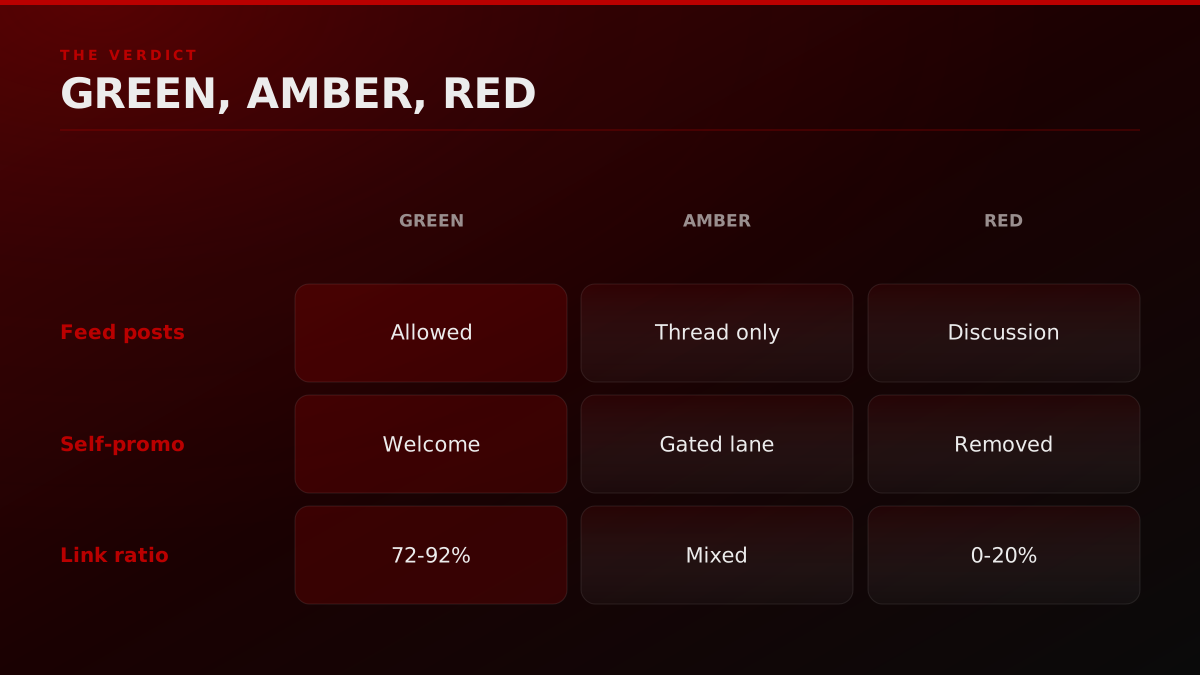
The verdict map above compresses 1,364 sampled posts into three rows. GREEN means the main feed, or a stickied lane inside it, tolerates a genuine product post. AMBER means promotion is welcome only inside a specific recurring thread and gets removed everywhere else. RED means the community treats external links as noise and your post will be removed, downvoted, or ignored regardless of format. The rest of this guide is the evidence behind that table, one community and one failure mode at a time.
One framing to carry through: Reddit is not a billboard, it is a set of rooms, each with its own bouncer. The same link that gets you thanked in one room gets you removed from the next. Our job in building this map was to read every bouncer's actual rules, then check those rules against what really happened to recent posts, because the two do not always match.
Any tips on marketing an API platform towards developers?
Why developer marketing breaks exactly where developer building does not
The reason this map exists is that developer-tool founders are usually excellent at building and genuinely stuck on distribution. That is not a stereotype, it is the single most-repeated framing in the communities themselves: a technical founder ships a working API or tool and then has no idea how to get the first users. The gap is real, it is common, and Reddit is where founders go to say so out loud.
Scroll r/SaaS on any given week and the pattern is unmistakable. "Developer who built a SaaS but can't figure out marketing. How did you get your first users?" is not an outlier post, it is a genre. So is the blunter version: most founders and developers are great at building, and marketing is where things fall apart. On r/startups the same anxiety wears a different phrase, the recurring "what do you wish you'd known before marketing your product to get your first 100 customers."
Developer who built a SaaS but can't figure out marketing. How did you get your first users?
Operator noter/SideProject: 193 posts per day, 92% external-link ratio in-sample., FORKOFF Subreddit Map, sampled 2026-07-10
There is a second layer under the skills gap: fear. On r/programming, solo and indie developers name it directly, "marketing is scary for a solo developer," and the blocker they describe is confidence, not budget. On r/webdev, developers debate whether selling to their own peer group is uniquely hard. On r/devrel, the question goes fully existential: "Do software developers hate marketing?" The underlying worry is that the audience itself is allergic to being marketed to.
Marketing is scary for a solo developer
That worry is half right, and getting the half right is the whole game. Developers are not allergic to marketing. They are allergic to marketing that looks like marketing. That distinction is why the subreddit tiers exist at all, and it is why a value-first post survives in a room where a positioning statement gets removed. Before we map the rooms, it helps to understand the landscape they sit inside.
The developer-audience landscape in 2026: bigger, stricter, and AI-indexed
Reddit in 2026 is simultaneously a larger opportunity and a stricter one. It hosts more than 100,000 active communities and reported roughly 97 million daily active uniques in late 2024, and its threads increasingly surface inside Google and AI search answers, which means a developer researching your category is often reading a subreddit discussion about it before they ever open your documentation. The audience is enormous and the discovery surface is compounding.
Reddit is now a default research surface for developers
Reddit hosts more than 100,000 active communities and reported roughly 97 million daily active uniques in late 2024, and its content increasingly surfaces inside Google and AI search results, which means a developer researching your category is likely reading a subreddit thread about it before they ever reach your docs.
Source: Reddit Inc. investor materials, Q3 2024
At the same time, the rules got tighter and the plumbing changed. Reddit's 2023 data API pricing changes ended the old free-scraping era and pushed structured access under formal data API terms. Practically, that means two things. First, any credible subreddit analysis now has to run through sanctioned, authenticated access, which is exactly why our map was built through our own Reddit data infrastructure rather than a headless browser. Second, a lot of older "how to market on Reddit" advice quietly went stale, because it assumes a pre-2023 world of open scraping and looser moderation that no longer exists.
The 2023 API changes reset how third parties reach Reddit data
Reddit's 2023 data API pricing changes ended the old free-scraping era and pushed structured access under formal data API terms, which is why any current subreddit analysis has to run through sanctioned, authenticated access rather than the pre-2023 assumptions many older marketing guides still repeat.
Source: Reddit data API terms
The commercial backdrop makes the stakes concrete. Reuters reported in February 2024 that Google signed an AI content-licensing deal with Reddit worth about 60 million dollars per year, which is what it looks like when the world's largest search company puts a price on exactly the kind of threads this map teaches you to show up in. The published platform numbers, taken together, describe a channel that is simultaneously huge, formalized, and wired directly into the search and AI surfaces developers research through.
The published platform numbers behind the channel decision
| Figure | Value | Source |
|---|---|---|
| Daily active uniques | 97M+ reported, late 2024 | Reddit Inc. investor materials, Q3 2024 |
| Active communities | 100,000+ | Reddit Inc. |
| Data API terms era begins | 2023 | Reddit data API terms |
| Google AI licensing deal | About 60 million dollars a year | Reuters, February 2024 |
| AI answer visibility lift, citation-rich pages | Up to 40% | Princeton GEO study, arXiv 2311.09735 |
Platform figures as published by Reddit Inc. The Google deal value is the figure Reuters reported in February 2024, not a Reddit-confirmed number. The 40% figure is the maximum visibility boost measured in the GEO study's generative-engine benchmarks.
There is also a category-confusion problem that keeps developer companies from running the channel well at all. On r/devrel, practitioners actively argue about where developer relations ends and developer marketing begins. When nobody owns the boundary, nobody owns Reddit, and the channel ends up run ad hoc by whoever has a free afternoon. That is how a company with a genuinely great API ends up with a single removed post and a conclusion that "Reddit doesn't work for us," when the real problem was posting through the wrong door with a cold account.
Developer marketing and developer relations are not the same job
Practitioners on r/devrel actively debate where developer relations ends and developer marketing begins, a category confusion that leaves many API companies unsure who owns Reddit at all, which is exactly how the channel ends up run ad hoc by whoever has a spare afternoon.
Source: r/devrel community discussion, 2019 to 2026
The operators who actually reach developers converge on one principle, and it resolves the whole "do developers hate marketing" debate. You do not lead with your message, you lead with something the developer can use. "Creating valuable content is the best way to market to developers," writes Firecrawl's ericciarla, describing a content engine that grew the company fast. The one-line version, from another builder: don't market to developers, solve problems and let them come to you. Hold that principle steady and every subreddit tier below stops looking arbitrary.
Don't market to developers. Just solve problems. Let them come to you.
Is it against the rules to promote your dev tool or API on Reddit?
It depends entirely on the subreddit and the format, and that ambiguity is the source of most trouble. Most developer subreddits allow product mentions inside a dedicated lane, a megathread, a Feedback Friday, a "what are you working on" thread, while auto-removing the same link from the main feed. A minority ban promotion outright, in any format. There is no single Reddit-wide rule, only 27 different ones in the communities on this map.
The nearest thing to a universal norm is Reddit's own etiquette on self-promotion, historically summarized as a rough 9-to-1 rule: for every one time you post your own thing, contribute roughly nine times to the community in ways that have nothing to do with you. It is not enforced by a counter, but moderators and AutoModerator configs absolutely enforce the spirit of it, and it maps onto how a healthy account looks: mostly a helpful participant, occasionally a builder sharing work.
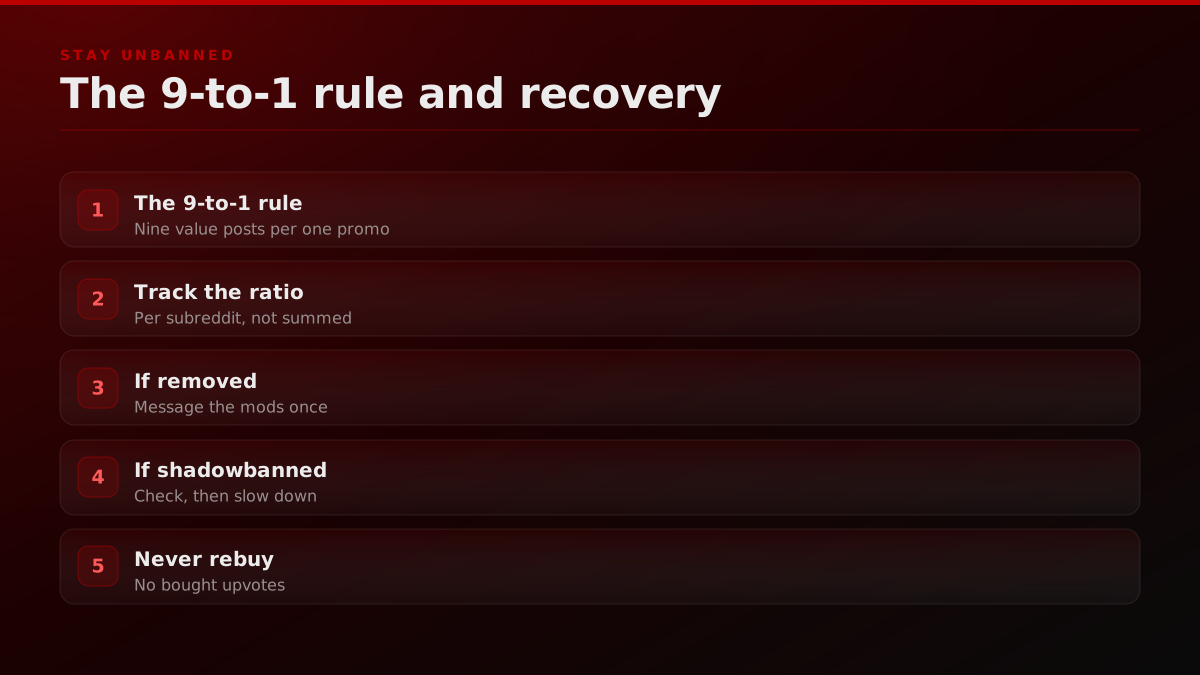
The practical translation for a developer-tools company is a ratio you actually track. Nine genuinely useful contributions, answers, teardowns, config shares, bug reports on other projects, for every one post about your own tool, held across each subreddit, not summed across all of Reddit. An account that is 90% self-links in one community is a removal waiting to happen even if every individual post follows that sub's format rules. This is also why the Reddit karma and account-warming cadence matters more than any single clever post: the ratio is a property of the account over time, not of the post in isolation.
Operator noteSeveral allowlisted subs showed 0% link tolerance in the sample. The list lied., FORKOFF Subreddit Map, 2026-07-10
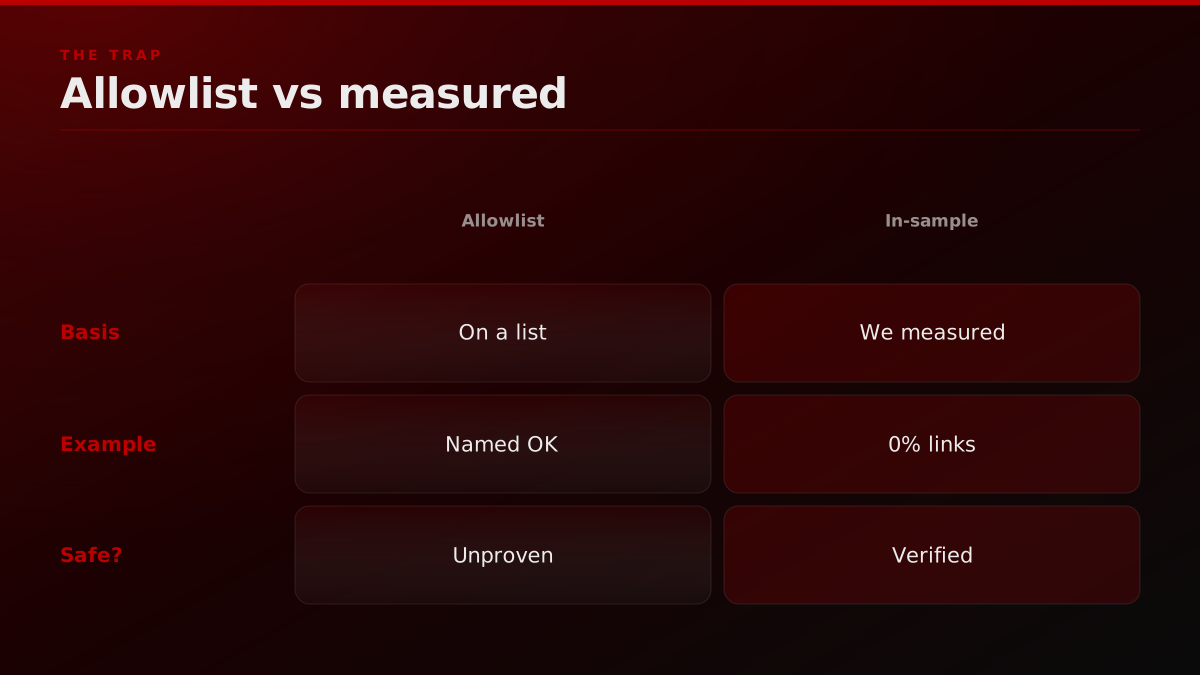
There is a trap worth flagging here, because it burned several communities in our own sample. A subreddit appearing on a "developer subreddits that allow self-promotion" allowlist does not mean its recent posts actually tolerate links. Several allowlisted subs in our study showed a 0% external-link ratio across their sampled top posts. The allowlist described the rulebook. The sample described reality. When they disagree, believe the sample.
The full FORKOFF Subreddit Map: 27 developer communities, scored
Here is the map itself, built from measured data rather than reputation. We queried 30 candidate subreddits spanning developer generalists, language and framework communities, self-hosting and open-source hubs, and founder communities. Twenty-eight returned live data; two API endpoints, r/api and r/developertools, returned HTTP 404 and one, r/programmingtools, came back functionally inactive. That leaves 27 resolved communities, each classified from its sampled posts.
Operator noter/api and r/developertools both returned HTTP 404. We reported it, not hid it., FORKOFF Subreddit Map, 2026-07-10
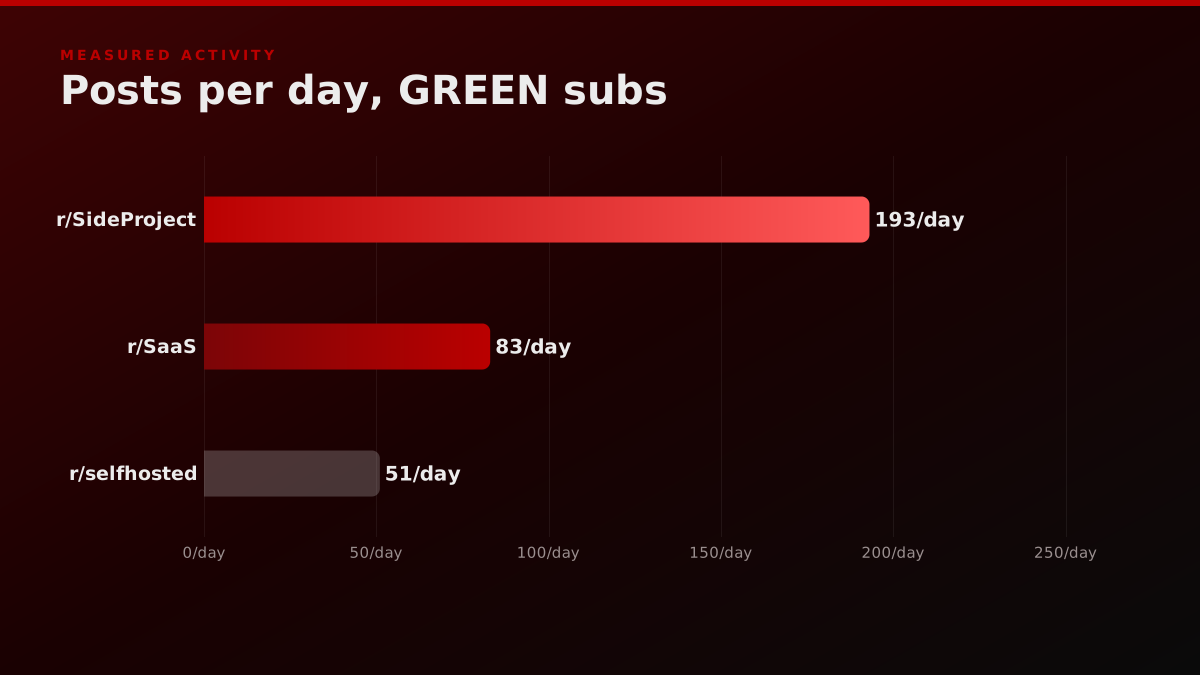
The GREEN tier is small and earns its place. r/SideProject was the most active community in the entire sample at roughly 193 posts per day, with an estimated 92% external-link ratio, it is quite literally built for people shipping projects and linking to them. r/SaaS ran about 83 posts per day at a 72% link ratio and carried the highest founder-post volume of anything we sampled, making it the strongest ongoing-marketing community for a founder-facing tool. r/selfhosted was quieter at about 51 posts per day but ran a live stickied project lane we found directly in the sample, which is exactly the sanctioned door a self-hostable tool needs.
The three GREEN developer subreddits, measured
| Subreddit | Posts per day | External-link ratio | Why it scored GREEN |
|---|---|---|---|
| r/SideProject | 193 | 92% | Purpose-built for launches, open link posting |
| r/SaaS | 83 | 72% | Highest founder-post volume sampled, link-tolerant |
| r/selfhosted | 51 | Stickied lane | Live stickied project megathread found in-sample |
Figures measured in-sample on 2026-07-10; posts-per-day is a sampled rate, not an official Reddit metric. r/selfhosted's link tolerance is expressed through its stickied lane rather than a raw feed ratio.
The AMBER tier is the majority, and it is where most of the audience actually lives. r/programming, r/webdev, r/Python, r/javascript, r/typescript, r/rust, r/golang, r/node, r/reactjs, r/django, r/opensource, r/devops, r/kubernetes, r/aws, r/dataengineering, r/dotnet, r/php, r/laravel, r/flutter, and r/androiddev all showed real promotional tolerance, but only through a specific gate: a weekly showcase thread, a "what are you working on" post, a package-share day. Post inside the lane and you are welcome. Post the same link to the main feed and it is removed, often within minutes, by rule or by AutoModerator. AMBER is not a rejection. It is a room with a service entrance, and you have to use it.
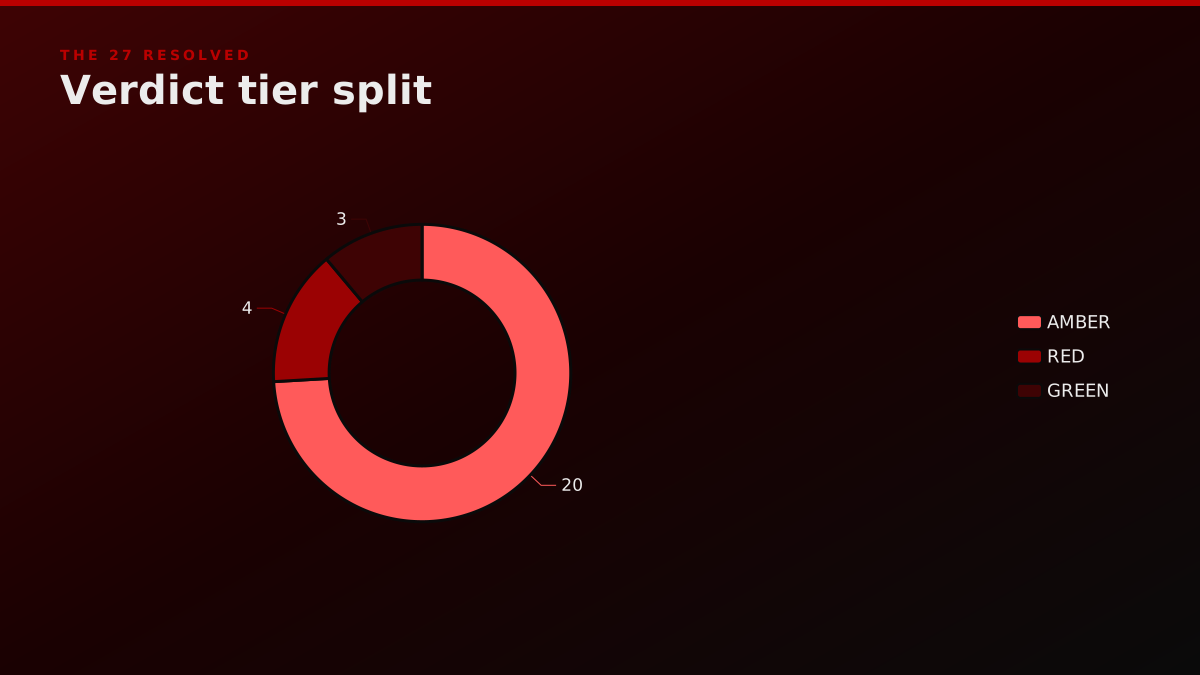
The RED tier is where allowlists most often lie. r/MachineLearning, r/ExperiencedDevs, r/cscareerquestions, and r/learnprogramming showed an estimated 0% to 20% external-link tolerance across their sampled top posts, and crucially, some of them appear on generic "subreddits that allow self-promotion" lists anyway. Membership on such a list did not translate into engagement safety. These communities are worth being present in as a helpful expert, they are terrible places to drop a product link, and treating them as distribution channels is how accounts get flagged.
Developer Relations and Developer Marketing…they aren't the same thing
Finally, the honest limitation, stated in the map rather than buried. Our own Reddit data API currently has no subreddit-metadata endpoint, so this study reports no subscriber counts. Every figure here is measured activity, posts per day, sampled external-link ratio, in-sample lane presence, not community size. We would rather show you a real measured ratio than an impressive subscriber number we did not directly verify, and being upfront about what was and was not verifiable is itself part of the methodology.
The AMBER tier in detail: the sanctioned door in each major developer subreddit
The AMBER tier is where most developer-tool marketing actually happens, because it holds the bulk of the qualified audience, so it is worth walking through the specific door each major AMBER community leaves open. The pattern is consistent: a strict main feed plus one named, recurring thread where promotion is not just tolerated but expected. Learn the thread name and you have the key; ignore it and you have a removal.
The sanctioned door in each major AMBER community
| Community | The door | What survives there |
|---|---|---|
| r/webdev | Showoff Saturday weekly thread | A live demo of something you built |
| r/programming | No promo lane, main feed only | A substantive technical article |
| r/rust | Weekly what-are-you-working-on thread | A project share written for the Rust audience |
| r/reactjs | Show /r/reactjs style threads | A working React project with source |
| r/golang, r/django, r/node | Recurring project-share threads | A stack-native tool with real substance |
| r/devops, r/kubernetes, r/aws | No reliable lane, expertise first | Answers to hard operational questions, no links |
Doors as observed in the 2026-07-10 FORKOFF sample and each community's public posting rules. Thread names and cadences change, so verify the pinned posts and sidebar before posting.
r/programming is the strictest of the big generalist subs. Its main feed is for substantive articles and technical discussion, and a bare product link is removed on sight under its content rules. The only durable play here is to write something genuinely worth reading, a real technical post about a hard problem you solved, where your tool is the incidental context rather than the pitch. That is a high bar, which is exactly why r/programming scored lower on the Community-Fit Score than its size would suggest.
r/webdev is friendlier, and its door has a name: "Showoff Saturday," the weekly thread where web developers share what they built. Post your tool there with a live demo and it is welcome; post it to the Tuesday main feed and it is gone. r/webdev is the clearest case in the whole map of a community with excellent audience fit and a strictly gated door, which is why so many founders misread it as hostile when it is merely rule-bound.
The language and framework subreddits follow the same shape with different thread names. Many run a recurring "what are you working on this week" thread where project sharing is the point; r/rust's weekly thread is a well-known example, and r/golang, r/django, and r/node maintain similar rhythms. r/reactjs has historically run "Show /r/reactjs" style threads. r/php and r/laravel tolerate package shares with real substance. The universal tell: if a subreddit schedules or pins a recurring showcase or "what are you working on" thread, that thread is your only door, full stop.
The infrastructure and data communities, r/devops, r/kubernetes, r/aws, and r/dataengineering, are stricter still, because they skew senior and low-tolerance for anything that smells like vendor marketing. In these, the winning move is closer to the RED-tier play than the GREEN one: answer hard operational questions with genuine expertise for weeks, and let a single recommendation land only when someone explicitly asks. r/opensource is a special case worth its own note: it welcomes genuinely open-source tools warmly and treats closed-source "open-core with a paywall" pitches with suspicion, so lead with the license and the repository, not the pricing.
The reason the AMBER tier rewards this door-by-door discipline is that the sanctioned threads are not a consolation prize, they are a better environment than the main feed would be. The people reading "Showoff Saturday" or the weekly project thread arrived specifically to see new work, so your post reaches a self-selected, launch-receptive slice of a large community. Used well, AMBER communities out-convert their GREEN counterparts on a per-view basis precisely because the audience in the lane is pre-qualified. The map tells you the tier; the door tells you how to use it.
Which developer subreddits allow self-promotion, and which ban them?
The cleanest way to read the allow-versus-ban question is by the door each community leaves open. Three doors exist across the map: an open main feed (rare, GREEN), a sanctioned self-promotion lane inside an otherwise strict feed (common, AMBER), and no door at all (RED). Knowing which door a subreddit uses is more actionable than knowing its subscriber count, because the door is what determines whether your post survives.
Open-feed communities are the GREEN three. In r/SideProject, a launch post with a link is the native content type; the community exists for it. r/SaaS tolerates product links in ordinary posts as long as they carry real substance, a lesson, a metric, a build story, rather than a bare "check out my thing." r/selfhosted's open door is its stickied release lane, where a genuinely self-hostable tool with docs is exactly what people came to see.
Lane-gated communities are the AMBER majority, and each has its own named door. r/webdev concentrates promotion into "Showoff Saturday." Many language subreddits run a recurring "what are you working on this week" thread, r/rust's is a well-known example, where sharing your project is the point. r/reactjs has historically run "Show /r/reactjs" style threads. The rule of thumb: if a subreddit has a weekly or monthly recurring showcase thread pinned or scheduled, that thread is your only sanctioned door, and the main feed is closed to promotion.
Dax Raad
@thdxr
you'll basically never see me talking about implementation details. easy mistake to make is thinking that's how you market to developers. you end up just confusing yourself thinking interesting implementation details are why someone would use your thing
Ban-in-practice communities are the RED tier plus a few strict AMBER edges. Here, no format saves a product link, and attempting one repeatedly is how you earn a subreddit ban or a sitewide spam flag. The move in these communities is to be genuinely, generously helpful with zero links for a long time, so that on the rare occasion someone asks "what do you use for X," a single honest recommendation from a known-helpful account is welcome precisely because it is not a pattern.
you'll basically never see me talking about implementation details. easy mistake to make is thinking that's how you market to developers.
If you want the community-selection logic as a repeatable process rather than a memorized list, that is what our Reddit marketing for B2B founders playbook covers at the channel level; this map is the developer-tools-specific instance of it, and we run the same GREEN, AMBER, RED scoring for other verticals.
Why do posts about developer tools get removed from r/programming and r/webdev?
Posts get removed from r/programming and r/webdev for one structural reason: both tolerate promotion only inside gated threads, not the open main feed, so a product link dropped into the main feed reads as self-promotion and is auto-removed. It is not personal, and it usually is not a human moderator making a judgment call in the moment. It is a rule and an AutoModerator config doing exactly what the community configured them to do.
This is the single most misread situation in developer marketing on Reddit, because the audience fit is genuinely excellent. r/webdev is full of exactly the people who would use a web-developer tool. That fit is why founders keep posting there, and the removal is why they keep concluding "Reddit doesn't work." Both the fit and the removal are real. They are reconciled by the door: r/webdev wants your tool in "Showoff Saturday," not in the Tuesday-morning main feed.
The allowlist-versus-reality gap makes this worse. A founder reads that r/webdev "allows self-promotion," posts to the main feed, gets removed, and feels lied to. The allowlist was describing the showcase-thread door. The founder used the front door. The fix is not a better post, it is the right door, and the way you find the right door is by reading the sidebar, the wiki, and the pinned posts before you write anything, then confirming against what recent posts actually survived.
There is a timing dimension too, and it compounds the door problem. Even inside the correct lane, a post that lands when the subreddit is asleep gets buried before the audience wakes up. Door plus timing is the full picture, which is why we treat best time to post on Reddit as a companion decision to subreddit selection rather than an afterthought. The right link, in the right lane, at the wrong hour, still underperforms.
Do large developer subreddits like r/MachineLearning or r/ExperiencedDevs allow product mentions?
Rarely, in practice. Across our sampled top posts, both r/MachineLearning and r/ExperiencedDevs showed near-zero external-link tolerance, and, importantly, allowlist membership alone did not translate into real engagement safety. Treat these communities as credibility and discussion surfaces, not distribution channels, and expect main-feed product posts to be removed regardless of how relevant your tool is.
The reason these large, high-status communities score RED is that their entire value proposition is signal-to-noise. r/MachineLearning positions itself around research and serious technical discussion; a product link reads as noise against that backdrop almost by definition. r/ExperiencedDevs is a peer community for senior engineers talking shop, and a vendor showing up to promote reads as exactly the intrusion the community formed to avoid. The stricter and more prestigious the developer community, the more a bare promotional post costs you in standing.
That does not make them worthless, it makes them a different play. In RED communities, the move is patient expertise: answer hard questions well, with no link, over weeks. Build a username that senior developers recognize as consistently helpful. The payoff is not a traffic spike, it is that when your category comes up and someone asks for recommendations, a single reply from a trusted account is welcome. This is slow, it does not fit a launch calendar, and it is the only thing that works in these rooms.
Do Software Developers Hate Marketing?
The strategic error is spending launch energy on RED communities because they are large. Size is a vanity metric if the link tolerance is zero. A 193-post-per-day GREEN community that welcomes your link will send you more qualified developers this week than a giant RED community will send you this quarter, and it will do it without costing you any standing. Chase the door, not the subscriber count.
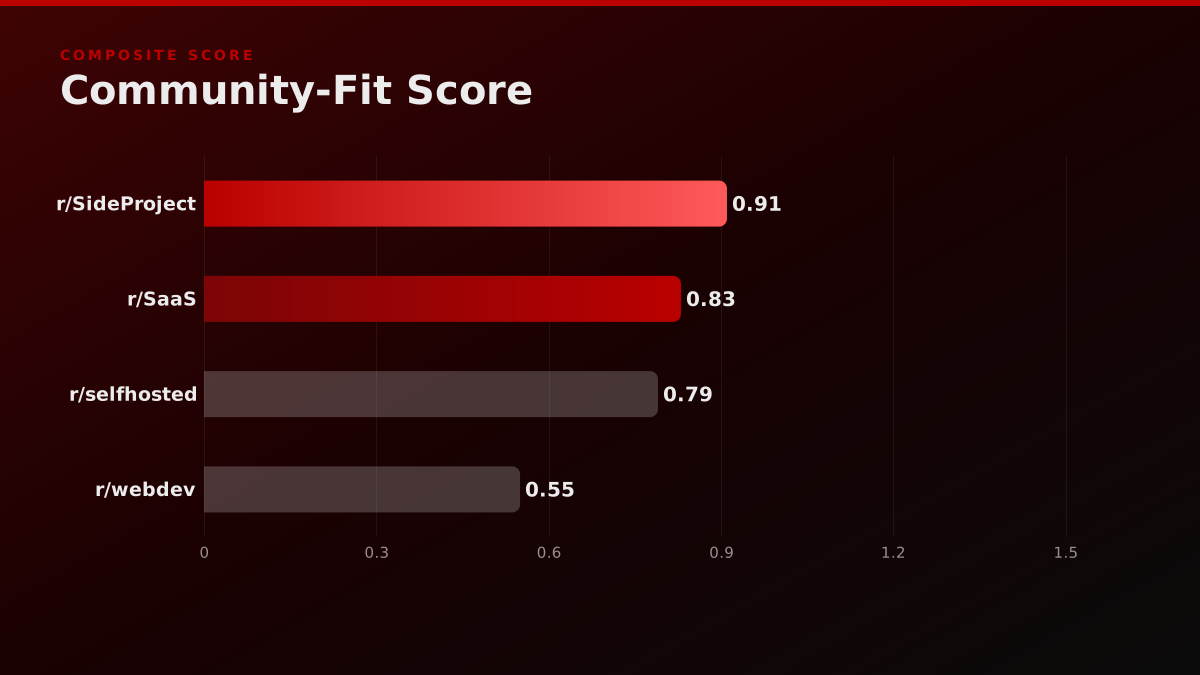
FORKOFF Community-Fit Score, top developer subreddits
| Subreddit | Community-Fit Score | Verdict | Basis |
|---|---|---|---|
| r/SideProject | 0.91 | GREEN | Verified in-sample |
| r/SaaS | 0.83 | GREEN | Verified in-sample |
| r/selfhosted | 0.79 | GREEN | Verified in-sample |
| r/webdev | 0.55 | AMBER | Public-reputation lane |
| r/Python | 0.52 | AMBER | Public-reputation lane |
| r/programming | 0.41 | AMBER | Public-reputation lane |
| r/MachineLearning | 0.18 | RED | Verified in-sample |
| r/learnprogramming | 0.12 | RED | Verified in-sample |
The Community-Fit Score is a FORKOFF composite of measured activity, link tolerance, sanctioned-lane presence, and buyer fit, scaled 0 to 1. Scores are directional and specific to the API and developer-tools buyer, sampled 2026-07-10.
What is a self-promotion megathread, and how do you actually use one?
A self-promotion megathread is a stickied, recurring post, usually weekly, where a subreddit concentrates the promotional content it removes from the main feed: "Show off Saturday," "Feedback Friday," "Self-Promotion Sunday," or a rolling "what are you working on" thread. It is the sanctioned door for AMBER communities. Using it well is the difference between a welcome contribution and a wasted post nobody sees.
The mechanics matter, because a megathread is not just a place to dump a link, it is a small conversation with its own etiquette. Post your tool with a working demo or a code sample, a one-paragraph description of the problem it solves, and an explicit invitation for feedback. Then, and this is the part most people skip, come back and reply to every comment. Megathread visibility rewards active authors, and the comments you get are the highest-signal early feedback you will find anywhere.
The cardinal rule: never cross-post the same link to the main feed of a subreddit whose megathread you just used. That is the fastest way to convert a welcome contribution into a removal and a moderator's attention. The megathread is the deal, use it and the community is happy, break it and you have told the moderators you do not read rules. One or the other, not both.
There is a scaling insight here that most founders miss. A single megathread post is low-yield in isolation, but a habit of showing up in the same subreddit's weekly thread, contributing between times, and building recognition compounds. By the fourth or fifth week, regulars know your project and your username, and your posts start getting engaged replies instead of silence. Megathreads reward consistency, not one-shot drops, which is why they belong inside a founder funnel that runs for months, not a launch that runs for a day.
The winning play on developer audiences is value-first, not message-first
The most-repeated advice from operators who have actually reached developers is to give them something to use, a demo, a teardown, a working code sample, rather than a positioning statement, which maps cleanly onto why a link posted inside a value-first thread survives and a bare product drop gets removed.
Source: ericciarla of Firecrawl, via X, 2025-04-05
What is the best subreddit to launch a side project or indie developer tool?
By measured activity and link tolerance, r/SideProject is the best subreddit to launch a side project or indie developer tool. In our sample it ran roughly 193 posts per day with a 92% external-link ratio, the highest of any community we measured. It is purpose-built for builders shipping and sharing work, which means a launch post there is the native content type rather than an intrusion the community has to tolerate.
The reason r/SideProject wins for launches specifically is that the audience arrives in a launch-receptive mindset. People browse it to discover new projects and to share their own; a link to your tool is the reason they are there. Compare that to posting the identical link into r/programming's main feed, where the audience arrived for technical discussion and reads your link as an interruption. Same link, same tool, opposite reception, entirely because of what the audience showed up expecting.
For a launch to land in r/SideProject, the post still has to earn attention against a very active feed. Title around the problem, not the product name. Lead with a short, honest build story, the itch you scratched, the thing that annoyed you enough to build this. Include a demo or a live link that works in thirty seconds. Developers reward a real, runnable artifact far more than a feature list, which is exactly Pratham's point about showing a screen recording of the product in action.
The easiest way to market to developers is to just show them a screen recording video of your product in action.
r/SideProject is the anchor, but it is rarely the only right room for a launch. A self-hostable tool should anchor in r/selfhosted instead, where the audience specifically wants deployable software. A founder-facing SaaS with an API might anchor in r/SaaS. The rule is one anchor per launch, chosen by fit, followed by careful cross-posting to adjacent lanes, which is the launch-day ladder we lay out later in this guide.
Pratham
@Prathkum
The easiest way to market to developers is to just show them a screen recording video of your product in action.
How active is r/SaaS compared to r/SideProject for founders marketing a product?
r/SideProject was the more active community in our sample at roughly 193 posts per day with a 92% external-link ratio, built for launches. r/SaaS ran about 83 posts per day at a 72% link ratio and carried the highest founder-post volume of anything we sampled. The practical read: r/SideProject is the better single-launch drop, and r/SaaS is the better community for ongoing marketing discussion and founder relationships over time.
The activity difference is not a quality difference, it reflects two different jobs. r/SideProject's higher volume and link ratio make it a firehose of launches, great for a spike of eyes on a new tool, but also a fast-moving feed where posts scroll away quickly. r/SaaS moves slower and skews toward substantive discussion, founders comparing notes on pricing, churn, first-customer acquisition, which makes it the better place to build a durable presence and to be recognized before you ever launch.
For a developer-tools founder, the smart move is to use both for their strengths rather than choosing one. Build recognition in r/SaaS over weeks by contributing to the exact "how did you get your first users" threads that define the community, then anchor your actual launch in r/SideProject where the launch mindset lives, then bring the launch results back to r/SaaS as a discussion post, "here's what a Reddit launch actually returned," which is itself high-value content that reinforces your standing.
SaaS Founders/Developers: What do you wish you'd known before marketing your product to get your first 100 customers?
This two-community rhythm is a small version of the larger principle behind our SaaS product launch distribution framework: no single surface carries a launch, the outcome comes from a few well-chosen surfaces reinforcing each other. On Reddit specifically, r/SideProject and r/SaaS are the two rings most developer-tool founders should run first.
Is r/selfhosted a good place to post an open-source or self-hosted developer tool?
Yes, for genuinely self-hostable or open-source tools, r/selfhosted is one of the strongest communities on the map. It scored GREEN in our study, running roughly 51 posts per day with a live stickied project lane we found directly in the sample. It is quieter than r/SideProject, but the audience is precisely qualified: people who run their own infrastructure and actively want deployable software with real documentation.
The qualifier is the whole point. r/selfhosted rewards a tool you can actually self-host, a real deployable release, a Docker image, a clear install path, open-source code or at least an open-core model. It is a poor fit for a hosted-only SaaS with no self-host story, because the community's entire identity is running things themselves. If your tool has a self-host path, lead with it here; if it does not, this is the wrong GREEN community and r/SaaS or r/SideProject fits better.
Operator noteNo subscriber counts here. The API has no metadata endpoint, so we do not guess., FORKOFF Subreddit Map limitation, 2026-07-10
What makes r/selfhosted especially valuable for developer-tools companies is the quality of the resulting users. Self-hosters are technical, they read documentation, they file good bug reports, and they become advocates when a tool respects their autonomy. A launch here converts fewer raw clicks than r/SideProject but a higher share of them into engaged, technically capable users, which for an API or infrastructure tool is often the better trade. Fewer, better-qualified developers beat a larger, shallower spike.
Why Developers Need Marketing Strategy
A primer on why developer-first companies still need a real marketing strategy.
The stickied project lane is your door. Post your release there with the self-host instructions front and center, respond to the inevitable configuration questions, and treat the thread as both distribution and free QA. The configuration questions you get in that lane are a roadmap for your documentation, which is itself a durable AI search optimization asset once you turn the recurring questions into indexed docs pages.
How do you find the right subreddit for a dev-tool or API launch?
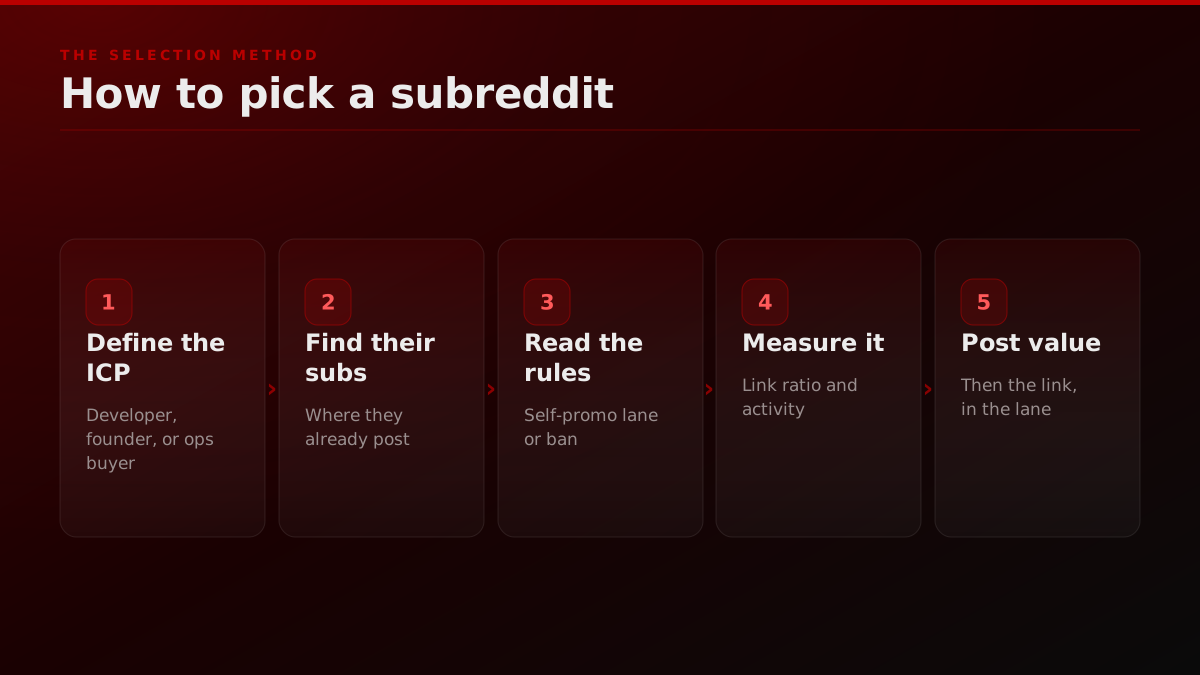
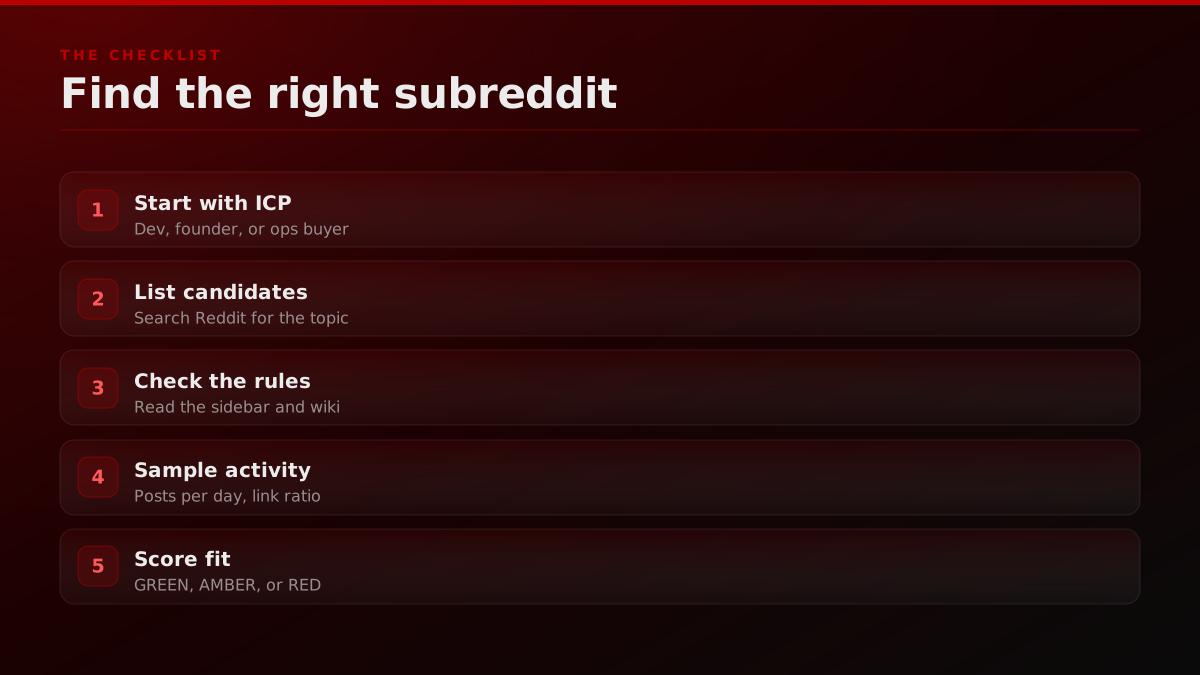
You find the right subreddit through a five-step process, not a memorized list, because the list changes and the process does not. Define your buyer first, developer or founder, list the subreddits they already post in, read each sidebar and wiki for the self-promotion rule, sample recent posts for the external-link ratio, and score the community GREEN, AMBER, or RED before you post a single link. That sequence is the entire discipline.
Step one is buyer definition, and it is where most founders go wrong by skipping it. "Developers" is not an audience, it is a dozen audiences. A backend infrastructure API, a frontend component library, a data-engineering tool, and a no-code builder all reach different people in different subreddits. Before you list a single community, write down who specifically pushes the button to adopt your tool, an individual developer, a tech lead, a founder, and let that determine the map. r/dataengineering is right for one and irrelevant for another.
Step two is finding where that buyer already posts. Search Reddit for your problem space, not your product, and watch which subreddits keep surfacing. Read the actual threads to confirm the audience matches your buyer rather than just the topic. Step three is reading the rules, every sidebar, every wiki, every pinned post, to find the self-promotion door. Step four is sampling: read the recent top posts and count how many carry external links, because that measured ratio is worth more than any stated rule. Step five is the verdict.
Being able to market to developers in web3 is a different game altogether. The hype alone won't cut it. You need clear narratives, strong documentation and the right channels.
This process generalizes across every audience we have mapped, and it is deliberately the same methodology behind our internal cold-outreach Reddit Sub Maps and our public studies like the Reddit marketing for AI startups map. The audiences change, the five steps do not. When the process feels like overhead for a single launch, remember that you are building a reusable map, not a one-off decision; the next launch reuses it.
How do you measure whether a subreddit is worth marketing your API in?
Measure four things: posting activity (posts per day), external-link tolerance in recent top posts, whether a sanctioned self-promotion lane exists, and audience fit with your specific buyer. We combine these into a composite we call the FORKOFF Community-Fit Score, scaled 0 to 1, and act only where the score and the raw measured link ratio both clear the bar. A single dimension in isolation, even a big subscriber count, is not enough to justify effort.
Two of those inputs deserve names, because naming a metric is what makes it repeatable. The first is the Link-Tolerance Ratio: the share of a subreddit's recent top posts that carry an external link, measured directly from a live sample rather than inferred from the rules. A high Link-Tolerance Ratio means a link post is normal here; a 0% ratio, even in an allowlisted sub, means links do not survive regardless of what the sidebar says. The second is the Community-Fit Score, which blends the Link-Tolerance Ratio with activity, lane presence, and buyer fit into one comparable number.
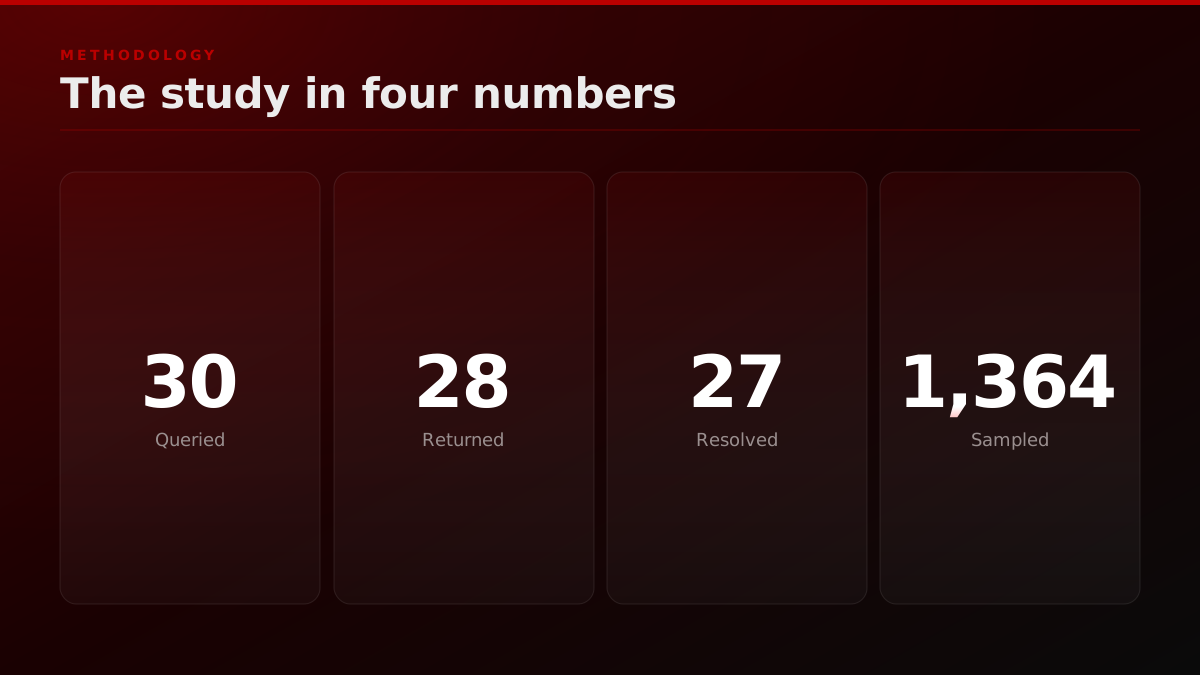
The methodology behind the scores is deliberately transparent. We queried 30 candidate subreddits through our own Reddit data API with Bearer-token authentication, 28 returned data, 27 resolved to a verdict, and we sampled 1,364 posts total, 664 top-of-the-month plus 700 newest, up to 25 per subreddit. Each row is disclosed as verified-in-sample (we measured it directly) or public-reputation (we know the lane exists but did not have enough in-sample link data to measure the ratio). That disclosure is the honesty layer: you should know which numbers we measured and which we inferred.
Operator note1,364 posts sampled. 664 top-of-month plus 700 newest, up to 25 per sub., FORKOFF Subreddit Map methodology, 2026-07-10
The reason this measurement discipline matters for an API specifically is that developer attention is expensive and easily wasted. Posting into a RED community is not neutral, it costs you standing and can flag your account. The Community-Fit Score turns "where should we post" from a gut call into a ranked decision, and it turns a removed post from a mystery into a predictable outcome you chose to avoid. If you would rather have this run for your exact buyer than build it yourself, that is precisely the Reddit marketing work we do.
The lurk-to-launch cadence: warming an account before you ever promote
Before any of the map matters, the account posting has to look like a real participant, because Reddit's spam systems and human moderators both weight account history heavily. A brand-new account that posts a product link on day one is the textbook spam signature, and it gets removed or shadowbanned no matter how good the tool is. The fix is a cadence, not a trick: warm the account over weeks so that its first promotional post lands on a foundation of real contribution.
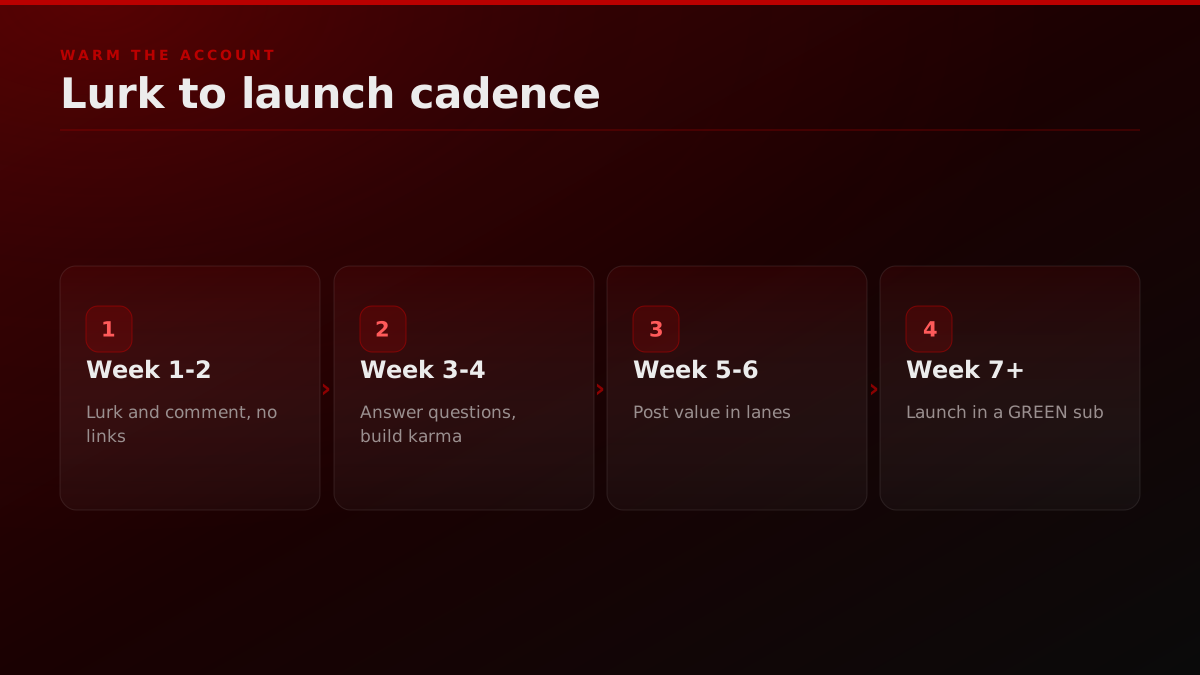
The lurk-to-launch karma cadence
STEPS- 01
Weeks 1 to 2: lurk and comment, zero links
Read the subreddits on your map daily. Comment where you can actually help, answer a question, correct a misconception, share a config, and post no links at all. The goal is a small, real comment-karma base and a feel for each community's tolerance before you ever ask for attention.
- 02
Weeks 3 to 4: contribute answers, still no promotion
Answer the recurring questions in your category with genuinely useful, link-free replies. If your tool solves the exact problem, describe the approach without dropping the URL. This is where developers start recognizing your username as helpful, which is the only currency that makes a later post land.
- 03
Weeks 5 to 6: post value inside the sanctioned lanes
Move into the self-promotion threads, Feedback Friday, Show off Saturday, the project megathread, with a working demo, a code sample, or a teardown. Keep the ratio heavily weighted toward contribution. A link here is welcome because the lane exists for exactly this.
- 04
Weeks 7 and beyond: launch in a GREEN subreddit
Only now do you post a real launch in r/SideProject, r/SaaS, or r/selfhosted, with an account that has a history, karma, and recognition. The launch reads as a builder sharing work, not a drive-by ad, which is the entire difference between a top post and a removal.
The cadence runs in four phases across roughly six to seven weeks. Weeks one and two are pure lurking and commenting, help where you can, drop zero links, and build a small comment-karma base. Weeks three and four move to substantive answers in your category, still link-free, so that regulars start recognizing your username as useful. Weeks five and six are your first posts inside sanctioned lanes, with a working demo and a heavy contribution-to-promotion ratio. Only in week seven and beyond do you post a real launch in a GREEN community, now with an account that has history, karma, and recognition behind it.
The reason this cannot be rushed is that every shortcut maps to a spam signal. A day-old account, a post that is 90% self-link, five identical cross-posts in an hour, these are the exact patterns Reddit's systems are tuned to catch, and getting caught early poisons the account for everything after. The full account-safety mechanics, karma thresholds, shadowban detection, and recovery, are worth reading in depth in our Reddit karma and account-safety guide before your first campaign, not after your first removal.
I got my first 4 paying SAAS customers after 3 months of development and organic marketing
There is a genuine payoff for the patience beyond just avoiding removal. A warmed account with recognized standing gets a categorically different reception: engaged replies instead of silence, benefit-of-the-doubt from moderators instead of a fast removal, and the credibility for a single honest recommendation to land in a RED community where a cold account could never post at all. The cadence is not overhead, it is the thing that makes the rest of the map usable.
The Reddit launch-day playbook: a Show HN for developer tools
Hacker News gave developers "Show HN" as a sanctioned, ritualized way to launch. Reddit has no single equivalent, but you can build one across the GREEN communities, and doing it deliberately is what separates a launch that trends from a link that sinks. The playbook is a ladder: anchor in one GREEN subreddit, lead with the problem and a working demo, run the thread as an AMA, cross-post only to genuinely adjacent lanes, and measure everything.
The Reddit launch-day ladder, a Show HN for Reddit
STEPS- 01
Pick one GREEN subreddit as the anchor
Choose the single best-fit GREEN community for your tool, r/SideProject for a broad indie launch, r/selfhosted for a self-hostable tool, r/SaaS for a founder-facing product. Do not blast the same post to five subreddits at once; that pattern is the fastest way to a spam flag.
- 02
Lead with the problem and a working demo
Title the post around the problem you solve, not your product name. Open with a short, honest build story, then the demo link and the code or docs. Developers reward a real artifact they can run in thirty seconds far more than a feature list.
- 03
Turn the thread into an AMA
Sit in the comments for the first three to six hours and answer everything, including the skeptics, in your own voice. The comment activity is what pushes the post up the feed, and the questions become your best FAQ and roadmap input for free.
- 04
Cross-post only to genuinely adjacent lanes
After the anchor thread has settled, share to one or two adjacent AMBER communities through their sanctioned threads, reframed for that audience, never copy-pasted. Each cross-post should read as written for that specific subreddit.
- 05
Capture and measure, then feed the funnel
Tag every link with a campaign parameter, watch the upvote ratio and referral-to-signup path, and write down what the thread taught you. A launch you cannot measure is a launch you cannot repeat, and repeatability is the whole point.
The anchor choice is the first and biggest decision. Pick one GREEN community that best fits your tool, r/SideProject for a broad indie launch, r/selfhosted for a self-hostable tool, r/SaaS for a founder-facing product, and make that your primary thread. Do not blast the identical post to five subreddits simultaneously; near-simultaneous cross-posting of the same link is one of the clearest spam signatures Reddit has, and it converts a launch into a removal wave. One anchor, chosen by fit, gets your full attention on launch day.
The thread itself lives or dies in the comments. Title around the problem you solve rather than your product name, open with an honest short build story, and put a demo or live link that works in thirty seconds right at the top. Then sit in the comments for the first three to six hours and answer everything, skeptics included, in your own voice. The comment activity is what pushes the post up the feed, and the questions you field become your best FAQ, your roadmap input, and your next several pieces of content, all for free.
This Developer Tools Marketing Strategy Got a Startup $197K in 90 Days!
A developer-tools marketing case study walkthrough tied to early revenue growth.
Only after the anchor thread has settled do you climb to adjacent AMBER communities, through their sanctioned lanes, with the post reframed for each specific audience. A launch that resonated in r/SideProject gets rewritten, not copy-pasted, for r/selfhosted's self-host angle or a language subreddit's showcase thread. Each cross-post should read as written for that room. This ladder is the Reddit-native expression of the same multi-surface logic in our product launch playbook, applied to one channel with its own etiquette.
How do you promote an API to developers on Reddit without getting banned?
You promote an API without getting banned by posting value before any link, keeping links inside each subreddit's sanctioned lane, holding a roughly 9-to-1 ratio of contribution to promotion, and checking the measured link tolerance before you post, because several allowlisted subs still showed 0% tolerance in our sample. Every one of those is a rule you can follow deliberately, which is what makes account safety a process rather than luck.
The value-first requirement is not a platitude for an API specifically, it is mechanical. An API's best marketing artifact is a working thing a developer can run: a code sample, a live playground, a teardown of how you solved a hard problem, a genuinely useful answer to someone's integration question. Lead with that, and the link becomes context rather than the point. Lead with the link, and you are a bare product drop in a community that removes exactly that.
Eric Ciarla
@ericciarla
Creating valuable content is the best way to market to developers. We've run this playbook with @firecrawl, and have grown like crazy over the last year. Want to help build our content engine?
The account-level discipline is where most bans actually originate, not the individual post. Reddit's spam systems watch patterns across your history: link ratio, cross-post velocity, account age, how many communities you touch and how fast. A 9-to-1 contribution-to-promotion ratio held per subreddit, a warmed account, and cross-posting spaced out rather than simultaneous keep you clear of the patterns that trigger shadowbans. If a post does get removed, message the moderators once, politely, and adjust; if you suspect a shadowban, check it, then slow down rather than pushing harder.
The recovery rules are simple and worth stating because panic makes people do the wrong thing. Never buy fake upvotes or engagement to recover a flagged post, it is the fastest way to a permanent sitewide flag. Never rebuy your way out of a removal with more of the same behavior. The recovery from a removed post is a better next post through the right door, and the recovery from a shadowban is patience plus a clean pattern, which again is exactly why the Reddit karma and account-warming cadence is the foundation everything else sits on.
Measuring what Reddit actually returns: the referral-to-signup funnel
Most developer companies treat Reddit qualitatively, "we posted, it felt like it went well," which is exactly why they cannot decide whether to invest more. The fix is to instrument Reddit like any other channel: a referral-to-signup funnel with a campaign parameter on every link, so a launch becomes a measured event you can compare and repeat instead of a vibe you half-remember. Post views to profile clicks to site visits to signups, tracked, is what turns Reddit from an experiment into a channel.
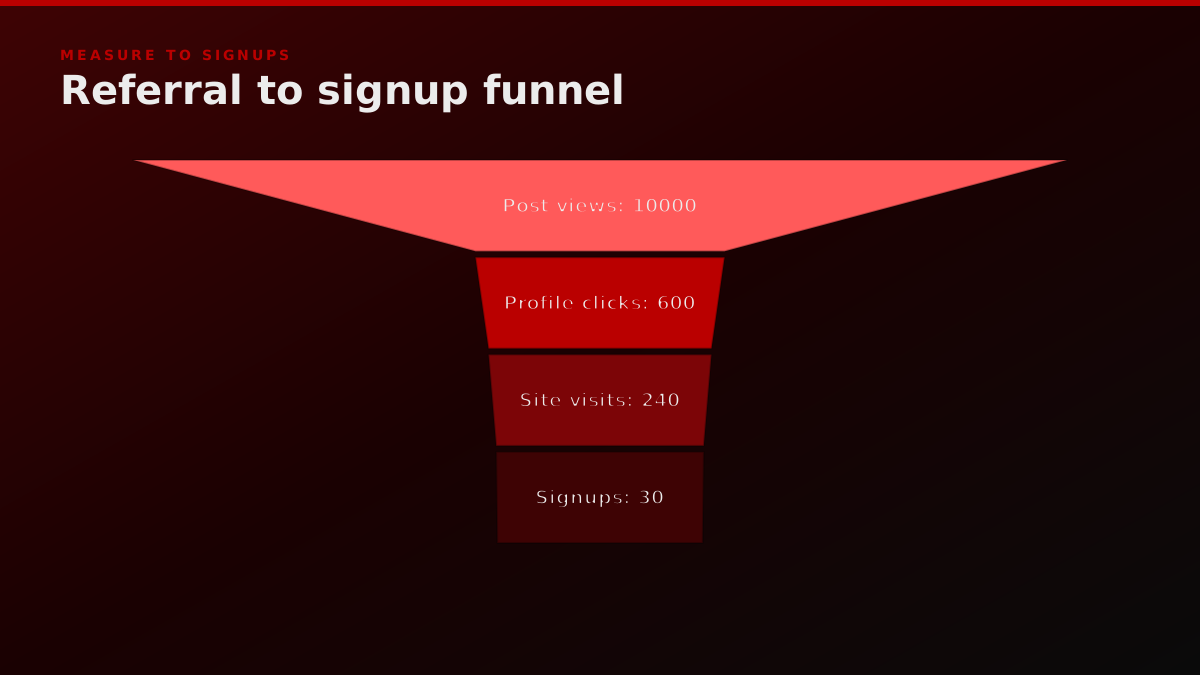
The instrumentation is straightforward. Put a UTM campaign parameter on every link you post, distinct per subreddit and per launch, so your analytics can tell you which community actually sent signups rather than just clicks. Watch the upvote ratio on the post itself as an early quality signal, a high ratio means the community welcomed it, a low one means you posted through the wrong door or at the wrong time. Then follow the path from referral to signup, because raw clicks from a launch are worthless if none of them convert.
The metric that matters for an API is not upvotes, it is qualified signups per subreddit per launch. A GREEN community that sends fifty developers who create an account and hit the API beats a viral thread that sends five thousand clicks and zero signups. Measuring at the signup layer also protects you from the vanity trap of chasing large RED communities: once you can see that they send clicks but not conversions, the decision to skip them makes itself. This is the same measurement rigor we bring to answer engine optimization and generative engine optimization, where the only metric that counts is whether the surface actually produced the outcome.
There is a compounding return most companies miss entirely. A Reddit launch thread that ranks in Google and gets cited by AI answer engines keeps sending developers to your docs for months after it drops off the feed. Instrumenting the funnel is how you notice that long tail and decide to invest in it, turning a one-day launch into a durable discovery asset. That durable-asset framing is where Reddit stops being a launch tactic and becomes part of a real Twitter marketing and community distribution engine that runs continuously.
The most common developer-tool Reddit mistakes, and the fix for each
Most failed Reddit campaigns for developer tools fail for a small set of repeatable reasons, and naming them is more useful than any list of tactics, because avoiding the mistakes is most of the win. The five that recur across the communities and threads we studied are: wrong door, cold account, wrong buyer, message-first posting, and no measurement. Each has a specific, boring fix, and boring is exactly what works here.
The wrong-door mistake is the most common: posting a real product to the main feed of an AMBER community instead of its sanctioned lane. The fix is to read the sidebar, wiki, and pinned posts before writing, find the showcase thread, and use it. The cold-account mistake is posting from a brand-new or link-heavy account that trips spam filters; the fix is the lurk-to-launch cadence, which cannot be skipped. The wrong-buyer mistake is choosing subreddits by topic rather than by who actually adopts your tool, which is why r/dataengineering is perfect for one API and a waste for another.
The message-first mistake is the deepest, because it feels like marketing done right. Founders lead with positioning, "the fastest, most developer-friendly API for X," into an audience that has heard a thousand such claims and trusts none of them. Developers themselves keep naming this. On r/webdev, they openly debate whether selling to a developer is the hardest form of marketing, precisely because their peer group filters out messaging and responds only to demonstrable substance. The fix is to lead with a usable artifact, a demo, a code sample, a teardown, and let the developer draw the conclusion your positioning statement was trying to force.
The building-versus-marketing skills gap sits underneath all five mistakes, and it is worth naming without judgment, because it is nearly universal. As one widely-echoed r/SaaS post puts it, most founders and developers are great at building, and marketing is where things fall apart. That is not a character flaw, it is a division of skill, and it is exactly why a measured, process-driven map like this one helps: it turns the part founders are weak at, channel judgment, into a checklist the part they are strong at, systems thinking, can actually execute.
The no-measurement mistake is the one that quietly ends the channel. A founder runs three launches, cannot tell which worked, concludes Reddit is unreliable, and stops. The fix is the referral-to-signup funnel with campaign tags on every link, so that "did Reddit work" becomes a number instead of a feeling. Fix these five and you have removed nearly every reason a developer-tool Reddit strategy fails, which is a more reliable path to results than any single growth hack.
Reddit versus Hacker News, Dev.to, and Stack Overflow for developer tools
Reddit is one developer-community surface among several, and choosing it deliberately means understanding what it does that the alternatives do not. The honest comparison: Reddit offers the widest range of audience-specific communities and the most durable, searchable threads, Hacker News offers a single high-intensity launch ritual with brutal but valuable feedback, Dev.to offers a friendly content-publishing surface with low promotional friction, and Stack Overflow offers pure problem-solving credibility with essentially zero tolerance for promotion.
Hacker News, through Show HN, gives developers a sanctioned, ritualized launch format that Reddit lacks natively, which is exactly why the launch-day ladder earlier in this guide reconstructs a Show-HN-style ritual across Reddit's GREEN communities. A Show HN post reaches a concentrated, technically demanding audience in a single window; a Reddit launch reaches a wider, more segmented audience over a longer tail. Many developer tools should do both, on different days, with the post reframed for each culture rather than cross-posted.
Dev.to and its peers are publishing surfaces more than discussion surfaces, better suited to the durable-content half of developer marketing than to a launch spike. A genuinely useful technical article on Dev.to compounds in search over time, much like a well-ranked Reddit thread does, and both feed the same AI-search visibility that increasingly decides whether developers find you at all. Stack Overflow is a credibility surface: you build standing by answering hard questions well, never by promoting, and that standing quietly pays off when your name comes up elsewhere.
The strategic point is that these surfaces are complements, not substitutes, and Reddit's specific strength, many audience-matched communities plus durable searchable threads, makes it the best default starting channel for most developer tools. The right sequence for a small team is usually Reddit first, because the map lets you target precisely and the threads compound, then Hacker News for a concentrated launch moment, then a content surface like Dev.to to build the durable-article layer. Running all three as one system is where a real distribution engine, not a one-off launch, actually lives.
Developer marketing is not developer relations: who should own Reddit
A quiet organizational problem sinks more developer-tool Reddit efforts than any tactical error: nobody clearly owns the channel, because the company has not decided whether Reddit is a marketing job or a developer-relations job. On r/devrel, practitioners argue this boundary constantly, right down to whether a "developer marketing engineer" is even a real role, and the ambiguity is not academic. When the boundary is unclear, Reddit becomes everybody's occasional side task and nobody's owned channel, which is how it ends up run badly.
The useful distinction is by intent, and it is drawn in full at what developer marketing is. Developer relations builds long-term trust and technical credibility with a developer community, answering questions, maintaining docs, showing up consistently, with no direct promotional ask. Developer marketing drives awareness and adoption of the product, with a clear conversion intent. On Reddit, both happen, and they map cleanly onto the tiers: the RED communities are pure developer-relations surfaces where only trust-building works, the GREEN communities tolerate genuine marketing, and the AMBER communities require the DevRel posture in the main feed and permit the marketing posture only inside the lane.
Gracie
@0xGraciee
Being able to market to developers in web3 is a different game altogether. The hype alone won't cut it. You need clear narratives, strong documentation and the right channels. Here's what works and what doesn't work when reaching devs
The nuance sharpens in specialized audiences. Marketing to web3 developers, for instance, is a different game that hype alone will not win; it demands clear narratives, strong documentation, and the right channels, which is developer relations and developer marketing fused rather than separated. Whether your audience is web3, data, infrastructure, or frontend, the person who owns Reddit needs both instincts: the patience of DevRel and the conversion focus of marketing, applied to the right tier at the right moment.
Practically, that means one owner, not a committee. Whether the title is DevRel, developer marketing, or founder, one person should own the map, the account warming, the launch cadence, and the measurement, because the channel rewards consistency and a recognizable voice more than it rewards volume. This is also the single most common reason companies bring in outside help: not because the tactics are hard, but because owning the channel consistently, week after week, is a real job that a busy founding team keeps dropping.
Why Reddit threads keep sending developers to your docs: the AI-search compounding effect
The most underrated reason to run Reddit well for a developer tool has nothing to do with the launch-day spike. It is that a good Reddit thread is a durable, searchable, AI-indexed asset that keeps sending qualified developers to your docs for months, and increasingly, keeps getting cited by AI answer engines when a developer asks ChatGPT or Perplexity how to solve the exact problem your tool solves. The spike is the smallest part of the return.
This matters more every quarter because of how developers now research. A developer evaluating tools in your category increasingly starts with an AI answer engine, and those engines lean heavily on exactly the kind of content Reddit produces: specific, experience-backed, discussion-rich threads where real users describe real trade-offs. Research into generative-engine optimization, including the widely-cited Princeton GEO study, finds that citation-worthy content is dense with statistics, sources, and quotable specifics, which is precisely what a good technical Reddit thread contains. A thread where you helped solve a real problem, with your tool as the honest answer, is the kind of source these engines cite.
Citation-rich content measurably wins AI answer visibility
The Princeton-led GEO study demonstrated that optimizing content with citations, quotations, and statistics can boost a source's visibility by up to 40% in generative engine responses, which is exactly the profile a strong technical Reddit thread already has: dense with specifics, sources, and quotable first-hand experience.
Source: Aggarwal et al., GEO: Generative Engine Optimization, arXiv, 2023
The compounding is real and measurable. A launch thread that ranks in Google and gets pulled into AI answers is not a one-day event, it is an asset that appreciates, sending a steady trickle of high-intent developers long after it leaves the feed. That is why the measurement framework earlier in this guide instruments the long-tail referral path and not just launch-day clicks: the long tail is often larger than the spike, and it is invisible unless you tag for it.
Capturing that compounding return deliberately is a distinct discipline, and it is exactly where our answer engine optimization, generative engine optimization, and AI search optimization work lives: turning earned community discussion and documentation into content that AI engines reliably cite. For a developer tool, that is often the highest-leverage marketing surface there is, because it reaches developers at the precise moment they are asking how to solve the problem you exist to solve. The Reddit thread is the seed; the AI-search visibility is the compounding interest.
What real developer-tool growth on Reddit looks like
The honest version of "case studies" here is that most developer-tool Reddit wins are not dramatic viral moments, they are compounding presence, and the public examples that exist support that read. Firecrawl's own team describes growing fast on the back of a content engine aimed at developers rather than a single lucky thread, which is the value-first pattern doing its work over time. Open-source and self-hostable tools routinely credit communities like r/selfhosted for their early qualified users precisely because the audience is technical and advocacy-prone.
The ceiling on that compounding effect is category ownership, the point where developers mentally attach your name to the problem space itself. Lee Robinson, who built developer-experience programs at Vercel before moving to Cursor, observed exactly this happening with Apollo and GraphQL: sustained, well-executed developer marketing made the tool nearly synonymous with the category it served.
Apollo did such a phenomenal job marketing to developers that I've noticed GraphQL is often synonymous with Apollo.
Amay Korade
@KoradeAmay
Don't market to developers. Just solve problems. Let them come to you.
Our own first-party evidence is the map you are reading. We built it by running the same composite scoring methodology behind our internal cold-outreach Reddit Sub Maps, generalized into a public, vertical-specific study: 30 subreddits queried, 28 returned data, 1,364 posts sampled, every verdict traced to measured link tolerance rather than reputation. That is the FORKOFF experience signal, we do this measurement for real client engagements, and the numbers here are the real output of the real process, not a rounded illustration. For context on scale, our clipping network alone has processed more than 5 billion views, and the same measurement-first instinct runs through everything we distribute.
The pattern across every genuine win is the same three things, and none of them is a growth hack. First, a value-first artifact the developer can actually use, a demo, a sample, a teardown. Second, the right door in the right community, GREEN main feed or AMBER sanctioned lane, never a bare link into a RED room. Third, a warmed, recognized account posting it, so the community reads a builder sharing work rather than a vendor running an ad. Get those three right and Reddit works for developer tools. Get any one wrong and it looks like Reddit "doesn't work," when really you posted through the wrong door.
The uncomfortable truth under all of it is that there is no shortcut that survives contact with the audience. Developers are unusually good at detecting manufactured attention, and the tactics that inflate numbers, bought upvotes, sock-puppet threads, coordinated fake enthusiasm, are exactly the ones that destroy standing when they are noticed, which they usually are. The durable play is slow, honest, measured presence in the communities the map marks GREEN and AMBER, run as a system rather than a one-off.
The full 27-community roster, tier by tier
No competitor map we found actually lists the communities with a verdict attached, so here is the full resolved roster from the study, organized by tier, with a one-line read on each. Treat it as a starting shortlist to validate against your own buyer, not a permanent ruling, because subreddit rules and moderation do change, which is exactly why the process matters more than any static list.
The GREEN tier is three communities. r/SideProject is the launch community, highest activity and highest link tolerance in the sample, the default anchor for a broad indie developer-tool launch. r/SaaS is the founder community, highest founder-post volume, best for ongoing marketing discussion and a founder-facing product with an API. r/selfhosted is the infrastructure-owner community, quieter but precisely qualified, the right anchor for anything genuinely self-hostable or open-source. If your tool fits one of these three, that is where your first real post belongs.
The AMBER tier is the working majority, and it splits into three practical groups. The generalist developer subs, r/programming and r/webdev, carry huge audiences behind strict doors: r/programming wants a real technical article, r/webdev wants "Showoff Saturday." The language and framework subs, r/Python, r/javascript, r/typescript, r/rust, r/golang, r/node, r/reactjs, r/django, r/php, r/laravel, r/flutter, and r/androiddev, each run a showcase or "what are you working on" lane and reward a tool that speaks their stack natively. The infrastructure and data subs, r/devops, r/kubernetes, r/aws, and r/dataengineering, are stricter and more DevRel-shaped, tolerating promotion only after real expertise is established. r/opensource and r/dotnet round out the tier with their own genuine-substance thresholds.
The RED tier is four communities to respect and not promote in: r/MachineLearning, r/ExperiencedDevs, r/cscareerquestions, and r/learnprogramming, all of which showed near-zero external-link tolerance in the sample. These are credibility and discussion surfaces, valuable for building a recognized, helpful presence, and terrible for a product link. And the three that did not resolve are worth naming for honesty: r/api and r/developertools both returned HTTP 404 from the data API, and r/programmingtools came back functionally inactive, so despite intuitive-sounding names, none of the three is a live channel.
The single most important thing this roster shows is that the obvious-sounding subreddits are frequently the wrong ones. A founder marketing an API might reasonably assume r/api or r/developertools are the natural homes, and both are effectively dead. They might assume the biggest developer communities are the best targets, and the biggest ones skew RED. The communities that actually convert, r/SideProject, r/SaaS, r/selfhosted, plus the right AMBER lanes for your stack, are rarely the ones intuition picks first, which is the entire argument for measuring instead of guessing.
The methodology in full, and its honest limits
Because this map is only as trustworthy as its methodology, here is the full accounting, including what it cannot tell you. We assembled 30 candidate subreddits spanning developer generalists, language and framework communities, self-hosting and open-source hubs, API-adjacent communities, and founder communities, chosen to represent the realistic surface an API or developer-tools company would consider. Every query ran through our own Reddit data API using Bearer-token authentication, the sanctioned, authenticated path, with no scraping of reddit.com and no headless browser touching the site.
For each community we pulled two samples: the top posts of the past month and the newest posts, up to 25 each per subreddit, which totaled 1,364 posts across the 28 communities that returned data. From that sample we measured posting activity as a posts-per-day rate, computed the external-link ratio as the share of sampled top posts carrying an off-Reddit link, and noted any stickied or scheduled self-promotion lane that appeared in the sample. Those three measured inputs, plus a buyer-fit judgment specific to the API and developer-tools audience, feed the Community-Fit Score. Every row is labeled verified-in-sample where we measured the link ratio directly, or public-reputation where we could confirm a lane exists but lacked enough in-sample link data to measure the ratio precisely.
The honest limits are as important as the numbers. First, our own Reddit data API has no subreddit-metadata endpoint, so this study reports zero subscriber counts, we would rather omit a size figure than publish one we did not directly verify. Second, a sampled posts-per-day rate is a snapshot, not a rolling average; a community's activity varies week to week, and a single sample captures a moment. Third, moderation and rules change, so a GREEN verdict today can tighten tomorrow, which is why the map is a method you re-run, not a monument. Fourth, the Community-Fit Score is directional and tuned to the developer-tools buyer specifically; the same subreddit would score differently for a consumer app or a job-seeker audience.
Stating those limits plainly is not a hedge, it is the point. A map that claimed perfect precision about a living, moderator-governed platform would be lying, and developers, of all audiences, are the quickest to catch it. What this methodology does deliver is a defensible, reproducible, dated ranking, 30 queried, 28 returned, 27 resolved, 1,364 posts sampled on 2026-07-10, that beats reputation and folklore every time, and that you or we can re-run whenever the ground shifts. That reproducibility is the difference between a subreddit map you can act on and a listicle you have to trust.
Where FORKOFF fits, and how to run this as a system
Everything above is runnable in-house, and plenty of developer-tools founders should run it themselves at first, because doing it teaches you your own audience faster than any agency deck. If you go that route, pair this map with the channel-level Reddit marketing strategy playbook and the Reddit marketing tools roundup, which cover the strategy layer and the tooling layer this map plugs into. The point at which teams bring us in is usually when Reddit needs to become a repeatable system rather than a founder's spare-afternoon project: consistent account warming, a live map that stays current as communities change their rules, a launch cadence, and measurement that actually closes the loop to signups.
That system is what our Reddit marketing work is, and it rarely runs alone. Reddit is one surface; developer audiences also live on X, in newsletters, on YouTube, and in each other's founder networks, which is why we most often run Reddit inside a broader founder funnel that reinforces one channel with the others. A launch thread that trends on Reddit and gets amplified on X and turned into indexed documentation compounds in a way that any single surface cannot.
Two adjacent lanes matter specifically for developer tools. The first is AI visibility: once your best community threads and docs rank, keeping them cited by ChatGPT, Perplexity, and Google AI answers is durable, high-intent distribution, which is exactly what our answer engine optimization and AI search optimization work protects. The second is founder-led amplification, where the same value-first content works across Twitter marketing and community, and where developer-audience nuance, clear narratives and strong docs over hype, decides whether it lands.
For companies whose developer audience overlaps with events, launches, or creator distribution, the same measurement discipline extends to our events and activations and influencer marketing work. The through-line is constant: measure the surface, use the right door, lead with value, and let the audience come to you.
When to post: the timing layer on top of the map
The map tells you which subreddit and which door; timing decides whether the right post in the right lane actually gets seen. Reddit feeds move fast, and a launch that lands while a community is asleep can be buried under newer posts before the audience ever wakes up, which is why timing is not a nice-to-have but a multiplier on everything else you get right. A GREEN community and the perfect post still underperform at 3 a.m. in your audience's time zone.
For developer audiences specifically, the timing intuition that works for consumer content often misleads. Developers browse during work hours, on breaks, and in surprising off-cycle windows, one recurring observation among operators is that quieter periods like holiday weeks can be unusually good for reaching developers, because that is exactly when they finally have time to play with new tools and personal projects. The lesson is not a single magic hour but that developer attention does not follow a normal nine-to-five consumer curve, so you test against your own audience rather than importing a generic schedule.
The practical rule is to match your post time to when your specific target subreddit is most active and most receptive, then confirm it with your own data over several launches. Post when the community is awake and browsing, watch the first-hour engagement as the early signal, and treat the upvote velocity in that first hour as the truest read of whether your timing and your post both landed. If the first hour is quiet, the post rarely recovers, so a mistimed launch is better rescheduled than pushed harder.
Timing also interacts with the account-warming cadence in a way founders miss. The weeks you spend lurking and contributing before a launch are also weeks of free reconnaissance on when your target communities are actually active, which threads get traction at which hours, and which days the moderators are most present. By the time you launch, you should already know your anchor community's rhythm from having lived in it, not from a generic "best time to post" chart. That first-hand rhythm is worth more than any published heatmap.
Because timing deserves its own depth, we treat it as a companion decision to subreddit selection rather than a footnote, and the full breakdown of Reddit posting windows, per-community rhythms, and how to read first-hour velocity lives in the best time to post on Reddit guide. Pair it with this map: the map picks the room and the door, the timing guide picks the moment, and together they decide whether your developer-tool post trends or sinks.
The blunt answer
Here is the blunt answer for an API or developer-tools company deciding where to spend its Reddit energy. Post openly in the three GREEN communities, r/SideProject, r/SaaS, and r/selfhosted, matched to your tool. Use the AMBER majority, r/programming, r/webdev, r/Python and the rest, only through their sanctioned self-promotion lanes, and never through the main feed. Stay out of the RED tier for promotion entirely, r/MachineLearning, r/ExperiencedDevs, r/cscareerquestions, and r/learnprogramming showed near-zero link tolerance, and be present there only as a genuinely helpful expert.
Under all of it sits one rule that resolves every edge case: developers do not hate marketing, they hate marketing that looks like marketing. A working demo posted through the right door by a warmed, recognized account is welcome in almost every community on this map. The identical link, dropped cold into the main feed by a day-old account, is removed in almost all of them. The subreddit is the same. The outcome is opposite. The variable you control is the door, the account, and whether you led with something a developer can actually use.
Build the map, warm the account, lead with value, measure to signups, and Reddit becomes a real, compounding channel for a developer tool instead of a place founders go to say they cannot figure out marketing. That is the entire playbook, and the data behind it is measured, dated, and reproducible: 30 subreddits queried, 28 returned, 27 resolved, 1,364 posts sampled, on 2026-07-10.