

Crypto-native clipper marketplaces vs managed qualified-view campaigns.
FORKOFF Clipping and Crypto clipper marketplaces solve different jobs. Crypto clipper marketplaces sits in the Web3 creator marketplaces category. FORKOFF Clipping is a managed agency that runs the distribution for you and prices on outcomes at $0.003 per qualified view (CPQV), counting a view only after four checks (real human, in-region, traffic-valid, not a bot), across a network that has processed 5B+ views. Choose Crypto clipper marketplaces for the tool or roster; choose FORKOFF to have the distribution run for you and every paid view audited.
▸ Compared on operating model, pricing denominator, distribution, and audit trail.
FORKOFF vs crypto clipper marketplaces: A crypto clipper marketplace is a self-serve platform where a token project posts a bounty and crypto-native clippers self-source clips, usually paid on a raw CPM. Published clipping-marketplace rates sit around $1 to $5 per 1,000 views, and the platform takes a cut on top (9 percent on ClipAffiliates, roughly 6 to 7 percent in processing fees on Whop), while payout runs on raw submitted views with no per-view qualification. That gap matters: independent 2026 measurement puts automated bot traffic above 50 percent of all web traffic, with invalid-traffic rates on short-form platforms as high as 24 percent, none of which a raw-view marketplace filters before it pays. FORKOFF Clipping is the managed alternative. It prices at $0.003 per qualified view (CPQV), where a view counts only after four checks (real human, in-region, traffic-valid, not bot or farm), with an append-only per-view audit ledger exportable to CSV or JSON, across a network that has processed 5B+ views. Marketplaces optimize for token-native reach; FORKOFF optimizes for a view that survives a treasury review.
← scroll horizontally to see more →
| Feature | FORKOFF ClippingManaged outcome agency | Crypto clipper marketplacesWeb3 creator marketplaces |
|---|---|---|
| Optimization axis | Qualified outcomes + audit trail. | Token acceptance + raw distribution. |
| Pricing denominator | $0.003 per qualified view (CPQV). only views that pass all four checks. | Raw CPM or tool subscription; no qualification denominator. |
| Compliance | Sanctioned-geo gating at brief. | Brand-side enforcement. |
| Audit trail | Append-only ledger, exportable CSV/JSON, per-view reason codes. | Dashboard counts; no per-view audit trail. |
The 99.71% traffic legitimacy rate is documented in the qualified-views methodology.
Crypto-native clipper marketplaces optimize for token acceptance. FORKOFF optimizes for qualified outcomes and an audit trail brands can take to their treasury report.
FORKOFF runs this as managed clipping campaigns billed on the qualified-view ledger, not on seats or uploads.
For the fuller picture behind this comparison, read the managed clipping playbook.
CryptoClippers runs as an open bounty marketplace for web3 projects: you fund a pool, publish a clip brief, and anonymous clippers self-source cuts and claim a payout per view their submission reports. Nobody vets the clipper, and nobody re-checks the view before it is paid. FORKOFF Clipping is the opposite arrangement. A strategist owns the brief, a vetted clipper roster produces the cuts, and every view is re-checked before it is billed. A bounty board moves volume. A managed campaign moves an audited number.
Our network has processed 5B+ views to date, and the qualification thresholds cited on this page are read straight off that per-view history. An open bounty pool has no such record, because it pays on whatever count the platform reports at submission time. That is the reason FORKOFF can settle on a documented managed-lane reference rate near $0.003 per qualified view (a $0.0024 to $0.0038 band, not a fixed rate card) while a bounty board pays raw CPM on counts nobody audited.
A web3 launch usually has to answer to a treasury or a token community, and "we paid clippers for 4 million views" is not an answer that survives that room. FORKOFF bills a view only after it clears a device check, a watch-time floor, a traffic-legitimacy pass, and an audience-geo match, and it logs the reason whenever a view is filtered out. The output is an append-only ledger a treasury reviewer can read, documented in our qualified-views methodology.
If you want cheap reach and can absorb the fraud risk yourself, a bounty board is the faster path. If the campaign has to hold up to a treasury audit and sanctioned-jurisdiction gating, the managed model is the one built for it. See how the engagement runs on the clipping service page, or where FORKOFF sits against other operators in the best clipping agency comparison.
Reviewed by the FORKOFF clipping team, the operators who sign off on every payout against the ledger.
The qualification ledger changed how we report to the board. Real attention, verified weekly, not dashboard vanity.
Alex Morgan
Growth Lead, AI Infrastructure Startup
Brand-side spend is invoiced in fiat by default. Token-paid retainer engagements are available case-by-case.
Token-paid creator marketplaces optimize for native crypto distribution: token-based listings, on-chain payouts, and crypto-native clipper rosters. FORKOFF optimizes for qualified outcomes with a per-view audit ledger. Different optimization axes for different buyer needs.
When the campaign goal is native crypto reach, payout in token is the brand requirement, and the brand is comfortable owning compliance and qualification in-house. Token-acceptance marketplaces are the right fit when the brand prizes on-chain distribution mechanics.
Crypto-native marketplaces typically push compliance enforcement to the brand. FORKOFF gates sanctioned geos at the brief layer before clippers accept the work, and ships per-view reason codes that flag any view that fell outside the qualified set. Pre-distribution gating versus post-distribution remediation.
A per-view, append-only record with reason codes for every accepted and rejected view, exportable to CSV or JSON. The line items are durable enough to attach to a treasury report, listing-partner review, or finance audit. That record is the wedge against raw-view marketplaces.
Yes. Web3 + AI + B2B is the lane. Token launches that need treasury or listing-partner review are a primary use case, because the qualified-view ledger is the record those reviews ask for.
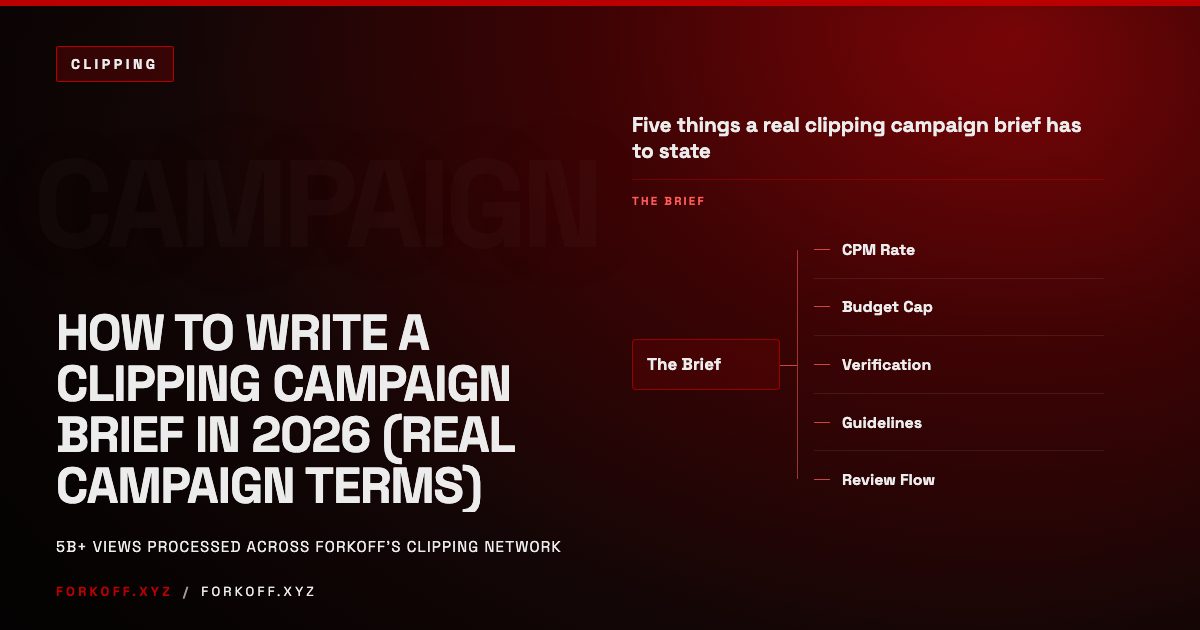
A clipping campaign brief sets the CPM, budget cap, submission rules, and review flow that decide whether a campaign gets quality clips or wasted budget.
 Read
Read
A launch-week playbook for clipping Twitch and Kick streams into qualified installs, with Drops mechanics, wishlist math, and a 7-day production calendar.
Read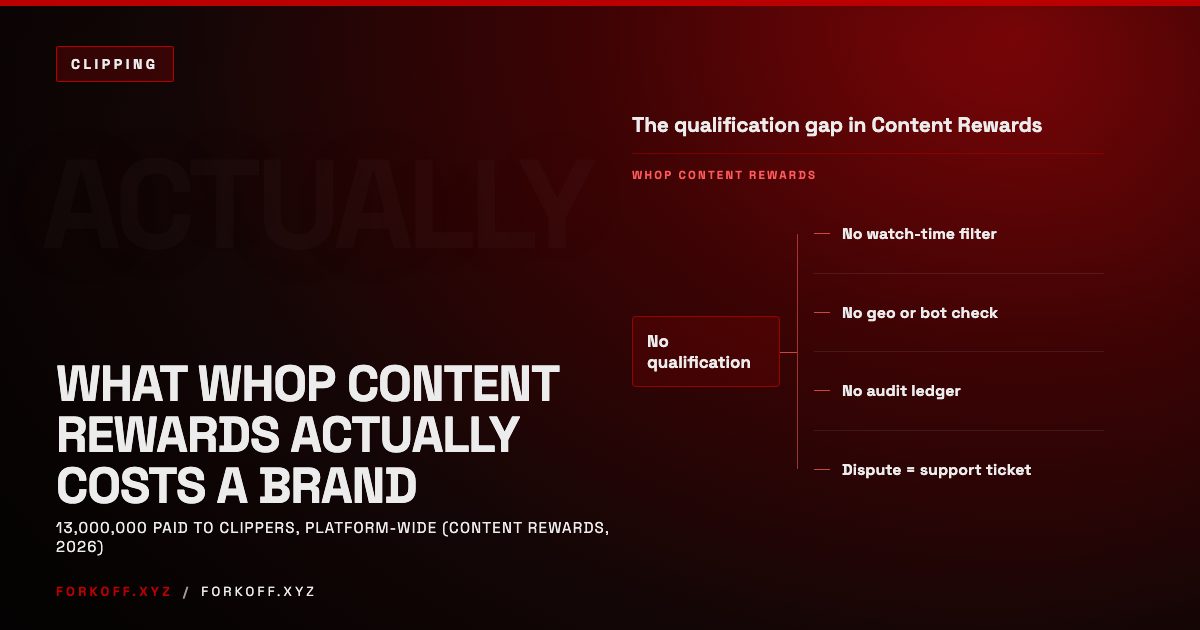
A cost breakdown of Whop Content Rewards for brands: real campaign budgets, CPM bands, the qualification gap, and when a managed clipping lane wins instead.
Read