

Varun Kundra
@varunkundra · 1.5K followers
ANNOUNCEMENT: Rokt has just paid out over $1 BILLION to brands. Rokt is a money printing button: Click enable and add up to 10% more profit. RT + comment "Rokt" and I'll send you a FREE Profit Gap Agent.
Rokt launchReconstructed reading
Rokt is a real product by a real founder (@varunkundra). RADAR has tracked 4.3M views on this launch, according to the source post linked below. RADAR measures how the launch reach was built, not whether the product works or whether anyone was honest. This reading is reconstructed confidence and every input is public.
By Simba, Launch Intelligence Analyst · Reviewed by JK · Published 29 Jun 2026 · Confidence: reconstructed
Independent, methodology-derived signal, not a statement of fact about any person. RADAR reads how reach was built, a signature, not an accusation. See the methodology.
Did the Rokt launch go viral organically, or was the reach amplified?
The Rokt launch by @varunkundra drew 4.3M views on 359 likes, which is 12,075 views per like, well above the roughly 500 organic ceiling. RADAR reads a reconstructed reading in how that reach was built, a signature of the mechanics and not a claim about the product or the founder. This is a reconstructed reading and every input is public and reproducible.
New here? Start with the product
What is RADAR, and what does this grade mean?
RADAR is FORKOFF's launch authenticity rating system. It reads whether a product launch earned its reach through real engagement or bought it through paid distribution, using only public signals anyone can pull from the launch post. Every reading carries a letter grade, a confidence label, and the date it was last checked, and links back to a published method you can reproduce. Rokt is a real product by a real founder (@varunkundra). RADAR measures how the reach was built, not whether the product works or whether anyone was honest.
Reconstructed reading
Independent, methodology-derived signal, not a statement of fact about any person. RADAR reads how reach was built, a signature, not an accusation. See the methodology.
What this grade means
RADAR reads this launch from its views-to-likes ratio alone, without a full amplification trace, so the grade is labeled reconstructed and held at lower confidence. The read is a signature of how the reach was built, not a claim about the product or the founder.
The signals RADAR reads
Views-to-likes ratio
Organic reach tops out near 500 views per like. When views climb far past that without the likes to match, the extra reach is arriving without the engagement organic reach produces.
Amplification wave shape
Organic amplification spreads over hours and days. A coordinated launch fires a synchronized burst of quote posts in the first few hours, read from each post's own timestamp.
Posting-time fingerprint
A post that fires exactly top of the hour on a weekday is scheduled. On its own it is weak, but it corroborates a coordinated launch alongside the other two signals.
Those three public signals sit on top of RADAR's five-component forensic read. The full method, the bands, and the confidence model are on the RADAR methodology page.
This launch in the data
Where does this reach sit against the tracked corpus?
Where it sits in the corpus
Rank 30 of 30 tracked launches by views per like, lowest (most organic) first. A lower ratio is the favorable end.
Against the benchmark
This launch's views per like next to the organic median (354) and the amplified median (1,441) across the tracked set.
A real company, a real milestone, and a view count the engagement cannot account for.
State the obvious caveat first, because it shapes everything below. This is not a net-new startup launch. Varun Kundra is a real person and the genuine operator of @varunkundra, but he is not Rokt's founder. Rokt was founded in 2012 by Bruce Buchanan. Kundra co-founded AfterSell, a Shopify upsell app that Rokt acquired in February 2024, and he now serves as Senior Vice President, Demand Diversification at Rokt. The post is a Rokt product and marketing promotion from a senior employee, citing a real company milestone (over $1 billion paid to brands), not a founder announcing a company. The product is real, the company is real, the milestone claim is the company's own, and the person is real. RADAR's finding is narrow: it is about how the 4.33 million views were built, not about whether anyone did anything wrong.
Here is the tension that makes this read worth writing carefully. A genuine senior operator at a multibillion-dollar company posted a genuine corporate milestone. The reply layer (693 written posts) and the quote layer (141 original posts) read like a real, if modest, conversation, and on a normal post from an account this size that conversation is exactly what you would expect to see. What does not fit is the 4.33 million view count stacked on top of it. A few hundred likes and a few hundred replies are the footprint of a small human audience. A 4.33 million view figure is not. When the gap between the reach and every layer of engagement is this wide, the reach is arriving from a source that does not also produce engagement. That is the fingerprint RADAR labels a botted signature, and it is what the public data here shows.
The rest of this teardown walks the reading first, then steps back to the product, the person, the funding, and the market, so a reader can audit the read and understand the post in full. RADAR exists to separate the marketing layer (what a post claims) from the data layer (what the public signals actually show). A botted signature is a statement about the view count, not a verdict on the company, the product, the milestone, or the person.
Engagement coupling: the reach and the engagement are decoupled
The thing that usually hides a buy is absent here, which makes the read more legible, not less. Kundra's account is a senior-operator account, not a mega-influencer handle, so 4.33 million views is not explained by an enormous follower base passing the post around. There is no large organic audience here to mask an inflated view count behind a plausible views-per-follower number. The reach simply outruns every human signal under it.
Signal one: the views-to-likes gauge deep in the bot-inflated zone
The load-bearing signal is V:L, views divided by likes. On X, the same feed that surfaces a post also makes it easy to like, so under organic distribution reach and likes rise together up to roughly 500 views per like. X's 2026 ranking treats engagement types as interconnected signals and rewards them together, with written replies weighted heavily for authenticity because a reply is costly effort (opentweet.io, sproutsocial.com). When views climb but likes do not keep pace, the views are arriving from a channel that does not also produce engagement. This post shows that gap at an extreme: 4,334,778 views divided by 359 likes is 12,074.6 views per like, a like rate of about 0.008 percent. For comparison, a normal high-reach post lands near 0.2 to 0.25 percent. This like rate is roughly 25 to 30 times thinner than that band (tweetarchivist.com).
Signal two: every engagement layer is tiny against the reach
Likes are the cheapest action to fake, so a thin like layer alone is suggestive rather than conclusive. The stronger tell is that every layer is tiny against the reach at once. The costly actions here total 359 likes, 85 reposts, 693 replies, and 141 quotes, 1,278 actions against 4,334,778 views, a coupling of about 0.03 percent. Launches that read organic at multi-million-view reach run closer to 0.3 to 0.45 percent. Fake-engagement detection guidance describes the bought-reach pattern as exactly this: disproportionately high reach paired with thin organic engagement across the board (miqwal.com, tweetarchivist.com). The reach here is more than ten times larger than the engagement under it would support.
Views per like
More than 24 times the 500 organic ceiling and more than twice the 5,000 line where bot-inflated reach lives. The reach detached from the likes.
Total coupling
1,278 actions (likes, reposts, replies, quotes) against 4,334,778 views. Roughly a tenth of the coupling RADAR sees on launches that read organic at this reach.
Reply to like inversion
Replies and quotes exceed the likes, which is unusual on most posts. Still tiny against 4.33M views, and partly incentivized by the giveaway in the post.
Engagement incentive
The post offers a free Profit Gap Agent for a repost and a comment, which directly incentivizes the reply and repost layer rather than leaving it spontaneous.
Signal three: the inversion that does not rescue the read
There is one detail an honest read has to confront. The replies (693) and quotes (141) actually exceed the likes (359). On most posts likes are the largest layer, so a reply count nearly double the like count is unusual. It is worth stating plainly what this does and does not mean. It does not lift the post into the organic band, because the absolute numbers are still tiny against 4.33 million views: a 693-reply layer is a 0.016 percent reply rate, and a 359-like layer is a 0.008 percent like rate. One more piece of context belongs here: the post offers a free Profit Gap Agent in exchange for a repost and a comment, so part of the reply and repost layer is directly incentivized rather than spontaneous, which makes that layer read even less like organic word of mouth. The most parsimonious reading is that the replies, quotes, and likes together are the footprint of a small, partly incentivized human conversation, hundreds of people reacting to a senior operator's corporate milestone, while the 4.33 million views are a separate, decoupled figure layered on top of that conversation rather than produced by it. The conversation looks human. The view count does not look like it came from the same place.
Read together, the three signals tell one story. A real account posted a real milestone and drew a small real conversation. The view count attached to that post is an order of magnitude too large to have been produced by the people who engaged with it. That decoupling is the botted signature.
What Rokt is, and what the post promotes
The post itself reads as a milestone-plus-call-to-action: a company achievement (over $1 billion paid out) used as the hook for the product pitch (turn on the Rokt button, add profit at checkout). That is standard corporate marketing structure, and it is the kind of opinion-free, proof-led framing that tends to draw a measured professional reaction rather than a viral organic cascade, which is part of what makes the 4.33 million view count stand out against the modest engagement.
Rokt operates in the transaction moment specifically. Its surfaces sit at checkout and post-purchase, where it places relevant offers for clients across a network described as roughly 3,000 e-commerce partners (rokt.com). The product's positioning is that the same checkout flow a merchant already runs can be monetized with one integration, turning the confirmation step into an additional profit line.
The $1 billion-paid-to-brands figure is the company's own reported number, surfaced in the post. RADAR treats it as a claim made by Rokt, consistent with the company's public materials, and does not independently audit the accounting behind it. It is cited here as what the post asserts, not as a RADAR-verified fact.
Varun Kundra, AfterSell co-founder, now an SVP at Rokt
The single most important framing fact on this page is that Kundra is not Rokt's founder. Rokt was founded in 2012 by Bruce Buchanan (sacra.com, rokt.com/company/about). Kundra co-founded AfterSell, a Shopify upsell app, which he and his team bootstrapped with no disclosed venture capital to an eight-figure exit when Rokt acquired it in February 2024 (announced January 2024). He is now Senior Vice President, Demand Diversification at Rokt (mentorpass.co, crunchbase.com, rokt.com). So the post is best read as a senior Rokt employee promoting a Rokt product and a Rokt milestone, not as a founder announcing or launching a company. That distinction matters for how the reach should be interpreted: there is no founder-launch news cycle here that would explain a multi-million-view organic spike, which makes the gap between the reach and the engagement more notable, not less.
Kundra's track record reads as a genuine operator. A bootstrapped Shopify app acquired by a multibillion-dollar company is a real, verifiable outcome. RADAR states this to be precise about the human element: nothing about the person's history suggests a need to manufacture attention, and RADAR makes no claim that he did. The reading is about the view count attached to one post, not about the operator.
A well-capitalized company, no raise in this post
The headline round is a $325 million Series E led by Tiger Global, announced in December 2021, which set Rokt's valuation at roughly $1.95 billion (rokt.com Series E, prnewswire.com). A December 2022 secondary transaction led by Square Peg and Wellington Management marked the valuation at $2.4 billion (rokt.com secondary); later secondaries have reportedly marked the company higher still, so RADAR treats the $2.4 billion figure as the December 2022 mark rather than the current one. Rokt has since made acquisitions of its own, including mParticle for roughly $300 million in January 2025 and Canal, rebranded to Rokt Catalog, in July 2025.
| Structural fact | Reading |
|---|---|
| Raise in this post | None; it announces a payout milestone, not a round |
| Rokt total raised | ~$488M across ~8 rounds, ~23 investors |
| Headline round | $325M Series E led by Tiger Global, Dec 2021, ~$1.95B valuation |
| Dec 2022 valuation mark | $2.4B secondary led by Square Peg and Wellington; later secondaries reportedly higher |
| AfterSell (Kundra's company) | Bootstrapped, no disclosed VC, eight-figure exit to Rokt, Feb 2024 |
Separately, Kundra's own company AfterSell was bootstrapped, with no disclosed venture capital, to its eight-figure exit when Rokt acquired it in February 2024 (crunchbase.com).
Named investors associated with Rokt include Tiger Global Management, Wellington Management, Whale Rock Capital Management, Pavilion Capital, and Square Peg. RADAR names them only to give the funding context, and the methodology section below states explicitly that nothing on this page implies anything about any of them. A well-capitalized, fourteen-year-old company gives a senior employee a legitimate audience and real distribution channels, which makes the absence of proportionate engagement under a 4.33 million view count the thing that stands out.
Where this sits, and how it compares
This is a real, demonstrably funded category with named enterprise customers. The market is not in doubt, and the product's adoption by large brands is documented. That context cuts against any reading that the post is hollow: the company and its traction are real. The narrow point is that real traction does not require, and is not evidenced by, a 4.33 million view count with 359 likes.
Comparable RADAR launches
RADAR has profiled a library of launches. The closest reference points for this read are the launches where reach detached from engagement, contrasted against the organic baselines:
Placed against that set, the Rokt post sits well past even the distribution-amplified launches: at 12,075 views per like it is roughly five times the views-per-like of HyperAgent, which RADAR already read as carrying a non-organic distribution signature.
Methodology, and what we are not saying
RADAR does not output a pass or fail on a person or a company. It outputs a signature and a confidence label, both built from public metrics anyone can pull, so the reader can check the work. For this post, the botted signature rests on the decoupling between reach and every engagement layer:
- The views-per-like ratio (12,075:1) sat more than 24 times above the 500:1 organic ceiling and more than twice above the roughly 5,000:1 line where bot-inflated reach typically lives.
- Total engagement (1,278 actions: 359 likes, 85 reposts, 693 replies, 141 quotes) was about 0.03 percent of the 4,334,778 views, roughly a tenth of the coupling RADAR sees on launches that read organic at comparable reach.
- The reply and quote layers, while larger than the likes, are still tiny in absolute terms against the view count and are partly incentivized by a repost-and-comment giveaway in the post, consistent with a small real conversation sitting under a separately inflated view figure rather than producing it.
- RADAR is <strong>not saying that Varun Kundra bought bots, paid for fake views, or did anything wrong</strong>. Nothing on this page asserts or implies that. RADAR has no evidence of who or what produced the view count, and it does not claim to. A view figure can be inflated by many mechanisms a poster never chooses or even sees, including third-party engagement or amplification services contracted elsewhere in a marketing chain, recycled or embedded impressions from cross-posting and syndication, automated accounts acting without any principal's involvement, and platform-side counting behavior. RADAR reads the shape of the public numbers, not intent, and not authorship of the reach.
- RADAR is <strong>not saying Rokt is fake, that the product does not work, that the $1 billion payout claim is false, or that the company's traction is not real</strong>. The company, the product, the named enterprise customers, and the funding history are all real and verifiable. The $1 billion figure is Rokt's own reported milestone, cited as a claim.
- RADAR is <strong>not saying the conversation under the post is fake</strong>. The 693 replies and 141 quotes read as a genuine, if modest, human reaction, though the post's repost-and-comment giveaway means part of that layer is incentivized rather than spontaneous.
- RADAR is <strong>not making any claim about Rokt's investors or any third party</strong>. Tiger Global Management, Wellington Management, Whale Rock Capital Management, Pavilion Capital, and Square Peg are named only for funding context. Nothing here implies any of them, or any partner, customer, or agency, backed, produced, or knew of any view inflation, or did anything wrong.
- RADAR is <strong>not saying the post violated any rule</strong>. The finding is narrow and specific: on the public metrics, the 4.33 million view figure is decoupled from the engagement under it to a degree consistent with non-human amplification. That is a statement about one number, not about a person, a company, or anyone's honesty.
Confidence and how to reproduce it
Confidence is labeled reconstructed: this read is built from the live metric snapshot and the engagement-ratio reading, not a full forensic trace of every account that contributed a view or a quote. A reconstructed botted signature is a confident read of the ratio, labeled lower-confidence than a verified trace so it is never overclaimed. Every input is public. Pull the post's view, like, repost, reply, and quote counts; divide views by likes for the gauge; and total the engagement layers against the views to check the coupling. The decoupling falls out of the data. See the full method at the RADAR methodology.
Questions readers ask about this launch
Is this a Rokt launch by its founder?
+
What does a botted signature mean here?
+
Does a botted signature mean Kundra or Rokt did something wrong?
+
Why does it matter that the replies exceed the likes?
+
What is a healthy views-to-likes ratio on X?
+
Sources
Primary citation: x.com/varunkundra/status/2043745912917561772. Every number traces to a public pull; reads re-checked over time.
- x.com/varunkundra/status/2043745912917561772 (source post, 13 Apr 2026)
- x.com/varunkundra (operator profile)
- linkedin.com/in/vk1 Varun Kundra
- mentorpass.co Varun Kundra
- crunchbase.com AfterSell
- rokt.com Rokt to acquire AfterSell
- kron4.com / Cision PR Newswire Rokt to acquire AfterSell
- rokt.com Series E led by Tiger Global
- prnewswire.com Rokt Series E
- rokt.com secondary transaction to $2.4B (Dec 2022)
- tracxn.com Rokt funding and investors
- rokt.com/company/about (founded 2012, Bruce Buchanan)
- rokt.com/products/product-overview
- sacra.com Rokt profile
- pitchbook.com Rokt company profile
- capterra.com Rokt alternatives
- paylode.com Rokt alternatives
- opentweet.io X algorithm 2026
- sproutsocial.com Twitter algorithm
- miqwal.com fake engagement detection
- tweetarchivist.com impressions guide
- tweetarchivist.com bots detection
How RADAR read this launch, component by component
Each named component carries a plain-English definition and a directional read where the public data supports one. RADAR publishes the component names, never the weights or the formula.
View-velocity signature
Not publishedWhether the view curve grew the way organic spread does, or spiked like an injected burst.
Per-launch read not published in the public dataset. This component needs the forensic engine output.
Engagement coupling
Flags amplificationWhether likes, replies, and reposts grew in step with views (the organic signature), or the views ran out ahead.
At 12,075 views per like, reach runs well ahead of the likes, far above the roughly 500 organic ceiling.
Reply-network authenticity
Not publishedWhether the accounts replying are real, distributed people or a coordinated cluster posting together.
Per-launch read not published in the public dataset. This component needs the forensic engine output.
Amplifier-cluster pattern
Not publishedWhether the quote-tweet amplification looks like organic word of mouth or a known activation cluster.
Per-launch read not published in the public dataset. This component needs the forensic engine output.
Smart-follower activation
Not publishedWhether genuinely influential reference accounts engaged, or the reach was only low-quality volume.
Per-launch read not published in the public dataset. This component needs the forensic engine output.
Are you the founder of Rokt? You can claim or contest this read. RADAR attaches a founder response to the launch and re-examines any component you dispute.
Authorship
Simba
Co-founder, FORKOFF
Reviewed by: Kshitij JK
Last reviewed:
Published:
Methodology
RADAR reconstructed reading of the Rokt launch from public metrics: the views-to-likes ratio against the roughly 500 organic ceiling and the posting-time slot, framed as a signature of how reach was built, not an accusation.
Sources cited
- RADAR methodology , FORKOFF
- Rokt source post , X
Where to go next
Understand launch authenticity
Three ways in, depending on what brought you here: learn how the score works, get a launch read or built, or get the plain answer on this launch.
Learn the score
What a launch authenticity score is
A launch authenticity score reads whether a launch earned its reach or bought it, from public signals. Start with the definitions and the checks you can run yourself.
Verify or build
Launch authenticity verification
Want a launch read by the same method, or a launch video made and distributed on the outcome? RADAR reads any public launch, and FORKOFF builds the launch behind the reach.
The skeptic's question
Is the Rokt launch legit?
If you are checking whether the Roktlaunch was real users or bots, here is the honest read: RADAR's reading is Reconstructed reading, at reconstructed confidence, computed from public metrics and reproducible from the source post. It measures how the reach was built, not whether the product works.
Peer launches
Launches with a similar read
notch launch
@vinayjain404
1.8M views · 5,824 per likeRead
Anoria launch
@michaelblhssn
5.7M views · 4,410 per likeRead
depthfirst launch
@andreamichi
1.6M views · 2,983 per likeRead
MetaMask Money Account launch
@MetaMask
3.7M views · 2,709 per likeRead
Libra AI launch
@CholagharGokul
1.9M views · 2,589 per likeRead
HyperAgent launch
@howietl
14.3M views · 2,265 per likeRead
The benchmark behind every reading
- The organic vs amplified benchmark. What a healthy launch ratio looks like, side by side.
- RADAR methodology. The bands, the confidence model, and how to reproduce a read.
- The Launch Authenticity Report 2026. The aggregate study across the tracked corpus.
- The X Launch Authenticity Study 2026. Two in three tracked launches show a bought-amplification signature.
- Verified-organic leaderboard. The launches RADAR reads as genuinely organic.
- Best product launch videos. The editorial cut of every tracked launch, ranked by views.
- Product launch video service. Get a launch video made and distributed, priced on the outcome.
Want a launch read by RADAR's method?
RADAR reads whether a launch's reach was earned or bought from public data, with the confidence label and the source citation on every reading.
Receipts, deep dives, and playbooks.
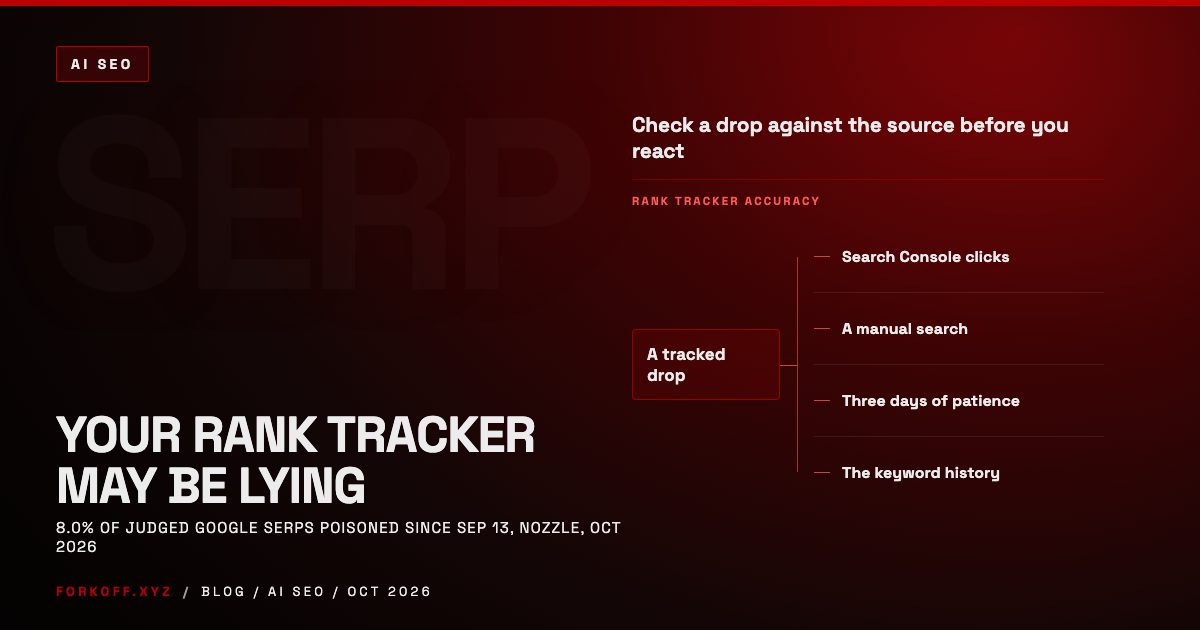
Your Rank Tracker May Be Lying: How to Report SEO and AEO After Google's Poisoned SERPs
Google is serving rank trackers poisoned SERPs. What one tracker measured, how to tell a fake drop from a real one, and how to report SEO and AEO you can trust.
 Read
Read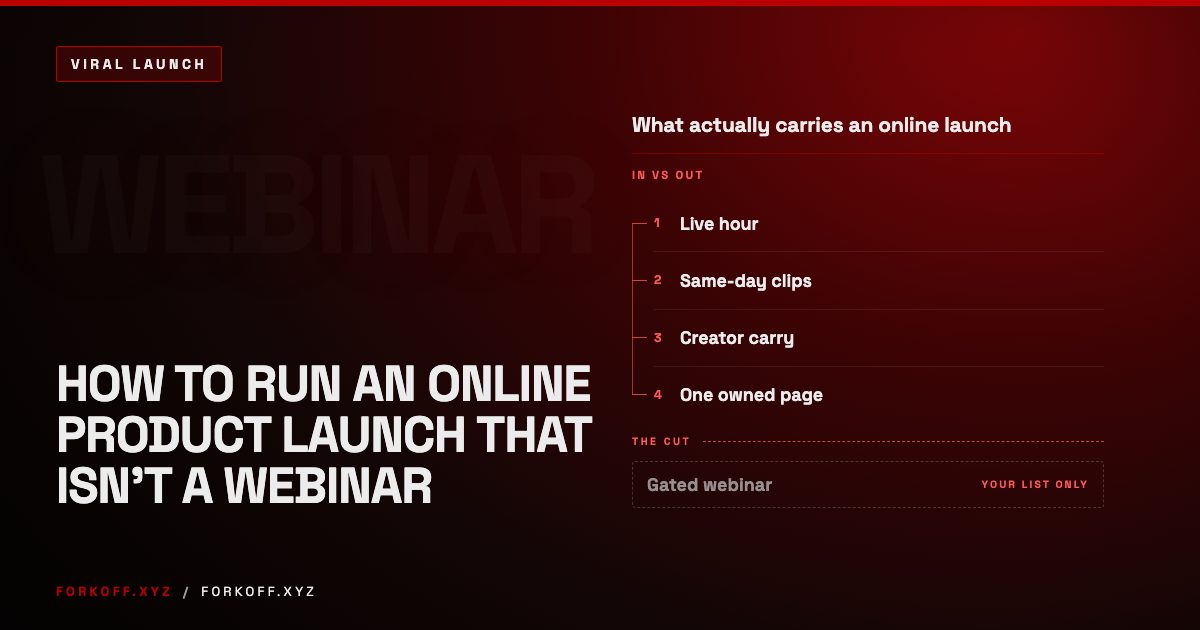
How to Run an Online Product Launch That Isn't a Webinar
An online product launch is a live moment cut into clips that creators carry, not a gated webinar. Here is the livestream, clip and creator stack for 2026.
Read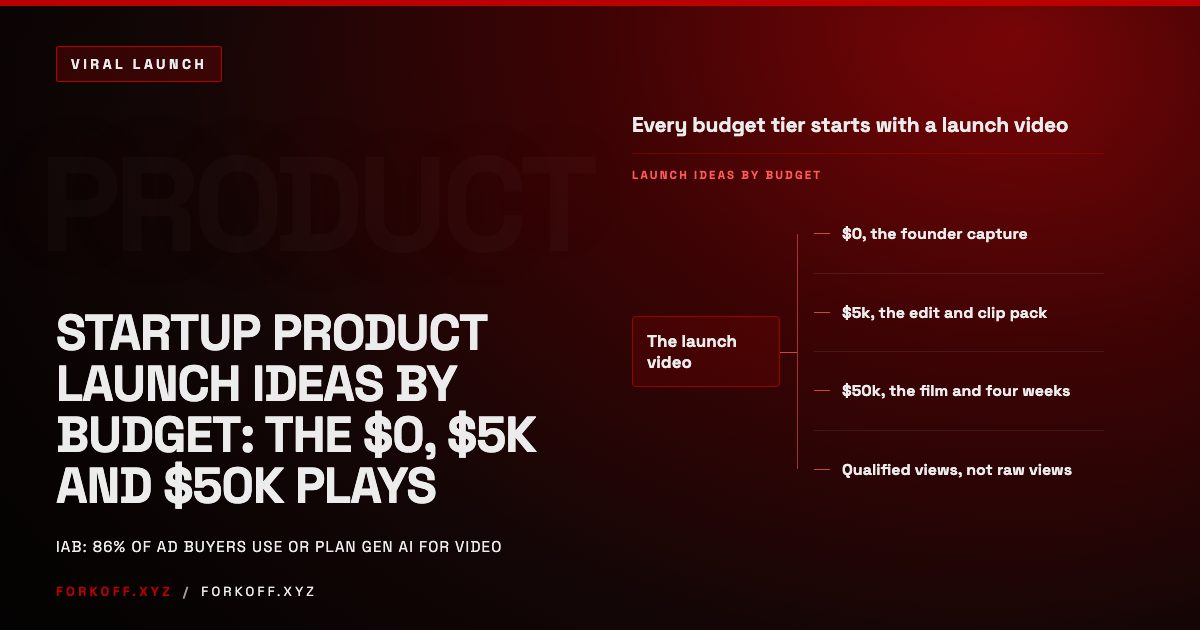
Startup Product Launch Ideas by Budget: The $0, $5k and $50k Plays
Product launch ideas for a SaaS startup sorted by budget: what the launch video should be at $0, $5k and $50k, and the distribution around it.
Read