
FORKOFF · RADAR directory
The verified organiclaunch directory
Open launch archives rank thousands of launches by raw view count and never ask whether the reach was earned. This directory does the opposite. It publishes only the launches RADAR read as genuinely organic, 10 of the 30 it tracks, each carrying its Authenticity Grade and linked to a full reading. Paying for distribution is legal and common; RADAR measures how reach was built, so the names below are the launches whose reach and engagement grew together.
What is the verified organic launch directory?
The verified organic launch directory is the set of product launches whose reach RADAR read as genuinely organic, meaning views and engagement grew together rather than the reach running ahead of the audience. Every listed launch carries an Authenticity Grade, an A for a verified organic read or a B for a largely organic one, backed by a published, reproducible method. Unlike a plain launch archive that ranks by views alone, this directory verifies reach before it names a launch, so a listing is a signal that the launch cleared the read.
What a listing on this page means
A launch appears here only after its reading came back organic. That is the whole entry criterion, and it is deliberately narrow: 10 of the 30 launches RADAR tracks clear it. The other 20 are read, published, and counted in the distribution above, but they are never named on this page. A listing is therefore a positive result, not a directory entry every launch gets by existing.
Each listing also carries a letter, and the letter is about evidence rather than performance. An A means the organic read sits on a full forensic trace of how the reach arrived. A B means the same organic read was reconstructed from the published ratio and the engagement shape without that trace. Per our own trace records, 7 of the 10 launches named here carry an A and 3 carry a B. A B is not a weaker launch. It is a weaker evidence file, and saying so is more useful than rounding it up.
Nothing on the page is a claim about a product, a company, or a founder. The products are real and the launches happened; what RADAR reads is how the reach was built. The full method, the thresholds, and the confidence rules are written out on the RADAR methodology page, and the ranked version of this same safe set is the RADAR leaderboard.
Why only the organic reads are named here
An index that names launches on the unfavorable side of a reading would be doing something different from measurement. Paying for distribution is legal and ordinary, and a single aggregate ratio is a thin basis on which to attach a company name to a negative label in a browsable list. So the index publishes the favorable side by name and reports the rest only as a share of the corpus.
The 67% that carry an amplification signature are not hidden. Each one has its own published reading with the source post cited, the signals laid out, and an explicit section on what the reading is not saying, and they are read one at a time in the launch authenticity study and summarised in the launch authenticity report. What they do not get is a scarlet letter on a scannable grid.
The practical effect is that the counts on this page carry two different weights. The named set is a list you can check launch by launch. The 67% is a distribution, a statement about the corpus rather than about any one launch in it, and it should be read that way. If a reading here is wrong, the correction path is published alongside the method rather than buried, and a corrected reading changes the list.
The corpus distribution
33% of tracked launches read cleanly organic. 67% carry an amplification signature.
Across the 30 launches RADAR tracks, 10 read cleanly organic and 20 carry a distribution-amplified signature. This is a distribution of the corpus, not a verdict on any one launch. Only the organic reads are named below; the amplified reads are counted here in aggregate and read one at a time on the launch authenticity study, where each carries the standing signature-not-accusation framing.
Independent, methodology-derived signal, not a statement of fact about any person. RADAR reads how reach was built, a signature, not an accusation. See the methodology.
33%
Read organic
67%
Amplification signature
10
Named and graded
30
Tracked launches
Why a listed launch can sit above the ratio line
Views per like is the load-bearing signal, but it is not the verdict. Across the named set the ratio runs from 98 to 2,709 with a median of 396, and the top of that range sits well above the roughly 500 views per like RADAR treats as the organic ceiling. One launch on this page clears the ceiling by a wide margin and still reads organic, and that is worth explaining rather than hiding.
The reason is that a full reading weighs four more things. Whether reach arrived on a curve that engagement followed, or in a block engagement never caught up with. Whether the written layers grew in step with the views. Whether the accounts replying and quoting read as real and spread out rather than as one cluster. And whether the quote and repost pattern looks like word of mouth or like a known amplifier ring. A very large, established account distributing to an audience far beyond its own followers produces a high ratio for an ordinary reason: most of those people scroll past without tapping like.
So the ratio is where a reading starts and not where it ends. That cuts both ways. A launch can sit comfortably inside the ceiling and still fail the coupling or the reply-network check, in which case it is not named here either. The ratio itself is benchmarked in our views-to-likes benchmark, and the wider picture of how launch videos perform sits in the state of launch videos.
Verified, not just ranked
A launch archive that ranks by view count treats a bought view and an earned view as the same thing. RADAR reads the difference. The views-to-likes method checks each launch against a roughly 500 organic ceiling, then weighs the reply and quote layers, so the directory below is a set of launches that cleared the read, not the loudest posts in a feed. A grade is an independent, methodology-derived signal of how reach was built, never a statement of fact about any person. To see how far the read reaches, the coverage breadth grid shows the same method applied across every market vertical, from AI to fintech to consumer.
What sits behind each entry
Every card links to that launch's own reading, and the readings come in two depths. Of the 10 launches named here, 10 carry a full teardown with the signals worked through one at a time, and 0 carry the shorter reading: the metrics, the band, the confidence label, and the source post. Both cite the original launch post, so any figure on this page can be checked against the thing it was read from.
The figures behind the 10 listings are public post metrics, re-pulled after the launch had settled rather than screenshotted on launch day. Per our own record of those posts, the named set carries 28.8M+ views of launch reach, 10,130 replies, and 3,907 quote posts. Replies and quotes matter more than their volume suggests, because each one is an original post somebody chose to write, which is the layer a bought view does not produce.
The named set spans 6 market verticals across 10 different accounts, with no account listed twice. The per-vertical version of that spread, including the launches that are counted but not named, is the coverage breadth grid, and the whole tracked set is indexed on the RADAR hub.
How to use the filters and the sorts
The grid below has two controls: a grade filter and a sort. The filter narrows the list to the A reads (7 launches) or the B reads (3 launches), which is the fastest way to see only the entries backed by a full trace. The sort reorders whatever the filter left. Neither control ever adds a launch that was not already in the named set.
Sort by reach when you want scale. The named set runs from 62,447 views at the small end to 7,081,850 at the large end, a median of 2,527,487, so this sort spans two orders of magnitude and the top of the list is dominated by a handful of very large launches. Sort by newest when you want recency: the named launches run from January 2026 to June 2026, inside a tracked corpus that starts in October 2025.
Sort by engagement when you want the cleanest reads rather than the biggest ones. It orders by views per like ascending, so the launches whose likes kept closest pace with their views come first, starting at 98 views per like. That ordering usually disagrees with the reach sort, which is the useful part: the launch with the most views is rarely the launch with the tightest engagement coupling. For a curated read of the strongest launch videos rather than a sortable list, see the best product launch videos.
The verified set
Verified organic launches
The launches RADAR read as organic, filter by grade and sort by reach, recency, or engagement. Each card carries the Authenticity Grade badge and links to that launch's full RADAR reading. The amplified reads are never listed here; they live in the aggregate above.
Filter by grade
Sort by
Showing 10 verified organic launches.
OpenAI's Jalapeño AI chip
@OpenAI
Cursor for iOS
@cursor_ai
Koji
@suekhim
MetaMask Money Account
@MetaMask
Short Video Overviews (NotebookLM)
@NotebookLM
Contra Payments
@contraben
Parker
@alexgoughcooper
Seed Audio 1.0
@higgsfield_ai
Browserbase Agents
@browserbase
Jupiter Wallet biometrics
@JupiterExchange
The same set, as data
The named set as a table
The same 10 launches the cards above show, laid out as rows so the numbers can be scanned down a column or copied out. Reach and views per like are the two measured figures; the letter is the evidence band, and the vertical is a product-domain tag rather than part of the reading. Ordered by reach, largest first.
| Launch | Vertical | Reach | Views per like | Grade | Launched |
|---|---|---|---|---|---|
| OpenAI's Jalapeño AI chip@OpenAI | AI | 7,081,850 | 312 | A | June 2026 |
| Cursor for iOS@cursor_ai | Dev tools | 6,434,483 | 492 | A | June 2026 |
| Koji@suekhim | Consumer & Health | 4,840,488 | 396 | B | May 2026 |
| MetaMask Money Account@MetaMask | Crypto/Web3 | 3,740,512 | 2,709 | A | June 2026 |
| Short Video Overviews (NotebookLM)@NotebookLM | AI | 2,527,487 | 211 | A | June 2026 |
| Contra Payments@contraben | Fintech | 2,275,499 | 445 | B | February 2026 |
| Parker@alexgoughcooper | Marketing & Sales | 1,632,025 | 498 | B | January 2026 |
| Seed Audio 1.0@higgsfield_ai | AI | 197,543 | 98 | A | June 2026 |
| Browserbase Agents@browserbase | Dev tools | 90,223 | 292 | A | June 2026 |
| Jupiter Wallet biometrics@JupiterExchange | Crypto/Web3 | 62,447 | 130 | A | June 2026 |
| All 10 named launches | 6 verticals | 28,882,557 | 396 median | 7 A, 3 B | January 2026 to June 2026 |
Every figure is a public post metric, re-pulled after the launch settled. Each launch name links to its own reading, where the source post is cited in full.
How an entry gets added, and when it changes
A launch reaches this page in three steps. It enters the tracked corpus when it is a public product or company launch post with complete enough public metrics to read. It is then read with the same method every other launch gets. Only if that reading comes back organic does it get named here. Most launches stop at step two, which is why the corpus holds 30 launches and this page names 10.
Timing is part of the rule. Metrics are re-pulled after a launch has settled, because a like count read in the first hour is still climbing while the impressions have largely run, and reading the two together manufactures a views-per-like gap that says nothing about how the reach was built. Nothing is modelled: where a metric is not published, the launch stays out of the corpus rather than being estimated into it.
This page is not a live feed, and it would be dishonest to present it as one. Every number here is computed at build time from one source file, which is the reason the counts on this page, the coverage grid, and the leaderboard cannot drift apart: they are three views of the same set rather than three hand-maintained lists. The tracked corpus currently spans October 2025 to June 2026. When a launch is added or a reading is corrected, every one of those surfaces moves in the same deploy.
What this directory is not saying
A listing says one thing: this launch's reach read as organically built. It is not a quality rating, not a ranking of the products, and not a statement that a launch not listed here did anything wrong. Absence from the list has three ordinary explanations before it has an interesting one, and the most common is simply that the launch was never in the corpus.
The size of the set is the honest constraint. Per our own corpus, 10 named launches drawn from 30 tracked is enough to show a method works and nowhere near enough to describe an industry. The selection also tilts: RADAR reads launches that put up enough public reach for a views-to-likes comparison to mean something, so a launch that reached a few thousand people is not missing because it read badly, it is missing because at that size the ratio is noise.
Read a listing as a signal that one launch cleared one published, checkable read. Read the 33% and 67% figures as a distribution of this corpus and not of launches in general. If you want the corpus-wide picture rather than the named set, the launch authenticity report is the right surface, and the method behind every figure on both is on the methodology page.
A view tier you can stand behind, built organic
FORKOFF has processed 5B+ views of managed distribution, and RADAR is the measurement side of that work. Our product launch video service builds a launch to a target view tier through genuine organic distribution and a make-good if it misses, never bought reach. Read the method, or talk to a strategist.
Receipts, deep dives, and playbooks.
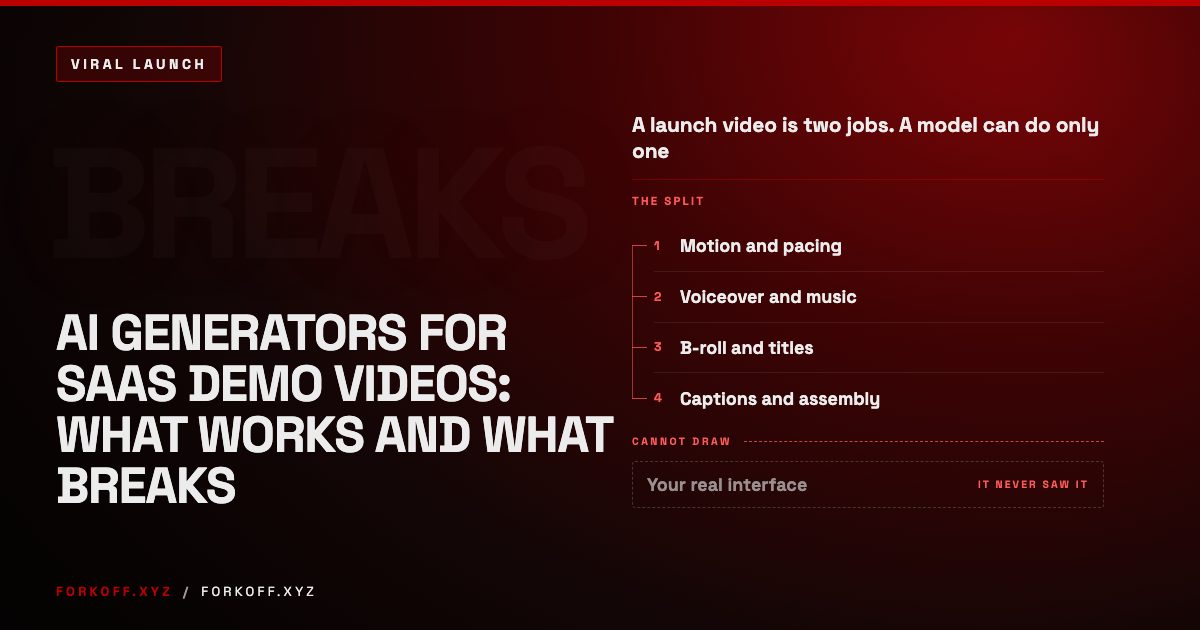
AI Generators for SaaS Demo Videos: What Works and What Breaks
AI video generators handle motion, voiceover and pacing well and draw your interface badly. Which half of a launch video to give a model, which half to keep.
 Read
Read
Why Sora Went Viral in 5 Days, and Dead in 6 Months
OpenAI's Sora beat ChatGPT to 1M downloads, then shut down 6 months later. The public download, revenue, and moderation data behind both halves.
Read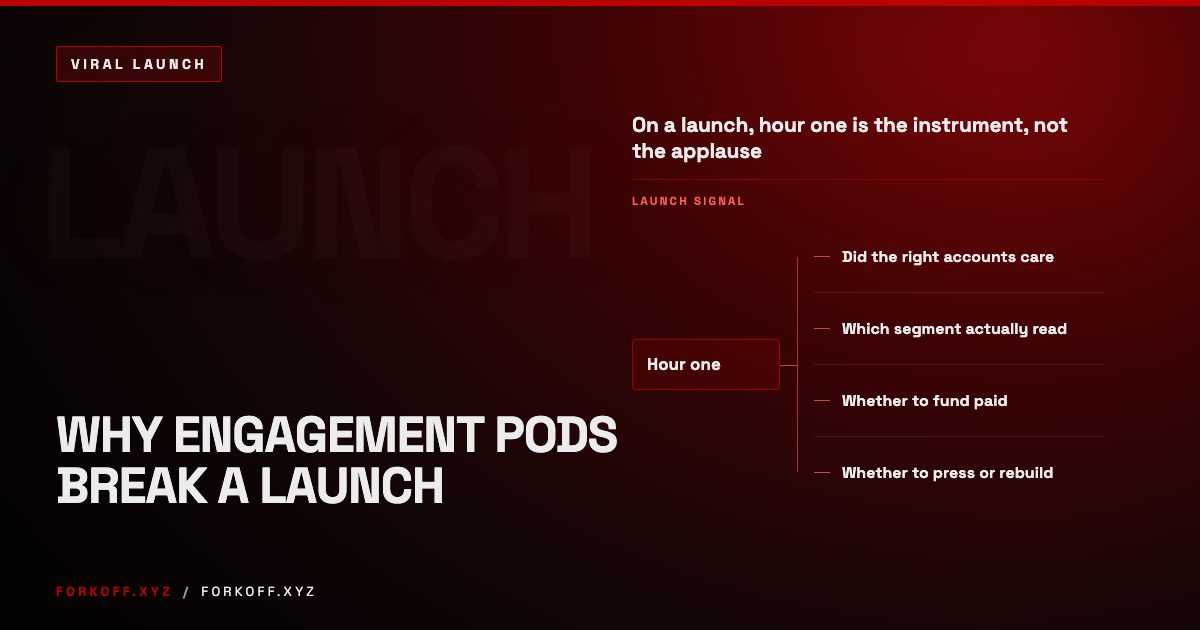
Why Engagement Pods Break a Launch
On an ordinary post a pod costs you some reach. On a launch it costs you the only measurement you had. LinkedIn's own trust VP explains where the penalty lands.
Read