A funding announcement is the coordinated set of moves that turns a closed round into distribution, not a single press mention. Run well, it compounds for weeks into brand, inbound pipeline, hires, and momentum toward the next round. Run as a lone wire release, it is gone by the next morning. This playbook is the end to end system: what to plan, the assets to build, how to distribute them across every surface, and how to measure what the raise actually returned.
What Does a Great Funding Announcement Actually Do?
A funding announcement is a distribution event, not a press release. Its job is to convert a brief attention spike into five compounding outcomes: brand recognition, inbound pipeline, hiring, sales, and momentum toward the next round. The dollar amount is the credibility ticket; the story, the specific numbers, and the coordinated rollout are what turn attention into anything durable. Run as a single wire hit, a raise evaporates in a day; run as a coordinated multi-surface event, it pays out for weeks, and the money becomes the least interesting thing about it.
A funding announcement is a distribution event
A funding announcement is a distribution event, not a press release. Its job is to convert a brief attention spike into brand, inbound pipeline, hiring, sales, and momentum toward the next round, and the dollar amount is only the credibility ticket. The spine is a coordinated multi-surface rollout: nail the narrative, sequence the stakeholders, build the content stack, run the launch-day choreography, then work the follow-up for 30 days. Run it once and the money becomes the smallest thing it buys you.
Here is the tell that the category is broken. In June 2026, Kyle Tucker closed roughly $60M for an AI legal-services rollup carrying about $25M ARR, roughly 100% growth, and around 130% net revenue retention, then went to X and asked strangers for "the latest funding-announcement/PR playbook". A founder with elite metrics and a massive check had no plan for the one moment the market was guaranteed to look at him. Within hours his thread became a live marketplace, agencies sliding into his replies to sell him the playbook he lacked. Matt Epstein pitched him mid-thread with "I'm the guy behind most viral launches in this platform I will send you a dm," and a dozen followed. The demand is so obvious a crowd formed to monetize it in an afternoon.
Kyle Tucker
@kylehtucker
can any startup/vc folks out 🙏 help me w the latest funding-announcement/PR playbook ? any dm/advice appreciated! (we just closed 60m seed/incubation round for our AI legal services rollup and super excited abt it - ~25m arr, ~100% gr, ~130% nRR and growing/acquiring arr
The sharpest reply reframed the entire problem. It was not "here is a better press release."
"This is a good problem to have, but the playbook is bigger than a press release. The announcement should become a distribution event: founder post / investor posts / customer/operator quotes / specific numbers / clear category framing / podcast/newsletter outreach / short clips / follow-up" , Korba (X)
That list is the actual product. A press release is one line item inside it, and not the most important one.
The dollar amount is the ticket, not the story
Founders fixate on the number because the number is what closed. But it is the least portable part of the news. Everyone raises. What makes a customer, a candidate, or a future investor stop scrolling is why the raise happened and where the company is going.
"This is why 'we raised $X' is the least interesting part of the story." , Mike Annunziata (Also, Substack)
Annunziata's point: a well-built announcement makes a startup legible at the moment attention briefly spikes. The raise is why people show up. The narrative is why they remember you, follow you, apply, or reply to your sales email three weeks later. Treat the amount as the invitation and the story as the party.
The five outcomes, named
Run the announcement as an event and it drives five things at once. Skip the coordination and you get one press mention and a dead thread.
- Brand recognition. A coordinated rollout puts your category framing in front of thousands of relevant people in one window, cheaper attention than you will buy for months. This is the distribution reset every founder is now planning around.
- Inbound pipeline. Buyers passively aware of you now have a reason to book a call. A raise is social proof that you will still exist in twelve months, half the enterprise objection handled for free.
- Hiring. Senior operators track raises the way recruiters do. The announcement is your highest-signal recruiting ad, and it is free, the kind of moment a real founder-led growth engine is built to capture.
- Sales. For B2B, the raise de-risks the vendor decision. For crypto and consumer, it seeds the "serious player" perception that pulls users in.
- Next-round capital. Investors pattern-match on momentum. OBA PR credits First Round data with roughly 2.7x higher response rates and about 40% faster time to close for founders who built press momentum. A well-run announcement starts the next raise a year early.
The operational version of this thesis is not "post more." It is process.
"Treat your funding announcement as a GTM event, with the same rigor you'd have as your sales motion or fundraising process." , Dylan Reider (Infinite Runway)
You would not run your sales motion off a single tweet and hope. You would sequence it, instrument it, and follow up. The announcement gets the same treatment or it wastes the one moment you were guaranteed an audience. The rest of this playbook is how to run that event.
Should You Even Announce Your Round?
Announce when the raise adds credibility you can convert (hiring, enterprise pipeline, next-round momentum) and you have either owned distribution or a story a journalist can write. Do NOT announce a bridge, flat, or down round, a raise too small or early to be news, anything under an investor confidentiality request, or a round where attention invites scrutiny you are not ready for. There is also a legal clock: once you file a Form D with the SEC, that filing becomes public within 15 days, so announce before the filing surfaces and controls your narrative. The default is not "announce everything." It is "announce what you can convert."
When should a founder announce their fundraise?
Z47 Moments
Z47 on when a founder should announce their fundraise, the timing and should-you-announce decision.
The reasons to stay quiet
A raise is not automatically good news to broadcast. Some rounds are better left off the wire.
- Bridge, flat, and down rounds. A bridge reads as "we did not hit the milestone for a priced round." A flat or down round makes the number the story in the worst way. If the amount or the terms tell a story you do not want told, do not tell it.
- Confidentiality requests. Some investors, especially at pre-seed or in strategic corporate rounds, prefer no announcement. Honor it. A lead relationship is worth more than a press hit.
- Stealth by design. If your moat is that competitors do not know what you are building, a funding announcement hands them your roadmap and your runway.
- Too small or too early to be news. Coverage odds fall off a cliff below the mid-seven-figures, and roughly speaking fewer than one in six Series A raises earns major-outlet coverage, with seed far lower (a working estimate from what actually lands, not a promise). If you have no audience and no journalist angle, "announcing" to no one is just silence with extra steps.
Funding alone rarely earns coverage
Roughly fewer than one in six Series A raises earns major-outlet coverage, and seed is far lower. Coverage odds fall off a cliff below the mid-seven-figures. If you have no audience and no genuine journalist angle, the honest move is to go small or stay quiet rather than announce to no one.
Source: Working estimate from what actually lands, cross-checked with TechCrunch reporting
The most useful skeptic here is someone who read these pitches for a living.
I'm usually finding myself trying to talk early-stage, pre-product founders out of doing press releases.
Kamps, who sat on the newsroom side, argues that for most pre-product founders the raise is simply not newsworthy, and the honest move is to skip the release. His alternative is almost a punchline: for many early founders, "it's often better to spend a couple of hundred dollars on a bottle of champagne" than to chase press. Take the steelman seriously. If you are pre-product with no distribution, the machine in this playbook is not for you yet. Celebrate privately and build.
The Form D clock forces your hand
Even if you decide to announce, the SEC decides your timing floor. Most priced US rounds require a public Form D filing. The classic insider move, from the TechCrunch reference on this, is to file late on day 15 and get your announcement out first, so your framing lands before a database scraper or a "funding roundup" bot turns your raise into a one-line commodity you did not write. Let the filing break the news and you lose the narrative; announce first and the filing just corroborates you.
The decision rule
Announce if you can answer yes to both: (1) the raise, its terms, or its investors add credibility you can convert into hiring, pipeline, or next-round momentum, and (2) you can reach the right people, either owned distribution or a genuine journalist angle (a real "why now," a named lead, a number worth quoting). Yes to only one: go small, a single founder post, no machine. Yes to neither, or the round is a bridge, flat, down, confidential, or stealth-critical: do not announce. Silence is a valid strategy. A botched announcement is not.
The contrarians on Kyle's thread who said "just tweet it, back to building" are right for exactly one profile: the founder who already owns an audience. For everyone else, going direct with no distribution is indistinguishable from saying nothing. Next: how to decide what winning means before you touch a channel.
Set Goals and Define Success Before You Pick Tactics
Before you choose a channel, name the two or three outcomes this announcement must drive and attach a measurable target to each. Different goals demand different channels: a hiring goal lives on LinkedIn and X, measured in qualified applications; an enterprise-pipeline goal lives in tier-1 press plus targeted founder outreach, measured in booked calls; a developer-signup goal lives on Reddit, Hacker News, and a launch video, measured in activations; an investor-FOMO goal lives in earned media and VC amplification, measured in inbound investor meetings. Pick tactics to serve the goal. Picking channels first, then reverse-engineering a goal, is how announcements end up loud and useless.
Announce Your Round to Raise More
Ash Rust
Ash Rust on announcing your round to raise more, framing the announcement around the goal before the tactics.
Set the goals, then the numbers
The spine every strong announcement starts from is dull and correct: decide what success looks like, in numbers, first. Set targets across three buckets.
- Audience growth. Followers, subscribers, community members. In crypto, Telegram and Discord plus X followers and Kaito mindshare; in SaaS, newsletter subscribers and LinkedIn followers; in AI, waitlist and GitHub stars.
- Coverage. Number and caliber of publications, podcasts, or newsletters. Not "get press," but "one tier-1 exclusive plus three trade mentions."
- Conversion. The outcome that pays rent: inbound demo requests, qualified applicants, developer activations, investor meetings. This is the bucket most founders forget to set a number for, which is why most announcements cannot prove they did anything.
Write the targets down before you build a single asset. A target of "3,000 profile visits, 40 inbound DMs, 15 qualified applicants, 8 sales calls" turns "let's make noise" into a campaign you can grade.
Assess your resources honestly
Ambition has to match bandwidth. A five-surface rollout with a launch video, a press exclusive, and a friendlies quote-retweet group is a real production across project management, copywriting, and design. If it is you and one marketer the week after a raise, you will ship four of the nine pieces badly.
Scope to what you can execute well. A tight three-channel announcement that lands beats a nine-channel plan that half-ships. This is also the decision point for outside help: a PR agency or a distribution partner to run the launch is worth it when the raise justifies the spend and you lack the internal hands.
PR agency vs DIY vs one-campaign, by round size
| Path | Best-fit round | What you get | Watch-out |
|---|---|---|---|
| DIY founder-led | Pre-seed to small seed | Owned channels and founder voice | Caps at the reach you already own |
| One-campaign PR | Seed to Series A | A scoped announcement push and media list | Only worth it if the news is real |
| Ongoing retainer | Series A and up with steady news | Continuous exposure and pitching | Wasted if you will not keep generating news |
Calibrate spend to the goal and news cadence, not vanity. Per peter kris on X, a one-campaign engagement is a clean scope; ongoing fits only if you keep generating news.
"get a PR agency and try to do one-campaign engagement, they will answer all those questions. 60m is sizeable budget, so maybe ongoing work might fit, but that depends on if you can generate interesting news." , peter kris (X)
Calibrate spend to the goal and news cadence, not vanity. A one-campaign engagement for the announcement is a clean scope; an ongoing retainer only makes sense if you will keep generating news.
Different goals, different playbooks
Media strategy should follow the goal, not reflex.
TechCrunch still matters, but it's no longer the default. If your goal is investor credibility, especially if you're raising again soon, TechCrunch may still be a strong choice.
Read that as a rule, not a plug for one outlet. For next-round investor credibility, tier-1 earned media earns its cost. For developer adoption, a Reddit and Hacker News plan plus a launch video beats any magazine. For enterprise pipeline, a named-account outreach wave tied to the raise beats broad reach. The point is upstream: you cannot instrument what you never defined. Set the two or three outcomes, attach the numbers, size the plan to your team, then decide who hears about it first.
Who Should You Tell First? Stakeholder Sequencing
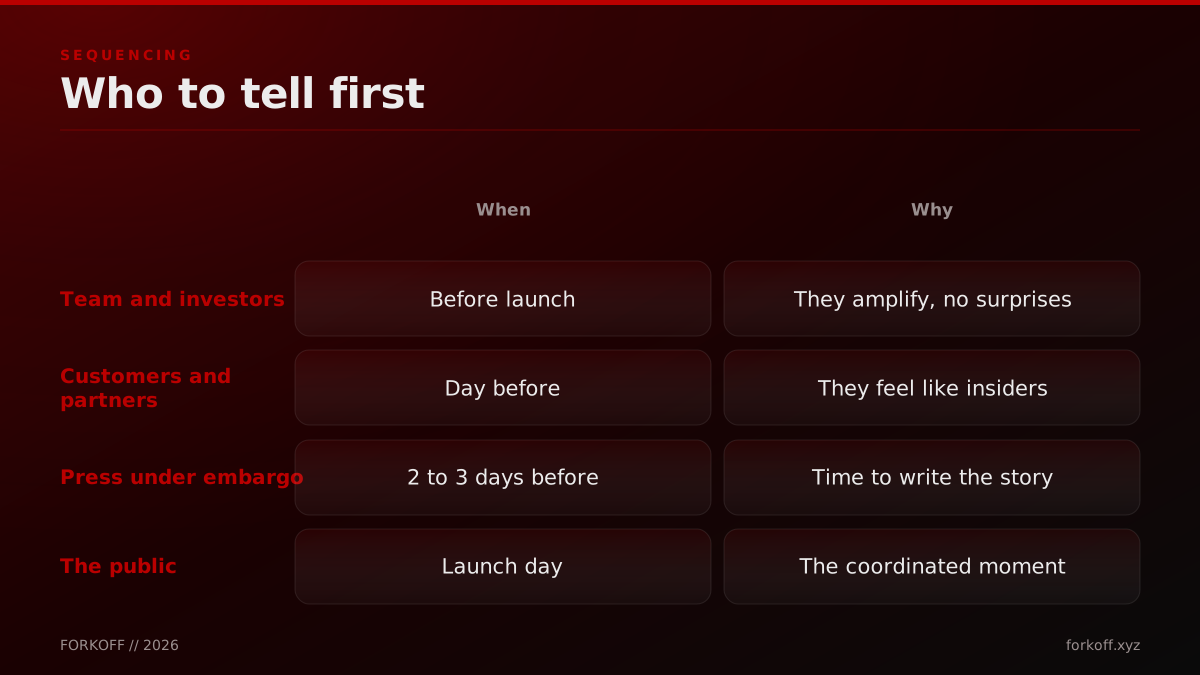
The order is fixed: employees and existing investors first, then customers and close partners, then press under embargo, then the public on launch day. The logic is trust and control. The people most invested in you should never learn you raised from a tweet or a TechCrunch alert, and journalists need lead time under embargo to write something real. Get the order wrong and a good-news moment becomes a trust problem: a blindsided employee, an investor who feels leaked-on, a customer who hears it from a competitor. The sequence costs nothing and protects the one thing an announcement is supposed to build.
Why order is the whole game
An announcement touches everyone who has bet on you, and each group needs the news framed for them in the right window. The stakeholder-sequencing discipline the sharper 2026 guides call out is simple: brief the inner circle before the outer one, always. A team member learning of the raise from a push notification reads it as "I am not really on the inside." A customer hearing it from a headline instead of their account owner reads it as "they were too busy for me." Both are unforced errors.
The mechanic that makes the outer ring work: before you go public, build and line up the friendlies (advisors, angels, investors, power users, partners) you will ask to amplify. In crypto that is a Telegram group assembled to quote-retweet the minute it drops; in SaaS or fintech, a short list of investors and design partners you pre-briefed and asked to reshare. Either way, amplifiers are told before the public so the launch has a coordinated first hour instead of a cold start, the distribution move sharp marketing teams now run by default.
The sequence
| Stakeholder | When | How | Why |
|---|---|---|---|
| Employees | T-minus 3 to 7 days | All-hands or written note from the founder | They are the most invested; blindsiding the team damages trust and they are your first amplifiers |
| Existing investors | T-minus 3 to 7 days | Direct note; confirm quotes and reshare plans | They may have confidentiality preferences and are your highest-signal amplifiers |
| Friendlies (advisors, angels, power users, partners) | T-minus 2 to 5 days | Private group (Telegram/Slack/email) with the assets pre-loaded | Line up the quote-retweet and reshare wave so hour one is loud, not silent |
| Key customers and design partners | T-minus 1 to 3 days | Personal note from their account owner | They must hear it from you, not a headline; a raise de-risks their bet on you |
| Press | T-minus 2 to 7 days, under embargo | Exclusive or embargoed pitch with the full kit | Journalists need lead time to write something real; embargo controls the break |
| The public | Launch day, T-zero | Founder post, hook tweet, blog, video, coordinated amplification | The event itself, timed before the Form D filing surfaces |
The TechCrunch reference frames the press slot correctly: give the reporter enough lead time to work the story, because a rushed pitch gets a rushed rewrite of your release, if anything. Two to seven days under embargo is the working range, longer for a real feature, shorter for a same-week exclusive.
Get the inner ring wrong and nothing else matters
You can produce a flawless launch video and land a tier-1 exclusive and still poison the well by letting your best engineer find out about the raise on X. The sequence is not bureaucracy. It is the cheapest trust insurance you will buy, and it doubles as your amplification setup: every person you brief early is primed to reshare on cue. Tell the inner ring first, arm the friendlies, brief the press under embargo, then go loud with the whole network ready to move in the same hour. That coordinated first hour separates an announcement that trends from one that trickles.
Operator noteArm every friendly with copy-paste language and a posting window before launch, so hour one is a wave, not a cold start., FORKOFF distribution runs
Nail the Narrative: Company Story, Founder Story, and Why Now
The raise is the ticket, the narrative is the show. A funding announcement that compounds is built on three story layers in order: the company narrative (what world you are building and for whom), the founder story (why you are the person to build it), and the "why now" plus category framing (what changed that makes this inevitable this year). The dollar figure is a credibility signal, not the plot. As Mike Annunziata puts it, "we raised $X" is the least interesting part of the story; a well-crafted announcement exists to make a startup "legible at a moment when attention briefly spikes." Nail the narrative before you touch an asset, because every tweet, press pitch, and video inherits it.
The three layers, generalized across verticals
The Notion brand-storytelling brainstorm is a fast way to force clarity. Answer these in one sitting, out loud, before you write copy.
Company narrative: describe your company to three different people, an investor, a user, and someone with zero context. If the three descriptions do not share a spine, you do not have a narrative yet. Then answer: what unique value you offer, what the world looks like when you win, and what you want people to feel.
Founder story: what is your professional origin, how do you aim to change your field, what are your core values, and what phrases do you want associated with you. This is not a resume. It is the reason a customer, a hire, or a next-round investor trusts you with the mission, and the raw material for all your founder-led content.
Why now plus category: what shifted (a regulation, a model capability, a cost curve, a behavior change) that makes the market ready now and not two years ago. Category framing is where you stake the positioning competitors have to respond to.
Well crafted funding announcements help make a startup legible at a moment when attention briefly spikes.
The running example: why Kyle's raise is a narrative problem, not a PR problem
Kyle Tucker closed roughly $60M for an AI legal-services rollup, at approximately $25M ARR, near 100% growth, and around 130% net revenue retention, then asked X for a playbook. Elite metrics, but a raise number plus great metrics is still not a story. His "why now": AI can now do the document-heavy work that made legal services impossible to roll up profitably, and the retention figure proves clients stay once migrated. That "why now" is the load-bearing sentence. Without it, $60M is a headline that evaporates in a day.
Weak versus strong narrative
The gap is concrete. Watch the same raise told two ways across three verticals.
| Vertical | Weak (money-first) | Strong (why-now-first) |
|---|---|---|
| AI | "We raised $60M to build AI for legal services." | "Legal work was too document-heavy to roll up profitably. AI changed the unit economics. We raised roughly $60M to consolidate a fragmented market before incumbents notice, and our clients already renew at ~130% net retention." |
| SaaS | "We closed a $12M Series A to grow our platform." | "Finance teams still reconcile spend in spreadsheets. We turned that into a live system, hit seven-figure ARR in 14 months, and raised $12M to reach every team drowning in month-end close." |
| Fintech | "We raised $20M to expand our payments product." | "Cross-border payouts still take three days and lose 4% to fees. We settle in minutes. We raised $20M to bring that to the next 50 markets, starting where the friction is worst." |
The weak version leads with the raise and asks the reader to care. The strong version leads with a tension the reader already feels, then uses the raise as proof the fix is funded. The strong versions carry a number and a specific "why now," which is what a customer forwards, a recruit screenshots, and an AI answer engine lifts as a citable claim.
The discipline: write the "why now" sentence first, in one line, with a number in it. If you cannot, you are not ready to announce. Everything in the content stack that follows (hook tweet, founder blog, press release, launch video) is this narrative rendered into different formats for different surfaces. Get the three layers right once, and the rest of the rollout stops feeling like guesswork.
The Core Content Stack: Every Asset You Need
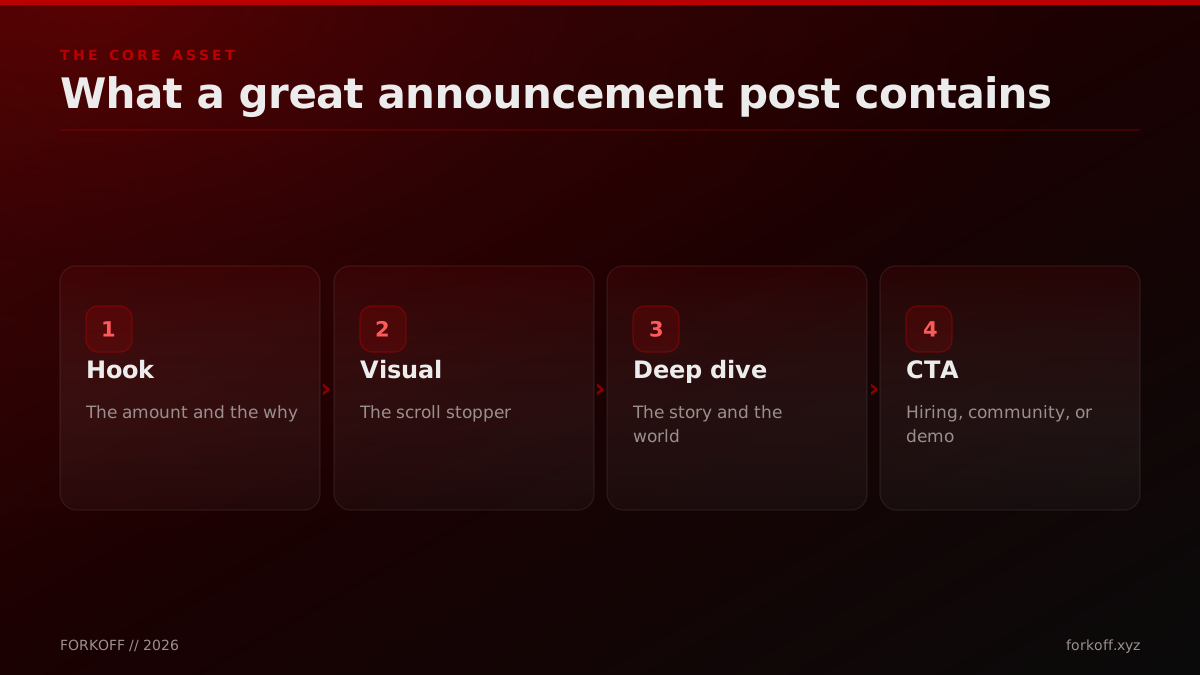
The content stack is the fixed kit every announcement ships, regardless of round size or vertical: a hook tweet (amount plus lead investor plus the narrative hook), a scroll-stopping visual, a deep dive (founder blog plus X thread), two to three investor quotes, one or two customer or operator quotes, specific numbers throughout, and one clear call to action. Build all of it before launch day, because the announcement is a coordinated release, not a live improvisation. As Korba framed it on the Kyle Tucker thread, the announcement should become "a distribution event: founder post / investor posts / customer/operator quotes / specific numbers / clear category framing / podcast/newsletter outreach / short clips / follow-up." Miss one asset and the whole thing thins out.
The anatomy, asset by asset
Hook tweet: your opening post combines the fundraise details (the amount, the lead investor tag) with your narrative hook (what the raise is for). This is the piece that gets quote-retweeted, so it carries the weight. Lead with tension or a number, not "excited to announce."
Visual impact: the graphic or short video that stops the scroll. Make it brand-aligned and put the raise amount and investor lineup on it boldly, because most people see the image before they read a word.
Deep dive: the founder blog post and the matching X thread built to go viral on Twitter that tell your story so far and the world you are building toward. This is where the three narrative layers from the previous section live in full. It is also your canonical, linkable, indexable home for the news, which matters for search and AI citation.
CTA: end with purpose. Give the audience one next step, join the community, see open roles, book a demo, or try the product. A raise post with no CTA wastes the one day your profile gets extra traffic.
"The announcement should become a distribution event: founder post / investor posts / customer/operator quotes / specific numbers / clear category framing / podcast/newsletter outreach / short clips / follow-up." , Korba (X)
The press release: written like news, not a brochure
Even in a distribution-first world, the press release earns its place. It forces message discipline and, as one r/startups operator noted, writing one "generates an artificial deadline that adds exclusivity and urgency to communications with journalists." The format is fixed: amount, round stage, and lead investor in the first sentence, then use of funds, a CEO quote, a lead-investor quote, and the boilerplate. Keep it to roughly 400 to 600 words and write it like a reporter, not marketing copy. Alexander laid out the same motion cleanly:
"draft a 1-2 pg press release / find journalists covering rollups (and their x/LinkedIn/email) / send your press release and ask if they want to do an exclusive." , Alexander (@Alex_Badalyan)
10 highly practical startup marketing tips that have helped to grow a SaaS product to 30,000+ paying customers
When you market tech products like Skype and Pipedrive for 10+ years you'll pick up techniques, best practices and tips that work almost always. I wrote them down because each of them has proven valuable in conversations with people that are marketing startups in one way or another.
Do not reinvent the templates
Two reference classes save days. For the founder-direct email and social angle, the userlist swipe file collects 10-plus real startup round-announcement emails you can adapt line by line. For the press release, PRLab's funding-announcement template gives a structure and worked examples matching the amount-first format above. Pull the skeleton, then rewrite every sentence in your own voice.
Numbers are the connective tissue
Every asset gets stronger with a specific number. The hook tweet carries the raise and one metric, the visual the amount, the deep dive growth or retention, the quotes proof. Vague announcements ("strong momentum," "rapid growth") get skimmed; concrete ones get forwarded and cited. When Kyle can say roughly $25M ARR at around 130% net retention, that pair does more work than three paragraphs of adjectives. Thread the same two or three numbers through the whole stack and the rollout reads as one coherent event, not seven disconnected posts.
Creative Assets and the 2026 Launch-Video Layer
The biggest 2026 shift in funding announcements is the launch video moving from talking-head to creative, the single layer every incumbent guide names but never teaches. Subah Wadhwani flagged it in reply to Kyle: "explore doing a launch video. the paradigm is shifting from standard talking head videos to more creative approaches." A strong launch video is not a founder monologue to a webcam. It is a produced piece engineered for a specific hook, format, and distribution path, and in FORKOFF's experience it is the difference between a raise that gets a few thousand impressions and one that crosses a million.
The hook library and the format menu
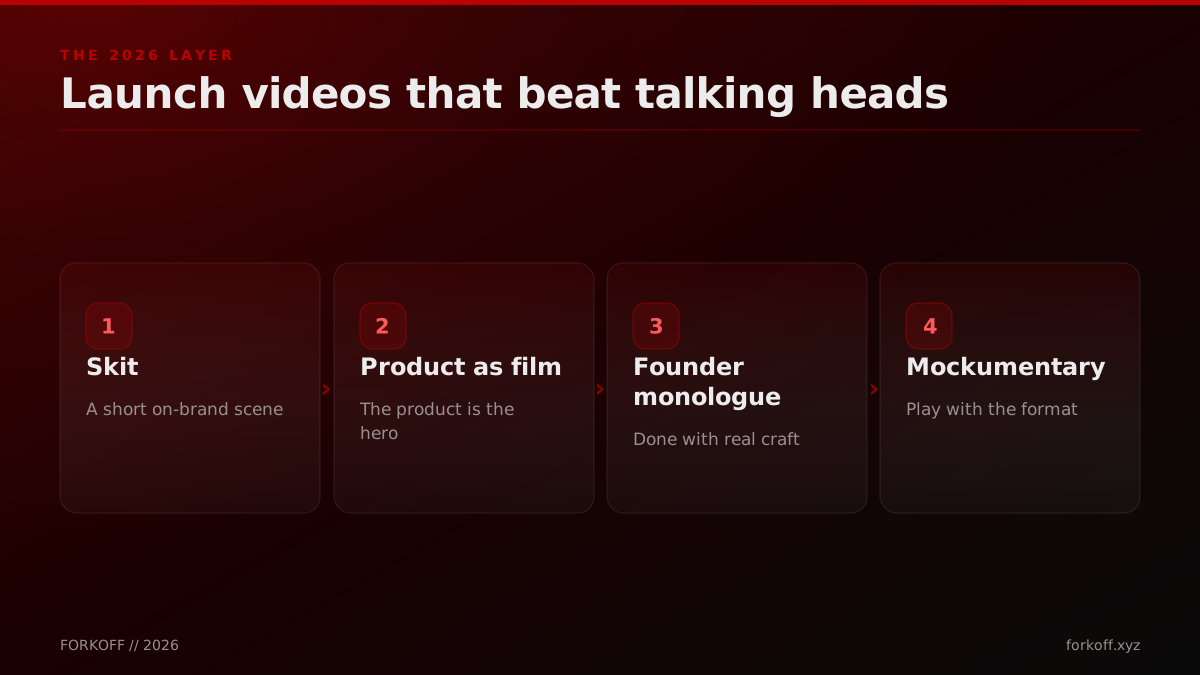
The first one to two seconds decide everything. Before you shoot, run the launch-video readiness checklist and write ten hooks, then pick the sharpest: a bold on-screen claim, a visual pattern-break, a "here is what nobody tells you about X," a number card, or a cold open mid-action. Then choose a format that fits your story rather than defaulting to the talking head.
- Skit: a short scripted scene dramatizing the problem you solve. Works for consumer, fintech, and horizontal SaaS.
- Product-demo-as-film: the product is the star, shot cinematically instead of as a screen recording. Strong for dev tools and AI.
- Founder monologue done well: still viable, but scripted, lit, cut tight, and built around one idea, not a rambling update.
- Mockumentary: satirical, high-shareability, best when your brand can carry irreverence.
Budget tiers and hire versus DIY
Match spend to your round and your bench, and know what a launch video actually costs before you commit. A DIY tier (roughly a few hundred to a couple thousand dollars) is a phone, decent lighting, and tight editing, enough for a founder monologue or simple demo. A mid tier adds a freelance editor and scriptwriter; a studio tier is a specialist team producing a skit or film. The people behind the biggest launch videos are specialists for a reason. As Jess noted, "matt and his team are the folks behind the millions of views on many of the big startup launch videos," pointing at Matt Epstein, who pitched Kyle in-thread as the swarm rushed to sell him the playbook he lacked. The rule of thumb: DIY if you have taste and time, hire a specialist video team if the raise is large and the video is the centerpiece.
"explore doing a launch video. the paradigm is shifting from standard talking head videos to more creative approaches." , Subah Wadhwani (@subahwadhwani)
Subah Wadhwani
@subahwadhwani
@kylehtucker hey kyle, happy to help. congrats on the insane round! 1/ explore doing a launch video. the paradigm is shifting from standard talking head videos to more creative approaches. would love to learn more about what you're building to determine the best creative here.… Show more
The part everyone skips: distribution to 1M+ views
A great video that nobody warms up for dies at 3,000 views. The distribution mechanics matter as much as the creative. Based on FORKOFF's launch-video work and launch-video teardowns of hits that crossed the million-view line (MaveHealth at roughly 2.61M, Composio at roughly 2.05M, and Lica at roughly 1.44M, per our analysis), three moves recur:
- Warm-up: spend the two weeks before launch posting into the exact conversation your video lives in, so the algorithm and the audience already know you when the video drops. A cold account posting a big video gets no distribution.
- Wave-riding: launch alongside a trend or a live debate the video can attach to, and monitor for the wave in real time so you can amplify while attention is already flowing.
- Cluster tagging: identify the tight cluster of accounts (peers, investors, recap accounts, debate principals) whose reposts unlock a new audience, and give them a reason to share, usually by being genuinely good or by tagging the debate they already care about.
This is squarely FORKOFF's wheelhouse. The clipping and distribution network has processed 5B+ views, and the launch-video layer is the coordinated, outcome-priced work that turns a raise into a distribution moment instead of a press hit. You do not have to run it with us, but you do have to run it, because the video is only half the asset. The other half is the warm-up, the wave, and the cluster, which the guides that say "do a launch video" never mention.
Media Strategy: Press, Exclusives, and the Journalist Motion
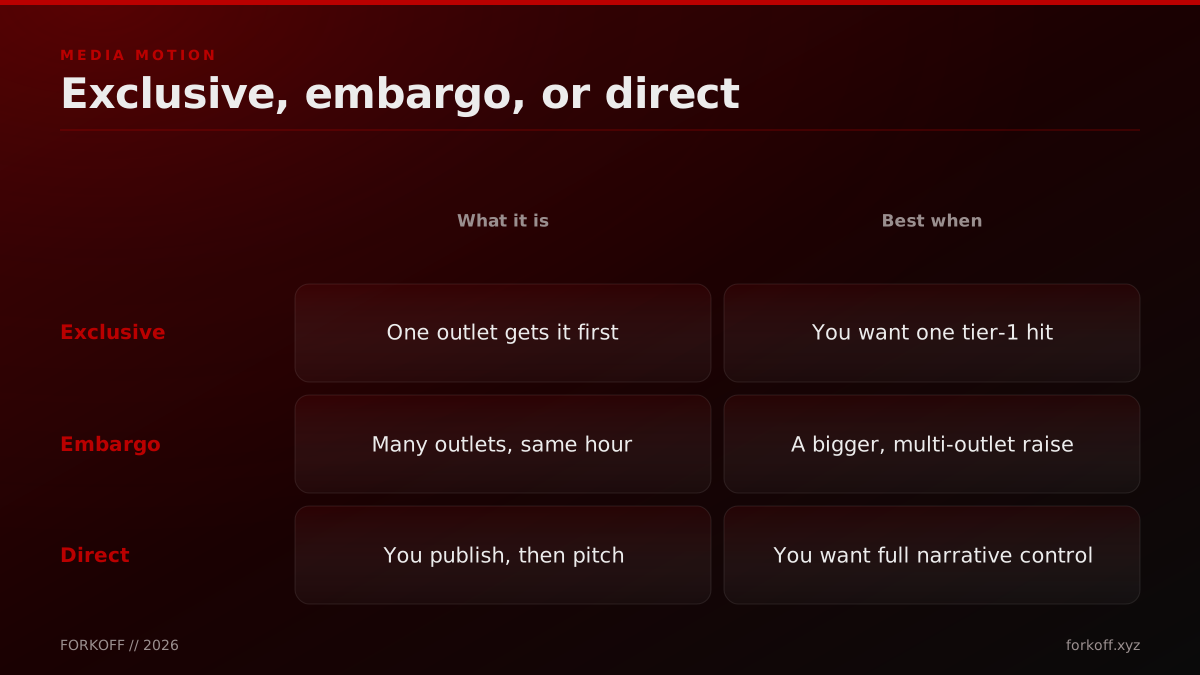
Media strategy starts with one decision, your media motion, then runs like a process. Three options: an exclusive (one outlet, one reporter, first access for a committed story), an embargo (several outlets under a "do not publish before" time so coverage lands together), or a direct announcement (skip the press cycle, publish it yourself, and let your owned and alternative launch surfaces carry it). Pick by goal, not reflex. And keep the wire in perspective: wire-distributed releases have roughly a 2 to 3% pickup rate, so a paid wire blast is corroboration and SEO, not coverage. The reflex "get TechCrunch" is over. As Heather Sliwinski puts it, "TechCrunch still matters, but it's no longer the default... choose media by goal."
The three motions, side by side
| Motion | What is it | Pros | Cons |
|---|---|---|---|
| Exclusive Coverage | One reporter at one outlet gets the story first, in exchange for a committed, dedicated piece. | Deeper, higher-quality story; the reporter is invested; the most common and reliable seed-stage motion. | Only one outlet; if the reporter passes or the piece underdelivers, you have burned the news; requires a strong single relationship. |
| Embargo Announcement | Multiple outlets get the news early under a shared publish time, so coverage breaks together. | Coordinated wave of coverage; broader reach on the same day; good for larger, multi-outlet rounds. | Embargoes break; harder to secure with several outlets; each piece tends to be shorter and less committed than an exclusive. |
| Direct Announcement | You publish the news yourself across owned channels and founder-direct social, no press intermediary. | Full control of narrative and timing; fast; compounds your own audience; no dependency on journalists. | No third-party credibility signal; reach is capped by the distribution you already own; invisible if you have no audience. |
Exclusive vs embargo vs wire, pickup and control
| Motion | How it works | Pickup | Narrative control |
|---|---|---|---|
| Exclusive | One outlet gets it first | One committed story | High, one reporter invested |
| Embargo | Many outlets under one publish time | Coordinated same-day wave | Medium, coverage can vary |
| Wire distribution | Blasted to a database | Roughly 2 to 3 percent | Low, corroboration and SEO only |
| Direct | You publish it yourself | Capped by your own reach | Full, no intermediary |
Wire pickup rate roughly 2 to 3 percent, per shadow.inc. Treat the wire as a citable record, not coverage.
Journalist targeting and story-fit
The motion only works if you pitch the right person. Find journalists who cover your beat (your stage, your vertical, your kind of story) and know their recent pieces. Story-fit beats outlet prestige: a reporter who covers rollups will care about Kyle's raise; a general tech reporter will not. Alexander compressed the motion into four steps:
"draft a 1-2 pg press release / find journalists covering rollups (and their x/LinkedIn/email) / send your press release and ask if they want to do an exclusive. if yes, consider doing it." , Alexander (@Alex_Badalyan)
How to Announce Your Seed Funding
Underscore VC
Underscore VC on how to announce your seed funding, the media-strategy view from the investor side.
The pitch email and media training basics
Keep the pitch short: a subject line with the amount and the hook, two sentences on why now, the numbers, the lead investor, and a clear ask ("want the exclusive?"). Offer something specific: first access, data, or a customer to talk to. If you land the interview, prep it like a sales call: know your three key messages, have your numbers memorized, bridge back to the story you want told, and never say anything you would not want printed.
The wire reality and choosing by goal
Do not confuse distribution with coverage. A wire release goes to a database; roughly 2 to 3% get picked up. Use the wire to create a citable record, not to generate the story. And weigh the goal before you chase a tier-1 hit. As one Hacker News operator put it, "TC might be worthwhile for funding announcements, but I'd never use it for a product announcement," rdl (Hacker News). Press is one input into a distribution event, valuable mostly for the credibility it lends to hiring and the next raise. For investor credibility on a round you will raise again soon, an exclusive earns its cost; for inbound and reach, your own channels and a coordinated wave usually outperform a single press hit. Match the motion to the outcome and treat coverage as a means, not the scoreboard.
The wire is corroboration, not coverage
Wire-distributed press releases get picked up roughly 2 to 3 percent of the time. A paid wire blast creates a citable record and some SEO, but it does not generate the story. Use it to corroborate the news after your own coordinated push, not as the mechanism that lands coverage.
Source: shadow.inc, How to Announce a Funding Round
Operator notePick one media motion before you pitch: exclusive for a deep single hit, embargo for a bigger round, direct when you own reach.
VC and Investor Amplification
Your investors are the highest-credibility, lowest-cost amplifiers you will ever have, and most founders barely use them. The people who just wired you money have a direct financial stake in the announcement landing, a following of other founders and LPs, and the one thing you cannot manufacture: third-party validation. The move is not "tag your VC and hope." Get your lead investor to publish the thesis (why they backed you, in their own voice), line up participating funds and angels to quote-retweet with real commentary instead of a bare repost, and stand up a briefed "friendlies" group chat before launch so amplification fires in a tight window instead of trickling over a week. Alex Angeline puts investor amplification first in the stack, ahead of tier-1 press.
"Depending on your VC, having them put out post/write-up on the deal, thesis, reason for backing is typically effective. Second to that, would try to get a mention/feature in Pro Rata, Bloomberg/WSJ, and TechCrunch." , Alex Angeline (X)
Read the order there. The VC write-up comes first because it is the cheapest credibility you can buy (one email) and the most durable. A journalist mention is a spike; an investor's public thesis on why they backed the category is an evergreen asset that recruits, customers, and your next round all read later.
Get the lead VC to publish the thesis, not a congratulations
A "congrats to the team" tweet from your lead is worth almost nothing. The asset you want is a written thesis: the market shift they are betting on, the specific reason they picked you over the others they saw, and one number that proves traction. That post does work a press release cannot, answering the question every skeptical reader has ("why is smart money in this?") from the mouth of the smart money. Ask for it three weeks out, offer to draft a version they can edit (partners are busy and often ship your draft with light changes), and get a firm publish time so it slots into your sequence rather than landing two days late. OBA PR, citing First Round data, reports founders with real media and investor momentum see roughly 2.7x higher response rates and about 40% faster time to close on the next round. The investor's public voice is a compounding fundraising asset, not a vanity retweet.
Press momentum compounds into the next round
OBA PR, citing First Round data, reports founders with real media and investor momentum see roughly 2.7x higher response rates and about 40 percent faster time to close on the next raise. An investor's public thesis on why they backed you is a compounding fundraising asset, not a vanity retweet.
Source: OBA PR, citing First Round data
Participating investors and angels: commentary, not a bare repost
Every fund and angel on the cap table is a distribution node. A bare retweet gets suppressed by the algorithm and skimmed by humans; a quote-retweet with two sentences of specific commentary ("I put in because X team shipped Y in six months, rare in this category") gets reach and reads as real. Send each a short brief with the link, three suggested angles, and the exact window to post. Do not send identical copy to all of them (a wall of the same sentence is obvious and dead). Give them raw material and let each write in their own voice.
Build the friendlies group chat before launch day
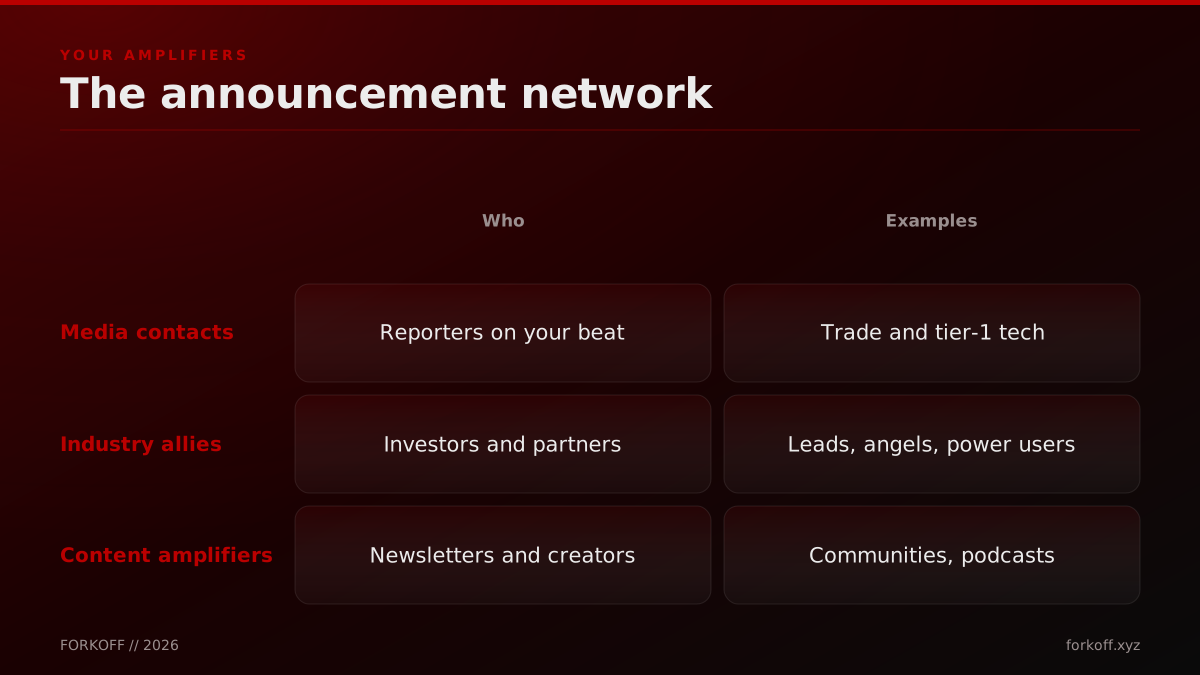
The single tactic that separates a coordinated raise from a scattered one is a briefed friendlies chat standing before the announcement goes live. This is the FORKOFF external-network map, generalized across SaaS, AI, fintech, and crypto/web3: investors, strategic partners, advisors, and power users on one side; sub-industry newsletters, communities, aligned creators, and podcasts on the other. Inventory these before you write a tweet.
| Media Contacts | Industry Allies | Content Amplifiers |
|---|---|---|
| Journalists on your beat (Pro Rata, TechCrunch, Bloomberg/WSJ, vertical trades) | Lead + participating investors, angels | Sub-industry newsletters (Lenny's-tier for SaaS, sector Substacks) |
| Newsletter authors who cover raises | Strategic partners and integration partners | Communities (relevant subreddits, Slack/Discord groups, Telegram for crypto) |
| Podcast hosts in your category | Advisors and prior operators who vouch | Aligned creators and KOLs (crypto KOLs, LinkedIn B2B voices, X operators) |
| Analysts and researchers | Power users and design partners willing to quote | Podcasts where you can book a launch-week slot |
Put the amplifiers into one group chat (Telegram or a shared thread) a week out. Drop the link the moment it is live, with copy-paste language and each posting window, so 20 to 40 credible accounts fire inside the first hour instead of over three days. That concentrated burst is what ranking algorithms read as a real event. Brief them, do not surprise them.
Operator noteStand up the friendlies group chat a week out; 20 to 40 credible quote-retweets in the first hour reads as a real event., FORKOFF distribution runs
The Distribution Playbook, Channel by Channel
Content is king, distribution is king kong. A coordinated multi-channel rollout beats one press hit every time, because a single outlet lands once and disappears while a sequenced push across owned media, social, community, and audio compounds attention into inbound, hires, and pipeline. The channels are not equal or simultaneous: owned media (your blog and newsletter) is the canonical source everything else links to; X carries reach and founder-direct voice; LinkedIn carries B2B social proof; Reddit and Hacker News carry the technical audience and, increasingly, the AI answer engines; KOLs and podcasts extend the tail. Run them in order, each pointing traffic back to the owned post, and the announcement behaves like a distribution event instead of a press release that evaporates in a day.
Owned media is the canonical anchor
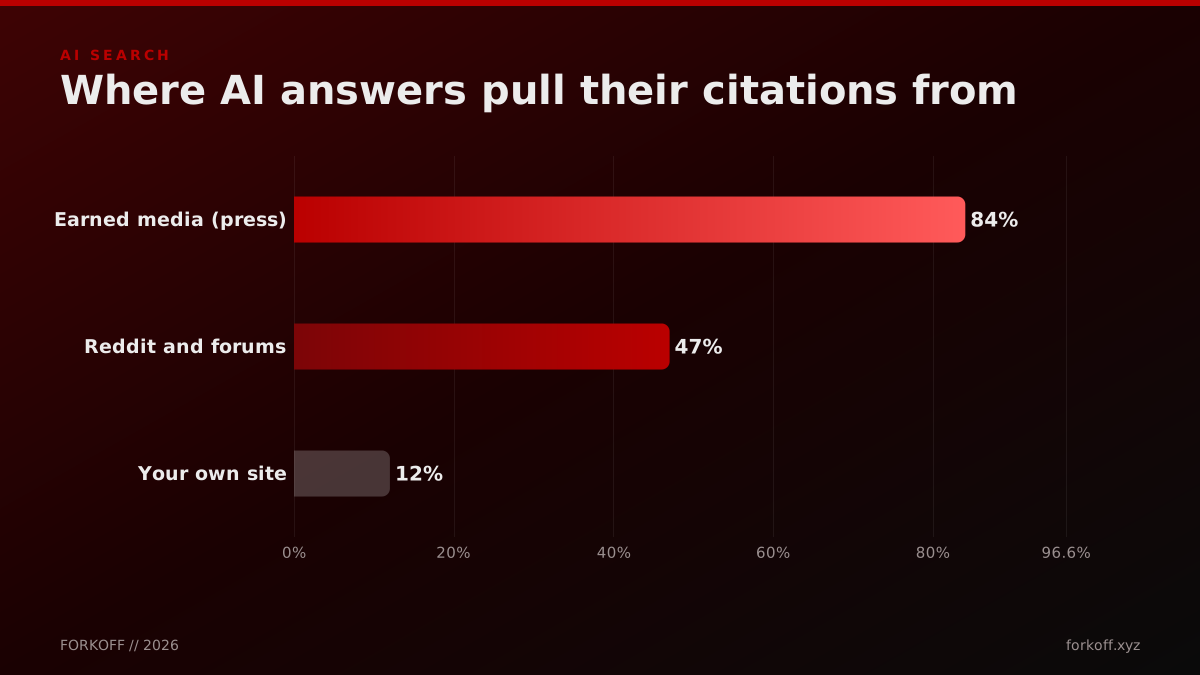
Publish the announcement on your own blog first and treat it as the source of truth every other channel links to. The company post carries the full narrative, numbers, and use-of-funds; the founder post (personal blog or a long X/LinkedIn thread) carries the human story; the newsletter goes to your warmest, already-opted-in list. Owned media matters more than ever because earned and owned coverage is what AI answer engines cite: Shadow reports earned media makes up roughly 84% of AI citations, so the post you control is what feeds ChatGPT, Perplexity, and Google AI Overviews later.
AI answers cite earned media, not your blog
Earned media makes up roughly 84 percent of AI citations, and Perplexity draws about 46.7 percent of its citations from Reddit. The post you control feeds AI answer engines only when it is corroborated on the surfaces those engines trust, which is why a distribution event beats a single press hit even inside the machines.
Source: shadow.inc, How to Announce a Funding Round
X thread mechanics and LinkedIn for B2B proof
On X, Twitter marketing starts with the hook tweet: the amount, the lead investor tag, and the narrative hook in the first line, with a scroll-stopping visual. Then a short thread telling the story, ending with one clear CTA (hiring, a product link, a community). On LinkedIn, the register shifts to B2B social proof: a longer, first-person founder post that customers and enterprise buyers read, with the raise framed as "here is what we can now build for you." X is for reach and founder voice; LinkedIn is for the buying committee.
Reddit, Hacker News, and community: post without getting killed
Community is where technical and operator audiences live, and where the AI-citation payoff concentrates. Shadow reports Perplexity draws about 46.7% of its citations from Reddit. But these communities punish Reddit self-promotion with a ban. The rules: post as a real person, not a brand account; lead with value or a genuine question, not the dollar amount; pick the right room (r/SaaS, r/startups, relevant vertical subs, Hacker News Show/Ask); never cross-post the same wire release everywhere. The best version is an AMA, where the raise is the credential and the substance is the answers. Chris from Loops made the AMA itself the announcement:
"I just raised 3.2M from some of the best investors in the world. AMA!" , centurylight (Reddit, r/SaaS)
I just raised 3.2M from some of the best investors in the world. AMA!
Hey there my name is Chris and I'm one of the founders of Loops. We're making email simple and easy to use for startups. I started my career in the creative space and pivoted to marketing and strategy after I was hired at Curiosity, a streaming video company founded by… Show more
That works because it trades the wire's roughly 2 to 3% pickup rate for a direct conversation with the operators you want as users. Kyle Tucker's AI-legal rollup is the test case: a founder with real numbers (~$25M ARR, ~100% growth) has more to gain from an operator AMA and a real Reddit motion than from a two-line wire nobody picks up.
KOLs, podcasts, and short clips
For crypto/web3, KOLs and Kaito mindshare are a native layer generalist guides skip: brief aligned creators to post commentary, not shills, in the launch window. For every vertical, book one or two podcast slots in launch week (audio is where founders explain the "why now" at length) and cut the best 60 seconds into clips that seed X, LinkedIn, and Shorts for the follow-up wave. The clip keeps the announcement alive after day one.
| Channel | Job | Best format |
|---|---|---|
| Blog / newsletter | Canonical source, AI-citable | Full post + warm-list email |
| X | Reach, founder voice | Hook tweet + thread + visual |
| B2B social proof | First-person founder post | |
| Reddit / HN | Technical audience, AI citations | AMA or genuine value post |
| KOLs / podcasts / clips | Extend the tail | Commentary, audio, 60s cuts |
Where announcement attention decays and where it compounds
| Channel | Attention window | Primary job |
|---|---|---|
| X | 24 to 72 hours | Reach and founder-direct voice on launch day |
| Several days | B2B social proof for the buying committee | |
| Reddit and Hacker News | Weeks to months | Technical audience and AI-citation deposits |
| YouTube and clips | Months | Long-tail discovery and the follow-up wave |
Owned media (blog and newsletter) is the canonical anchor every channel links back to. Earned media is roughly 84 percent of AI citations, per shadow.inc.
The Announcement as a Distribution Event: The Coordinated Rollout
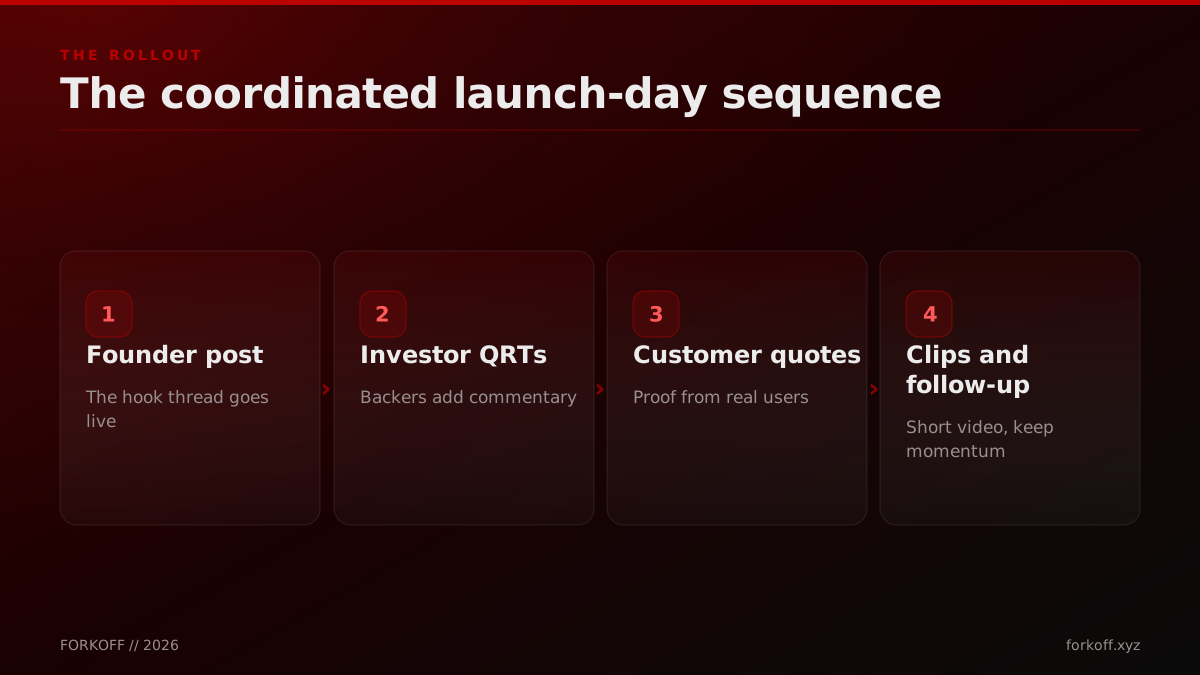
The winning motion is a choreographed product-launch sequence, not a single post. A funding announcement run as a distribution event is a set of pieces fired in a deliberate order inside a tight window: the founder posts first, investors amplify within the hour, customer quotes add third-party proof, numbers make it credible, category framing makes it legible, then podcast and newsletter outreach, short clips, and a follow-up wave keep it alive for days instead of hours. This is the piece almost every incumbent guide only asserts ("coordinate your channels") without operationalizing. Korba laid out the entire stack in one reply to Kyle Tucker, the closest thing the market has to a canonical checklist:
This is a good problem to have, but the playbook is bigger than a press release. The announcement should become a distribution event: founder post / investor posts / customer/operator quotes / specific numbers / clear category framing / podcast/newsletter outreach / short clips / follow-up
Read that as a sequence with an order and a clock, not a menu. Here is the choreography, end to end.
The sequence: who posts, in what order, in what window
- Founder post (T-0, hour 0). The owned blog post goes live and the founder's hook tweet and LinkedIn post drop simultaneously, all pointing to the blog. This is the source everything else links back to. Nothing fires before it is live.
- Investor posts (hour 0 to 1). The lead VC publishes the pre-drafted thesis; participating funds and angels quote-retweet with their own commentary from the friendlies chat. The goal is 20 to 40 credible accounts inside the first hour, so the algorithm reads a spike, not a trickle.
- Customer and operator quotes (hour 1 to 3). Design partners and power users post their own "why I use this" reactions, the third-party proof layer, far more persuasive than anything the founder says about themselves.
- Specific numbers, surfaced (throughout). ARR, growth, net revenue retention, users, whatever is real and flattering. Kyle Tucker's ~$25M ARR, ~100% growth, and ~130% nRR turn "another raise" into "this one is real." Numbers are the credibility ticket; without them the post is noise.
- Category framing (throughout). One sentence that tells the reader what box you are in and why it matters now ("the [category] for [shift]"). If the audience cannot file you, they forget you.
- Podcast and newsletter outreach (day 0 to 3). The booked podcast slots record and newsletter mentions land over the next one to three days, extending the moment past launch day.
- Short clips (day 1 to 5). The best 60 seconds of the podcast, the founder's best line, the launch video cut, seeded across X, LinkedIn, and Shorts to keep the announcement in feeds after the initial spike fades.
- Follow-up (day 3 to 14). A "here is what happened, who we are hiring, what we are building" recap that converts the attention spike into durable inbound. This is where compounding happens, and the step most founders skip entirely.
Why the order is load-bearing
The sequence is not arbitrary. If investors post before the founder's anchor is live, they link to nothing. If numbers show up without category framing, readers cannot place you. If there is no follow-up, the whole thing decays to a one-day spike, the failure mode Korba's "distribution event" framing prevents. Mike Annunziata's line is why the choreography matters: "we raised $X" is the least interesting part of the story; a well-crafted announcement makes a startup legible at the one moment attention briefly spikes. The rollout is how you spend that spike on brand, pipeline, hires, and your next round instead of letting it evaporate. This is the coordinated distribution work FORKOFF runs on outcome-priced terms: someone owns the run-of-show so the founder can keep building.
⚡️Korba.tgn⚡️
@korba_jr
@kylehtucker This is a good problem to have, but the playbook is bigger than a press release. The announcement should become a distribution event: founder post investor posts customer/operator quotes specific numbers clear category framing podcast/newsletter outreach short clip… Show more
Should You Just Tweet It? Go-Direct vs Coordinated
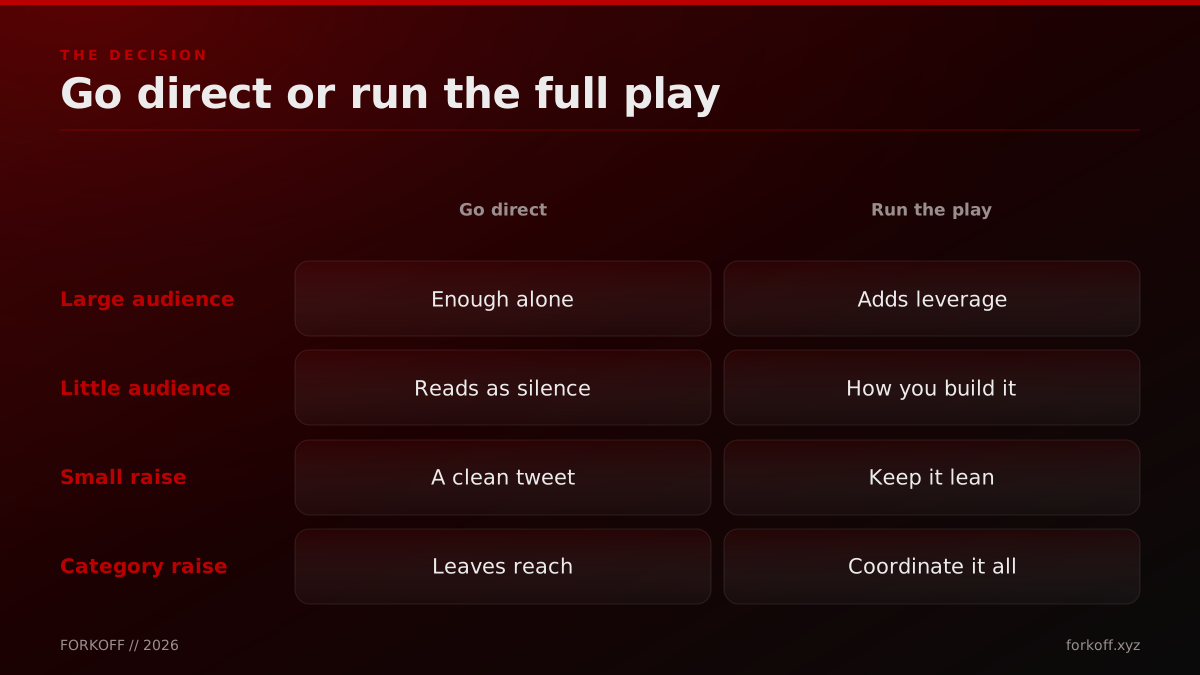
Going direct works only if you already own distribution. "Raised $60M, back to building" is a great flex when you have a large, engaged audience that carries it for you, and indistinguishable from silence when you do not. The coordinated playbook is not busywork; it is how founders without a built-in audience manufacture the moment founders with an audience get for free. The contrarian camp calling Twitter launches a scam is loud, credible, and mostly right about a narrow case, so it deserves a real steelman before the rebuttal.
The steelman: the go-direct camp is not wrong
The skeptics have a point, and it is worth stating in full.
"Just drop a tweet, 'Raised $60M, back to building'" , Koby Conrad (X)
Koby Conrad 🌻
@kobyjconrad
@kylehtucker Just drop a tweet “Raised $60M, back to building” 🫡
"The new playbook is X. That's it. Just X." , John Hutton (X)
"founders going direct" , Barbell (X)
Each is correct under a specific condition. If you already have the audience (Koby and John), the tweet IS the distribution, and the machinery adds cost without reach. If your raise is small or pre-product, Haje Jan Kamps, a former TechCrunch reporter, talks those founders out of press releases entirely because the raise is not newsworthy. And the third condition is real too: an announcement that pulls the team off the product for two weeks is a bad trade if the product still needs the team. The camp is really saying: do not run enterprise machinery for a moment that does not warrant it, and do not confuse announcement theater with progress.
The rebuttal: for most founders, "going direct" with no audience is silence
The condition the camp assumes (you already own distribution) is exactly what most founders lack. If your personal account has 800 followers, "Raised the round, back to building" reaches 800 people, half of them bots, and converts nothing. The coordinated playbook manufactures the distribution you do not have: it borrows the investors' audiences, the design partners' credibility, the podcast hosts' listeners, and the community's attention, and concentrates them into one window. That is not a substitute for owning distribution; it is how you build the first version of it, using the one moment other people are willing to amplify you.
The decision framework
| Your audience | Round size / goal | Verdict |
|---|---|---|
| Large + engaged (50k+ real followers) | Any size, goal is reach | Go direct. The tweet is the distribution. Add a blog post for AI citations, skip the machinery. |
| Small (under ~5k) | Any size, goal is inbound/hires/pipeline | Coordinated. You have no reach to spend; borrow it via investors, customers, community. |
| Medium (5k to 50k) | Small round or pre-product | Mostly direct. A founder post + investor amplification, skip wire and PR agency. |
| Medium (5k to 50k) | Larger round, category-defining goal | Coordinated-lite. Founder-led sequence + friendlies + one or two press/podcast slots. |
| Any | Fintech/crypto with compliance scrutiny | Coordinated. You want message control and a real narrative before scrutiny lands. |
The meta-move: asking in public is already a soft launch
There is a subtle third option the camp missed in real time. When Kyle Tucker asked X for "the latest funding-announcement/PR playbook" and disclosed his ~$60M raise, ~$25M ARR, and elite retention in the same breath, he had already done the thing he was asking how to do. The reply that named it:
"I think you just made the announcement." , Brian (X)
The ask-in-public is a legitimate build-in-public tactic: it surfaces the numbers, invites the crowd to react, and turns the thread itself into distribution (roughly 25k views and a marketplace of PR pitches, in Kyle's case). It works for the same reason going direct works, because it borrows attention, and fails for the same reason, because it needs an audience willing to engage. If you have that audience, the soft launch and the real launch can be the same post. If not, the coordinated rollout is still how you manufacture the moment.
Cross-Vertical Adaptations: SaaS, AI, Fintech, Crypto
The spine of the announcement (distribution event, coordinated rollout, numbers as the credibility ticket and narrative as the story) holds across every vertical. What changes is the proof that earns trust, the channels that carry reach, and the scrutiny the news invites. A SaaS raise converts on customer quotes and pipeline framing; an AI raise on a model, benchmark, or eval a skeptical reader can check; a fintech raise on trust and compliance signals, because the same news that draws customers draws regulators; a crypto raise on web3 mindshare mechanics (KOLs, a Kaito footprint, a friendlies quote-retweet group) that exist in no other market. Kyle Tucker's roughly $60M for an AI legal-services rollup (~$25M ARR, ~100% growth, ~130% nRR) is an AI-vertical case, and the deltas below are why his playbook cannot be copy-pasted from a generic SaaS guide.
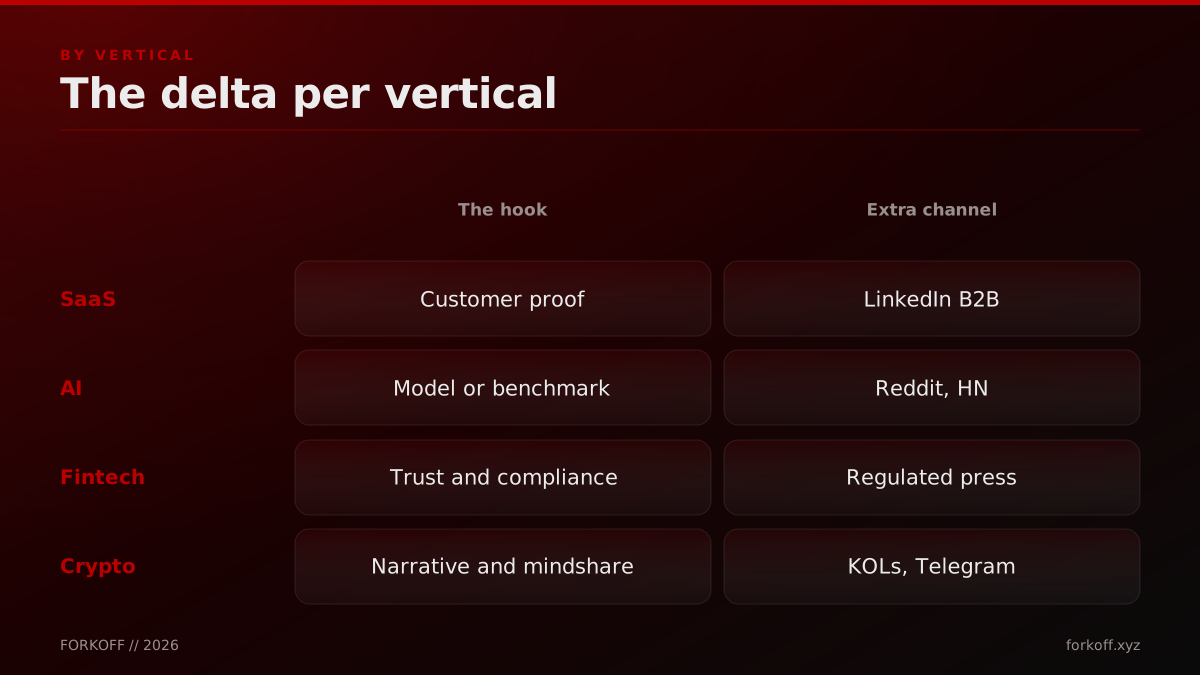
The per-vertical delta table
| Vertical | Lead proof | Primary channels | Watch-out |
|---|---|---|---|
| SaaS | Named customer quote plus a real usage or retention number | LinkedIn (B2B social proof), founder X, customer email | Do not bury the "who is it for"; announce it like a GTM event |
| AI | A model, benchmark, or eval the reader can verify; the "why now" of the capability | X (technical audience), Hacker News, launch video | Benchmark hype without receipts gets torn apart in the replies |
| Fintech | Trust: named backers, security posture, licensing, real revenue | Tier-1 press for credibility, LinkedIn, targeted trade media | SEC Form D scrutiny and compliance exposure; get the house in order first |
| Crypto/web3 | Backer lineup, category framing, token or protocol narrative | X (KOLs, friendlies QRT group), Telegram, The Block / CoinDesk / Cointelegraph | Token-narrative sensitivity; mainstream press treats crypto raises with suspicion |
The announcement hook and primary channel by vertical
| Vertical | Lead hook | Primary channel |
|---|---|---|
| SaaS | Named customer plus a real usage or retention number | LinkedIn and founder X |
| AI | A model, benchmark, or eval a reader can verify | X, Hacker News, launch video |
| Fintech | Trust: named backers, revenue, licensing | Tier-1 press and targeted trade media |
| Crypto and web3 | Backer lineup and category or protocol narrative | X KOLs, friendlies QRT group, Telegram |
The spine holds across verticals; the proof, channels, and scrutiny change. Fintech carries SEC Form D and compliance exposure.
SaaS and AI: proof over posture
For SaaS, the announcement is a sales asset: the dollar amount is the least interesting part, and the credibility it signals to customers, recruits, and partners is the payoff, per Mike Annunziata. Lead the founder post and blog with a customer who already gets value, then let the raise ride behind it. For AI, the hook is the capability. Skeptical readers want a benchmark, an eval, or a demo they can poke, not adjectives. The 2026 shift practitioners keep calling out is the launch video, which lands especially hard for AI because it can show the product doing something surprising.
"explore doing a launch video. the paradigm is shifting from standard talking head videos to more creative approaches. ... reddit is [continues]" , Subah Wadhwani (X)
Reddit matters more for AI and dev-tool raises than any generalist guide admits, and the reason is downstream: Shadow reports earned media is roughly 84% of AI-answer citations and Perplexity pulls about 46.7% of its citations from Reddit. If your buyers ask an AI which tool to use, your Reddit and earned-media footprint is what gets read back to them.
Fintech: the news invites scrutiny
A fintech announcement is a trust event before it is a distribution event. The same coverage that pulls in customers pulls in regulators, partners doing diligence, and competitors looking for a weak claim. Two realities travel with the raise. First, the SEC Form D filing lands within 15 days of the first sale of securities, setting a public clock on your news. Second, the announcement widens your exposure surface.
The SEC Form D clock sets your timing floor
Most priced US rounds require a Form D filing, and that filing becomes public within 15 days of the first sale of securities. File and then announce first, so your framing lands before a database scraper or a funding-roundup bot turns your raise into a one-line commodity you did not write.
Source: TechCrunch, How to Announce a Funding Round
"You definitely want to make sure you have adequate commercial insurance in place (and that it actually covers the AI and professional services exposure)" , Sophia Zaller (X)
Frame fintech and AI-services raises around trust: named backers, real revenue, security posture, and licensing where relevant. Understate rather than overstate; a corrected claim is a headline you do not want.
Crypto/web3: the mindshare machine no one else runs
Crypto is the vertical with a genuinely different distribution engine, and the FORKOFF internal spine is built on it. Set targets in community growth, media caliber, and Kaito mindshare or smart-follower metrics, then activate three surfaces generalist guides never mention: KOL marketing seeded ahead of the token launch, trade press (The Block, CoinDesk, Cointelegraph) that carries more weight with a crypto-native audience than mainstream outlets, and a friendlies group. The offline analog, choosing which conference to sponsor, earns the same audience in person. The spine is explicit: "Create a Telegram group of all the friendlies you'll ask to quote retweet your announcement on X." That quote-retweet swarm at launch minute is the crypto analog of an investor amplification wave, and it turns a single post into a mindshare spike. Mind the token-narrative sensitivity: a raise that reads as an exit-liquidity setup will be punished by the same community you are courting.
Hardware, biotech, and consumer follow the same logic with their own proof: hardware on a working unit and a ship date, biotech on trial data and named scientific backers (with regulatory caution), consumer on a launch moment and a visual that travels. The cross-vertical breadth is the moat. No incumbent guide adapts the play past B2B SaaS, so the founder in AI-legal, fintech, or crypto lands on a guide not written for them.
The Day-by-Day Launch Timeline (T-Minus Run-of-Show)
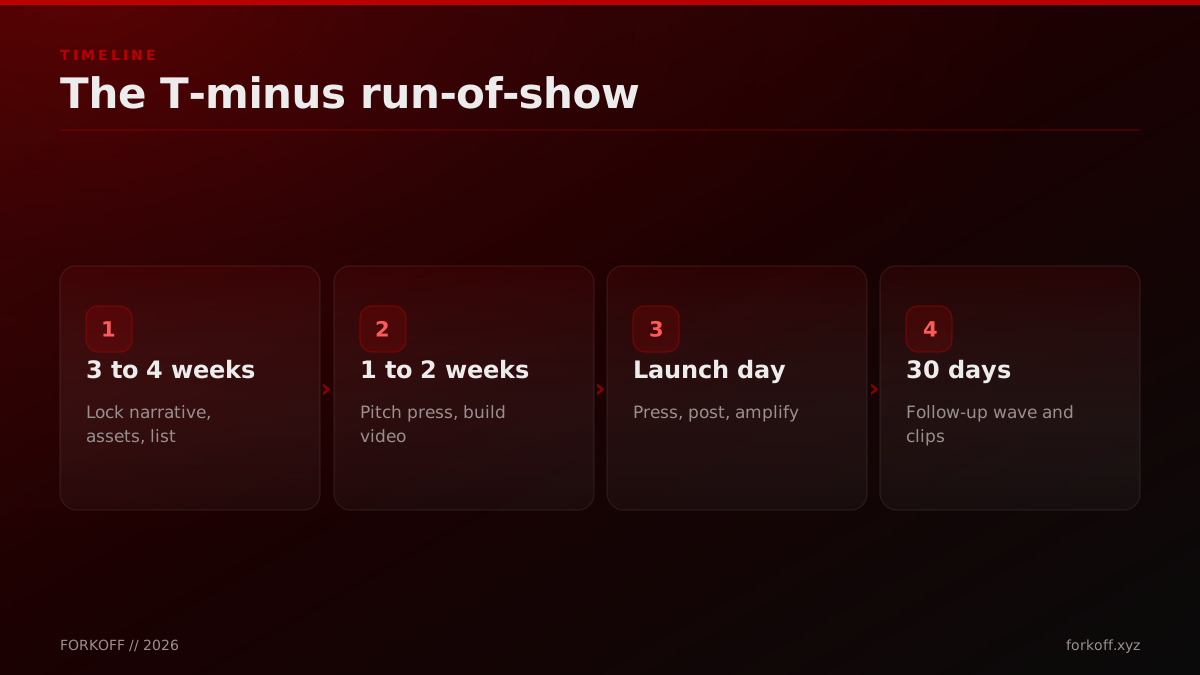
A strong announcement is coordinated over roughly 3 to 4 weeks, not thrown out the day the wire clears. The founders who compound their raise run it backward from launch day like a product ship: lock the narrative and assets, brief investors and friendlies, pitch journalists with enough lead time to offer an exclusive, then execute launch day hour by hour and keep pushing for 30 days. The deepest PR-side guide, OBA PR, runs a full backward calendar with per-phase deliverables, and the tactical primers converge on a two-week minimum coordination window with investors before you go public. The reason to treat it as an event is compounding: OBA PR credits First Round data with roughly 2.7x higher response rates and about 40% faster time-to-close when the raise is worked as PR momentum rather than a one-off.
"the playbook is bigger than a press release. The announcement should become a distribution event: founder post / investor posts / customer/operator quotes / specific numbers / clear category framing / podcast/newsletter outreach / short clips / follow-up" , Korba (X)
The backward calendar
| Window | Do this |
|---|---|
| T-minus 3 to 4 weeks | Lock the narrative and the "why now". Draft press release, founder post, blog. Build the media list. Brief lead investor and friendlies. Start the launch video. |
| T-minus 1 to 2 weeks | Pitch journalists; offer one exclusive. Gather investor and customer quotes. Finish the video and the hero graphic. Draft every post. |
| T-minus days (3 to 1) | Confirm embargo or exclusive in writing. Schedule posts. Line up the friendlies quote-retweet group. Dry-run the sequence. |
| Launch day | Run the hour-by-hour below. |
| 72 hours | Reply to every comment and DM. Repurpose into clips. Send the customer and newsletter emails. Chase journalists who passed with the "it's live" nudge. |
| 30 days | Follow-up wave: podcasts, guest posts, the recap thread, hiring push, and the numbers readout. |
T-minus 3 to 4 weeks: lock the story
Everything downstream fails if the narrative is soft. Write the press release early not because the wire matters most, but because the writing forces the message and creates a deadline.
"Press releases are useful for two things though. Writing one helps to fine tune what you want to say and generates an artificial deadline that adds exclusivity and urgency to communications with journalists." , standrews (Reddit)
Brief your lead investor now so their post is ready, and stand up the friendlies group so the launch-minute amplification is not improvised.
T-minus 1 to 2 weeks: pitch and offer the exclusive
This is the media window. The classic motion is a one-to-two-page release plus targeted outreach with an exclusive on the table for one reporter.
"draft a 1-2 pg press release / find journalists covering rollups (and their x/LinkedIn/email) / send your press release and ask if they want to do an exclusive. if yes, consider doing it / supplement with checking w/ pr agency if they'd do a one off campaign" , Alexander (X)
Journalists need lead time to write. Pitch too late and you get a link dump, not a story.
Launch day, hour by hour
- Hour 0: exclusive or embargoed press goes live.
- Hour 0 plus 5 minutes: founder posts the hook (X and LinkedIn), pinned.
- Hour 0 plus 15 minutes: lead investor quote-retweets with the thesis; friendlies group fires its quote-retweets.
- Hour 1: team amplifies from personal accounts; customer or operator quotes go up.
- Hour 2: launch video and short clips ship into the thread.
- Hour 3 onward: founder replies live in the thread and DMs; send the customer and newsletter emails.
Operator noteRun launch day as a war room: press at hour 0, founder hook at 0:05, investor QRTs at 0:15, clips shipped by hour 2.
The 72-hour and 30-day wave
The first 72 hours compound the attention you bought: reply to everyone, cut clips from the video, and re-pitch the journalists who passed now that it is live. The 30-day wave is where the raise turns into pipeline and hires: booked podcast slots, a guest post or two, a "one month in" recap, a hiring push riding the visibility, and a numbers readout. Beware announcing into a dead or noisy week; a well-run rollout on the wrong day still underperforms.
The Copy-Paste Kit: Templates and Checklists
These are the templates founders actually reach for, built to adapt in an afternoon. They are deliberately generic-but-usable and cross-vertical: swap the customer quote for a benchmark if you are AI, add the compliance line if you are fintech, add the KOL and friendlies group if you are crypto. The press-release shape follows the standard components every guide agrees on: amount, round, lead investor, use of funds, a founder quote, and boilerplate, kept to roughly 400 to 600 words and written like news. The headline follows the pattern Dylan Reider recommends: "[Company] raises $X to [do the thing that matters]." Keep the actual coverage strategy separate from the release itself; the release is a message-forcing artifact and a wire fallback, not the coverage.
1. Funding press-release skeleton
[COMPANY] RAISES $[X][SEED/SERIES A] TO [MISSION IN PLAIN WORDS]

[CITY], [DATE] , [Company], [one-line description of what it does and
for whom], today announced a $[X] [round] led by [Lead Investor], with
participation from [Others]. The company will use the funds to [use of
funds: hire, ship, expand].

[Paragraph 2: the "why now". The problem, the shift in the market,
what is now possible that was not before.]

[Paragraph 3: proof. A real number (revenue, users, growth, a benchmark)
and, if you have it, a named customer.]

"[Founder quote: the vision and the why, not the dollar amount]," said
[Name], [Title] of [Company].

"[Investor quote: why they backed you, the thesis]," said [Partner],
[Firm].

About [Company]: [2-3 sentence boilerplate. What, who for, where.]
Press contact: [Name, email]
2. Hook-tweet template
We raised $[X] to [mission].

[One line of "why now" that makes a stranger care.]

Led by [Investor tag], with [others].

[Proof line: a number or a customer.]

Here's what we're building and who we're hiring 👇
[thread continues / link to blog / video]
3. Founder blog-post outline
1. The one-line news (amount, round, lead) , first sentence.
2. The problem, told through a real story or moment.
3. Why now: what changed in the market or the tech.
4. What we've built so far + a real number.
5. What the money is for (hires, product, expansion).
6. Thank-yous (investors, team, early customers) , brief.
7. The CTA: we're hiring [roles] / try it / join the community.
4. Investor-quote request email
Subject: Quick quote for the [Company] announcement ([Date])

Hi [Partner],

We're announcing the round on [date]. Could you send a 1-2 sentence
quote on why you backed us / the thesis? Feel free to use this as a
starting point, edit freely:

"[Draft quote in their voice.]"

Also: would you be up for quote-retweeting the founder post at launch
(around [time])? I'll send the link 10 minutes before. Thank you.
5. Journalist pitch email (exclusive offer)
Subject: Exclusive: [Company] raises $[X] to [mission]

Hi [Name],

Saw your piece on [specific recent article]. We're announcing a $[X]
[round] led by [Investor] on [date] and I'd like to offer you the
exclusive.

The short version: [2 sentences: what, why now, the standout number].

Happy to send the release, founder, and investor under embargo. Want it?

[Name, title, phone]
6. Launch-day run-of-show checklist
[ ] Press live (exclusive/embargo confirmed in writing)
[ ] Founder hook posted + pinned (X + LinkedIn)
[ ] Lead investor QRT fired
[ ] Friendlies group QRT wave fired
[ ] Team amplifying from personal accounts
[ ] Customer / operator quotes live
[ ] Launch video + clips shipped into thread
[ ] Customer email + newsletter sent
[ ] Founder replying live to comments + DMs
[ ] UTMs live on every link; tracking confirmed
7. Media-kit contents list
- One-line + one-paragraph company boilerplate
- Founder headshots (high-res) + team photos
- Logo pack (light/dark, SVG + PNG)
- The hero announcement graphic
- The launch video + 2-3 short clips
- Fact sheet: amount, round, lead, use of funds, key numbers
- Founder + investor quotes (pull-ready)
- Press contact
Ship all of it on one page and you become the bookmark founders send each other, which is exactly the natural-link behavior that makes a resource compound.
How Do You Measure It? Treat the Announcement as a Funnel
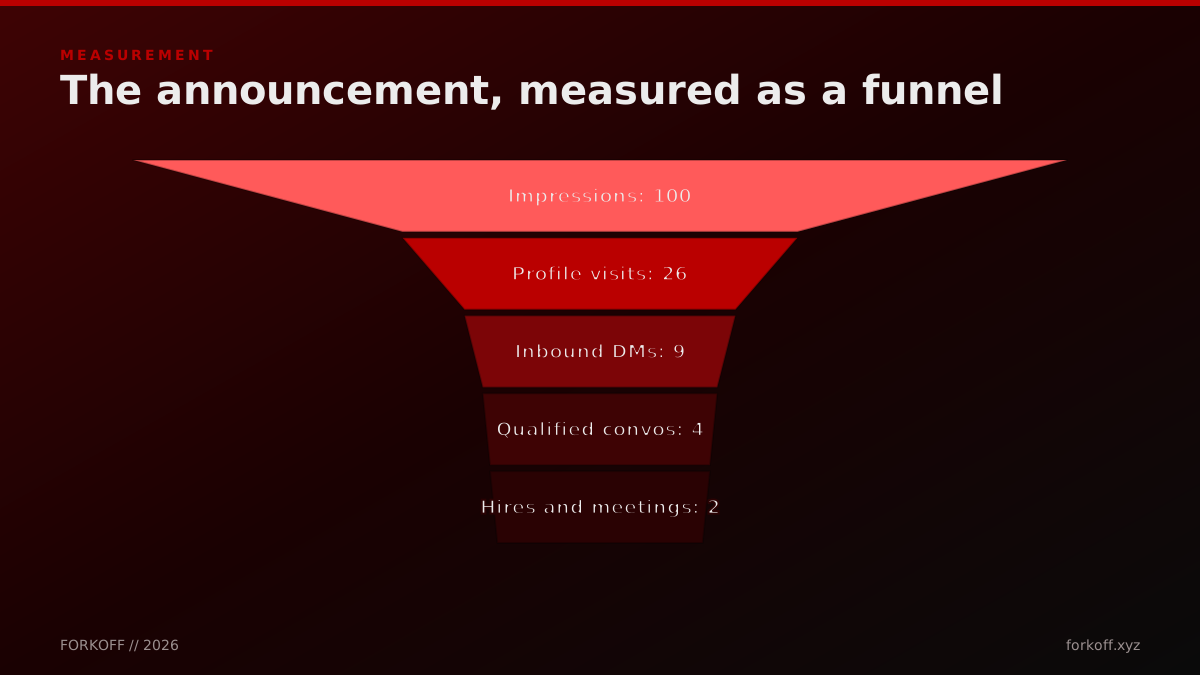
Measure the announcement as a funnel, not a press hit. The incumbent habit is to count coverage (did we get TechCrunch, how many pickups) and stop. That misses the entire point, because wire-distributed releases see only roughly a 2 to 3% pickup rate and coverage is a means, not the outcome. The outcome is a chain: impressions to profile visits to inbound DMs and demo requests to hires sourced to follow-on-investor meetings to pipeline influenced to community growth to AI-citation share. Instrument each step so you can prove the raise did more than trend for a day, and monitor in real time who is picking up your announcement as it spreads. The reframe the sharpest operators push is exactly this.
Treat your funding announcement as a GTM event, with the same rigor you'd have as your sales motion or fundraising process.
The KPIs to instrument
| Funnel stage | Metric | How to capture |
|---|---|---|
| Reach | Impressions, video views, coverage pickups | Native platform analytics; a simple pickup tally |
| Attention | Profile visits, follows, blog and page visits | X/LinkedIn analytics; GA with UTMs on every link |
| Intent | Inbound DMs, demo requests, sign-ups, form fills | UTMs plus a "how did you hear about us" field |
| Talent | Applications, sourced conversations, hires | An announcement-tagged applicant source |
| Capital | Follow-on-investor meetings booked | A 30-day inbound-investor tag in your CRM |
| Pipeline | Sourced and influenced opportunities and revenue | CRM opportunity source plus a 30-day influence window |
| Durable | Community growth, AI-citation share | Follower and member deltas; AI-answer citation checks |
What a good announcement looks like by day 7, 30, and 90
| Checkpoint | What to look for | Example target |
|---|---|---|
| Day 7 | Impressions and profile-visit spike, first inbound logged | 3,000 profile visits, 40 inbound DMs |
| Day 30 | Sourced hires, pipeline, investor meetings, held community growth | 15 qualified applicants, 8 sales calls |
| Day 90 | Durable pipeline closed, AI-citation and branded-search lift | Pipeline influenced and closed from the cohort |
Directional targets to calibrate against your own baseline, not universal guarantees. Instrument every stage with UTMs and a 30-day inbound tag.
How to attribute it
Attribution does not need to be perfect, just honest and consistent. Three cheap mechanisms carry most of the weight. First, put UTMs on every link so GA separates announcement traffic from everything else. Second, add a "how did you hear about us" field to your demo and contact forms for the launch month; self-reported source catches the dark-social inbound UTMs miss. Third, run a 30-day inbound tag in your CRM: any new inbound (customer, candidate, or investor) in the 30 days after launch gets tagged to the announcement, so you can total the pipeline and hires it seeded. For durable impact, re-check AI-citation share, because earned media is roughly 84% of AI-answer citations and a well-covered raise raises how often an AI recommends you months later.
Operator noteTag every inbound customer, candidate, and investor for 30 days after launch, so the raise proves its second job in numbers.
What a good result looks like
Set the bar at three checkpoints, and remember these are directional targets to calibrate against your own baseline, not universal guarantees.
- Day 7: a clear impressions and profile-visit spike above baseline, the exclusive or coverage live, and the first inbound DMs and demo requests logged. The raise itself is not the story; as Mike Annunziata puts it, a well-crafted announcement makes the startup "legible at a moment when attention briefly spikes", so the day-7 test is whether that spike converted to attention on the company, not the number.
- Day 30: measurable inbound pipeline and sourced hires attributable to the tag, follow-on-investor conversations booked, and community growth that held rather than snapping back to baseline.
- Day 90: the durable layer. Pipeline influenced and closed from the announcement cohort, hires shipped, and a lift in AI-citation share and branded search. This is where the difference between a press hit and a distribution event becomes undeniable.
The contrast is the whole argument. An incumbent measures whether it got covered. A founder who runs the announcement as a distribution event measures whether it compounded into brand, pipeline, hiring, and the credibility that funds the next round. Kyle Tucker's public ask (roughly $60M for an AI-legal rollup) turned into a marketplace of pitches precisely because the market knows the announcement is worth far more than the press hit, and almost no one measures it that way. This measurement layer is the one no competing guide ships, the same instrumentation a founder funnel is built to prove.
Make It Citable: AEO for Your Announcement (and This Playbook)
Answer Engine Optimization (AEO) is the practice of writing so that AI answer engines (Google AI Overviews, ChatGPT, Perplexity, Claude, Gemini) quote you when a buyer asks them a question. It matters for a funding announcement because a growing share of your future customers, hires, and even investors will meet you first through an AI answer, not your homepage. The catch: these engines rarely cite your own site. Earned media is roughly 84% of AI citations, and Perplexity draws about 46.7% of its citations from Reddit. So you engineer the announcement to be quotable (self-contained answer blocks, specific numbers, a clear category claim) and you place it on the sources AI trusts (press, Reddit, forums, and podcasts that get cited), not only your blog.
Why the announcement is an AEO event, not just a PR event
When a founder crosses a milestone, the internet briefly indexes them. A raise generates coverage, social posts, and community threads inside a tight window, and that corpus is what an answer engine ingests when someone later asks "who is building the best AI legal tool" or "which fintech just raised a Series A." If the coverage carries a crisp, extractable claim ("Company X raised $Y to do Z, growing 100% year over year"), the model lifts it verbatim. If it is a vague amount plus a founder quote about being "thrilled," there is nothing to cite.
This reframes what you are optimizing for. The old goal was a TechCrunch hit. The AEO goal is a citable claim, repeated across enough trusted surfaces that the model treats it as consensus. That is why the distribution-event model beats the single-press-hit model even in machines: more surfaces, more corroboration, more citations, all of which you can track as pickups and citations accrue.
"This is a good problem to have, but the playbook is bigger than a press release. The announcement should become a distribution event: founder post / investor posts / customer/operator quotes / specific numbers / clear category framing / podcast/newsletter outreach / short clips / follow-up" , Korba (@korba_jr)
The four levers that make coverage citable
- Author AEO answer capsules. Write a 40-to-60-word, self-contained paragraph that answers one question with a number in it, near the top of every asset (blog post, press release lead, founder thread). This section opens with one. AI engines lift these because they are complete and quotable without the surrounding page.
- Carry specific numbers. "Growing fast" is unquotable. "Roughly $25M ARR, about 100% year-over-year growth, around 130% net revenue retention" (the metrics Kyle Tucker put in public when he closed his ~$60M round) is a claim a model can cite. Numbers are the difference between being read and being repeated.
- State one clear category claim. Name the category you lead ("the first AI-native legal-services rollup"). Models answer category questions ("what is the leading X") and cite whoever made the cleanest claim. Vague positioning gets skipped.
- Place it where ChatGPT trusts the citation. Because earned media is ~84% of AI citations and Reddit alone feeds ~46.7% of Perplexity's, a real press mention and an honest Reddit thread are worth more to the machine than ten of your own posts. Get the claim onto those surfaces.
Question-shaped headers, teach your founder the trick
Look at how this pillar is built: most H2s are questions a founder actually types, each answered immediately below in a capsule. Answer engines match the user's question to a header that mirrors it, then read the block underneath. Use the same shape in your announcement post. Instead of "Our Journey," write "Why we raised now" and answer it in two sentences with a number. Instead of "The Product," write "What [Company] does" and define it in one line.
The payoff compounds. A founder who ships an AEO-shaped announcement is not just chasing this week's press; they are seeding the answer that surfaces every time a prospect asks an AI about their category for the next year. In our experience that is the most underpriced return on an announcement, because no incumbent guide teaches it and almost no founder does it. Write for the machine and the human at once, and the raise keeps paying out long after the news cycle ends.
Failure Modes and How to Recover
Most announcements do not blow up in the catastrophic sense. They fail quietly, in one of four ways: the journalist thread goes silent, the embargo breaks, the coverage is negative or wrong, or the whole thing lands flat with no engagement. Each has a specific recovery, and none of them is "give up and delete the tweet." Because a coordinated announcement runs across many surfaces, a failure on one surface (a dead reporter) rarely kills the event, you route the energy to another. No incumbent guide covers recovery, so treat this as the section that keeps a bad launch day from becoming a wasted raise. The recoveries below assume you did the coordination work; if you skipped it, the fix is usually "do the thing you skipped, now."
Failure 1: the journalist never replies
You pitched an exclusive, sent the release, and got nothing back. This is the most common failure, and survivable because press was never the whole plan. Wait 48 hours and send one tight follow-up (a new hook, not "just checking in"). If still silent, release the exclusive: pitch two or three other reporters in parallel with a same-day deadline. If press does not land at all, go direct. The raise is still real, and your owned channels do not need a reporter's permission.
"TechCrunch still matters, but it's no longer the default. ... If your goal is investor credibility, especially if you're raising again soon, TechCrunch may still be a strong choice." , Heather Sliwinski
If the goal was credibility for the next round, a dead thread hurts less than it feels like, because a strong founder post plus visible investor amplification signals the same credibility to the people who matter.
Failure 2: a botched embargo
Someone published early, or the news leaked before your date. Do not scramble to suppress it. The moment the number is public the embargo is dead, so lift it for everyone and go live immediately with your full coordinated push. An embargo break is a timing problem, not a message problem: your release, founder thread, investor quote-retweets, and blog post are already written, so the recovery is pressing "go" a few hours early. The founders who suffer are the ones who had no assets ready and treated the embargo as the plan instead of a scheduling tool.
"Press releases are useful for two things though. Writing one helps to fine tune what you want to say and generates an artificial deadline that adds exclusivity and urgency to communications with journalists." , standrews (r/startups)
Failure 3: negative or misreported coverage
A reporter got the number wrong, framed the raise as a down round, or ran a skeptical angle. For factual errors, ask for a correction in writing, politely, with the source document attached. For an unfriendly frame, do not argue in public: publish your own version (the blog post and founder thread you controlled anyway) and let your narrative outrank the bad take through volume and amplification. An announcement invites scrutiny, so have the operational house in order first.
"You definitely want to make sure you have adequate commercial insurance in place (and that it actually covers the AI and professional services exposure)" , Sophia Zaller (@sophiamzaller)
Failure 4: it lands flat
You shipped, and it got 40 likes and no inbound. Diagnose before you re-fire. Usual causes: the amount was the headline instead of the "why now," you relied on one channel, or you never briefed your friendlies. The recovery is a second wave, not a repost. Re-cut the story around the narrative (not the dollar figure), add the customer or investor quote you skipped, and this time activate the coordinated amplification: the friendlies quote-retweet group, the investor thesis post, a short clip. Wire distribution alone will not save you, its pickup rate is only roughly 2 to 3%. A flat launch is almost always a distribution failure, not a bad-news failure, and distribution is the one variable you fully control.
The through-line across all four: because you built a multi-surface event, a single-surface failure is recoverable. The founders who cannot recover are the ones who bet the whole announcement on one reporter, one channel, or one tweet.
The No-Distribution Founder Play
Here is the reality every incumbent guide ignores: most founders cannot land a tier-1 journalist and do not have an audience to post to. The good news is you do not need either to make the raise count. You manufacture founder-led distribution by borrowing it, from your investors, your customers, and peer founders, and you use the announcement itself as the event that builds the audience you were missing. Going direct is only enough if you already own distribution; if you do not, the coordinated play is how you create the moment from zero. The raise is one of the rare, cheap windows where people will pay attention to you on purpose, so spend it building the channel, not just spiking it.
We fundraised! $1.5m pre-seed, i will not promote
Wanted to share a little success story on our end. We raised a $1.5m pre-seed. Happy to answer any questions, even if I'm far from being an expert. Perhaps my experience is useful to you! Area: crypto/fintech, Stage: pre-seed, Current company size: 5 people (hiring), Location: EU, remote
Steelman the contrarians, then answer them
The loudest advice a founder hears is to do nothing fancy. It is worth taking seriously.
"Just drop a tweet, 'Raised $60M, back to building' 🫡" , Koby Conrad (@kobyjconrad)
"The new playbook is X. That's it. Just X." , John Hutton (@johnghutton)
They are right, for people who already have a following. "Just tweet it" works when the tweet reaches 200,000 people; when it reaches 200, going direct is indistinguishable from silence. The coordinated playbook exists because most founders are in the second group. So the no-distribution founder does the opposite of "do less": they borrow reach they have not yet earned.
Borrow your investors' and customers' audiences
Your new investors have followings, newsletters, and a professional interest in your success. Ask them to do the amplification you cannot: post the thesis, tag you in the first tweet, quote-retweet your announcement.
"Depending on your VC, having them put out post/write-up on the deal, thesis, reason for backing is typically effective." , Alex Angeline (@alexangeline_)
Do the same with customers. A single operator quote ("we replaced three tools with this") from a recognizable logo carries more weight with a cold reader than any adjective about yourself. Arm both groups with suggested language so amplification is a copy-paste, not a homework assignment.
Use the community as the venue
If you have no audience, borrow a room that already has one. Instead of broadcasting to nobody, post inside a Reddit community that already gathers your buyers, an AMA on the relevant subreddit, a build-in-public thread, a Hacker News "Show HN." This has a second payoff: because Reddit feeds roughly 46.7% of Perplexity's citations, an honest community thread is also an AEO deposit.
"I just raised 3.2M from some of the best investors in the world. AMA!" , centurylight (Chris, Loops) on r/SaaS
The AMA IS the announcement. You are not asking a gatekeeper for coverage, you are going straight to the operators who become users, hires, and word of mouth.
Trade amplification with peer founders
Build a small group of founders at your stage and agree to amplify each other's moments: when you announce, they quote-retweet; when they announce, you return it. This is the crypto "friendlies" mechanic generalized: a Telegram or Signal group of ten peers who each bring 5,000 followers gives you 50,000 in borrowed reach on demand, with zero budget.
Treat the announcement as the audience-building event
The reframe that changes everything: the announcement is not the finish line for distribution, it is the starting gun. The follow-count bump, the new inbound DMs, the people who replied, that is the audience you were missing, and now you have it. Follow back the operators, reply to every comment, and keep posting after launch day so the spike becomes a base.
"I think you just made the announcement." , Brian (@BrianInCrypto)
A founder with no distribution should treat the raise as the cheapest customer-acquisition and audience-acquisition moment they will get for a year. Manufacture the moment by borrowing, then keep what it builds.
Do's and Don'ts, and the Verdict
You get one shot at announcing a given round, so run it like the distribution event it is, not a press release you fire once and forget. The do's and don'ts below are the compressed version of the whole playbook: end your thread with a clear next step, tag your lead investors in the first tweet (not all of them), carry founder, investor, and customer quotes plus specific numbers, brief and arm every stakeholder before you go live, then monitor and amplify the early winners and keep momentum going with follow-up and podcasts. The failures are the mirror image: making it about the money, burying the numbers, surprising your own team, betting on one channel, or letting it die the day after.
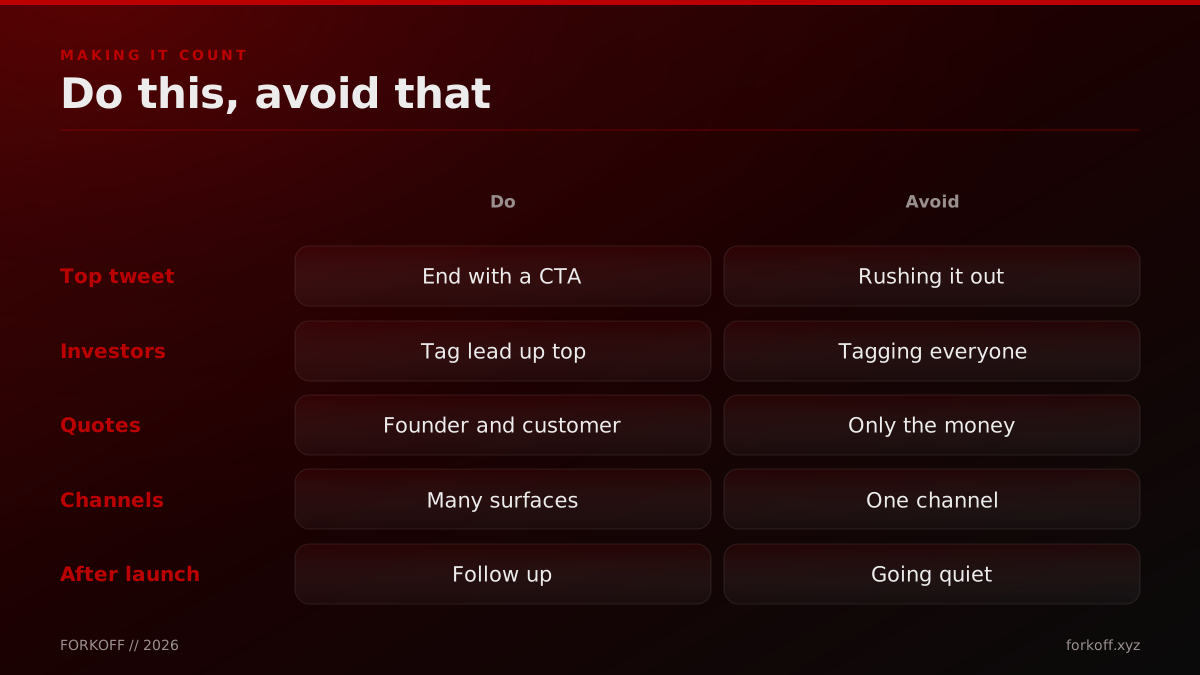
The do's and don'ts
| Do | Don't |
|---|---|
| Build a founder thread that ends in one clear CTA (join, hire, try, follow) | Focus the whole announcement on the dollar amount |
| Tag your lead investor(s) in the first tweet | Tag too many investors in the top tweet (it reads as noise and dilutes the signal) |
| Incorporate founder, investor, and partner (and customer) quotes | Overload the copy with jargon or make unverifiable claims |
| Carry specific, citable numbers (ARR, growth, retention) | Skip the numbers or hide them below the fold |
| Brief and arm every stakeholder with suggested language before launch | Forget to brief stakeholders, or surprise employees and existing investors |
| Coordinate the release across owned, earned, and borrowed channels | Rely on one channel (a lone tweet, or the wire alone) |
| Monitor launch day and amplify early positive coverage in real time | Rush it, ship with no assets ready, or announce into the January noise |
| Maintain momentum with a follow-up wave, podcasts, and short clips | Neglect post-announcement follow-up and let the spike evaporate |
| Update your site, bios, and pinned posts to reflect the raise | Treat the announcement as a one-time event instead of a compounding one |
"Treat your funding announcement as a GTM event, with the same rigor you'd have as your sales motion or fundraising process." , Dylan Reider (Infinite Runway)
A few deserve emphasis because they are where good founders still trip. Tagging your lead investor in the first tweet is a do, because their amplification is your borrowed reach; tagging all eight of your angels there is a don't, because it reads as a group photo and buries your message. Numbers are a do because they are what humans trust and what AI engines cite; vague superlatives are a don't because they are neither believable nor quotable. The biggest don't is treating this as one event: the raise that compounds into hiring, pipeline, and next-round credibility is the one whose founder kept working the story for weeks, not hours, usually with a founder funnel running coordinated distribution behind it.
The verdict
Strip away the tactics and one idea remains: a funding announcement is a distribution event, not a press release. Run it as a coordinated, multi-surface founder rollout and it compounds into brand, pipeline, hiring, and the credibility that makes your next round easier. Run it as a single press hit and it evaporates in a day. Everything in this playbook, the stakeholder sequencing, the launch video, the Reddit thread, the answer capsules, the borrowed audiences, serves that one reframe.
The proof is the founder we opened with. Kyle Tucker closed roughly $60M for an AI legal-services rollup at about $25M ARR, near 100% growth, and around 130% net revenue retention, and still had to ask X in public for "the latest funding-announcement/PR playbook." His thread turned into a marketplace of agencies rushing to sell him one, the whole gap in a single screenshot: a great founder with a great raise had no map. Now there is a plan. Use it, and make the raise the beginning of your distribution, not the end of your news cycle.


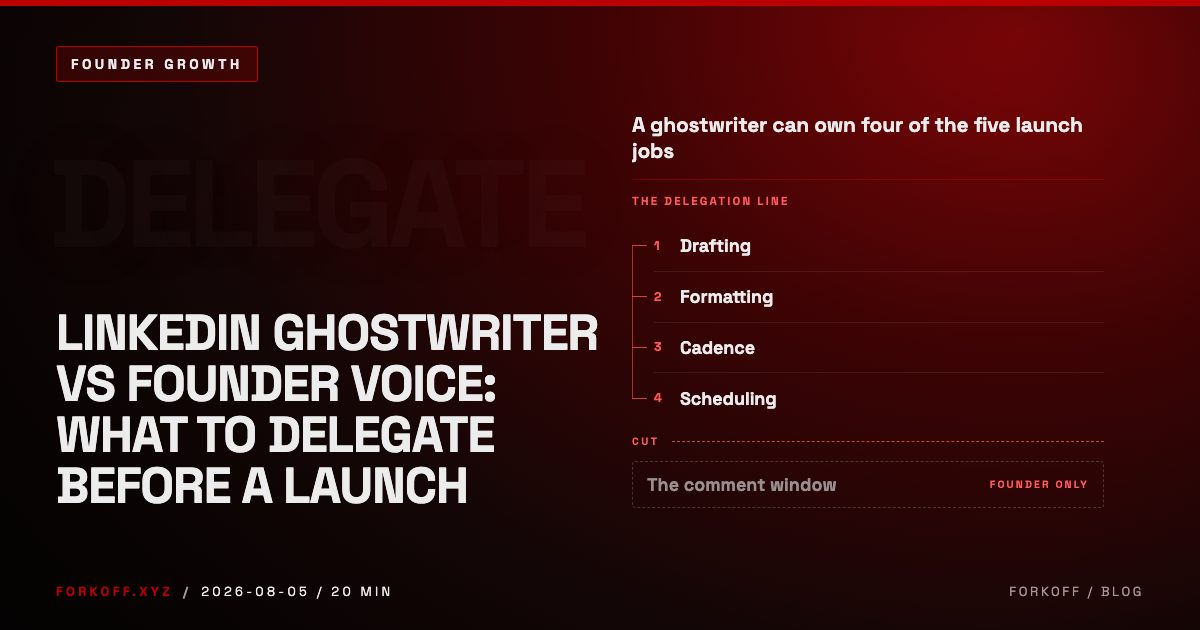
![How to Make a Launch Go Viral on X: The 5-Lever Playbook [2026]](/blog/covers/how-to-make-launch-go-viral-on-x-2026-cover.jpg)