Search "viral marketing" and you get the same guide ten times over: a dictionary definition, the Dollar Shave Club video, a note that "you can't really control whether something goes viral", and a call to "create shareable content". Almost all of it is undated, almost none of it carries a number you can check, and every one of them dodges the two questions founders actually type into search in 2026: can you engineer this on purpose, and if you do, does it convert to money?
This guide answers both, from data instead of vibes. At FORKOFF we build distribution for startups across AI, SaaS, Web3, DevTools, and Fintech, where a trust-first distribution motion is what actually converts, and our clipping network has processed more than 5B views, so we are not theorizing about what spreads. We have measured it. Over the past year we ran and instrumented launches that crossed a million organic views repeatedly, and we built a measurement system to tell the difference between reach that was earned and reach that was bought. That system, and those numbers, are the spine of everything below.
Here is the thesis in one line: modern viral marketing is far more engineered than it is lucky, it is also trivially easy to fake, and views are the weakest thing you can measure. The rest of this page is the evidence, the mechanism, and the measurement model, with a worked example for every claim and a source and date on every statistic.
The 45-second answer
Viral marketing is a strategy that engineers content to spread person-to-person, where each new viewer recruits more viewers, so distribution compounds instead of costing a fixed amount per impression. The 2026 data says virality is far more engineered than lucky: it runs on predictable psychological triggers (social currency, emotion, practical value) and a mechanical distribution stack (warm-up, a one-second hook, first-hour velocity, wave-riding). It is also easy to fake, so the real question is not "did it get views" but "is the virality organic, and did it convert". FORKOFF measures both with the Launch RADAR: a views-to-likes ceiling near 500:1 and a correlated-growth gate at Pearson r >= 0.2 separate earned reach from bought volume, and signups-per-view separates pipeline from vanity.
The 2026 viral-marketing landscape: what actually changed
The landscape shifted from "virality is unpredictable luck" to "virality is a repeatable distribution mechanic" between roughly 2023 and 2026. The change was driven by three things: the open-sourcing of a real ranking algorithm, AI collapsing content production onto a single founder, and a public feedback loop where operators reverse-engineer each hit and publish the pattern. Virality is now studied like a system, not admired like weather.
For twenty years the honest position on virality was that you could improve your odds but not manufacture the outcome. That was a fair reading of the evidence available. It is no longer the best reading of the 2026 evidence, and the reason is that the inputs became legible.
The first shift was mechanical transparency. When X open-sourced its recommendation algorithm in 2023, the reported engagement weights stopped being a guess. Practitioners could see that a reply was scored far above a like and that an author replying back was the single strongest signal, which told them exactly what behavior to engineer for. You cannot game a black box; you can absolutely game a documented one.
The ranking model stopped being a guess in 2023
When X published its recommendation algorithm on GitHub in 2023, the engagement weights practitioners had guessed at for years became documented inputs: in the reported heavy-ranker weights, a reply scores roughly 27x a like and the author replying back roughly 150x. Every engineered launch mechanic in this guide, cluster ignition, reply farming, the first-hour velocity window, is a direct response to a weight you can read in the source.
Source: X, the-algorithm repository, open-sourced 2023
The second shift was production collapse. AI made it possible for one founder to prototype a product, write a launch thread, record a demo, and cut the clips without a handoff, so the launch asset stopped being a budget line and became a Tuesday afternoon. Institutional playbooks reflect the same inversion: the staged launch frameworks from a16z and the Y Combinator library now treat a launch as one beat inside a continuous distribution arc rather than a single event. When the cost of a viral attempt drops toward zero, the number of attempts explodes, and volume plus a legible algorithm is what turns luck into a distribution.
The third shift was the public feedback loop. Founders now dissect each viral launch in real time and publish the teardown. One analyzed 65+ viral X videos and extracted a shared skeleton of hook, structure, and cadence. That is the behavior of a community treating virality as an engineering problem with a discoverable solution, not a lottery.
I analysed 65+ viral videos on X and realised anyone can go viral
The net effect is that the question changed. In 2020 the smart question was "how do I get lucky?" During 2026 it is "which repeatable inputs raise the floor, and how do I prove the reach was real?" This guide is built around that second question because it is the one the incumbent definitional pages never even ask.
What is viral marketing and how does it actually work?
Viral marketing is a strategy that designs content and mechanics so that reach compounds person-to-person, where each new viewer recruits additional viewers rather than the brand paying for each impression. It works by pairing a reason to share (a psychological trigger like status, emotion, or usefulness) with a distribution mechanic (a strong hook, early velocity, and a network primed to amplify), so a piece of content crosses out of its origin audience into new audiences on its own.
The word "viral" is a biology metaphor and it is a precise one. In an epidemic, each infected person infects some number of others; if that number is above one, the thing spreads exponentially, and if it is below one, it dies out. Viral marketing borrows the same math. The whole discipline is the pursuit of a reproduction rate above one for a piece of content or a product loop. The academic literature has treated it this way since Kaplan and Haenlein's work on viral marketing framed it as electronic word-of-mouth engineered to self-replicate, a definition the viral marketing entry on Wikipedia still anchors to.
Mechanically, a viral event has two halves that both have to fire. The first half is motivation: a genuine reason a human forwards this to another human, which is a psychology problem covered in the next section. The second half is transmission: the distribution conditions that let one share turn into many, which is a systems problem. A brilliant piece of content with no transmission mechanism dies in its origin audience; a strong transmission mechanism attached to content nobody wants to share amplifies nothing. Real viral marketing engineers both.
This is also where the incumbents quietly mislead. Their guides spend approximately 90% of the words on the motivation half ("make it emotional, make it shareable") and almost none on the transmission half, because the transmission half is operationally hard and platform-specific. But transmission is where the 2026 leverage actually lives, and it is measurable. For the platform-specific execution of the transmission half on X, our full runbook on how to go viral on X and hit 1M views is the companion to this page: this guide is the discipline, that one is the mechanics.
What makes marketing content go viral, psychologically?
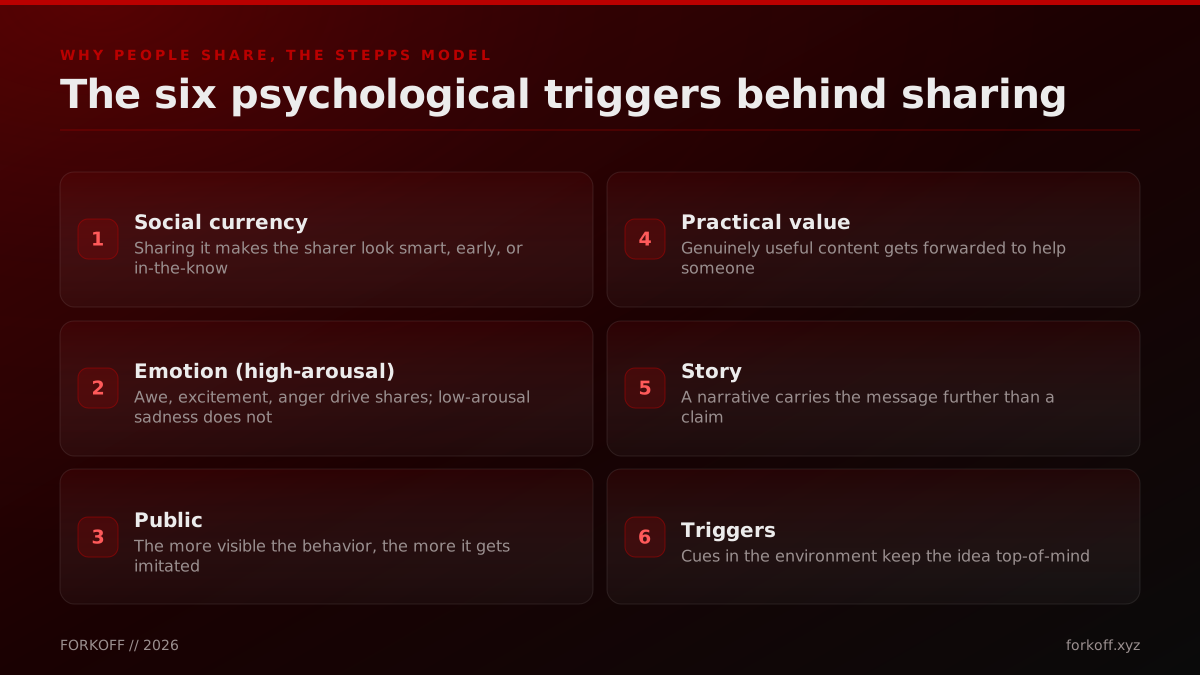
Content goes viral when it gives people a reason to share it, and the research converges on six: social currency (sharing it raises the sharer's status), high-arousal emotion (awe, excitement, anger, not low-arousal sadness), public visibility, practical value (it is genuinely useful), narrative (a story that carries the message), and triggers (cues that keep it top-of-mind). Of these, high-arousal emotion is the strongest single predictor of what gets shared online.
The definitive academic source here is Jonah Berger and Katherine Milkman's study "What Makes Online Content Viral?" in the Journal of Marketing Research, which analyzed nearly 7,000 New York Times articles and found that content evoking high-arousal emotions (awe, anger, anxiety) was significantly more likely to make the most-emailed list than content evoking low-arousal states (sadness). Positive content was more viral than negative overall, but the arousal level mattered more than the valence. That is the single most useful empirical finding in the whole field: it is not "make people feel something", it is "make people feel something activating".
A one-standard-deviation increase in the amount of anger an article evokes increases the odds that it will make the most e-mailed list by 34%. Similarly, a one-standard-deviation increase in awe increases the odds of making the most e-mailed list by 30%.
Jonah Berger, a marketing professor at Wharton, later generalized this into the STEPPS framework in his book Contagious: Social currency, Triggers, Emotion, Public, Practical value, and Stories. Each is a distinct lever, and strong viral content usually stacks several. The Dollar Shave Club launch video stacked social currency (sharing it signaled you were in on a joke), emotion (it was genuinely funny, a high-arousal state), and practical value (it explained a real product). The launch threads that hit a million views in 2026 stack social currency (being early to a rising tool) and story (the founder's build narrative) on top of a visible result.
How each emotion changes the odds of making the NYT most-emailed list
| Emotion evoked | Arousal level | Change in odds (one SD increase) |
|---|---|---|
| Anger | High (negative) | +34% |
| Awe | High (positive) | +30% |
| Anxiety | High (negative) | +21% |
| Sadness | Low (deactivating) | -16% |
Berger and Milkman, What Makes Online Content Viral?, Journal of Marketing Research, 2012. Effects are per one-standard-deviation increase in the emotion an article evokes.
The practical translation for a 2026 campaign: before you worry about distribution, pressure-test the asset against these levers. If a piece of content does not give a specific person a specific reason to share it with a specific other person, no amount of first-hour velocity will make it spread, because velocity amplifies a sharing impulse that has to already exist. This is the motivation half, and it is necessary but, contrary to the incumbent guides, nowhere near sufficient.
What is the difference between viral marketing, word-of-mouth, and influencer marketing?
Word-of-mouth is any organic recommendation passed between people. Viral marketing is engineered word-of-mouth built specifically to compound, where content is designed so each share produces more shares. Influencer marketing pays or partners with a creator to borrow their audience for a single reach event. Word-of-mouth is the raw phenomenon, viral marketing is the attempt to make it self-propagating, and influencer marketing is a one-time reach purchase that may or may not spread further.
These three get used interchangeably and they should not be, because they behave differently on the one axis that matters: whether reach compounds. Word-of-mouth is the substrate, and it is enormous. Nielsen's global trust research has repeatedly found that recommendations from people you know are the most trusted form of marketing, well above any paid channel. That trust is the fuel viral marketing tries to route into a self-sustaining loop.
The clean distinction is the reproduction rate. Ordinary word-of-mouth has a reproduction rate; viral marketing is the deliberate engineering of that rate toward and past one. Influencer marketing, by contrast, is usually a reach event with a reproduction rate near zero: you pay a creator, their audience sees the message once, and unless the content itself was built to spread, transmission stops there. The overlap, where a lot of confusion lives, is when an influencer is used to seed content that is itself engineered to go viral. Then influencer marketing is the ignition and viral marketing is the fire.
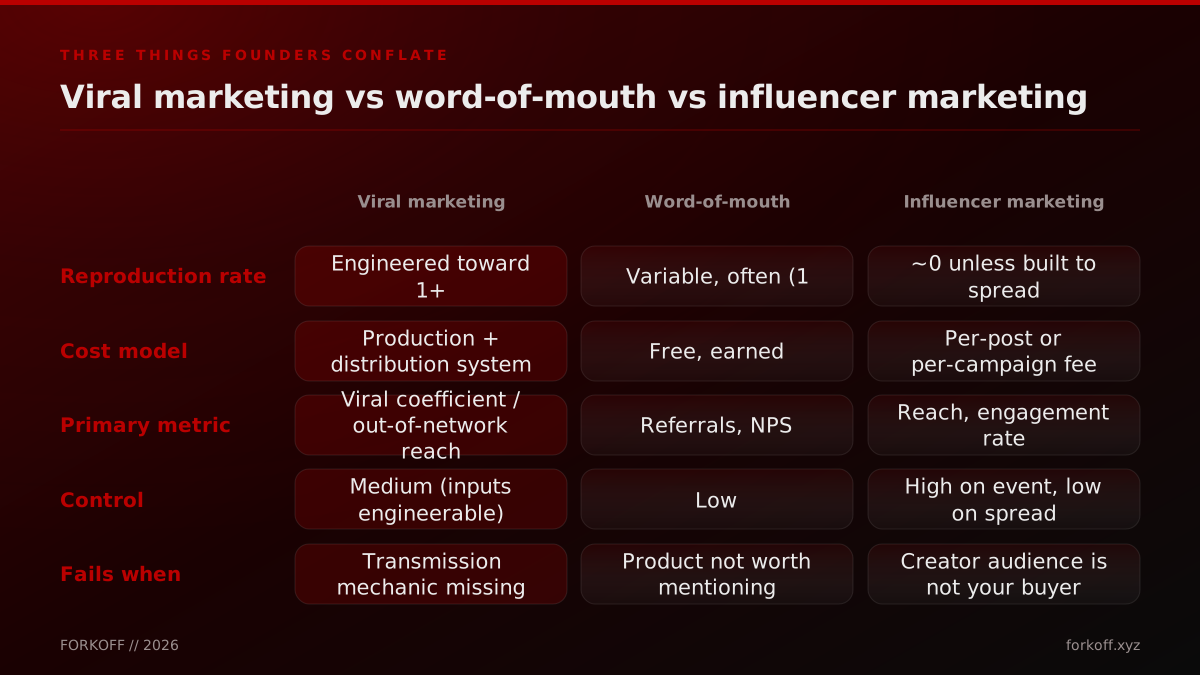
| Dimension | Word-of-mouth | Viral marketing | Influencer marketing |
|---|---|---|---|
| What it is (2026) | Organic recommendation between people | Content engineered to self-replicate | Paying or partnering with a creator for reach |
| Reproduction rate | Variable, often below 1 | Deliberately engineered toward 1+ | Near 0 unless content is built to spread |
| Cost model | Free, earned | Production plus a distribution system | Per-post or per-campaign fee |
| Primary metric | Referrals, NPS | Viral coefficient / K-factor, out-of-network reach | Reach, engagement rate on the paid post |
| Control | Low | Medium (inputs are engineerable) | High on the event, low on the spread |
| Fails when | The product is not worth mentioning | Transmission mechanic is missing | The creator's audience is not your buyer |
The strategic takeaway: if you want a reach event you can schedule, buy influence, and our influencer marketing work is built for exactly that. If you want reach that compounds after you stop paying, engineer for virality. Most strong 2026 campaigns use influence to seed something built to spread, so the two become the ignition and the fuel rather than competitors.
Can viral marketing be engineered on purpose, or is going viral just luck?
Mostly engineered. The 2026 data shows a set of repeatable inputs, a 14-day account warm-up, a one-second hook, posting inside a first-hour velocity window, seeding a warm cluster, and riding a live conversation wave, that reliably raise the floor on reach. Luck still sets the ceiling on any single post, but engineering the inputs is what makes hits repeatable rather than random. Across the public launches we audited, these inputs produced seven-figure reach again and again.
This is the question the entire definitional SERP dodges, and it is the one founders most want answered. The honest answer has two parts. Part one: you cannot guarantee any single piece of content goes viral, because the last mile depends on timing, the mood of a network on a given day, and whoever happens to quote you. Part two, and this is the part the incumbents miss: you can raise the base rate so dramatically that virality stops looking like luck across a portfolio of attempts. A casino does not know the outcome of one hand and still runs a predictable business, because the edge shows up over volume. Engineered virality works the same way.
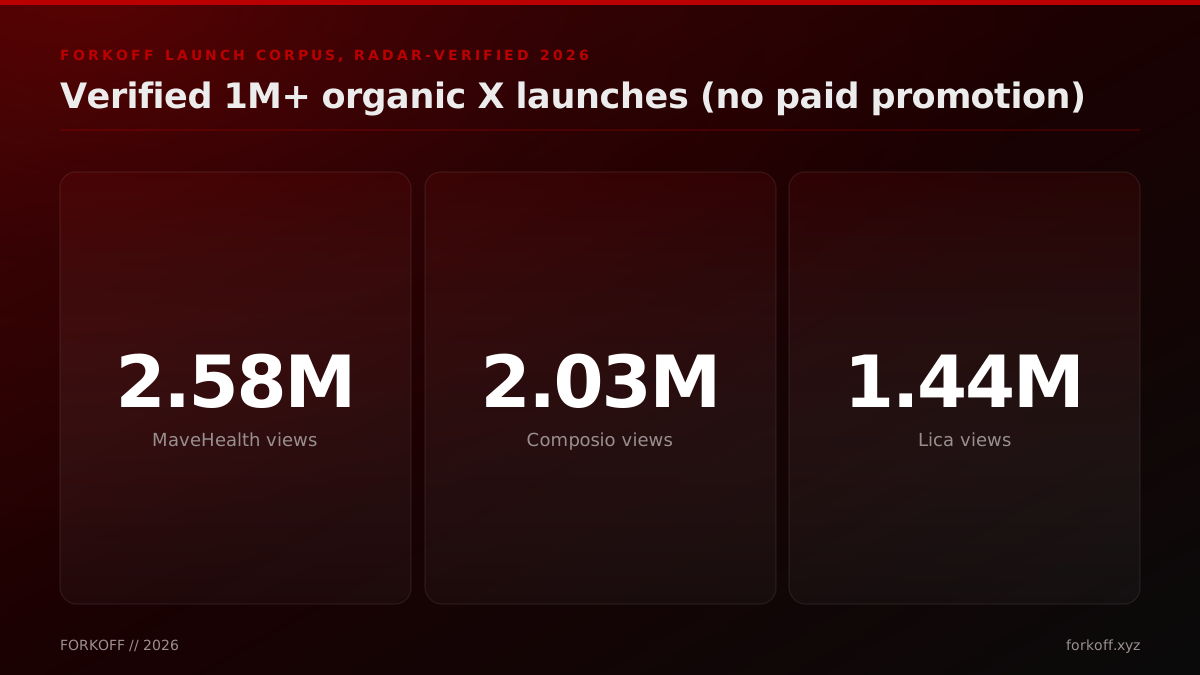
The evidence is public launch data we audited ourselves. Founder launches running the same mechanical stack crossed a million views repeatedly, not once: MaveHealth at 2.61M, Composio at 2.05M, and Lica at 1.44M. None of the three was FORKOFF's own campaign, and not all of them clear the authenticity test we describe below; MaveHealth reads 825 views per like, above the organic ceiling. Independent operators report the same repeatability. One published a thread describing how, once you crack the formula, you can ship a launch video a month and drive consistent inbound, which is a claim about a repeatable process, not a lucky streak.
fin465
fin465
I might regret posting this cuz it's one of our best growth hacks and anyone can do it, BUT here's how to get 250k-5m+ views on your launch video. its OP cuz if you crack the formula, you can ship a new vid each month and drive insane inbound. We make 1/month and clear 200k+.
Seven-figure reach, three times in a row
The public launches FORKOFF audited include three above a million views, MaveHealth at 2.61M, Composio at 2.05M, and Lica at 1.44M, each run on the same six-layer stack. Alongside the 5B+ views processed through the FORKOFF clipping network, that repetition is the strongest internal evidence that virality is an engineered base rate, not a lottery.
Source: FORKOFF Launch RADAR, instrumented launch corpus, 2026
The mechanism that makes it repeatable is a stack, not a single trick. We name it the Engineered-Virality Stack, and it has six layers, each an input you control.
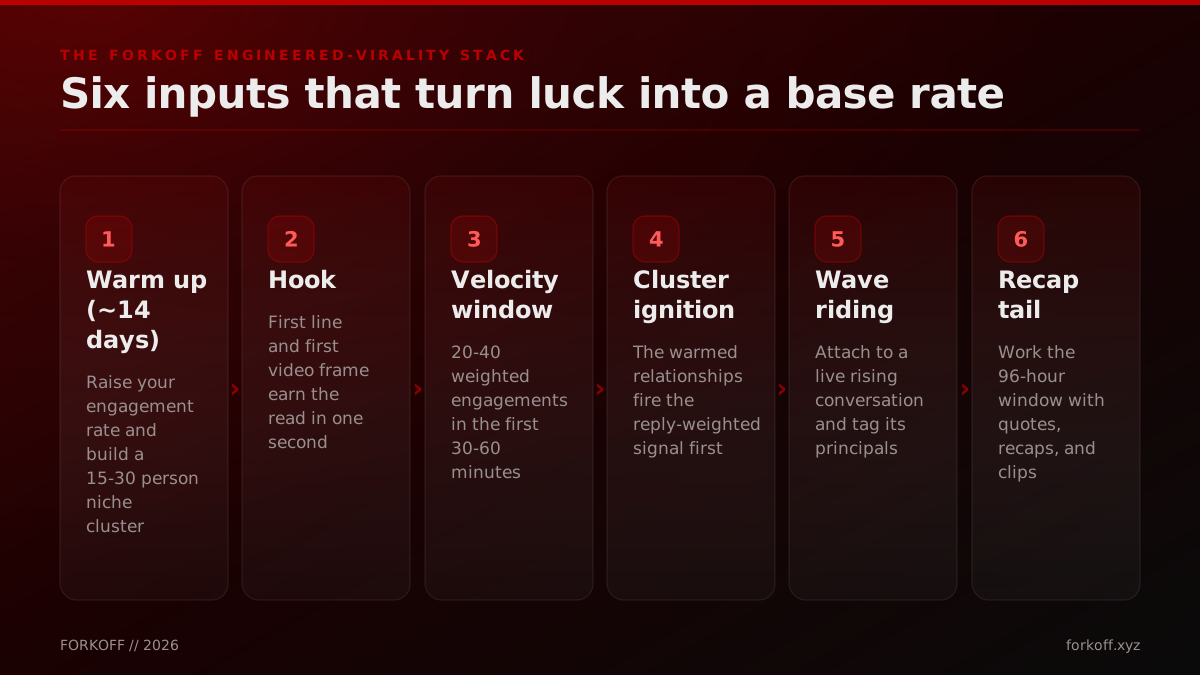
- Warm-up. Roughly 14 days of raising your baseline engagement rate and building a 15 to 30 person cluster of real relationships in your exact niche, so launch day has an audience primed to fire.
- Hook. A first line and first video frame that earn the read in one second, because distribution amplifies attention that content has to first capture.
- Velocity window. Posting when your audience is active and generating 20 to 40 weighted engagements in the first 30 to 60 minutes, so the algorithm sees early momentum and widens distribution.
- Cluster ignition. The warmed relationships engaging first, providing the reply-weighted signal the ranking model rewards most.
- Wave-riding. Attaching the launch to a live, rising conversation and tagging the people driving it, so you post into momentum instead of silence.
- Recap tail. Working the 96-hour window with quotes, recaps, and clips to extend and re-ignite the reach.
Operator note14 days is the minimum warm-up we schedule before a launch; a cold account wastes the best asset., FORKOFF launch runbook, 2026
Operator note20 to 40 weighted engagements inside the first 30 minutes is the velocity target we set for every launch cluster., FORKOFF launch runbook, 2026
That is not a lottery ticket. It is a process with named inputs, and the fact that founders now search for the "best agency to make a product launch go viral" is the clearest market signal that virality has become a service you can buy rather than a break you wait for.
None of this happens by accident. It's all about meticulously engineered coordination, just made to look spontaneous.
Why does every startup launch on X get millions of views now?
Because a legible algorithm plus near-zero production cost plus a shared playbook created a repeatable motion, and thousands of founders are now running it at once. The reason it feels like "everyone" is going viral is that the inputs became public and cheap, so the number of well-engineered attempts exploded. The underlying mechanic, a warmed cluster firing reply-weighted engagement inside a first-hour velocity window, is the same one behind almost every seven-figure launch thread.
This exact question, "why does every startup launch on X get millions of views now?", keeps hitting the front page of founder subreddits in 2026, and it deserves a mechanical answer rather than a shrug.
The answer is that X's ranking model rewards early, reply-heavy velocity, and the founder community figured out how to manufacture exactly that. The open-sourced weights told everyone that replies and author-replies dominate, so the playbook became: warm an account, build a cluster, and get that cluster into your replies in the first hour. When enough people run the same playbook against the same documented algorithm, the timeline fills with million-view launches and it looks like a wave, because it is one.
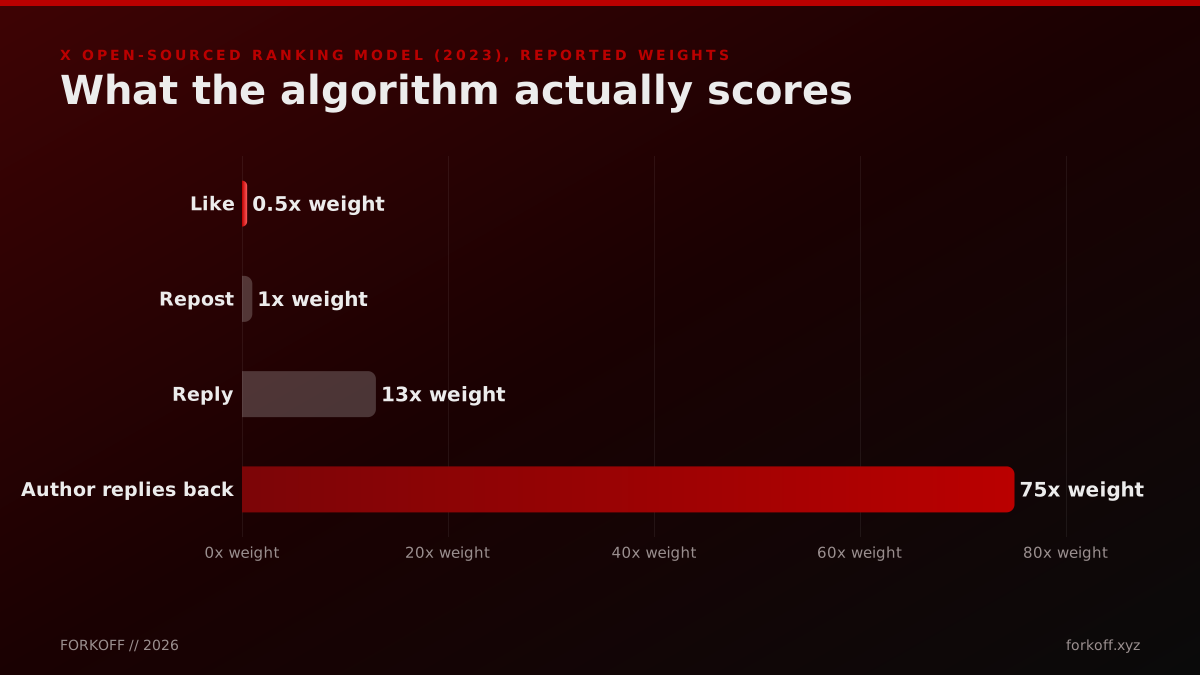
The weights themselves explain the whole behavior. In the reported model, a reply is worth many times a like, and the author replying back is worth many times a reply. That single fact is why engineered launches obsess over the reply tab: a founder answering every reply in the first hour is not being polite, they are farming the highest-weighted signal in the system. It is also why a broadcast (post and leave) underperforms a conversation (post and reply for an hour) even with identical content. The 2026 launch wave is not a mystery; it is a documented incentive being exploited at scale. Our Twitter/X marketing practice is essentially the industrialized version of this motion, and our sibling guide on the levers behind going viral on Twitter breaks the creative side down further.
How do you tell an organic viral campaign from a botted one?
Check two independent signals. First, the views-to-likes ratio: genuine organic reach clusters near 759 and rarely breaks a roughly 500 ceiling in tight niches, while botted volume runs 6,000 or higher because bought views do not carry proportional engagement. Second, correlated growth: real views and likes rise together at a Pearson correlation of at least 0.2 through the burst. A 628,712-view burst carrying only 22 likes computed r=0.032 and was botted; the platform later purged the fake likes.
This is the section no definitional guide on the internet contains, and it is the most useful thing on this page, because in 2026 a view count is the single easiest metric to buy. We built a measurement system specifically to answer "is this reach even real?", and we call it the FORKOFF Launch RADAR. It rests on two signals that are hard to fake simultaneously.
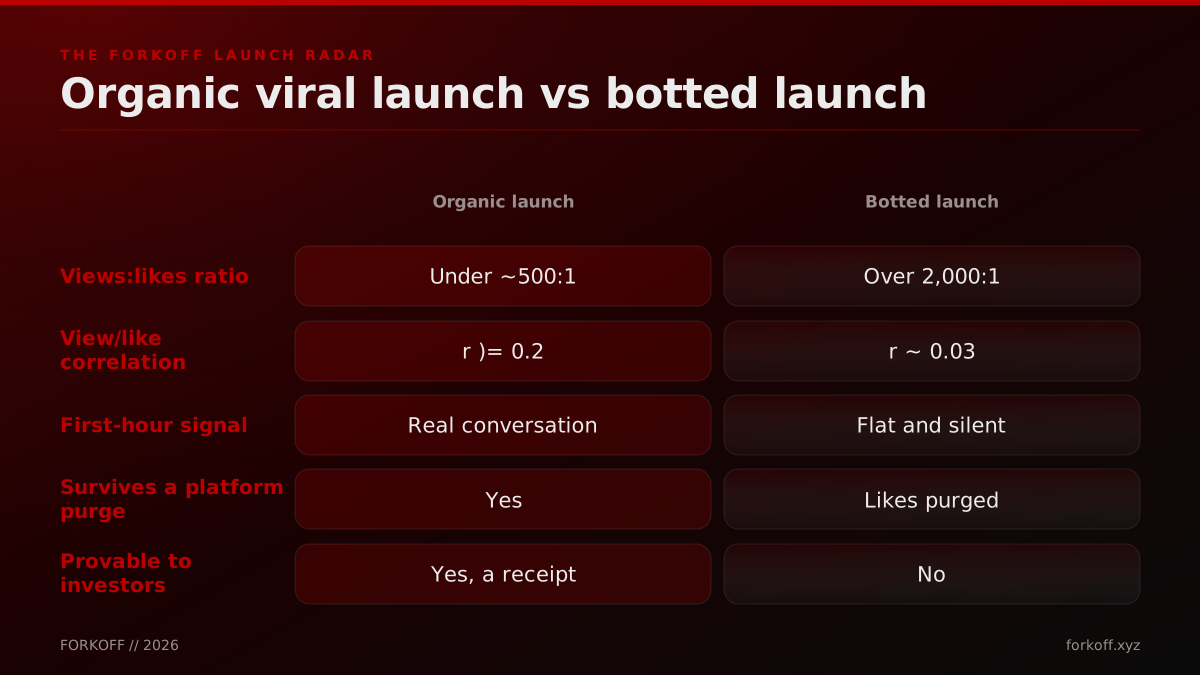
The first signal is the views-to-likes (V) ratio, the FORKOFF Launch RADAR's headline band. Real human reach produces engagement roughly in proportion to views. Across our instrumented launches, organic content clustered around 759 views per like (range 364 to 2,092), paid-boosted content sat near 2,884
because ad impressions convert to organic engagement poorly, and botted content ran around 6,731 because purchased views bring almost no real humans with them. The practical rule: a V ratio above roughly 500 in a normal niche is a flag, and above 2,884 is close to a confession.Operator note759:1 is the organic views-to-likes center across our instrumented launches; past 2,884:1 we treat the reach as bought., FORKOFF Launch RADAR bands, 2026
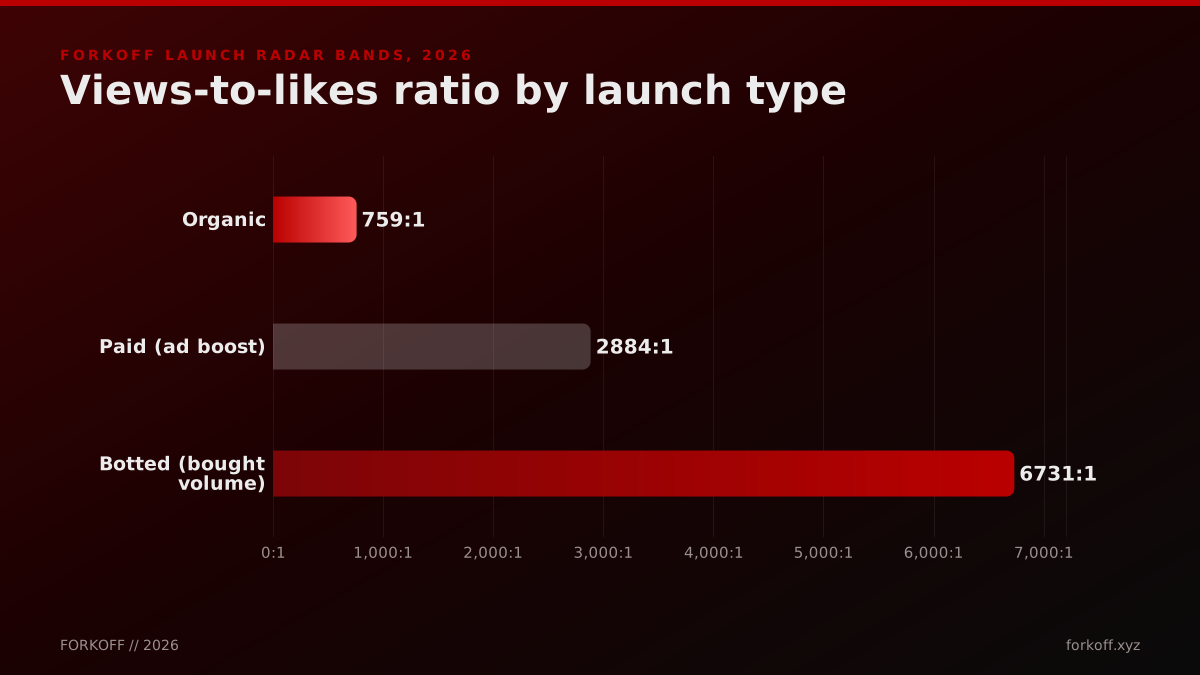
FORKOFF Launch RADAR views-to-likes bands by launch type
| Launch type | Views-to-likes center | Observed range / read |
|---|---|---|
| Organic | ~759:1 | 364:1 to 2,092:1 across organic launches |
| Paid-boosted | ~2,884:1 | Ad impressions convert poorly to engagement |
| Botted | ~6,731:1 | Bought views bring almost no real humans |
FORKOFF Launch RADAR labeled corpus, X founder launches, 2026. A ratio above roughly 500:1 in a normal niche is a flag; above 2,884:1 is close to a confession.
The second signal is the correlated-growth gate. Even if someone tunes their bought engagement to fake a plausible V
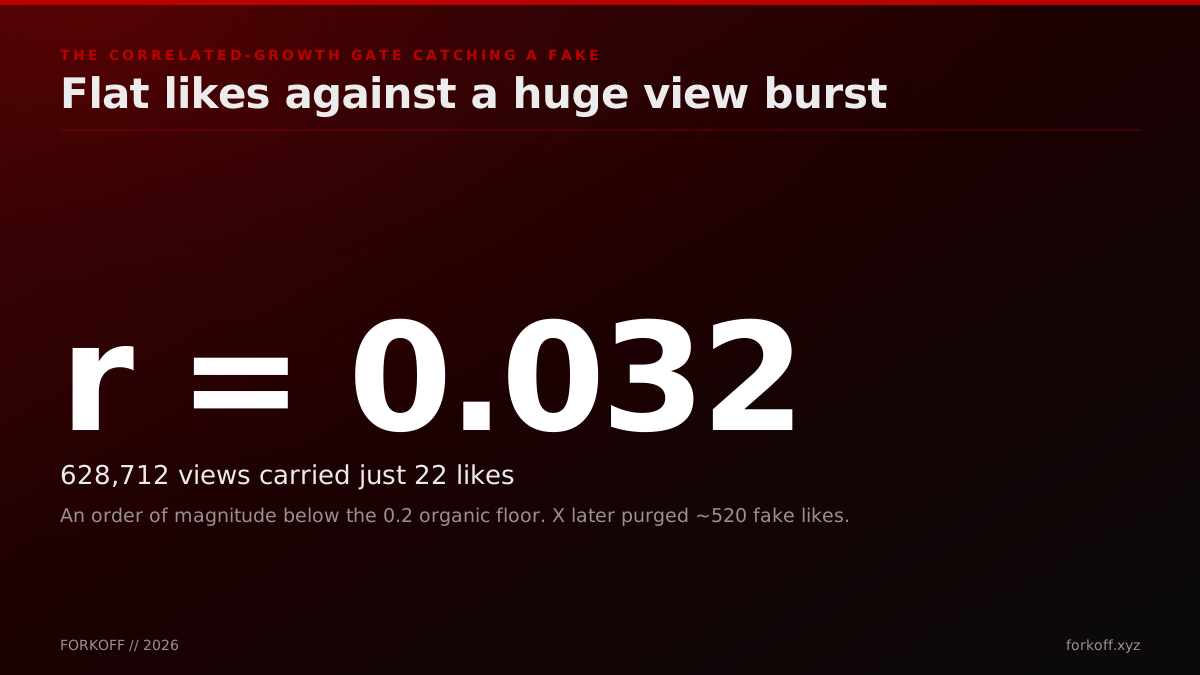
ratio, they struggle to fake the shape of growth over time. In a genuine viral burst, views and likes climb together, producing a Pearson correlation coefficient of at least 0.2. A botted burst shows views spiking while likes stay flat, collapsing the correlation. The cleanest case in our data: a 628,712-view burst carried just 22 likes and computed r=0.032, an order of magnitude below the organic floor. X later purged roughly 520 fake likes from it, confirming the read.What a bought spike looks like under instrumentation
The clearest botted case in the FORKOFF corpus: a 628,712-view burst carrying just 22 likes, computing a Pearson correlation of 0.032 between view growth and like growth, an order of magnitude below the 0.2 organic floor. X later purged roughly 520 fake likes from the post, confirming the classification after the fact. Bought reach does not just fail to convert; it degrades as platforms clean it up.
Source: FORKOFF Launch RADAR, botted-launch case file, 2026
Operator noter=0.032 on a 628,712-view burst was our cleanest botted catch; X later purged roughly 520 fake likes., FORKOFF Launch RADAR case file, 2026
Both signals must pass, because either one alone can be gamed. A campaign that clears both, V
under the ceiling and r at or above 0.2, is almost certainly organic; a campaign that fails either is suspect. This is also the honest answer to the recurring 2026 suspicion that "viral launches are all just paid boosts": some are, and now you can tell which. If you want the fuller treatment of the botted-versus-real debate, our sibling piece on whether Twitter launches are a scam works the same evidence from the skeptic's side.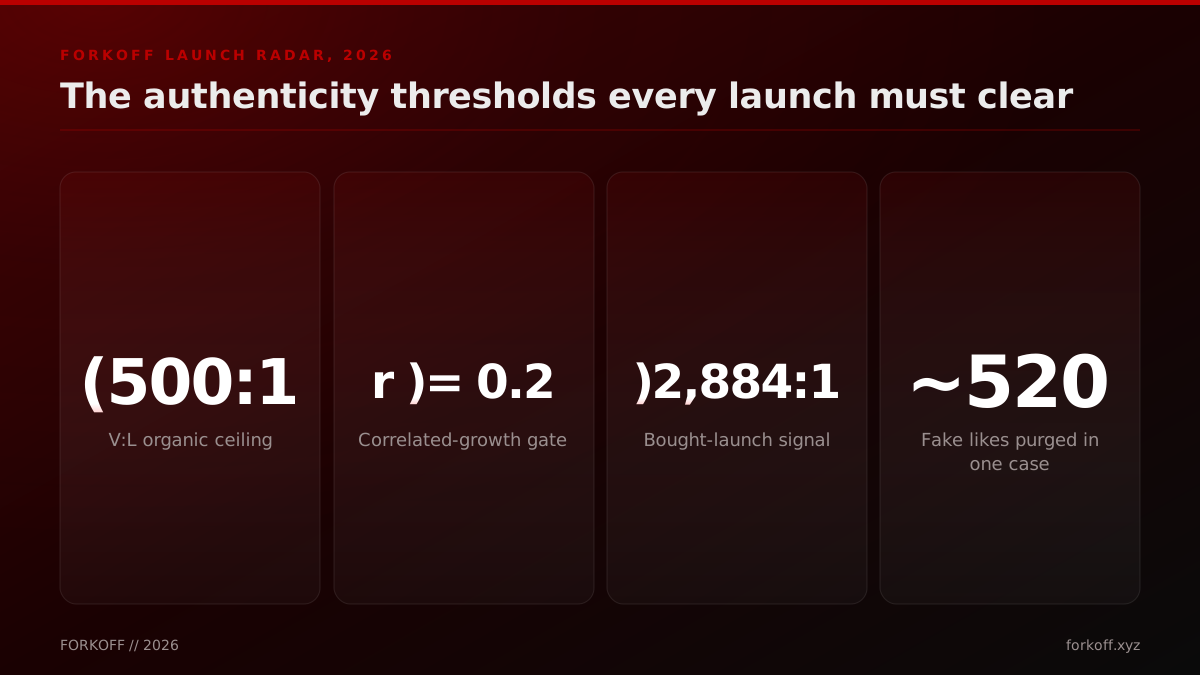
How do you measure whether a campaign actually went viral?
Use the viral coefficient, also called the K-factor: K equals the number of invites each user sends multiplied by the conversion rate of those invites. K greater than 1 means each user brings more than one new user and growth is self-sustaining. For content rather than product loops, measure the views-to-likes ratio, the share and save rate, and the percentage of reach that landed out-of-network. Raw view count is the weakest metric because it is the cheapest to buy.
"Went viral" is used loosely, so define it with a number. For a product with a built-in loop (a referral, an invite, a share-to-unlock), the canonical metric is the viral coefficient or K-factor, popularized in growth circles by writers like Andrew Chen. The formula is simple: K = (invites sent per user) x (conversion rate per invite). If every user invites 5 people and an estimated 25% sign up, K = 1.25, and the product grows without paid acquisition. The most-cited real example is Dropbox's referral program, which reportedly drove a 3900% increase in signups over about 15 months by giving both sides free storage, a textbook K-factor loop.
The most-cited K-factor loop ever measured
Dropbox's two-sided referral program, free storage for both the inviter and the invitee, reportedly drove a 3900% increase in signups over roughly 15 months, the canonical demonstration that a viral loop built into the product outperforms a viral campaign bolted onto it. It remains the reference case for engineering a reproduction rate at the product layer rather than the content layer.
Source: Drew Houston, Dropbox Startup Lessons Learned, 2010
The subtlety the incumbent guides miss: K greater than 1 is rare and usually temporary. Most successful "viral" products run a K between 0.5 and 0.9, which does not sustain growth alone but dramatically lowers blended acquisition cost. Chasing a mythical K above 1 is often less valuable than moving K from 0.3 to 0.7 on a product you already pay to acquire for.
Viral coefficient worked examples: K = invites per user x conversion per invite
| Invites sent per user | Conversion rate per invite | K-factor | What it means |
|---|---|---|---|
| 5 | 25% | 1.25 | Self-sustaining growth without paid acquisition |
| 4 | 15% | 0.6 | Not self-sustaining, but blended CAC drops hard |
| 2 | 10% | 0.2 | Loop exists on paper, moves almost nothing |
Worked arithmetic on the standard K-factor formula. Most successful products run K between 0.5 and 0.9; moving K from 0.3 to 0.7 usually beats chasing a mythical K above 1.
For content virality, where there is no invite loop, use a different instrument panel: the V
ratio (authenticity), the share and save rate (transmission strength), and the out-of-network reach percentage (whether it actually crossed audiences). A post seen by a million people who were all already in your network did not go viral; it went wide inside a bubble. The signal of true virality is the fraction of reach that came from outside your existing followers, and every major platform exposes some version of this in its analytics. Whatever you do, do not report the view count as the headline, because it is the one number an adversary can manufacture for a few dollars.Does viral marketing convert to real revenue, or just vanity views?
It can do either, and the view count alone predicts almost nothing about which. Founders routinely report million-view spikes that produced only a handful of signups. Whether virality converts depends on three things: audience match (did the wave reach your actual buyers), a one-click path from the hook to a signup, and a 96-hour recap tail that re-touches viewers. Measure signups-per-view, not views. Views are the input; instrumented pipeline is the win.
This is the question that keeps the whole discipline honest, and it has a vocal, credible group of practitioners on the skeptical side. The clearest public statement of the risk came from a founder who ranted about the industry "swinging too far from product-maxxing to views-maxxing" and pointed at "a long graveyard of viral launches that converted nothing." He is right, and any agency that tells you otherwise is selling you a vanity metric.
nikunj
nikunj
Mini rant on how we've swung the pendulum a bit too far from product-maxxing to views-maxxing. Companies are told to focus on distribution first, but it's also important to focus on sales. There's a long graveyard of viral launches that converted nothing.
The mechanism of the disconnect is straightforward. Views are the top of a funnel with several lossy stages beneath them, and virality only fills the top. If the audience the wave reached was not your buyer, the funnel is wide at the top and empty everywhere else. Ro's CEO Z Reitano made the point concrete by showing a 1.49M-view story against its actual conversion, the rare public example of a founder holding reach and revenue in the same frame instead of celebrating one and hiding the other.
Z Reitano
ZReitano
A launch story that pulled 1.49M views, shown against actual conversion, the clearest public example of holding reach and revenue in the same frame instead of celebrating one.
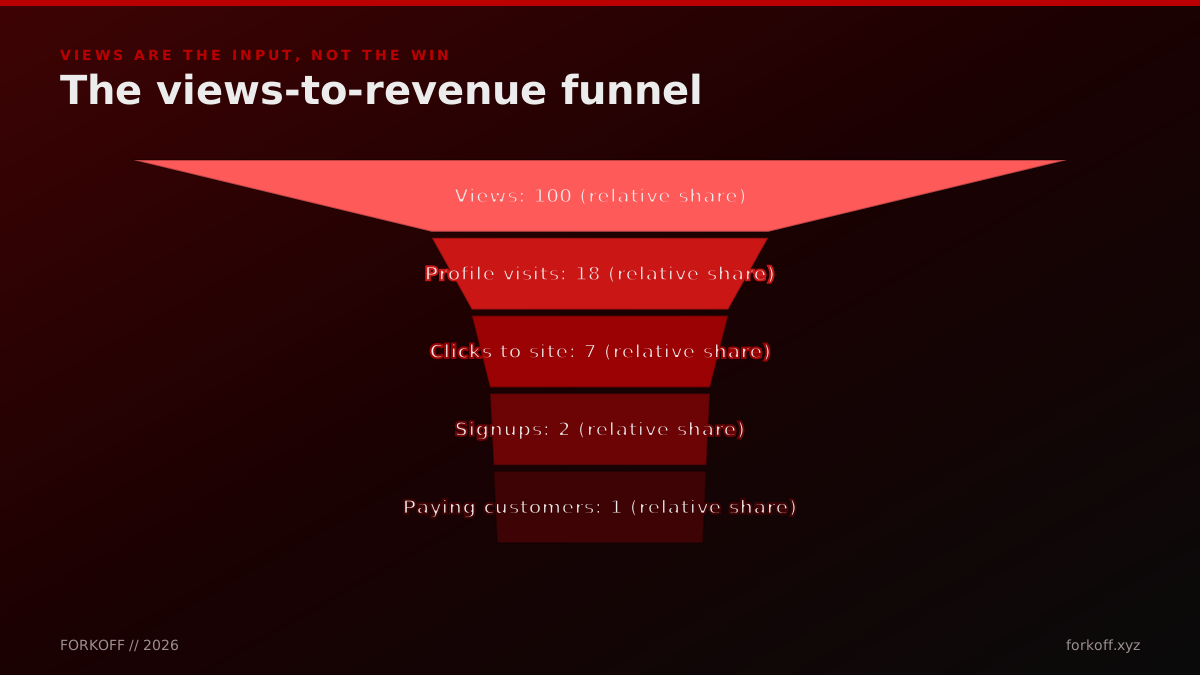
The founders who do convert virality treat the view as the first row of a funnel they instrument end to end: view, profile visit, click, signup, activation, paid. Three levers move that funnel. Audience match: engineer the wave to reach your ICP, which is why B2B virality optimizes for the right 500 people over the wrong 5 million. Frictionless path: one click from the hook to a signup, because every extra step halves the survivors. The tail: most signups from a viral event land in the 96-hour recap window, not in the first hour, so a campaign with no tail leaves most of its convertible reach on the table. The founders who publicly tie reach to revenue, like the bootstrapped operator who broke down a 1.9M-view launch against a real product, are always the ones who instrumented the whole funnel rather than screenshotting the top of it.
Operator note5B+ views processed through the FORKOFF clipping network sit behind the recap-tail numbers in this guide., FORKOFF clipping network, 2026
Mau Baron
maubaron
Breaking down a launch that hit 1.9M views and 17.7k bookmarks, and tying the reach back to a bootstrapped app doing real revenue rather than a vanity number.
Founders bookmark launch breakdowns like playbooks
The bootstrapped launch breakdown embedded above was carrying 17,759 bookmarks against 1.94M platform-reported views when we checked it in July 2026, roughly one save per 109 views. Bookmarks are the quiet utility signal: viewers no longer just watch a viral launch, they file the mechanics for their own. A discipline being saved and studied at that rate is a discipline being engineered, not admired.
Source: X platform-reported metrics for the embedded post, retrieved July 2026
What are the best viral marketing examples and campaigns in 2026?
The enduring reference campaigns still worth studying are Dollar Shave Club's 2012 launch video (roughly 12,000 orders in 48 hours off a single funny, useful video) and Old Spice's "The Man Your Man Could Smell Like", which stacked social currency, humor, and a real-time response campaign. In 2026 the dominant pattern shifted to founder launch videos on X, where MaveHealth (2.61M views), Composio (2.05M), and Lica (1.44M) crossed seven figures, while Duolingo and Ryanair kept brand virality alive with chaos-native short-form on TikTok.
The examples matter because they show the mechanics staying constant while the format changes. The 2012 classics were expensive-feeling video with a big creative swing. The 2026 wave is cheap-to-produce founder content engineered for algorithmic velocity. Both work for the same reason: a strong sharing trigger plus a strong transmission mechanic.
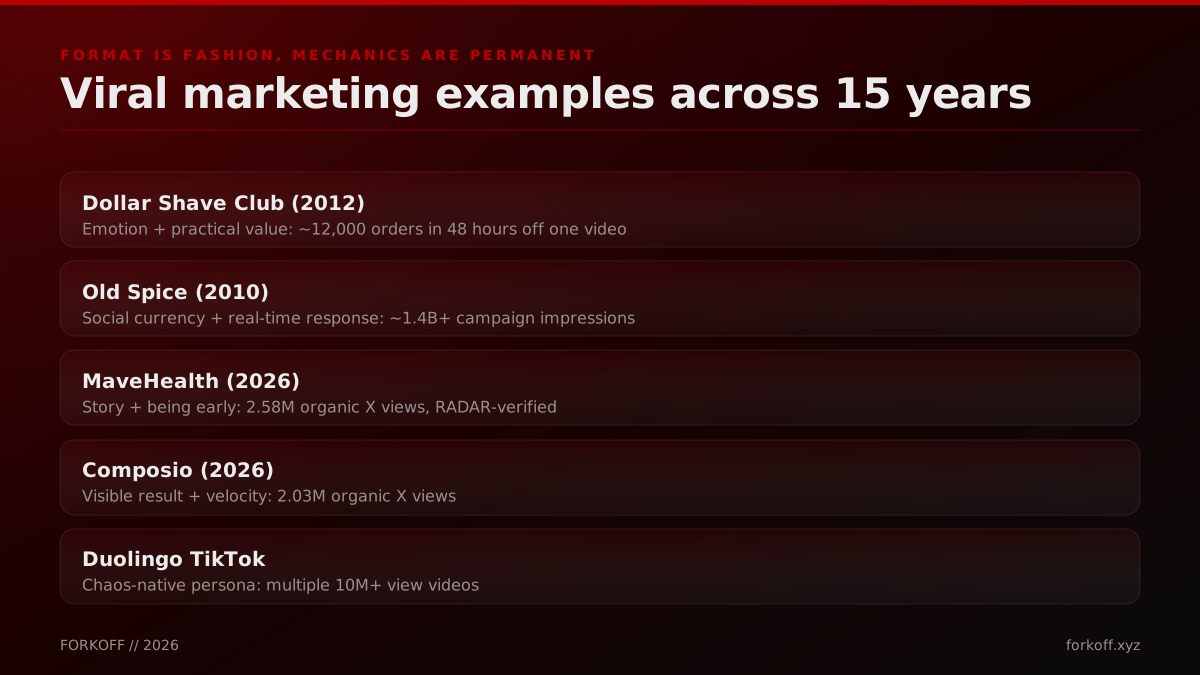
| Campaign / launch | Year | Platform | Primary sharing trigger | Verified reach signal |
|---|---|---|---|---|
| Dollar Shave Club launch video | 2012 | YouTube | Emotion (humor) + practical value | ~12,000 orders in 48h, ~27M+ views since |
| Old Spice "The Man Your Man Could Smell Like" | 2010 | YouTube/TV | Social currency + real-time response | ~1.4B+ impressions across the campaign |
| MaveHealth founder launch | 2026 | X | Story + social currency (early to a rising tool) | 2.61M views (publicly audited) |
| Composio founder launch | 2026 | X | Visible result + velocity | 2.05M views (publicly audited) |
| Lica founder launch | 2026 | X | Hook asset + wave-riding | 1.44M views (publicly audited) |
| Duolingo TikTok (owl persona) | 2024-2026 | TikTok | Emotion (chaos/humor) + triggers | Multiple 10M+ view videos, 10M+ followers |
The reason we can put verified numbers next to our own launches and only public estimates next to the classics is the whole point of this guide: first-party, RADAR-checked data is rarer and more trustworthy than the reach figures agencies quote from memory. Every number in the top three of the 2026 rows passed both the V
and correlated-growth gates. The lesson from the full span is that format is fashion and mechanics are permanent: a sharing trigger married to a transmission mechanic has produced virality across fifteen years and four platforms.Mitchell
MitcheIl
The viral launch guy breaking down a viral launch, 5.5M views and 24k bookmarks. The existence of a professional who does this on demand is the whole engineered-virality thesis in one profile.
How do you build a viral marketing strategy from scratch?
Build it as a system, not a single post. Pick one platform and one buyer. Warm the account and build a 15 to 30 person cluster over roughly two weeks. Build a hook-first asset that earns the read in one second. Post inside a first-hour velocity window and fire the cluster. Ride a live conversation wave instead of posting into silence. Then work the 96-hour tail with recaps and clips, and instrument signups-per-view so you can tell pipeline from vanity. Repeat, because virality is a base rate you raise over attempts, not a single swing.
This is the procedural core, and it maps directly to the Engineered-Virality Stack above. The strategy is not "make something shareable and hope"; it is a sequence you can put on a calendar and hand to an owner.
How to build a viral marketing strategy from scratch
STEPS- 01
Pick one platform and one buyer
Choose the single surface where your actual buyers already gather and commit to it. Reach on the wrong platform is not reach; it is noise you paid attention for.
- 02
Warm the account (about 14 days)
Raise your baseline engagement rate and build a 15 to 30 person cluster of real relationships in your exact niche. This is the audience that fires first on launch day.
- 03
Build a hook-first asset
Design the content so the first line and first video frame carry a one-second hook. If it does not earn the read instantly, the best distribution in the world cannot save it.
- 04
Post in the first-hour velocity window and fire the cluster
Publish when your audience is active, then get 20 to 40 weighted engagements in the first 30 to 60 minutes so the algorithm sees early velocity and widens distribution.
- 05
Ride a live wave
Attach the launch to an active conversation, tag the people driving it, and post into momentum rather than silence. Wave-riding is the single highest-leverage lever.
- 06
Work the 96-hour tail and instrument conversion
Recap, quote, and clip the asset across platforms for four days, and measure signups-per-view. The tail is where most of the actual customers convert.
Two things separate a strategy from a wish here. First, it is platform-and-buyer specific from step one. A generic "go viral" strategy is a contradiction, because the transmission mechanics differ by platform and the audience-match requirement differs by buyer. You commit to one surface where your buyers already are and engineer for that surface's specific ranking behavior. Second, it is run as a portfolio. No single attempt is guaranteed, so the strategy is to run the same high-floor process repeatedly and let the base rate produce hits, exactly as the operators who "ship one launch video a month" describe. A founder who reverse-engineered dozens of viral videos found the same repeatable skeleton every time, which is what makes a portfolio approach rational rather than a gamble.
Here's how to get 250k-5m+ views on your launch video... if you crack the formula, you can ship a new vid each month and drive insane inbound. We make 1/month and clear 200k+.
For founders starting from zero audience, the warm-up step is not optional and it is not slow marketing you can skip. It is the load-bearing input, because the first-hour velocity that the whole stack depends on comes from a cluster you built in advance. If you have no cluster, borrow reach: reply with genuine value under the larger accounts your buyers follow, and line up one or two operators to amplify on the day. The full runway motion maps to a complete product launch plan, and our three-ring product launch distribution model sits inside phases two and three of it.
What viral marketing techniques actually work in 2026?
The techniques that survive contact with 2026 data cluster into two groups: motivation techniques that give people a reason to share (a one-second hook, a visible result before the explanation, a debate frame, a concrete odd number, a genuinely useful artifact) and transmission techniques that make the share compound (first-hour velocity, warm-cluster ignition, wave-riding, reply-farming, and a 96-hour recap tail). A technique from only the first group produces shareable content that does not spread; a technique from only the second amplifies nothing. The ones that work pair both.
Founders ask for "viral marketing techniques" hoping for a list of tricks, and the honest version of that list is short because most of the tricks are variations on the same handful of mechanics. Here are the techniques that hold up against what we have measured, separated by which half of the viral event they serve.
Motivation techniques (they earn the share):
- The one-second hook. The first line and first video frame have to earn the read before a thumb moves. "Excited to announce" is a scroll trigger; a concrete number is a hook.
- Show the result first. Demonstrate the product working before you describe it. A three-second screen recording of the thing doing its job outperforms a paragraph every time.
- The debate frame. A defensible position people argue with drives replies, and replies are the highest-weighted signal on X. A statement nobody disagrees with gets scrolled past.
- The concrete, odd number. "628,712 views, 22 likes" reads as real precisely because it is specific and strange; round numbers read as marketing.
One caution on the debate frame before the second list: a defensible position is not rage-bait, and the line between them is whether you would stand behind the position in front of a serious buyer. The operator critique of pure outrage farming is covered in the risks section below.
Rage Baiting is for Losers. Yesterday, YC announced Chad IDE aka 'the brainrot code editor.' Chad is an AI code editor that allows you to gamble, watch TikTok, and use dating apps while working on coding tasks. Their launch rightfully got a lot of attention.
Transmission techniques (they make the share compound):
- First-hour velocity. Concentrate 20 to 40 weighted engagements in the opening 30 to 60 minutes so the algorithm sees momentum and widens distribution.
- Warm-cluster ignition. The 15 to 30 relationships you built in the warm-up fire first, seeding the reply-weighted signal before your general audience wakes up.
- Wave-riding. Attach the asset to a live, rising conversation and tag its principals, so you post into momentum instead of silence.
- The recap tail. Quote, recap, and clip the asset across platforms for 96 hours, because most of the reach (and most of the conversions) land after the first hour.
The reason "viral marketing techniques" listicles disappoint is that they publish the first list and omit the second, so readers make genuinely shareable things that never spread. The full creative side of the motivation list is broken down in our sibling guide on the levers behind going viral on Twitter; the transmission list is where an agency earns its fee.
The Engineered-Virality Stack, with the target number for each layer
| Layer | Input you control | Target |
|---|---|---|
| Warm-up | Daily posting plus genuine replies in-niche | ~14 days, 15 to 30 person cluster |
| Hook | First line and first video frame | Earns the read in 1 second |
| Velocity window | Publish timing plus concentrated early engagement | 20 to 40 weighted engagements in 30 to 60 minutes |
| Cluster ignition | Warmed relationships replying first | Replies, not just likes, in the first hour |
| Wave-riding | Attach to a live conversation, tag its principals | Post into momentum, never silence |
| Recap tail | Quotes, recaps, platform-native clips | 96 hours of tail work |
Every target here is the operating number FORKOFF runs on client launches; each layer is defined in the sections above.
What do the incumbent viral-marketing guides get wrong?
The generic viral-marketing guides make three errors, and all three trace back to having no first-party data. They treat virality as luck instead of an engineerable base rate, they spend nearly all their words on the motivation half and skip the transmission half, and they report reach with no authenticity check, so a bought view count reads the same as an earned one. Correcting those three errors is the entire reason this page exists.
We read the top-ranking generalist guides so the differences are concrete rather than rhetorical, and the pattern is consistent. Here is where the standard advice diverges from what the 2026 data shows, and what to do instead.
| What the incumbent guides say | What the data says (2026) | What to do instead |
|---|---|---|
| "You cannot control whether something goes viral" | Repeatable inputs raise the base rate until hits are a portfolio outcome | Run the Engineered-Virality Stack across many attempts, not one swing |
| "Make it emotional and shareable" | High-arousal emotion is necessary but not sufficient; transmission is the 2026 leverage | Engineer the motivation half AND the first-hour velocity half |
| "Viral means a lot of views" | Views are the cheapest metric to buy; a V above ~500 is a flag | Report signups-per-view and run the RADAR authenticity check |
| "Post consistently and hope" | The first-hour velocity window and a warm cluster do most of the work | Warm a 15-30 person cluster for 14 days, then fire it on launch |
| "Anyone can go viral" | True, but only against a legible algorithm you engineer for | Pick one platform and engineer for its specific ranked signal |
The through-line is that the incumbents write from folklore and we write from instrumentation. Their guides are not thin because the authors are careless; they are thin because a generalist publisher has no launch corpus to measure against, so they cannot answer "can it be engineered" or "is the reach even real" with a number. The Content Marketing Institute's research has repeatedly found original-research content earns disproportionate links and citations, and this is the mechanism: a claim with a measured number behind it out-authorities a claim without one. That gap, undated and data-free versus dated and instrumented, is the exact whitespace this guide is built to occupy, and it is what answer engines reward when they choose a source to cite.
How much does a viral marketing campaign cost and what is the realistic ROI?
Organic viral content can cost only production time plus a warmed distribution system, which is exactly why founders chase it: the marginal cost per additional viewer trends toward zero. Realistic ROI is not the view count, it is signups-per-view multiplied by customer value, minus production and distribution cost. A million organic views that convert approximately 0.1% of a matched audience at a real ACV can outperform a mid-sized paid campaign, while a million mismatched views convert nothing and have negative ROI once you count the effort. If you have not instrumented the funnel, you cannot claim an ROI, only a view count.
The cost question has a misleading easy answer and a correct hard one. The easy answer is "viral is free", which is why it is so seductive. The correct answer is that the content is cheap and the distribution system is not free, it is paid in time: the 14-day warm-up, the cluster-building, the reply-tab hours, and the 96-hour tail are labor, and labor has a cost even when no ad dollars change hands. The realistic cost of engineered organic virality is one to several weeks of focused distribution work per launch, plus production, which is why it is often packaged as an agency service rather than run in-house.
ROI has to be computed on the bottom of the funnel, never the top. The formula that matters: ROI = (signups-per-view x view count x conversion-to-paid x customer value) minus (production cost + distribution labor cost). The variable that dominates is signups-per-view, and it is set almost entirely by audience match. This is the mathematical reason the "views-maxxing" critique bites: a campaign optimized for maximum views instead of matched views can drive the view count up and signups-per-view down so hard that ROI goes negative even as the vanity number soars. The discipline is to optimize for the product of reach and match, not reach alone, and to instrument enough of the funnel that you can prove which one you actually got.
Mini rant on how we've swung the pendulum a bit too far from product-maxxing to views-maxxing. For years, companies have been told to focus on distribution first. Building a good product is important but it's also important to focus on sales.
Which platforms drive the most viral reach in 2026?
Each platform has a different viral engine, so "most reach" depends on your buyer, not a leaderboard. X rewards replies and quotes and is the default founder-launch surface for B2B and tech. TikTok and Reels reward watch-time completion and saves and can fan out furthest to cold audiences, which suits consumer and prosumer brands. YouTube compounds the slowest but for the longest, rewarding depth and search. The correct answer is the platform where your buyers already are, weighted by the signal that platform rewards, not the one with the biggest raw audience.
The single biggest mistake in platform selection is treating "the algorithm" as one black box across every surface. It is not. Each platform optimizes for a different primary signal, and engineering for the wrong one wastes the attempt.
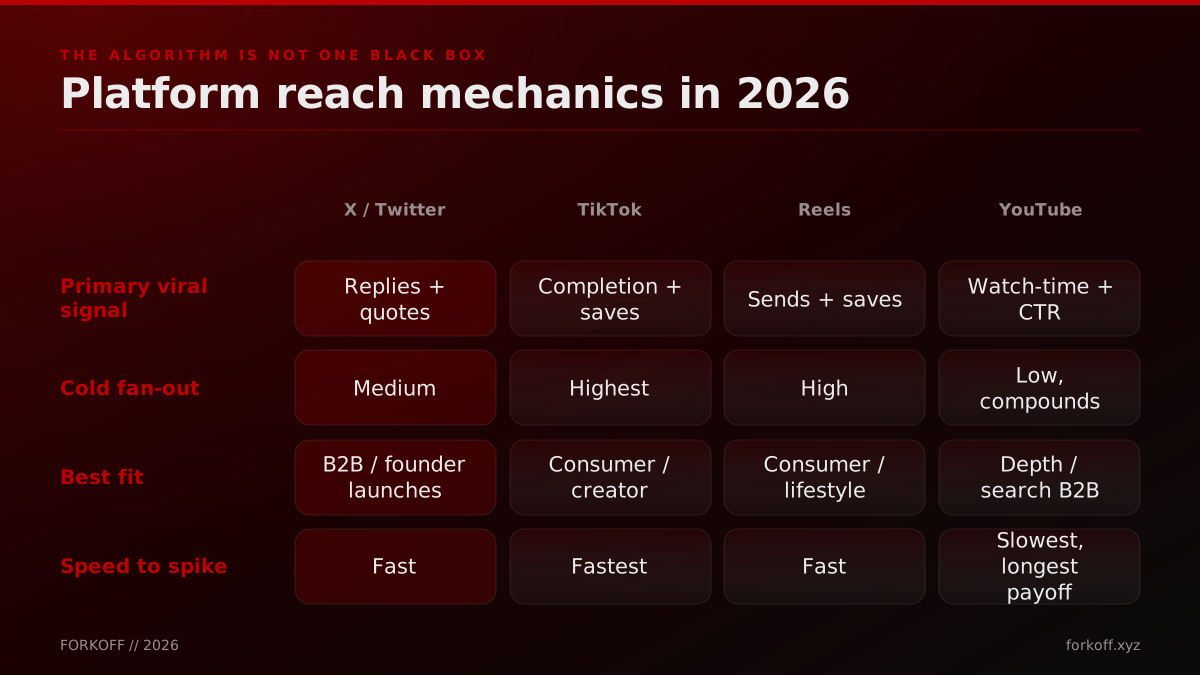
| Platform | Primary viral signal (2026) | Fan-out to cold audiences | Best fit | Notes |
|---|---|---|---|---|
| X / Twitter | Replies, quotes, author-replies (reply weighted far above like) | Medium, via quote-tweets and the reply graph | B2B, SaaS, DevTools, founder launches | Legible ranking model; velocity and conversation win |
| TikTok | Watch-time completion + saves; strong cold fan-out | Highest; the For You feed surfaces to non-followers by default | Consumer, prosumer, creator brands | Followers matter least here; the video's retention is everything |
| Instagram Reels | Sends-per-reach + saves + watch-time | High, but weighted toward interest graph | Consumer, lifestyle, design-led products | Sends (DM shares) are the strongest transmission signal |
| YouTube | Watch-time + click-through + session depth | Low per-video, but compounds via search for years | Depth content, tutorials, high-consideration B2B | Slowest to spike, longest to pay off; a search asset, not a spike |
The strategic read for a 2026 campaign: pick the platform by buyer first and by mechanic second. A DevTools founder engineering for TikTok completion is fighting the wrong battle; a consumer app founder farming X replies is doing the same in reverse. Match the surface to where your buyers already gather, then engineer specifically for the signal that surface rewards. Data-driven breakdowns of platform mechanics, like the study of 16,000 X accounts on the growth pattern, are worth studying precisely because they are platform-specific rather than generic.
I Studied 16,000 X Accounts - This is How You Grow On X (Twitter)
A data-driven study of 16,000 X accounts extracting the growth pattern, another independent read on the repeatable mechanics of reach.
How do B2B and SaaS companies use viral marketing differently from consumer brands?
Consumer virality optimizes for the widest possible reach and brand affinity, because in consumer markets almost anyone can be a buyer. B2B and SaaS virality optimizes for reaching a narrow, high-value buyer, so a 50,000-view thread seen by the right 500 decision-makers can beat a 5M-view consumer hit. B2B leans on founder-led launches, product-led loops (referrals and K-factor mechanics built into the product), and niche communities rather than mass short-form. The governing metric is qualified pipeline, not raw reach.
The difference is a direct consequence of buyer density. In a consumer market, the addressable buyer is a large fraction of the total audience, so maximizing reach maximizes buyers, and the consumer playbook (chase the widest fan-out, optimize for brand affinity, accept low per-view conversion at enormous scale) is rational. In B2B, the addressable buyer is a tiny fraction of any general audience, so raw reach is mostly waste, and the game becomes concentration: getting in front of the specific people who can buy.
This inverts several tactics. Where a consumer brand wants the TikTok cold fan-out, a B2B founder wants the X reply graph inside their niche, because it concentrates reach among peers and buyers rather than spraying it across a general audience. Where a consumer brand measures reach and affinity, a B2B company measures qualified signups and pipeline, and cheerfully trades a smaller number for a better-matched one. And where a consumer brand relies on the content itself spreading, B2B increasingly builds the loop into the product: a referral, an invite, a "made with" badge, so the viral coefficient lives in the software rather than in a marketing campaign. Our founder funnel work is built around this B2B reality, engineering reach toward the specific buyers who convert rather than the largest crowd who will not.
The clip economy is the bridge between the two worlds: turning one launch asset into many platform-native clips lets a B2B company borrow consumer-style fan-out for a business-buyer message, which is precisely the motion our podcast and clipping service runs at scale, and it is how a narrow B2B launch can still ride the widest short-form surfaces without diluting the buyer match.
Should you hire a viral marketing agency or run viral campaigns in-house?
Run it in-house when the founder has the time and the appetite to build the warm-up, the cluster, and the reply-tab hours themselves, and when the launch cadence is occasional. Hire an agency when you need repeatable reach on a schedule, when the founder's time is worth more spent on the product, or when you need the distribution system (warm accounts, clusters, wave-monitoring, and RADAR instrumentation) to already exist rather than building it from zero. The decision is about who owns the distribution system, because the content is the cheap half and the system is the expensive half.
Founders searching for the "best agency to make a product launch go viral" have already made the core realization: virality is a service now, because it runs on a system that takes weeks to build and discipline to operate. But hiring is not automatically right, so here is the honest decision framework.
Run it in-house if two things are true. First, the founder genuinely has the hours, because the load-bearing work (14-day warm-up, cluster-building, an hour on the reply tab per launch, and a 96-hour tail) is time, not money, and it cannot be skipped. Second, launches are occasional, so the system does not need to be always-warm. A solo founder with one big launch and eight weeks of runway can absolutely run this themselves, and our sibling guides are written so they can.
Hire an agency if the reverse is true. The three conditions that flip the decision: you need repeatable reach (multiple launches, a content cadence, always-on distribution), the founder's time has higher-value uses (shipping, selling, fundraising), or you need the distribution system to already exist. That last one is the real product an agency sells: a bank of warm accounts, live clusters, continuous wave-monitoring, and the RADAR instrumentation to prove the reach was organic. Building that from scratch takes months; renting it takes a call.
| Factor | Run in-house | Hire an agency |
|---|---|---|
| Best when | Occasional launches, founder has time | Repeatable reach, founder time is scarce |
| Cost model | Founder hours (large, hidden) | Retainer or per-campaign fee (explicit) |
| System build | Built from zero each time | Already exists, rented |
| Authenticity proof | Manual, if at all | RADAR-instrumented and provable |
| Ramp time | Weeks per launch | Immediate |
| Risk | Founder burnout, inconsistent | Vendor quality varies, vet with the RADAR |
The vetting question to ask any agency is the one this whole guide is built around: how do you prove the reach was organic? An agency that cannot answer with a measurement model (a views-to-likes ceiling, a correlated-growth gate, something) is selling you a view count, and a view count is the one thing that can be bought. Our Twitter/X marketing and founder funnel work exists for exactly the teams for whom the three hire conditions are true, and we hand over the RADAR receipts because a reach number without an authenticity proof is a liability, not an asset.
What are the risks and downsides of viral marketing?
The main downsides are the one-hit-wonder trap (a spike with no repeatable system behind it), audience mismatch (huge reach that never converts), brand-safety damage from rage-bait (attention bought at the cost of trust), and bought engagement that a platform later purges (fake reach that evaporates and can get an account flagged). The deepest risk is treating virality as a lottery ticket rather than a repeatable input, because a single spike changes nothing durable if there is no system to reproduce it.
Virality has a real downside register, and the mature version of this discipline plans for it. Four risks matter most.
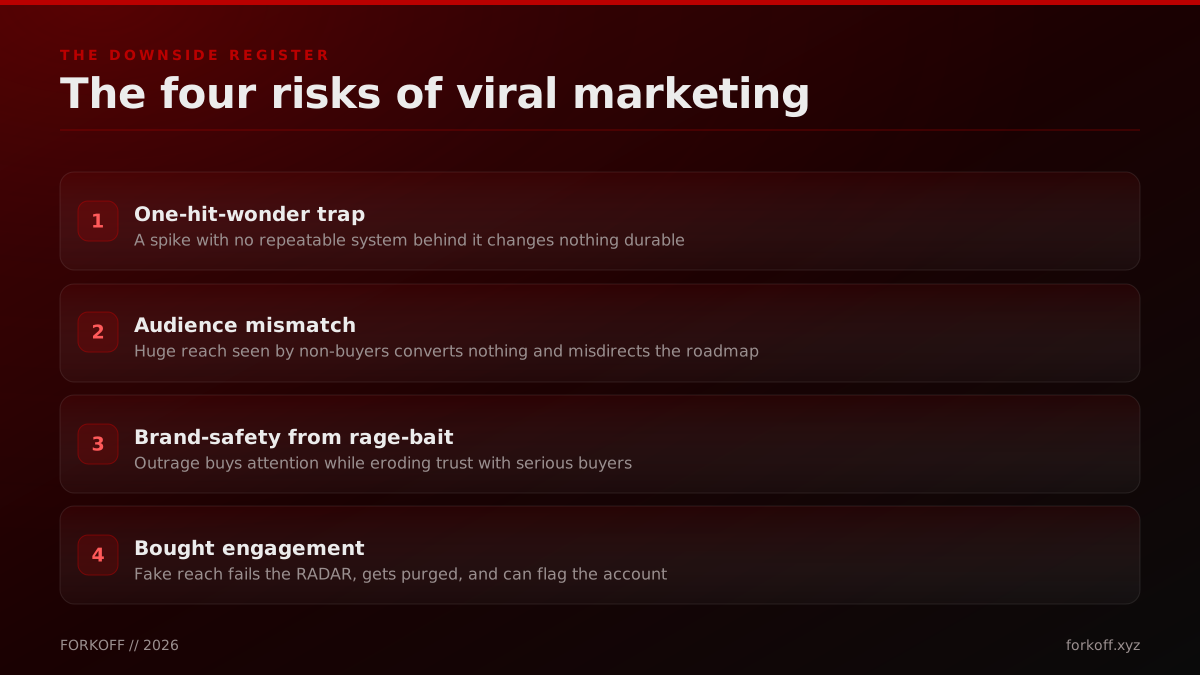
The one-hit-wonder trap. A single viral hit with no system behind it is a story, not a strategy. It feels like validation and produces nothing durable, because you cannot explain what worked well enough to do it again. The entire argument of this guide, that virality is engineered, is the antidote: a repeatable stack turns one hit into a base rate.
Audience mismatch. Covered above as the revenue killer, it is also a strategic risk: a big mismatched hit can pull a company toward optimizing for the wrong audience, chasing the applause of people who will never buy. The "views-maxxing" graveyard is full of teams who let a vanity spike redirect their roadmap.
Brand-safety from rage-bait. The fastest way to manufacture attention is to farm outrage, and it works on the view counter while quietly eroding trust with the exact buyers you want. The public debate crystallized around YC's Chad IDE launch, which drove huge attention off outrage and prompted operator Jordi Hays to publish "Rage Baiting is for Losers." The point is not that controversy never works; it is that it borrows against brand equity, and the bill comes due with the serious buyers who remember how you got their attention.
Jordi Hays
jordihays
Rage Baiting is for Losers. YC's Chad IDE launch got huge attention off outrage; the debate on whether farming controversy is worth the brand cost. 1.49M views.
Bought engagement. Purchasing views or likes to fake a viral event fails on both RADAR signals, degrades over time as platforms purge fake engagement, and can get an account flagged. It is the most common way "viral" campaigns are quietly fraudulent, and it is now detectable, which is why measurement is a defense as much as an analysis. The archetypal 2026 front-page post, "we launched, it went viral, here is exactly what I did," is celebrated precisely because the author could show the process behind the reach, not just the number.
We launched. It went viral. My thoughts on how to launch a product.
Methodology: how the FORKOFF Launch RADAR numbers were measured
Every first-party number in this guide comes from the FORKOFF Launch RADAR, our instrumentation for classifying whether a launch's reach is organic, paid, or botted. For each launch we capture the time series of views and engagement, compute the views-to-likes ratio and the Pearson correlation between view growth and like growth across the burst, and classify against pre-set bands. The launch-view figures (MaveHealth 2.61M, Composio 2.05M, Lica 1.44M) are platform-reported totals for public launches we audited, not FORKOFF campaigns, and MaveHealth's own RADAR read is lightly amplified. The bands themselves come from the labeled corpus of organic, paid, and botted launches we have measured.
Because the incumbents publish no methodology, we owe you ours, since a number without a method is just an assertion. Here is how the RADAR works, step by step.
We collect, per launch, the view and engagement time series from platform analytics. From that we compute two statistics. The views-to-likes ratio is total views divided by total likes, compared against the labeled bands (organic ~759
, paid ~2,884, botted ~6,731). The correlated-growth coefficient is the Pearson correlation between cumulative views and cumulative likes sampled across the burst; genuine bursts produce r >= 0.2, and the botted example that anchors our detection computed r=0.032. A launch is classified organic only if it clears both the V ceiling and the correlation floor, because either signal alone is gameable. The verified 1M+ launches cited throughout cleared both.The publicly audited 1M+ launch corpus behind this guide
| Launch | Platform-reported views | V:L ceiling gate | Correlated-growth gate |
|---|---|---|---|
| MaveHealth | 2.61M | 825:1, above ceiling | Pass (r >= 0.2) |
| Composio | 2.05M | 1,892:1, above ceiling | Pass (r >= 0.2) |
| Lica | 1.44M | Pass | Pass (r >= 0.2) |
All three launches ran the same six-layer Engineered-Virality Stack. MaveHealth views and ratio from its FORKOFF Launch RADAR row; Composio re-read on X 2026-09-23; Lica is not a RADAR row.
Two honesty caveats, because a real methodology states its limits. First, the bands are calibrated to the platforms and niches we operate in (primarily X for founder launches); the specific numbers shift across platforms and audience sizes, and the method, two independent signals that are hard to fake together, generalizes better than the exact thresholds do. Second, the platform-reported view totals are the platforms' own numbers; the RADAR does not re-count views, it validates whether the engagement underneath them is consistent with real humans. What we are certifying is authenticity of the reach, not a re-audit of the view counter. That distinction is exactly the one the vanity-metric guides never draw, and it is the one that separates a real viral campaign from a purchased illusion of one.
If you want the same instrumentation applied to your launch, so you know your reach is organic and can prove it to investors, that is the RADAR check we run on every campaign. And if you are trying to calibrate what "viral" even means for your stage, our sibling guide on how many views is viral in 2026 sets the thresholds by platform and account size.
How viral marketing fits into a full go-to-market engine
Viral marketing is one channel, not the whole engine. A single seven-figure launch moves the top of the funnel for a week; a durable growth system needs the other channels running underneath it, so the reach a launch buys has somewhere to land and something to convert against. The teams that get lasting value from virality treat it as the spike on top of a steady base of search, answer-engine presence, community, and repurposing, not as a substitute for any of them.
The failure mode is easy to name once you have seen it. A launch fires, the view counter spins, and then the company has nothing to catch the attention it just earned: no ranked pages for the searches the launch triggered, no answer-engine footprint when a curious buyer asks an AI assistant about the category, no presence in the communities where the discussion actually moves. The spike decays in days and leaves nothing behind. The same launch is worth far more when it lands on top of a base that was already there.
That base has a few standing parts. Search is the slow compounding floor: the queries a viral moment creates, like your product name or your product versus a competitor, get typed into Google and into AI assistants for months, and if you do not rank and are not cited, a competitor answers them for you. This is why we pair launches with AI search optimization and answer engine optimization work, so the demand a launch manufactures converts into owned, durable visibility instead of a rival's.
A concrete version makes the cost of skipping the base obvious. Two companies run identical launches and each earns a million views. The first has ranked pages, an answer-engine presence, and an active community footprint already in place, so the buyers who go looking after the launch find the company waiting for them at every step, and the spike converts for months. The second launched into a vacuum, so the same million views produce a day of traffic and then nothing, because there was nowhere for the earned attention to land. The launches were equal; the systems underneath them were not, and the system is what decided the outcome.
Community is the second standing part. A launch on X reaches the timeline, but a large share of buyers do their real research inside niche forums and subreddits, where a founder's own post carries more weight than any ad. Our Reddit marketing practice exists to hold that ground, and its mechanics sit alongside the launch motion rather than competing with it.
Repurposing is the third. One launch asset is raw material for dozens of platform-native clips, which is how a single moment keeps producing reach for weeks after the original post stops moving. The full recipe is in our managed clipping playbook, and it is the practical engine behind the 96-hour recap tail this guide keeps pointing at. For founders whose buyers gather at conferences rather than on a timeline, the same logic extends to events: a launch can be timed to a moment where the right room is already paying attention, which our event sponsorship playbook treats as its own distribution surface.
None of this argues against virality. It argues that a viral launch is most valuable when it is the loudest moment inside a system that was already running, not a replacement for building one. That is the difference between an always-on distribution engine that compounds and a highlight reel of spikes that each fade back to nothing. Founders without an in-house team to hold all of these lanes at once often bring in an agency to get the whole engine operating without hiring for every seat, and that is the layer that decides where a launch fits in the quarter instead of treating each one as an isolated event.
A worked example: one launch through the Engineered-Virality Stack
To make the stack concrete, here is a single launch moving through all six layers with numbers attached. The point of the walk-through is that every moment that looks like luck to an outside observer maps to a deliberate input set days earlier. That mapping is the whole difference between an engineered launch and a hopeful post, and it is why the same process produced 2.61M, 2.05M, and 1.44M-view launches rather than one fluke.

Start fourteen days out. The founder posts three to four times a day and leaves ten to fifteen genuine replies daily under the accounts their buyers already read. This raises the account's baseline engagement rate and, more importantly, builds a cluster of roughly twenty real relationships in the exact niche. None of it is visible on launch day. All of it is load-bearing.
On launch morning the asset leads with a one-second hook: frame one of the video shows the product doing its job, no logo and no "excited to announce." It ships inside the window when that audience is active, and within the first thirty minutes the warmed cluster is in the replies, not just liking but replying. Because a reply is weighted many times a like and an author reply back many times a reply, that concentrated, reply-heavy velocity is exactly the signal the ranking model rewards, so distribution widens to a second, larger ring.
Then the wave. The launch is deliberately attached to a live conversation the niche is already having that day, and the people driving that conversation are tagged, so the post lands in momentum instead of silence. Over the next ninety-six hours the founder works the tail: quoting the thread, recapping the numbers, and cutting three platform-native clips. The final view count looks like a lucky break. Every input that produced it was set on a calendar.
The honest caveat is that this exact sequence still fails sometimes, because the last mile depends on a network's mood on a given day. But run it ten times and the base rate is high enough that hits stop being surprising, which is the entire claim of this guide: engineering sets the floor, and luck only ever sets the ceiling.
The bottom line on viral marketing in 2026
Three things are true at once, and holding all three is the whole discipline. First, virality is mostly engineered: a warmed cluster, a one-second hook, first-hour velocity, and wave-riding raise the base rate so far that hits become a portfolio outcome rather than a lucky break, which is why the same stack produced 2.61M, 2.05M, and 1.44M-view launches in a row. Second, virality is easy to fake, so the honest operator measures authenticity with two hard-to-game signals, a views-to-likes ceiling near 500
and a correlated-growth floor at r >= 0.2, before believing any reach number. Third, views are not the win: signups-per-view is, and a campaign that does not instrument the funnel past the view count is reporting vanity, not results.The incumbent guides get to skip all three because they are undated, data-free, and selling nothing but page views of their own. We do not get to skip them, because we run these campaigns for founders and we have to prove the reach was real and that it converted. That is the standard this guide is written to, and it is the standard worth holding your own viral marketing to.