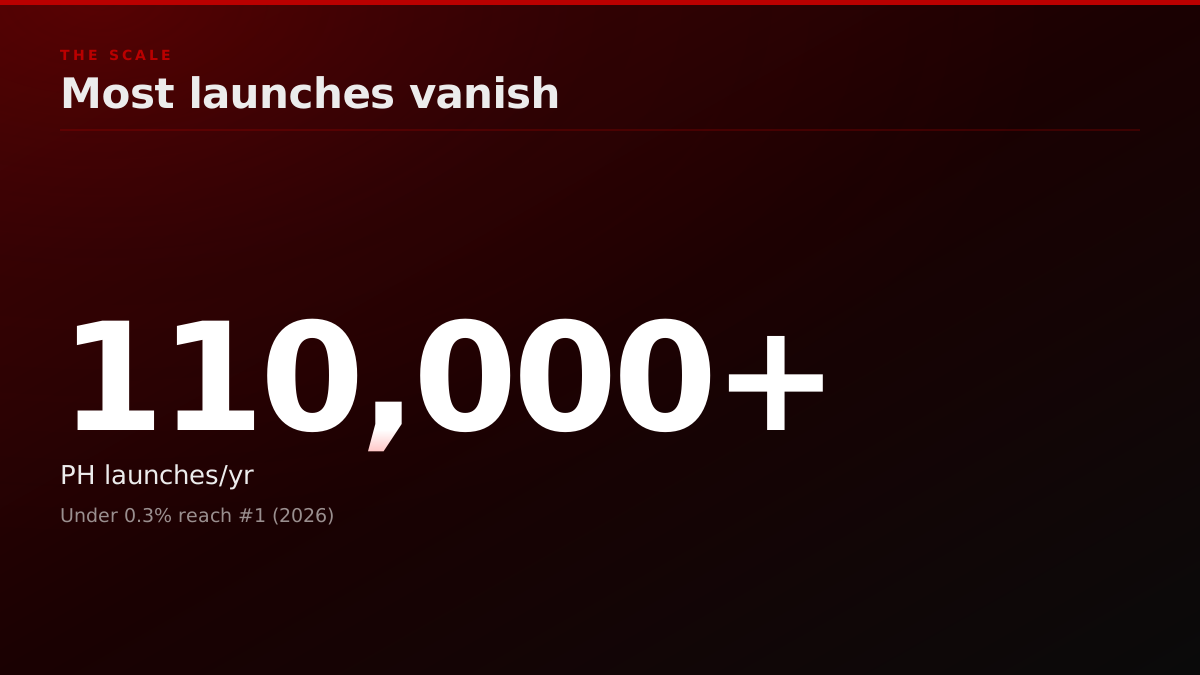
A Product Hunt launch is a 24-hour competition where a maker submits a product to Product Hunt's daily leaderboard and the community votes, comments, and ranks it against every other product posted that day. Over 110,000 products launch on Product Hunt every year, and under 0.3 percent ever reach number one, so the tactics that separate a top-12 finish from an invisible one are not folklore, they are specific, measurable, and mostly ignored by first-time makers. This playbook covers all of them: the maker comment as a crafted asset, the hour-by-hour first-four-hours runbook, the data behind the "launch at midnight Tuesday" advice, whether a hunter is worth paying for, and what to do with the badge once you have it.
Last updated 2026-07-10.
TL;DR
Every Product Hunt guide mentions the first comment, the midnight launch, and the badge in a single sentence each, then moves on. That one-sentence treatment is exactly why most first-time makers mess up launch day. Below is the worked version: a five-part maker comment template with a real example, an hour-by-hour runbook from 12
AM Pacific Time through the first four hours, the actual vote-weight discount one founder measured (120 upvotes converted to 31 ranking points), and the real Product Hunt data on self-hunting (79 percent of featured posts, 60 percent of Product of the Day winners) that answers whether paying a hunter is worth it. None of it works without the thing every ranking page skips: the post-launch distribution layer that keeps you visible after the leaderboard resets.The 30-second answer
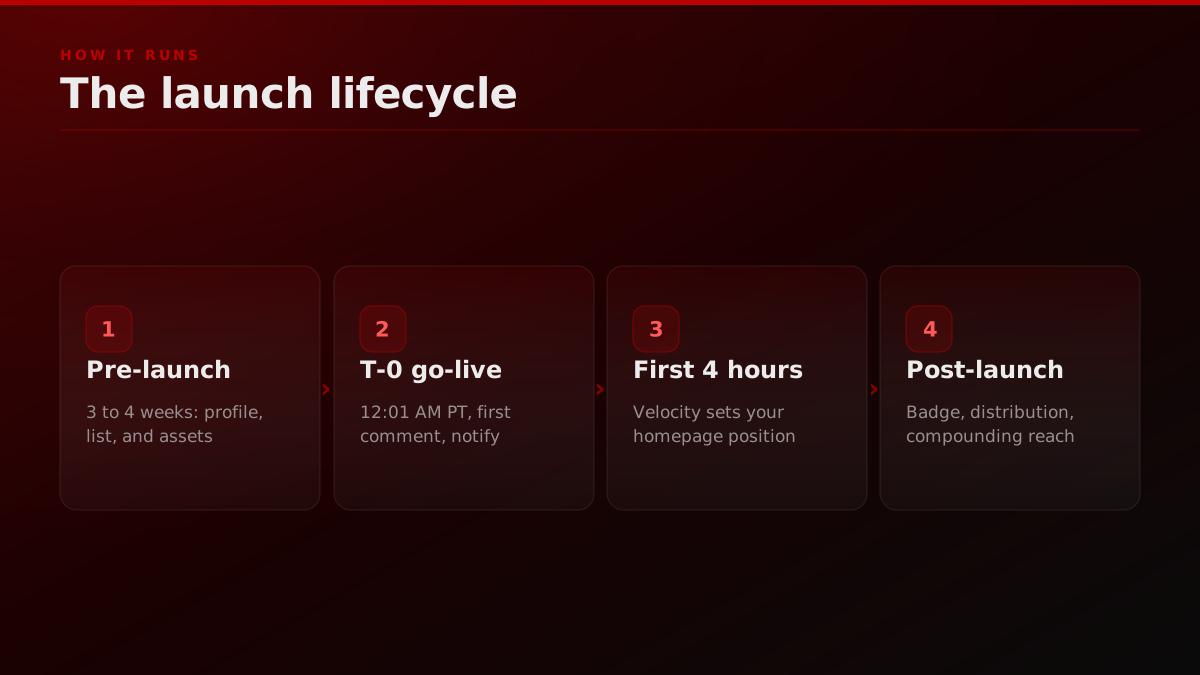
A Product Hunt launch is won or lost before launch day. Spend 3 to 4 weeks building genuine community presence and a 200-to-300-person warm supporter list, then launch at 12:01 AM Pacific on a Tuesday, Wednesday, or Thursday and post a five-part maker comment under 200 words the moment you go live. Self-hunt: Product Hunt's own data shows 79 percent of featured posts and 60 percent of Product of the Day winners were self-hunted. Vote quality beats vote count, one founder's honest recap showed roughly 120 upvotes credited as only 31 ranking points, and the homepage cliff at position 12 (106 upvotes at number 12 versus 44 at number 13 on one measured day) decides who gets discovered. The traffic spike decays within about 72 hours, so the post-launch distribution plan, clipping, Reddit, X, and the badge placed where buyers decide, has to exist before the leaderboard resets.
What is a Product Hunt launch?
A Product Hunt launch is the act of submitting your product to Product Hunt's daily leaderboard, where it competes against every other product posted in the same 24-hour window (12
AM to 11 PM Pacific Time) for community upvotes, comments, and a final ranking. The top finishers earn Product of the Day, and the best of the week and month compete again at those higher tiers. It is not a directory listing. It is a live, time-boxed competition with a start gun, a leaderboard, and a clock that resets every midnight Pacific.Product Hunt has run this daily-leaderboard format since it launched in November 2013, and its scale changed materially after AngelList acquired the platform in 2016 and folded it into a broader startup-discovery ecosystem, a history worth knowing because it explains why the platform behaves like an evolving product with changing incentives, not a static directory, per its own public history.
The mechanics are simple to describe and hard to execute well. You (or your product's maker profile) submit a name, tagline, gallery, and description before the day you want to launch. At 12
AM Pacific on that day, the listing goes live and the clock starts. Community members, anyone with a Product Hunt account, upvote products they like and leave comments, and the homepage ranks every live product by a formula Product Hunt does not publish. What you can observe, and what this playbook is built around, is how that formula behaves in practice.The confusion first-time makers hit almost immediately is treating a Product Hunt launch as a marketing channel like any other. It is closer to a sport with a season that resets daily. You get one shot per product per day, the field resets to zero every midnight, and your standing at hour two of the competition strongly predicts your standing at hour twenty-four. That single fact, that early position compounds, is the thread running through every section below.
The 2026 Product Hunt landscape: why the old one-liners stopped being enough
Product Hunt in 2026 is more crowded and more algorithmically opaque than the "launch at midnight, write a good comment" advice from five years ago accounts for. Over 110,000 products now launch per year, roughly 300 a day, and the platform has quietly hardened its vote-weighting to fight bot and reciprocity farming, which means the tactics that worked in 2021 (mass Slack blasts, buy-a-vote services, generic first comments) actively hurt you now. Tibo, Product Hunt's own Maker of the Year and the builder behind Taplio, put the scale bluntly: "110,000+ products were launched on Product Hunt in the last 12 months, and under 0.3% reached #1" (Tibo's 12-month Product Hunt launch data). The rest, he said, "got no visibility, no traffic, no customers... most makers launch blind, wrong day, weak tagline, no first comment strategy."
Tibo
@tibo_maker
110,000+ products were launched on Product Hunt in the last 12 months. <0.3% reached #1 and rest got no visibility, no traffic, no customers. most makers launch blind, wrong day, weak tagline, no first comment strategy, so I analyzed 113,762 launches.
The community-facing evidence backs this up. On r/ProductHunters, one founder named the exact failure mode this playbook is structured around: a glass ceiling that appears right around position 12, where the homepage's visible slots run out and everything below becomes functionally invisible to a normal visitor. Another founder documented flopping as a 19-year-old solo founder specifically because the launch went out with no pre-built audience, which is the single most correctable mistake in this entire guide.
I Almost Cracked Product Hunt. The real lesson: there's a glass ceiling at #12
How My Product Hunt launch flopped. I launched too early, with no audience, and here's everything I learned as a 19 year old solo founder
110,000+ products were launched on Product Hunt in the last 12 months. <0.3% reached #1... most makers launch blind - wrong day, weak tagline, no first comment strategy.
What has not changed is the reward for doing the unglamorous work early. The teams that beat this landscape (one three-person team that beat OpenAI's own launch to Product of the Week, another that open-sourced the week-by-week SOP behind 30 separate number-one finishes) all describe the same pattern: a system run repeatedly, not a single clever trick executed once. Our own agency work sits downstream of exactly this landscape shift; Product Hunt is now one leg of a coordinated launch, and treating it as the whole strategy is the fastest way to end up in the 99.7 percent.
We beat OpenAI on Product Hunt and became Product of the Week: 5 Launch Tips for 2026
30x Product Hunt #1 + 6,000 GitHub stars in 7 days, here's the launch system I open-sourced
How does Product Hunt's ranking algorithm work?
Product Hunt has never published its exact ranking formula, but its observable behavior discounts votes from new or low-activity accounts, weighs genuine comments and engagement heavily, and rewards early velocity in the first hours of the day, when your homepage position gets set and then tends to compound for the rest of the 24-hour window. The single most important operational fact: it is not one vote, one point. Real founder data shows the gap between raw votes and ranking weight is large and unpredictable if you have not planned for it.
The clearest evidence comes from a founder's own honest recap. Basma, launching a tool called QuoteTimer, posted the real numbers: "~120 upvotes → only 31 points... Finished #20... Votes from new PH accounts barely count." That is not a rounding error, it is roughly a 74 percent discount between what showed on the vote counter and what the ranking algorithm actually credited.
::directive{id="tw-basma-vote-weight"} The lesson is specific: a vote from an account with real Product Hunt history (past upvotes, comments, a completed profile) is worth dramatically more than a vote from an account created the day of your launch, which is exactly why "get your friends to make accounts and vote" fails as a strategy and why building genuine standing in the community beforehand is the actual unlock.
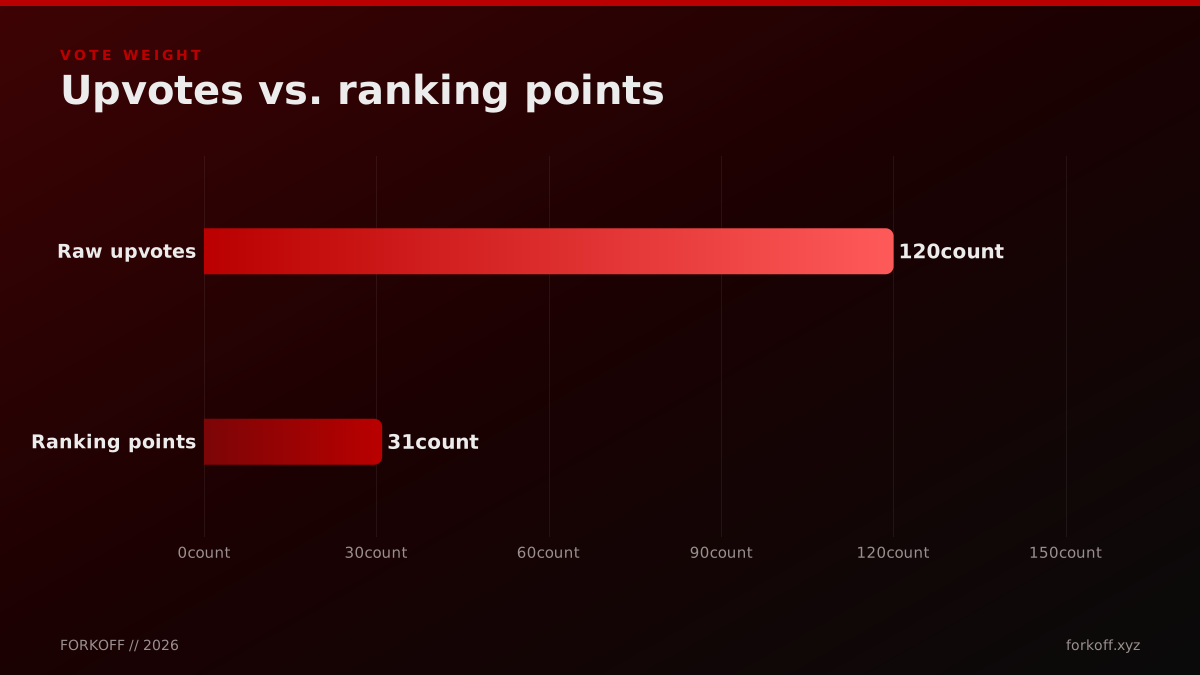
One launch, vote counter versus algorithm: the QuoteTimer recap
| Metric | Reported number |
|---|---|
| Raw upvotes | ~120 |
| Ranking points credited | 31 |
| Comments received | 7 (14 total with maker replies) |
| Notable voters flagged | 9 |
| Final position | #20 |
Self-reported by the maker in her public launch recap on X, March 2026.
The second observable mechanic is the homepage cliff. Product Hunt's daily homepage surfaces a limited set of organic listings plus a handful of promoted slots before a visitor has to click through to "see all of today's products," a click most casual visitors never make. Practically, this means the difference between finishing in the visible top tier and finishing just outside it is not a small gap in outcomes, it is the difference between a launch that gets discovered and one that does not. Founders who track their own analytics report exactly this kind of cliff: a 12th-place finish holding roughly 106 upvotes against a 13th-place finish holding roughly 44, a collapse steeper than a smooth ranking curve would predict.
The homepage is a wall at position 12
A founder who launched twice posted the actual leaderboard data behind the cliff this playbook is structured around: on their measured launch day, position 12 held 106 upvotes and position 13 held 44, a 62-upvote drop bigger than the spread across the entire top 12. The mechanism is plain, the Product Hunt homepage surfaces 9 organic products plus 3 promoted slots, and everything below sits behind a see-all click most casual visitors never make. Their conclusion: if you are not in the top 12 by hour two, you are effectively un-launched.
Source: r/ProductHunters, glass-ceiling leaderboard data, May 2026
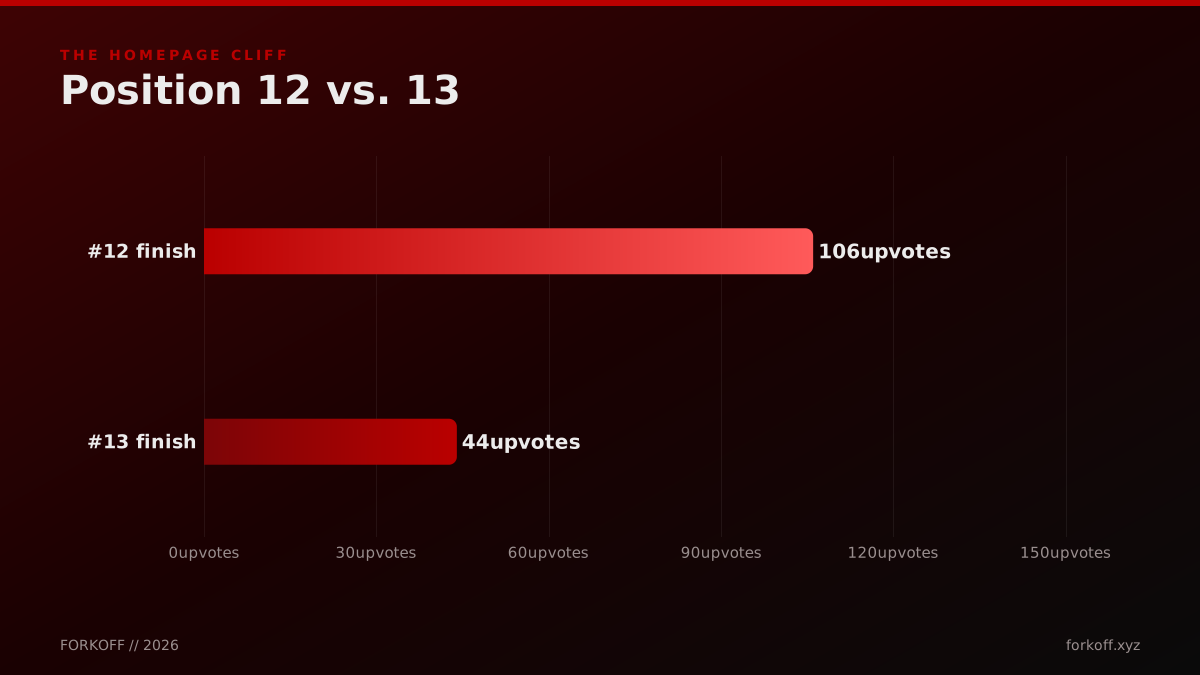
The leaderboard cliff, one measured Product Hunt day
| Position | Product | Upvotes |
|---|---|---|
| 10 | Panels Store | 112 |
| 11 | Manex | 112 |
| 12 | Replyke V7 | 106 |
| 13 | Mobilewright | 44 |
| 14 | DANCING CATS | 34 |
| 15 | Doomscroll Calculator | 25 |
Leaderboard data as posted by the launching founder on r/ProductHunters, May 2026. The 62-upvote drop from position 12 to 13 is the homepage wall.
The third mechanic is time-decay and velocity. Because the day resets at midnight and the leaderboard is live, votes and comments in the first few hours carry outsized weight on your trajectory, not because Product Hunt explicitly weights early votes higher, but because early position drives the organic discovery that produces later votes. A product sitting at position 4 at 4
AM Pacific gets seen by far more of the day's traffic than one sitting at position 40, which produces more votes, which holds the position. It is a compounding loop, and the founders who win it are the ones who treat the first few hours as the entire game, which is exactly the subject of the runbook later in this post.The fourth mechanic, visible in the same recap, is a "notable voter" signal: Basma's launch logged 9 "notable" voters among the roughly 120 total. Product Hunt flags certain voters (makers with strong track records, established community members) distinctly from anonymous or brand-new accounts, and a listing with a healthy share of notable voters reads as more credible, to the algorithm and to human visitors scanning the comment section, than the same vote count from unknown accounts. This is the same account-quality logic running through every mechanic in this section, applied to a specific, visible UI signal: who voted matters as much as how many voted.
~120 upvotes → only 31 points... 9 "notable" voters... Finished #20... Votes from new PH accounts barely count.
If you want the mechanism in your own words for a pitch deck or an FAQ page, our answer engine optimization work runs the same logic on AI search rankings: early signal quality compounds into later visibility, and gaming the early signal (with bots or low-quality votes) gets discounted or penalized by the platform's own defenses.
How many upvotes do you actually need to reach a top-12 finish?
There is no fixed number Product Hunt publishes, and the real-world range founders report is wide because it depends on the day's total competition, not a fixed threshold. Community-reported outcomes in this playbook alone span from a 20th-place finish on roughly 120 raw upvotes (31 ranking points) to a number-one finish that a three-person team credits to weeks of community groundwork rather than a specific vote count. The honest framing: stop optimizing for a target vote count and start optimizing for vote quality, an established account genuinely engaging is worth several new, unengaged ones, which makes the pre-launch audience work in the next section more valuable than any specific number in this one.
What is the best day and time to launch on Product Hunt?
Launch at 12
AM Pacific Time on a Tuesday, Wednesday, or Thursday. The day resets exactly then, which gives you a full uninterrupted 24-hour voting window rather than launching mid-cycle and losing hours you cannot get back. Midweek days consistently outperform Monday (which absorbs a backlog of makers who "meant to launch last week") and the weekend (when engaged tech and startup traffic drops off sharply). This is the single most repeated piece of advice across every Product Hunt guide, but almost none of them explain why, which is the gap this section closes.The why is mechanical, not folklore. Product Hunt's own before-launch guidance recommends account maturity and community presence well ahead of your launch date, which tells you the platform itself expects launches to be planned, not opportunistic. Harshil Tomar distilled the timing rule the way most operators actually run it: "build a pre-launch list 2-3 weeks before... 2. pick a tuesday, wednesday, or thursday and launch at 12
am." The midnight-Pacific timing matters because it is the exact moment the day's leaderboard resets to zero, so launching then buys you the maximum possible runway before the competition catches up; launch at, say, 9 AM Pacific instead, and you have already ceded nine hours of a 24-hour clock to whoever launched on time.Harshil Tomar
@Hartdrawss
how to launch on product hunt and actually get traction (not just upvotes): 1. build a pre-launch list 2-3 weeks before. collect emails on your landing page. you need 200-300 people ready to click on launch day. 2. pick a tuesday, wednesday, or thursday and launch at 12:01 am
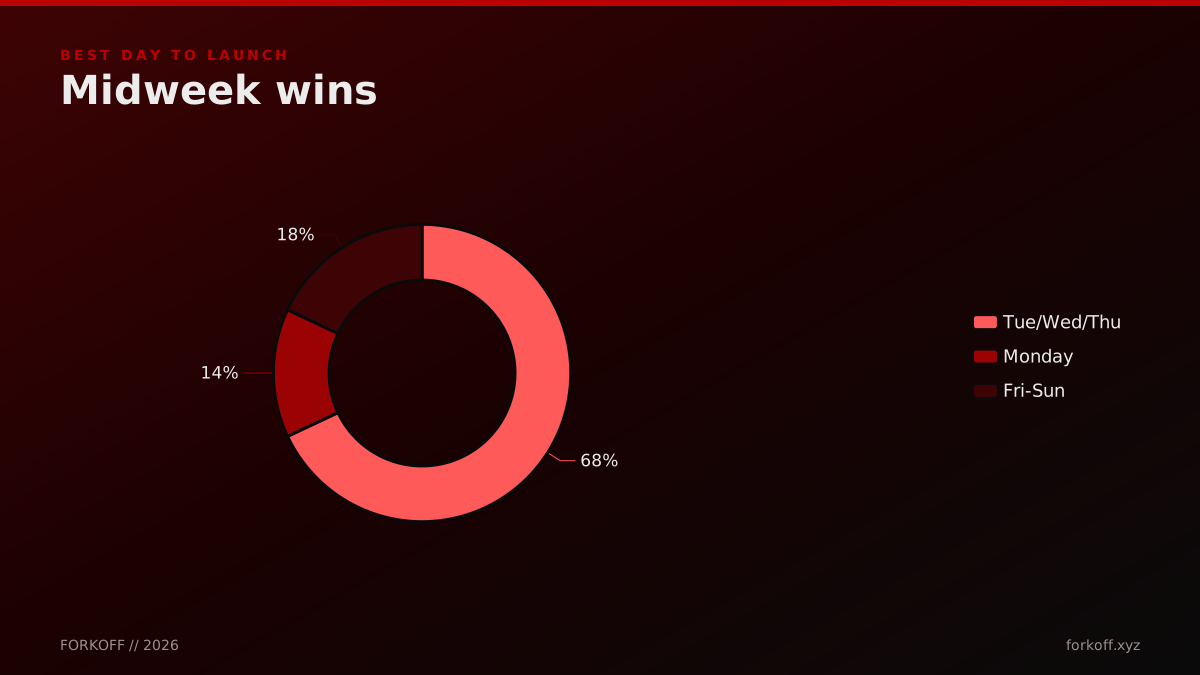
Launch timing tradeoffs, competition versus traffic
| Window | Competition | Traffic | Best when |
|---|---|---|---|
| Tuesday to Thursday, 12:01 AM PT | Fiercest | Highest | Signups and revenue are the goal |
| Weekend | Lightest | Lower | The number-one badge is the primary goal |
| Monday | Backlog of delayed launches | Medium | Rarely, absorbs last week's queue |
| Mid-day start, any day | Same field, fewer hours | Lost runway | Never, the clock starts at 12:01 AM Pacific |
Competition and traffic split per Lenny's Newsletter's launch guide; the 12:01 AM Pacific rule per the timing section of this playbook.
There is a real cost to getting this wrong, and it shows up in the community's own postmortems. One founder specifically flagged launching on a Monday afternoon as the moment the algorithm window had already closed on them, six hours into a day they had not planned around the midnight reset. Compare that against K Mansouri's account of hitting number one and fourth Product of the Week: the mechanics of launch day mattered far less than three weeks of daily community presence beforehand, which is the subject of the next two sections. Timing gets you a fair 24-hour shot; it does not substitute for the audience that actually fills that shot with votes.
K (Khashayar) Mansouri
@k_mansourizadeh
We hit #1 on Product Hunt (and #4 Product of the Week). Here's what we actually did: Pre-launch (this was ~80% of the result). About 3 weeks before launch, we showed up in the Product Hunt community daily: commented on other launches, supported founders, and learned what "good" l… Show more
One nuance worth naming, because the "always Tuesday to Thursday" advice is repeated so uniformly it starts to sound like folklore: Lenny's Newsletter's Product Hunt launch guide draws a real distinction between optimizing for rank and optimizing for traffic, noting that weekends can offer a smoother path to a number one finish because fewer competitors launch then, while weekdays draw more total buyer traffic because that is when your actual audience is online and working. If your primary goal is the badge and the backlink, a quieter weekend slot is a legitimate alternative; if your primary goal is signups and revenue, the midweek, midnight-Pacific default in this section is still correct for the overwhelming majority of first-time launches.
That distinction stopped being qualitative in September 2026. Ziga Potocnik of Databox pulled every Product Hunt launch between 1 January and 1 September 2026, 4,962 launches across 244 days, and measured the points it actually took to break the top 5 on each day of the week. Saturday's median was 165 points against Thursday's 235, a 70-point gap from the calendar alone. The mechanism is competition rather than the algorithm: in that dataset Tuesday averages 30.4 launches a day and Saturday 10.7. Friday is the weekday version of the same effect, 205 median points for top 5, the lowest of any weekday. One figure cuts against the assumption that a bigger field always raises the bar, since Tuesday carries 1,064 launches to Monday's 629 and is still the easier of the two to crack, 210 points against 220.
Read those as thresholds, not as a verdict on where a launch ends up. The study measures what it took to reach a rank, not what the launch earned afterwards, and Potocnik concedes in the comments that he pulled only medians and averages, with no 75th-percentile or per-category breakdown, so it cannot say whether the weekend gap holds for a strong launch or only at the cutoff. It puts numbers on the rank side of the rank-versus-traffic trade above. It leaves the traffic side exactly where Lenny's guide left it.
"Best day" is also a population-level pattern, not a guarantee for your specific product. If your audience skews heavily toward one geography or industry with a different work rhythm (crypto-native audiences, for instance, engage differently than enterprise SaaS buyers), test against your own list's engagement history before locking a date.
Weekends buy rank, weekdays buy traffic
Lenny's Newsletter's launch guide draws the distinction most timing advice flattens: weekend launch days have the best odds of a number-one finish because fewer products compete, but carry less traffic, while Tuesday through Thursday carry the highest traffic on the platform and the fiercest competition. The right day depends on which outcome you are actually buying. If the badge and the backlink are the goal, a quiet weekend is a legitimate play; if signups and revenue are the goal, midweek at 12:01 AM Pacific remains the correct default.
Source: Lenny's Newsletter, How to successfully launch on Product Hunt
How long before launch should you start preparing on Product Hunt?
Start preparing at least 3 to 4 weeks before launch day, and treat a full month as the comfortable default. Product Hunt's own guidance goes further, recommending 3-plus months of genuine community presence for makers who want the platform's trust signals working in their favor, though the practical floor most successful launches actually run on is closer to a month of focused prep. The preparation window is not busywork, it is the period where your account earns the standing that determines how much your votes and comments count on launch day itself.
6 Tips For Launching on Product Hunt
MattyD Startups
Six concrete tips for a first Product Hunt launch, from a serial indie founder.
Here is what the prep window is actually for, mapped to the mechanics covered above. Weeks 1 to 2: complete your Product Hunt profile (bio, links, a real photo), and start genuinely engaging with other makers' launches, upvoting and commenting on products you actually find interesting. This is what builds the account-history signal that later makes your own launch-day votes count for more than a brand-new account's would. Weeks 2 to 3: build your pre-launch supporter list. Harshil Tomar's number, 200 to 300 people ready to click on launch day, is a reasonable floor for a first launch. Week 3 to launch: finalize your gallery, tagline, and draft your maker comment (covered in full below), and personally reach out to the supporters you have identified, one by one, not as a blast.
build a pre-launch list 2-3 weeks before. collect emails on your landing page. you need 200-300 people ready to click on launch day.
The founders who skip this window are the ones who show up in the flop postmortems. The 19-year-old solo founder who documented a flopped launch named the cause directly: launching too early, with no built audience, meant the maker comment and the polished visuals had nobody warm to receive them. Preparation is not a checkbox before the real work starts on launch day, it is where the real work happens; launch day is where you spend the capital the prep window built.
Pre-launch (this was ~80% of the result). About 3 weeks before launch, we showed up in the Product Hunt community daily: commented on other launches, supported founders.
How do you set up your Product Hunt maker profile before you ever launch?
Set up your Product Hunt maker profile weeks before launch day: a complete bio, your real photo, your website and social links, and a history of genuine engagement with other makers' launches, because Product Hunt's own guidance requires a minimum one-week account age before you can post and explicitly recommends three-plus months of community presence for the trust signals to fully kick in. A brand-new account created the morning of your launch is the single fastest way to trigger the vote-discounting behavior covered in the algorithm section above.
Per Product Hunt's own before-launch checklist, the concrete setup tasks are: complete your profile with a description, website, and social links; invite your team and community to join Product Hunt directly; set a measurable goal tied to your actual business objective, not just "get upvotes"; prepare your launch content in advance; choose an authentic hunter, which per the data in this playbook should almost always be you; and focus on genuine engagement over vanity metrics from day one of setting up the profile.
The same guidance lays out three legitimate readiness postures, and picking the right one for your situation matters more than most first-time makers realize. "Just ship it" favors quick feedback and fast validation, appropriate for an early-stage tool where the goal is signal, not scale. "Get feedback first" runs a private beta with target users before the public Product Hunt listing, appropriate when the core workflow is unproven and a bad first impression on a public leaderboard would be expensive to recover from. "Capitalize on momentum" means launching opportunistically when an unrelated tailwind appears (a viral tweet, a relevant news cycle, a competitor's stumble), appropriate only if your assets and profile are already launch-ready so you can move in days, not weeks.
Whichever posture fits, the profile work underneath all three is identical: a real account, a real history, and a real network, built before the clock starts. This is the layer most "launch at midnight on a Tuesday" advice skips entirely, and it is the layer that determines whether your first vote of the day comes from an account Product Hunt trusts or one it discounts.
What should your Product Hunt tagline and gallery actually say?
Your Product Hunt tagline is a single sentence, under 60 characters, that states what your product does for whom, and your gallery is 3 to 5 images or a short video that shows the product actually working, in that order of priority: a specific tagline beats a clever one, and a product-in-action screenshot beats a polished logo slide every time. This is the asset layer that sits between your profile setup and your maker comment, and it is where most first-time launches lose visitors before they ever reach the comment section.
The tagline mistake we see constantly is vague positioning language borrowed from a homepage hero, "the future of productivity" or "AI-powered everything," dropped into a field with no room for nuance. A tagline has one job: let a visitor scrolling the homepage in two seconds decide whether to click. "Real-time project tracking for agencies under 10 people" tells a visitor exactly whether they are the buyer; "the future of collaboration" tells them nothing. Write the tagline last, after you have written the maker comment, and pull the sharpest, most specific line from that comment rather than starting from a blank page.
The gallery follows the same specificity rule. Lead with the product doing the thing it does, a real screenshot or a 20-to-40-second demo clip, not a stylized logo animation or an abstract illustration. Product Hunt visitors are evaluating dozens of listings in a single scroll session; a gallery that requires three clicks to understand what the product actually does loses that visitor to the next listing down. If you have the assets, a short video outperforms static screenshots because it answers "how does this actually work" without requiring the visitor to imagine it, and it is the same asset your maker comment and your post-launch clipping wave can reuse.
Should you build an audience before launching on Product Hunt?
Yes, and it is very likely the single highest-leverage thing in this entire playbook. Founders who report strong finishes consistently credit pre-launch community presence, not launch-day tactics, as the majority of what worked. K Mansouri, describing a number-one finish and fourth Product of the Week, was explicit about the split: "Pre-launch (this was ~80% of the result). About 3 weeks before launch, we showed up in the Product Hunt community daily: commented on other launches, supported founders, and learned what 'good' [looks like]." Read that number again: 80 percent of the outcome came from three weeks of unglamorous community participation before launch day even started.
Pre-launch presence is most of the outcome
A founder who hit number one on Product Hunt (and fourth Product of the Week) attributed roughly 80 percent of the result to the three weeks before launch day: showing up in the Product Hunt community daily, commenting on other launches, and supporting other founders. The launch-day tactics everyone obsesses over, the comment, the timing, the vote asks, operate on top of standing that either exists by then or does not. Three weeks of 15-to-20-minute daily participation is the cheapest ranking input available on the platform.
Source: K Mansouri, number-one launch recap, X, February 2026
The mechanism connects directly back to the vote-weight discount covered earlier. An account that has spent three weeks commenting on other makers' launches, upvoting products it genuinely likes, and building a recognizable presence is not a new, low-activity account when it finally votes for your product on launch day, and neither are the accounts of the people you have been supporting, many of whom will reciprocate. Skip this and you are launching entirely on cold traffic and brand-new accounts, both of which Product Hunt's own vote-weighting actively discounts, as Basma's 120-to-31-points recap demonstrated in hard numbers.
Demand Curve's in-depth Product Hunt guide makes the same case from the growth-marketing side: the firm recommends arriving with at least 400 genuine supporters before you launch, and frames the mechanism plainly, "Product Hunt doesn't create momentum. It amplifies momentum." That is the whole argument for pre-launch audience building in one sentence: the platform is a multiplier on an audience you already have, not a generator of one you do not.
Product Hunt amplifies momentum, it does not create it
Demand Curve's Product Hunt playbook recommends arriving with an audience of at least 400 people before launching, and compresses the reason into one sentence: Product Hunt doesn't create momentum, it amplifies momentum. That framing resolves the most common launch-day disappointment, a polished listing with no warm audience behind it multiplies zero. The platform is a distribution multiplier on the audience you bring, which is why the pre-launch list floors in this playbook (200 to 300 at minimum, 400-plus by Demand Curve's bar) are input requirements, not nice-to-haves.
Source: Demand Curve, Product Hunt launch playbook
First Round Review's interview with LaunchKit's Brenden Mulligan makes a similar case at smaller scale: a focused group of 20 to 30 genuine evangelists, people who already want to know what you are launching, outperforms a mass blast to a cold list every time, because those evangelists engage the way an established Product Hunt account does, not the way a brand-new one does.
There are four concrete mechanics behind "build an audience," and you can run all four in the 3-to-4-week prep window without them competing for time. Daily community participation. Comment genuinely on other makers' launches every day, the exact habit K Mansouri credited with 80 percent of the result. It costs 15 to 20 minutes a day and it is the single highest-leverage line item in this entire playbook. A pre-launch supporter list. Collect 200 to 300 names (per Harshil Tomar's floor) of people who have explicitly agreed to check out your launch, via a landing page, a DM campaign, or your existing newsletter. Reciprocal support. Genuinely support other makers you have built relationships with in the weeks before your own launch; a meaningful fraction of your early votes on launch day come back through the same relationships you invested in. A warmed personal network. The founder, not a company account, personally messaging the 20 to 50 people most likely to engage authentically, which is a different and more effective list than your full supporter list.
Pre-launch audience floors, by source
| Source | Recommended floor | Framing |
|---|---|---|
| Harshil Tomar, X | 200 to 300 warm names | People ready to click on launch day |
| Demand Curve playbook | 400-plus supporters | Amplifies momentum, does not create it |
| First Round Review (Brenden Mulligan) | 20 to 30 genuine evangelists | A focused group beats a mass blast to a cold list |
| K Mansouri, X | 3 weeks of daily community presence | Roughly 80 percent of a number-one result |
Each row links from the audience-building section of this playbook; the floors measure different things (list size versus participation) and stack rather than compete.
Operator note200 to 300 warm names before date-lock. Product Hunt multiplies the audience you bring; a cold launch multiplies zero., FORKOFF pre-launch checklist
Does commenting on other makers' launches actually help your own ranking later?
Indirectly, yes, through two separate mechanisms this playbook has already covered rather than any explicit reward Product Hunt hands out for being active. First, an account with a real history of genuine comments and upvotes on other listings is the opposite of the "new, low-activity account" pattern that gets discounted, per the vote-weight mechanic covered earlier, so your own votes and comments on launch day carry more weight simply because your account looks established, not manufactured. Second, and less obvious, genuine engagement builds real reciprocal relationships: the makers whose launches you supported in good faith are disproportionately likely to check out and genuinely engage with yours when the roles reverse, which is a real, human dynamic, not a loophole, and it is exactly why "3 weeks of daily community presence" outperformed launch-day tactics in K Mansouri's own account of a number-one finish.
The failure mode to avoid is treating this as a transactional vote-exchange, "I'll upvote yours if you upvote mine," which collapses back into the reciprocal, low-quality vote pattern Product Hunt's defenses are built to catch. The difference is intent and specificity: a genuine comment engaging with what a product actually does reads, to a human and to the platform's own signals, completely differently than a drive-by upvote traded for another drive-by upvote.
The counter-case is just as instructive. A founder who asked, unprompted, what mattered most for a first-time launch, timing, community, the maker comment, or the first 100 upvotes, was asking a genuinely open question, because most guides do not rank these against each other. Based on the evidence in this section, the honest answer is community, by a wide margin, then a well-crafted maker comment, then timing, then chasing raw upvote counts.
::directive{id="tw-pluvioox-question"} Building the audience is not a separate marketing task bolted onto your Product Hunt launch; it is the launch, three weeks in advance of the day everyone else thinks is the actual event. If audience-building is the bottleneck on your team, this is exactly the kind of pre-launch runway our Twitter marketing and Reddit marketing work exists to compress.
What should a Product Hunt maker comment say?
A Product Hunt maker comment should be under 200 words, posted the instant your listing goes live, and cover five things in order: the origin story, the problem you are solving, what makes your approach different, a genuine ask for feedback (never for upvotes), and a real, human signature. This is the single most under-built asset in almost every launch guide, mentioned in one sentence ("write a good first comment") and then abandoned. Below is the actual template and a worked example, because a comment this important deserves more than a footnote.
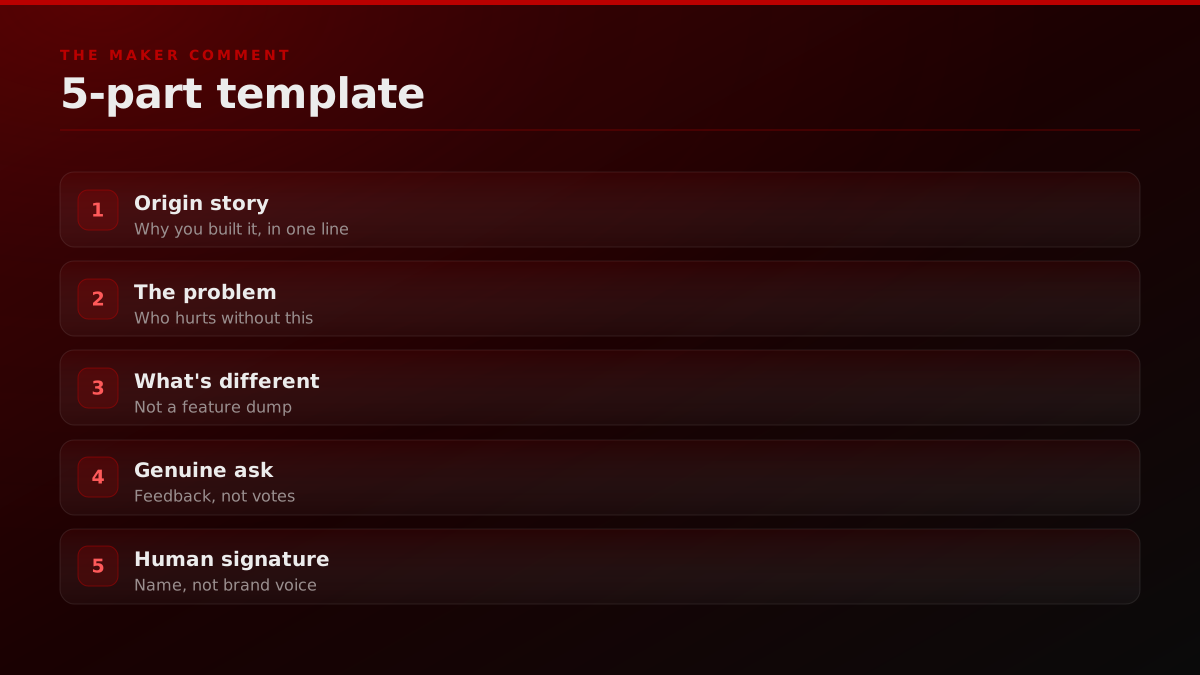
Here is the five-part structure, with the job each part does.
- Origin story (1 to 2 sentences). Why you personally built this. Not the company's mission statement, your reason. "I built this after losing three days of client work to a tool that silently dropped my export" reads as a real person; "We are on a mission to revolutionize workflows" reads as marketing copy that gets skimmed and ignored.
- The problem (1 to 2 sentences). Who hurts without this, and how, in concrete terms. Specificity is the whole game here: name the exact task, the exact frustration, the exact moment the problem shows up.
- What is different (1 to 2 sentences). Not a feature list. One sentence on the actual mechanism or decision that makes your approach not-the-same-as-the-five-competitors-already-on-the-page. If you cannot say it in one sentence, the comment is the wrong place to try.
- A genuine ask (1 sentence). Ask for feedback, a specific question, or what people think of a specific decision you made, never "please upvote" or "check it out," both of which read as exactly what they are and get discounted by the same account-quality signals covered above.
- A human signature. Your first name, and something small and real, "building this solo out of a spare bedroom in Austin," not a company title. Product Hunt's community rewards the maker showing up as a person, not a brand.
A worked example, under 200 words, following the template: "I built this after watching my agency lose two client deadlines to a project tracker that could not handle more than three collaborators without falling over. Every tool we tried either did too little (a glorified to-do list) or too much (an enterprise suite nobody on a 4-person team wants to configure). [Product] is the middle: real-time collaboration for teams under 10, with none of the setup tax. The one thing I am genuinely unsure about is our pricing model, flat per-team instead of per-seat, and I would love to hear if that feels right or wrong for how your team actually works. I am Alex, building this solo, and I will be in this thread all day answering everything." That comment hits all five parts in 156 words, asks a real question that invites real engagement, and reads like a person, which is exactly the tone ItsnotHardy asked veterans about before their own Sellbio launch: "What is the one crucial detail that most first-time makers completely mess up on launch day?" The maker comment is very often the answer.
HardyHardy
@ItsnotHardy
My Product Hunt launch for Sellbio is officially imminent. Maker comment is drafted. Visuals are polished. "Coming Soon" page is live. But what am I missing? PH veterans: What is the one crucial detail that most first-time makers completely mess up on launch day?
A second worked example, this time for a more technical, B2B-flavored product, to show the template flexes across register without losing its structure: "Three years ago I was the third engineering hire at a startup that lost a production incident because our on-call rotation lived in a spreadsheet nobody trusted. I built [Product] so a five-person infra team gets PagerDuty-grade routing without the enterprise sales call and the six-figure contract. It plugs into Slack and your existing alerting in under ten minutes, no agent to install. What I am most unsure about is whether teams this size actually want a free tier or would rather pay a flat, predictable fee from day one, if you run on-call for a small team, I would genuinely value your take in the comments. I am Priya, and I will be answering every question here today." Same five parts, same under-200-word length, same real question at the end, just a different voice for a different buyer.
Two comments instead of one is not a coincidence. The template is the constant; the story, the specificity, and the genuine question are what change with your actual product and audience, and a maker comment that could be pasted onto any Product Hunt listing without editing is a maker comment that will underperform both of these.
Timing matters as much as content. Post the comment at 12
AM the moment you go live, not an hour later once you have "settled in." It is pinned to the top of your listing, it is the first thing every visitor reads, and an empty listing for even 15 minutes at the exact moment your earliest, warmest supporters arrive wastes the highest-leverage minutes of your entire launch day.Operator note156 words: the worked maker comment above. Under 200, posted at 12:01 AM, it is the cheapest pinned asset on the listing., FORKOFF launch playbook
What is the difference between a maker and a hunter on Product Hunt?
The maker is the person (or team) who built the product, and the only one who can post the pinned maker comment. A hunter is the account that submits a product to Product Hunt, historically a separate role reserved for community members with large followings who would "hunt" (feature) other people's products to give them a launch-day boost. In 2026, the distinction has mostly collapsed: Product Hunt explicitly bans paying someone to hunt your product, so the maker and the hunter are almost always the same person, self-hunting their own launch.
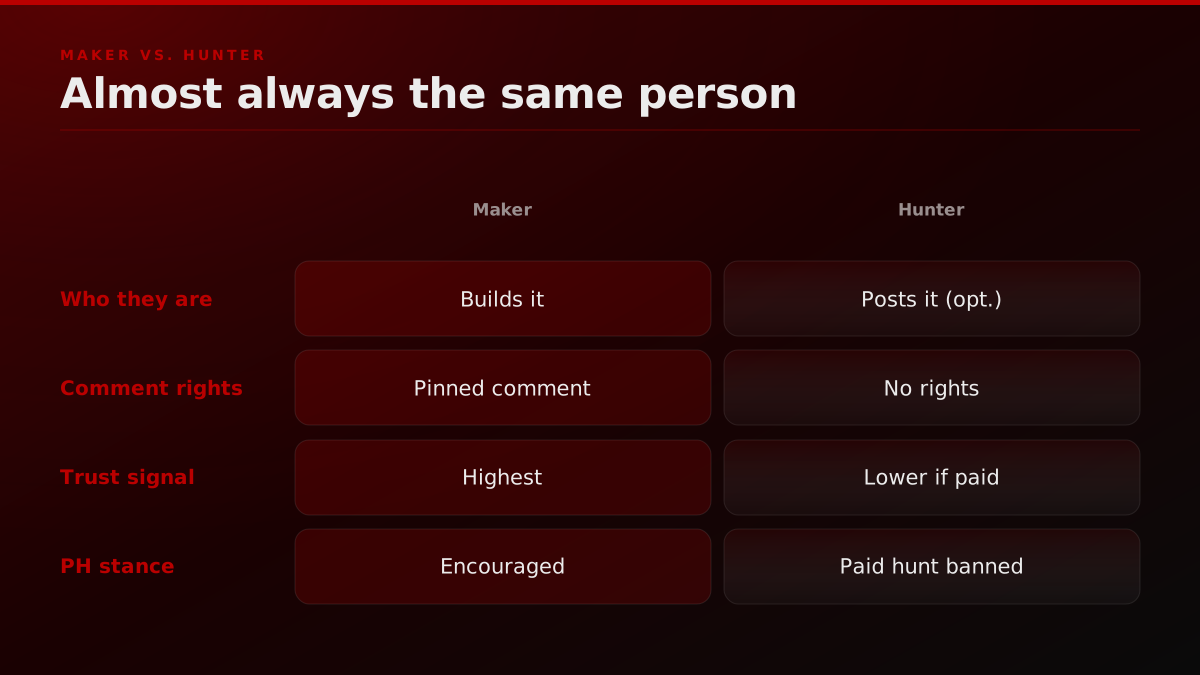
The role still exists for the rare case where a well-connected community figure genuinely wants to hunt your product because they believe in it, unpaid, which can lend real early credibility if it happens organically. What it is not, and what Product Hunt's own guidelines are explicit about, is a service you buy. "Paying people to hunt your product goes against our guidelines," per Product Hunt's own before-launch page, and the practical effect of self-hunting versus paying a hunter is covered with real numbers in the next section.
Is it worth paying a hunter to launch your product on Product Hunt?
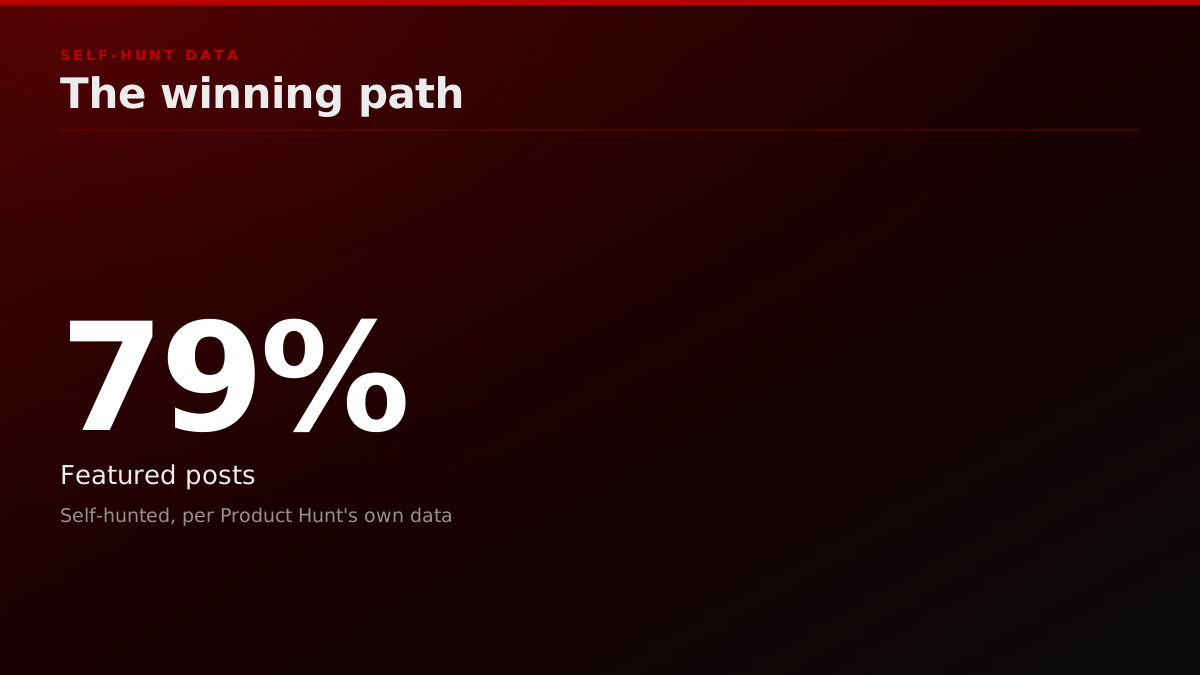
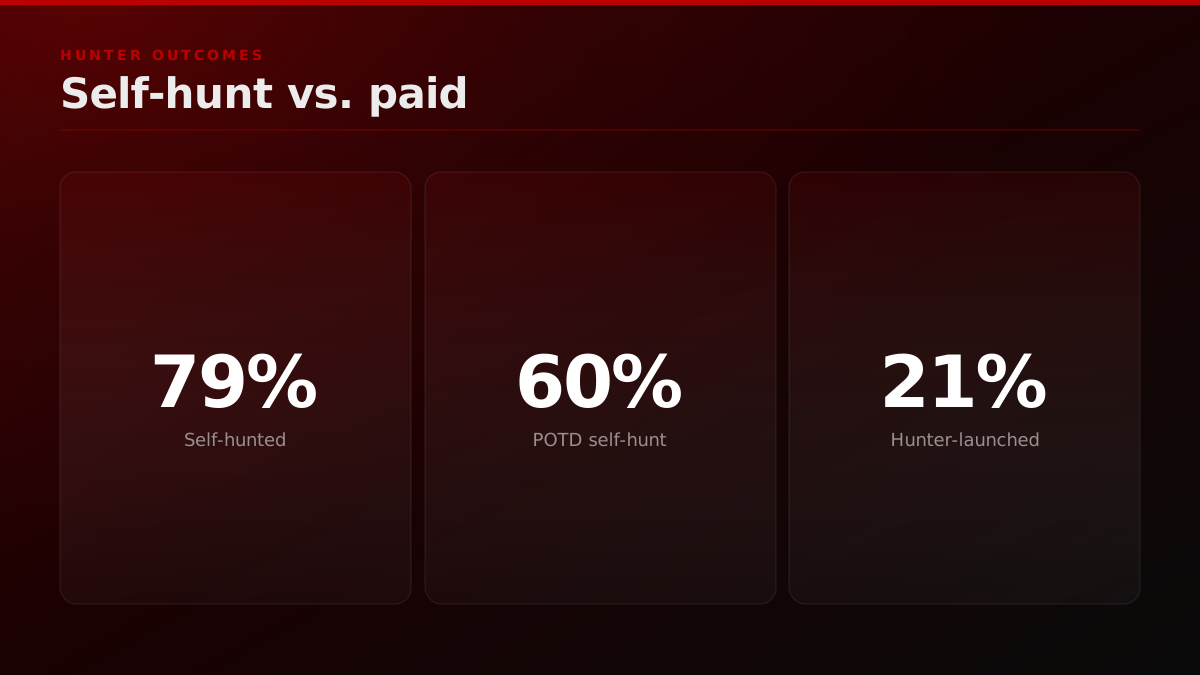
Usually not, and Product Hunt's own data settles the question more decisively than most guides acknowledge. Per Product Hunt's before-launch page, 79 percent of featured posts and 60 percent of Product of the Day winners were self-hunted, meaning the maker submitted their own product rather than paying or recruiting an established hunter to do it. Self-hunting is not the scrappy fallback option, it is the majority path for the launches that actually win.
Product Hunt's own numbers on self-hunting versus paid hunters
| Outcome | Share or stance | Source |
|---|---|---|
| Featured posts that were self-hunted | 79 percent | Product Hunt before-launch guidance |
| Product of the Day winners that were self-hunted | 60 percent | Product Hunt before-launch guidance |
| Paying someone to hunt your product | Against guidelines, risks unfeaturing or removal | Product Hunt before-launch guidance |
All three rows from Product Hunt's own published before-launch page, producthunt.com/launch/before-launch.
There are three reasons self-hunting wins more often than paying a hunter, and each maps back to a mechanic covered earlier in this playbook. First, guideline risk: paying for a hunt violates Product Hunt's own rules, and platforms that catch rule violations discount or remove the associated traction, the same defensive posture behind the new-account vote discount. Second, comment authenticity: only the maker can post the pinned maker comment, so a hunted launch either loses that asset entirely or runs it through someone who did not build the product and cannot speak to the origin story with the specificity the template above depends on. Third, community trust: a hunter with a large following can produce an early vote spike, but Product Hunt's community increasingly recognizes and discounts hunted, hyped launches that lack a genuine maker presence in the comments, which is exactly the account-quality signal this playbook keeps returning to.
The one scenario where an unpaid hunt genuinely helps: a respected figure in your specific niche discovers your product organically and wants to feature it because they believe in it, which functions as a credible, unbought endorsement rather than a bought traction signal. You cannot manufacture this by paying for it, which is the entire point. If your actual constraint is that you lack any warm network to draw early, authentic votes from, the fix is not a paid hunter, it is the pre-launch audience-building covered above, and it is exactly the gap our influencer marketing desk closes for clients who need real, credible amplifiers rather than a rented one-day spike.
How much does a Product Hunt launch actually cost?
Self-hunted, the direct dollar cost of a Product Hunt launch is close to zero, the platform itself is free to use, and the real cost is founder and team time across the prep window and launch day. Where budget actually gets spent is in the surrounding distribution layer, not the Product Hunt listing itself.
| Line item | Typical cost | What it buys |
|---|---|---|
| Product Hunt listing | Free | The launch itself, self-hunted |
| Paid hunter | Not recommended, violates guidelines | Marginal reach, real platform risk |
| Launch assets (gallery, demo video) | Founder time to low four figures | The tagline and gallery covered above |
| Pre-launch list building | Founder time only | The 200 to 300 warm names this playbook keeps returning to |
| Post-launch clipping/UGC | Operator time to mid four figures | Short-form cuts that carry momentum past 72 hours |
| KOL amplification | Per-post, varies widely | Credible reach into networks you do not already have |
The pattern in this table matches every other section of this playbook: the free line items (self-hunting, community participation, the founder's own network) are also the highest-leverage ones, and the paid line items amplify what the free layer already built rather than substituting for it. Spend on amplification only after the free layer exists; money spent chasing a cold launch buys very little.
What happens in the first 4 hours of a Product Hunt launch?
The first four hours of a Product Hunt launch set your ranking trajectory for the entire 24-hour window, because early votes from established accounts carry the most algorithmic weight and your homepage position at hour two strongly predicts the organic traffic, and therefore the votes, you receive at hour twelve. Every guide says "the early hours matter." Almost none give you a minute-by-minute plan. Here is the granular version, calibrated to a 12
AM Pacific go-live.The first four hours of a Product Hunt launch, minute by minute
STEPS- 01
12:01 AM PT: go live
The day resets and your listing goes live. Pin the maker comment immediately. Do not wait until morning to post it.
- 02
12:05 AM: notify the inner circle
Message your closest supporters individually, not a mass blast. Ask them to check it out and comment honestly, never to just upvote.
- 03
12:30 AM: reply to every comment
Early comments set the tone. Reply within minutes, ask follow-up questions, and treat every commenter like your first customer.
- 04
1:00 AM: check your position
See where you sit on the homepage. If you are outside the top 12, your inner circle needs to engage harder in the next hour.
- 05
2:00 AM to 3:00 AM: the quiet stretch
US traffic is asleep. Use this window to answer any remaining comments and make sure your team is ready for the morning wave.
- 06
4:00 AM to 6:00 AM: US East Coast wakes up
The first real traffic wave of the day. Your position now is a strong predictor of where you finish, because homepage placement compounds.
- 07
7:00 AM to 9:00 AM: US West Coast wakes up
The second wave. This is when most self-hunted, well-prepared launches make or hold their top-12 position for the rest of the day.
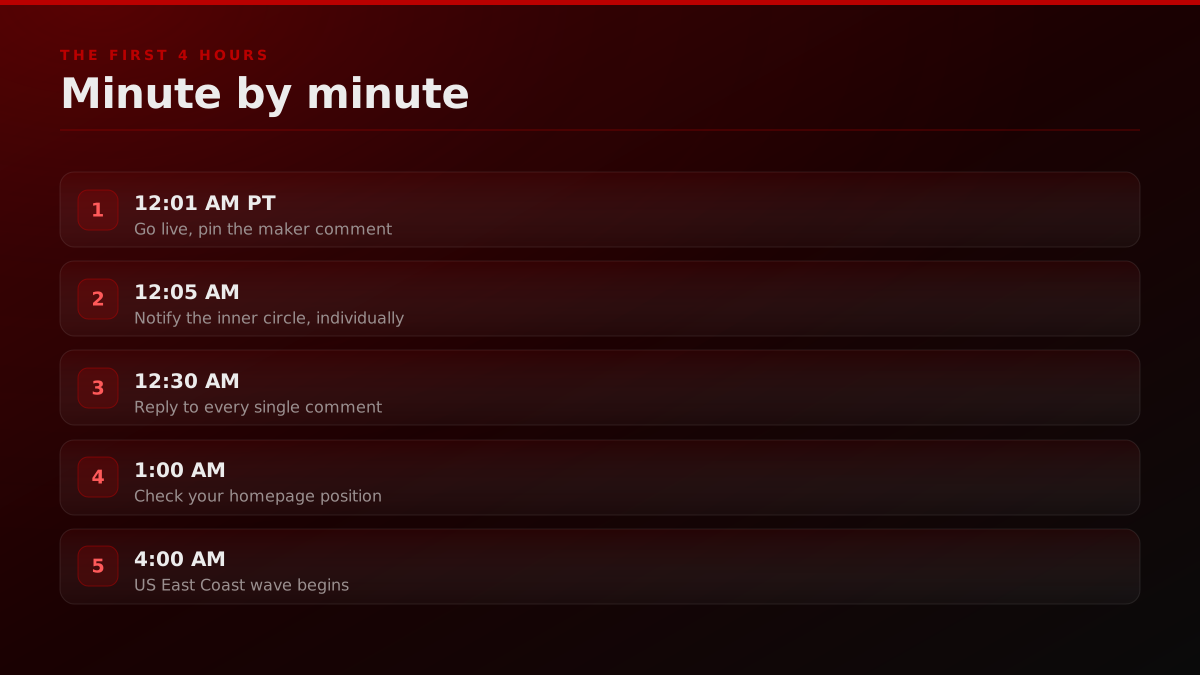
- 12 AM PT: go live. Your listing goes live the instant the day resets. Post your maker comment immediately, do not wait. Every minute the listing sits without the pinned comment is a minute your earliest visitors see an empty room.
- 12 AM: notify the inner circle, individually. Message your closest supporters one at a time, not a mass blast, and ask them to check it out and comment genuinely, never to "just upvote." A personal message gets a personal, high-quality engagement; a mass blast gets low-effort, low-account-quality votes.
- 12 AM: reply to every single comment. Basma's own launch-day discipline, replying to every comment (turning 7 comments into 14 total engagements), is the standard to hit. Early replies signal an active, engaged maker, which the community and, observably, the algorithm both reward.
- 1 AM: check your position. See where you actually sit on the homepage. If you are outside the top 12, this is the moment to ask your inner circle to engage harder, before the quiet overnight stretch locks in a position that is hard to climb out of later.
- 2 AM to 3 AM: the quiet stretch. US traffic is largely asleep. Use this window to clear every outstanding comment and make sure your team (or you, solo) is rested and ready for the two waves coming at 4 AM and 7 AM.
- 4 AM to 6 AM: US East Coast wakes up. The first real wave of the day's traffic. Your position heading into this window is a strong predictor of where you finish, because homepage placement compounds through organic discovery.
- 7 AM to 9 AM: US West Coast wakes up. The second, and usually largest, wave. Well-prepared, self-hunted launches typically make or hold their top-12 position during this exact window, which is why the prep and the first three hours matter so much: they set the base this wave builds on.
The pattern across every real founder account cited in this playbook is the same: momentum compounds, both up and down. A strong first two hours produces a homepage position that pulls in organic votes for the rest of the day almost for free. A weak first two hours means every subsequent hour is spent trying to climb out of a hole instead of extending a lead. This is why the pre-launch audience work and the maker comment quality matter more than any single launch-day tactic: they are what determines whether your first two hours are strong or weak.
If you're not in the top 12 by hour 2, you're effectively un-launched.
Who owns what during launch day: the war-room roles
A launch-day runbook only executes if each hour has a named owner, so staff four roles even on a two-person team. The maker is the voice: the pinned comment, the personal DMs, and the replies to every substantive question, because only the maker can speak to the origin story with real specificity. The community lead works the comment section continuously, replying within minutes and flagging anything that needs the maker's direct voice. The distribution lead fires any scheduled amplification (a founder's X thread, a KOL post, a Reddit seed) on the exact hours the runbook specifies, not whenever they get to it. The ops lead watches the actual product: is the signup flow working under the traffic spike, is the payment path clean, are there any bugs a wave of first-time users is about to surface. On a solo launch you wear all four hats, but running through them in order, rather than reactively, is what keeps a solo launch from missing something a four-person team would have caught.
What do you do if your launch is going poorly by mid-morning?
If you check your position at hour four or five and you are sliding rather than holding, the fix is not panic, it is a return to the fundamentals covered in this playbook, executed harder. Re-message your warmest, most engaged supporters individually (not a repeat blast to the same list, that reads as desperate), specifically ask a handful of respected people in your niche to genuinely check out the listing and comment if they find it useful, and double down on replying to every existing comment with real depth, since comment quality is itself a signal the algorithm and human visitors both weigh. What you should never do is buy votes, spin up new accounts, or post the listing to a vote-exchange group mid-launch; per the mechanics covered earlier, this is exactly the pattern Product Hunt's defenses are built to catch, and getting flagged mid-launch is a worse outcome than a mediocre but clean finish. A quiet finish outside the top 12 is recoverable; a flagged launch is not.
How do you get the Product Hunt badge and where should you place it?
Product Hunt generates an embeddable badge (an image with a link back to your listing) directly from your product's own Product Hunt page once your launch has run, accessible through the embed or widget option on that page. The badge is not something you request or apply for separately, it is a byproduct of having launched, and the specific badge variant (Featured, Product of the Day, Product of the Week) reflects your actual result. The technical embed is straightforward once you have it:
<a href="https://www.producthunt.com/posts/your-product-slug?utm_source=badge-featured&utm_medium=badge&utm_source=badge-your-product-slug" target="_blank" rel="noopener">
  <img src="https://api.producthunt.com/widgets/embed-image/v1/featured.svg?post_id=YOUR_POST_ID&theme=light" alt="Your Product - Your tagline | Product Hunt" style="width: 250px; height: 54px;" width="250" height="54" />
</a>
Swap featured.svg for the variant your launch earned (Product Hunt provides equivalents for Product of the Day and Product of the Week directly on your listing's own embed page), and swap in your actual post_id and slug, both visible on your product's Product Hunt page. The badge is a small SVG or PNG, so it loads fast and does not hurt page speed, which removes the one legitimate technical objection to placing it prominently.
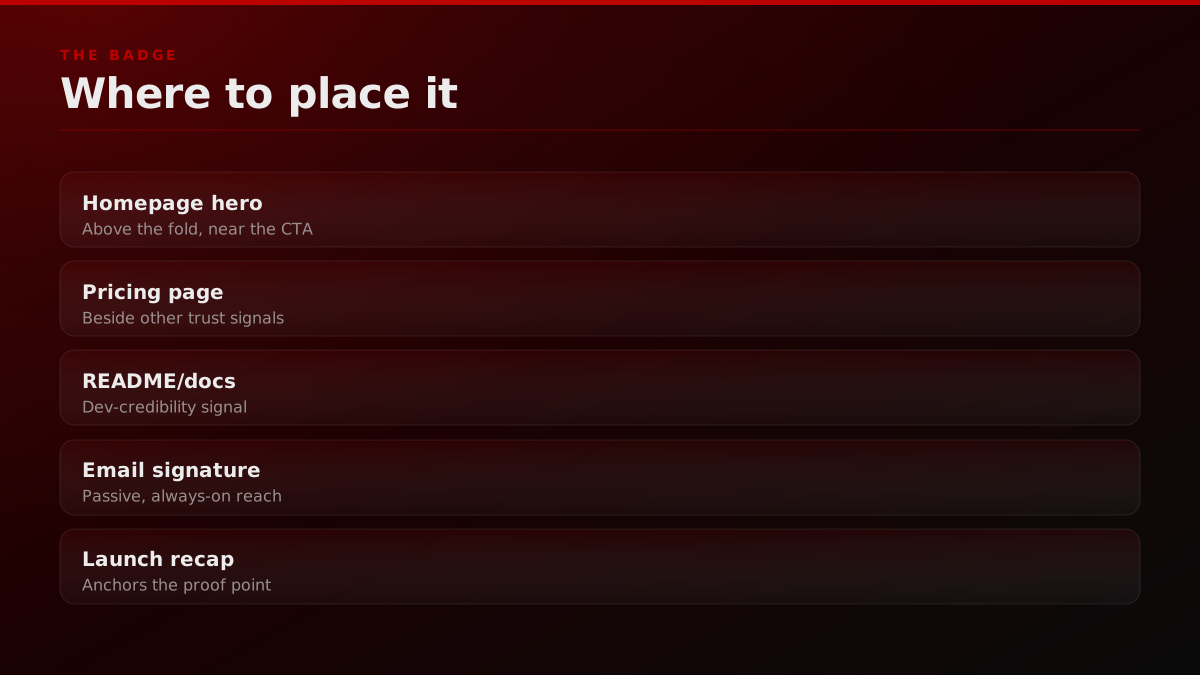
Placement matters more than the badge's existence. Rank these five spots by where a buyer is actually making a decision, not by where it is easiest to paste a snippet.
- Homepage hero, above the fold. Near your primary call to action, where a first-time visitor is deciding in the first five seconds whether to trust you.
- Pricing page. Directly beside other trust signals (security badges, customer logos), at the exact moment a visitor is weighing whether to pay.
- README or docs (for dev-facing products). A Product Hunt badge functions as a credibility signal specifically to a technical, early-adopter audience that already trusts the platform.
- Email signature. Passive, always-on reach, costs nothing to maintain, and reaches every person you correspond with going forward.
- The launch recap post itself. Whatever channel you use to announce your results (an X thread, a blog post like this one), anchor the recap with the actual badge, not just a screenshot of your ranking.
The badge's real value is not the traffic it drives directly, which decays fast along with the rest of the launch-day spike, it is the durable trust signal and the dofollow backlink it leaves behind. A visitor six months from now who has never heard of Product Hunt's daily leaderboard still recognizes "Featured on Product Hunt" as third-party validation, which is why placement 1 and 2 above matter long after your actual launch day traffic has gone to zero.
The before-and-after conversion logic is straightforward even without a fabricated percentage: third-party trust badges (security certifications, "as seen in" press logos, platform badges) work by reducing a first-time visitor's perceived risk at the exact moment they are deciding whether to trust an unfamiliar product, and a Product Hunt badge does that job specifically for a tech-literate, early-adopter visitor who recognizes what the badge means. It does almost nothing for a visitor who has never heard of Product Hunt, which is why matching the badge's placement to a page your actual ICP visits (not just your general homepage) is more valuable than placing it everywhere indiscriminately. Track your own before-and-after conversion rate on the pages where you add it; that number is more trustworthy than any industry-wide average, because badge lift depends heavily on how tech-literate your specific visitor base is.
One more badge nuance worth naming: the variant matters. A "Featured" badge (any product that launches and gets some traction) reads very differently to a sophisticated buyer than a "Product of the Day" or "Product of the Week" badge, which signal you outright won your leaderboard cohort. If your launch earns the higher tier, use that specific badge, not the generic "Featured" default; the extra credibility is free and the swap takes thirty seconds on your product's Product Hunt page.
The most common Product Hunt launch mistakes to avoid
The most common Product Hunt launch mistakes are: launching with no built audience, a maker comment that reads as a sales pitch instead of a real person, launching on the wrong day or outside the midnight-Pacific window, directly asking for upvotes instead of genuine engagement, and having no follow-up plan for the traffic and signups the launch actually produces. Every one of these is a plan gap, correctable weeks in advance, not a product-quality problem.
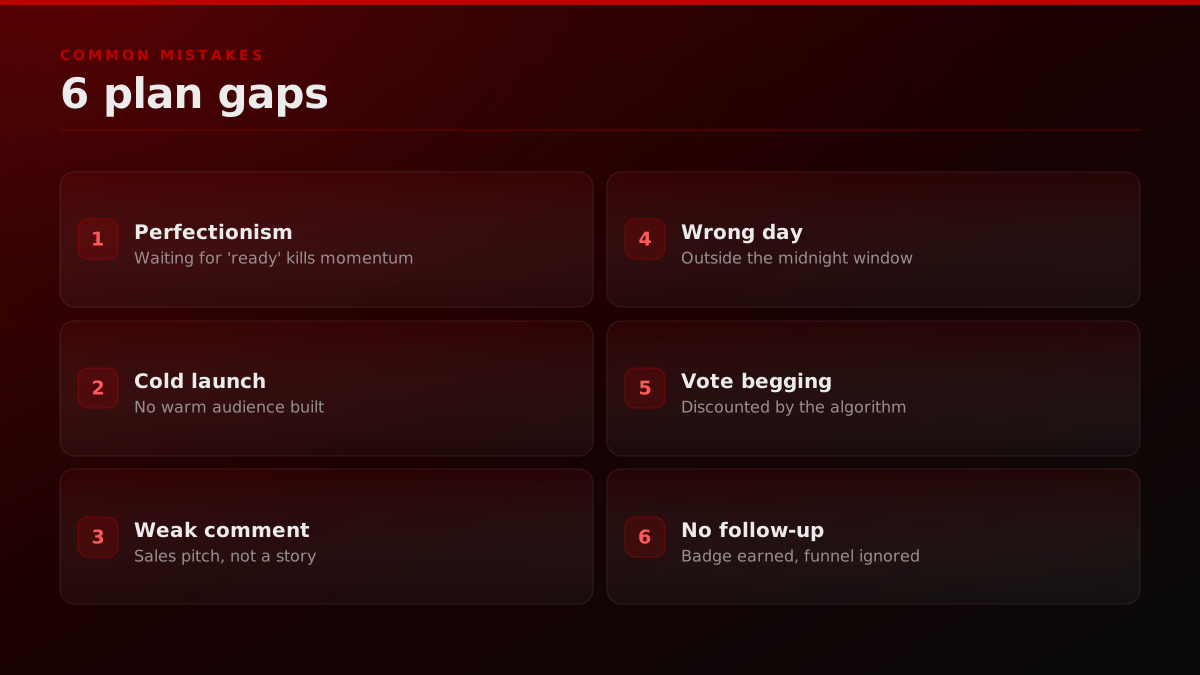
Real accounts from the community make each mistake concrete rather than abstract.
- Launching with no built audience. The clearest case is the 19-year-old solo founder who documented a flopped launch and traced it directly to launching too early, before any real audience existed to receive it. Fix: run the 3-to-4-week prep window covered above, every time, no exceptions for "the product is ready so let's just go."
- A weak or generic maker comment. A comment that reads like marketing copy gets skimmed past by a community that has seen thousands of them. Fix: use the five-part template above, and post it the instant you go live, not an hour later.
- Wrong day or wrong time. Launching mid-cycle (any time other than 12 AM Pacific) or on a low-traffic day (Monday, weekends) cedes hours of a 24-hour window you cannot get back. Fix: lock a Tuesday, Wednesday, or Thursday, and set an alarm for 11 PM Pacific the night before.
- Directly asking for upvotes. "Please upvote my launch" reads as exactly what it is, both to the community and, observably, to Product Hunt's own vote-weighting, which discounts votes that arrive through obvious, low-quality solicitation rather than genuine interest. Fix: ask for feedback and honest opinions, never votes directly.
- Buying votes or using new accounts. Basma's own recap ("Votes from new PH accounts barely count") and "same WiFi" flag illustrates exactly why this backfires: Product Hunt's defenses catch coordinated, low-quality voting patterns and discount them, sometimes severely.
- No follow-up plan. A badge earned and a funnel ignored is the single most expensive mistake on this list, because it wastes every bit of the traffic the previous five items got right. If your Product Hunt launch is one piece of a broader go-to-market motion, our general product launch plan playbook covers the full pre-launch-to-post-launch system this section only summarizes.
- Silence during the day. A founder who goes quiet after the first comment forfeits the cheapest trust available on launch day. Set aside the entire day, not just the first hour, to reply, and treat every comment as a real conversation, not a box to check.
- Skipping the profile work. Launching from a brand-new or incomplete account undercuts every vote you earn before the day even starts, per the account-quality mechanics covered earlier in this playbook. Fix: run the profile setup weeks ahead, not the night before.
Two of these deserve a specific warning because they look like shortcuts and are actually traps. Vote-trading groups (Slack or Discord communities that promise "upvote mine, I'll upvote yours") produce exactly the reciprocal, low-quality vote pattern Product Hunt's defenses are built to catch, and getting flagged can suppress your entire launch, not just the suspect votes. Paid engagement pods carry the same risk under a different name. Genuine community participation, the kind covered in the audience-building section above, produces the same votes without the platform-risk downside.
The vote counter is not the scoreboard
One maker's honest recap of a QuoteTimer launch put hard numbers on the discount every guide gestures at: roughly 120 raw upvotes were credited as only 31 ranking points, a 20th-place finish, with 9 notable voters flagged among the total. Her own takeaway, votes from new Product Hunt accounts barely count, is the single most operational fact in this playbook. Account history, not raw vote count, is the currency, which is why vote-trading groups and day-of-launch account signups produce spikes the algorithm quietly writes off.
Source: Basma, QuoteTimer Product Hunt launch recap, X, March 2026
The meta-lesson across every real postmortem cited in this playbook: none of the founders who flopped lacked a good product. They lacked a plan for the parts of a Product Hunt launch that are not the product, the audience, the comment, the timing, and the follow-through. Those are exactly the parts this playbook exists to fix. It also tracks the broader research on why launches fail generally: CB Insights' analysis of startup failure reasons found poor product-market fit behind 43 percent of failures, and two-thirds of those were early-stage companies that never found a market at all, exactly the audience gap a rushed, cold Product Hunt launch cannot paper over. HubSpot's own product launch checklist makes the same point in one line worth keeping on a sticky note: "if you fail to effectively spread the word about your product launch, it will most likely fail."
Real Product Hunt launch stories, and what actually separated the winners from the flops
The community-reported evidence behind this playbook is not two or three anecdotes, it is a consistent pattern across a wide range of launches, from solo indie hackers to funded startups. Reading them side by side is more instructive than any single case study, because the same handful of variables (audience, comment quality, timing, follow-through) explain almost every outcome.
On the winning side: one team documented the exact playbook behind a number-one micro-SaaS finish, crediting a specific, repeatable sequence rather than a lucky break. Another founder walked through building, launching, and landing 1,000-plus new users from a single well-prepared Product Hunt push, treating the launch as the payoff of weeks of groundwork rather than the start of the work. On YouTube, Roy Povarchik, Director of Growth at Wilco, breaks down a similar top-three ranking process in concrete, repeatable steps rather than vague encouragement, and a build-in-public walkthrough channel covers the same ground from a solo founder's vantage point, both reinforcing that the tactics in this playbook are not agency theory, they are what practitioners on both sides of the table actually run.
How we ranked #1 on Product Hunt (exact playbook)
How I Built, Launched and Hit #1 on Product Hunt to get 1,000+ New Users
How to Launch on Product Hunt & Rank Top 3 | Roy Povarchik, Director of Growth at Wilco
Hetz Ventures
Roy Povarchik, Director of Growth at Wilco, on how to launch and rank top three on Product Hunt.
Product Hunt Tips: How to Successfully Launch on Product Hunt
Build In Public with KP
A build-in-public walkthrough of what actually moves the needle on launch day.
On the losing side, the pattern is just as consistent. One founder's night-before-launch thread, asking for any tips at all with hours to go, is the exact moment the prep window in this playbook is meant to prevent; by the night before, the pre-launch audience and the maker comment should already be finished, not started. Another community member compiled a list of lessons learned specifically flagged by the community as required reading before your own launch, covering many of the same traps (weak comment, wrong day, no follow-up) named throughout this post. And on X, Leah's silver-medal finish came with an offer that captures the community norm this playbook keeps returning to: trade genuine feedback with other makers, do not trade votes.
Launching Tomorrow - Any Tips
Some things I've learned from a recent product launch, read this thread before launching your product!
Leah
@leahlibest
Hit silver on Product Hunt recently. If you're a maker who needs upvotes or feedback, comment your link. I got you.
The clearest single before-and-after case is a domain resale story from Constantin, who sold the domain of an early side project for a modest sum; the new owner rebuilt and relaunched it as Keymentions, reaching $400 MRR and a number-one Product Hunt finish within three months. Same original concept, same market, a completely different execution, and a completely different Product Hunt outcome, which is as close to a controlled comparison as this space produces: the product idea was never the bottleneck, the launch execution was.
Constantin
@constantout
I recently sold the domain of my first project for $250. In just 3 months, the new owner of Keymentions reached $400 MRR, got #1 on Product Hunt, and built a great product. Here's the full story of Keymentions.
The same pattern shows up outside Reddit and X. A widely shared Indie Hackers guide puts it bluntly: the founders who win on Product Hunt are not the best marketers, they are the ones solving a real problem for real people and showing up to talk about it honestly. Foundr's own launch guide reaches the identical conclusion from the e-commerce side of the platform, which is the same evidence this playbook keeps returning to from a different angle entirely.
Should you launch on Product Hunt at all?
Launch on Product Hunt if your buyer is a builder, an early adopter, or works in tech, SaaS, AI, DevTools, or an adjacent Web3 category, and if you have (or can build in three to four weeks) a warm pre-launch audience willing to engage genuinely. Deprioritize or skip it if your buyer is a non-technical enterprise decision-maker, an offline-first consumer, or a market where "featured on Product Hunt" carries no recognition or trust weight.
The honest case for launching: even a modest top-20 finish produces a durable backlink, a credibility badge, and a genuine cohort of early, technically sophisticated users who tend to give the most useful early product feedback of any acquisition channel. The founder who beat OpenAI's own launch to Product of the Week, as a three-person team, is proof the platform still rewards a well-run launch over a well-funded one. Product Hunt is one of the few remaining channels where a genuinely good, well-prepared launch from a nobody can outperform a mediocre launch from a household name. Y Combinator's own Startup School guidance on launching makes a related point: launch early and treat it as a repeatable motion, not a single make-or-break event, which is exactly the posture that turns one Product Hunt launch into a system instead of a one-shot gamble.
The honest case against launching, or at least against treating it as the centerpiece of your go-to-market: the traffic and signup spike decays within roughly 72 hours regardless of your finish, and a launch with no post-launch distribution plan produces a vanity metric, not a business outcome. If your buyer genuinely does not hang out on Product Hunt (a healthcare compliance tool selling to hospital procurement teams, for instance), the badge earns you a nice-looking logo and very little else. Match the channel to your actual buyer before you match the tactics to the channel.
The synthesis, and the one most guides never state plainly: launching on Product Hunt is close to free (your time, not your money, assuming you self-hunt per the data above) and the downside is limited to a modest time investment and a mediocre-but-not-embarrassing ranking. For most software products with even a partially technical buyer, the expected value of running a well-prepared launch clears the bar. The real decision is not whether to launch, it is whether you are willing to run the three-to-four-week prep window that determines whether your launch is a top-12 finish or an invisible one.
Product Hunt doesn't create momentum. It amplifies momentum.
Can you launch on Product Hunt more than once, for an update or a re-launch?
Yes, and a growing share of experienced makers treat Product Hunt as a repeatable motion rather than a one-time event, launching again for a major version, a significant new feature, or a relaunch under a new name or positioning. Product Hunt draws a real distinction between a brand-new product and an update to an existing listing, and the rules and expectations differ enough to plan around deliberately.
A first launch is your one shot at the full, unfiled listing, the maker comment introducing the product for the first time, and the badge tier that matters most for a young company's credibility. A major update or version launch works when the change is substantial enough to be newsworthy on its own, a significant new capability, a full redesign, a pivot in positioning, not a routine bug-fix release; Product Hunt's community responds to genuine news, and a thin update dressed up as a launch reads as exactly that. A relaunch under new branding or a repositioned pitch is legitimate when the underlying product has meaningfully changed since the first attempt, and it gives you a second chance to apply everything in this playbook that the first launch skipped.
The founder who open-sourced the week-by-week SOP behind 30 separate number-one finishes is the clearest proof this works: launching repeatedly, treating each one as an iteration on a system rather than a fresh gamble, is a legitimate and increasingly common strategy, not a loophole. If your first launch underperformed, the fix is rarely "launch again exactly the same way sooner," it is running the full prep window, the maker comment template, and the timing rules in this playbook that the first attempt likely skipped, then launching a genuinely improved product on the next natural milestone.
How do you sustain traffic and momentum after a Product Hunt launch ends?
You sustain traffic after a Product Hunt launch by treating the badge and the launch-day cohort as the start of a distribution motion, not the end of one: keep engaging every commenter and voter individually in the days after, convert the launch into short-form and written content that keeps discovering new audiences, and layer Reddit, X, and PR waves on top of the Product Hunt spike rather than relying on the leaderboard alone to carry momentum. The traffic pulse from launch day itself decays within about 72 hours no matter how well you executed; what happens in the following two weeks determines whether the launch mattered.
Operator note72 hours is the decay window we plan around; the post-launch distribution plan is written before launch day, never after., FORKOFF launch ops
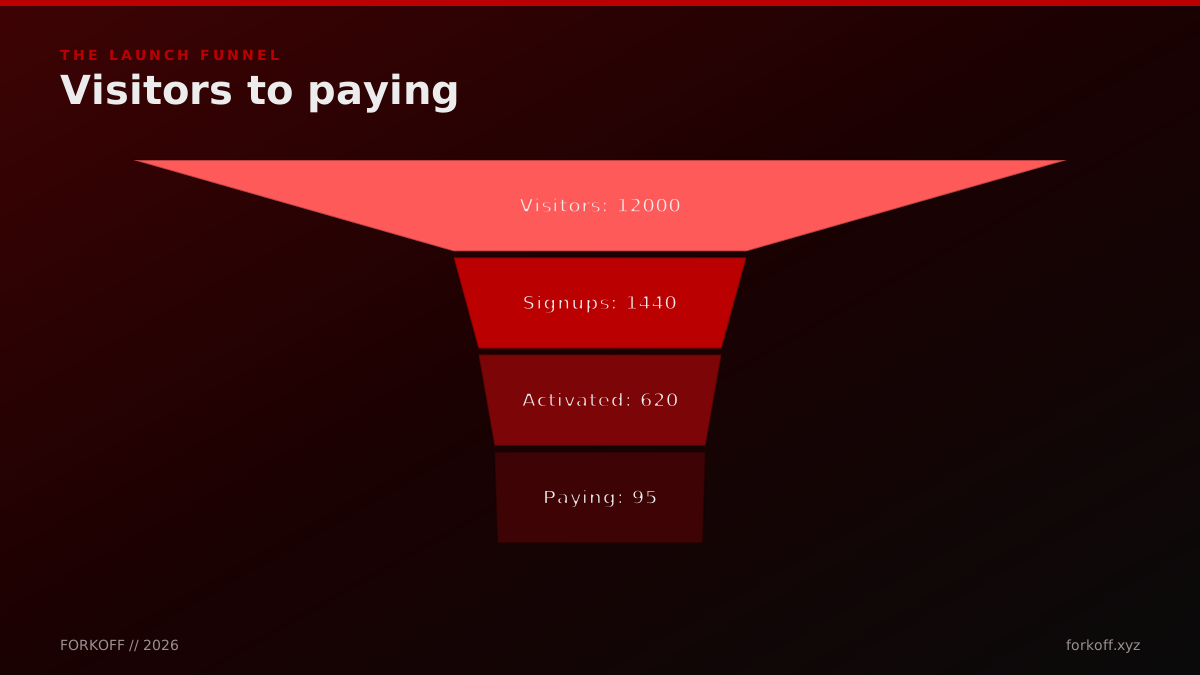
Four things carry momentum past the 72-hour decay window. Continue the comment thread. Every person who upvoted or commented is a warm lead; reply to late arrivals for at least a week, not just launch day. Clip the launch. Short-form cuts of your product demo, your maker comment read aloud, or a founder reaction video seed discovery for weeks after the Product Hunt spike is gone, which is exactly the mechanic our clipping service is built around, having processed over 5 billion views across client campaigns. Re-seed on Reddit and X. A genuine, value-first post in the communities your buyer actually lives in (distinct from a Product Hunt cross-post) reaches an audience the leaderboard never touched, and if you are weighing a physical meetup or side event alongside the launch, our events management work runs that layer too. Instrument the funnel. Track visitors, signups, activation, and paying conversion by channel, the way we cover in depth in the general product launch plan playbook, so you know which post-launch channel is actually converting rather than just guessing. You can sanity-check the economics with our cost-per-qualified-view calculator before you scale any paid amplification.
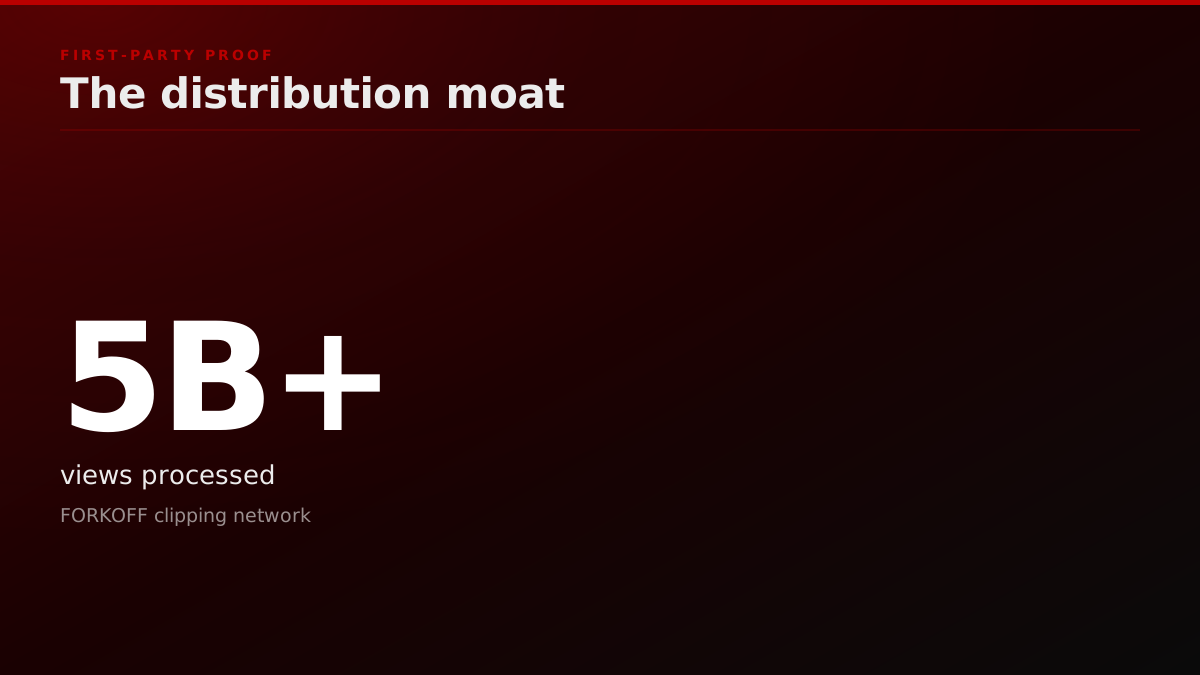
Operator note5B+ views processed across our clipping network; launch-day clips are what carry week two after the Product Hunt spike decays., FORKOFF clipping network
The founders who avoid the "launched, spiked, flatlined" pattern all describe the same shift in posture: Product Hunt stops being the campaign and becomes one input into a campaign that was already running before launch day and keeps running after it. Our three-ring distribution model for SaaS launches names this explicitly: the founder's own voice is ring one, the team is ring two, and paid or partner amplification is ring three, and Product Hunt's badge is fuel for all three rings simultaneously, not a replacement for any of them.
What should you actually measure on a Product Hunt launch day, beyond your ranking?
Track five numbers on launch day, and treat your final ranking as the least important of them: total visitors, signup rate, activation rate, paying conversion, and the share of traffic Product Hunt drove versus your other channels. A number-one finish that converts nobody is a worse business outcome than a fifteenth-place finish that converts at a healthy rate, and you only find out which one you had by instrumenting the funnel before the day starts, not after.
Operator noteUTM-tag the Product Hunt listing link before midnight; retroactive attribution never recovers the launch-day channel split., FORKOFF funnel instrumentation
Set up UTM-tagged tracking on your Product Hunt listing link before launch day, and define your activation event (the specific action that means a signup actually got value) in advance, not retroactively. The founders who post the "I launched and got one non-paying user" complaint in indie-hacker communities almost universally share one root cause: they measured launch day by the vote counter and never instrumented what happened after someone clicked through, so they cannot say whether the problem was the traffic, the landing page, the onboarding, or the offer. Product Hunt traffic specifically skews toward technically sophisticated early adopters who evaluate quickly and churn fast if the value is not obvious in the first session, which makes a clean, fast onboarding flow disproportionately important for this channel compared to, say, a warmer email-list conversion.
Compare your Product Hunt cohort's activation and retention against your other channels a week later, not on launch day itself. A cohort that spiked in signups but shows unusually low week-one retention is telling you something specific: the tagline or gallery attracted the wrong buyer, a mismatch worth fixing in your positioning before your next launch, on Product Hunt or anywhere else. This is the exact instrumentation discipline our general product launch plan playbook covers for a full go-to-market motion, and it applies with extra force to Product Hunt specifically because the traffic is concentrated into a single, unusually short window.
What Product Hunt alternatives exist if you skip it or want a second platform?
Product Hunt is the largest and most recognized launch leaderboard for software products, but it is not the only one, and several founders on X circulate a "launch-max" approach that adds Hacker News, DevHunt, BetaList, Peerlist, and niche indie directories to the same launch week. The launch-platform ecosystem itself is smaller and more interconnected than it looks from the outside; TechCrunch has traced the founder and investor overlap between Y Combinator, Product Hunt, and a16z, which is part of why the same "launch well, launch again" advice keeps circulating across all of these platforms. If your buyer is more technical than Product Hunt's general startup-and-builder audience, Hacker News's "Show HN" format can outperform Product Hunt outright for developer tools, though it competes for the same attention and generally should not run the same day as your Product Hunt push.
Here is how the main launch platforms compare on the factors that actually decide where you should spend your limited launch-week effort, current as of 2026.
| Platform | Audience | Format | Best day/time | Badge/backlink value |
|---|---|---|---|---|
| Product Hunt | Founders, builders, early adopters, broad tech | 24h leaderboard, upvotes + comments | Tue-Thu, 12 AM PT | High, widely recognized |
| Hacker News (Show HN) | Highly technical, developer-heavy | Ranked thread, upvotes + comments | Weekday mornings, US Eastern | Medium, dev-credible, no persistent badge |
| BetaList | Pre-launch, early-access seekers | Static listing, no live ranking | Any day, submit ahead of queue | Low-medium, steady long-tail traffic |
| DevHunt | Developer tools specifically | 24h leaderboard, similar to PH | Weekday | Medium, dev-niche recognition |
| Peerlist | Builders, indie hacker community | Feed-based, less competitive | Any weekday | Low-medium, community goodwill |
The right approach for most launches is depth over breadth: run Product Hunt with the full preparation this playbook covers, then roll the directory long tail (BetaList, DevHunt, Peerlist, and category-specific lists) across the following week rather than firing everything on day one, which tends to produce a shallow presence everywhere instead of a strong one anywhere. We cover the full platform-by-platform breakdown, including which ones are worth the time for which product categories, in launch platforms beyond Product Hunt. If your launch is tied to a fast-moving model or feature drop rather than a full product, the compressed timeline in our 48-hour model-drop marketing playbook is the more relevant version of this same system.
How FORKOFF runs Product Hunt launch distribution
At FORKOFF, we treat a Product Hunt launch as one coordinated wave inside a larger distribution system, not the whole campaign. We are an AI growth agency running distribution, content, and go-to-market for startups across AI, SaaS, Web3, DevTools, and Fintech, and our clipping network alone has processed over 5 billion views. On a client launch, we run the pre-launch audience-building most founders skip, we own the Reddit marketing and Twitter marketing waves that carry momentum past the Product Hunt homepage, and we bring in influencer marketing amplification that is credible rather than rented.
The founder still has to be the voice, the maker comment still has to come from the person who built the product, and no agency can (or should try to) substitute for that. What we add is the pre-launch runway and the post-launch distribution capacity most teams cannot staff on their own, the difference between a launch that trends for a day and one that keeps producing signups two weeks later. If your launch is part of a broader go-to-market motion, our founder funnel engagement plugs directly into this, a launch video gives the leaderboard something to share, and our answer engine optimization work makes sure the launch keeps earning citations in AI search long after the leaderboard resets.
::directive{id="cta-3"} You can see where we have been cited and featured on our press page, and pressure-test the economics of a coordinated launch with our marketing ROI calculator.
This is also why we treat Product Hunt as a research surface as much as a launch channel. Every client launch we run adds to our own pattern-matching on what actually moves a listing from the low twenties into the top twelve, and that first-party experience is what informs the specifics in this playbook, the vote-weight discount, the account-quality mechanics, the maker-comment structure, rather than repeating the same one-line advice every other guide on this topic has repeated since 2021.
The bottom line
Here is the blunt answer: a Product Hunt launch is winnable by a well-prepared nobody, and it is lost far more often to a missing plan than to a mediocre product. Build the pre-launch audience for three to four weeks before you touch the timing or the comment. Launch at 12
AM Pacific on a Tuesday, Wednesday, or Thursday. Write the maker comment as a real person telling a real story, not brand copy. Self-hunt; the data (79 percent of featured posts, 60 percent of Product of the Day winners) says it is the winning path, not the fallback. Run the first four hours like they are the whole game, because they largely are. Place the badge where a buyer is actually deciding. And build the post-launch distribution plan before launch day, not after, because the traffic decays in 72 hours and what you do with it in the two weeks after is the entire point of doing this at all.That is the whole system. The founders who treat it as a system, not a checklist, are the ones who show up in the 0.3 percent instead of writing the next flopped-launch postmortem.
If you take one thing from this entire playbook, take this: every mechanic covered here, the vote-weight discount, the homepage cliff, the notable-voter signal, the self-hunt data, traces back to the same root cause. Product Hunt rewards accounts and comments it can verify as genuine, and it discounts everything that looks manufactured. Spend your prep window building genuine standing instead of hunting for a shortcut around that filter, and the tactics in this post stop being a checklist and start being obvious.