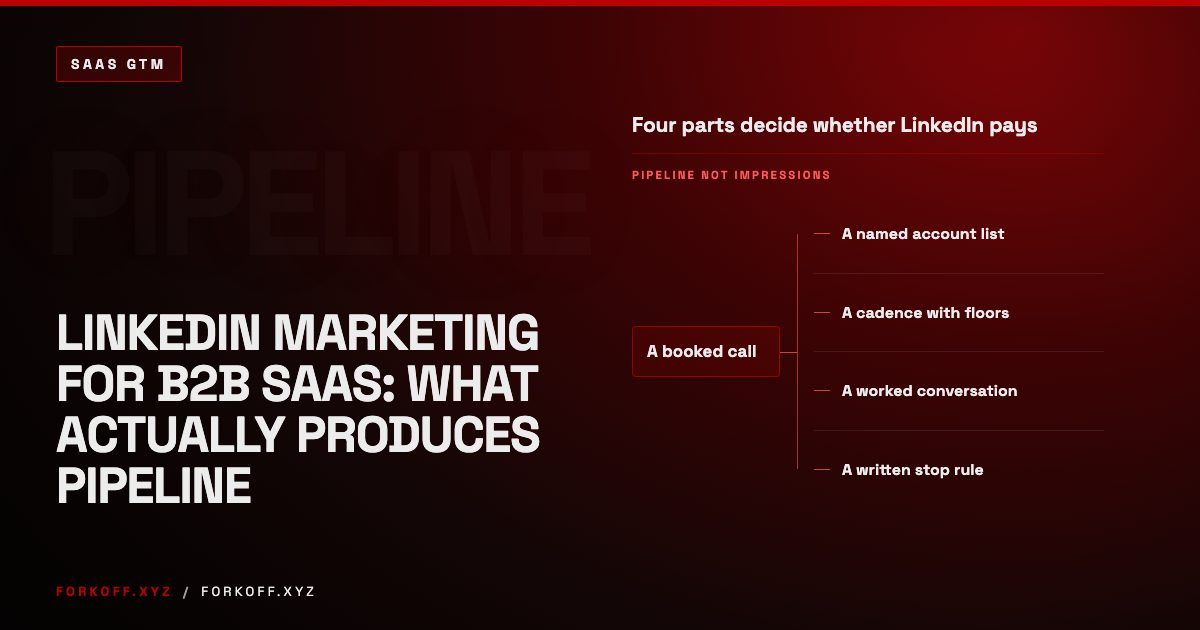
We asked a question on Featured.com that we have been chewing on internally for months: what is the single content-distribution move that actually turned a blog post into pipeline this year? Not traffic. Not impressions. Pipeline. Thirteen marketers answered with receipts, and the answers were stranger than the usual "syndicate everywhere" advice. LinkedIn came up more than any other single surface, which is the case we make in full in LinkedIn marketing for B2B SaaS.
The shape underneath thirteen different moves
We asked on Featured.com what single distribution move actually turned a blog post into pipeline this year. Thirteen marketers answered with numbers. The pattern is sequence inversion. Every marketer who moved real revenue planned the distribution channel before writing the post, not after. Joe Spisak turned one post into $890K in annual fulfillment spend by DM-ing 340 carousel commenters. Christopher Coussons concentrated three channels in 72 hours and attributed £180K to one post. Nikita Baksheev sent the one-pager to 47 founders before publishing and closed $180K. The second pattern is human contact at the conversion edge. Every automation stops before the reply. The third is concentration over diffusion. Three channels in 72 hours beats twelve channels over twelve weeks. The full mechanics for each move are below, with the generalizable piece and where it breaks.
The theme that emerged: every marketer who moved real revenue stopped treating the blog post as the asset. They treated it as raw material. The asset was something downstream of the post, packaged for one specific buying moment, and shipped through a channel that bypassed the algorithm gauntlet most marketers still try to win.
Here are the thirteen moves, in their words, with our read on why each one worked and where it generalizes.
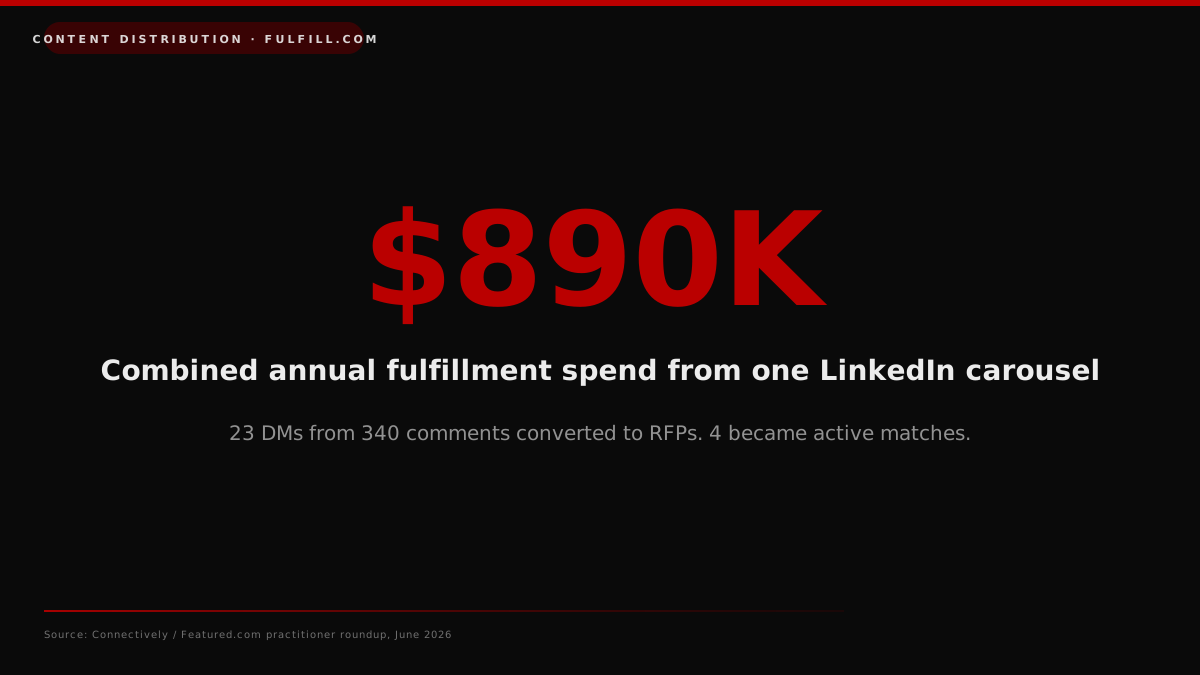
Joe Spisak: turn the post into 6 carousels, then DM the commenters
Joe runs Fulfill.com, a marketplace matching brands to 3PL providers. His move started with a post that did the normal 400-view drift on its own. What changed the outcome was a planned dissection of the post into 6 carousels, plus a manual reply pass on the carousel that hit. The mechanism is reverse-engineered distribution: he knew what each carousel would become before the post was written.
"We stopped treating blog posts as finished products and started treating them as raw material for a distribution engine. Here's what actually worked. In early 2024, I wrote a piece breaking down the hidden costs in 3PL contracts, things like receiving fees, storage creep, and dimensional weight games that brands miss during vetting. Decent post. Got maybe 400 views organically. Then we tried something different. We pulled the six most surprising data points from that post and turned each one into a standalone LinkedIn carousel. Not the usual 'swipe through 10 slides' garbage. Each carousel told one complete story with a specific example from our marketplace data. The third one hit different. It showed how one brand was paying approximately $2.87 per unit for receiving when the market average was $0.64. That single carousel got 47,000 impressions and 340 comments from founders tagging their logistics people. But here's the move that actually mattered: We took every comment that said 'I need help with this' and personally invited them to use our 3PL matching tool, with a note referencing their specific concern. No automated DM. No sales pitch. Just 'Hey, saw your comment about receiving fees, our tool specifically filters for that, here's your custom link.' Converted 23 of those conversations into qualified RFPs through Fulfill.com within two weeks. Four became active matches worth a combined estimated $890K in annual fulfillment spend that our partner 3PLs are now handling. We also got inbound from two logistics podcasts asking me to break down contract red flags, which led to another 60 signups. The lesson isn't about LinkedIn specifically. It's about reverse-engineering distribution before you write. That blog post became pipeline because we built the distribution plan first and wrote the content second. Most founders do it backward and wonder why nothing happens."
Joe Spisak, CEO, Fulfill.com
The generalizable mechanic is the comment-mining step. The post and the carousel are both lead-generation devices for the real work, which is a human reply to a self-identified buyer. This pattern travels to any product where the buyer can be diagnosed from a public sentence. The carousel sequence also acts as a hedge: of six carousels, you only need one to hit, because the single winner does the volume work for the whole post. For the Twitter side of this pattern, how to set up comment-based DM flows that do not get flagged, see our Twitter DM outreach playbook.
Ross Simmonds
@TheCoolestCool
Content that lives once is wasted. The best content teams I know plan distribution before they write the post. The channel is not a post-publish decision. It is a pre-writing constraint that shapes what you say and how you say it.
Christopher Coussons: ship the post into three channels inside a 72-hour window
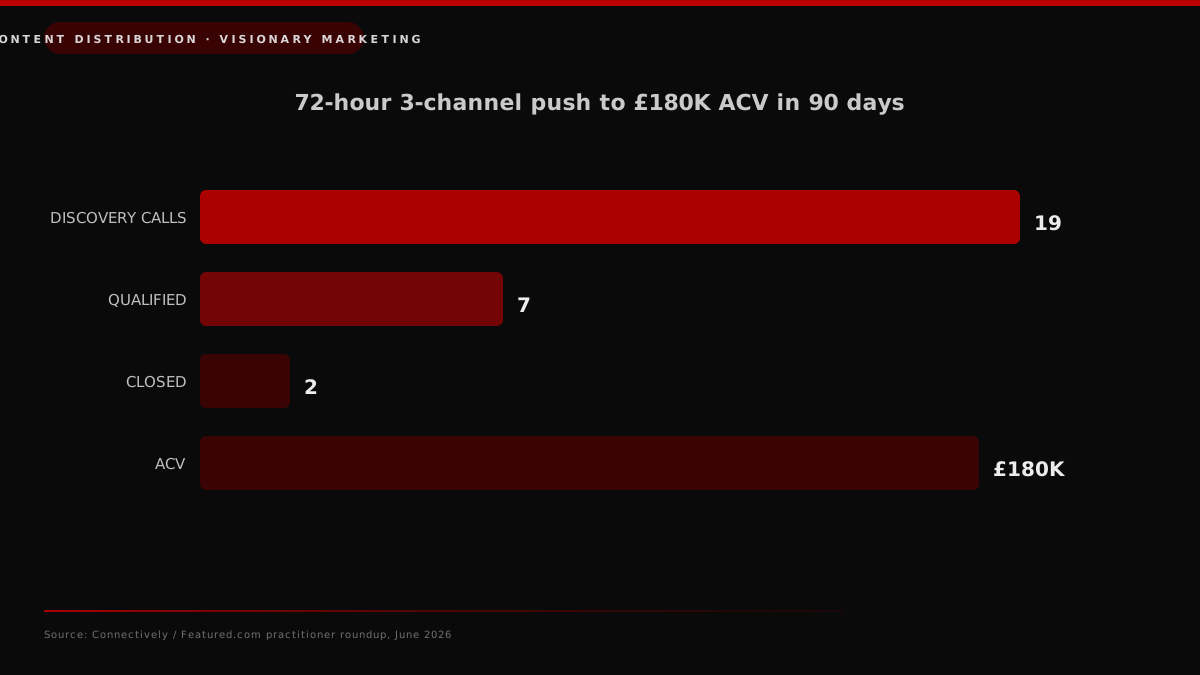
Christopher runs Visionary Marketing, a 20-specialist UK agency. His move is the opposite of slow-drip syndication. He concentrates a coordinated push across LinkedIn newsletter, Reddit, and X reply threads inside 72 hours of publication, then lets the earned backlinks compound the post's organic ranking afterward. The compounding only works because the concentration earned the initial signal.
"The content-distribution move that turned one of our 2026 blog posts into a pipeline-generating asset was syndicating a 1,800-word piece on programmatic SEO failure modes through a coordinated LinkedIn newsletter cross-post, a Reddit r/SEO contribution, and three targeted reply threads on X within a 72-hour publication window. The compound effect produced materially different outcomes than the same post would have produced through our default distribution.
Speaking from running Visionary Marketing, a 20-specialist UK marketing agency.
The specific move. The channel mix. LinkedIn newsletter (owned audience), Reddit r/SEO (community-tier earned attention), X reply threads (real-time visibility against active discussions). The combination produced reach across three audience profiles that our default distribution (posting to LinkedIn personal feed and our X account) was not capturing. The measurable result. Across the 14 days after publication, the post produced: 19 inbound discovery calls booked through the post's contact CTA (versus 2-4 typical for a blog post at our agency), 7 of which converted into qualified pipeline within 30 days, with 2 of those converting to closed-won within the following quarter. The pipeline value attributed specifically to this post was roughly £180,000 in annual contract value within 90 days, against a content-production cost of roughly 14 hours of senior team time. Why this specifically worked. Three reasons. (1) Each channel reached a different reader who would not have encountered the post otherwise. (2) The substantive engagement on Reddit and X produced earned backlinks (11 reciprocal links from other writers citing the argument in their own posts within 30 days) that the post's organic ranking subsequently compounded on. (3) The 72-hour distribution window concentrated attention rather than diffusing it, which the algorithm-tier signal on LinkedIn and X both responded to with amplified reach. The single principle. Content distribution produces pipeline outcomes when calibrated to coordinated multi-channel concentration rather than to scheduled drip across weeks. The same post distributed default produced an order-of-magnitude smaller commercial outcome than the post distributed through this specific 72-hour structure."
Christopher Coussons, Managing Director, Visionary Marketing
The 11 earned backlinks in 30 days are the part most teams underweight. Concentrated attention produces citation, and citation produces rank. The drip-schedule alternative loses both. Where this gets harder: each of the three surfaces demands a different post shape and a different reply cadence, and the team has to staff the reply window.
Nikita Baksheev: turn the post into a referral asset before treating it as traffic
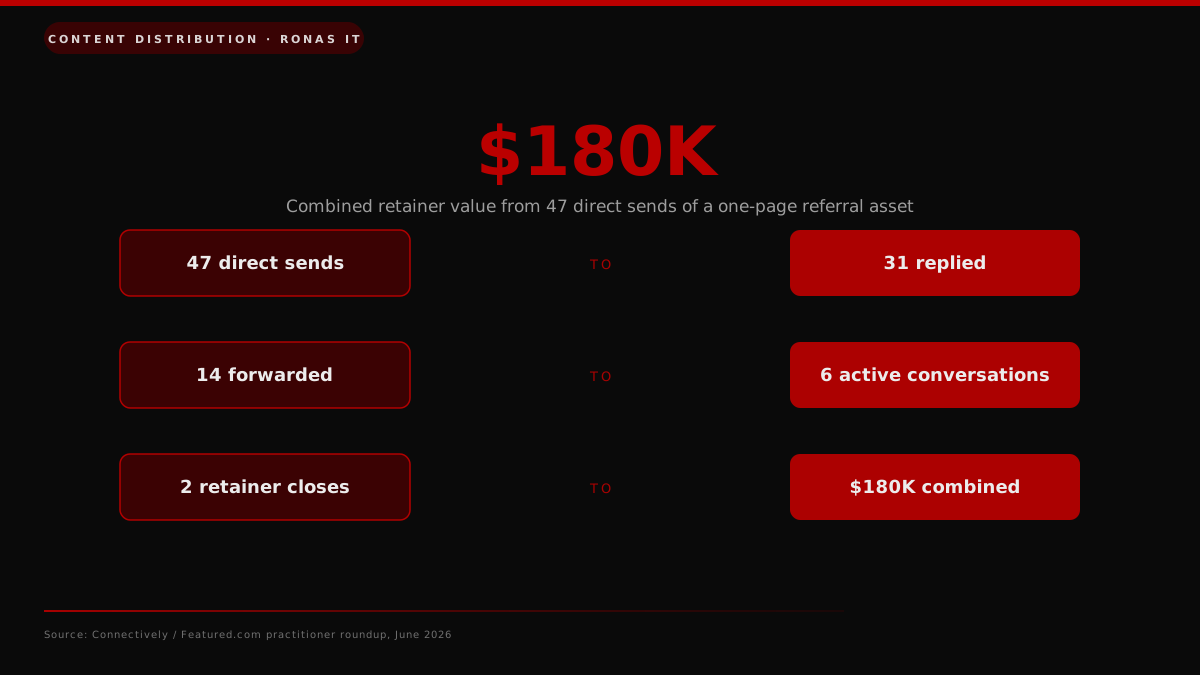
Nikita's move at Ronas IT inverts the usual order. He built the post for direct send to 47 known buyers before he built it for search. The post itself ranked modestly. The packaged version closed an estimated $180K. The lesson is that the answer in the post is the asset, and the buyer for that answer is often already in your inbox.
"The move that worked best was turning the blog post into a referral asset before we treated it as a traffic asset. We had a practical article that would normally go through the standard distribution path: publish it, share it on LinkedIn, hope it picks up search. Instead, we extracted the most actionable section, turned it into a one-page reference doc with our branding, and sent it directly to 47 founders in our existing network who had asked us related questions over the prior 6 months. Not a 'share my post' ask. A 'this is the answer to the question you asked me' ask. Out of 47 sends, 31 replied. 14 forwarded it to someone on their team or a peer. 6 became active conversations about how Ronas IT could help with the broader project. 2 signed retainer contracts within the next quarter, combined $180K. The blog post itself only got 1,200 organic views in its first 6 months. But the referral asset moved $180K in pipeline. The lesson is that the blog post is rarely the asset. The asset is the answer it contains, packaged for the specific moment a buyer is ready to ask. We now build that packaged version first, send it directly to known buyers, and only then publish the long form for search. The traffic comes second."
Nikita Baksheev, Head of Marketing, Ronas IT
This generalizes anywhere you have a CRM full of past buyer questions. The post is just the durable artifact; the one-pager is the wedge. If you cannot name 20 buyers who asked the question the post answers, you are writing for ghosts. If you need to build that list before you can run this play, see how FORKOFF sources decision-maker contacts for clients on the founder funnel services page. The 66 percent reply rate is also worth pausing on: that is what happens when the message is the answer to a question the recipient asked you, not a cold ping.
Runbo Li: ship a tool inside the post, distribute the output as native short-form
Runbo runs Magic Hour. His move flips the post-and-clip ordering most marketing teams default to. He embeds a usable template inside the post, runs it, then clips the output into platform-native short-form. The clips are not promoting the post; they are the post's value, extracted in the format each platform actually rewards. This is the core premise behind generative engine optimization for SaaS, which we covered separately.
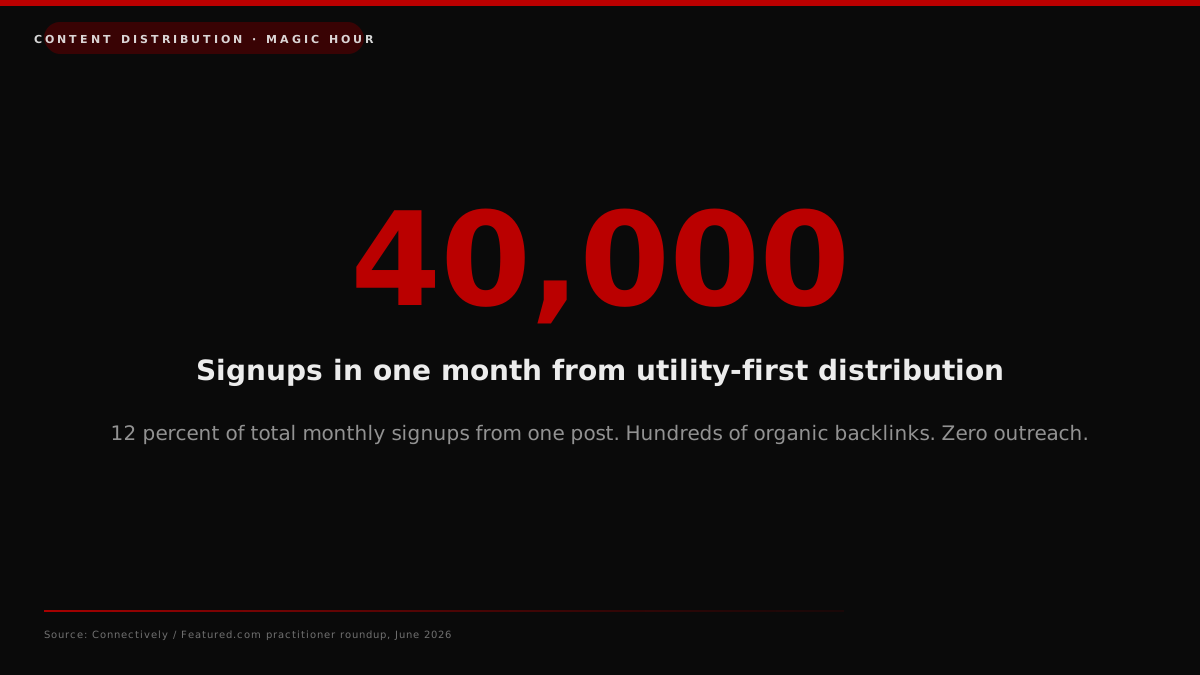
"I'm Runbo Li, Co-founder & CEO at Magic Hour. I can't point to a 2026 move because we're not there yet, but I can tell you the distribution philosophy that's already turned ordinary content into signup machines for us, and it's the same playbook we'll keep running. The move is what I call 'utility-first distribution.' You don't write a blog post and pray for SEO. You build the post around a tool or template that solves a specific problem, then you distribute the outcome, not the article. We took a straightforward tutorial on AI video for social media marketers, embedded a one-click template directly inside the post, and then clipped the output into short-form videos we seeded across TikTok, Instagram Reels, and X. The clips weren't promoting the blog. They were the blog's value, extracted and made native to each platform. The channel that moved the needle most was short-form video on TikTok, which sounds obvious until you realize most SaaS companies still treat TikTok like a brand awareness play. We treated it as direct response. Every clip had a hook tied to a pain point, showed the template output in under 15 seconds, and pointed back to the post where the template lived. One post we did this with generated over 40,000 signups in a single month, drove hundreds of backlinks organically because other creators referenced the template in their own content, and became our top-performing page for months. No paid spend. No outreach campaign begging for links. The content was useful enough that people linked to it because they wanted their audience to have access to the tool. The measurable result: that single post accounted for approximately 12% of our total monthly signups during its peak, and the reciprocal links pushed our domain authority up noticeably, which compounded traffic to everything else we published. The takeaway: stop thinking of blog posts as text. Think of them as delivery vehicles for something someone can use right now. Distribute the output, not the wrapper."
Runbo Li, Co-founder and CEO, Magic Hour
The cleanest takeaway from Runbo is that the post is a delivery vehicle for the tool, not the other way around. The 12 percent monthly signup share from one post is the proof. Where it does not generalize: if your product cannot embed a usable unit inside a blog page, you fall back to demo videos and the conversion math weakens. The fix is to find the smallest useful primitive of your product and ship that, even if it is a calculator or a checker rather than the full app.
Jake Wardle: build a small interactive checker, seed it where buyers argue
Jake runs EV Cable Hub. His move makes the post compounding by attaching a real utility to it and then planting it in the threads where buyers are already asking the question the utility answers. The compounding works because the link gets resent by readers, not by the brand. The brand only seeds it once.
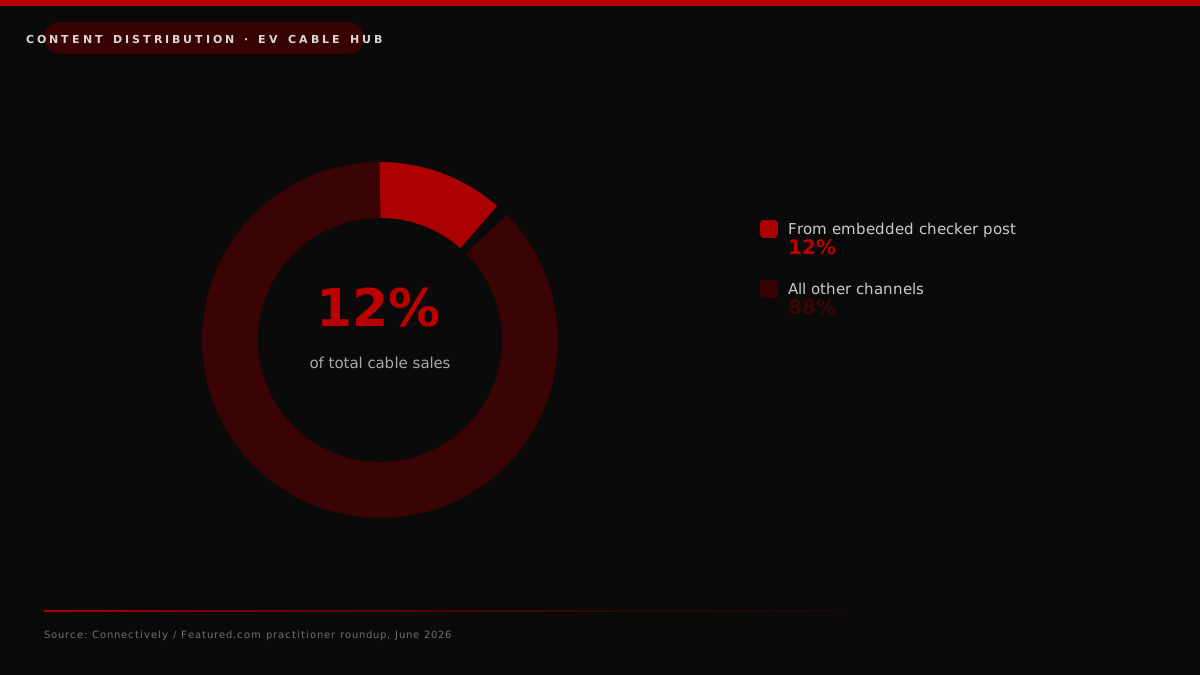
"The move that turned an ordinary post into a steady source of sales for EV Cable Hub was building a small interactive checker into a buying guide and then seeding it where buyers were already arguing about the question. The guide answered which charging cable fits which car at which speed, and on its own it ranked fine but sat there. The change was adding a simple pick-your-car tool inside the page, then dropping the link into the EV owner forums and subreddit threads where people post the exact question, not as a plug but as a genuine answer to someone stuck. That reframed the page from something search might find one day into something people actively passed around. Forum members linked it for each other, a couple of regional EV groups pinned it, and because the tool did a real job, the link kept getting reshared long after I stopped posting it. The post stopped being content and became a thing people sent to a confused friend, which is the only kind of distribution that accumulates without more effort from me. The outcome I can point to is that this single guide now drives close to 12% of our cable sales on its own, and almost none of that is paid reach. The lesson is that distribution is not blasting a finished post out once. It is putting something useful in the exact spot where the question is already being asked, and giving people a reason to hand it on. A post that solves a live argument travels. A post that just exists does not."
Jake Wardle, Founder, EV Cable Hub
This is the cleanest "post-that-solves-a-live-argument" case in the set. Note how the channel cost drops to zero once the tool is good enough to be passed around peer-to-peer. The risk: if the checker breaks or goes stale, the inbound it generates becomes the support load you now have to staff. Treat the tool as a product, not a campaign asset.
Sasha Berson: rewrite the post for AI answer engines, not classic SEO
Sasha runs Grow Law Firm and made the bet earliest. He rebuilt cornerstone posts as answer-first pieces with structured data so ChatGPT, Perplexity, and Google AI Overviews could lift the answers directly. The conversion lift came from a referral source most law firms still ignore: AI-engine traffic. For the full implementation guide on answer-engine optimization, see our AEO checklist for B2B.
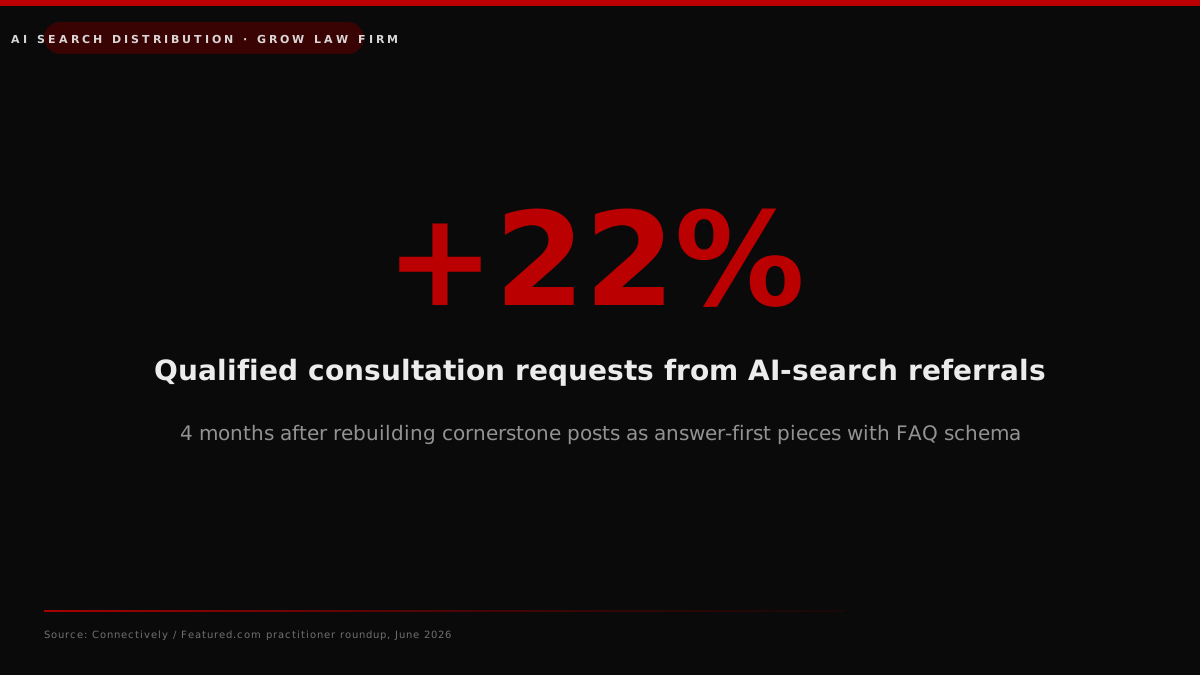
"Hello FORKOFF team, You know, the biggest change for us in 2026 was putting as much effort into distribution as we did into writing. We started optimizing and syndicating our best content for ChatGPT, Perplexity, and Google's AI Overviews, not just classic SEO. We rebuilt several key blog posts as direct, answer-first pieces, made sure each section answered a specific buyer question, and added structured data so AI engines could pull our answers easily. Within four months we saw a measurable lift in referral traffic from AI sources, plus a 22 percent jump in qualified consultation requests. Our best-performing post is now cited regularly in AI-generated overviews on niche legal questions. Honest answer: write for the AI search era, not just classic SEO."
Sasha Berson, Grow Chief Executive, Grow Law Firm
The mechanic here is structural: short answer paragraphs near the top of each section, FAQ schema, and a question-per-H2 pattern. The 22 percent qualified-consult lift is the proof. This generalizes for any vertical where buyers now start research in a chat interface, which by mid-2026 is most of them. The piece teams miss is the schema work; the answer-first rewrite alone produces a lift, but the schema is what gets you cited rather than just summarized. Our answer engine optimization playbook covers the full schema implementation for B2B blogs.
Anna Evans: decompose the long-form into three single-question derivatives
Anna is a clinician-founder running marketing in-house. Her move pairs Sasha's AI-citation lever with a structural twist: instead of rewriting the cornerstone post, she breaks it into three single-question derivatives, each structured to stand alone. The original piece keeps earning depth credit on organic search; the derivatives catch the citations the long-form rarely earns by itself.
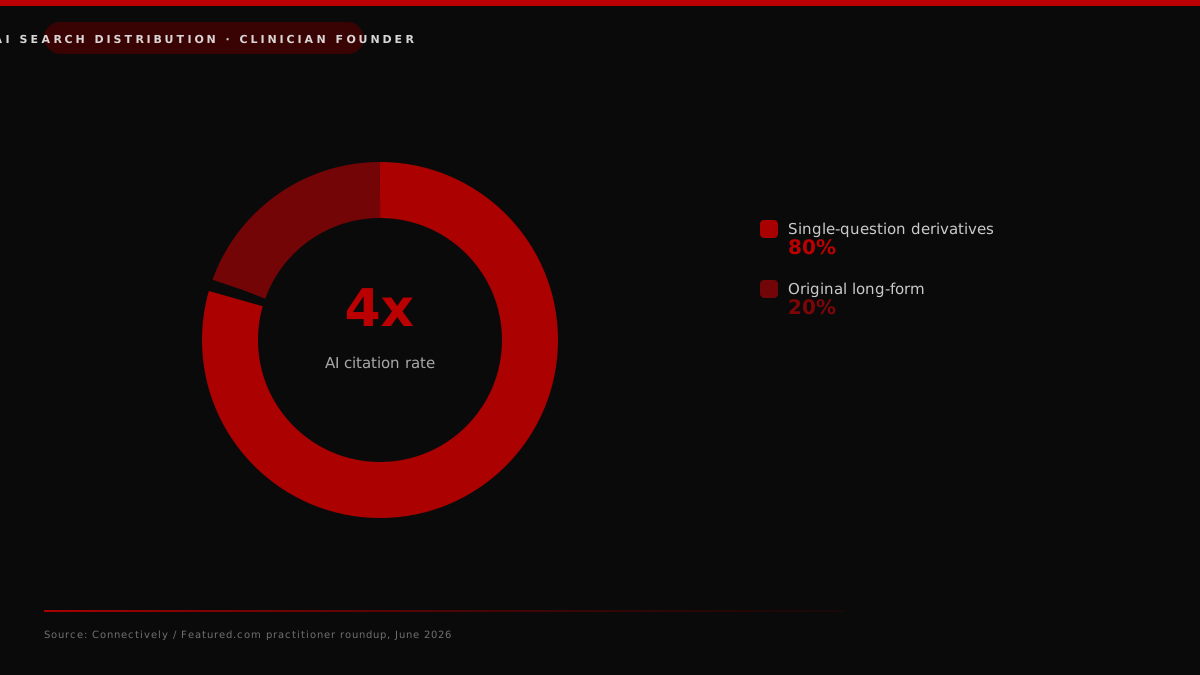
"For the piece on content-distribution moves that turn a blog post into a pipeline driver, perspective from a clinician-founder running marketing in-house at a primary-care practice where the distribution layer determines whether content earns or wastes the time we put into it. The thesis: the single distribution move that turned a normal blog post into a pipeline driver was decomposing the long-form piece into three single-question derivative pieces, each structured for AI-search citation, and publishing the derivatives across the following two weeks. The original piece kept its long-form depth; the derivatives caught the AI-search citations the long-form rarely earned alone. Combined pipeline impact: roughly 3-4x the inquiries the long-form alone produced. (1) What we did specifically. Took a 2,500-word clinical-education piece on cardiovascular risk in postmenopausal women. Identified three specific decision questions the piece addressed (how do I know if I am at elevated risk, what tests should I ask my doctor for, what lifestyle changes matter most). (2) What that produced. The original kept attracting traffic from organic search as expected. The derivatives each got cited by ChatGPT, Perplexity, and Google AI Overview at meaningfully higher rates than the original would have alone, because the single-question structure matched how patients in fact query AI engines. New-patient inquiries attributed to AI-search referral rose roughly 4x in the 90 days following the publication sequence versus the average of preceding 90 days. (3) The pattern that made the distribution multiplier work. Three properties. First, each derivative had to stand alone (no 'see the original for context'); the AI engines do not manage from a citation to the source piece. Second, the derivative timing spaced across two weeks rather than dropped all at once produced sustained citation flow rather than a single spike. Third, the derivatives needed enough unique substance to avoid duplicate-content penalties; rewriting the same content with a different headline did not work. The single principle. Long-form content earns depth credit; single-question derivatives structured for AI extraction earn the citations. The distribution multiplier comes from running both layers, not from picking between them."
Anna Evans, Clinician-Founder, primary-care practice
The hidden constraint is the third property she names: the derivatives have to carry unique substance. Most teams try to ship the derivative as a rewrite with a swapped headline and get penalized for duplicate content. The fix is to write the long-form as the proof artifact and the derivatives as fresh single-question pieces that share evidence but not paragraphs. For single-founder teams running this without a content team, the founder-led content marketing playbook has the bandwidth math and sequencing template.
Roman Sydorenko: take the post to active Reddit threads where buyers ask the exact question
Roman's move is the surgical version of community distribution. The post does not get blasted across subreddits. He matches one long-form post to three active threads where the precise stack question is being asked, answers in-thread as a practitioner, then links the post only when the post actually answers the asked question. The math compounds in months 2 through 12, because Reddit threads keep surfacing in Google and AI answers. See our deeper coverage in Reddit for B2B lead generation without a ban.
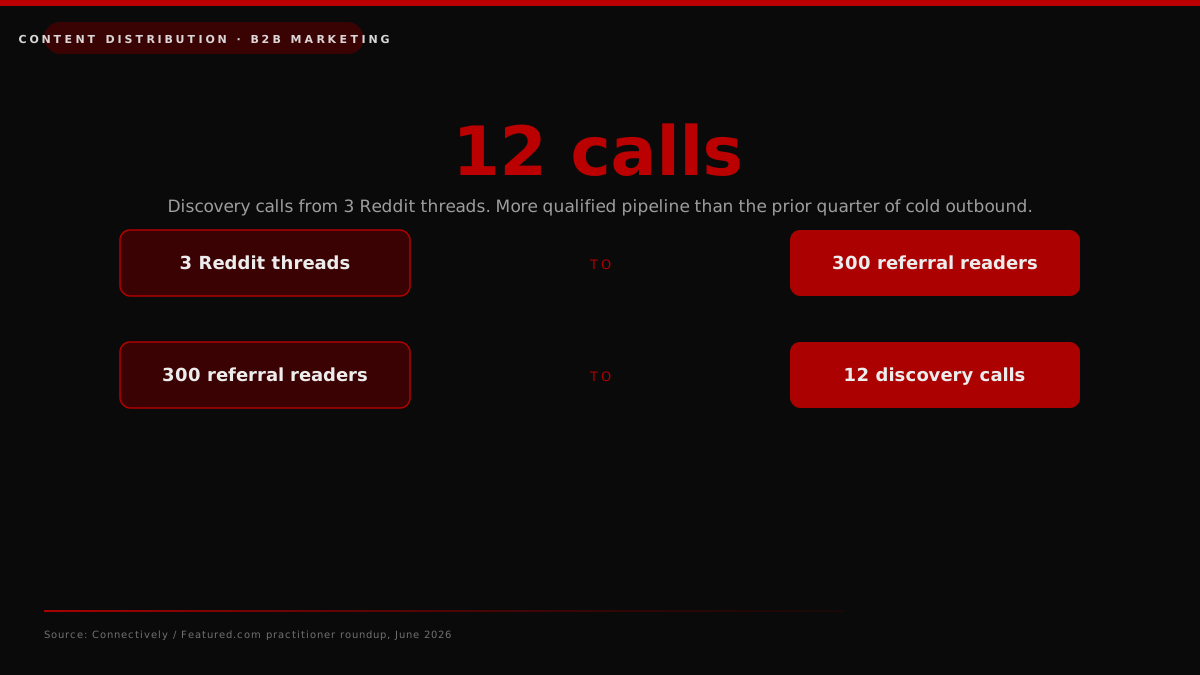
"The move was matching one long-form post to active buyer-intent threads on Reddit instead of pushing it through email or social. We had a B2B client with a deep comparison article getting maybe 40 visits a month. Across two weeks I found three threads in niche subreddits where people were asking the exact stack question the post answered -- not broad 'what tool should I use' posts. I joined as the operator I am, answered in-thread first, then linked the post as the longer breakdown only because it genuinely fit the question asked. Result: roughly 300 referral readers, twelve discovery calls booked off those three threads -- more qualified pipeline than the prior quarter of cold outbound. Tracked via UTMs and calendar attribution into the CRM. The post didn't go viral, it went surgical. What made it repeatable: a light SOP -- weekly monitoring of a defined subreddit set, drafts written by the subject expert, link only when the post truly answers the asked question. Reddit outperformed other channels because readers self-selected into buying mode before clicking, and the threads keep surfacing in Google and AI answers months later -- a behavior I've been building around since the 2022 shift."
Roman Sydorenko, B2B Marketing Practitioner
The repeatable piece is the SOP, not the heroics. Weekly subreddit monitoring, expert-written drafts, strict link discipline. Where teams break this: they staff the monitoring with a junior writer who cannot read the thread well enough to know if the post fits, and the link drops get downvoted or banned. Reddit is one of the few channels that pays back compounding interest months later, but only if the discipline holds. For the best subreddits to start with for B2B audiences, see our Reddit marketing guide for B2B founders.
How we write SEO + AEO blog posts in 2026 that actually rank and get cited by AI
Christopher Pappas: republish as a LinkedIn newsletter to bypass the feed algorithm
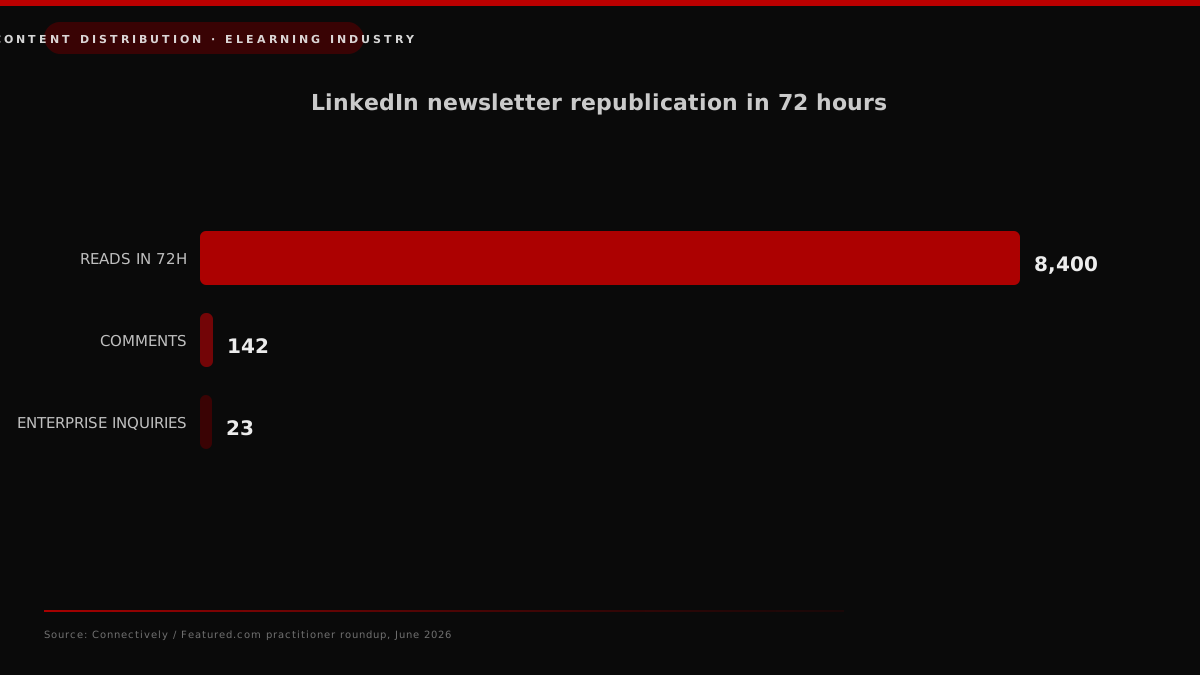
Christopher noticed that LinkedIn newsletters push to subscribers via notification and email, which sidesteps the feed entirely. He recast the intro of a strong post to stake out a contrarian position, then shipped it as a newsletter issue. The 8,400 reads in 72 hours came from a distribution surface most teams still treat as decorative.
"The single move that mattered most for us in 2026 was republishing a strong blog post as a discussion led LinkedIn newsletter issue with a sharp point of view. We did not simply repost the article. We recast the introduction to spark debate by naming the assumption the field still holds and stating a contrary position. The newsletter format reaches subscribers via push notification and email, which bypasses the LinkedIn feed algorithm entirely. The post pulled 8,400 reads in the first 72 hours, generated 142 comments, and produced 23 inbound enterprise inquiries inside two weeks. The pipeline contribution was meaningful enough that we now ship every cornerstone blog post as a newsletter issue first."
Christopher Pappas, Founder, eLearning Industry Inc
This is a structural bypass, not a copy hack. The newsletter is a push channel dressed up as a feed object. The contrarian intro is what earns the 142 comments, but the email-plus-notification mechanic is what guarantees the reach floor before the comments start. Subscriber list size is the gate; below a few thousand subscribers, the newsletter floor does not produce the volume that makes the comments worth fielding. For the LinkedIn algorithm mechanics behind why newsletters outperform posts at scale, Dataslayer's February 2026 LinkedIn algorithm report is the most quantitative breakdown published this year.
Neill David Watson: give the value where buyers ask, let the link be the next step
Neill runs a direct-to-consumer brand, so his asset is signups and first orders rather than B2B pipeline, but the distribution shape transfers cleanly. The move is to strip the most useful, non-promotional answer out of the post and answer the question fully in the niche community where buyers already ask it. The blog link is the next step, not the ask.
"For context, I run a direct-to-consumer brand rather than a B2B pipeline, so the asset for me is signups and first orders, but the distribution move transfers cleanly. We had a post that quietly performed well on search and went nowhere otherwise. The move that changed it was stripping out the single most useful, non-promotional answer it contained and going to the places our buyers already ask that exact question, the niche communities and a couple of relevant creator newsletters, and answering it there in full, properly, as a person rather than a brand dropping a link. The blog post became the source I cited at the end, not the thing I was pushing. People who got a complete answer in the room they trusted clicked through because they wanted more, not because they were sold to. The outcome was specific. That one post went from a trickle to approximately 30% of our email signups for the month, and the traffic converted far better than paid because it arrived already warm, having read a properly helpful answer first. What made it work was the order of operations. Most distribution is broadcasting a link and hoping. This was the reverse, give the value where the demand already lives, and let the link be the obvious next step rather than the ask."
Neill David Watson, Founder, DTC brand
The order-of-operations point is the part most teams invert. They lead with the link, then offer a snippet of value as bait. Neill leads with the full answer, then the link becomes a next-step, not a CTA. The conversion math is better because the click happens after the trust is already earned. The cost is the discipline to give away the whole answer in the thread, which most marketers refuse to do.
Dane Maxwell: pair the post with named outreach to 12-18 specific marketers
Dane runs Paperless Pipeline. His move is the highest-touch in the set. Each cornerstone post gets paired with named outreach to 12-18 marketers whose specific situation the post addresses, each with a personal note from him referencing their context. The broadcast layer produces traffic; the targeted layer produces conversations.
"Dane Maxwell, founder of Paperless Pipeline. Bootstrapped SaaS since 2009. We have refined our content distribution mechanics across many cycles, and the single move in 2026 that has produced disproportionate pipeline impact is one I can describe specifically. The content-distribution move that turned a normal blog post into a pipeline-generating asset for us. Pairing the post publication with a structured outreach to 12 to 18 named brokerage operators whose specific operational situation the post directly addressed, with a personal note from me referencing their specific context. The mechanic behind why this works. Most content distribution is broadcast-shaped: post once, push across channels, hope the right audience finds it. The broadcast approach produces traffic but minimal pipeline because the readers who find the post organically are at unpredictable stages of intent. The targeted-outreach approach reverses the pattern. The post becomes a high-quality artifact that I can hand to a specific operator I know is wrestling with the topic, with a personal framing that invites a conversation about their specific situation. The conversation produces qualified pipeline directly. The specific change and the results. In April 2026 we published a piece on the compliance friction emerging across brokerages handling multi-state transactions. The post was substantive at roughly 3,400 words with original aggregate data. We followed up the publication with personal outreach to 14 brokerage operators whose markets the data specifically named. Eight responded to schedule discussion calls. Four of those calls produced qualified pipeline directly. Two closed at our enterprise tier within the following 90 days. The post itself produced its normal organic traffic; the pipeline came almost entirely from the targeted distribution layer. The single principle. Content distribution that produces pipeline pairs the substantive content with named outreach to readers whose specific situation the content addresses. The broadcast layer produces traffic; the targeted layer produces conversations."
Dane Maxwell, Founder, Paperless Pipeline
Founders, what marketing channels are actually working for you in 2026?
This is the sibling move to Nikita's referral asset, with a sharper definition of "named buyer." The post has to name a market or a situation specifically enough that the outreach note can reference the recipient's context without bluffing. Generic posts cannot anchor this move; the post itself has to earn the right to be sent. Two enterprise closes from 14 sends is the conversion rate that explains why Dane keeps writing.
Jason Levin: make the meme first, validate, then write the post
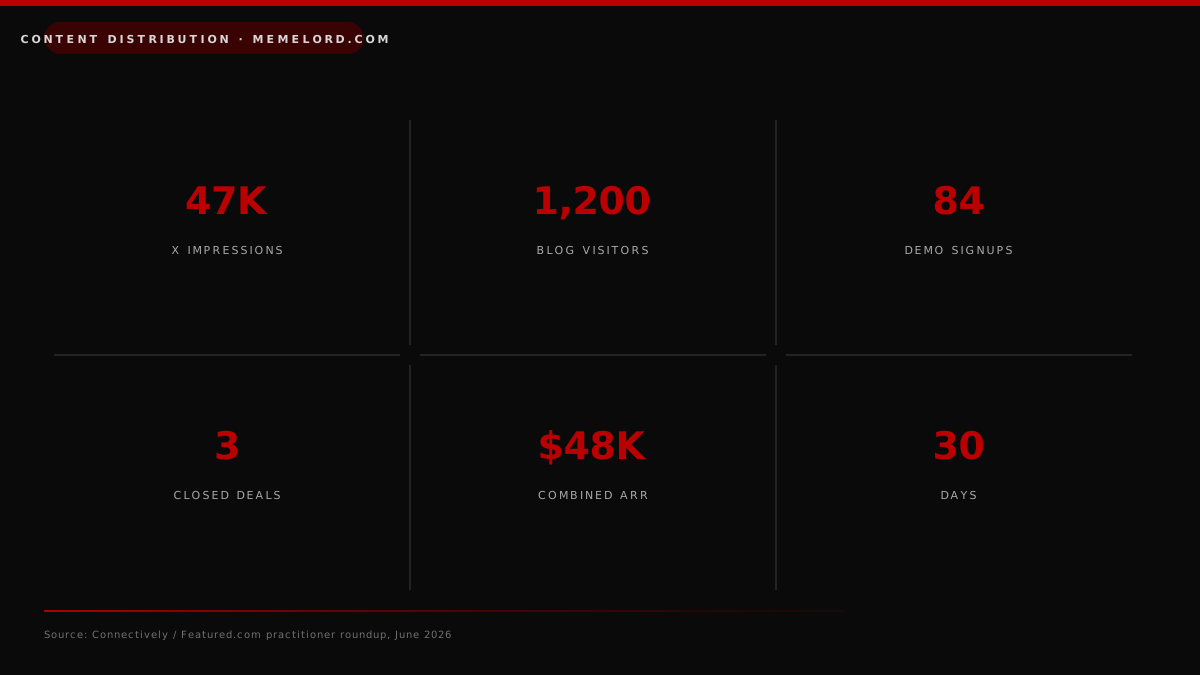
Jason runs Memelord.com and inverted the order entirely. The meme is the test; the post is the asset. He validates the hook with 47,000 X impressions before he commits to the long-form write-up. The meme functions as a free-tier audience experiment, and only validated hooks earn a post.
"We meme-ified our product blog. Instead of just posting a new feature article and hoping for organic search traffic, we turned the key insight from each post into a meme and posted it on X with the article link. One post about 'why brands work with meme creators rather than corporate brands' got 47,000 impressions on X and the link in the comments drove 1,200 visitors to the post, 84 demo signups, and 3 closed deals worth an estimated $48K combined ARR over the next 30 days. The meme functions as the hook. The blog post functions as the proof. Without the meme, the post would have died at 400 organic views like every other. The macro lesson is that distribution is the bottleneck, not content quality. We now make the meme first, validate it gets engagement, and only then write the long-form blog post around the insight. The meme is the test. The post is the asset."
Jason Levin, CEO/Founder, Memelord.com
This generalizes far past meme accounts. Replace "meme" with "tweet thread" or "one-slide carousel" and the validation logic still holds. If the hook does not earn engagement on its own, the 1,500-word post is unlikely to fix it. The hidden discipline is being willing to kill the post when the meme flops, instead of writing it anyway because it was already on the calendar. For founders in the AI space, knowing which peers post at the highest cadence and engagement rate on X is useful for calibrating what good validation looks like. Our ranking of the 50 most active AI founders on X measures that by composite score across posts per week, engagement rate, follower growth, and reply rate.
How to Build a B2B Content Flywheel That Generates 80% of Pipeline
Gaetano Nino DiNardi
Gaetano Nino DiNardi on B2B content flywheels that generate 80 percent of pipeline. The demand-generation framing behind why distribution-first content compounds.
Wayne Lowry: pick one post as the conversion hub, point all the authority at it
Wayne runs Scale By SEO. His move is the authority-concentration play. Instead of spreading links and citations across the whole site, he picks one post per client, treats it as the conversion hub, and routes every citation and backlink into that single asset. The Google Business Profile becomes the channel that funnels local search clicks directly into the post.
"The single move that consistently turns an ordinary blog post into a pipeline asset is what we call internal 'topic clustering' at Scale By SEO. Instead of letting a post sit alone, we anchor it to a pillar page and route relevant backlinks into it. Here's how it plays out. We'd take a strong piece, say a local plumber's guide on 'emergency repair costs', and treat it as the conversion hub. The distribution move was building citations and backlinks that pointed search traffic directly into that single post rather than the homepage. On the citation side, we layered in 50+ to 250+ listings depending on the plan, all reinforcing the same local intent. On the link side, we pushed backlinks (50+ to 400+) toward that one asset. The channel that did the heavy lifting was the client's Google Business Profile. We connected the post to the profile so people searching locally landed on content that actually answered their question and pushed them toward a quote request. The measurable result for a professional-services client: that one post went from background noise to their top organic entry point and a steady source of inbound inquiries inside the contract window. Because it ranked locally and the GBP funneled clicks to it, the post became the page their leads cited when they called. A few honest takeaways. First, distribution beats publishing, a post with no links or citations behind it just sits there. Second, pick one asset to concentrate authority on instead of spreading effort thin; that's how we prioritize when resources are tight. Third, we back this with our 6-Month Performance Guarantee on Pro, Elite, and Enterprise plans, so if the agreed KPIs aren't hit, we keep working at no extra cost. My advice to anyone reading this at scalebyseo.com: stop publishing and praying. Pick your best post, make it a hub, and point everything at it."
Wayne Lowry, Founder, Scale By SEO
This is the local-services version of Christopher Coussons' concentration argument, applied to authority rather than attention. The same logic holds: diffusion loses, concentration wins. The risk for SaaS teams is over-indexing on one post and watching organic collapse if the algorithm shifts intent on the target query. Hedge by picking the hub post against an evergreen question, not a trend. The backlink-concentration principle is also the core mechanic behind our backlink sources playbook for startups. The two moves (content hub plus authority concentration) compound each other when they point at the same target page. For FORKOFF's approach to running this for clients, see the AI marketing agency services page and the content distribution service that operationalizes these moves.
Ole Lehmann
@itsolelehmann
Repurpose one viral thread into four assets: turn it into a blog post, a newsletter edition, standalone scheduled posts, and a landing page with email capture. Then turn post replies into a warm leads pipeline by drafting personalized outreach for high-value commenters.
The pattern underneath
Thirteen different marketers, thirteen different surfaces, one shape underneath. Every one of them treated the blog post as a downstream artifact of a distribution move that was planned, named, and shipped first. Joe planned the carousels and the DM pass before writing. Christopher Coussons concentrated three channels inside 72 hours. Nikita built the one-pager and the send list before publishing. Runbo built the tool inside the post and let TikTok extract the value. Jake added a checker and seeded it in the threads where buyers were already arguing. Sasha decided the AI-engine surface was the buyer and rewrote for it. Anna decomposed the cornerstone post into single-question derivatives that AI engines could cite. Roman matched one post to three buyer-intent Reddit threads. Christopher Pappas chose the newsletter push channel before recasting the intro. Neill answered the question in full inside the community and let the link be the next step. Dane paired each post with 14 named-marketer sends. Jason validated the hook on X before committing to long-form. Wayne picked one post per client and pointed every citation at it.
The common move is sequence inversion. Most teams write the post, then improvise distribution after the fact. The marketers with pipeline numbers attached to their posts decided where the post was going, who would read it, and what specific buyer moment it was answering, then wrote the post backwards from that decision. The post is the proof artifact for a sales motion that already exists; it is not the sales motion itself.
The second pattern is human contact at the conversion edge. Joe replied manually to 340 commenters. Nikita sent the one-pager personally to 47 founders. Roman answered three Reddit threads as the practitioner he is. Neill answered the question fully in the community. Dane sent 14 personal notes per post. Christopher Pappas fielded 23 enterprise inquiries by hand. The distribution move generates the surface; the human reply converts it. Automation at the conversion edge is where most teams kill the move.
The third pattern is concentration. Christopher Coussons concentrated across three channels in 72 hours. Wayne concentrated authority into one post per client. Anna concentrated her decomposed derivatives into a two-week publication window. Jake concentrated the tool into the threads where the argument was already live. Diffusion across weeks and surfaces produces traffic; concentration produces signal, and signal is what the algorithms reward and what readers remember.
If you want more on the underlying mechanics, how the ChatGPT citation strategy for agencies works, how to build a founder-led content engine, how generative engine optimization changes what you should write next, or what the 13 marketers on backlink tactics still working in 2026 did to earn links to those same distribution posts, the linked posts go deeper on each layer. And if you want the version of this sequenced into a deployable stack for your own pipeline, our B2B SaaS playbook page shows how we run these same thirteen moves for clients at different growth stages. Pick one. Plan distribution before you write. Reply to the commenters by hand.
Kartik Chugh, Cofounder, FORKOFF