Perplexity vs Google AI Overviews is a prioritization choice, not an either-or debate. Perplexity runs a live web crawl and cites content within days, while Google AI Overviews draw on the existing Google index and follow a 30 to 90 day cadence. For most B2B, AI-native, and Web3 companies, optimize Perplexity first, then layer the shared foundation into Google AI Overviews.
The practical question is not which engine is better for users but which engine you optimize first when budget and time are finite. The answer is Perplexity, for three reasons. Perplexity's crawler is live and frequent, meaning a page published today can show up in citations within days. Perplexity rewards source diversity and recency, which are levers a small publisher can pull fast. And Perplexity's citation behavior is documentable and reproducible, while Google's AI Overview selection criteria remain partially opaque. Optimize Perplexity first, then layer in the Google-specific additions, using the shared foundation that works on both.
About these numbers
The first-party citation figures here come from the FORKOFF GEO Citation Lab, a fixed 50-prompt buyer-intent cluster re-run across five AI surfaces (ChatGPT, Claude, Perplexity, Gemini, and Google AI Overviews) and measured with the FORKOFF AI Search Visibility Checker. The May 2026 run recorded a cross-brand surface average, meaning the cite rate averaged across every brand tested in that cluster, of 41 percent on Perplexity against 34 percent on Google AI Overviews. That cross-brand average is a different denominator from FORKOFF's own-domain cite rate, which the FORKOFF AI Citation Index tracks separately and reports higher, at 48 percent on Perplexity and 35 percent on Google AI Overviews for forkoff.xyz specifically. Both figures are real and both are correctly measured; they answer different questions, one for the surface as a whole and one for a single domain. Third-party benchmarks (Semrush, Ahrefs, AuthorityTech, Google Search Central 2025-2026) supplement the first-party data where noted. All figures are directional estimates from a specific measurement window, and individual outcomes vary by site authority, content freshness, robots.txt configuration, and the query type the engine is answering.
Perplexity vs Google AI Overviews, where to optimize first
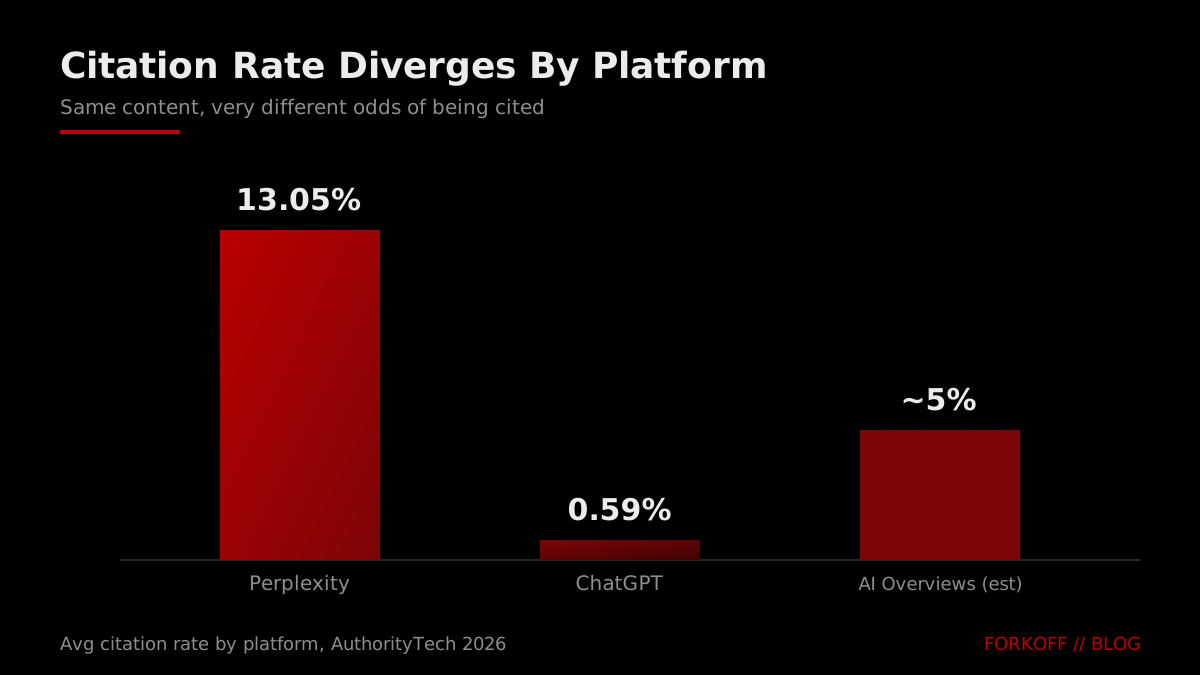
For most B2B SaaS, AI-native, and Web3 companies, optimize for Perplexity first. It indexes content in days versus 30 to 90 days for Google AI Overviews, its users skew to technical buyers, and its citation rate runs near 13 percent versus under 1 percent on ChatGPT. The catch is that only 11 percent of cited domains overlap across engines, so each one needs its own track. Build the shared foundation, which is answer capsules, FAQPage schema, and freshness, then sequence Perplexity first and let Google AI Overviews confirm later.
The optimization decision nobody puts in writing
Every marketer running answer engine optimization in 2026 hits the same fork in the road. Perplexity exists. Google AI Overviews exist. Both cite sources, both reward different content, and almost nobody has the bandwidth to optimize for both at full intensity at the same time. The extraction-surface versus generative-surface contrast at the heart of this choice is the same one the AEO vs GEO guide maps in full. So the real question is not which platform is better for users. The real question is where you point your first optimization sprint.
That decision is missing from the entire search results page. Search the topic today and you get consumer reviews of which AI is nicer to use, feature-list comparisons that read like spec sheets, and broad how-to posts that tell you to optimize for AI search without ever saying which engine to start with. None of them answer the practitioner's actual question: given limited time, where does the first dollar of optimization effort go?
This post answers it. The short version is in the matrix below and the verdict at the end. The reasoning in between is the part that survives a quarterly review with your founder or your client.
Perplexity vs Google AI Overviews: the optimization matrix
| Dimension | Perplexity | Google AI Overviews |
|---|---|---|
| Index source | Live web crawl | Existing Google index |
| Citations per answer | 5 to 12 footnotes | 3 to 5 inline |
| Citation rate (avg) | ~13.05% | incremental on page-1 pages |
| Source preference | Reddit, G2, dev docs, fresh posts | High-DA, schema, page-1 authority |
| Speed to citation | Days to weeks | 30 to 90 days |
| Referral traffic per citation | Higher, footnote click-through | Lower, users stay on SERP |
| Audience scale | ~12 to 15M DAU (2026) | ~15 to 20% of 8B+ daily queries |
| Optimize first for | B2B SaaS, AI-native, Web3 | Strong existing Google SEO at scale |
Figures synthesize Perplexity and Google Search Central documentation, AuthorityTech 2026 citation mechanics research, and FORKOFF client engagement observations. Treat estimated figures as directional.
Perplexity is growing fastest where technical buyers already live
Perplexity reached an estimated 12 to 15 million daily active users in 2026 and grows fastest among technical and research-adjacent audiences, the exact buyers most B2B SaaS and AI-native companies sell to. For those companies, a citation on Perplexity reaches a higher-intent reader than the same citation buried in an AI Overview shown to a general consumer query. The engine you optimize first should match where your buyers already research, not where the largest raw audience sits.
Source: Perplexity public usage figures and FORKOFF audience analysis, 2026
Why this is a prioritization problem, not a feature debate
The instinct when two platforms matter is to split effort evenly. Half the sprint on Perplexity, half on Google AI Overviews, call it balanced. That instinct is wrong, and the reason it is wrong is the single most important data point in this entire comparison.
AuthorityTech research found that only 11 percent of cited domains appear on both Perplexity and ChatGPT. Read that again. Nearly nine out of ten domains that earn a citation on one engine earn nothing on the other. The engines are not two views of the same web. They are two separate citation economies with different currencies. A page optimized for one will, more often than not, sit invisible on the other.
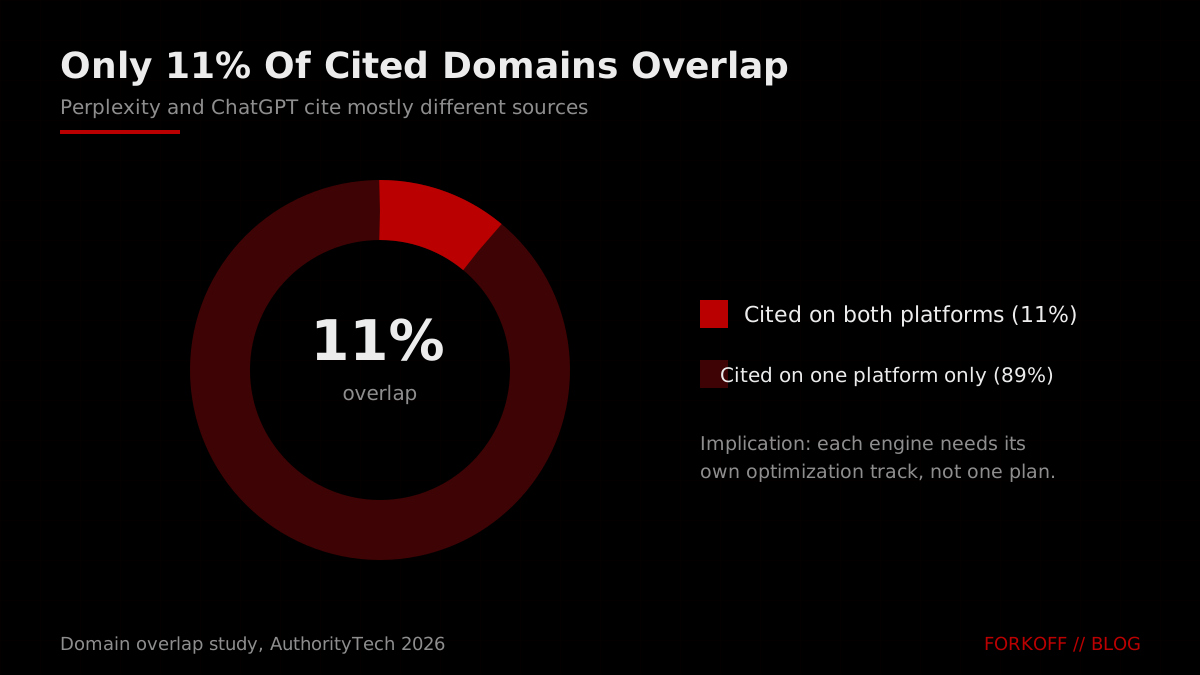
That divergence is what turns this into a prioritization problem. If the engines overlapped heavily, you could optimize once and harvest everywhere, and the order would not matter. Because they barely overlap, the order matters enormously. You want your first sprint to land on the engine where the feedback comes back fastest, the audience converts best, and the work you do still compounds toward the second engine later. For most B2B companies, that engine is Perplexity. The rest of this post earns that claim.
Operator noteOnly 11% of cited domains overlap across engines, so one plan cannot serve both., AuthorityTech 2026
Platform mechanics compared
Before the verdict, the mechanics. The two engines disagree at almost every layer of how a citation gets made: crawl frequency, citation count per response, freshness weighting, authority signals, and what format the cited content needs to be in. Understanding those layers is what lets you predict where your content will land before you publish it, and it is what reveals why the same piece of content can rank in one engine and be invisible in the other.
Perplexity runs a live web crawler called PerplexityBot. When a user asks a question, Perplexity performs a fresh search, pulls candidate sources, and synthesizes an answer with footnotes, usually 5 to 12 of them per response. Because the crawl is live and frequent, a page you publish today can show up in Perplexity citations within days. The citation logic rewards recency, source diversity, and a tight match between the page and the query intent. Perplexity documents the crawler behavior in its own bots and crawlers guide, and its official blog is the primary source for how the answer engine evolves.
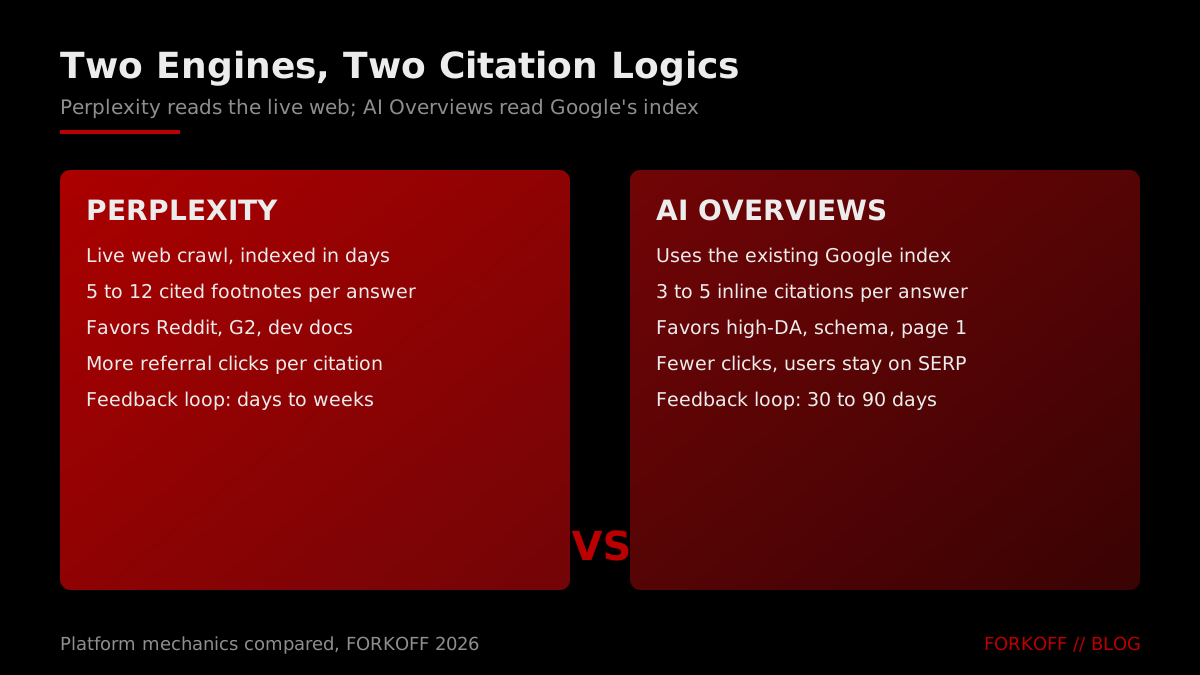
Google AI Overviews work from the opposite direction. They do not crawl fresh for each query. They draw on the existing Google index, the same index that powers classic search rankings. An AI Overview appears for roughly 15 to 20 percent of queries, and when it does, its 3 to 5 inline citations skew heavily toward pages that already rank on page one or two for that query. The logic is the familiar SEO stack: E-E-A-T, existing SERP authority, schema, and answer-capsule presence layered on top. Google's own AI features documentation is explicit that there is no special markup to opt into AI Overviews; the same content quality and structured-data signals that drive search drive the overview. There is no shortcut around the index. If you do not rank, you do not get cited.
How Ranking in Google AI Overviews, ChatGPT, and Perplexity are Different
Ahrefs
Ahrefs breaks down how ranking in AI Overviews, ChatGPT, and Perplexity differ.
That single structural difference, live crawl versus existing index, cascades into every other dimension. It sets the speed, the source preferences, the traffic behavior, and ultimately the order in which a smart team should optimize.
Consider what the difference means for a brand-new page with no ranking history. On Perplexity, that page is a legitimate citation candidate the moment PerplexityBot crawls it, which can happen within days. Its lack of accumulated authority is not disqualifying, because Perplexity weighs query-intent match and recency heavily. On Google AI Overviews, the same brand-new page is effectively invisible. It has no page-one ranking to be promoted from, no link equity, and no history of satisfying the query, so the synthesis layer has no reason to reach for it. The two engines treat the same asset as either immediately eligible or not yet eligible, and that gap is the practical reason a young brand sees Perplexity results long before it sees AI Overview results.
There is also a difference in how each engine handles being wrong. Perplexity, crawling live, corrects fast: update a page with a better answer and the next crawl can pick it up. Google AI Overviews inherit the latency of the index, so a correction you publish today may not reach the overview for weeks. If accuracy in your category matters, and in B2B and crypto it usually does, the fast-correcting engine is also the safer one to lead with.
Operator noteDefault for B2B SaaS and AI-native is Perplexity first, days-not-months feedback wins the sprint., FORKOFF GEO engagements, 2026
The speed differential is the whole argument
If you remember one reason to start with Perplexity, make it speed. The feedback loop on Perplexity is days to weeks. The feedback loop on Google AI Overviews is 30 to 90 days, the same cadence as traditional SEO, because it rides the same index and the same authority signals.
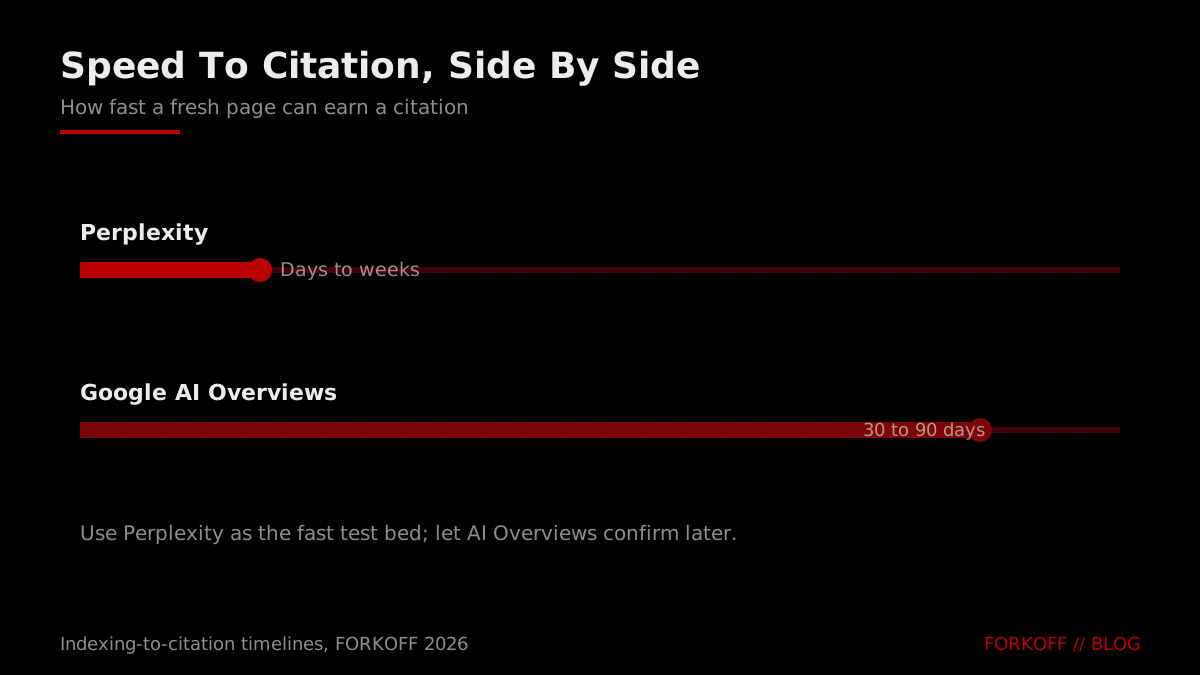
Speed is not a vanity metric here. It is the difference between an optimization program you can actually steer and one you fly blind through for a quarter. When you ship an answer capsule to a page and Perplexity starts citing it within two weeks, you learn whether your hypothesis was right while the work is still fresh in your head. You can iterate. When the same change takes three months to register in AI Overviews, you have shipped four more changes by the time the signal arrives, and you cannot tell which one moved the needle.
Same page. Perplexity cites it within two weeks of publishing it with a clear answer capsule. Google AI Overviews, still nothing three months later for the same page. They are completely different systems. Perplexity is live web. AI Overviews are Google's existing ranking signals plus schema. If you want fast feedback on AEO experiments, Perplexity is your test bed and AI Overviews are the slow confirmation.
This is why practitioners increasingly treat Perplexity as a test bed for answer engine optimization experiments and AI Overviews as the slow confirmation. Validate the content change on the fast engine, then let the slow engine catch up on its own schedule. The work is the same work. The order is what makes it learnable.
Musawir Raji 🪁
@MusawirRaji
That's where I come in SEO and AEO are not the same thing, and most agencies selling “SEO packages” in 2026 are quietly hoping you never find out. SEO is what you already know. Write content, structure pages, build backlinks, Google ranks you, user clicks through. You own the… Show more
Optimizing for Perplexity
Optimizing for Perplexity comes down to three sequential layers: access, content, and presence. Access is the gate nobody checks first, which is exactly why it breaks programs. If PerplexityBot is blocked in robots.txt (often by a legacy SEO plugin's catch-all disallow rule), your content is invisible regardless of quality. Content optimization means answer capsules, source diversity, and recency signals. Presence means building the Reddit footprint and external citation profile that Perplexity's retrieval layer rewards when deciding which sources to pull for a given query.
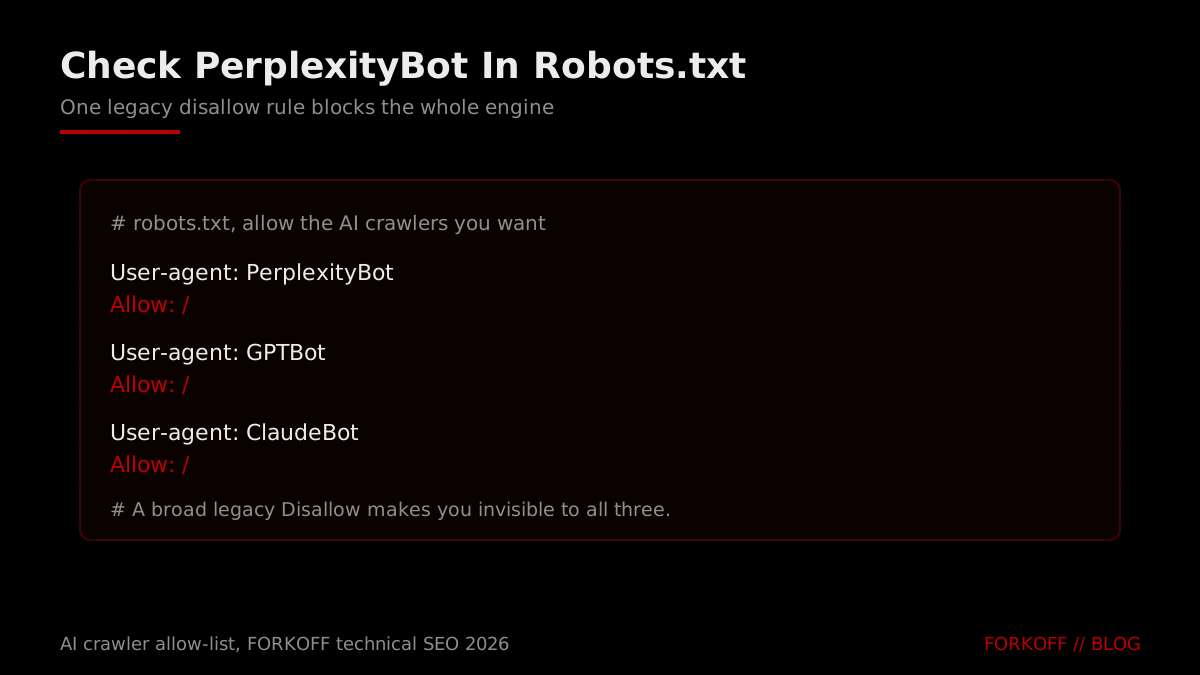
Start with robots.txt. Perplexity's crawler respects disallow directives, so if PerplexityBot is blocked, your content is invisible to the engine no matter how good it is. The block is rarely intentional. It comes from an overly broad disallow rule or a legacy SEO plugin that auto-blocked unknown bots before AI crawlers existed. Confirm that PerplexityBot is allowed, and while you are in the file, confirm that GPTBot and ClaudeBot are allowed too if you want presence in ChatGPT and Claude answer products. Each operator publishes its own crawler identity, and the allow-list you write should name each one explicitly rather than relying on a catch-all.
Most invisible-on-Perplexity sites blocked the crawler by accident
The single most common reason a site never appears in Perplexity is not weak content. It is a robots.txt rule that blocks PerplexityBot, usually inherited from an old plugin or a broad disallow that predates AI crawlers. The fix is one line, and citation recovery often follows within weeks because Perplexity re-crawls quickly. Audit the crawler allow-list before you touch a single word of content.
Source: FORKOFF technical SEO audits, 2026
Once access is clean, content is the lever. Perplexity rewards a direct answer capsule, which is a 2 to 3 sentence answer to the query placed in the first 200 words of the page, before the long preamble. It rewards freshness, so a regular update cadence on your highest-value pages keeps them in the live-crawl rotation. And it rewards the formats it disproportionately cites: structured comparison tables, numbered frameworks, and clear definitions. Practitioner coverage of these formats, including the Ahrefs blog, converges on the same point that structure beats prose volume for citation. The implementation detail for each format lives in our answer engine optimization playbook, and the per-page mechanics in the AEO guide.
How to get recommended by AI (IMO)
Practical GEO/AEO experience and experiment results from a developer turned SEO.
Presence is the third layer and the one that takes longest. Perplexity preferentially cites Reddit threads, G2 and Capterra reviews, developer documentation, and recent first-hand practitioner content. If your category has an active subreddit and your brand is absent from it, Perplexity has fewer reasons to surface you. Building authentic community presence is slower than editing a page, but it is what separates brands Perplexity cites repeatedly from brands it cites once.
The community layer is also the one most teams get wrong, because they treat it as a posting campaign rather than a presence. Perplexity does not cite a thread because a brand seeded it; it cites a thread because the thread genuinely answers the query, and the most-cited threads are the ones where real practitioners argue, correct each other, and converge on a useful answer. The implication for a brand is uncomfortable but clear: you earn Perplexity citations in a community by being a useful participant in it over months, not by dropping links. Get your product reviewed honestly on G2, contribute substantive answers in your category's subreddit under a real identity, and keep your developer docs current and specific. Those are slow assets, which is exactly why starting them in week one of a Perplexity-first sprint matters. The page edits land in days; the presence compounds over the quarter.
One more access nuance trips up teams on modern stacks. A site rendered entirely client-side can be crawlable in theory but thin in practice, because the crawler may capture an empty shell before JavaScript hydrates the answer. If your highest-value pages depend on client-side rendering to show their content, confirm that the answer capsule is present in the server-rendered HTML. Perplexity rewards the answer it can read on first fetch, not the answer that appears a second later in the browser.
How Perplexity picks its citations
It helps to picture the selection from Perplexity's side. For a given query, the engine runs a live search, gathers a candidate set, and chooses sources that are recent, diverse, and tightly matched to the intent. It is biased toward sources that read like first-hand answers rather than marketing pages, which is why Reddit and practitioner blogs punch above their domain authority here.
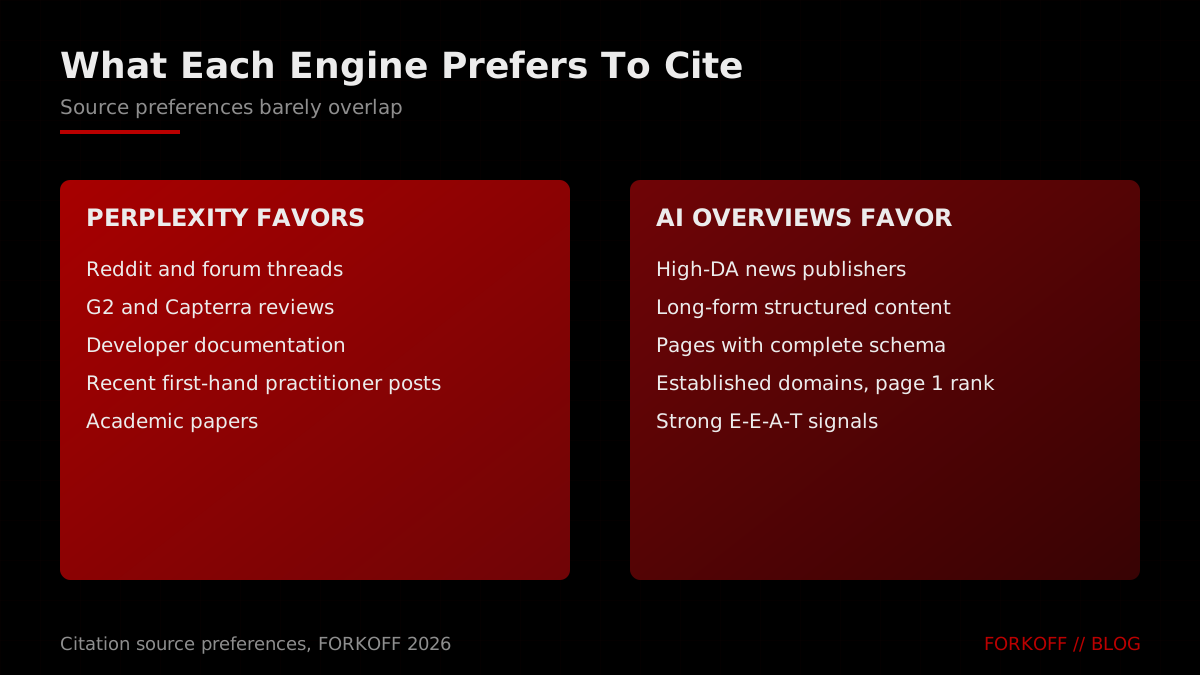
The practical takeaway is that Perplexity citation is winnable by smaller and newer brands in a way Google AI Overviews citation is not. You do not need years of accumulated domain authority. You need a clean crawl, a sharp answer capsule, recent publication, and some genuine community footprint in your category. That is a list a focused team can complete in a quarter, which is the other half of why Perplexity belongs first in the sequence.
Operator noteAudit PerplexityBot in robots.txt before writing content; one disallow line hides the whole site.
Optimizing for Google AI Overviews
Google AI Overviews reward the SEO fundamentals you may already have, plus a thin AI-specific layer on top. The fundamentals are the index entry ticket: the page needs existing authority, ideally a page-one or page-two ranking for the target query, real E-E-A-T signals, and a healthy link profile. Without those, no amount of AI-specific tuning gets you cited, because AI Overviews pull from pages already trusted by the core ranking system.
Alex Groberman
@alexgroberman
Google now cites itself in 17% of all AI Mode answers. It is now cited more than YouTube, Facebook, Reddit, Amazon, Indeed and Zillow combined. What does that mean for your brand's visibility inside AI Mode? SE Ranking just published a study of 1.3 million citations across htt… Show more
On top of the fundamentals sit the AI-specific amplifiers. Complete schema markup, especially FAQPage and Article, helps Google parse the page as a citation candidate. An answer capsule near the top of the page gives the system a clean snippet to lift. Clear heading structure and direct question-and-answer formatting raise the odds your page becomes the inline citation rather than the page that ranks just below it.
The honest framing for AI Overviews is that the optimization is incremental for sites with strong existing SEO and nearly impossible for sites without it. If you already rank page one for a cluster of queries, adding schema and answer capsules is a high-leverage, low-cost move that converts existing rankings into AI Overview citations. If you do not rank yet, the path to AI Overviews runs through the same long road as classic SEO, and that road is 30 to 90 days at minimum.
This is the part that frustrates founders who expected AI search to reset the leaderboard. It does not, at least not on Google's surface. The AI Overview is a synthesis built on top of the ranking system that already exists, so the incumbents who own page one for a query are the same brands the overview reaches for. If you are an incumbent, that is good news: you defend and extend a position you already hold by adding a schema-and-capsule finishing layer worth a few days of work. If you are a challenger, AI Overviews are not where you break in. You break in on Perplexity, where eligibility does not require an established ranking, and you let the authority you build there, plus the classic SEO you do in parallel, eventually carry you into AI Overviews. The order is not arbitrary; it follows directly from who each engine is structurally built to reward.
A useful way to pressure-test your own position is to take your ten highest-intent commercial queries and check, honestly, where you rank in classic Google results. If you sit page one for most of them, an AI Overviews push is cheap and worth doing soon. If you sit page two or worse, treat AI Overviews as a 90-day-plus project that runs behind a classic SEO effort, and spend your near-term optimization budget on Perplexity, where the same ten queries are winnable now.
AI Search, Perplexity & SEO: The 2026 Strategy You're Missing
Surfer Academy
A 2026 strategy walkthrough on AI search and Perplexity for SEO teams.
How Google AI Overviews rank brands
The brands that win AI Overview citations are usually the brands that already won the underlying query. Google is layering a synthesis step on top of its existing ranking, not replacing the ranking. So the question of how to rank brands in AI Overviews collapses, mostly, into the question of how to rank in classic Google search, with a schema-and-capsule finishing layer.
For the full deep dive on the Google-specific ranking signals that feed AI Overviews, see our companion piece on how AI Overviews rank brands. It covers the index-side mechanics in detail; here, the point is narrower. AI Overview citation is a downstream reward for SEO you have already done, which is why it sits second in the optimization sequence for most teams, not first.
Google updates guidance on third-party SEO tools, services, and advice
Coverage of Google's updated guidance on third-party SEO advice.
Which platform sends more traffic
Traffic behavior is where the two engines invert. Perplexity sends more referral traffic per citation because its footnote-dense format invites users to click through to sources. Google AI Overviews send less referral traffic per citation because the inline format is designed to answer the user on the results page, where they stay.
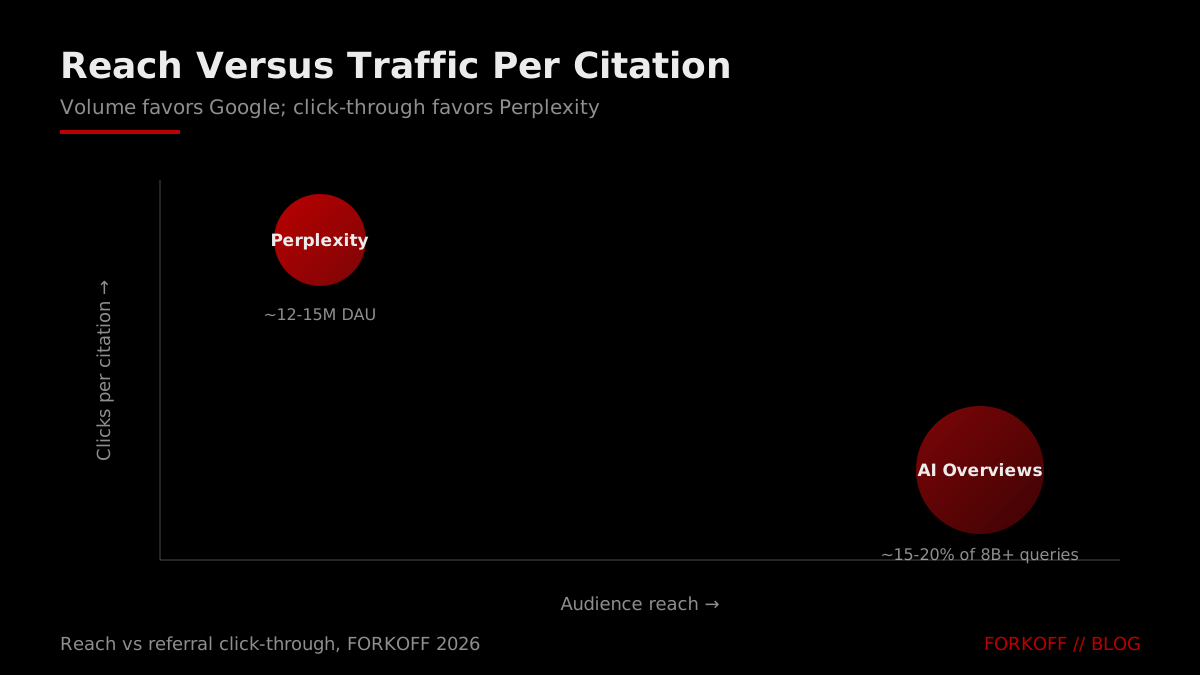
But Google wins on raw scale by orders of magnitude. Google processes more than 8 billion queries a day, and even at AI Overviews appearing on only 15 to 20 percent of them, the addressable audience dwarfs Perplexity's estimated 12 to 15 million daily active users. So the traffic math is a genuine trade-off: Perplexity gives you more clicks per citation against a smaller audience, while AI Overviews give you fewer clicks per citation against a vastly larger one.
For a B2B or AI-native company, the per-citation click-through and the audience quality usually outweigh the raw reach, because a technical buyer who clicks a Perplexity footnote is worth more than a consumer who reads an AI Overview and moves on. For a high-volume consumer business already ranking well on Google, the scale argument flips. Match the engine to your buyer, not to the bigger number. We size both surfaces for clients with the AI search visibility checker and the free AEO checker before recommending a sequence, and the full diagnostic lives in our GEO audit.
There is a second-order traffic effect worth naming. A Perplexity citation that earns a click sends a visitor who has already read your answer in context and chose to learn more, which is a warmer arrival than a cold organic click. That visitor tends to land deeper in the funnel, ask sharper questions, and convert faster. An AI Overview, by contrast, frequently satisfies the user inside the results page, so the value you capture is brand impression and authority rather than a session. Both have worth, but they are different kinds of worth, and you should not measure a Perplexity program and an AI Overviews program with the same yardstick. Count clicked-through sessions and their conversion rate for Perplexity; count citation share and impression for AI Overviews.
AI crawler robots.txt reference
| Crawler | Operator | Answer surface |
|---|---|---|
| PerplexityBot | Perplexity | Perplexity answers and citations |
| GPTBot | OpenAI | ChatGPT browsing and search |
| ClaudeBot | Anthropic | Claude answer products |
| Googlebot | Search, AI Overviews, AI Mode |
Each user-agent must be allowed in robots.txt for the matching engine to crawl and cite a page. A broad legacy disallow rule blocks all of them at once.
The crawler reference table above is the checklist most teams skip and then spend a quarter wondering why nothing moved. Every row is a separate gate. PerplexityBot gates Perplexity, GPTBot gates ChatGPT, ClaudeBot gates Claude, and Googlebot gates the entire Google stack including AI Overviews and AI Mode. A single overly broad disallow line at the top of robots.txt can close all four gates at once, which is why the access audit belongs before any content work and not after.
Small business SEO in competitive markets: what actually works in 2026?
Technical SEO discussion on what moves visibility in competitive markets in 2026.
Shared tactics that work on both
The good news in all this divergence is that the foundation is shared. Three tactics improve citation odds on both Perplexity and Google AI Overviews, and they are the work you should do first regardless of which engine you prioritize.
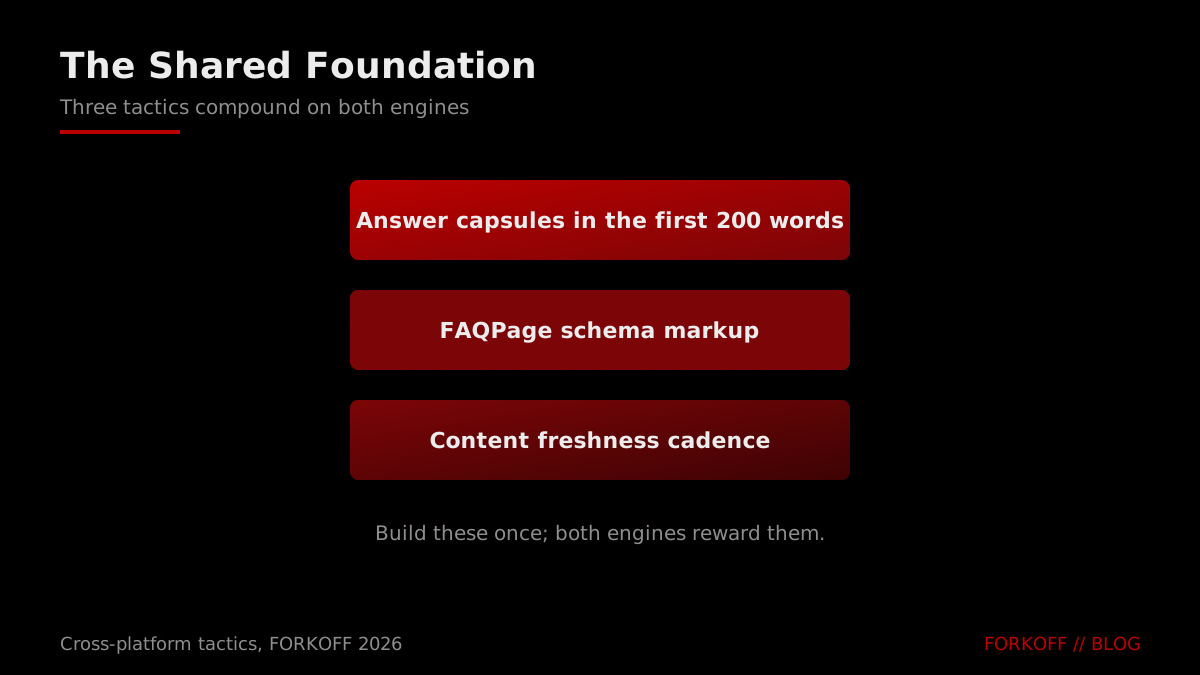
The first is the answer capsule: a 2 to 3 sentence direct answer to the page's core question, placed in the first 200 words, before any preamble. Both engines lift it. The second is FAQPage schema markup, which gives both engines a structured, machine-readable set of question-and-answer pairs to cite, following the schema.org FAQPage standard. The third is content freshness, a regular update cadence that keeps pages in Perplexity's live-crawl rotation and signals recency to Google. The academic case for these structure-first tactics is laid out in the Princeton GEO paper, which measured how source structure and citation density shift generative-engine visibility.
How to Use Reddit to Dominate AI Search Rankings in 2026
Surfer Academy
How Reddit presence drives AI search rankings, the lever Perplexity rewards most.
Build these three once and you have a foundation that compounds on both engines. The platform-specific work then layers on top: PerplexityBot access plus community presence for Perplexity, domain authority plus schema finishing for AI Overviews. Foundation first, then the engine you chose, then the second engine. That sequence wastes the least effort.
The reason the shared foundation matters so much to the prioritization argument is that it removes the main objection to picking an order. A team worried about starting with Perplexity often frames it as a bet against Google, as if effort spent on one engine is lost to the other. It is not. The answer capsule you write to win a Perplexity citation is the same capsule an AI Overview lifts. The FAQPage schema you deploy for one is parsed by both. The freshness cadence that keeps you in Perplexity's crawl rotation also signals recency to Google. So the early Perplexity-first sprint is not a detour away from AI Overviews; it is most of the AI Overviews groundwork, done first, on the engine that tells you within days whether it worked. The only genuinely engine-specific work is the thin top layer, and that is the part you sequence.
Operator noteAnswer capsule, FAQPage schema, and freshness compound on both engines, build them once.
Platform divergence data, in one place
It is worth collecting the numbers that drive the verdict, because the verdict is only as good as the data under it. Perplexity's average citation rate runs near 13.05 percent against ChatGPT's 0.59 percent, a roughly 46-fold gap that shows how differently these systems decide what to surface. Only 11 percent of cited domains overlap between Perplexity and ChatGPT. Perplexity answers carry 5 to 12 footnotes; AI Overviews carry 3 to 5 inline citations. AI Overviews appear on roughly 15 to 20 percent of queries. Perplexity indexes fresh content in days; AI Overviews follow a 30 to 90 day cadence.
FORKOFF's own numbers point the same way. In the FORKOFF GEO Citation Lab, a fixed 50-prompt buyer-intent cluster run across five AI surfaces and measured with the AI Search Visibility Checker, the May 2026 run recorded a cross-brand surface average, the cite rate across every brand measured in that cluster, of 41 percent on Perplexity against 34 percent on Google AI Overviews. The AuthorityTech figure above measures how often a single brand is cited across the open web. The lab figure measures a cross-brand average, how often any tested brand is cited on a buyer-intent prompt for that surface. And the FORKOFF AI Citation Index measures a third, narrower denominator, FORKOFF's own domain alone, which runs higher at 48 percent on Perplexity and 35 percent on Google AI Overviews. Three different denominators, one consistent conclusion: Perplexity cites more readily than Google AI Overviews on every measure, so it is the faster surface to earn a citation on, which is exactly why the Perplexity SEO engagement sequences it first.
The 11 percent overlap is a strategy, not a footnote
AuthorityTech research found that only 11 percent of cited domains appear on both Perplexity and ChatGPT. That is not a rounding detail. It means a single optimization plan written for one engine will leave you near-invisible on the other. Teams that treat AI search as one channel and ship one set of pages consistently underperform teams that run two tracks with a shared foundation. The divergence is the reason a prioritization decision matters at all.
Source: AuthorityTech citation mechanics study, 2026
None of these figures is a vanity stat. Each one points the same direction: the engines are different enough that order of operations is the highest-leverage decision you make in an AI search program. Get the order right and the same hours of work produce visible citations a quarter sooner.
Alex Groberman
@alexgroberman
Reddit sued Perplexity and a group of major scraping providers including SerpApi, Oxylabs and AWMProxy. In the process, they revealed how Perplexity, ChatGPT and Google actually work. The lawsuit also reveals how SEO Stuff has been getting traffic and sales for customers from h… Show more
What this looks like for Web3 and crypto
For Web3 and crypto companies, the Perplexity-first verdict is even sharper. The crypto audience adopts AI search tools fast, and Perplexity's live-web credibility makes it the default research surface for protocol data, token mechanics, and ecosystem questions where freshness matters more than archival authority. A protocol that ships a clear answer capsule and keeps its docs fresh can earn Perplexity citations quickly, well before it accumulates the domain authority that AI Overviews demand.
We audited twelve client sites. Seven of them had PerplexityBot blocked in robots.txt. Not intentional, it was either an overly broad disallow rule or a legacy plugin that auto-blocked unknown bots. These clients had been wondering why they were not appearing in Perplexity. The answer was that they were invisible to its crawler. One rule change fixed it within three weeks.
The same robots.txt caution applies, and it bites harder in crypto, where sites are often built on frameworks with aggressive default bot rules. Audit the crawler allow-list first. For the full vertical treatment, see our piece on GEO for crypto and Web3, which extends this prioritization to chain-native products.
The decision framework, step by step
The decision framework runs as a four-step sequence: audit access first (PerplexityBot, GPTBot, ClaudeBot, Googlebot all allowed in robots.txt), build the shared foundation (answer capsules, FAQPage schema, freshness cadence), add the Perplexity-specific layer (Reddit presence, source diversity, citation-friendly H2 structure), then add the Google-specific layer (E-E-A-T signals, site authority, structured data). Most operators skip to step three and wonder why step four does not work. Here is the framework as a sequence you can run today, in order:
First, audit access. Confirm PerplexityBot, GPTBot, and ClaudeBot are allowed in robots.txt and that Googlebot is unblocked. This is a 30-minute check that gates everything downstream.
Second, build the shared foundation. Ship answer capsules on your highest-value pages, add FAQPage schema, and set a freshness cadence. This work compounds on both engines.
Third, choose your first engine. If you are a B2B SaaS, AI-native, or Web3 company, optimize Perplexity first for the fast feedback loop and the technical audience. If you are a high-volume business with strong existing Google rankings, weight toward AI Overviews, where your existing authority converts into citations cheaply.
Fourth, run the second engine once the first shows results. The foundation you built carries over, so the second sprint is lighter than the first.
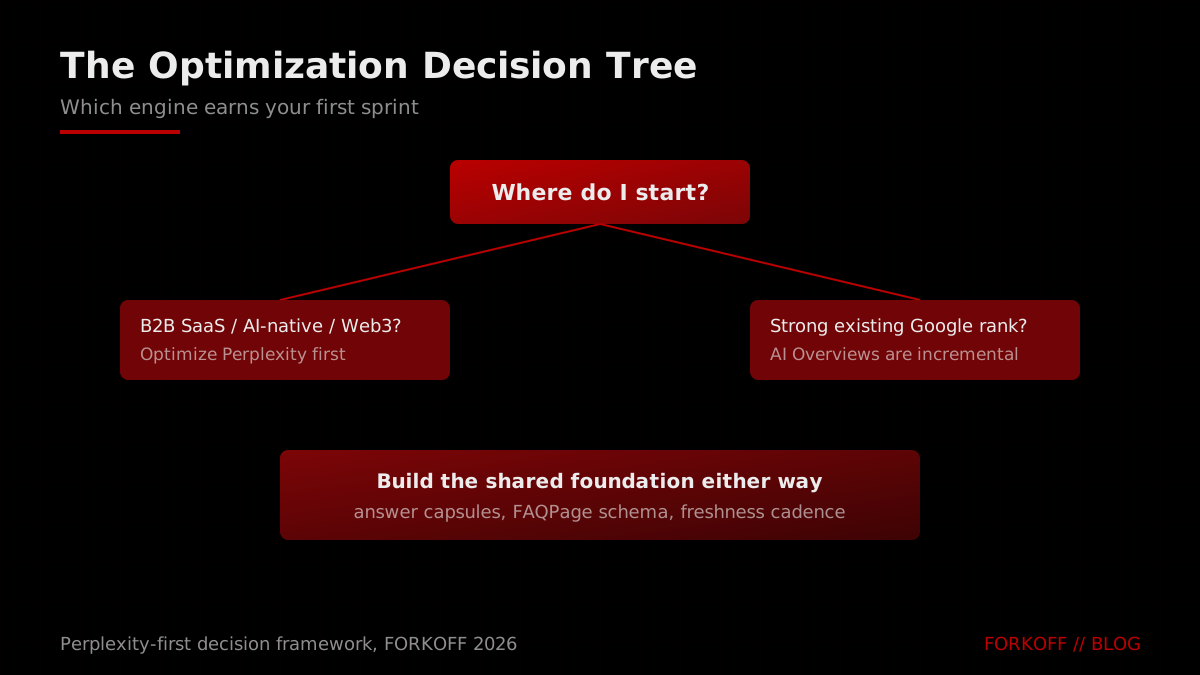
Once you know which platform to prioritize, the implementation checklist is the next step. Our B2B AEO checklist walks the per-page execution, and the generative engine optimization playbook for SaaS frames the whole program. To measure results per engine, use the share of AI citations methodology, and for agencies explaining the platform choice to clients, the ChatGPT citation strategy for agencies covers the third major engine.
A 90-day prioritization plan
The framework above becomes a calendar like this. In days 1 to 30, clear crawler access, ship answer capsules on your top pages, start building Reddit and G2 presence in your category, and watch Perplexity citations as the early signal. In days 31 to 60, add FAQPage schema across the page set, deepen the page-one rankings that feed AI Overviews, refresh your top pages, and start measuring share of citations per engine. In days 61 to 90, press on AI Overviews specifically, build the authority links that the index rewards, expand the answer capsules that worked, and lock the freshness cadence into an operating rhythm.
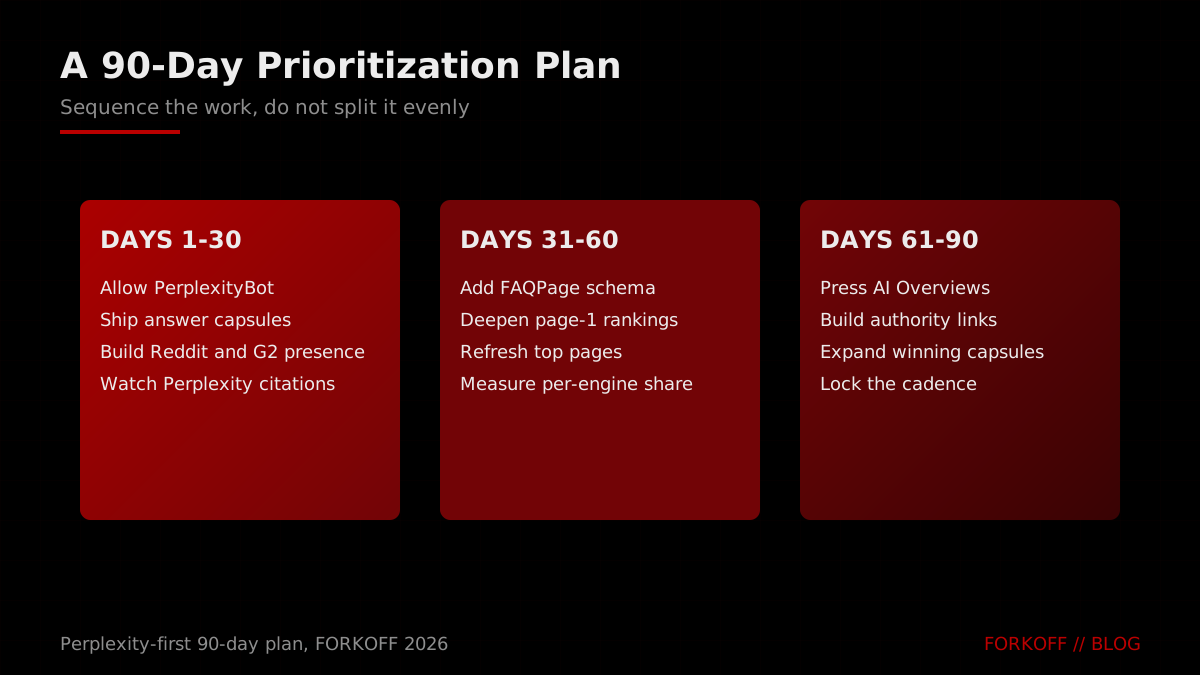
The plan front-loads Perplexity deliberately. The fast engine teaches you what works while the slow engine is still warming up, so by the time you push hard on AI Overviews you already know which capsules and which formats earn citations. Schema deployed for Perplexity directly benefits AI Overviews, so almost nothing in the early phase is wasted on the later one.
Resist the urge to compress this into a single month. The temptation, especially under launch pressure, is to do everything at once and declare the program live by week two. The problem is that you then cannot tell which lever moved which engine, and you lose the diagnostic value that made the sequence worth running. The 90-day shape exists so that each phase produces a readable signal: phase one tells you whether your capsules and crawler access work on Perplexity, phase two tells you whether your schema and ranking work feeds AI Overviews, and phase three is where you scale the moves that proved out. Run it as three distinct reads, not one blurred sprint, and the same total effort produces a clearer map of what to keep doing.
The verdict: optimize Perplexity first
For most B2B SaaS, AI-native, and Web3 companies, the answer is Perplexity first. The feedback loop is days instead of months, the audience skews to technical buyers who convert, the citation rate is materially higher, the referral click-through per citation is stronger, and the work compounds toward Google AI Overviews anyway. You lose nothing by starting here and you gain a quarter of learnable feedback.
Google AI Overviews come second but eventually become essential, because the audience scale is too large to ignore once your foundation is in place. If you already have strong Google SEO at scale, the order tightens: AI Overview optimization is incremental and cheap on top of rankings you already own, so you can run both tracks closer to parallel. But even then, the shared foundation comes first, and the 11 percent overlap means each engine still needs its own track. If you are choosing a partner to run this, our comparison pages for the best GEO agency, best AEO agency, and best LLM SEO agency lay out how to evaluate one. The end-to-end program sits inside our LLM SEO service and the broader GEO service, and the methodology behind our per-engine numbers is documented in the GEO citation lab rerun and consolidated in the FORKOFF AI Citation Index, which reports each engine's own-domain cite rate separately.
The mistake to avoid is the even split. Two half-built tracks lose to one finished track plus a foundation that carries into the second. Sequence the work, start with the engine that returns feedback fastest, and let the shared foundation do the compounding. If you want a per-engine program built and sequenced for your company, talk to FORKOFF and we will map the first sprint to where your buyers already research.