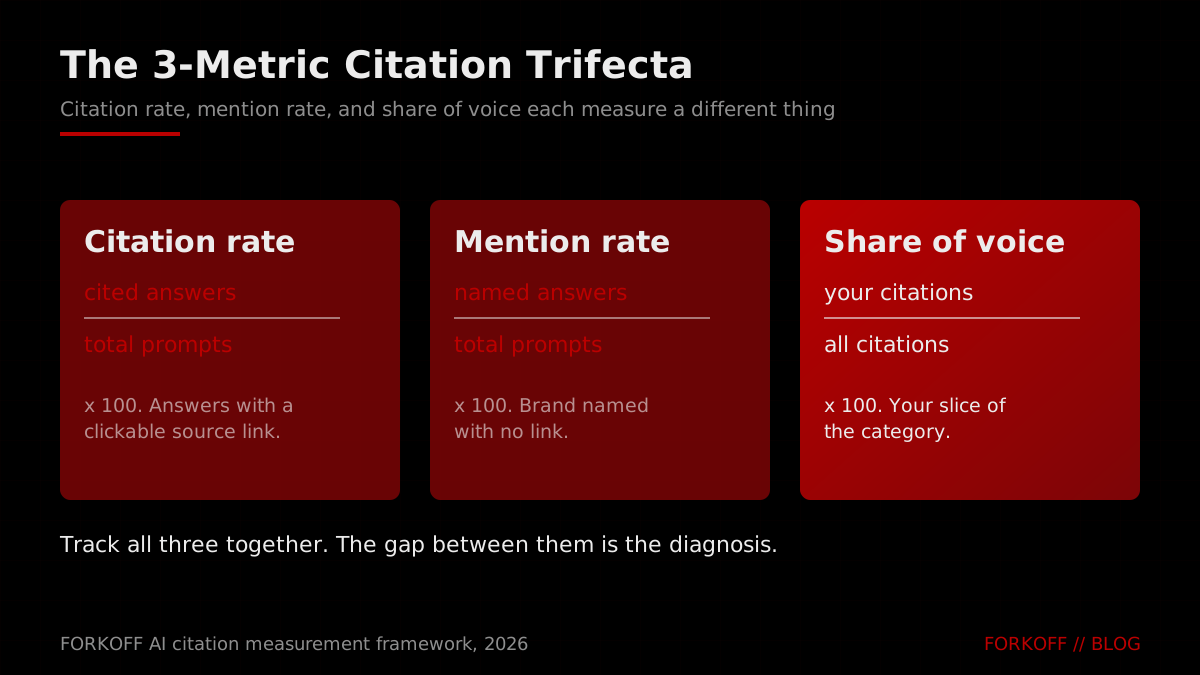
AI citation measurement is the practice of scoring three separate metrics, citation rate, mention rate, and share of voice, against one fixed prompt set, computed per platform, every week. Citation rate is the percentage of AI answers that link your pages. Mention rate is the percentage that name you without a link. Share of voice is your citations as a fraction of every brand citation in the category. A single blended number hides the only signal worth acting on, which is the gap between those three values.
The 30-second answer to measuring AI citations
AI citation measurement runs on three metrics, not one. Citation rate is the percentage of AI answers that link your pages. Mention rate is the percentage that name you without a link. Share of voice is your citations as a slice of every brand citation in the category. Run a fixed set of 30 to 60 prompts per topic cluster, per platform, every week, and score the three metrics separately. Measure per platform, because a 2026 study found a 46x gap in brand citation rates and only 11 percent of cited domains overlap between ChatGPT and Perplexity. FORKOFF ran this exact framework on its own domain and moved its average cite rate from 22 to 34 percent across five AI surfaces.
How to measure AI citations at a glance
The 30-second rule is that AI citation measurement is three metrics computed against one fixed prompt set, scored separately, per platform, every week. Citation rate counts the answers that link your pages. Mention rate counts the answers that name you without a link. Share of voice counts your citations as a fraction of every brand citation in the category, which is the number that ranks you against competitors rather than against yourself.
The matrix above shows why one number fails. A brand can post a strong mention rate and a near-zero citation rate at the same time, and the two readings call for opposite fixes. The trifecta turns the report from a vanity figure into a work order.
The 3-metric citation trifecta
| Metric | Formula | What it signals |
|---|---|---|
| Citation rate | (answers that link you / total prompts) x 100 | On-page optimization and source trust |
| Mention rate | (answers that name you / total prompts) x 100 | Brand presence in training data |
| Share of voice | (your citations / all brand citations) x 100 | Competitive position in the category |
Track all three together; the ratio between them is the diagnosis, not any single value.
This post gives you the full measurement framework: the three metrics with their formulas, how to build the 30 to 60 prompt set that every metric depends on, how to score per platform when the platforms disagree by 46 times, the industry benchmarks that tell you what good looks like, the tool stack by buyer tier, and the four-tier reporting cadence that keeps stakeholders informed without drowning them. FORKOFF ran this exact framework on its own domain and published the result in the GEO citation lab rerun, where the average cite rate moved from 22 to 34 percent across five AI surfaces. Those per-engine numbers are consolidated as the standing source-of-record in the FORKOFF AI Citation Index.
One number cannot describe AI visibility
Most marketers report a single AI visibility figure to a stakeholder and call it measurement. That number hides the only distinction that matters. A brand can be named in half the answers in its category and linked in almost none of them, which means the model knows the brand exists but does not trust its pages enough to cite them. The fix for a citation problem is on-page evidence and structured data. The fix for a mention problem is authority and training-data presence. A single blended score cannot tell you which problem you have, so it cannot tell you what to do next. Three metrics, scored separately, turn a vanity number into a diagnosis.
Source: FORKOFF AI citation measurement model, 2026
About these numbers
The first-party figures here come from the FORKOFF GEO Citation Lab, measured with the FORKOFF AI Search Visibility Checker and the free AEO checker on a fixed 50-prompt buyer-intent cluster across five AI surfaces. The headline first-party result is that FORKOFF ran this exact three-metric framework on its own domain and moved its average cite rate from 22 percent (February 2026 baseline) to 34 percent (19 May 2026 rerun) across those five surfaces. Public benchmarks from Semrush, Ahrefs, and SparkToro across 2025 and 2026, the AuthorityTech 21,143-citation analysis, and the 2026 cross-platform study cited below supplement the first-party data. All numbers are directional estimates from a specific measurement window, and individual outcomes vary by category, prompt set, and platform.
Why one AI visibility number is not measurement
The most common mistake in AI citation reporting is the single score. A marketer runs a tool, exports a percentage, and tells the stakeholder the brand is "at 12 percent AI visibility." That number is an average of things that should never be averaged.
Citation rate and mention rate describe different events in the model's behavior. A citation is a clickable link to your page inside the answer. A mention is your brand name appearing in the prose with no link. The two correlate loosely at best. Semrush put the distinction plainly when it noted that traditional share of voice shows who ranks while AI share of voice shows who gets mentioned, two separate questions that demand separate instruments.
Semrush
semrush
Traditional Share of Voice shows who ranks. AI Share of Voice shows who gets mentioned. As AI-driven search reshapes discovery, measuring brand visibility means going beyond SERPs. Here’s how to measure AI Share of Voice 👇 https://t.co/ST5V5csJkd. https://t.co/D0Ck4Dkzmr
When you collapse the two into one figure, you lose the ability to act. A brand mentioned in 40 percent of answers and cited in 4 percent has a trust problem on its pages, not an awareness problem. A brand mentioned in 4 percent and cited in 4 percent has an awareness problem, because the model barely knows it exists. Same blended "visibility" if you average naively, opposite remediation plans.
Operator noteOne client celebrated a high 'AI mentions' number that was all unlinked name drops, zero citations, zero traffic., FORKOFF client diagnostic, 2026
I had a client celebrating high AI mentions, not realizing it was all unlinked name drops, no citations, no traffic. Tracking them separately changed their strategy entirely.
The third metric, share of voice, adds the competitive frame. Citation rate and mention rate tell you how the model treats you in isolation. Share of voice tells you how the model treats you relative to every other brand competing for the same answers. A 10 percent citation rate sounds modest until you learn the category leader sits at 6 percent, at which point 10 percent is a commanding lead. Connor Gillivan, who runs SEO across several businesses, framed the stakes well: Google shows you in a list, while AI tells buyers who to choose, which makes relative position the thing that converts.
Connor Gillivan
ConnorGillivan
Google shows you in a list. AI tells buyers who to choose. That's the difference between SEO and AEO. And most marketers aren't ready. I run SEO across 6 businesses. TrioSEO alone has 30+ clients. The SEO playbook still works. Rank on Google. Drive traffic. Convert. But h… Show more
There is a second reason the single number fails, and it is operational rather than analytical. A blended score gives a team nothing to assign. When citation rate and mention rate are reported separately, the work routes cleanly: the citation gap goes to the on-page and structured-data owner, the mention gap goes to the content and authority owner, and the share-of-voice gap goes to whoever owns competitive positioning. A team that reports one number ends up arguing about what the number means in every review, because the number does not point at an owner. The trifecta is partly a measurement choice and partly an accountability choice, and the accountability half is why it survives contact with a real marketing org rather than living only in a dashboard.
The 3-metric citation trifecta and its formulas
The three-metric trifecta is citation rate, the percentage of prompts whose answers link your domain, mention rate, the percentage that name your brand with or without a link, and share of voice, your citations divided by all brand citations on the same run. Define each with an explicit formula so every report is reproducible and every number is auditable.
Citation rate is the count of AI answers that include a clickable link to your domain, divided by the total number of prompts in the run, times 100. If you run 60 prompts and 9 answers link you, your citation rate is 15 percent. Mention rate uses the same denominator with a different numerator: the count of answers that name your brand at all, linked or not, divided by total prompts, times 100. Share of voice changes the denominator entirely: your citations divided by the total citations to all brands across the same prompt run, times 100.
The three are nested. Mention rate is the widest signal, citation rate sits inside it, and share of voice reframes citation rate against the field. Reporting them as a stacked view makes the gaps legible at a glance.
Two advanced metrics extend the trifecta once the basics are stable. Position-weighted citation score weights each citation by where it appears in the answer, since a source cited first carries more influence than one cited fifth. Citation sentiment drift tracks whether the context around your citations stays positive over time, because a brand can hold its citation rate while the framing sours. Start with the three core metrics; add the advanced pair only after the weekly run is reliable.
A word on the denominator, because it is where most homegrown trackers go wrong. All three metrics divide by the prompt run, not by the number of answers that happened to mention any brand. If you divide citation count by only the answers that cited someone, you inflate every figure and lose the ability to compare weeks where the model cited more sparingly. The denominator is the full, frozen prompt set every time, present or absent, cited or not. That choice keeps the trend line honest when the model's behavior shifts, which it does without warning whenever a platform ships a retrieval update. A clean denominator is also what lets you compare your brand against a competitor on the same run, because both numerators sit over the same fixed base.
There is also a question of what counts as a citation at all. A citation is a link the reader can click to reach your domain. A footnote-style numbered reference that resolves to your page counts. A bare domain name printed in the prose without a link does not count as a citation; it counts as a mention. Drawing that line the same way every week is more important than where exactly you draw it, because consistency is what makes the trend interpretable. Write the rule down, put it in the methodology note of the report, and never quietly change it mid-quarter.
Citation absorption versus citation selection
A nuance that separates a sophisticated report from a naive one is the difference between selection and absorption. AuthorityTech's analysis of 21,143 citations made the case that these are distinct events with very different value, and the framing borrows from the academic work on generative engine optimization, the Princeton GEO paper that first quantified how source-level signals change what a model surfaces.
Selection means your page made the model's reference list for a query. The model considered your page relevant enough to pull. Absorption means the model actually extracted content from your page and wove it into the generated answer. You can be selected without being absorbed, which happens when the model lists your page as a source but quotes a competitor in the prose.
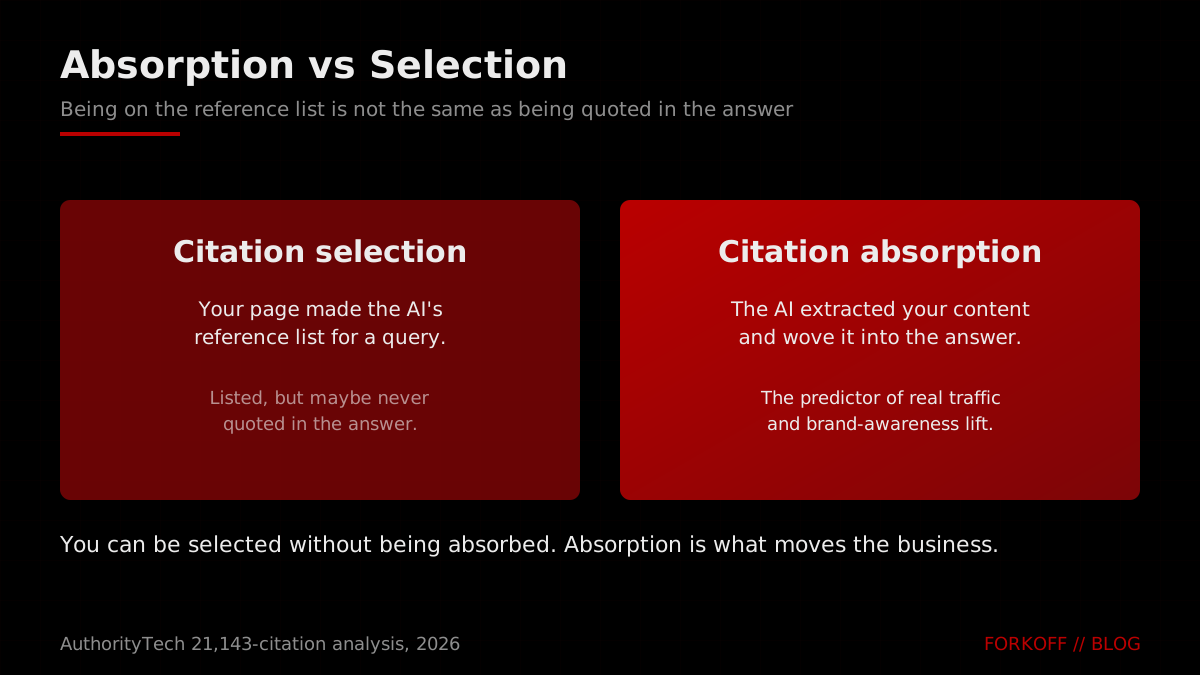
The distinction matters for reporting because absorption is the stronger predictor of real traffic and brand-awareness lift. A reader who sees your brand woven into the answer forms an impression. A reader who never expands the source list does not see a citation that was merely selected. When a client's citation count climbs but referral traffic stays flat, the gap between selection and absorption is the usual explanation, and the report should name it rather than celebrate the raw count.
Measuring absorption is harder than measuring selection, which is why most tools report selection and call it citation. Selection is a structured field the model exposes as a source list, easy to parse. Absorption requires reading the answer prose and judging whether a claim traces to your page, which is a content comparison rather than a list lookup. For a manual run, the practical proxy is to log whether your brand appears in the answer body, not just the source list, as a separate boolean alongside citation and mention. That third boolean turns into an absorption rate over the prompt run and gives the report a signal the tools usually miss. It is the metric to add once the core three are stable, because it explains the most common reporting paradox, the one where citations rise and nothing downstream moves.
Selection and absorption are not the same event
AuthorityTech analyzed 21,143 citations and surfaced a distinction most tools collapse. A page can be selected, meaning it lands on the model's reference list for a query, without being absorbed, meaning the model actually extracts its content into the generated answer. Absorption is the stronger predictor of traffic and brand-awareness lift, because a reference a reader never sees does little for the business. When a citation count moves but nothing downstream does, the gap between selection and absorption is usually the reason. Reporting on selection alone overstates the result.
Source: AuthorityTech analysis of 21,143 citations, 2026
Per-platform measurement when the platforms disagree
The single biggest structural decision in AI citation measurement is to score every platform separately. The data forces it, and so does the way each platform documents its own retrieval. OpenAI's web-search tooling docs describe a retrieval layer that supplements training data selectively, while Anthropic's product updates show Claude evolving its own citation behavior on a separate timeline. Reading each platform's own documentation, rather than assuming they converge, is the habit that keeps a measurement program honest.
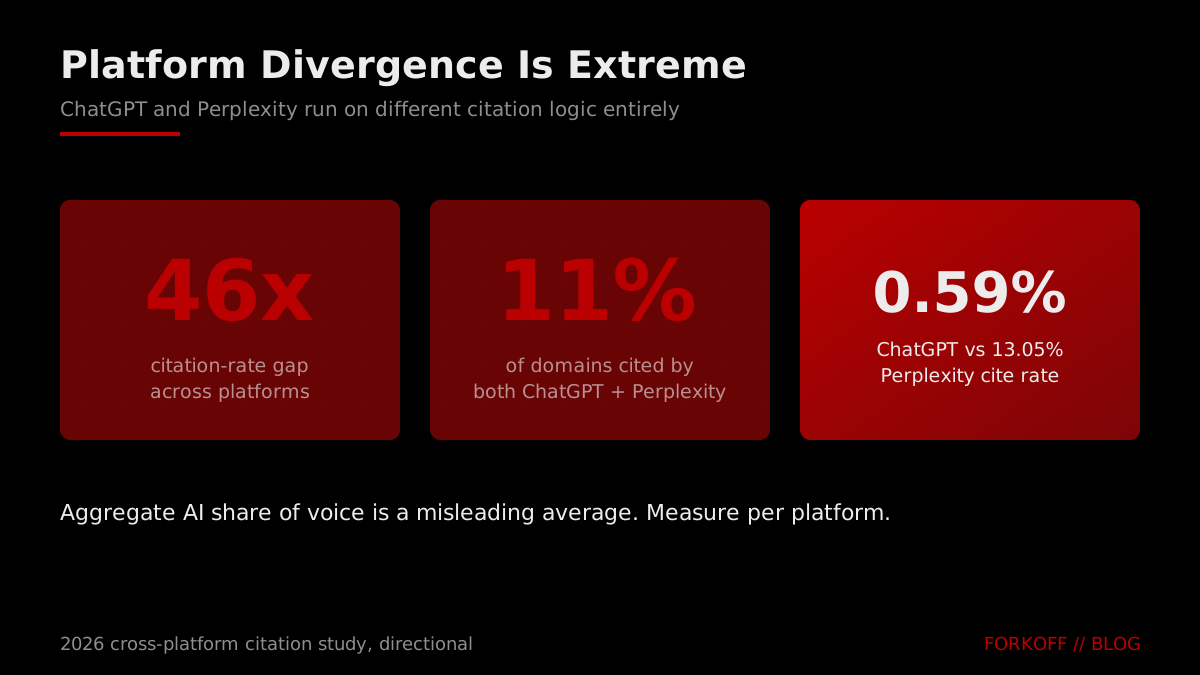
A 2026 cross-platform study found a 46x difference in brand citation rates across AI engines. ChatGPT cited brands roughly 0.59 percent of the time. Perplexity cited them around 13.05 percent. The two engines read the same web and return almost disjoint reference sets: only 11 percent of the domains cited by one are also cited by the other. The explanation is architectural. Perplexity live-indexes the web and surfaces many sources per answer, while ChatGPT leans more on training data plus selective retrieval and cites far less often. Google's own documentation on AI Overviews describes a third pattern again, where the surface leans on pages that already rank, which is why Overviews behave more like an extension of classic search than like Perplexity. Vendors with large datasets confirm the spread: Profound reports across roughly 15 million prompts a day, and the Semrush AI Visibility Toolkit draws on a corpus of over 289 million prompts, both of which show the same per-engine divergence rather than a single industry-wide cite rate.
Aggregate AI share of voice is a misleading average
A 2026 cross-platform study found brand citation rates differing by 46 times across AI engines, with ChatGPT citing brands roughly 0.59 percent of the time and Perplexity citing them around 13.05 percent. Only 11 percent of the domains cited by ChatGPT are also cited by Perplexity. Two engines reading the same web return almost disjoint reference sets. A brand can own Perplexity for its category and be invisible on ChatGPT at the same moment. Average those two together and the report is worse than no report, because it points the optimization budget at a phantom. Per-platform measurement is not a refinement, it is the floor.
Source: 2026 cross-platform citation study, directional
Per-platform citation behavior at a glance
| Platform | Citation behavior | Measurement note |
|---|---|---|
| ChatGPT | Low cite rate, leans on training data | About 0.59 percent brand cite rate |
| Perplexity | High cite rate, live-indexed sources | About 13.05 percent brand cite rate |
| Google AI Overviews | Cites pages that already rank | Track alongside classic rank |
Only 11 percent of cited domains overlap between ChatGPT and Perplexity; measure each engine on its own.
The practical consequence is that an aggregate AI share of voice is not a summary, it is a distortion. Averaging a 13 percent Perplexity cite rate with a 0.59 percent ChatGPT cite rate produces a middle number that describes neither engine. SaaS founders comparing notes have run into this directly, with one founder strong on Perplexity and invisible on ChatGPT while a peer has the exact mirror image, and the only sane response is to treat the engines as separate channels with separate scorecards. That per-engine split is also why the optimization work runs as separate tracks: a Perplexity SEO program targets the live-index surface while an LLM SEO program targets the training-data-and-retrieval surfaces that behave nothing like it.
Operator note0.59 percent on ChatGPT versus 13.05 percent on Perplexity is a 46x gap on the same web., 2026 cross-platform citation study
Tim Soulo of Ahrefs added a sobering data point to the platform conversation: AI search traffic to 75,000 websites moved from 2.9 million to 2.8 million over 11 months, a slight decline even as AI adoption surged. The lesson for measurement is that citation share is a positioning metric first and a traffic metric second, which is exactly why share of voice belongs in the trifecta.
Per-platform measurement also changes how you read a win. A jump in your blended figure could come entirely from Perplexity while ChatGPT stayed flat, and since Perplexity cites far more often, a Perplexity gain moves the average more for the same effort. Without the split, you would credit a strategy that only worked on one engine and assume it generalizes. Report the per-platform columns side by side, let the stakeholder see which engine moved, and tie each engine's trend to the specific work that touched it. The discipline pays off the first time a platform ships a citation-behavior update, because the column that shifts tells you which engine changed and the columns that held tell you your own pages did not regress.
Tim Soulo 🇺🇦
timsoulo
AI search traffic to 75k websites dropped from 2.9M to 2.8M over the past 11 months. That's a 3% decline while AI adoption is at an all-time high. [see yourself at 👉 chatgpt-vs-google(.)com] And I don't think we’re going to see much traffic growth from AI search going forward.… Show more
How To Track Your Brand Mentions in ChatGPT + Perplexity (LLMPulse Demo)
A demo of tracking brand mentions across ChatGPT and Perplexity together.
Building your prompt set, the measurement instrument
Every metric above is computed against a prompt set, so the prompt set is the instrument and its quality caps the quality of everything else. Build it deliberately: map 10 to 15 prompts per buyer-journey stage across awareness, comparison, intent, and brand, landing at 30 to 60 prompts per topic cluster, then freeze the set so the trend measures the brand and not your edits.
Map prompts to the buyer journey rather than to your feature list. Awareness-stage prompts ask "what is [category]" and "how does [category] work." Comparison-stage prompts ask "best [category] tools for [ICP]" and "[competitor] alternatives." Intent-stage prompts ask "how much does [category] cost" and "is [category] worth it." Then add brand-specific prompts: "who leads [category]," "[your brand] review," and "is [your brand] any good." Aim for 10 to 15 prompts per journey stage, per platform, landing at 30 to 60 per cluster.
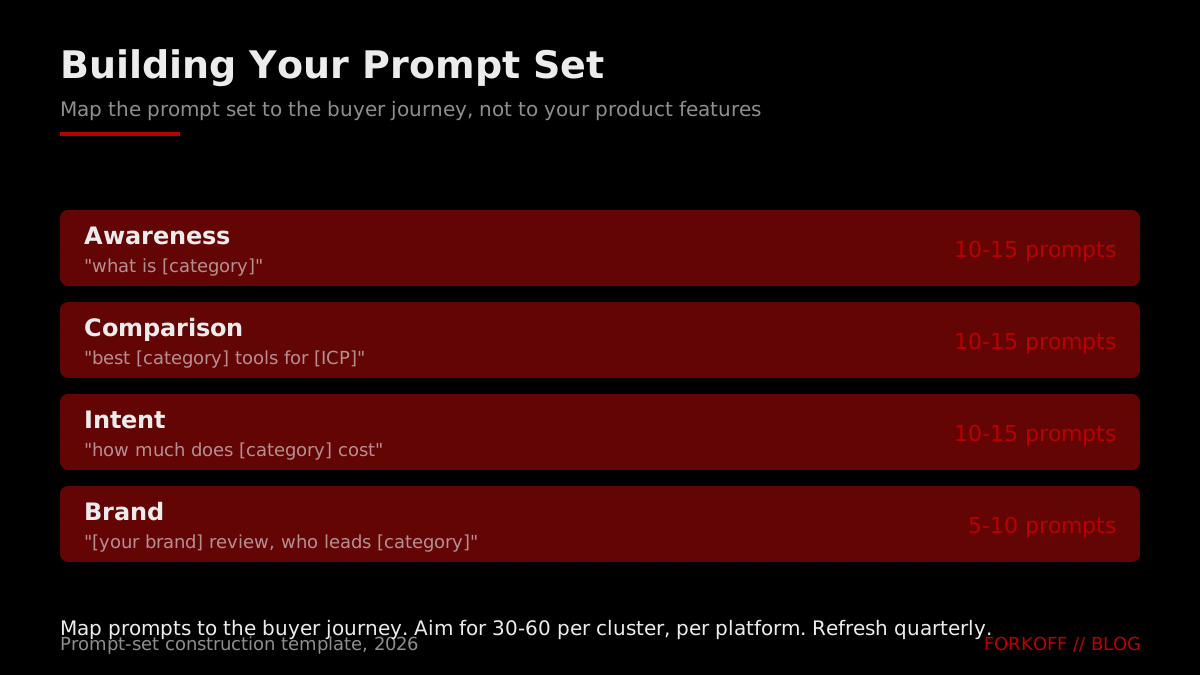
Sample size is not optional. Below 30 prompts per cluster the citation rate becomes unstable, because a single answer flipping from present to absent swings the percentage by several points. Practitioners who built homegrown prompt-based tracking before commercial tools existed landed on 40 prompts per client run, logged weekly as present or absent, as the point where the trend data became trustworthy.
Anyone actually tracking AEO / AI citations?
Before the tools existed I did this manually: 40 prompts per client, run weekly, present or absent. That sample gave reliable trend data. I still use the same prompt-set method to sanity-check the tool outputs.
Operator noteBelow 30 prompts per cluster, one answer flipping present to absent swings the rate too far to trust., FORKOFF measurement model
Freeze the set once it is built and run it at consistent times to reduce recency variance. Refresh on a quarterly cadence, not weekly, so the trend line measures the brand rather than your edits to the instrument. r/bigseo operators trading methods on building brand mentions in LLMs reinforce the same discipline: the prompt set is an asset you maintain, not a query you retype each week.
How are you building up brand mentions in LLMs?
The prompt set is the measurement instrument
Every metric in AI citation measurement is computed against a prompt set, so the prompt set is the instrument and a sloppy one corrupts everything downstream. Practitioners who built homegrown tracking before commercial tools existed converged on the same shape: a fixed set of prompts, mapped to the buyer journey, run on a schedule, with presence logged answer by answer. The discipline is consistency. A prompt set that drifts week to week produces trend lines that measure the drift, not the brand. Define the set once, freeze it, and only refresh on a deliberate quarterly cadence.
Source: r/SEO and r/bigseo practitioner discussion, 2026
The 5-step measurement workflow
With the prompt set defined, the weekly loop is five steps: run the frozen set on each platform, score each answer for citation and mention, compute the three trifecta metrics per platform, benchmark against your category and prior weeks, then report on each stakeholder's cadence. Naming the steps keeps the process repeatable across a team or an agency book of clients.
First, run the frozen prompt set on each platform you measure. Second, score each answer for citation and mention, logging present or absent per metric per prompt. Third, compute the three trifecta metrics per platform. Fourth, benchmark the result against your category and your own prior weeks. Fifth, report on the cadence each stakeholder needs. The loop never changes; only the numbers do.
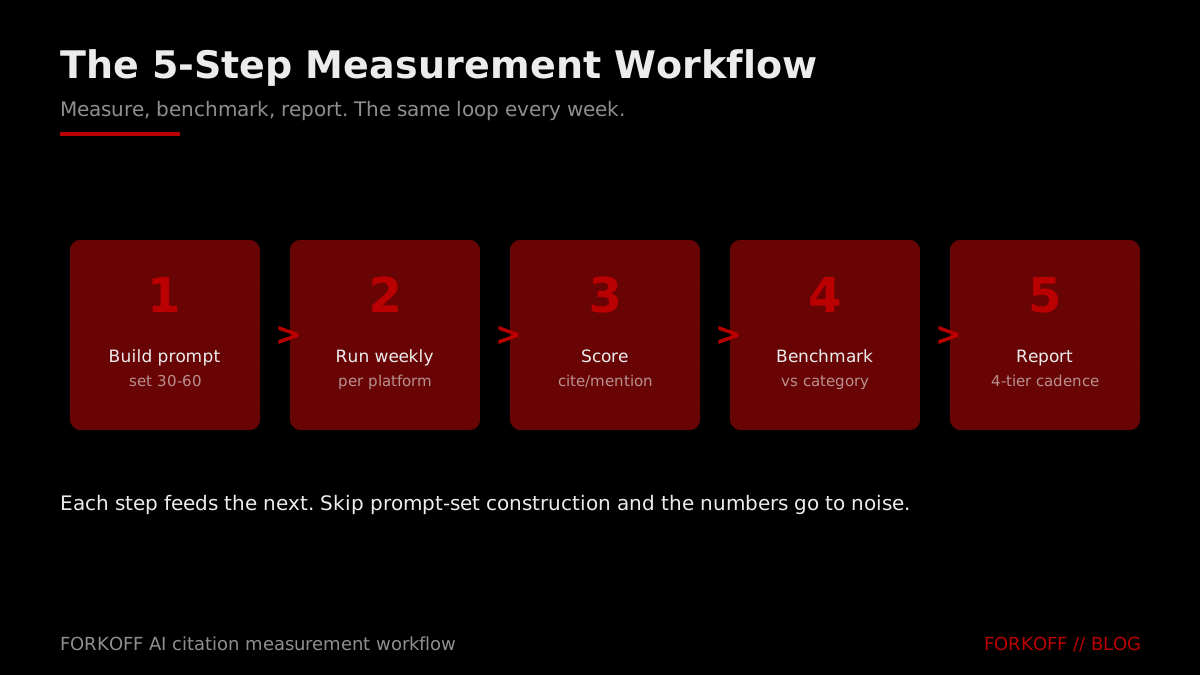
A short video walkthrough is worth more than a paragraph here for operators who learn by watching the screen, and the step-by-step share-of-voice measurement clip covers the same loop end to end.
How to Measure AI Assistant Share of Voice (Step-by-Step Walkthrough)
A step-by-step walkthrough of measuring AI assistant share of voice.
The naming matters because consistency is the entire game. An agency running this loop for 20 clients cannot afford a different method per analyst. A named five-step workflow with frozen prompt sets makes the output comparable across clients, across weeks, and across the people running it.
Scoring is the step where teams underinvest, and it is the step that decides whether the numbers are trustworthy. The cheap way is a keyword match: search the answer text for the brand name and a domain string. That misses linked citations rendered as numbered references and over-counts brand names that appear in a competitor's product name. The reliable way reads each answer for two booleans, brand-cited and brand-mentioned, with a written rubric so two analysts score the same answer the same way. Tools automate this, but the rubric still has to exist, because the tool inherits whatever definition you give it. When citation share moves week to week, the first thing to check is whether the scoring rule drifted, not whether the model changed.
The benchmarking step has its own discipline. Benchmark against two things: your own prior weeks and the specific competitors you actually lose deals to. A category-wide average is interesting context but a poor target, because it averages brands you will never compete with. Pick three to five named competitors, score them on the same prompt run, and report your share of voice against that set. That number is the one a stakeholder can act on, because it answers the question they actually have, which is whether the brand is winning or losing the answers their buyers see.
Industry citation benchmarks by vertical
A measured citation share of voice means nothing without a benchmark, and the benchmark is vertical-specific. B2B SaaS leaders typically post 8 to 15 percent on ChatGPT and 20 to 35 percent on Perplexity, crypto and web3 brands run 3 to 10 percent, and consumer brands trend 12 to 25 percent. The same percentage that signals dominance in one category signals weakness in another.
B2B SaaS leaders in mature categories typically post citation share of voice of 8 to 15 percent on ChatGPT and 20 to 35 percent on Perplexity. Tech, SaaS, deep tech and Web3/AI brands run lower, 3 to 10 percent across platforms, because models tend to discount promotional and token-related claims, a dynamic the GEO playbook for crypto and web3 addresses directly. Consumer brands with deep editorial and Wikipedia coverage trend higher, 12 to 25 percent. Any brand sitting under 5 percent on both ChatGPT and Perplexity for its core category should treat AI citation work as a priority investment, not a maintenance task.
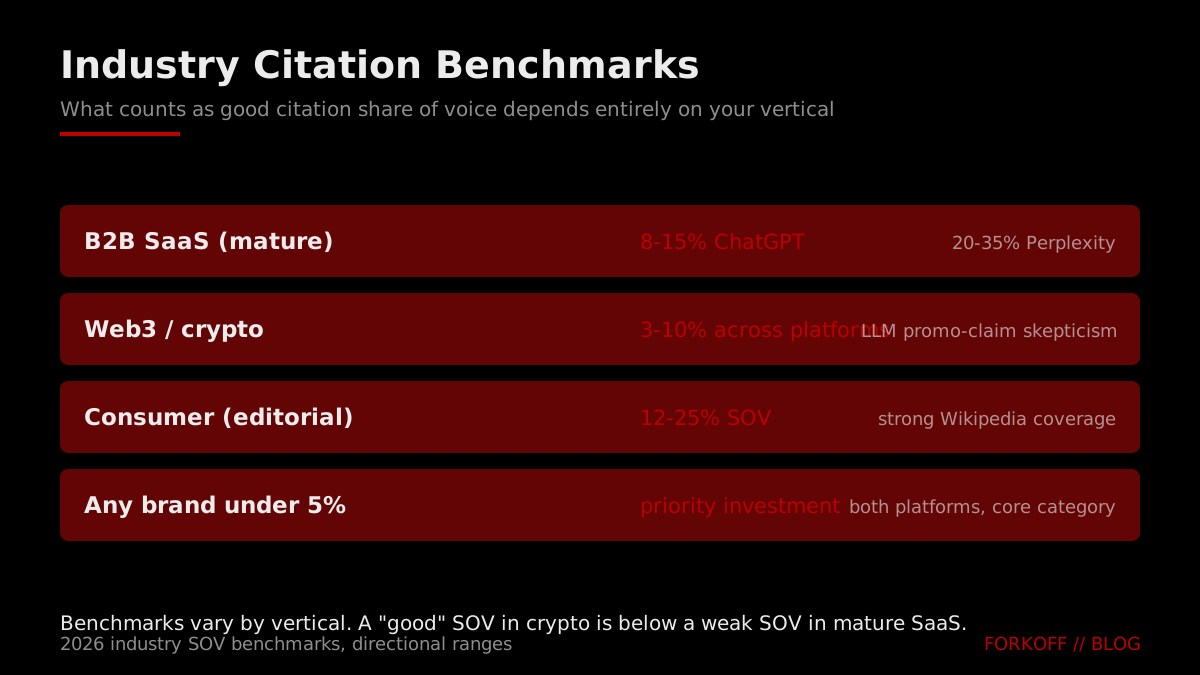
The benchmark also reframes the goal. A crypto brand chasing the 25 percent figure a consumer brand reports is chasing a number its category does not produce. Set the target against the category leader you actually compete with, which is precisely what share of voice measures. Marketers who have lived the ranks-high-but-not-cited gap describe it in the same terms across forums: the page ranks, the brand does not get picked, and the fix is category-specific evidence rather than more keywords.
How to improve ai brand visibility when your site ranks high but isnt cited
The tool stack for citation measurement by tier
You can run the entire framework by hand in a spreadsheet, and many practitioners started there. Tools earn their cost by automating the weekly run and the scoring, not by replacing the framework. Four lead the 2026 category at different tiers.
Otterly.ai starts around $29 per month and fits solo marketers and agencies with under 10 clients. The Semrush AI Visibility Toolkit runs about $99 per month per domain and suits teams already paying for Semrush, where the extra prompt data points compound existing workflows. Profound is enterprise, built for portfolios of 50 or more brands that need statistical scale. Ahrefs Brand Radar has the strongest Google AI Mode coverage of the four. For methodology background on how these vendors define their metrics, the Semrush blog's primer on AI visibility is a useful neutral reference, and the full AI visibility tool comparison maps cost against capability in detail.
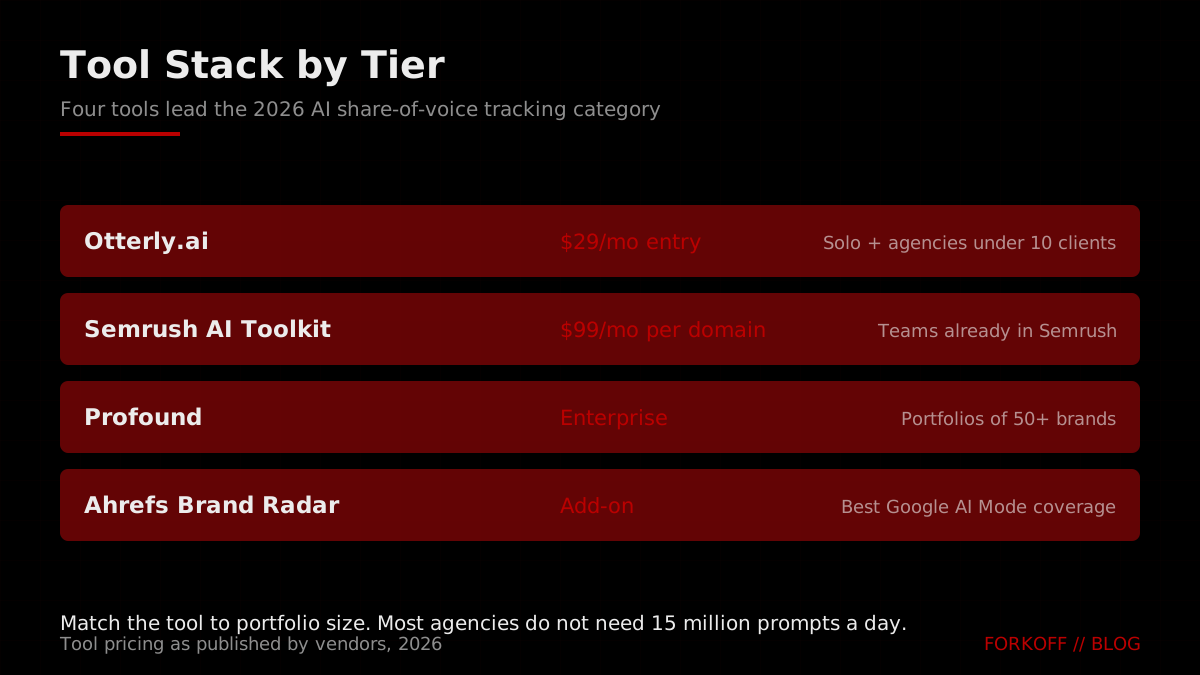
The tool decision is a portfolio-size decision, not a feature-count decision. An agency with brand-level clients usually pairs Otterly or Semrush for those accounts with Profound for any enterprise contract. An in-house team measuring one brand rarely needs more than the entry tier. An explainer separating mentions, citations, share of voice, and position is a useful primer before you trial any of them, so the tool's dashboard maps to metrics you already understand.
AI Visibility Explained: Mentions, Citations, Share of Voice, and Position
An explainer separating mentions, citations, share of voice, and position.
The citation-to-mention diagnostic
The reason to track three metrics rather than one becomes concrete in the diagnostic step. The combination of mention rate and citation rate names the problem and points at the fix: high mentions with low citations is an on-page evidence gap, low mentions with low citations is an authority gap, and a high citation rate with rising share of voice means the system is working.
A high mention rate with a low citation rate means the model knows your brand and talks about it but does not link your pages. That is an on-page evidence and trust problem. The remediation is structured data, clearer claims, and citable formats, the work mapped in the AEO checklist for B2B and the schema markup for AEO guide. A low mention rate paired with a low citation rate means the model barely registers your brand, which is an authority and training-data problem that responds to coverage and time, not markup. A high citation rate with rising share of voice means the system is working and the job shifts to defending the lead.
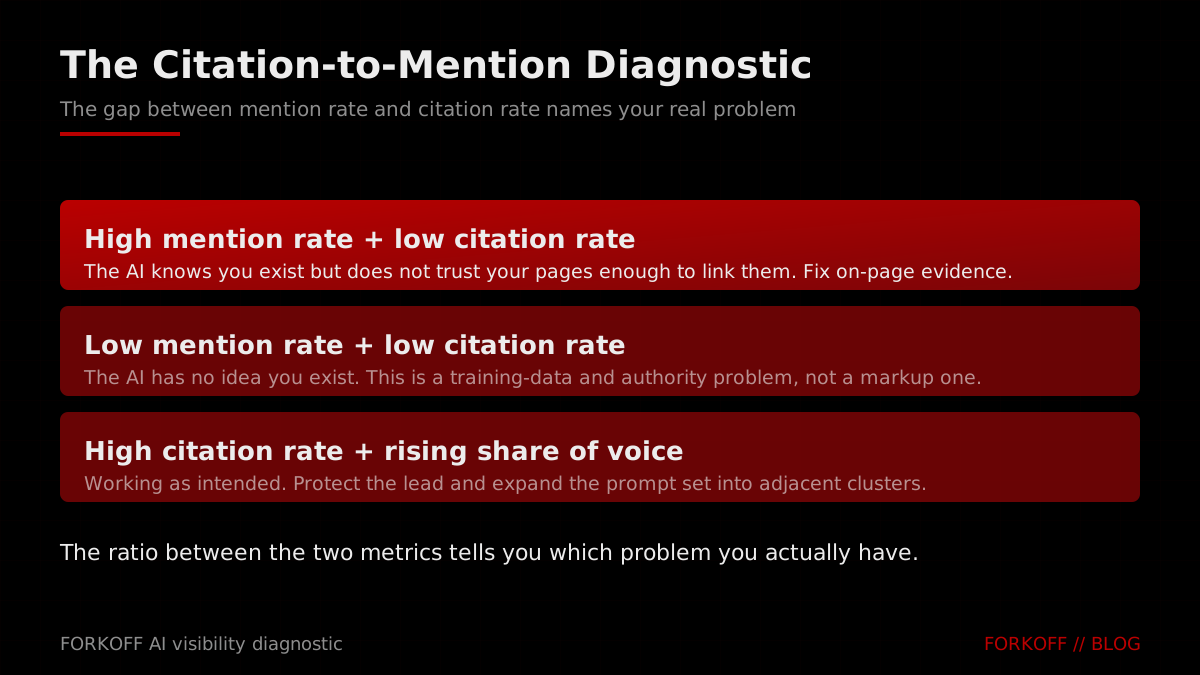
This is why the report should never collapse to one number. The diagnosis lives in the relationship between the metrics, and the relationship is invisible once they are averaged. The same logic governs how AI engines decide what to surface in the first place, covered in how AI Overviews rank brands and the broader generative engine optimization playbook for SaaS.
Building the reporting cadence
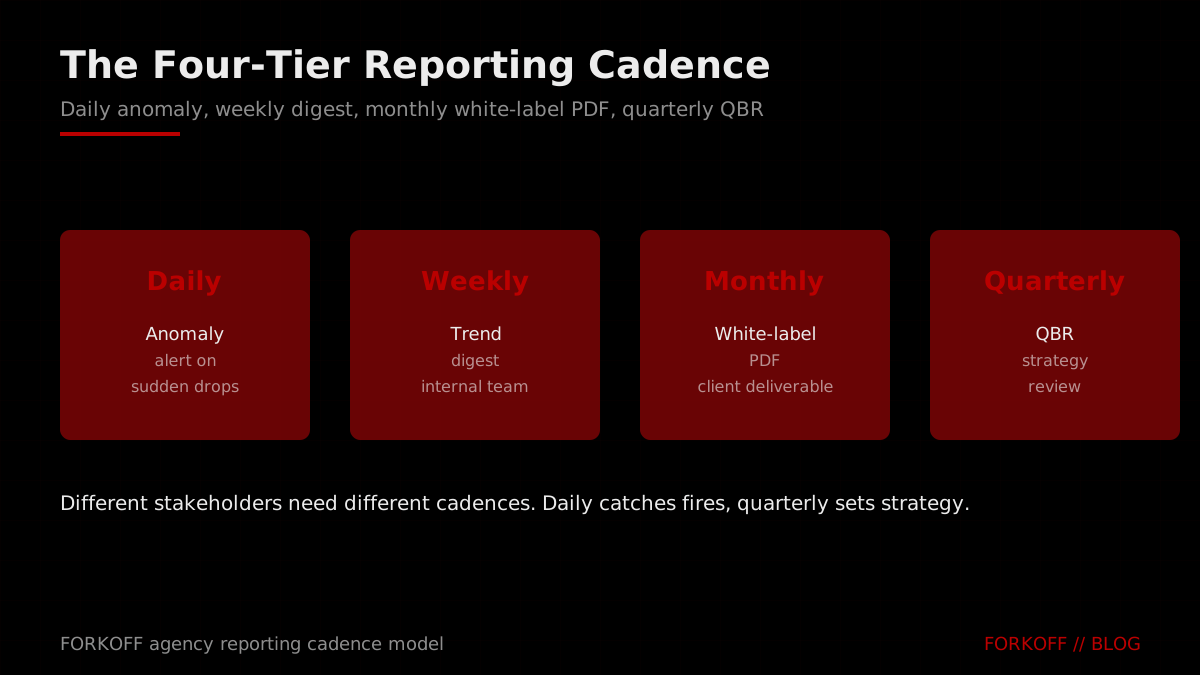
Measurement that no one reads is wasted measurement. The four-tier cadence matches the right signal to the right stakeholder without flooding anyone: daily is an anomaly alert on sharp drops, weekly is an internal team digest, monthly is the white-label client deliverable showing the trifecta per platform, and quarterly is the QBR where the trend feeds strategy and the prompt set gets its scheduled refresh.
Daily is an anomaly tier: an automated alert when a metric drops sharply, so a sudden de-citation gets caught before the monthly review. Weekly is a digest for the internal team, a short trend read that informs the next sprint. Monthly is the client deliverable, a white-label PDF that shows the trifecta per platform with the prior month's comparison. Quarterly is the QBR, where the trend over three months feeds strategy and the prompt set gets its scheduled refresh.
Agencies have learned to translate the metrics for the audience. Client-facing reports often rename "citation rate" to plain language like "you appeared in X percent of AI answers for your category this month, up from Y percent last month," a single trend line a non-technical stakeholder reads in seconds. The internal scorecard keeps the precise metric names; the client report keeps the plain ones. Both run off the same numbers.
The cadence also protects against a failure mode that catches new measurement programs: over-reacting to weekly noise. A single week's citation rate can move two or three points purely from model variance, with no change in your pages or your authority. A team watching the weekly digest too closely will chase those swings, re-optimize pages that were fine, and burn cycles. The monthly tier exists precisely to smooth that noise into a trend the stakeholder can trust, and the quarterly tier exists to make structural decisions that should never be made on a single month. The daily anomaly alert is the one exception, and it is deliberately narrow: it fires only on a sharp drop, the kind that signals a page got de-indexed or a competitor displaced you, not the kind that signals a normal week. Set the daily threshold loose enough that it stays quiet most days, because an alert that fires constantly is an alert nobody reads.
Operator noteFORKOFF moved its own average cite rate from 22 to 34 percent across 5 AI surfaces in one rerun., geo-citation-lab-forkoff-rerun-2026
The minimum viable measurement stack
If the full framework is too much to start, do not skip measurement, shrink it. The minimum viable stack is two highest-intent clusters, 30 prompts each for 60 total, run weekly on ChatGPT and Perplexity, scored for citation rate and mention rate separately, with share of voice logged against your top three competitors. A small honest stack beats a large abandoned one.
Pick the two highest-intent topic clusters. Write 30 prompts per cluster for 60 total. Run them on ChatGPT and Perplexity weekly. Score citation rate and mention rate separately. Log share of voice against your top three competitors. Send a one-line trend to the stakeholder monthly. That stack produces statistically defensible numbers and fits inside a few hours a week.
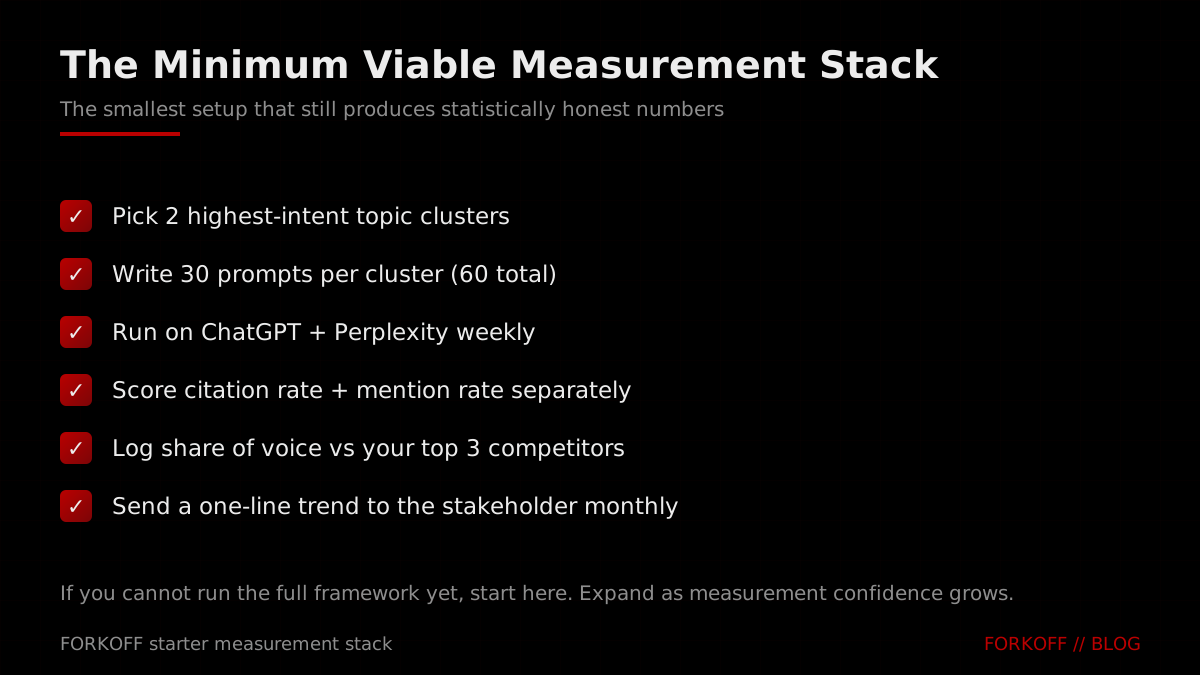
Expand from there as confidence grows: add Google AI Overviews, add more clusters, add the advanced metrics, automate the run with a tool. The point of the minimum stack is to start the trend line, because the second monthly data point is the one that makes the first one useful. FORKOFF began its own measurement the same way before scaling to five AI surfaces and publishing the citation lab rerun that moved the cite rate from 22 to 34 percent.
Modern context: measurement in the agent era
The discipline matters more now than it did a year ago because the surfaces multiplied. Measurement now spans ChatGPT, Perplexity, Google AI Overviews, Claude, Gemini, and the agent layer that calls them, and each behaves differently enough to need its own column in the scorecard.
The structural input audit that decides whether your pages are even eligible for citation is a separate workstream from this measurement loop, covered in the agentic SEO audit. Measurement tells you the outcome; the audit tells you why the outcome looks the way it does. The two pair: you measure share of voice, find a citation problem, then run the audit to locate the structural fix. For teams selling into specific verticals, the SaaS company and AI startup buyer pages frame how this measurement ties to pipeline. The free AEO checker and GEO audit tools give a fast baseline before you commit to a weekly run, and the AEO vs GEO measurement split explains why each surface needs its own baseline, and the answer engine optimization guide and playbook carry the optimization side once measurement reveals the gaps. The best AEO agency and best GEO agency comparisons cover who runs this work at scale.
The agent era also raises the stakes on absorption versus selection. As more buyers delegate research to agents that read AI answers on their behalf, an unabsorbed citation reaches no human at all. The metric that mattered least a couple of years ago is becoming the metric that decides whether AI visibility converts.
The verdict on measuring your share of AI citations
Measuring AI citations well comes down to refusing the single number. Track citation rate, mention rate, and share of voice as three separate readings, computed against a frozen set of 30 to 60 prompts per cluster, scored per platform because the platforms disagree by 46 times, benchmarked against your vertical rather than a global figure, and reported on a four-tier cadence that fits each stakeholder. The gap between the three metrics is the diagnosis, the per-platform split is the floor not the refinement, and absorption is the outcome that actually moves the business.
FORKOFF runs this framework for founders and agencies and ran it on its own domain first, moving the average cite rate from 22 to 34 percent across five AI surfaces. If you want the measurement loop built and operated for you, with the prompt set, the per-platform scoring, and the white-label report on your cadence, that is the engagement.