
If you run a protocol, you already know the pattern. The token launches, the price prints, and a wave of inflows arrives from CoinMarketCap and the listing sites. Then, within weeks, most of those wallets are gone. The follower count went up, the Discord swelled, the agency deck was full of impressions, and almost none of it converted into holders who stuck around. The budget is spent and the metric that actually matters, retention, barely moved. That gap between activity and outcome is the single most expensive problem in web3 marketing for protocols, and it is the reason so many founders end up burned by their first agency.
The complaint is loud and constant. Operators say it on X every week, and the sentiment is not subtle.
Limpong
@limpong1
It's no secret anymore that most Web3 marketing is trash. just imagine agencies taking huge and sometimes unreasonable cuts, plus KOLs only posting copy paste content, if that happens then the project just burns money with no clear result. I see Rally trying to step in and solve
It's no secret anymore that most Web3 marketing is trash. Just imagine agencies taking huge and sometimes unreasonable cuts, plus KOLs only posting copy paste content, if that happens then the project just burns money with no clear result.
This guide is the editorial version of the answer. It defines what a web3 marketing agency actually is, lays out the six surfaces a category-winning one runs, compares the pricing models so you can see which one is structurally aligned with your result, and gives you a high-level checklist for vetting one before you sign. It draws on first-party data from FORKOFF's own campaigns rather than recycled agency self-promotion, and it points you to the deeper resources where each topic has its own dedicated playbook. If you would rather skip the diagnosis and look at the alternative model directly, the alternatives to traditional web3 marketing agencies page is the short path.
About these numbers
Campaign performance figures (3,085 clips, 1,190,014 organic views, 13 active distribution days, 61 percent of views from 25 percent of clips, 4.7x per-clip yield for YouTube Shorts vs Reels, 192 percent subscriber growth, 208 percent revenue growth, month-over-month retention of 83/59/83 percent) are FORKOFF first-party data from an anonymized crypto educator client, attributed at the subscription payment level. Agency pricing ranges (an estimated $5,000 to over $70,000 monthly retainer) are FORKOFF operator estimates based on publicly listed pricing and proposal benchmarks across the market as of June 2026; individual engagements vary. The "roughly 75 percent first-term retention" subscription benchmark is a directional industry figure drawn from practitioner community observation and SaaS/creator-economy retention studies; treat as a reference point, not a universal standard. All competitor descriptions are summarized from each agency's own public service pages as of June 2026.
What a web3 marketing agency actually does
A web3 marketing agency is the team that builds and runs distribution for a crypto or blockchain project across the channels where token-holding audiences actually pay attention. That is the whole job, stated plainly. It is not a creative shop that makes a logo and a launch video, and it is not a paid-ads buyer that loads a budget into Meta and Google. Those channels are largely closed to crypto because of ad policy, so the work happens organically on X, Telegram, Discord, YouTube, podcasts, and at live events. The agency's value is its ability to place the right content on those surfaces and route the attention it earns toward a wallet action.
The deeper point is that the discipline is not a flavor of web2 marketing. It is a different operating model with a different scoreboard. In web2, the north-star metric is a marketing qualified lead and the proof is a pixel firing. In web3, the north-star metric is wallet retention and on-chain action, and the proof can be verified publicly on a block explorer. The Ethereum Foundation's overview of web3 lays out why ownership sits at the center of the model, and that ownership changes the marketing job from acquiring customers to building a community that holds a stake in the product. A founder who hires a generalist agency expecting a familiar funnel is usually disappointed, because the funnel does not exist in the same shape.
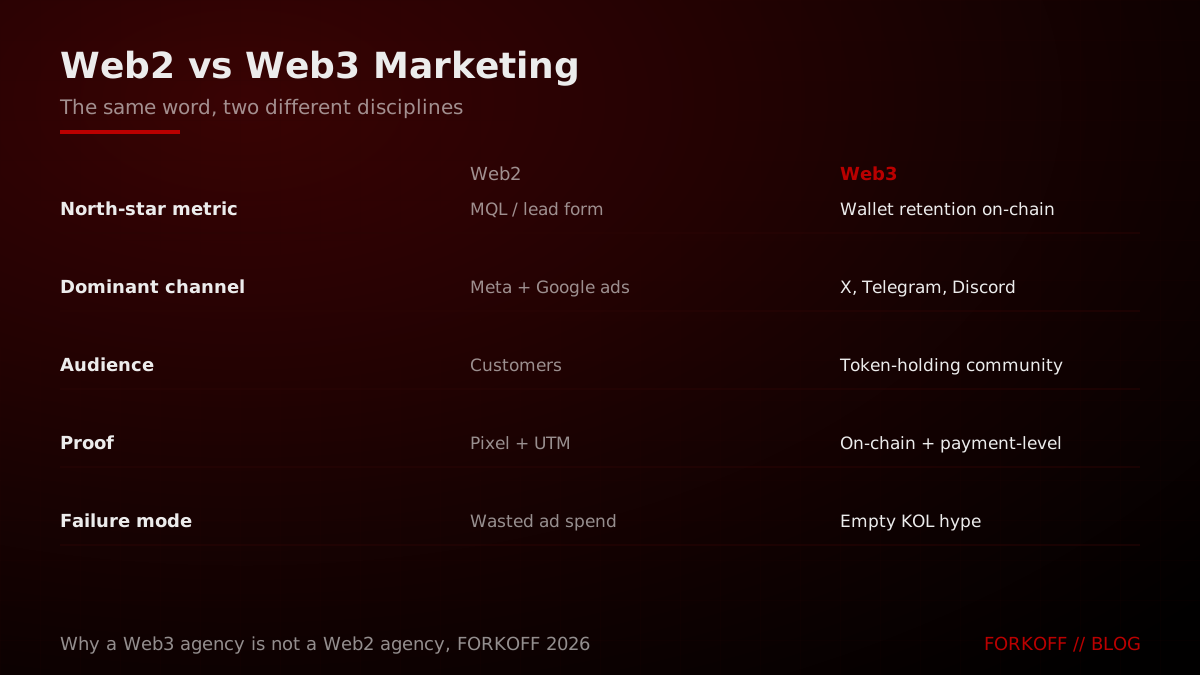
The contrast is worth making concrete, because it explains most agency failures. When a web2 shop takes a web3 client, it tends to reach for paid acquisition and lead capture, hits the crypto ad wall, and falls back on the one organic channel it half-understands, which is usually a few KOL posts. The result is reach without a route in. A native web3 agency starts from the channel constraints and the on-chain proof standard, which the DeFi ecosystem documentation frames well, and builds the engagement around them from the start.
Web2 marketing versus web3 marketing at a glance
| Dimension | Web2 marketing | Web3 marketing |
|---|---|---|
| North-star metric | MQL or lead form fill | Wallet retention and on-chain action |
| Dominant channels | Meta and Google paid | X, Telegram, Discord, YouTube, events |
| Audience | Customers and prospects | Token-holding community as the product |
| Proof of work | Pixel and UTM attribution | On-chain and payment-level attribution |
| Common failure mode | Wasted ad spend | Empty KOL hype with no conversion |
The disciplines share a name and almost nothing else; treat a generalist web2 shop's web3 claim with caution.
There is a second-order reason the proof standard matters so much in this industry. Because wallet activity and holder counts are partly public, a serious agency can hand you receipts you can independently verify, and a weak one can no longer hide inside an impressions dashboard. That transparency is quietly reshaping the market, and the agencies leaning into verifiable proof are the ones earning trust.
On-chain verifiability raises the bar for proof
Web3 is the one industry where the customer relationship is partly public. Wallet activity, holder counts, and on-chain flows are visible in a way that web2 customer data never is, as the Ethereum Foundation documents across its overview of the ecosystem. That visibility cuts both ways. It means a serious agency can prove outcomes with receipts a founder can independently check, and it means a weak agency can no longer hide behind impression dashboards. The agencies that lean into verifiable proof win the trust war. The ones that report screenshots are quietly being sorted out of the market.
Source: Ethereum Foundation, Web3 overview, 2026
Who hires a web3 marketing agency
The buyer is almost always a founder or a head of growth at a protocol that has a product and a launch on the horizon but no distribution muscle in-house. The pain that drives the hire is specific: the team can build, but it cannot reliably reach the audience that would hold the token, and it has watched competitors with weaker products win attention through better distribution. That asymmetry is what sends a founder looking for an agency in the first place, and it is why marketing for web3 protocols is a category at all.
The decision is rarely made calmly. It usually follows either a failed first attempt, where an in-house intern or a generalist agency spent a budget with nothing to show, or a hard deadline, where a TGE is weeks away and the distribution plan is a blank page. Both situations produce the same buyer: someone who needs channel expertise faster than they can build it and who has already learned, sometimes expensively, that reach without conversion is worthless. The community version of this search plays out in public constantly, with founders comparing notes on who delivered and who did not.
The other recurring buyer is a protocol that has marketed itself adequately so far but has hit a ceiling it cannot break alone. The internal team can sustain a community but cannot run a coordinated launch across six surfaces at once, and bringing in an agency for the surge is cheaper and faster than hiring six specialists. For that buyer, the agency is a force multiplier on an existing team rather than a replacement for one, which is a healthier engagement than the rescue hire and tends to produce better results because the internal context already exists.
The six surfaces a category-winning agency runs
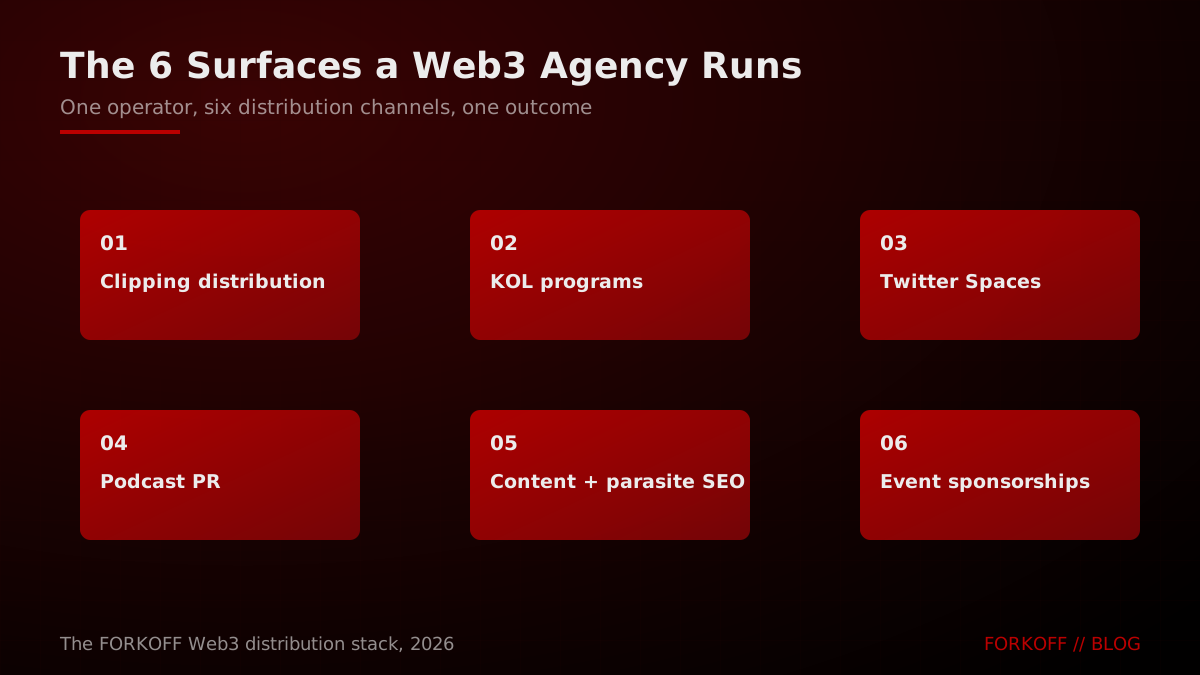
The difference between an agency that moves a metric and one that bills for activity is usually coverage. A real engagement runs the surfaces where a crypto audience actually lives, as a connected system, not as a menu of one-off tactics. FORKOFF runs six of them in-house, and each maps to a distinct job in the funnel from first attention to a held wallet. The sections below take them one at a time so you can judge any agency's pitch against what the work actually involves.
Clipping and short-form distribution
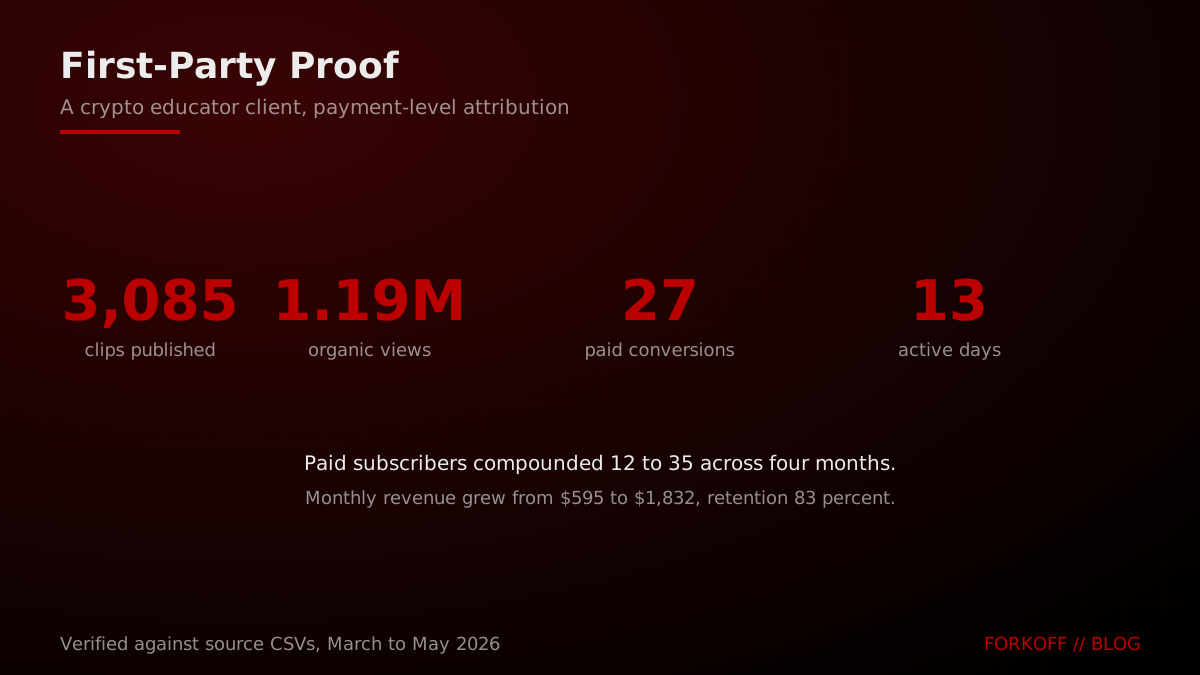
Short-form clipping is the volume engine. A founder appearance, an AMA, or a Spaces recording is cut into dozens or hundreds of channel-native clips and distributed across YouTube Shorts, Instagram Reels, and TikTok, where they reach people who have never heard of the project. The leverage here is real and measurable. In one anonymized crypto educator client campaign, 3,085 clips produced 1,190,014 organic views in only 13 active distribution days, and the per-clip economics were lopsided in a useful way.
Operator note3,085 clips and 1,190,014 organic views landed in 13 active distribution days, not a full month, for that same client., a crypto educator client, March 2026
The lopsided part is the lesson. For that client, 61 percent of the views came from 25 percent of the clips, all of them YouTube Shorts, at 4.7 times the per-clip yield of the equivalent Reels. A real agency reads that data back into the next batch and over-indexes on the format that is working, rather than spraying the same content everywhere at equal weight. The discipline is in the routing, not just the volume. For the founder-facing version of this surface, the web3 clip distribution model shows how recordings become a recurring distribution asset.
Operator note61 percent of that client's views came from 25 percent of the clips, all YouTube Shorts, at 4.7 times the per-clip yield of Reels., FORKOFF clipping campaign, March 2026
KOL programs
KOL marketing is the surface most associated with web3, and also the one most abused. Done well, it places credible voices in front of an aligned audience and is measured by the wallets and pipeline it produces. The best crypto KOL marketing platforms vary significantly in how they source creators, screen for bots, and commit to outcomes. Done badly, it is the empty hype that founders complain about: a roster of accounts posting copy-paste threads with no conversion behind them. The difference is entirely in the selection and the attribution. A KOL marketing for web3 protocols engagement that cannot tell you which creator drove which wallet is selling reach, not results.
Leonidas
@LeonidasNFT
Airdrop farmers = FAKE users. Market makers = FAKE volume. Paid promo KOL networks = FAKE engagement. Insider allocation w/ low float = FAKE market cap. Web3 marketing agency buzzword propaganda = FAKE decentralization.
Paid promo KOL networks = FAKE engagement. Web3 marketing agency buzzword propaganda = FAKE decentralization.
The market is openly turning on the old KOL model, and that backlash is a signal worth heeding when you evaluate an agency. The ones still selling follower-count packages are the ones being sorted out. Before signing with any creator, use the 9-point crypto KOL vetting checklist to screen for follower fraud and engagement bots. The crypto KOL marketing framework breaks down how to structure a program that is accountable rather than performative, and it is the resource to send any agency that pitches you a flat roster with no attribution plan.
Twitter Spaces and live audio
Spaces are where a web3 community gathers in real time, and a category-winning agency treats them as a recurring distribution event rather than a one-off. A well-run Spaces program produces a live audience, a recording that feeds the clipping engine, and a set of quotable moments that become threads and clips for weeks afterward. Running Twitter marketing for crypto communities well means treating each Space as the top of a content cascade, not as a standalone event that disappears when it ends.
Crypto Marketing (Strategy Guide 2026)
Crypto Team
A 2026 crypto marketing strategy guide covering the channel mix.
Podcast PR and founder placement
Podcasts are the long-form trust surface. A founder who appears on the right shows builds credibility that no thread can match, and each appearance becomes raw material for every other surface. A serious agency books the placements, prepares the founder, and then turns each episode into clips, threads, and quote cards, which is the podcast distribution for web3 founders loop. The placement is the start of the work, not the end of it. An agency that books a podcast and walks away has done a tenth of the job.
How to Start a Web3 Marketing Agency in 2026?! Ali Solanki
Ali Solanki
A 2026 walkthrough of how a web3 marketing agency is built and run.
Content and parasite SEO
Content is the compounding layer, and in 2026 it is also the answer-engine layer. The job is to make the project the cited source when someone searches the category or asks an AI assistant about it, which means structured content, schema, and placement on surfaces that already rank. The AI-era marketing for web3 brands approach treats search and AI Overviews as a distribution channel in their own right. As a16z crypto's research and reference sources like Investopedia's web3 explainer show, the category is information-dense, which means the project that owns the clearest explanations earns the citations.
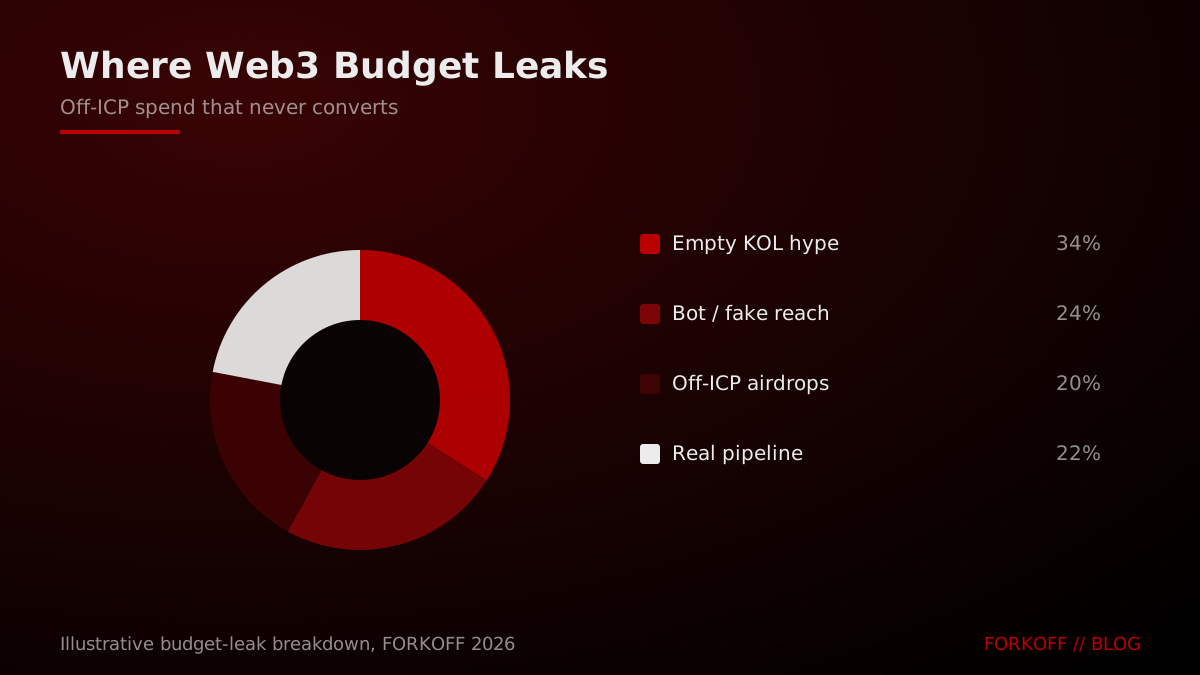
That budget-leak picture is the case for content as an investment rather than a cost. A large share of typical web3 spend disappears into reach that never touches the right wallet. Content that ranks and gets cited keeps working long after a paid push stops, which is why it is the surface with the best long-run return and the one most agencies underinvest in.
Event sponsorships and activation
Events are the in-person trust surface, and in crypto they remain disproportionately important. A sponsorship is only worth the spend if it is run as a distribution event: pre-event content, on-site capture, founder placement on panels and side events, and post-event clips and follow-up. Web3 event marketing and sponsorship activation done well turns a booth into a pipeline event rather than a branding expense. The agencies that treat events as a logo on a banner are the ones whose event line item never shows a return.
These six surfaces are why the channel mix in web3 looks so different from anywhere else, and why an agency's own footprint on them is such a strong signal.
The channel mix is dictated by where crypto audiences live
A web3 agency cannot run the standard web2 playbook because the standard paid channels are largely closed to it. Crypto ad policy on the major ad networks is restrictive, so the audience is reached organically on X, Telegram, Discord, YouTube, and at events instead. That constraint shapes everything downstream. It is why community management, KOL relationships, and live activation matter more in web3 than in almost any other vertical, and why an agency's own footprint on those surfaces is a real signal of whether it can do the work.
Source: FORKOFF channel strategy notes, 2026
How web3 marketing agencies charge
Pricing is where alignment is won or lost, and it is the part founders study least carefully. There are three models in the market, and the structure of the contract tells you more about whether the agency will deliver than any case study on its site. Understanding the three is the difference between a relationship that pushes toward your result and one that quietly bills for motion.
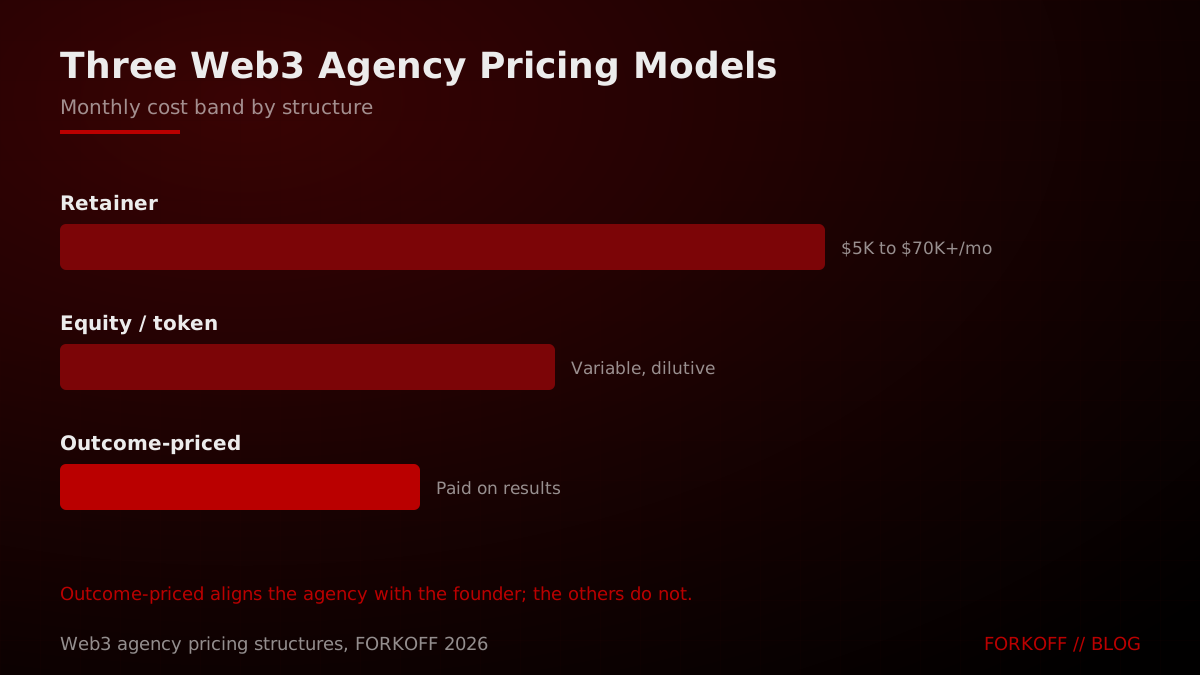
The flat monthly retainer is the default. It runs from roughly $5,000 a month for a narrow scope to well over $70,000 for a full-stack program with a large KOL network. The retainer is simple to budget and easy to start, and it is also structurally misaligned. The agency is paid the same whether your token finds holders or not, so its incentive is to keep the relationship alive rather than to hit a number. That is the mechanism behind the most common failure in the industry.
The flat retainer is structurally misaligned with your outcome
A retainer pays the same whether your token finds holders or not. The agency's incentive under that contract is to keep the relationship alive, not to hit a number, because the invoice clears either way. That is the mechanism behind the most common founder complaint in crypto: months of activity, decks full of impressions, and no movement in the metric that matters. The fix is not a better retainer agency. It is a different contract structure that ties the agency's pay to a result the founder cares about, which is the entire argument for outcome pricing.
Source: FORKOFF founder funnel notes, 2026
The three web3 agency pricing models compared
| Model | Typical cost | Who carries the risk | When it makes sense |
|---|---|---|---|
| Monthly retainer | $5,000 to $70,000 per month | The founder | You have a clear scope and trust the team |
| Equity or token grant | Variable and dilutive | Shared, long horizon | Pre-seed with no cash and a long runway |
| Outcome-priced | Tied to results | The agency | You want incentives aligned from day one |
Cost ranges are directional and reflect commonly quoted web3 agency retainers; scope drives the number.
The second model is equity or token grants, common with pre-seed projects that have no cash. It can align incentives over a long horizon, but it is dilutive and it ties the agency's reward to outcomes far outside its control, such as market conditions and tokenomics. The third model is outcome pricing, where the agency's pay is tied to a result the founder defines. This is FORKOFF's model, and it exists precisely to put the agency's compensation on the same side of the table as the founder's outcome. The broader market is moving in this direction because founders are tired of paying for motion.
GuruVerseX
@GuruVerseX
The Web3 marketing playbook of paying middleman agencies to fund empty KOL hype is officially broken. We are witnessing a massive shift in how influence is actually valued. For years, gatekeepers ignored talented builders and writers simply because they did not have massive follo… Show more
The Web3 marketing playbook of paying middleman agencies to fund empty KOL hype is officially broken. We are witnessing a massive shift in how influence is actually valued.
If you want the head-to-head version of how this plays out against specific competitors, the FORKOFF versus RZLT comparison and the FORKOFF versus OutreachZ comparison lay out the model differences in detail. The summary table later in this post names the field directly.
The proof: first-party campaign data
Most agency content cites the agency's own marketing copy as evidence, which is no evidence at all. The honest version uses verified numbers, even when the absolute size is modest, because the shape of a result is what generalizes. The clearest first-party example FORKOFF can share comes from an anonymized crypto educator client, attributed at the payment level from raw subscription data rather than from view-based inference.
Operator noteOne anonymized crypto educator client's campaign was attributed at the payment level from raw subscription data, not view-based inference., FORKOFF clipping campaign, March 2026
Over four months of clipping campaigns, that client's paid subscribers compounded from 12 to 35 (n=1 client case), a 192 percent increase, while monthly revenue grew from $595 to $1,832, a 208 percent increase. Month-over-month paid retention ran at 83 percent, then 59 percent, then 83 percent. The middle month dipped below benchmark and is disclosed here deliberately, because an agency that only shows you the good months is hiding the variance you will actually live with. Two of the three months beat the roughly 75 percent first-term retention that subscription benchmarks treat as healthy, and the dip-and-recovery is the real shape of a working program.
Operator noteAcross four months that client's paid subscribers compounded from 12 to 35 and monthly revenue from $595 to $1,832., a crypto educator client, February to May 2026
The absolute revenue is small, and that is the point. The story is the compounding shape and the payment-level attribution, not the dollar size. A single, estimated $50-per-month crypto education niche is a clean test case precisely because the numbers are unglamorous and verifiable. When you evaluate any agency's proof, look for that combination: a verifiable attribution method, disclosed variance, and a result tied to a payment or an on-chain event rather than an impression. For the broader set of receipts, the FORKOFF campaign case studies collect them in one place.
How to vet a web3 marketing agency
You do not need a forensic process to filter out most weak agencies. You need a short list of questions that an invoice factory cannot answer well. The checklist below is the high-level version, designed to be run in a first call before you invest hours in a deeper evaluation.

The ten questions cluster around four themes. The first is attribution: do they measure at the on-chain or payment level, or do they report impressions and follower counts? The second is references: will they connect you directly with current clients, or do they deflect? The third is footprint: does the team have a credible presence on the channels they are selling, or are they selling distribution they cannot demonstrate? The fourth is alignment: is outcome pricing on the table, and will they agree to a 90-day performance gate with clear exit terms? An agency that answers all four cleanly is rare, and worth the premium.
This guide deliberately stops at the high-level checklist, because the deep version already exists and there is no value in duplicating it. If you have been burned before and need the scored red-flag matrix, the contract safeguards, and the second-hire framework, work through how to evaluate a web3 marketing agency after getting burned. That post is the spoke to this hub, and it goes far deeper on the vetting mechanics than is appropriate here. Founders also surface the same questions in the community, and the threads are worth reading for the unfiltered version.
my honest review of the best Web3 marketing agencies (after vetting them for 3 months)
A founder shares an honest review thread after vetting web3 marketing agencies for three months, comparing what each delivered against what each promised and where the gaps showed up.
The red flags are the inverse of the checklist, and they are worth naming explicitly because they are easy to rationalize away in the moment.
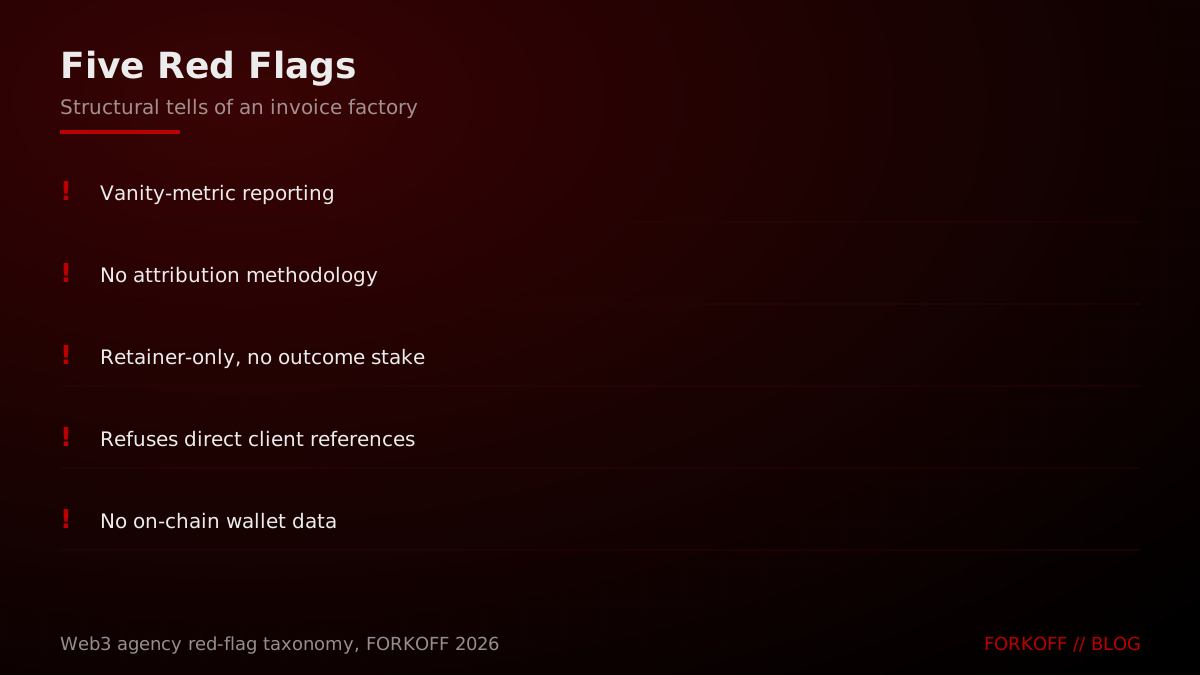
When you see two or more of these, walk. The single most reliable predictor of a wasted engagement is an agency that cannot or will not prove outcomes, and every red flag reduces to that one failure. A founder asking the community for an agency recommendation is, underneath, asking how to avoid exactly these flags.
Looking for a web3 marketing agency for token launch
A founder asks the BlockchainStartups community for a web3 marketing agency recommendation ahead of a token launch, surfacing the criteria founders use when they have a TGE deadline.
What types of web3 projects benefit most
Not every crypto project needs the same engagement, and a good agency scopes the work to the project type rather than selling one package to everyone. The clearest pattern is that the projects with a token event ahead of them benefit most, because the launch concentrates the value of distribution into a narrow window that cannot be repeated.
DeFi protocols are a strong fit because the audience is sophisticated and the proof standard is naturally on-chain, which suits an agency that measures outcomes at the wallet level. The marketing job is to translate genuine protocol mechanics into a narrative that a yield-focused audience trusts, which rewards an agency with real DeFi literacy and punishes one that treats it as generic crypto. Pre-TGE protocols are the highest-leverage type of all, because the months before a token event are when community and credibility have to be built from a standing start, and an agency with an existing network compresses that timeline dramatically.
DePIN networks are a newer and increasingly common fit, where the marketing job spans both a crypto-native token audience and a real-world hardware or service user base, which doubles the channel complexity. NFT collections, GameFi titles, DAOs, and real-world-asset platforms each carry their own audience quirks, but they share the same underlying need: distribution across organic channels measured by retention rather than reach. The constant across all of them is that stage matters more than category, and a protocol in its launch sprint benefits more than a mature one in steady state regardless of which vertical it sits in.
When to hire versus build in-house
The decision is not agency or in-house in the abstract. It is a function of stage, budget, and what the protocol is ready to convert. The right answer changes as a protocol matures, and getting the timing wrong in either direction is its own form of wasted spend.
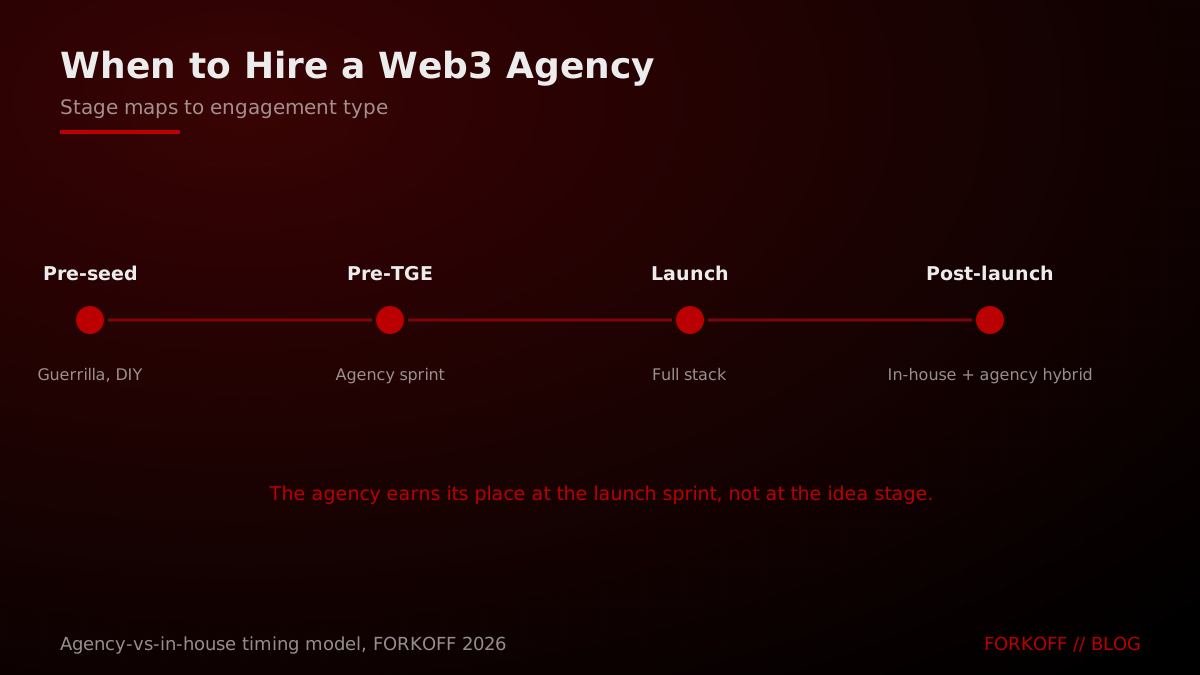
At the earliest stage, before there is a token or a launch date, an agency is often the wrong call. A pre-seed protocol with little cash is usually better served by guerrilla plays it can run itself, and the guerrilla marketing plays for early-stage web3 protocols guide covers the budget-light tactics that compound without an agency invoice. Hiring a full-stack agency to market a product that is not ready burns money on reach you cannot yet convert.
The agency earns its place in the launch sprint. Around a TGE, the combination of channel expertise, an existing KOL network, and PR relationships compresses months of relationship-building into weeks, which is exactly when that compression is worth the most. This is the window where token launch marketing and TGE distribution pays for itself, because the launch is a one-time event you cannot re-run if the distribution is weak. The community and airdrop layer that sits inside the launch sprint has its own sequencing logic, covered in the airdrop marketing playbook for 2026. The community is also actively assembling teams for this exact moment.
We are building a remote marketing team for web3 companies
An r/web3 thread on building a remote marketing team for web3 companies, with operators discussing how to structure distribution and which functions to keep in-house versus outsource.
Post-launch, the calculus shifts again. A protocol in steady state with recurring community operations and an established cost of acquisition is usually better off building those functions in-house, often with a fractional CMO for web3 protocols providing strategy and an agency handling surges around launches and events. The mature pattern is a hybrid, not a binary, and an agency that pushes you toward a permanent full-service retainer when you have outgrown the need is optimizing for its revenue, not yours.
FORKOFF versus the field
The comparison most founders want is direct, so here it is. The axes below are factual and structural, and the competitor positioning is summarized from each agency's own public service descriptions. The point is not to disparage anyone. It is to show how the pricing model and the proof standard differ, because those two axes predict the experience more than anything else.

FORKOFF versus the field on the axes that matter
| Axis | FORKOFF | NoGood | OutreachZ | RZLT |
|---|---|---|---|---|
| Pricing model | Outcome-priced | Retainer | Retainer | Retainer |
| Surfaces run in-house | Six connected surfaces | Growth and paid focus | Outreach and link focus | Brand and community focus |
| Proof standard | Payment-level and on-chain | Analytics dashboards | Outreach reply metrics | Engagement and reach |
| Asset ownership | Client keeps the assets | Varies by contract | Varies by contract | Varies by contract |
Axes are factual and structural; competitor positioning is summarized from their public service descriptions. See the per-competitor comparison pages for detail.
The table reduces to two structural choices. The first is the pricing model, where FORKOFF is outcome-priced and the rest of the field defaults to retainers. The second is the proof standard, where FORKOFF commits to payment-level and on-chain attribution while the field tends toward analytics dashboards, reply metrics, and reach. Neither choice makes a competitor bad at what it does; a strong retainer agency with a clear scope can absolutely deliver. The choices simply tell you where the incentive sits and what kind of evidence you will receive. For the line-by-line versions, the FORKOFF versus RZLT and FORKOFF versus OutreachZ pages go deeper, and the best crypto marketing agency rankings page sets the wider field in context.
What 2026 changes for web3 marketing
The job is shifting under everyone's feet, and an agency that is still running the 2023 playbook is already behind. Two forces are doing most of the reshaping. The first is the answer-engine layer. Search increasingly resolves inside AI Overviews and assistants like ChatGPT and Perplexity, which means the project that is the cited source wins attention before a user ever reaches a traditional result. That makes answer-engine optimization and generative-engine optimization a distribution channel, not a nice-to-have, and it is the work the AI-era marketing surface now centers on.
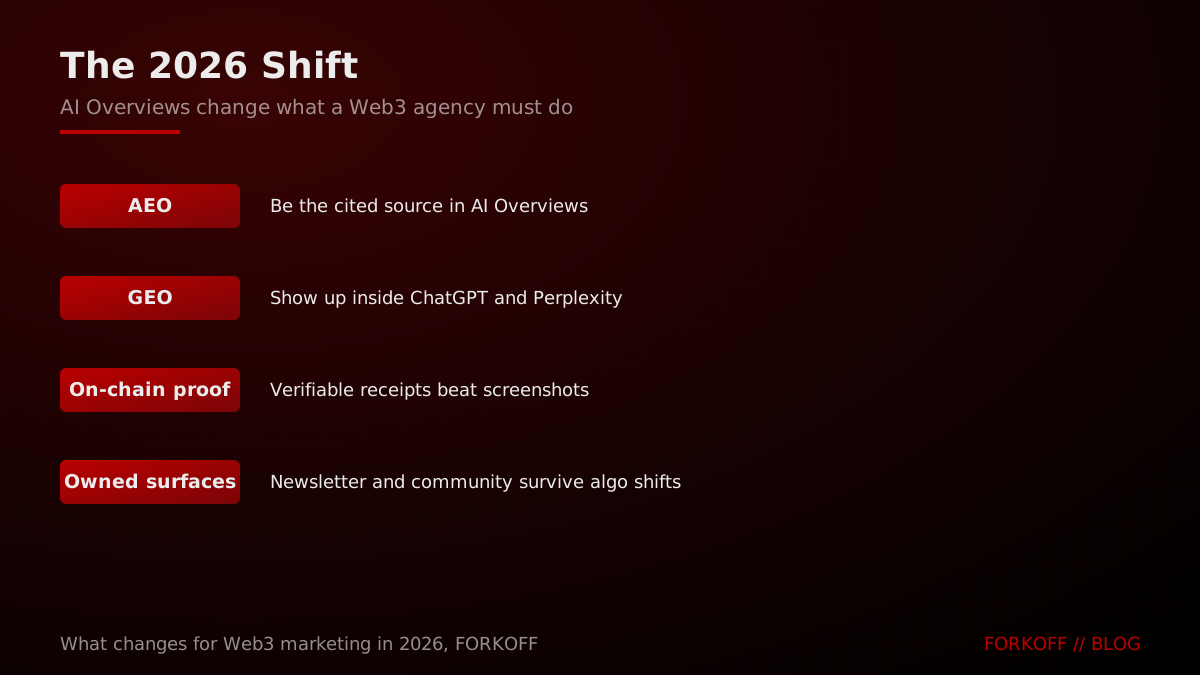
The second force is the trust correction. The market has lost patience with empty KOL hype and bot-inflated reach, and the agencies that survive the correction are the ones that can prove outcomes on-chain and at the payment level. Industry data sources like Chainalysis research, DeFiLlama's on-chain metrics, and ecosystem references such as CoinDesk and CoinMarketCap make verifiable data the baseline expectation, and the broader category context from the World Economic Forum and research shops like Messari keeps raising the bar on what counts as credible. The owned surfaces, the newsletter and the community, are the ones no algorithm can switch off, which is why a durable engagement builds those alongside the acquisition channels. The web3 go-to-market playbook and the web3 marketing in Dubai and the MENA region guide both go deeper on how this plays out in execution and in specific markets.
Web3 marketing is a distribution problem, not a promotion problem
The reflex when a token underperforms is to buy more reach: more KOL posts, more paid threads, more airdrop noise. That reflex is why so much budget evaporates. Reach without a route into a product is a vanity expense. A category-winning agency starts from the opposite end. It maps the surfaces where the right audience already pays attention, then builds a repeatable system that places channel-native content there and routes the attention toward a wallet action or a pipeline event. The content is the cheap part. The distribution system and the attribution underneath it are what a real agency is selling.
Source: FORKOFF web3 distribution model, 2026
Market presence and where the work happens
Web3 is global by default, but the surfaces and the relationships are regional in practice. A KOL who carries weight in one market is unknown in another, the event circuit clusters in specific cities, and the regulatory framing differs enough that the same campaign cannot run unchanged everywhere. An agency's real footprint is measured by which markets it can actually operate in, not by the cities listed on a contact page.
FORKOFF operates across the major web3 hubs, and the regional specifics matter most around events and KOL relationships, which are inherently local. The Gulf region in particular has become a center of gravity for token launches and protocol headquarters, and the playbook there has enough regional texture that it deserves its own treatment. The full version of that regional approach, including the compliance and channel nuances, lives in the web3 marketing in Dubai and the MENA region guide, which is the resource for any founder targeting that market specifically.
The broader principle is that a category-winning agency adapts the same six-surface system to the market rather than running an identical campaign everywhere. The surfaces are constant; the relationships, the language, and the event calendar are local. An agency that cannot speak to the regional differences in its target market is selling a template, and a template rarely converts a community that expects to be addressed in its own context.
The verdict
A web3 marketing agency is worth hiring when it functions as a distribution system with proof, and worth avoiding when it functions as an invoice factory with a dashboard. The distinction is not subtle once you know what to look for. The category-winning agency runs the surfaces where crypto audiences actually live, prices on the outcome you care about, and hands you receipts you can verify on-chain or at the payment level. The rest sell reach, bill a flat retainer, and report follower counts. The market is sorting these two groups apart in real time, and the founders who ask the right questions early are the ones who avoid the expensive lesson.
FORKOFF was built around the first model. It runs clipping, KOL programs, Spaces, podcast PR, content and AEO, and event activation as one connected stack, on an outcome-priced contract, with payment-level and on-chain proof. If that is the kind of engagement you want, the next step is a conversation about your specific launch, not a generic proposal. You can also compare FORKOFF to other agencies directly or read the campaign case studies for the evidence behind the model.