Most founders treat the marketing agency vs in house decision as a price comparison. They line up a posted salary against a monthly retainer, pick the cheaper-looking number, and move on. That comparison is wrong in a way that costs real money, because the two numbers are not the same kind of number. A salary is unloaded. A retainer is already loaded. Comparing them directly is like comparing a wholesale price to a retail price and concluding the wholesaler is being generous.
The honest question is not "which costs less per month." It is "which delivers more outcome per dollar over the next twelve to eighteen months, accounting for ramp, churn, tools, and the gap between one person and a function." When you model it that way, the decision stops being about preference and starts being about stage. This guide builds the full-cost matrix so you can answer it with numbers instead of instinct, and it draws on FORKOFF first-party engagement data rather than generic benchmarks where it can.
FORKOFF runs marketing for founders as an outcome-priced founder-funnel engagement, so we model this exact tradeoff for companies every week. The numbers below are anonymized where consent was not granted, but they are real and source-traced. What matters up front is the principle: the visible cost is almost never the real cost, and the real cost is where the decision lives.
The 30-second answer to marketing agency vs in house
A $120,000 marketing hire is not a $120,000 decision. Loaded with payroll tax, benefits, tools, and recruiting, the true year-one cost lands near $196,000, and the hire produces almost no pipeline for the first 3 to 6 months. If that person leaves at month 9, the clock resets and you eat another $80,000 in churn cost. An outcome-priced agency carries none of the ramp or churn risk and stays cheaper for well over a year at a typical retainer. The honest rule: before you have repeatable go-to-market, buy the function from an agency or fractional lead; after you have proven channels and the volume to justify fixed cost, bring the proven engine in-house. In one FORKOFF first-party engagement, 90 days of founder-led delivery cost $9,300 and closed one engagement at $36,000 ACV, while an equivalent hire would have burned roughly $49,000 in salary alone and still been mid-ramp.
The salary is the smallest part of the cost
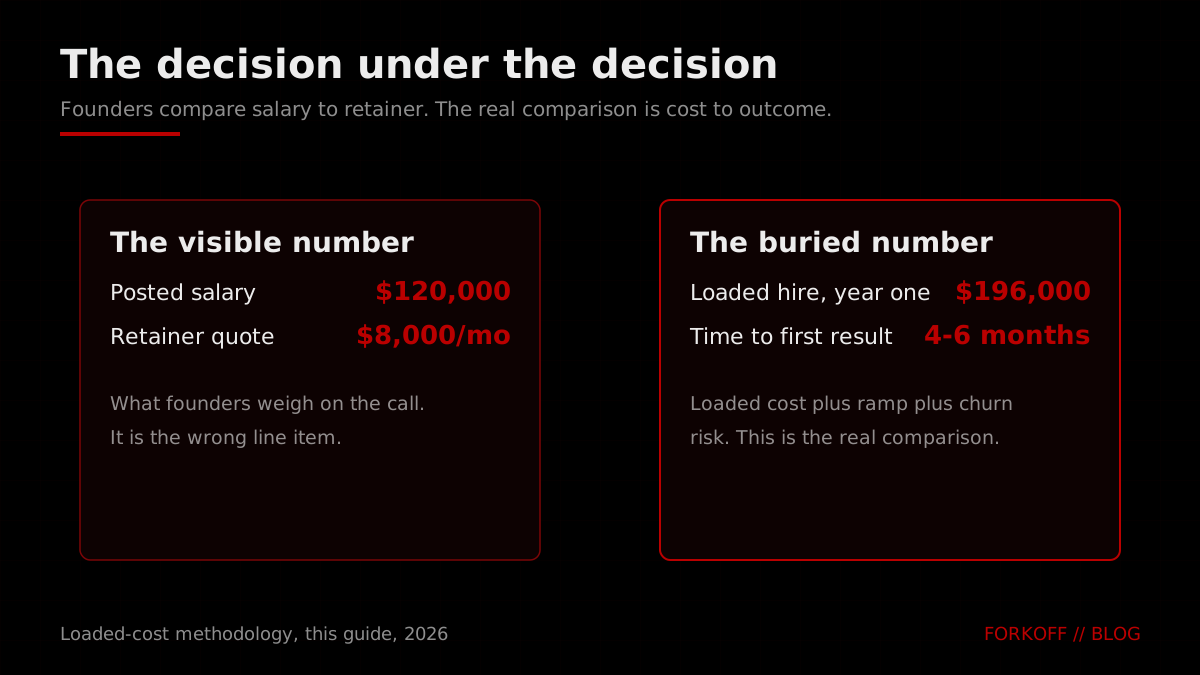
Founders anchor the agency-versus-hire decision on two visible numbers, the posted salary and the monthly retainer, and both are misleading. A marketing salary carries a loaded multiplier of roughly 1.4 to 1.7x once you add payroll tax, benefits, equipment, software seats, and the recruiting cost to fill the role. A $120,000 base becomes a $196,000 year-one commitment before a single campaign ships. The retainer, by contrast, is already loaded: the agency absorbs its own tools, its own hiring, and its own bench. Comparing a loaded retainer to an unloaded salary is the single most common modeling error founders make, and it reliably makes the hire look cheaper than it is.
Source: BLS occupational wage data plus standard loaded-cost factors, 2026
About these numbers
Salary figures, loaded cost breakdowns, and retention rates in this post are sourced from FORKOFF first-party engagement data (anonymized, consent-gated), supplemented by publicly cited benchmarks from the Bureau of Labor Statistics, Glassdoor, and LinkedIn Salary (2026-Q2 snapshots). All figures are directional estimates; individual hiring and agency economics vary by market, role seniority, and product stage.
What decision do most founders get wrong?
The first mistake is framing the choice as agency or hire, full stop, as if it were a single irreversible decision. It is not. It is a sequence that depends on whether you have found repeatable go-to-market yet. The second mistake is the one that costs money: comparing the wrong numbers. A founder sees a $120,000 marketing manager on the job board and an approximately $8,000 a month retainer from an agency and does the arithmetic. The hire is $120,000 a year. The agency is $96,000 a year. The hire wins, supposedly, and you also "own the talent."
That math is broken on both sides. The hire is not $120,000, and the comparison ignores everything that makes the agency a function rather than a person. We will rebuild both sides correctly. By the end you will have a matrix you can run against your own stage and channel maturity, and a clear rule for which lane wins when.
Founders say this out loud constantly, and the sharpest of them already sense the framing is off. One DTC founder put it directly: the dream of taking everything in-house is real, but the binary is a false dichotomy.
I want to take all of my marketing in-house. I get it. That's the dream when you start. But it's more nuanced than that. In-house vs agency is a popular debate, but it's probably a false dichotomy.
Ash
@ashvinmelwani
“I want to take all of my marketing in-house.” I get it. That’s the dream when you start. But it’s more nuanced than that. In-house vs agency is a popular debate - but it’s probably a false dichotomy.
Should I hire a marketing agency or part-time in house marketing team?
A founder trying to improve their brand's marketing asks the community whether to retain an agency or bring on a part-time in-house marketer, weighing cost against control and continuity.
The reason this matters is that the gap between the visible number and the real number is not small. It is roughly 1.6x on the salary side, plus a ramp gap measured in months of burn, plus a churn risk that can reset the entire investment. Get the comparison right and the decision usually makes itself. Get it wrong and you commit six figures to a bet you did not understand you were making. This is the same modeling discipline we apply across every founder funnel engagement, where the cost of a channel is always its loaded cost, not its sticker.
Operator noteA $120K base lands at $196K loaded in year one, 1.63x before one campaign ships., BLS wage data plus loaded-cost factors, 2026
Agency vs in-house: what does the full-cost matrix show?
Here is the comparison that should drive the decision. It is the one comparison table in this guide, and it is the table to screenshot. Every row is an axis where the two options differ in kind, not just in degree, which is exactly why a single price comparison fails to capture the choice.
The full-cost matrix, marketing agency vs in-house hire
| Cost axis | In-house hire (loaded) | Outcome-priced agency |
|---|---|---|
| Direct cost, year one | $120,000 base, $196,000 loaded | $60K to $120K/yr, retainer or per-outcome |
| Ramp to first result | 3 to 6 months at full salary | Days to weeks, specialists pre-trained |
| Churn and continuity risk | ~$80,000 reset if they leave at month 9 | Continuity owned by the agency, not you |
| Tool and software stack | ~$18,000/yr billed back to you | Absorbed into the engagement |
| Skill coverage | One generalist across 6 disciplines | Specialist per discipline, one lead |
| Pricing model | Fixed salary regardless of output | Outcome-priced, tied to delivered results |
| Best stage fit | Series B and beyond with proven channels | Pre-seed through Series A finding GTM |
Loaded figures use BLS wage data plus standard 1.4 to 1.7x loaded-cost factors. Retainer ranges reflect founder-stage marketing engagements, 2026.
Read the matrix top to bottom and a pattern appears. On every axis that founders ignore, the in-house hire carries a hidden cost the agency does not: ramp, churn, tools, and the single-point-of-failure risk of one generalist covering six disciplines. On the one axis founders fixate on, sticker price, the difference is far smaller than the loaded reality. The agency is not always the right answer, but it is almost always cheaper and lower-risk than the hire looks on the surface, right up until the stage where volume flips the math.
The rest of this guide walks each row of the matrix in turn, because each one hides a number worth modeling. We start with the cost line that founders systematically underestimate: what a six-figure salary actually costs once it is loaded. This is the same lens we apply in the AI agency pricing unit economics breakdown, where the only honest number is the fully loaded one.
What does a $120K growth hire actually cost (loaded salary)?
A $120,000 base salary is the number on the offer letter. It is not the number that hits your bank account. The loaded cost of an employee, the figure finance teams actually budget, adds payroll taxes, benefits, equipment, software, and the cost of recruiting the person in the first place. The standard loaded-cost multiplier for a professional role sits between 1.4x and 1.7x, and a marketing hire who needs a full software stack lands near the top of that range.
Walk the stack. Payroll tax and benefits add approximately $34,000 on a $120,000 base in the United States, between employer FICA, unemployment insurance, health coverage, and retirement match. The marketing software the person needs, analytics, SEO tooling, email automation, design, social scheduling, and ad infrastructure, runs about $18,000 a year for a single operator. Recruiting and onboarding, whether you post on LinkedIn Jobs, pay a contract platform like Toptal, or burn your own time and a signing bonus, conservatively adds $24,000 amortized into year one. Add it up and the $120,000 base is a $196,000 commitment.
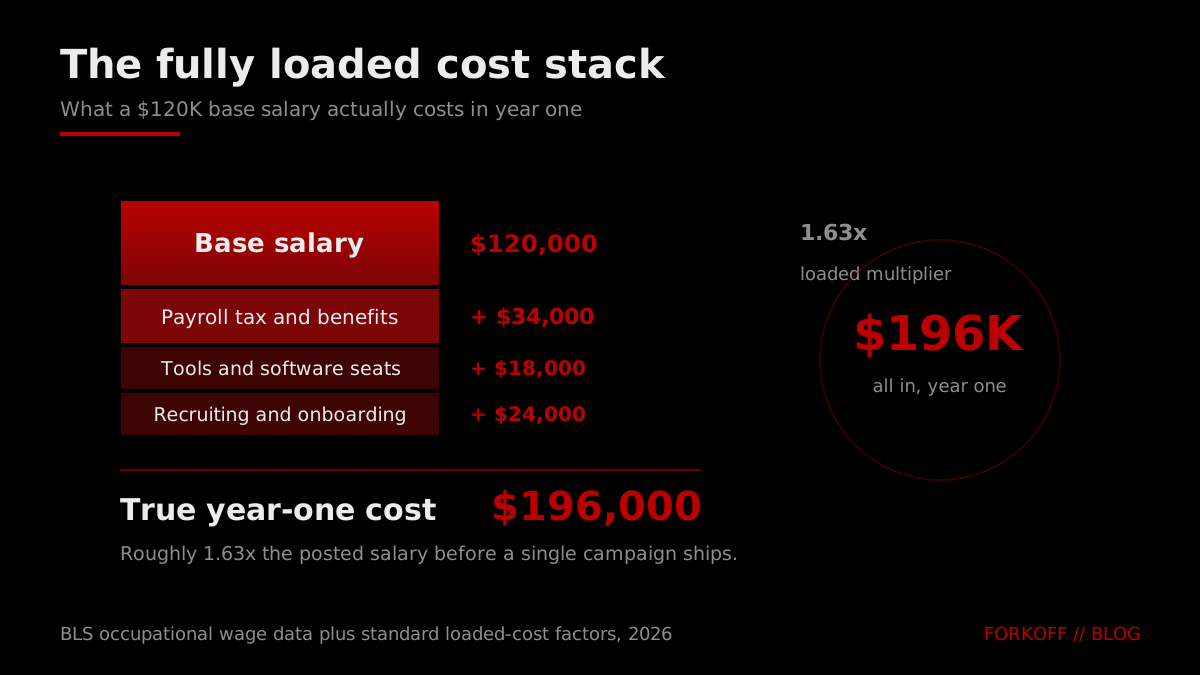
That is a 1.63x multiplier before the person has shipped a single campaign. The U.S. Bureau of Labor Statistics occupational wage data confirms the base ranges for marketing roles, commercial salary aggregators like Glassdoor and Indeed show the same posted ranges, and any Harvard Business Review treatment of marketing org cost will tell you the same thing finance already knows: the salary line is the smallest part of the headcount cost. When you compare that $196,000 to a $96,000 annual retainer, the agency is not 25 percent more expensive than the hire. It is roughly half the cost, and that is before you account for ramp and churn.
There is a reason agencies can absorb the loaded cost and present a flat number. They spread tools, recruiting, and bench across many clients, so the per-client share of those fixed costs is a fraction of what a single company pays to stand them up for one person. That is the structural efficiency of buying a function instead of building one, and it is the same efficiency that makes a part-time executive cheaper than a full-time executive hire at the same seniority.
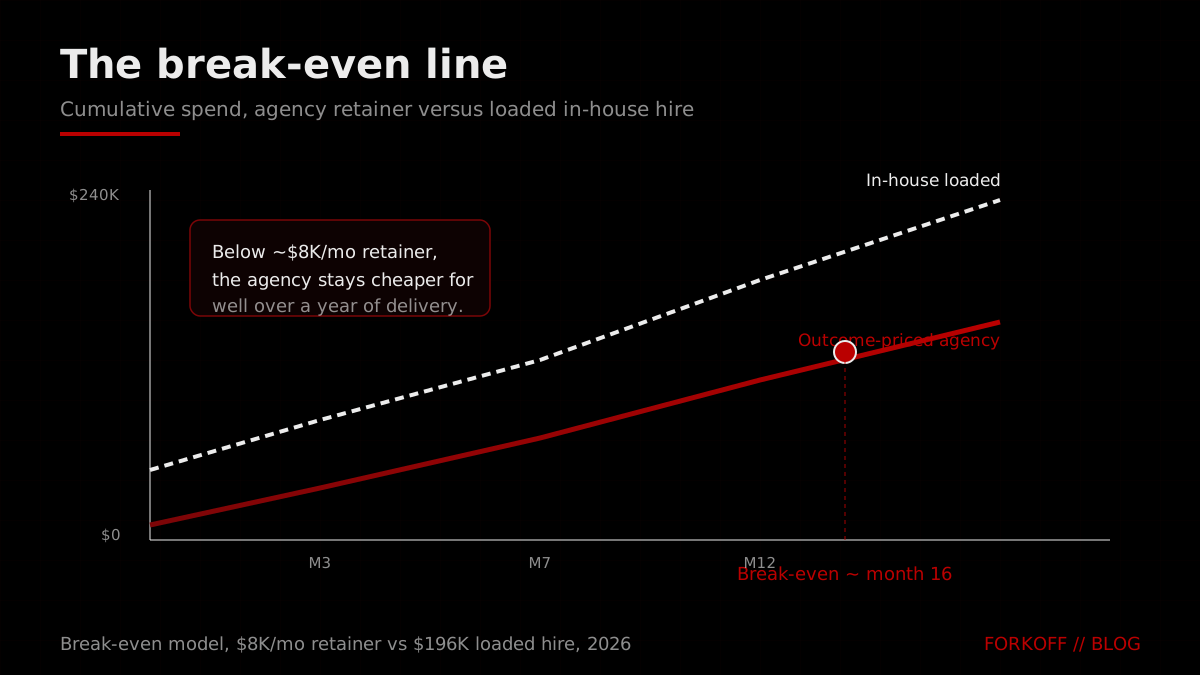
Cumulative spend by month, retainer vs loaded hire
| Month | In-house loaded, cumulative | Agency retainer, cumulative |
|---|---|---|
| Month 3 | ~$73,000 (incl. recruiting) | ~$24,000 |
| Month 6 | ~$98,000 | ~$48,000 |
| Month 12 | ~$172,000 | ~$96,000 |
| Month 16 | ~$222,000 | ~$128,000 |
Model assumes $196K loaded hire amortized across year one plus recruiting front-load, versus an $8K/mo outcome-priced retainer. Directional, not a quote.
The break-even table above makes the cumulative picture concrete. Track cumulative spend month by month and the agency stays meaningfully cheaper for well over a year. The lines do not cross until somewhere around month 16 under typical assumptions, and they only cross because the loaded hire's cost flattens after the recruiting front-load while the retainer keeps accruing. Below that crossover, the agency wins on pure cost, and it has not yet been credited for skipping ramp and churn.
What is the ramp cost of the 3-6 month productivity gap?
Even if you accept the loaded salary, you are still overpaying in the early months, because a new hire does not produce at full output on day one. They have to learn your product, your ICP, your positioning, your existing funnel, and your tool stack before they can ship work that moves a number. For most marketing roles that ramp takes three to six months, and during that window you are paying full loaded salary for a fraction of the eventual return.
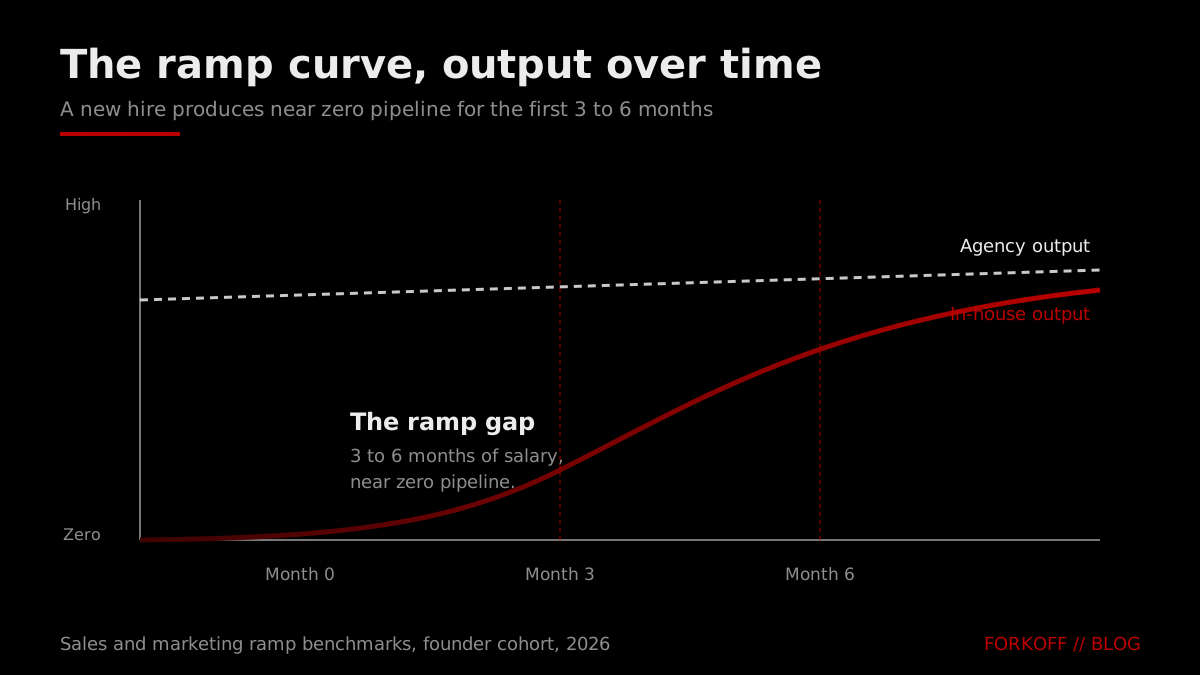
Quantify it. At $196,000 loaded annual cost, six months of ramp is approximately $98,000 of salary spent before the hire reaches steady-state pipeline. That is not a soft cost or a rounding error. For an early-stage company measuring runway in months, it is a material slice of the budget spent on output that has not arrived yet. The First Round Review guide to building a marketing team makes the same point from the operator's chair: the first hire's first quarter is mostly learning, not shipping.
The ramp gap is paid salary against near-zero output
A new marketing hire does not produce pipeline on day one. They spend the first weeks learning the product, the ICP, the positioning, and the tool stack, and most marketing roles take 3 to 6 months to reach steady output. During that window you are paying full loaded salary for a fraction of the eventual return. An established agency skips the ramp because the specialists are already trained and the playbooks already exist. For an early-stage company where every month of runway is scarce, the ramp gap is not a soft cost. It is months of burn against a flat output line, and it is the cost founders forget to model.
Source: Sales and marketing ramp benchmarks, founder cohort, 2026
An agency carries no ramp gap, and this is the part founders consistently undervalue. The specialists are already trained, the playbooks already exist, and the engagement starts producing inside days or weeks rather than months. You are buying an output line that is already at altitude instead of paying to climb it. For a company that needs pipeline this quarter, not next year, the ramp difference alone can justify the agency even before the cost comparison. We see this every time we run the first 90 days with a growth agency, where the goal is results inside the quarter, not a ramp plan.
Operator note3 to 6 months of full salary buys near-zero pipeline while a new hire ramps., Founder-stage ramp benchmarks, 2026
The ramp gap also compounds with a hiring risk founders rarely price: you might ramp the wrong person. If the hire turns out to be a poor fit, you discover it three to four months in, after you have already paid the ramp and before you have seen the output. Now you are choosing between sunk-cost persistence and starting over. An agency relationship surfaces fit far faster, because you see real deliverables in the first weeks, and switching costs are a contract clause rather than a termination.
What happens when the hire leaves at 9 months (churn risk)?
Marketing roles churn. The function is high-pressure, the results are visible, and the talent is mobile, which means the median tenure for a first marketing hire at an early-stage company is often shorter than the time it took them to ramp. The scenario to model is not "the hire works out forever." It is "the hire leaves at month 9," because that is a common outcome, and it is financially brutal.
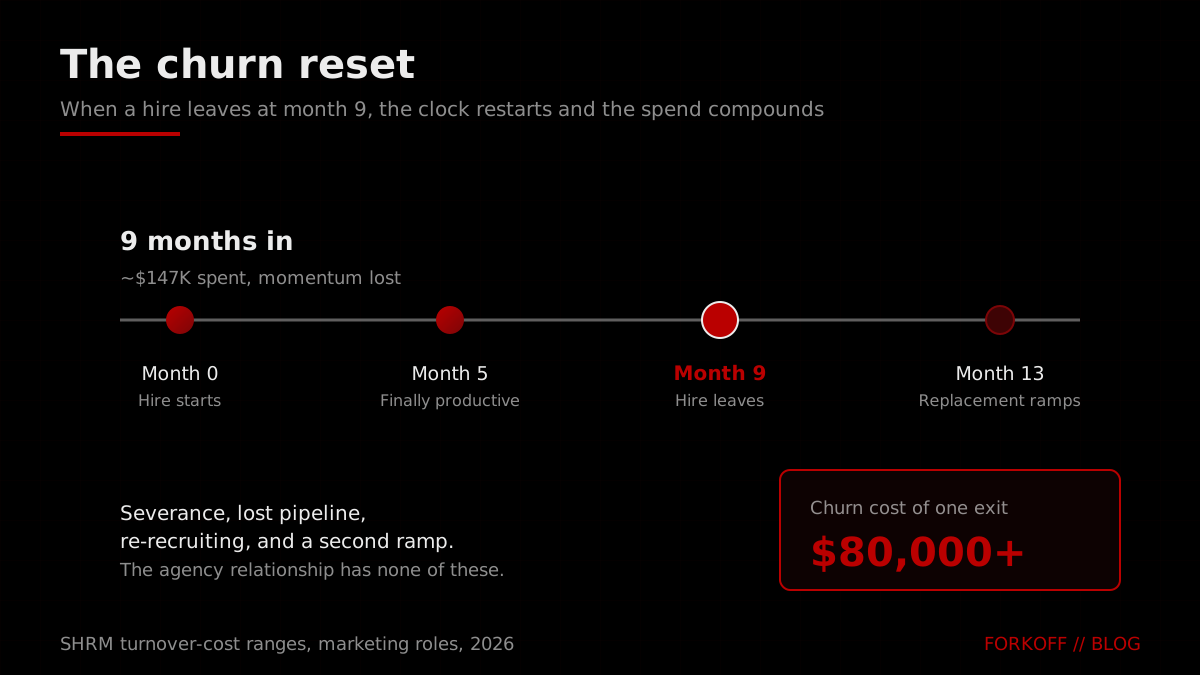
Trace the timeline. The hire starts at month 0, reaches productivity around month 5, and leaves at month 9. You have paid approximately $147,000 in loaded cost for four months of real output. Now the churn cost lands on top: severance, the lost pipeline while the seat sits empty, the cost to re-recruit, and a second full ramp on the replacement. SHRM turnover-cost research puts the all-in cost of replacing a professional employee at a large fraction of annual salary, and for a role with a long ramp the practical number lands at $80,000 or more. Gallup's work on disengagement and turnover underlines how expensive this churn is in aggregate.
Founders feel this acutely, which is why the question recurs across every operator community. An e-commerce founder weighing agency, freelancer, and in-house hire for social marketing is asking the same continuity question every founder eventually faces.
Social media marketing - Agency, freelancer or in-house hire?
The founder of an e-commerce health brand weighs three options for social media marketing, an agency, a freelancer, or an in-house hire, and asks operators which model gives the best return at their stage.
The agency relationship carries none of this. Continuity is the agency's problem. If a specialist on your account leaves the agency, the agency backfills from its bench without your pipeline skipping a beat, and you never see a severance line or a re-recruiting cost. You are paying for an outcome, and the outcome continues regardless of who on the agency's side delivers it. That continuity is a real, quantifiable hedge against the single largest hidden cost of the in-house path, and it is one reason we frame marketing spend as a portfolio of credibility and acquisition rather than a single fragile hire.
Operator note$9,300 of founder-funnel delivery closed one engagement at $36,000 ACV in 90 days., FORKOFF first-party engagement, source-traced, 2026
What tool-stack cost does neither option budget correctly?
The software a marketing function runs on is a cost both sides of this decision tend to ignore, and it tilts the comparison toward the agency in a way founders rarely notice. A single in-house hire still needs the full stack, because the work requires it regardless of how many people are doing the work. Analytics and attribution, SEO and content tooling, email and automation, design and creative, social scheduling, and ad tracking infrastructure are not optional for someone expected to run modern marketing.
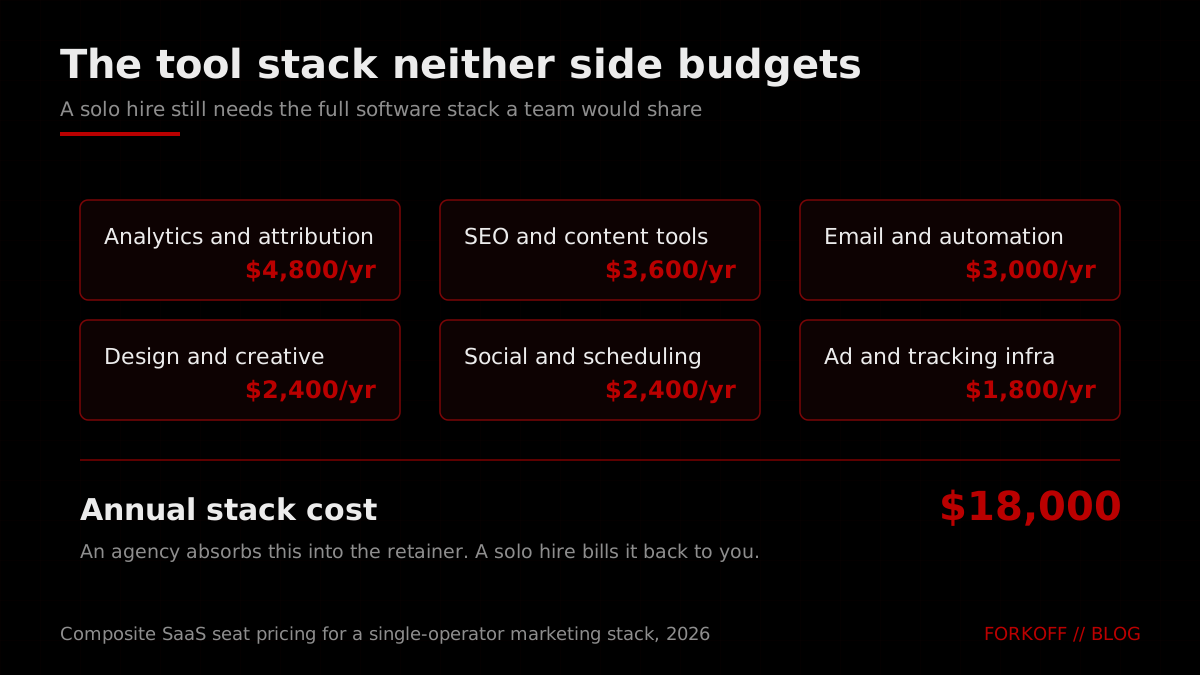
Price it out and a solo operator's stack lands near $18,000 a year, and that is conservative, since enterprise-tier analytics or a serious SEO suite alone can blow past that. This cost is invisible in the salary comparison because it does not show up on the offer letter, but it is real, recurring, and billed back to you the moment the hire requests their tools. An agency absorbs this entirely into the retainer. The agency already owns the seats, spreads them across clients, and often negotiates volume pricing a single company cannot. You are renting access to a stack that would cost you $18,000 a year to stand up alone.
This is the same hidden-overhead pattern that shows up everywhere in the build-versus-buy decision. The visible cost is the person or the retainer; the invisible cost is the infrastructure the person needs to do the job. Bessemer's Cloud Atlas, OpenView's SaaS metrics work, and SaaStr's writing on marketing spend all document how quickly tool spend accumulates inside a growth function. When you add $18,000 of annual tool cost to the in-house side of the matrix, the agency's flat retainer looks even better than the loaded-salary comparison already made it look.
What does an agency include that one hire cannot?
Cost is only half the comparison. The other half is coverage, and this is where one hire and a function diverge most sharply. Marketing is not one job. It is at least six: content, SEO, distribution, paid acquisition, lifecycle and email, and brand. A single hire is genuinely strong in one or two of those and competent-at-best in the rest, which means you are either accepting weak coverage across most of the surface or paying that person to learn disciplines on your time and your budget.
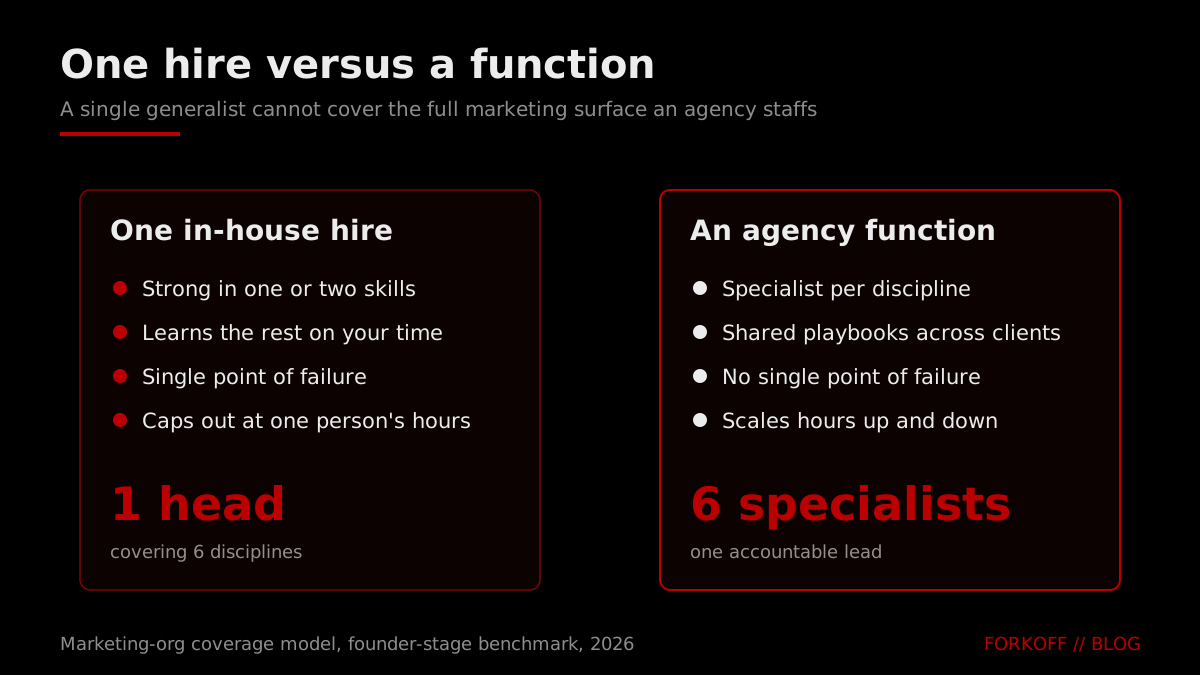
An agency function staffs a specialist per discipline under one accountable lead. The content person is a content person, the paid person is a paid person, and the playbooks are shared across every client the agency serves, so your account inherits patterns that took dozens of other companies to learn. There is no single point of failure, and the hours scale up and down with the work instead of being fixed at one person's forty-hour week. When Forrester or CMSWire write about marketing org design, the through-line is always the same: breadth of capability is hard to staff with headcount at an early stage, and that is exactly the gap an agency fills.
Operators debate this coverage question constantly, and the threads are worth reading before you decide. An r/marketing discussion on outsourcing versus building in-house surfaces the same coverage tradeoff from both sides, and creators like Exposure Ninja and Sam Dunning have built whole breakdowns around which model earns the better return for B2B companies specifically.
How To Do Better Marketing: Outsource vs In-house
An r/marketing thread debates whether it makes sense to assemble a full in-house marketing team or to outsource the function, with operators sharing the tradeoffs they hit on both sides.
In-House vs Marketing Agency: Which Earns The Best ROI?
Exposure Ninja
Exposure Ninja walks through which model earns the better ROI for growing companies.
B2B SaaS SEO: In-House Team vs. Agency?
Sam Dunning - Breaking B2B
Sam Dunning breaks down the in-house team versus agency question specifically for B2B SaaS.
This breadth is also why founders so often discover the hire was the wrong shape after the fact. They hired a content marketer because content felt urgent, then learned the real bottleneck was distribution or paid, two disciplines the content hire cannot cover. An agency does not force that bet. You get the discipline mix the goal requires, and the mix shifts as the goal shifts. A modern engagement covers the full surface, as our AI marketing agency service details, and that scope is what one hire structurally cannot replicate.
When does each option win (the stage gate)?
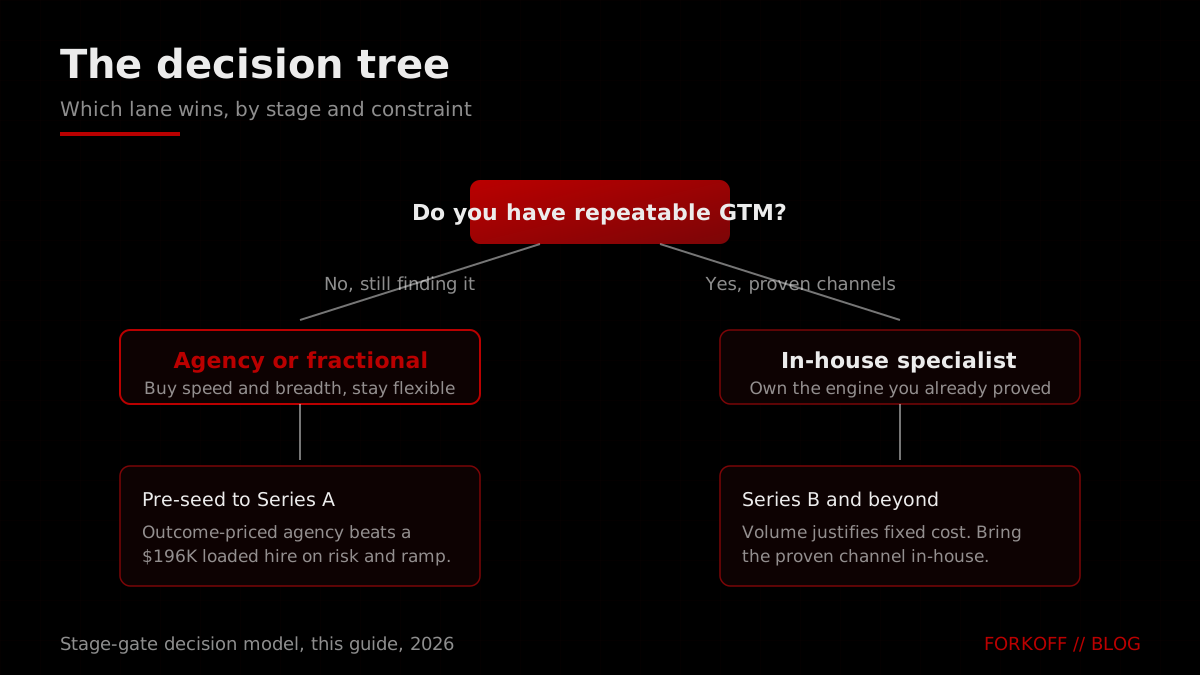
Strip away the cost detail and the decision reduces to one question: have you found repeatable go-to-market yet? That single fork routes most of the answer. Before repeatable GTM, you are still discovering what works, and the worst time to commit a loaded six-figure hire is when you cannot yet tell the hire what to do. After repeatable GTM, with proven channels and the volume to justify fixed cost, owning the engine in-house starts to pay off.
The right answer changes with stage, not preference
Agency versus in-house is not a values question, it is a stage question. Before a company has repeatable go-to-market, the highest-leverage move is to buy breadth and speed from an agency or a fractional lead while the founder still owns the strategy. Once channels are proven and the monthly volume is large enough that fixed cost beats variable cost, bringing the proven engine in-house starts to win. The mistake in both directions is treating the decision as permanent. The companies that compound treat it as a sequence: rent the function early, own it once the math flips.
Source: Stage-gate decision model, FORKOFF, 2026
The other half of the gate is the public signal that a company has flipped to the in-house side. When a brand's marketing volume grows large enough that a standing team is cheaper than a variable engagement, the in-house build wins, and large companies act on exactly that signal when they bring an external agency in-house at scale.
$IREN acquired Awaken, its former external creative and media agency, bringing brand and marketing in-house as it expands its AI Cloud business across North America, Europe and APAC.
Wall St Engine
@wallstengine
$IREN acquired Awaken, its former external creative & media agency, bringing brand and marketing in-house as it expands its AI Cloud business across North America, Europe and APAC.
How do Seed, Series A, and bootstrapped scenarios compare?
The matrix decides the general case, but founders live in specific cases, so here are three worked scenarios that map the decision onto real stage and budget constraints. Each one runs the same numbers from the matrix against a different reality.
A seed-stage AI startup with eighteen months of runway and no proven channel should not make a $196,000 loaded bet on one generalist. The runway math is unforgiving: six months of ramp is a third of a year of survival spent on output that has not arrived. The right move is an outcome-priced agency or fractional lead that produces pipeline this quarter while the founder keeps owning strategy. This is the exact profile we built the AI startup marketing model around, and the marketing strategies for AI startups guide walks the channel choices.
A Series A SaaS company with one proven channel and a real budget sits at the hinge. Here the answer is usually hybrid: a fractional or first in-house lead who owns the proven channel and the strategy, with an agency running the execution layers the lead cannot personally staff. The company gets senior ownership without betting the entire budget on a single hire's breadth. The developer marketing strategy and dev tools marketing model both show how a technical Series A splits this work.
A bootstrapped founder with no outside capital has the tightest constraint of all, because there is no runway buffer to absorb a ramp or a churn reset. For this founder the agency or fractional path is not just cheaper, it is the only responsible bet, since a single failed hire can end the company. The founder-led content marketing approach keeps the founder's own voice at the center while an outcome-priced layer handles the volume, the pattern our first-party data below was drawn from.
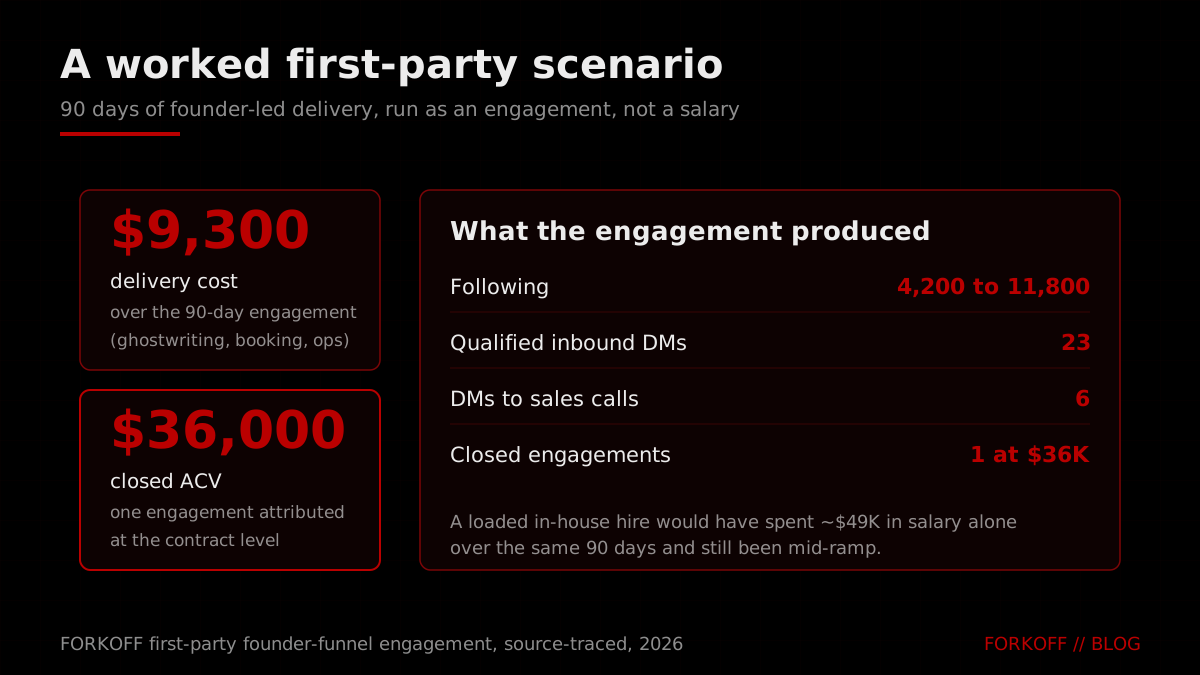
That first-party scenario is worth stating plainly, because it is the cleanest illustration of outcome pricing beating a loaded hire. In one FORKOFF founder-funnel engagement, 90 days of founder-led delivery, ghostwriting, podcast booking, and distribution ops, cost approximately $9,300. Over that window the founder's audience grew from 4,200 to 11,800, produced 23 qualified inbound DMs, converted 6 of them into sales calls, and closed one engagement at approximately $36,000 ACV. An equivalent in-house hire would have spent approximately $49,000 in loaded salary over the same 90 days and still been mid-ramp with no closed pipeline. The number that matters is the ratio: $9,300 of outcome-priced delivery against a $36,000 close, versus $49,000 of salary against zero.
What is the hybrid play (in-house lead plus agency execution layer)?
The fastest-growing companies rarely pick a pure lane. They run a hybrid, and once you understand why, it becomes the default recommendation for any company past the earliest stage. The structure is simple: an in-house lead or a fractional CMO owns strategy, brand, and the number, and an agency runs the execution layers underneath them.
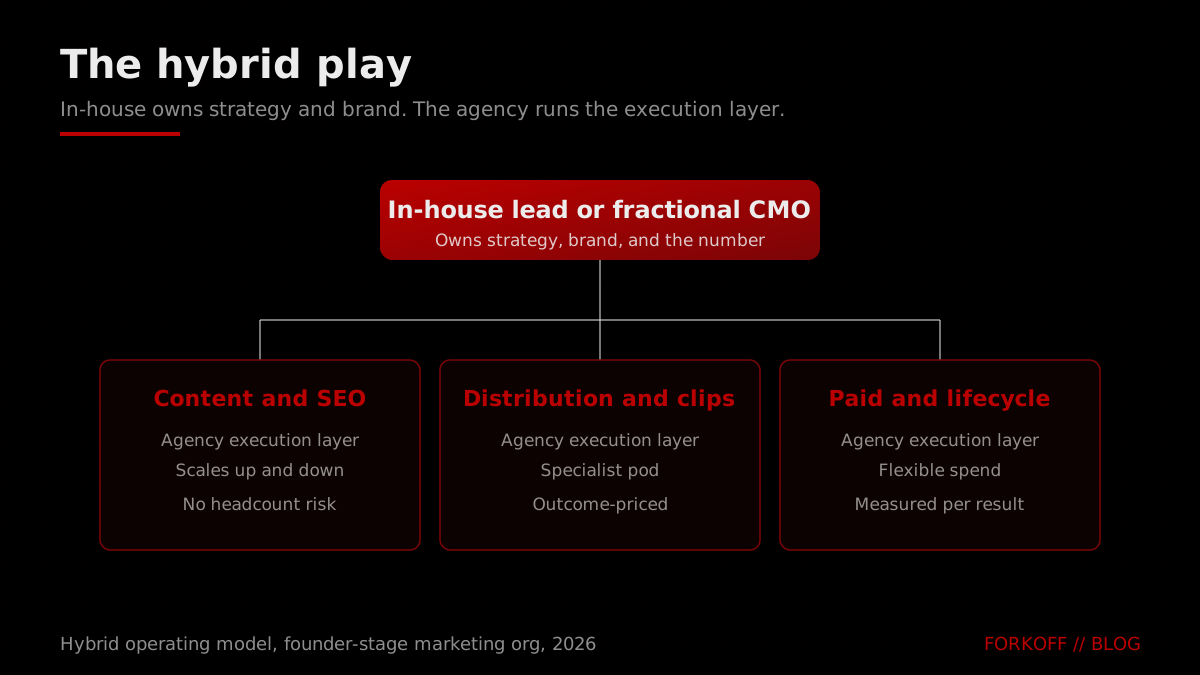
This works because it assigns each job to the side that does it best. Strategy, brand judgment, and accountability for the number belong in-house, with someone who lives the business every day. Execution at volume, content production, distribution, clipping, paid management, and lifecycle, belongs with specialists who do nothing else and can scale hours without a hiring decision. You get senior ownership without the loaded cost of staffing every discipline, and you get specialist execution without the ramp and churn risk of building the whole function in-house. The SaaS distribution reset and the agent-native GTM founder stack both describe this lead-plus-execution shape in detail. Operators who eventually build the full in-house team, like the playbook Sabri Suby walks through, tend to do it only after the hybrid has already proven the channels worth owning.
In-House VS Agency: How To Build Your Own Team
Sabri Suby
Sabri Suby on when and how to build your own in-house team instead of using an agency.
The public signal that a company has outgrown the hybrid and should bring everything in-house is volume. When the monthly marketing workload is large enough that fixed cost beats variable cost, and the channels are so proven that strategy is execution, the in-house build starts to win. That is exactly what large companies do when they bring an external agency in-house at scale, as happens once a brand's marketing volume justifies a full standing team. For most founder-stage companies, that moment is years away, and the hybrid is the right structure until it arrives.
What changed in 2026 as AI tilts the math toward outcome pricing?
The agency-versus-hire calculus shifted in 2026, and the shift favors the buy-the-function side more than it used to. The reason is that AI collapsed the cost of execution while leaving the cost of judgment untouched. Content drafting, clip production, ad-variant generation, and reporting are now substantially cheaper to run at volume, which means an agency that operates an AI-leveraged production layer delivers more output per dollar than a single hire manually producing the same work. The hire's loaded cost did not fall in 2026. The agency's effective output per retainer dollar rose.
That divergence matters because it widens the gap the full-cost matrix already showed. A solo in-house hire now has to compete not just with an agency's specialist breadth but with an agency's AI-accelerated throughput, and one person manually running modern marketing tools is structurally slower than a function that has automated the repetitive layer. The strategic judgment, the positioning, the channel bets, the brand calls, still has to live with a senior human, which is exactly why the hybrid model held up as the durable answer. What changed is the price of the execution layer underneath that judgment.
The second 2026 shift is on pricing structure. As AI made output cheaper to produce, outcome-priced engagements became more credible, because an agency confident in its production efficiency can tie price to results rather than to hours. That is the opposite of the old retainer-for-activity model, and it directly answers the loudest founder complaint about agencies. An outcome-priced founder-funnel engagement prices to delivered pipeline, not to a body in a seat, which removes the single biggest reason founders historically preferred a hire they could "control." The control founders actually want is accountability for the number, and outcome pricing delivers exactly that.
What are the red flags in each lane, agency and in-house?
Both lanes have failure modes, and naming them protects the decision regardless of which way you go. On the agency side, the red flags are concrete. The loudest founder complaint is paying for activity that does not convert, a frustration one operator voiced bluntly on X about projects bleeding $15,000 to $30,000 a month on agencies that under-deliver.
Every crypto project I talk to is hemorrhaging $15-30k/month on agencies that under-deliver. The fix is teaching founders to run marketing in-house.
MAX
@maxxmalist
launching a whop community teaching crypto founders how to do marketing in-house is a $50k/mo layup that nobody's running every crypto project i talk to is hemorrhaging $15-30k/month on agencies that under-deliver
Watch for retainers with no outcome accountability beyond a monthly report deck, since a flat fee for activity rather than results is the oldest agency trap. Watch for a generic playbook applied to your account with no evidence of fit, for account teams that churn so the people who pitched you are gone in a month, and for any agency that cannot show you the math behind a claim. Founders who have been burned here, as the getting-burned-by-an-agency breakdown documents, almost always cite one of these signals in hindsight. The defense is to demand outcome pricing and an audit-style verification of every claim before you sign.
On the in-house side, the red flags are subtler because they are organizational rather than contractual. The first is hiring a generalist and expecting specialist depth across six disciplines, which sets the person up to fail. The second is hiring before you have a channel to point them at, so they spend the ramp inventing strategy instead of executing it. The third is treating the hire as permanent and refusing to revisit the decision when the math changes, in either direction. The companies that get the most from an in-house hire are the ones who already proved the channel, the budget, and the volume, the profile the SaaS company marketing model is built for, and who hire to own a known engine rather than to discover an unknown one.
The cleanest way to avoid both sets of red flags is to make the decision on the matrix rather than on instinct or on whoever pitched you last. Run your stage, your runway, your proven channels, and your true loaded numbers through the comparison above. If you have not found repeatable go-to-market, buy the function and keep your runway. If you have proven channels and the volume to justify fixed cost, build the team. And if you are in between, run the hybrid. The numbers, not the preference, should pick the lane.
The marketing agency vs in house decision is not a verdict you render once and live with forever. It is a sequence you re-run as your stage changes, and the only honest input is the fully loaded number on each side. A $120,000 hire is a $196,000 commitment with a ramp gap and a churn risk. An outcome-priced agency is a flat, accountable cost that ties price to delivered results and carries none of the hidden lines. For most founders, most of the time, before the volume flips the math, the agency or the hybrid is the lower-risk, lower-cost, higher-output bet. If you are at the agency stage, see the best AI marketing agencies comparison for a ranked shortlist. Build the team when the matrix says to, not before.


![How to Make a Launch Go Viral on X: The 5-Lever Playbook [2026]](/blog/covers/how-to-make-launch-go-viral-on-x-2026-cover.jpg)