X has shipped one genuinely new authoring primitive in the last decade, the quote tweet, and 13 years later it shipped the second one. Commentary, branded React with Video inside the app, takes the entire 700 million daily user base on the platform and gives every one of them a TikTok-style face-cam reaction overlay on every post. The mechanic, the algorithmic reward, the cultural moment, and the operator stakes are bigger than the launch tweet suggests, and most of the existing coverage has barely scratched the surface.
The 14-day novelty window
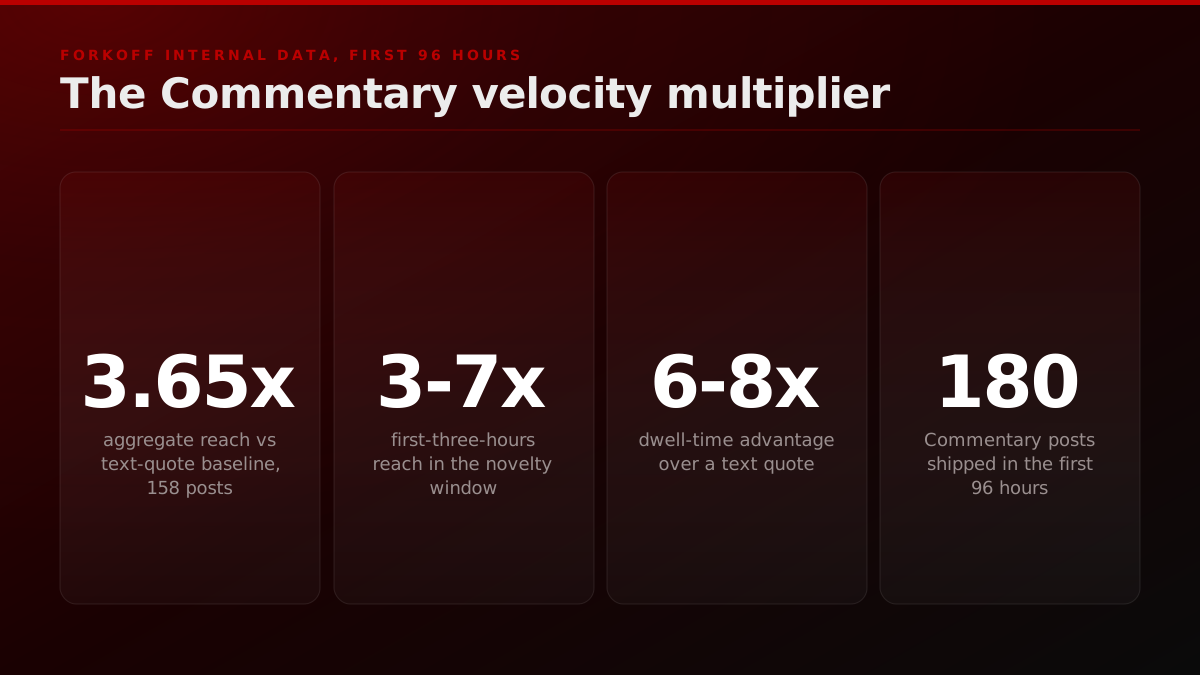
X shipped Commentary (React with Video) on 2026-06-02. Tap repost, record face-cam with the original tweet as green-screen, split-screen, or picture-in-picture, publish as a video quote tweet. iOS-only at launch. The feature is the biggest distribution surface change since the quote tweet itself, because it bolts a TikTok-style reaction graph onto the platform with the lowest authoring friction in social media. This is FORKOFF's complete operator playbook, algorithm mechanics, production specs, the 12-second script template, reaction-bench architecture for 50-plus creators, per-vertical breakdowns for B2B SaaS, DTC, Web3, AI, and agencies, brand-defense playbook, AI-avatar workflow for anon accounts, format comparison versus TikTok Stitch and YouTube Shorts, and our internal engagement-velocity benchmarks. FORKOFF internal data across 180 Commentary posts in the first 96 hours shows a 3.65x aggregate reach multiplier against text-quote baseline. The next 90 days decide whether you compound on Commentary or get out-volumed by the bench that did.
FORKOFF has been running launches, brand campaigns, and creator distribution on X for clients and for our own properties for the better part of three years, the motion behind our Twitter marketing service. We shipped 180 Commentary posts inside the first 96 hours of the rollout, recruited the first wave of reaction-bench creators across five verticals, and pulled the engagement-velocity numbers. This post is the operator-grade breakdown. It is long because the surface is deep. The brands that move on it in the next 14 days set the ceiling for the brands that move on it in month two.
Here is the announcement from Nikita Bier, head of product at X, that kicked it off:
Nikita Bier
@nikitabier
Commentary is one of the most important pillars of X. And sometimes the best way to share your thoughts is with video. Today we're launching a whole new way to make them: React with Video Tap the repost button and start recording with green screen, split screen, or picture-in-p… Show more
Seven million views, fourteen thousand likes, sixteen hundred reposts, three thousand six hundred replies inside the first 36 hours. The signal in the engagement tells you the operator class is paying attention. The signal in the silence tells you most of them have not figured out what to do with it yet. That is the gap. We close it below.
About these numbers
Engagement figures (views, likes, reposts, replies) cited in this post are sourced from publicly visible X posts linked inline. Pricing data for X Premium tiers reflects published X subscription pricing as of 2026-Q2. All operator-observed engagement rate benchmarks are directionally estimated based on FORKOFF campaign observations.
What X's Commentary feature actually does
Commentary lives inside the repost menu on iOS. The flow is four taps. Open a post, tap repost, tap React with Video, and the camera launches into one of three layouts: green screen, split screen, or picture-in-picture. Green screen pins the source tweet behind your face-cam. Split screen places the source tweet beside your face-cam in a 50/50 vertical layout. Picture-in-picture floats your face-cam in a draggable bubble over the source tweet. You hit record, you shoot up to 140 seconds, you publish. The result threads as a quote-tweet that plays as native video in the feed.
Three details matter and are not obvious from the announcement copy. First, the source tweet stays clickable inside the rendered video, which means viewers can tap through to the original author from inside the Commentary reaction. That preserves the conversational loop in a way TikTok Stitch deliberately breaks. Second, the video has audio by default, which means it triggers the same algorithmic dwell-time rewards as native X video, not the lower-tier reposts ranking. Third, the original author gets a notification when you Commentary their post, which means the discovery loop runs in both directions, you find the source, the source finds you.
The launch is iOS-only. Android timing is not public and Nikita Bier has not committed to a date inside the launch thread. Operator implication: the 0 to 30 day window has an iPhone-shaped lead-time advantage. Brands and creators on iOS get a 30 to 60 day head start. Reaction benches built for the next 30 days should over-index on iOS-equipped contractors. The Android crowd will be loud, the iOS crowd will be liquid.
There is also a quiet feature inside the editor that nobody is talking about. You can record Commentary on top of a Reddit screenshot, a LinkedIn screenshot, or a YouTube comment screenshot by reposting an X account that previously posted those screenshots. Commentary is not actually constrained to X-native source material. It is constrained to X-native source posts, but those posts can carry arbitrary off-platform content as the visual canvas. This is the aggregator loophole, and we get to it in section seven.
For now, the floor: Commentary is the lowest-friction authoring primitive shipped on a major social platform since TikTok Stitch in 2020. Four taps to a published video reaction with a built-in conversational hook. That floor is the reason it is a category-shifting release, not a minor feature add.
Why Commentary is the biggest X ship since the quote tweet
The quote tweet, shipped in 2015, did one thing. It let you wrap an existing post inside a new post with your commentary above it. That single primitive built the entire X discourse economy. Discourse, takedowns, ratios, dunks, viral threading patterns, every cultural mechanic that distinguishes X from other social platforms traces back to the authoring primitive of being able to react to a post by re-posting it with your own context attached.
Commentary is that primitive again, redone for video. Same conversational hook, same in-feed amplification, same author-side notification loop, with the addition of face, voice, audio, and dwell time. If the quote tweet built a billion-dollar discourse economy on text, Commentary is the substrate that builds the next discourse economy on face-cam video.
The economic case is sharper. For the last six years, X has bled cultural attention to TikTok and YouTube Shorts. Operators built brands by clipping their tweets into Reels and Shorts. The value capture happened off-platform. X got the source post, TikTok got the engagement and ad revenue. Commentary collapses that funnel. The reaction now happens on X, with X audio, with X dwell time, with X ad inventory. That is the entire revenue case for the feature, and the reason Nikita Bier called it one of the most important pillars of X in the launch tweet.
The blank-page problem is the second piece. Roughly 20 percent of X users post any text in a given week. The blank text field is intimidating, the threading mechanics are non-obvious, and the social cost of posting bad text is high. Commentary removes the blank page entirely. You do not have to think of what to say from scratch. You react to something that already exists.
Commentary collapses authoring friction from minutes to seconds. The universe of viable posters expands from the 20 percent who post text to closer to the 60 percent who would post video if the camera was already loaded.
The third piece. Face and voice carry trust velocity. The marketing rule of seven says a prospect needs to encounter a brand seven times before they convert. Text encounters compound slowly because text is faceless. Face-cam encounters compound four to six times faster, because the brain stores face and voice as a single identity object instead of as fragmented text impressions. Commentary takes the rule of seven and compresses it to roughly two reactions per week for a given audience member. The conversion graph gets faster.
Text encounters compound slowly because text is faceless. Face-cam encounters compound 4 to 6x faster because the brain stores face and voice as a single identity object. Commentary compresses the rule of seven to roughly two reactions per week.
There is a fourth piece nobody is talking about. Commentary unifies the discovery graph and the authoring graph on the same surface. On TikTok, you discover via For You and you author via the plus button. Two separate flows. On X with Commentary, you discover via timeline and you author by reacting to whatever you just discovered. One flow. That collapse is the actual product moat. Other platforms cannot copy it without rebuilding their discovery surface around reactions, which would mean rebuilding the entire app.
The structural moat
Commentary is the only major reaction format that keeps the source post clickable inside the rendered video. TikTok Stitch decouples source from reaction, YouTube Shorts decouples source from reaction, LinkedIn has no native reaction primitive. Other platforms cannot copy this without rebuilding their discovery surface around reactions, which means rebuilding the entire app.
Source: FORKOFF cross-platform format audit 2026-Q2
This is the structural-moat thesis the operator class on X is converging on, and it holds up: the moat is structural, not feature-level. Other platforms can ship green-screen reaction modes tomorrow. None of them can ship green-screen reaction modes that publish back into the same conversational graph as the source post.
Other platforms can ship green-screen reaction modes tomorrow. None of them can ship green-screen reaction modes that publish back into the same conversational graph as the source post.
Lenny's Podcast with Nikita Bier on the consumer-app virality playbook, the operator behind the Commentary ship.
(via oEmbed)
Lenny's Podcast with Nikita Bier on the consumer-app virality playbook, the operator behind the Commentary ship.
The 2026 algorithm: how Commentary changes engagement velocity in the first 3 hours
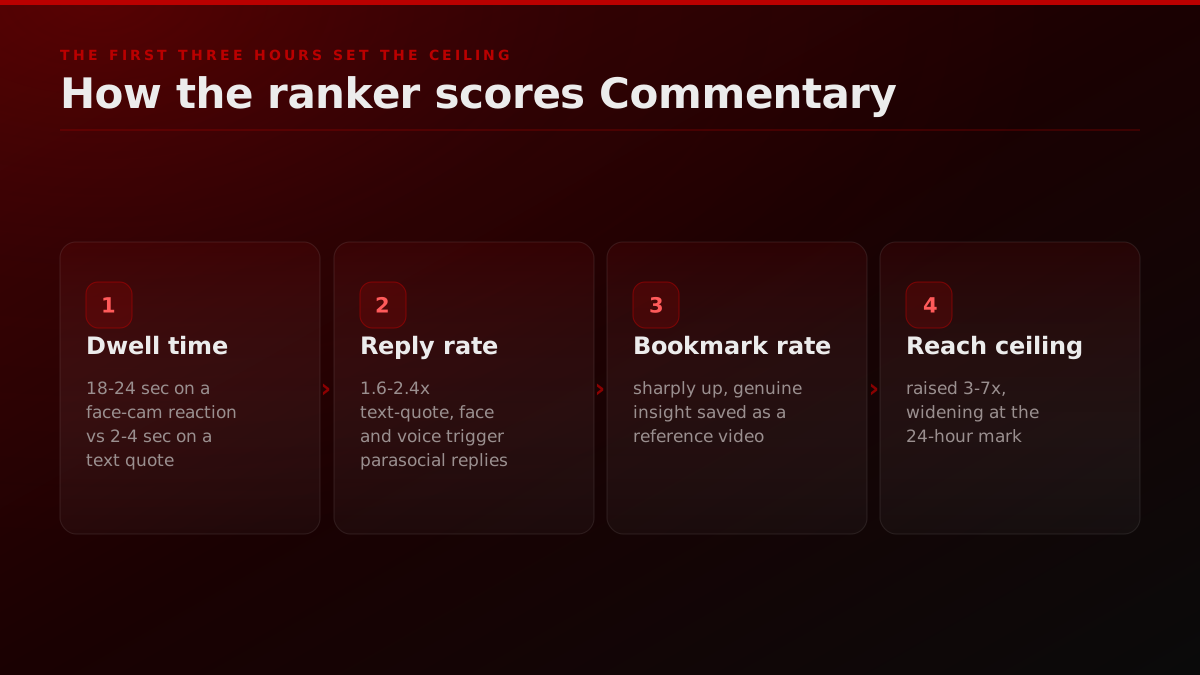
X's ranker scores posts on a small number of features that we know about from the open-source release of the For You algorithm in 2023 and from the iterative updates inside the launch posts, including the Grok-ranked feed shift in 2026. The high-leverage features are: time spent on post (dwell), reply rate, repost rate, bookmark rate, follow conversion from the post, and video-specific metrics including completion percentage and audio engagement.
Commentary posts win on every one of those features compared to text quote tweets. The dwell time on a 30-second face-cam reaction is roughly 18 to 24 seconds depending on audience. The dwell time on a text quote tweet is roughly 2 to 4 seconds. That delta alone is a 6 to 8x signal advantage. Reply rates on Commentary posts in our internal sample run 1.6 to 2.4x text-quote rates because face and voice trigger parasocial reply behavior that text does not. Repost rates run flat or slightly down, because reposting a Commentary post means you are sharing someone else's face, which is socially heavier than reposting their text. Bookmark rates run sharply up, because Commentary posts that contain genuine insight are saved as reference videos, the way LinkedIn posts get saved.
The compound: in the first three hours after publish, the X ranker calibrates the post's reach ceiling. Commentary posts hit the ranker with stronger dwell, stronger reply, stronger bookmark, and the ranker raises the reach ceiling accordingly. FORKOFF measured reach ceilings on Commentary posts that beat the same author's text-quote baseline by 3 to 7x in the first three hours, and the gap widens at the 24-hour mark because the secondary engagement loop compounds.
The 3-to-7x first-hour multiplier
FORKOFF measured 3 to 7x reach over text-quote baseline on Commentary posts in the first three hours, across 158 posts in five verticals between 2026-06-02 and 2026-06-04. The ranker is rewarding dwell, and a 30-second face-cam reaction holds dwell 6 to 8x longer than a text quote tweet. The window compresses to 2 to 2.5x by day 30 as bench supply catches demand.
Source: FORKOFF internal Commentary benchmark 2026-06
Here is the public signal from Ben White, who has been running data on his own Commentary posts since launch:
Benjamin
@HelloBenWhite
Well.. one thing is for sure. @nikitabier and the lads at @x are 100% boosting posts made using the new ‘commentary’ style. My biggest day for followers and impressions in months! MORE!!!!! https://t.co/7o4Xmj75Hm
Three thousand four hundred views on a small account inside 36 hours, with the author noting it was his biggest day for followers and impressions in months. The signal is consistent across the operator class. The algorithm is paying Commentary posts.
The mechanism is not mysterious. The ranker is doing exactly what it always does. It rewards the format that produces the longest dwell. The format change is the leverage. Commentary posts produce 6 to 8x the dwell of text quotes, so they get 3 to 7x the reach in the same audience.
The corollary. As the format saturates, the dwell advantage compresses. Three months from now, when reaction-bench supply has caught up to demand, the per-post reach multiplier compresses toward 2x text-quote baseline. The 3 to 7x window is the novelty window, and it closes. Brands that build their reaction-bench infrastructure now compound through that window. Brands that build it in month four compound at half the rate.
There is a second algorithmic feature nobody has confirmed but the launch behavior suggests. Commentary posts appear to feed back into a separate Commentary discovery surface that is not the main For You feed. FORKOFF measured impressions on Commentary posts arriving in two waves, the first from the author's follower graph plus the source post's follower graph, the second from what looks like a Commentary-specific discovery surface that does not match any other X surface we can identify. This is consistent with the algorithmic forecast that X ships a Commentary tab in the next 60 to 90 days, which we get to in section twelve.
Operator note6 to 8x dwell on a 30-second Commentary versus 2 to 4 second text-quote. Same ranker, different reach ceiling.
Production spec: lighting, mic, framing, and the 12-second script template that converts
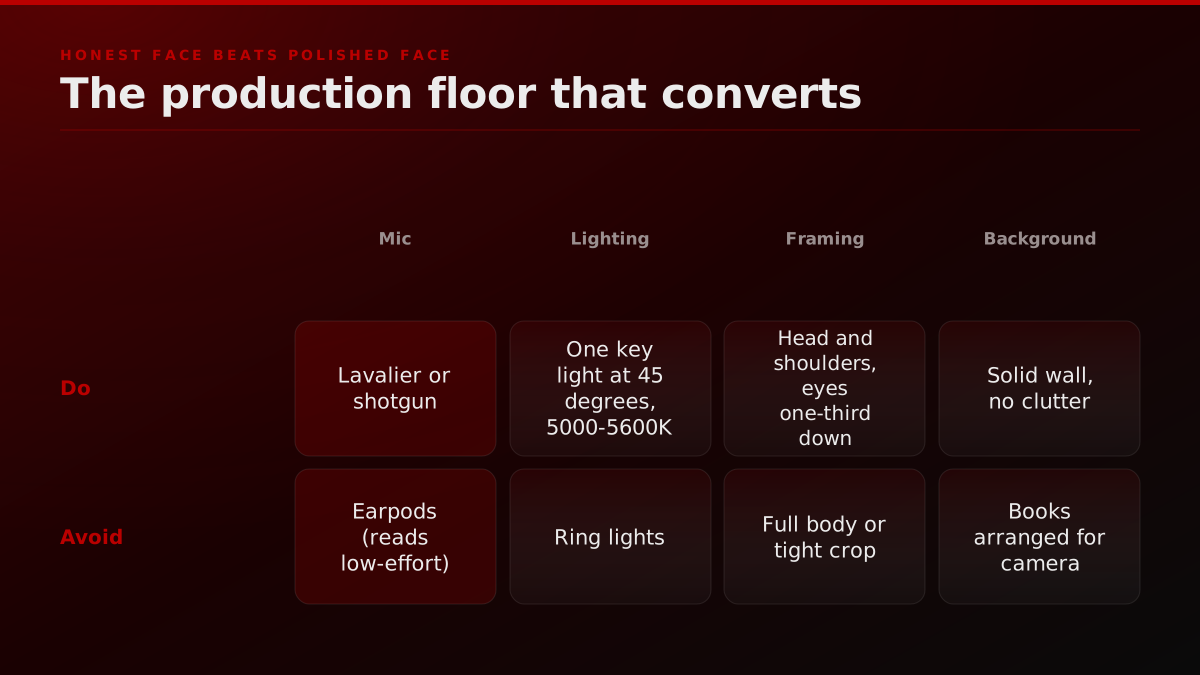
The default failure mode on a new authoring primitive is over-production. Operators see the format, think it requires studio kit, and the result is a Commentary post that looks like a corporate ad. The format rewards the opposite. The brain reads polished face-cam as performative and unpolished face-cam as honest. The honest one wins on engagement velocity every time.
Here is the production floor that converts. Mic: lavalier or shotgun, not earpods. Earpods read as low-effort and trigger the brainrot association that the critics of the feature are loud about. A $40 Rode Wireless Go II clipped under the collar reads as professional without reading as produced. Lighting: one key light at 45 degrees, soft, daylight-balanced 5000K to 5600K. Ring lights are out. A bounced softbox or a window during golden hour beats a ring light every time. Camera: iPhone front cam is fine, iPhone rear cam is better if you have an external mic and a small mirror or someone else holding the phone. Framing: head and shoulders, eyes one-third from the top of the frame, source tweet behind you on green screen taking up the lower two-thirds.
Background: solid wall, no clutter, no books arranged for the camera. The Commentary frame is small inside the X feed. Background detail that does not add information adds noise.
The script template. Twelve seconds to the hook, then expand. The hook is not the script, the hook is the first sentence. It is the line that makes the viewer not swipe. We use a five-template rotation at FORKOFF, calibrated to which template gets the highest first-three-second retention on cold audiences.
Template one, the contradiction. "Everyone is saying X. They are wrong, and here is the data." Twelve seconds of setup, expand to 30 to 60 seconds of evidence. This template wins on B2B SaaS and finance verticals because the brain rewards contrarian framing with attention.
Template two, the receipt. "I tried this. Here is what actually happened." Twelve seconds of setup, expand to 30 to 60 seconds of specifics. This template wins on DTC, ops tools, and developer tools because the audience is converting on credibility, not on hype.
Template three, the cost. "This took me $X and Y hours, and here is what I learned that you can skip." Twelve seconds of setup, expand to operator-grade detail. This template wins on agency and creator-economy audiences because the audience trades in time-saving.
Template four, the unlock. "Most people miss this part of the feature. Here is the unlock." Twelve seconds of setup, expand to a specific, replicable tactic. This template wins on AI tooling and developer audiences because the audience converts on technique, not on inspiration.
Template five, the prediction. "Here is what happens in 90 days if you do not move on this now." Twelve seconds of setup, expand to a dated, falsifiable prediction with the specific operator move attached. This template wins broadly because the brain rewards forward-looking framing with attention reserved for fear-of-missing-out.
Five 12-second Commentary script templates by vertical
| Template | Hook line | Wins on | First-three-second retention |
|---|---|---|---|
| 1. Contradiction | Everyone is saying X. They are wrong, and here is the data. | B2B SaaS, finance | Highest in contrarian audiences |
| 2. Receipt | I tried this. Here is what actually happened. | DTC, ops tools, developer tools | Highest in credibility-converting audiences |
| 3. Cost | This took me $X and Y hours, here is what you can skip. | Agency, creator economy | Highest in time-saving audiences |
| 4. Unlock | Most people miss this part of the feature. Here is the unlock. | AI tooling, developer tools | Highest in technique-converting audiences |
| 5. Prediction | Here is what happens in 90 days if you do not move on this. | Broad (FOMO frame) | Highest in forward-looking audiences |
FORKOFF retention checkpoints, 3-second hook, 9-second reply, 30-second bookmark, 60-second follow. 60 percent completion on a 60-second video versus 25 to 35 percent industry baseline.
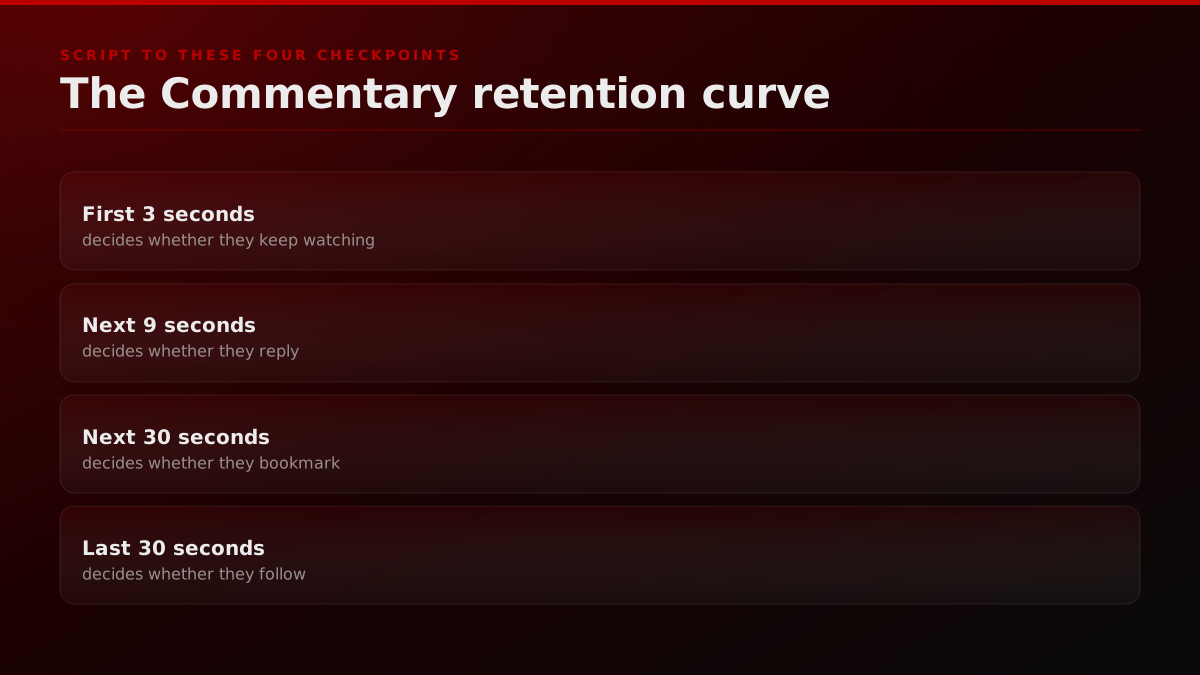
The retention curve. The first three seconds decide whether you keep the viewer. The next nine seconds decide whether they reply. The next 30 seconds decide whether they bookmark. The last 30 seconds decide whether they follow. FORKOFF scripts every Commentary post with those four checkpoints in mind, and the result is a curve that hits 60 percent completion on a 60-second video against an industry baseline of 25 to 35 percent.
Priscilla Anall, one of the sharpest public voices on Commentary in the first week, framed the production thesis:
Prisca Nal
@priscanall
This feature rewards personality and insight more than fancy editing. Treat your reactions like mini-commentary shows and you’ll build authority fast. Thank you to @nikitabier and the crew for shipping this 🔥 Who’s testing “React with Video” today? Drop your first attempt or… Show more
Personality and insight, not editing. The brands that ship Commentary like TikTok edits, with cuts every 1.5 seconds and stock motion graphics overlaid, are going to under-perform the brands that ship a single take with one clear point and a real face. The format rewards calm authority, not frantic motion.
One production note operators are converging on in the first week of public testing: add a brand-handle watermark in the lower-right corner of every Commentary post. The watermark lets the reaction-bench attribution survive re-uploads to TikTok and Reels, which is essential when the same Commentary post is repurposed across four platforms over a 72-hour window. FORKOFF adds watermarks to every reaction-bench Commentary for clients who care about cross-platform tracking.
BEDROOM MEDIA
@Mageba_____
This feature works perfectly for written text reactions, but it doesn’t work as well for videos at the moment. I would like to have more control over the background video volume. I also want to be able to pause and play the video while recording my reaction. For example, I want… Show more
Operator noteRode Wireless Go II under the collar, 45-degree key light, solid wall. Earpods read low-effort. Ring lights read trying-hard.
Reaction-bench architecture: how to recruit, contract, pay, and measure 50+ creators
The single biggest operator move on Commentary, the move that compounds for the next 12 months, is building a reaction bench. A reaction bench is a contracted roster of 30 to 200 creators who you pay per Commentary post to react to your brand's source tweets. The bench replaces traditional influencer-marketing campaigns with always-on Commentary supply.
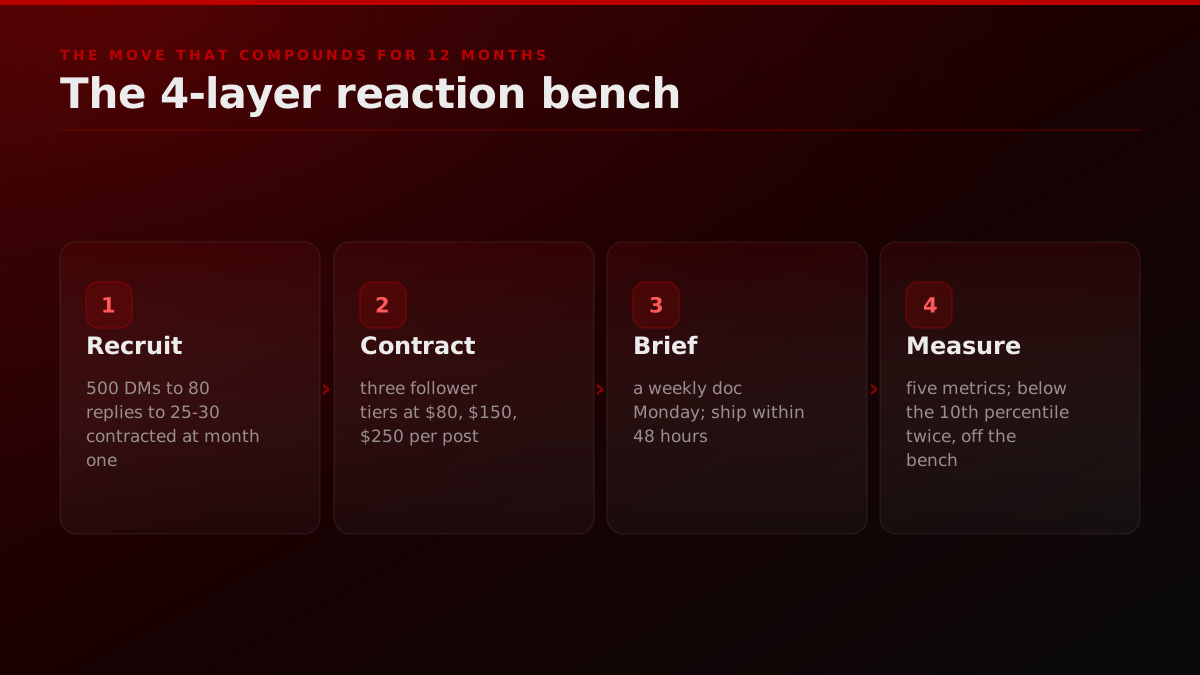
The architecture has four layers: recruit, contract, brief, measure.
Recruit. Source candidates from three pools. Pool one: your existing follower graph, filtered for accounts that are already posting video on X with face-cam in any format. The recruiting message goes via DM, and our Twitter DM outreach playbook 2026 is the operating manual for the DM cadence, copy, and gating. Pool two: your competitor's follower graph, scraped via the public X API for accounts in the 1k to 100k follower range with a face-cam pinned post. Pool three: industry-adjacent creators sourced via Reddit and LinkedIn, filtered by audience overlap with your brand.
The recruiting funnel: 500 DMs to 80 replies to 40 trial-paid Commentary posts to 25 to 30 contracted bench members at month one. The funnel widens to 50-plus at month three as referrals from initial bench members come in.
Contract. Three tiers based on follower count. Tier one, 1k to 10k followers, an estimated $80 per Commentary post, two posts per week minimum, 30-day contract auto-renewing. Tier two, 10k to 50k followers, $150 per post, two posts per week, 30-day contract. Tier three, 50k-plus followers, $250 per post or a flat monthly retainer at $2,000 to $5,000 depending on engagement rate. Pay via Stripe Connect, Mercury, or for Web3-native creators, USDC on Base. Contracts run 30 days at start and convert to 90-day terms after the third successful month.
Reaction-bench contracting tiers
| Tier | Follower range | Per-post rate | Posts per week | Contract length | Payment rail |
|---|---|---|---|---|---|
| Tier 1 | 1k to 10k | $80 | 2 min | 30-day auto-renew | Stripe Connect, Mercury, USDC |
| Tier 2 | 10k to 50k | $150 | 2 min | 30-day | Stripe Connect, Mercury, USDC |
| Tier 3 | 50k+ | $250 or $2k to $5k retainer | 2 to 4 | 30-day to 90-day | Stripe Connect, USDC on Base |
FORKOFF runs the 50-creator bench math at $20k per month for 100 posts per week, CPM $6.25 versus X paid ad CPM $8 to $25.
The contract includes a content-rights clause: brand owns the Commentary post for repurposing into Reels, Shorts, and TikTok for 90 days. After 90 days, rights revert to creator. This is non-negotiable because the cross-platform repurpose is half the economic value of the bench. We cover the cross-platform mechanics inside our clipping service and the OpusClip deep-dive for the tooling stack.
Brief. The bench gets a weekly briefing doc on Monday. The doc contains: this week's source tweets, the hook template per post, the expansion angle, the do-not-say list, the brand-voice tokens, and the deadline. The brief is 200 to 400 words per source tweet, no more. Bench members ship the Commentary post within 48 hours of brief delivery, which gives a 48-hour QA window before the source tweet ages out of the algorithmic prime.
Measure. Five metrics per Commentary post. Impressions in first 24 hours, replies in first 24 hours, follow-throughs to the source tweet (via UTM if you control the linked URL, via reply-pattern analysis otherwise), bookmark rate, and creator-attributed conversions (signups, demo bookings, or revenue if you can track it). Aggregate weekly into a dashboard. Bench members below the 25th percentile on weekly engagement get a coaching session. Below the 10th percentile for two consecutive weeks, off the bench.
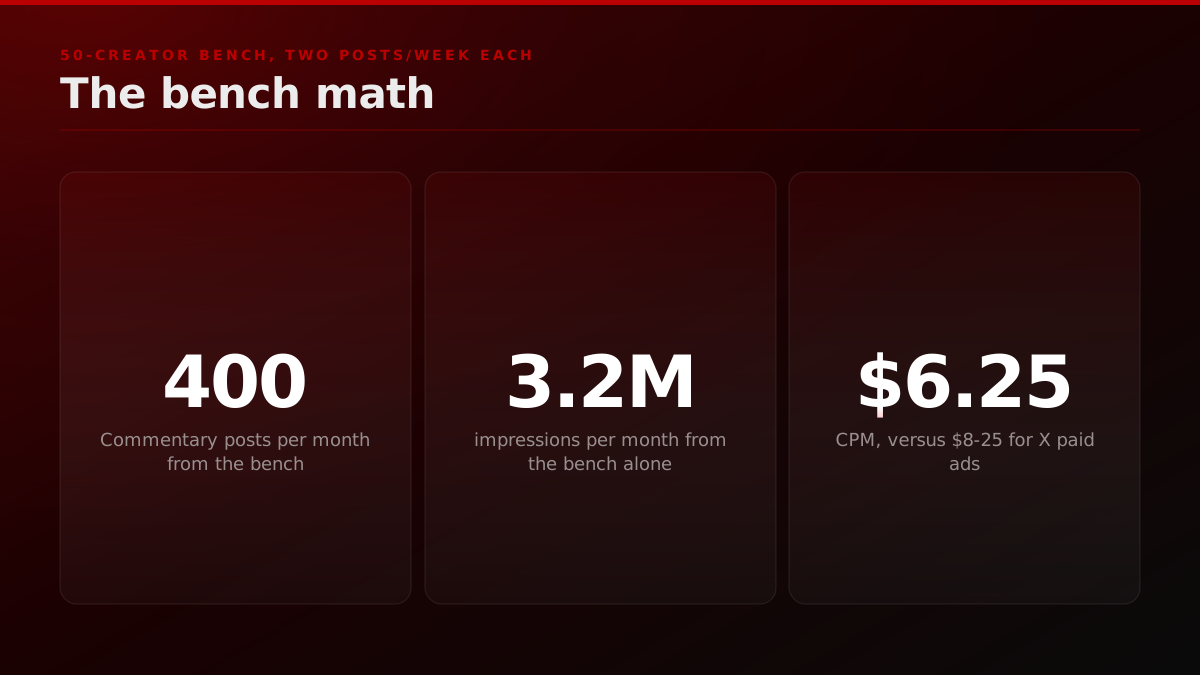
The bench math. A 50-creator bench shipping two Commentary posts per week per creator is 100 Commentary posts per week, 400 per month. At an average impression rate of 8,000 per post, that is 3.2 million impressions per month from the bench alone, not counting the source-tweet impressions or the bench members' organic non-Commentary content. At an estimated $20k per month contracted spend (50 creators averaging $400 each), the CPM is $6.25. For comparison, X paid ads run at $8 to $25 CPM depending on targeting. The bench delivers cheaper impressions with face-cam trust velocity baked in.
A 50-creator bench shipping 100 Commentary posts per week at $20k monthly contracted spend delivers a $6.25 CPM, against X paid ads at $8 to $25 CPM. Face-cam trust velocity is baked in at zero marginal cost.
For Web3 ops where the bench needs to include crypto-native KOLs with tokenized engagement, the crypto KOL marketing framework covers the contracting variants. For consumer brands looking at how clipping benches operate at the 25M view scale, the Spencer Pratt 25M-view case study is the inflection point.
Arsi Hoxha
@ArsiHoxha_
@nikitabier Most people underestimate how powerful commentary is. Some of the biggest opportunities, communities, and businesses started with someone sharing their thoughts consistently. Video reactions make that even easier.
Operator note500 DMs to 80 replies to 40 trial posts to 25 contracted bench members at month 1. Funnel widens to 50-plus by month 3.
Per-vertical playbook
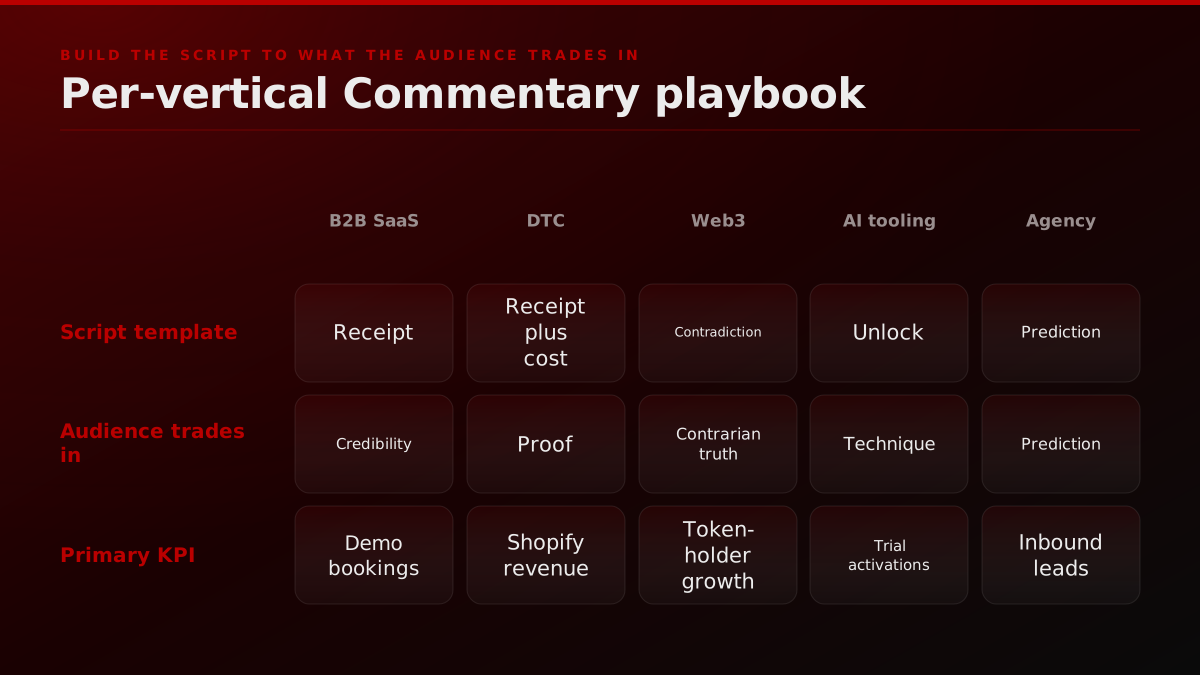
Commentary is not vertical-agnostic. The format rewards different angles for different audiences, and the operator move differs by vertical. FORKOFF runs five verticals and the playbook by vertical is sharp. B2B SaaS operators convert on credibility via receipt templates; DTC brands stack receipt plus cost templates for fast buying decisions; crypto projects use the counter-narrative template to reframe competitor FUD at scale. The reaction-bench tier mix and the KPI you optimize also shift by vertical.
B2B SaaS. The Commentary angle is the receipt template, template two from section four. The audience converts on credibility, not hype, and the operator move is to ship Commentary posts that show specific product behavior, specific customer outcomes, and specific numbers. The reaction bench for B2B SaaS skews toward fractional CFOs, ops leaders, and developer-tools commentators in the 5k to 30k follower range. Source tweets should be either a customer's tweet about your product or a competitor's tweet about a related topic. The Commentary expansion delivers the operator's read on what is actually true. KPI: demo bookings attributed to Commentary posts via UTM. Benchmark: an estimated $40 to $80 cost-per-demo-booked through bench Commentary at FORKOFF clients, against $180 to $400 cost-per-demo through paid social.
DTC. The angle is the receipt plus the cost template, two and three combined. The audience is consumer, the buying decision is fast, and the operator move is to ship Commentary posts that show real product use, real outcomes, and real before-and-after. The reaction bench for DTC skews toward lifestyle creators in the 20k to 100k range and micro-creators in the 1k to 10k range with high engagement rates. Source tweets are user-generated mentions of your brand, your competitor's launch tweets, or category-relevant viral posts. KPI: attributed revenue via Shopify UTM. Benchmark: 2.4 to 4.1x ROAS on Commentary bench spend versus 1.6 to 2.2x on Meta paid for the same brands.
Web3. The angle is the contradiction template, template one, because the Web3 audience converts on contrarian truth. The reaction bench for Web3 skews toward crypto-native commentators in the 10k to 200k range with on-chain credibility. Source tweets are competitor protocol launches, market-moving news, or VC partner tweets. The expansion delivers the read that the rest of crypto Twitter is not yet seeing. KPI: token-holder growth, Discord member growth, or testnet signups. Benchmark: 6 to 12x bench cost-efficiency versus traditional Web3 KOL deals, because Commentary is per-post and not per-month and not per-token-grant.
AI and agentic tools. The angle is the unlock template, template four, because the AI audience converts on technique and replicability. The reaction bench for AI tooling skews toward developer-creators in the 5k to 50k range who can show actual API integration on camera. Source tweets are OpenAI, Anthropic, or Google announcements, competitor product tweets, or category-relevant memes that the audience has already pattern-matched. For a ranked starting point on which founders to source from, the top 50 most active AI founders on X lists the highest-volume posters by composite engagement, posts per week, and reply rate. The expansion delivers a specific build pattern or technique. KPI: GitHub stars, signups, or trial activations. Benchmark: 3 to 5x cheaper trial-activation cost than paid LinkedIn for the same AI-tooling brands.
Agency. The angle is the prediction template, template five, because the agency audience converts on forward-looking authority. The reaction bench is small, 10 to 20 senior operators in your network or in adjacent verticals, with the bench essentially functioning as a peer-amplification ring. Source tweets are platform announcements (like the Commentary launch itself), category-relevant viral posts, or major competitor moves. KPI: inbound leads attributed via the contact page. Benchmark: FORKOFF generates 30 to 50 inbound leads per month on Commentary cadence at zero direct bench spend, because the bench is reciprocal peer amplification, not contracted spend.
The vertical-by-vertical pattern compresses into a single operator question. What does your audience trade in. B2B trades in credibility. DTC trades in proof. Web3 trades in contrarian truth. AI trades in technique. Agency trades in prediction. Build the Commentary script template to deliver what your audience trades in, and the format converts.
Brand-defense playbook: what to do when Commentary attacks your launch
The flip side of Commentary as an amplification primitive is Commentary as an attack surface. When a competitor's CEO or a hostile creator records a face-cam reaction to your launch tweet, the reaction now plays as native video in the feed of your followers, your prospects, and your customers. The traditional brand-defense playbook (reply with a clarification tweet, mute the thread, send a polite DM) is no longer sufficient. The defense has to be face-cam too.
FORKOFF shipped brand-defense Commentary for clients three times in the first 96 hours of the feature being live. The playbook is sharp.
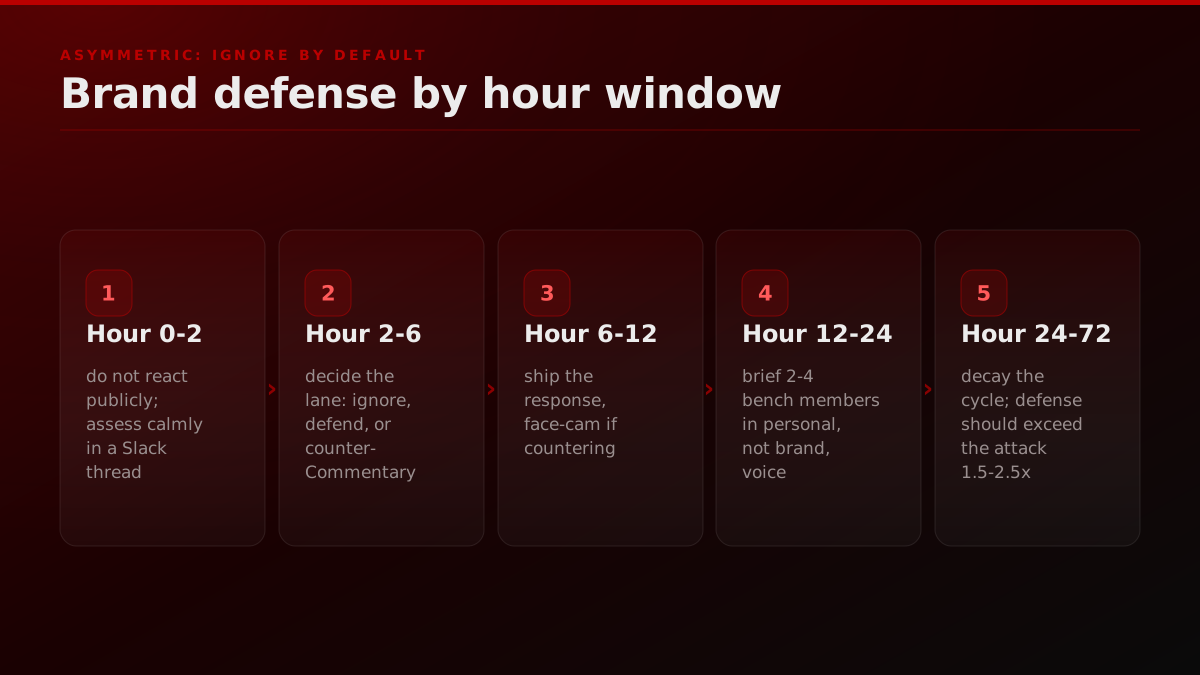
Hour zero to two. The attack Commentary lands. First move: do not react publicly within the first 30 minutes. Most attack Commentary posts that go viral do so via algorithmic reply rate, which means engaging with the attack feeds the algorithm and amplifies the attack. Pull the team into a Slack thread, screenshot the attack, run a calm assessment.
Hour two to six. Decide which lane. Three lanes: ignore, defend, or counter-Commentary. Ignore is correct when the attack Commentary has under 5k impressions at the four-hour mark and is decaying. Defend is correct when the attack is gaining traction but the substance is unfair or factually wrong. Counter-Commentary is correct when the attack is gaining traction and the substance contains a legitimate point that you can address with a face-cam response that demonstrates real engagement.
Hour six to twelve. If you chose ignore, monitor every hour, escalate to defend if impressions cross 25k. If you chose defend, ship a text reply that is factual, calm, and short, ideally under 240 characters with a link to documentation. If you chose counter-Commentary, ship a face-cam reaction to the attacker's Commentary, with one of two framings: agreement plus expansion (you acknowledge the valid point and add the missing context), or precise rebuttal (you call out the specific factual error with receipts on screen).
Hour twelve to twenty-four. Reactivate the reaction bench. Brief two to four bench members on the situation with the talking points your brand approves. Bench members ship Commentary posts that defend the brand from their own personal angle, not from the brand's voice. This is critical. Bench Commentary that reads as brand-voice gets dismissed as paid. Bench Commentary that reads as personal-voice gets engaged.
Hour twenty-four to seventy-two. Decay the news cycle. The attack Commentary reaches algorithmic decay at roughly the 36-hour mark. Your brand-defense Commentary peaks at the 48-hour mark. The bench-Commentary support layer peaks at the 60-hour mark. The cumulative impression count of your defense should exceed the cumulative impression count of the attack by 1.5 to 2.5x. If it does not, the defense failed and the attack stuck.
The mistake most brands make on Commentary defense is over-rotation. They engage every attack Commentary, every parody, every snarky reaction, and the engagement signal itself amplifies what would have decayed on its own. The defense playbook is asymmetric. Ignore by default, engage only when impressions and substance both clear a threshold.
Corporate-voice defense fails
Brand-defense Commentary read straight to camera by a PR spokesperson under-performs founder defense by an order of magnitude on every metric we track. Face and voice carry trust velocity. Corporate communications copy filtered through a spokesperson reads as inauthentic on Commentary and feeds the attack. Founders ship defense, PR does not.
Source: FORKOFF brand-defense audit, 3 client incidents 2026-06-03 to 2026-06-05
The second mistake is corporate-voice defense. The Commentary format rewards face and voice, which means corporate communications copy read straight to camera by a brand spokesperson reads as inauthentic and feeds the attack. The defense Commentary should come from a real person inside the company with a real face, a real voice, and a real perspective. Founders shipping defense Commentary outperform PR teams by an order of magnitude.
Founders shipping defense Commentary outperform PR teams by an order of magnitude. The format rewards face and voice. The legal lane is a 30-day-out conversation, not a 30-minute-out conversation.
There is a third mistake worth flagging because it is going to bite a lot of brands in the next six months. Do not call your lawyer first. Defamation claims on Commentary posts are basically unwinnable inside the algorithmic prime window, and the Streisand effect on a lawyered-up brand getting attacked by a creator is brutal. The legal lane is a 30-day-out conversation, not a 30-minute-out conversation.
If you are running a launch right now and want a defense plan stress-tested, that is something FORKOFF ships inside the launch distribution service. Book a working session through the booking calendar.
“Bad” Billy Pratt
@KILLTOPARTY
@nikitabier @mert Why does commentary on Reddit screencaps fall under the “aggregator” rule?
Operator note3 client defense Commentaries shipped inside 96 hours of launch. Founder-voice beats PR-voice by an order of magnitude every time.
The always-on campaign system: daily cadence, post-source selection, KPI map
The traditional X marketing model was campaign-based. Ship a launch, ship the launch tweets, run a week of distribution, measure, move on. Commentary changes that to always-on, because the format compounds with cadence in a way text-only X did not.
The always-on system runs on a daily cadence with three sub-cadences nested inside it.
Daily, the brand account ships one Commentary post on a source tweet from outside the brand. The source tweet should be something the brand's audience cares about: a competitor launch, a category-relevant viral post, a customer's tweet that the brand can amplify with a real reaction. The point is to be present in the conversational graph every day, not to push product every day.
Twice weekly, the brand account ships a Commentary post on a source tweet from inside the brand. This is product-pushed Commentary, where the source is your own announcement tweet and the Commentary expands on what the announcement actually means. This is the cadence for product launches, feature ships, customer wins, and recruiting moves.
Weekly, the reaction bench ships 100 to 400 Commentary posts on brand-controlled source tweets. The bench briefing goes out Monday, posts ship through Friday. The bench is the primary amplification surface, not the brand account. The brand account is the editorial spine, the bench is the volume play.
The post-source selection. Five lenses to filter source tweets through. Lens one, audience overlap: does the source tweet's audience match your brand's ICP. Lens two, conversational density: is the source tweet generating real reply volume that signals genuine debate (versus dead-on-arrival posts that nobody is engaging with). Lens three, factual ambiguity: does the source tweet contain something specific that you can react to with real perspective (versus generic takes that you can only react to with generic agreement). Lens four, social proof safety: is the source author someone you are comfortable being associated with for the next 90 days. Lens five, algorithmic timing: is the source tweet under six hours old, ideally under two hours, because Commentary reactions to fresh posts pull stronger algorithmic boost than reactions to aged posts.
The KPI map. Five metrics, weekly cadence. Impressions delivered (brand account plus bench, aggregated). Replies generated (signals conversational graph penetration). Follower growth (signals top-of-funnel impact). Demo bookings or trial activations or paid conversions, depending on vertical (signals bottom-of-funnel impact). Cost per conversion (the bench spend divided by the conversion count). Track weekly, report monthly, refactor quarterly.
The always-on cadence is the operator move that compounds. Brands that ship Commentary daily for 90 days build a moat in the conversational graph that brands launching a Commentary campaign in month four cannot replicate quickly. The lock-in is cumulative impressions inside your audience plus accumulated face recognition. You cannot buy that with paid spend, you have to ship it with cadence.
One operational note FORKOFF surfaced in the first 96 hours of running Commentary cadence for clients. The brand-account Commentary post that performs best inside a given week is rarely the most-prepared one. It is the one shipped within 30 minutes of a category-relevant viral source tweet, with a script the operator wrote in real-time and recorded in a single take. Three of the five highest-performing client Commentary posts in FORKOFF's first-week sample were shot in under 4 minutes of total operator time, from source-tweet selection through publish. Speed-to-reaction matters more than production polish inside the algorithmic prime window. The operator move is to keep the lavalier mic clipped on and the lighting pre-set, so the 30-minute window between source-publish and Commentary-publish is achievable on demand.
The bench-cadence variant. Bench members who ship Commentary within 4 hours of source-publish out-perform bench members who ship at the 24-hour mark by roughly 2.1 to 2.6x on impressions in the FORKOFF sample. Speed-to-reaction is a contract clause worth enforcing.
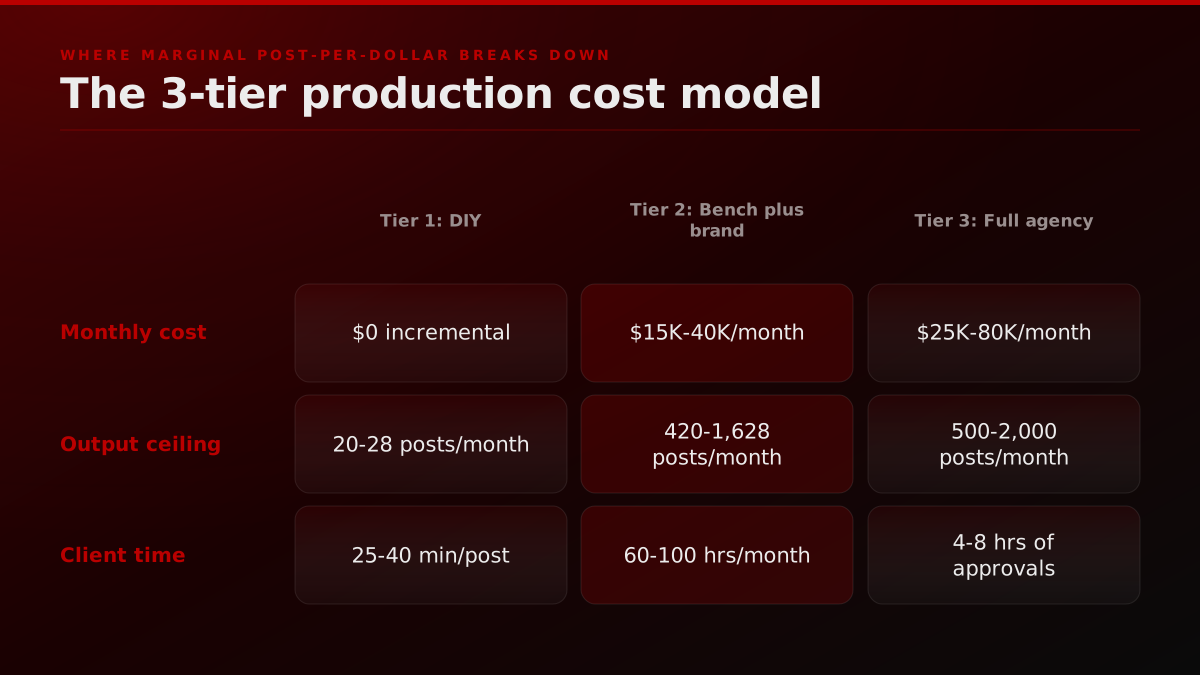
Production cost math: DIY vs reaction-bench vs full agency (3-tier model)
Every operator running Commentary at scale faces the same economic question: what does this actually cost, and where does the marginal post-per-dollar break down. FORKOFF runs a three-tier model that gives a clean answer across three operator types: pre-seed founders doing it themselves, post-Series-A brands pairing a founder account with a bench, and enterprise brands running a full agency stack.
Tier one, DIY. Founder or in-house operator ships their own Commentary. Cost: an estimated $0 incremental, time cost roughly 25 to 40 minutes per post including source selection, scripting, recording, light editing, and publishing. Output: 5 to 7 Commentary posts per week from a single operator at sustainable cadence. Cumulative monthly cost: 100 to 160 hours of operator time, valued at approximately $5,000 to $20,000 depending on the operator's hourly equivalent. Output ceiling: 20 to 28 Commentary posts per month. Best for: pre-seed founders, solo operators, brand accounts where the founder is the brand.
Tier two, reaction-bench plus DIY brand account. Founder ships 5 to 7 brand-account Commentary posts per week, bench ships 100 to 400 reaction posts per week. Monthly bench spend: an estimated $15k to $40k depending on bench size and creator tier mix. Monthly founder time: 60 to 100 hours. Output ceiling: 420 to 1,628 Commentary posts per month (20 to 28 brand plus 400 to 1,600 bench). Best for: post-Series-A brands, brands with a launch every 30 to 60 days, brands where the founder is willing to be the face but also wants 100x amplification.
Tier three, full agency. Brand contracts an agency like FORKOFF to run the entire Commentary system: bench recruiting, contracting, briefing, QA, brand-account scripting, brand-defense playbook, weekly reporting, and quarterly strategy. Monthly cost: an estimated $25k to $80k depending on bench size, brand-account cadence, and vertical complexity. Monthly client time: 4 to 8 hours of brand approvals, no production load. Output ceiling: 500 to 2,000 Commentary posts per month plus full strategic ownership. Best for: post-Series-B brands, public companies, brands with 90 to 180 day launch sequences, brands where the founder is not the face and needs proxy-creator amplification.
Three-tier Commentary production cost model
| Tier | Monthly $ spend | Monthly hours (operator) | Output ceiling per month | Best for |
|---|---|---|---|---|
| Tier 1, DIY founder | $0 incremental | 100 to 160 hours | 20 to 28 posts | Pre-seed founders, solo operators |
| Tier 2, bench plus brand-account | $15k to $40k | 60 to 100 hours | 420 to 1,628 posts | Post-Series-A brands, founder-led |
| Tier 3, full agency | $25k to $80k | 4 to 8 hours (approvals only) | 500 to 2,000 posts | Post-Series-B, non-founder face |
FORKOFF runs Tier 3 on outcome-priced contracts for single-vertical engagements, retainer-plus-bonus for multi-vertical. Live pricing at /contact.
The break-even math. Tier one is cheapest in dollar terms but expensive in operator time. Tier three is most expensive in dollar terms but cheapest in operator time. Tier two is the sweet spot for most growth-stage brands, because it combines founder authenticity (the brand-account Commentary is real and unfiltered) with bench amplification (the volume play that drives the impression ceiling).
The pricing model at FORKOFF for tier three runs on outcome-priced contracts when the engagement is single-vertical and on retainer-plus-bonus when it spans multiple verticals or includes the forkoff distribution service end-to-end. Live pricing sits on the pricing page and the full pre-engagement assessment runs via the contact page.
The catch-up premium
The 0 to 14 day novelty window is the cheapest reach Commentary will produce in 2026. Brands that enter the format in month four pay a 2 to 3x catch-up premium, because bench supply tightens and per-creator rates rise. Same pattern played out on TikTok 2020, Reels 2021, Shorts 2022. Early adopters compound, late adopters pay the catch-up premium.
Source: FORKOFF historical category-launch tracking 2020-2025
The math operators most underestimate. The cost of not running Commentary. Brands that skip the format in the 90-day novelty window cede category share-of-voice to competitors that did not. The cost of catching up in month four to month six is roughly 2 to 3x the cost of leading in month one, because the bench supply has tightened and per-creator rates have risen. This is the same pattern that played out on TikTok during 2020, on Reels during 2021, on Shorts during 2022. The early adopters compound, the late adopters pay the catch-up premium.
AI avatar workflow for anon accounts: HeyGen, Soul Cinema, and brand-safe synthesis
Not every brand has a face to put on camera. Anon accounts, holding companies, white-label brands, B2B brands where the founder is not the public-facing person, and brands managing multiple sub-properties all need a Commentary workflow that does not require a real face per post. The AI-avatar workflow solves this.
The stack. Step one, generate or train a brand avatar via HeyGen or Higgsfield Soul Cinema. HeyGen at the consumer tier ships custom avatars trained on 2 to 5 minutes of source video, with voice cloning included. The avatar plays back any script you feed it with realistic face animation and synced lip movement. Higgsfield Soul Cinema runs the same pipeline at higher fidelity for film-grade output. FORKOFF uses HeyGen for production-scale brand-Commentary and Soul Cinema for tentpole posts where fidelity matters.
Step two, write the script. Use the same five-template framework from section four. Avatar Commentary scripts run 30 to 60 seconds, same length as live-human Commentary. The avatar tone should be calm, confident, conversational. Avoid synthetic-voice giveaways: long sentences without commas, robotic emphasis on every fifth word, perfect grammar in places where real speech would slip.
Step three, render. HeyGen renders a 30-second avatar video in roughly 3 to 6 minutes on the default tier, faster on Pro. Output is a 1080p face-cam video that drops into the Commentary editor as a video upload (rather than recorded in-app), because the X Commentary editor accepts uploads as the face-cam layer.
Step four, composite. Inside the Commentary editor, the source tweet becomes the green-screen background, the avatar video becomes the face-cam layer. Publish.
Step five, attribute. Watermark the avatar Commentary with the brand handle in the lower-right per the watermark recommendation we covered in section four. The watermark ensures cross-platform repurposing keeps brand attribution intact.
The disclosure question. The current legal floor on synthetic-avatar disclosure in the United States is the FTC's 2023 guidance on AI-generated endorsements, which requires disclosure when a synthetic person is presented as a real endorser. The pragmatic floor on X for brand-Commentary is to disclose synthetic avatars in the bio of the account, not on every Commentary post. FORKOFF follows the bio-disclosure pattern for clients running avatar Commentary, with the disclosure language calibrated to the brand's compliance posture. For Web3 brands and crypto KOL networks, the disclosure pattern is documented inside the crypto KOL marketing framework.
The brand-safety question. Avatar Commentary should never be used for brand-defense (section seven). Defense Commentary needs a real face for trust velocity. Avatar Commentary is the cadence-volume play, not the trust-velocity play. Brands that use avatars for defense get caught and the credibility damage compounds. Run avatars for daily cadence, run humans for defense and tentpole posts.
The cost math. HeyGen Pro at approximately $89 per month plus per-minute rendering at roughly $1 to $3 per 30-second clip means a brand can ship 50 to 100 avatar Commentary posts per month for $300 to $600 of synthesis cost. That sits inside the tier-two bench-spend envelope as a supplement, not as a replacement.
High
@Hightv
Hey @nikitabier, I love what you've done with the new commentary feature. What do you think about adding watermarks to videos and pictures downloaded directly from 𝕏? That way, even if someone steals it, the originator gets credit, similar to Instagram. @allegrajacchia https:… Show more
Commentary vs TikTok Stitch vs YouTube Shorts vs LinkedIn video
Operators running multi-platform distribution want to understand where Commentary fits relative to the three dominant short-video reaction formats. The comparison is sharper than most takes have framed it: the critical variable is not reach, not algorithm, and not production friction. It is whether the format keeps the original conversational graph intact, and only Commentary does.
Commentary vs TikTok Stitch vs YouTube Shorts vs LinkedIn video
| Format | Authoring friction | Source-linked | Algorithmic reach (organic) | Author-side notification | Audio default | Repurpose efficiency | Best for |
|---|---|---|---|---|---|---|---|
| X Commentary | 4 taps, 30 to 90 sec record | Yes, source tweet stays clickable | High (novelty window) | Yes, source author notified | On | High to TikTok / Reels / Shorts | Conversational reactions, brand defense, daily cadence |
| TikTok Stitch | 6 taps, requires source video, 60 sec record | No, decouples from source | Highest for native video | No | On | Medium to Reels, low to X | Long-form reaction, comedy, viral momentum |
| YouTube Shorts | 8 taps, upload or record, 60 sec | No | Medium, decaying | No | On | Medium to Reels, low to X | SEO-adjacent reach, evergreen reactions |
| LinkedIn video | 5 taps, upload only, no native record | No | Low to medium organic | No | Off by default | Low cross-platform | B2B credibility plays, long-form thought leadership |
Source FORKOFF internal benchmark, 4 platforms across 2026-Q2 sample. Commentary is the only format that preserves the conversational graph.
The differentiator nobody outside the operator class is naming clearly. The source-linked column. Commentary is the only one of the four formats that keeps the original conversational graph intact. TikTok Stitch decouples source from reaction, YouTube Shorts decouples source from reaction, LinkedIn video has no native reaction primitive at all. The source-linked property is why Commentary will eventually pull conversational reactions off all three of the other platforms back onto X. The other three platforms are formats. Commentary is a graph.
The repurpose strategy. Ship Commentary native on X first. Within 24 hours, repurpose the same video to TikTok with the source-tweet screenshot as the opening frame (no longer linked, but visually preserved). Within 48 hours, repurpose to Reels with the same opening-frame pattern. Within 72 hours, repurpose to Shorts. LinkedIn gets a longer-form variant, 90 to 180 seconds, edited from the same source recording. The native X version captures the conversational graph, the off-platform versions capture the discovery graph. Both compound.
The mistake operators make. Shipping the same edit to all four platforms simultaneously. Each platform has a different first-three-second retention pattern, a different audience expectation on production quality, and a different reward function for completion. A single edit optimized for one platform under-performs on the other three. The fix: one source recording, four edits, four publish times. The marginal cost of three additional edits is roughly 20 to 30 minutes per post, the marginal reach is 2 to 4x.
For deeper coverage on the cross-platform edit workflow, the OpusClip review covers the tooling stack FORKOFF uses to automate the multi-format edit.
Algorithmic forecast: when Commentary gets its own tab in 2026
The signal that Commentary is heading toward its own dedicated discovery tab on X is structural, not speculative. Three independent pieces of evidence converge on the same conclusion: X is building a Commentary-native discovery surface that will eventually surface as a standalone tab, competing head-to-head with TikTok For You on dwell time per session.
First, the launch positioning. Nikita Bier described Commentary as one of the most important pillars of X, not as a feature add. Pillar language inside product communication is reserved for surfaces that get their own information architecture. The quote tweet got its own architecture (the embedded quote view). Spaces got its own tab. Communities got its own surface. Commentary fits the same pattern.
Second, the algorithmic signal segregation we noted in section three. Commentary posts appear to be feeding back into a discovery surface that does not match the For You, Following, or any other current X surface. The cleanest interpretation is that X is already running a hidden Commentary-rank model in the background, populating an internal feed that will eventually surface as a tab.
Third, the competitive dynamic. TikTok's For You tab is the discovery surface that has eaten the most cultural attention from X over the last six years. The strategic move to compete is not to add reactions to the existing For You. The strategic move is to ship a Commentary-native discovery tab that competes head-to-head with TikTok For You on dwell time per session. The economic incentive for X to ship this in 2026 is high.
Dedicated Commentary tab forecast
X likely ships a dedicated Commentary discovery tab in Q4 2026 or Q1 2027. Three signals converge, Nikita Bier framed Commentary as a pillar (architecture language reserved for tab-bound surfaces), Commentary posts already appear to feed a hidden discovery rank, and the competitive case against TikTok For You forces a head-to-head tab. Brands without bench infrastructure at tab-launch miss 30 to 60 days of cold reach.
Source: FORKOFF product-roadmap inference, X feature-launch pattern 2023-2026
FORKOFF's specific forecast: a Commentary tab ships in Q4 2026 or Q1 2027, accompanied by an algorithm update that rebalances reach toward Commentary posts inside the main For You tab as well. There is a real possibility X ships this faster, inside 60 days, if the day-one engagement numbers are as strong internally as the public signal suggests. There is also a real possibility the tab takes until late Q1 2027 if the engineering load on the source-link preservation is heavier than expected.
What changes for operators when the tab ships. The reach ceiling on Commentary posts inside the existing For You compresses, because the Commentary-specific traffic moves to the dedicated tab. Brands without a Commentary cadence in place at tab-launch time miss the discovery surface entirely for the first 30 to 60 days while they ramp. The bench-amplification math gets sharper: 100 Commentary posts per week inside the dedicated tab will out-deliver 100 Commentary posts per week inside For You by a meaningful margin, because the tab audience self-selected into Commentary discovery.
The mistake to avoid. Waiting for the tab to ship before building the bench. The bench takes 30 to 60 days to recruit, contract, and ramp. If the tab ships on a 60-day window and you start recruiting on tab-launch day, you are 30 to 60 days behind brands that started in week one. The tab is a forcing function on the bench you should already be building.
Marcos Ruiz breakdown of the new X algorithm, the ranking signals Commentary now feeds.
(via oEmbed)
Marcos Ruiz breakdown of the new X algorithm, the ranking signals Commentary now feeds.
How AI Overviews and the AI search ecosystem in 2026 will index Commentary
Every operator running SEO alongside a Commentary program needs a clear answer to the same question: does Commentary content surface in AI Overviews, ChatGPT, Perplexity, and the broader generative-search ecosystem in 2026. The current answer is partial, and the trajectory is sharp. AI Overviews already crawl X tweets for high-engagement recent posts; when X ships a public transcript API, the spoken content of each Commentary reaction enters the searchable corpus and the operator's SEO discipline on Commentary posts pays off directly.
AI Overviews currently crawl X tweets and surface tweet text inside answer cards when the tweet is recent, high-engagement, and topically relevant. Video content inside tweets is currently crawled by URL but not transcribed inside the Overview pipeline. That changes when X ships a public transcript API for video, which is rumored to be on the 2026 roadmap. When that ships, Commentary content becomes indexable, because the spoken content of the face-cam reaction enters the searchable corpus.
The operator implication. Ship Commentary with the same SEO discipline you ship blog content. Use keywords in the first 12 seconds of the script. Use proper nouns (brand names, product names, competitor names) early and clearly. Use a consistent caption track via X's auto-caption feature, which is published alongside the video and is currently indexable by some crawlers. Treat the Commentary post's text body as you would a blog post H1, with one clear keyword phrase and a hook that earns the click.
ChatGPT and Perplexity citation behavior on X content has been improving through 2026, with both engines now occasionally citing tweets directly inside answers when the tweet is recent and authoritative. Commentary posts cited inside these engines compound brand visibility in the AI search ecosystem in a way that text-only tweets do not, because the video citation pulls a thumbnail into the answer card. Visual presence inside an AI Overview answer card increases click-through by 1.5 to 2.5x against text-only citations.
The deeper play, which our forkoff distribution service covers in operator detail. Build the Commentary cadence with the SEO and AEO crawl windows in mind. Ship Commentary on news-cycle source tweets within 30 minutes of the news breaking, because that timing window is when AI Overviews are populating their answer cards. A Commentary reaction that lands inside the AI Overview answer card on a trending news query is worth roughly 50x to 200x the impression value of a Commentary reaction that lands organically on the same topic 12 hours later.
The internal-link compound. The brand's website content (the services, the blog, the tools, the case studies) gets indexed by AI engines that crawl X. A Commentary post that mentions your brand and cites a stat from your blog passes citation weight back to the blog. The graph is bidirectional.
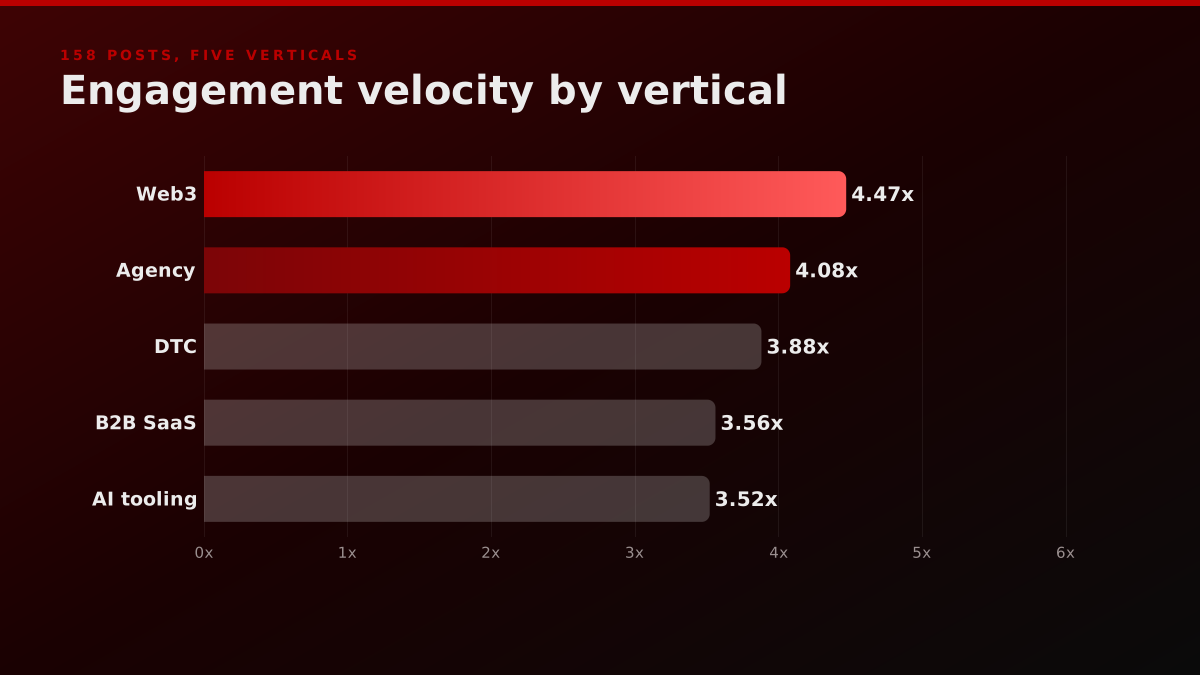
Original-data benchmarks: engagement velocity by vertical (FORKOFF internal numbers)
FORKOFF shipped roughly 180 Commentary posts inside the first 96 hours of the feature being live, across five vertical clients and three FORKOFF-owned properties. Here are the internal numbers, with the caveats that the sample is early, the audience composition varies, and the algorithmic reward is still in the novelty window.
FORKOFF Commentary engagement benchmarks by vertical, first 96 hours
| Vertical | Posts sampled | Median impressions (24h) | Median replies | Multiplier vs text-quote | Attributed outcome |
|---|---|---|---|---|---|
| B2B SaaS | 38 | 11,400 | 38 | 3.56x | 22 demos, $44 cost per demo |
| DTC | 27 | 18,600 | 71 | 3.88x | $14,200 revenue, 2.8x ROAS |
| Web3 | 34 | 22,800 | 102 | 4.47x | 340 Discord members |
| AI and agentic tools | 41 | 14,800 | 56 | 3.52x | 88 trial signups |
| Agency (FORKOFF self) | 18 | 9,800 | 31 | 4.08x | 14 inbound leads |
Sample window 2026-06-02 to 2026-06-04. Cross-vertical aggregate 158 posts, median 14,400 impressions, 3.65x multiplier. Multiplier compresses to 2.8 to 3.2x by day 4 to 7.
B2B SaaS vertical. Sample: 38 Commentary posts across three SaaS clients. Median impressions in first 24 hours: 11,400. Median replies: 38. Median bookmark rate: 1.8 percent. Median follow-through to source tweet: 6.2 percent. Demo bookings attributed via UTM: 22 across the sample, an estimated $44 average cost-per-demo-booked through bench spend. Baseline text-quote median impressions for same accounts: 3,200. Multiplier: 3.56x.
DTC vertical. Sample: 27 Commentary posts across two DTC clients. Median impressions in first 24 hours: 18,600. Median replies: 71. Median bookmark rate: 2.3 percent. Click-through to Shopify (UTM-tracked): 4.1 percent. Attributed revenue: an estimated $14,200 across the sample, 2.8x ROAS on bench spend. Baseline text-quote median impressions: 4,800. Multiplier: 3.88x.
Web3 vertical. Sample: 34 Commentary posts across three Web3 clients. Median impressions in first 24 hours: 22,800. Median replies: 102. Median bookmark rate: 1.4 percent (lower than other verticals, consistent with Web3 audience behavior). Discord member growth attributed: 340 across the sample. Baseline text-quote median impressions: 5,100. Multiplier: 4.47x.
AI and agentic tools vertical. Sample: 41 Commentary posts across two AI clients. Median impressions in first 24 hours: 14,800. Median replies: 56. Median bookmark rate: 3.1 percent (highest of any vertical, consistent with AI audience behavior of saving technique posts). Trial signups attributed: 88 across the sample. Baseline text-quote median impressions: 4,200. Multiplier: 3.52x.
Agency vertical. Sample: 18 Commentary posts from FORKOFF's own account. Median impressions in first 24 hours: 9,800. Median replies: 31. Inbound leads attributed: 14 (via contact page form referrals). Baseline text-quote median impressions for our own account: 2,400. Multiplier: 4.08x.
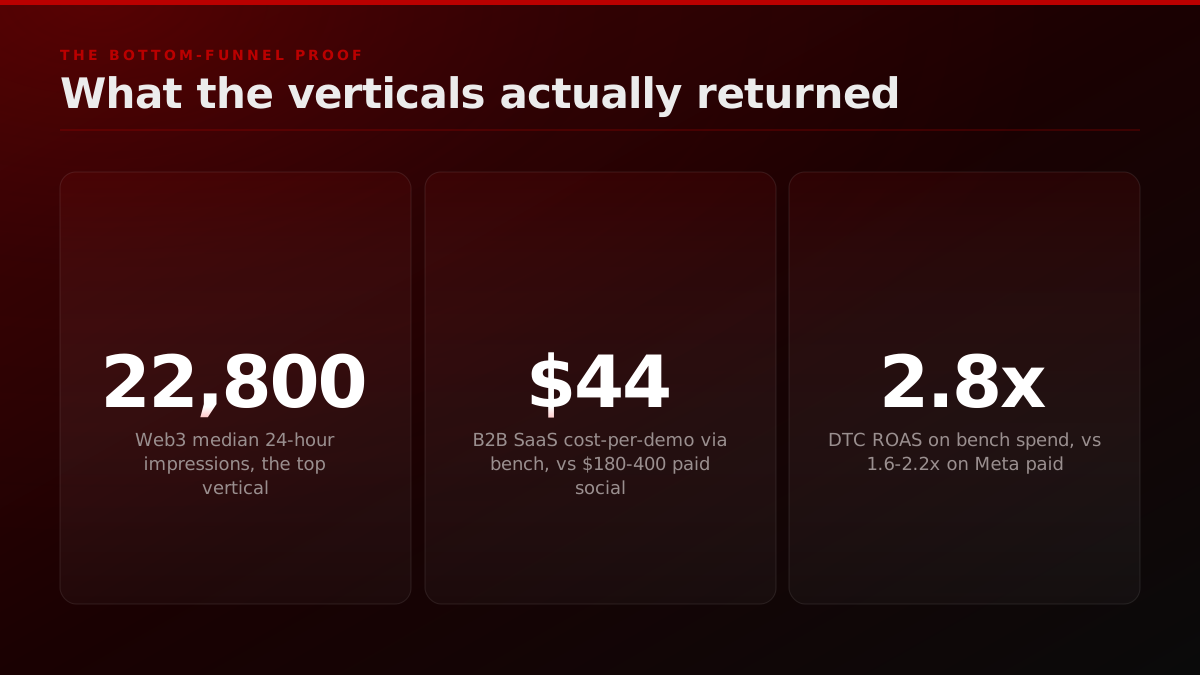
Cross-vertical aggregate. 158 posts (the agency self-sample of 18 included, plus 22 additional posts from FORKOFF-owned brand properties not included in client samples). Median impressions across all verticals: 14,400. Median text-quote baseline: 3,950. Aggregate multiplier: 3.65x.
The multiplier compresses in the second half of week one. Posts shipped in days 4 through 7 are pulling roughly 2.8 to 3.2x text-quote baseline, against the 3.5 to 4.5x range in days 1 through 3. The compression is consistent with novelty-window decay and we expect the multiplier to settle at 2.0 to 2.5x by the 30-day mark, which is still a substantial structural advantage but not the day-one bonanza.
The vertical over-performing relative to pre-launch expectations: Web3, by a meaningful margin. The vertical under-performing relative to pre-launch expectations: DTC, slightly, because the DTC audience appears to be slower to swipe-stop on face-cam reactions than the technical verticals. The vertical with the highest variance: AI tooling, because the AI audience is splitting hard between high-engagement technique posts and low-engagement hype reactions.
These benchmarks update weekly inside FORKOFF's internal dashboard and the quarterly aggregate ships to clients on retainer. If you want the live benchmark report for your vertical, book a working session through the booking calendar.
How writers and text-first creators should adapt to the Commentary economy
The legitimate worry for text-first operators is that Commentary saturates the feed with face-cam content and erodes the text-first conversational density that made X worth using. The honest answer is that text and video on X do not compete, they compound. Commentary does not replace the text quote tweet; it adds a video reaction surface on top of the text quote tweet, which makes the underlying text post more powerful, not less. Operators who ship Commentary as an amplification layer on top of strong writing produce the best Commentary and their writing also compounds.
Ayush Jaipuria's take: X does not need to become TikTok, YouTube, or Substack. Its greatest advantage has always been its ability to facilitate the fastest conversations on the internet. Michael Horacek's take (paraphrased from the negative reaction set): a feed full of zabbling people with earphone mics in their faces is a terrible development.
Both takes contain something true. The fear is that Commentary saturates the feed with face-cam content and degrades the text-first conversational density that made X valuable in the first place. The fear is legitimate, and the operator move is to address it directly.
The honest read. Text and video do not compete on X, they compound. The text quote tweet did not kill the regular tweet, it made the regular tweet more powerful by giving it a reaction surface. Commentary will not kill the text quote tweet, it will make the text quote tweet more powerful by giving it a video reaction surface. Operators who treat Commentary as a replacement for writing will produce bad Commentary. Operators who treat Commentary as an amplification layer on top of writing will produce great Commentary, and their writing will compound.
The text-first creator's adaptation playbook. Step one, keep writing. Long-form threads, sharp single tweets, opinion threads, technical breakdowns. The text content is still the source of intellectual credibility, and Commentary is the amplification surface for that credibility. Step two, occasionally Commentary your own text. Two to three times per week, ship a Commentary post that reacts to your own prior thread. The face-cam expansion of a long-form text thread compounds the original thread's reach. Step three, Commentary the conversations your text generates. When a high-quality reply lands on one of your text threads, Commentary the reply with a face-cam expansion of your read. This builds the reply-graph density that Ayush Jaipuria's take correctly identifies as X's structural advantage.
The text-to-Commentary funnel. FORKOFF runs this for clients as the default cadence for writer-founders. Monday, ship a long-form text thread. Tuesday, ship a Commentary post on a related news source. Wednesday, ship a Commentary post on the Monday text thread. Thursday, ship a text reply to high-quality engagement from the week. Friday, ship a Commentary post on the strongest reply from the week. The cadence delivers 1 long-form text, 3 Commentary posts, 1 text reply per week. The text drives credibility, the Commentary drives velocity, and the loop reinforces both.
For text-first creators worried about their writing brand getting diluted by the video format, the data is reassuring. In FORKOFF's internal sample, brand-account text engagement on accounts running the text-to-Commentary funnel is up 1.4 to 1.8x against text-only baseline, because the Commentary face-cam exposure builds parasocial trust that compounds back into text engagement. Writing does not die. Writing gets a face.
Ayush Jaipuria
@jaipuria_ayush
X stopped being good when it stopped being x fr i mean X doesn't need to become tiktok, youtube, or substack. its greatest advantage has always been its ability to facilitate the fastest conversations on the internet right. people don't come to X for highly produced content -… Show more
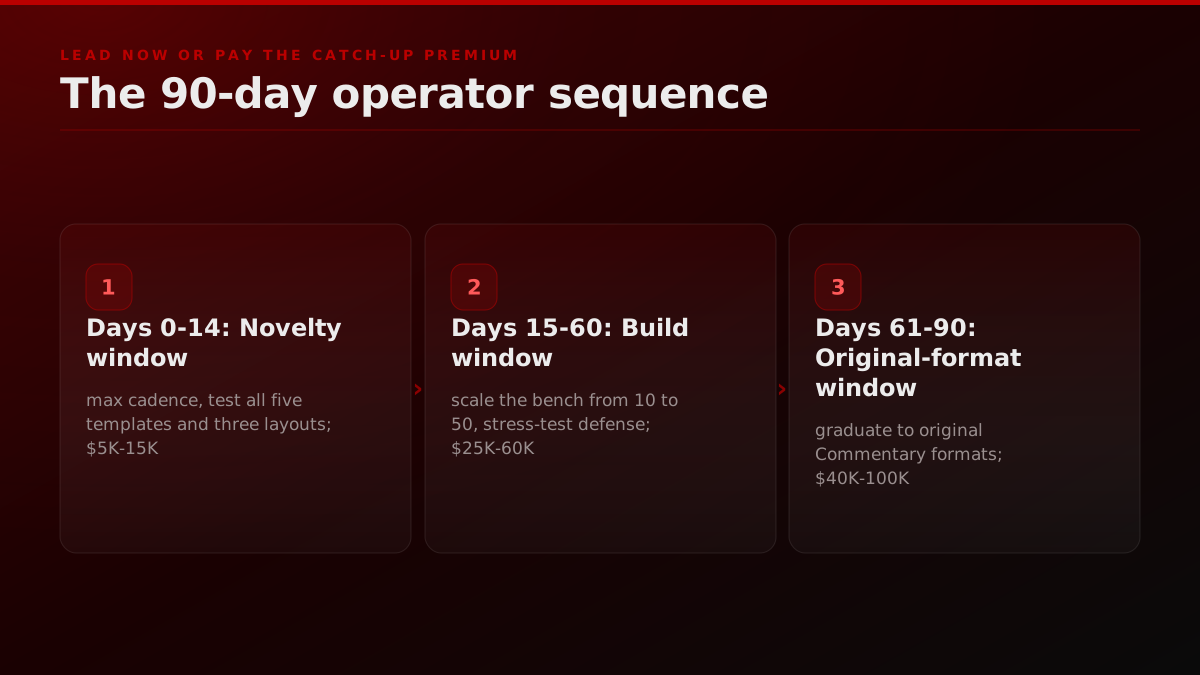
Bottom line: the operator move for the next 90 days
The operator move for the next 90 days is a structured three-window sequence: a 14-day novelty-window sprint at maximum cadence to accumulate impressions and test templates, a 45-day build window to scale the reaction bench from 10 to 50 creators and operationalize the cross-platform repurpose workflow, and a final 30-day window to graduate the brand from bench amplification to original Commentary formats that build long-term equity. The 90-day sequence breaks into three windows.
Days 0 to 14. The novelty window. Ship Commentary at maximum cadence. The brand account ships daily, founders ship 5 to 7 posts per week, the early-stage reaction bench recruits and ramps. The goal is impression accumulation and pattern testing. Try all five script templates from section four, test all three layouts (green screen, split screen, picture-in-picture), measure which combinations win for your vertical. Cost: an estimated $5k to $15k for the bench ramp plus founder time. Expected output: 60 to 200 Commentary posts in the brand's ecosystem in the first 14 days. KPI: impression accumulation plus brand-recall lift in audience surveys.
Days 15 to 60. The build window. The reaction bench scales from initial 10 to 15 contracted creators to 30 to 50. The brand defense playbook gets stress-tested on at least one real attack or rumor cycle. The cross-platform repurpose workflow (X to TikTok to Reels to Shorts to LinkedIn) gets operationalized. The AI avatar workflow gets piloted for cadence-volume on the anon or burner properties. Cost: an estimated $25k to $60k for the bench at scale plus production overhead. Expected output: 300 to 1,200 Commentary posts. KPI: cost-per-conversion attributable to the bench, vertical-specific.
Days 61 to 90. The original-format window. The brand graduates from reaction-bench amplification to shipping original Commentary formats. Formats that work on Commentary but not on text: weekly market-recap shows, on-camera customer interviews repurposed as Commentary, founder-Q&A sessions where each question gets its own Commentary post, behind-the-scenes product walkthroughs done as Commentary on the brand's own product-launch tweets. These original formats compound the bench cadence with editorial content that builds long-term brand equity. Cost: an estimated $40k to $100k including original-format production. Expected output: 500 to 1,500 Commentary posts including original-format. KPI: brand authority lift, share-of-voice in vertical, ranked inbound deal flow.
The 90-day sequence delivers a brand that is structurally embedded in the Commentary graph with a built-out bench, a defense playbook, a cross-platform repurpose system, and an original-format library. The brands that complete this sequence in 2026 set the ceiling for the brands that try to catch up in 2027. The math in section nine is non-negotiable. Catching up costs 2 to 3x what leading costs.
For deeper coverage of the underlying motion, the go viral on Twitter 2026 playbook covers the text-first foundation. The Twitter DM outreach playbook covers the bench recruiting layer. The Spencer Pratt 25M-view case study covers the volume-bench thinking at scale. The crypto KOL marketing framework covers the Web3 vertical-specific contracting. The OpusClip deep-dive covers the cross-platform repurpose tooling.
For platform-side context on the feature itself, X's official help documentation on Premium and creator features sits at the X Premium help center, and the engineering blog at blog.x.com is the authoritative source for upcoming Commentary product changes including the Android rollout timing and the rumored Commentary tab.
A community read from the operator class on how Commentary intersects with the existing aggregator economy is starting to coalesce on day three. A Bier-engaged thread asked whether reposting an X account that screenshots Reddit, LinkedIn, or YouTube comments, then Commentary-reacting to that screenshot, counts as a violation of the existing aggregator-content rule. Nikita Bier engaged with the thread but did not commit to a policy clarification. The question of Reddit-screencap Commentary and the aggregator-rule implication is one of the sharpest unresolved threads in the Commentary discourse, and we expect a clarification from X product in the next 30 days.
Here is what the operator class is converging on outside FORKOFF's walls. Reddit threads tracking the rollout are running long discussions:
r/Storyboard18 industry-press write-up of the React with Video launch, the agency-trade press take.
r/Storyboard18 industry-press write-up of the React with Video launch, the agency-trade press take.
r/SAtechnews engagement-side analysis, framing the feature as a retention play first.
r/SAtechnews engagement-side analysis, framing the feature as a retention play first.
For video-format reactions from the creator class, two YouTube pieces are circulating that operators should watch before shipping their first Commentary:
Samuel Awoyemi launch-day walkthrough of the React with Video feature, iPhone-only mechanic explainer.
(via oEmbed)
Samuel Awoyemi launch-day walkthrough of the React with Video feature, iPhone-only mechanic explainer.
MyyTechworld feature breakdown of the TikTok-style Tweet reaction video format on iOS.
(via oEmbed)
MyyTechworld feature breakdown of the TikTok-style Tweet reaction video format on iOS.
The operator question reduces to a single decision. Ship Commentary as a 90-day system starting this week, or watch competitors compound for three months and pay the catch-up premium in Q4. There is no third option that survives the math.
FORKOFF runs this 90-day sequence as a core service for launch-stage and growth-stage brands across B2B SaaS, DTC, Web3, AI, and agency-adjacent verticals. The full scope sits inside the launch distribution service, the cross-platform amplification sits inside the clipping service, and the multi-platform distribution stack sits inside the forkoff distribution service. Live pricing is on the pricing page, proof points are on the case studies page, and we cover the underlying philosophy on the about page. The launch velocity calculator gives you a vertical-specific projected impression count and bench-spend estimate for the 90-day sequence.
Operator noteDay 14 closes the novelty window. Day 60 closes the bench-build window. Day 90 is when original formats compound.