


01
Ad networks
count impressions
Ad networks count impressions. You pay every time a view is delivered, even when nobody watches. Reach is measured. Whether anyone cared is not.
Pay for ads that never get watched.
Brands pay an average of $0.0024 to $0.0038 per qualified view. verified watch-time, valid traffic, geo-routed delivery. If it doesn't qualify, it doesn't count.
Agencies sell effort. Bounty boards sell volume. FORKOFF sells qualified outcomes.
Clipping is not editing. It is distribution infrastructure.
Three content signals price on an inverting ladder: the more brand-dedicated the account, the higher the CPM and the lower the volume. Editing is the cheapest, most replaceable step in the chain. The infrastructure, screened clippers, qualification pipeline, and distribution across five platforms, is what a brand is actually buying.
A clipping agency is a managed service that recruits, briefs, and directs short-form editors, called clippers, who cut long-form content into platform-native clips, then reports on the results. Clipping pricing runs three ways: flat retainers, raw-view bounty boards, and outcome pricing. FORKOFF prices on outcomes at an average of $0.0024 to $0.0038 per qualified view, counting a view only after a four-stage gate checks watch-time, policy, geo, and traffic validity. The network has processed 5B+ views this way.
A clipping campaign is a managed program where a brand briefs a roster of clippers to cut long-form content into platform-native short clips, then pays only for the views that pass qualification. FORKOFF runs the whole campaign: brief, clipper screening, episode-level direction, moderation, and settlement. The difference from a self-serve tool or a raw-view bounty board is the unit you pay for. FORKOFF bills the campaign on qualified views at an average of $0.0024 to $0.0038 each, so a clipping campaign budget maps to verified watch-time and valid traffic, not impressions a dashboard inflated.
Clipping pipeline
3 moments marked
1:47:32
the cold-open answer
the contrarian take
the one-line proof
Hook in frame one, captions burned in, sized 9:16
Qualified views
896,000
At $0.0024 to $0.0038
$2,150 to $3,405
Paid on qualified views, not on hours edited
Clipping is how FORKOFF delivers short-form distribution at scale. Brands buying managed campaigns can start with our guide for brands buying clipping; estimate a budget with the CPQV calculator.
Cost per qualified view, or CPQV, is the price a brand pays for one view that passes every qualification check in the campaign brief. It is the honest unit of clipping campaign cost, because it strips out the views a raw-view count would have billed you for. Across FORKOFF campaigns the average lands near $0.0024 to $0.0038 per qualified view. The figure moves with platform mix, geo targeting, and how strict the brief sets watch-time and traffic-validity thresholds, but the unit never changes: you pay for views that qualified, and the verified proof shows the ones that did not.
The full per-platform CPQV spread, sample window, and exclusion-rate methodology are published in the FORKOFF CPQV benchmark. Compare that against a per-raw-view bounty board, which bills every view that loaded, and per-seat clipping software, which charges a flat subscription no matter how the views perform; the AI tools themselves are benchmarked head to head in the OpusClip vs Vizard comparison, and the model contrast is laid out in the pricing table further down this page. A one-paragraph definition lives at what is cost per qualified view.
Two numbers on this page do two different jobs. One is what you buy. The other is what our campaigns have measured. Reading the second as the first is the fastest way to size a campaign wrong, so here is each one and what it is for.
The entry price, what you buy
from $3,500
The FORKOFF entry buy is Clipping Foundation: from $3,500 per campaign, with a three-campaign minimum term. It is the smallest managed engagement we run and the figure to plan against. Where you land above it follows scope, geo, and the volume you want.
The measured rate, what campaigns delivered
$0.0024 to $0.0038 per qualified view
This is FORKOFF's reference rate for managed clipping, inside a reference band of $0.0024 to $0.0038. It is first-party evidence from 5B+ views processed, and it moves with platform mix, geo targeting, and how strict the brief sets watch-time. Read it as a reference for what efficient looks like on this model.
The measured rate is proof, not a published unit to multiply a view target by. Do that arithmetic and you get a number, not a quote. Bring the outcome you want and the scope lands on the call. The per-platform spread and exclusion-rate methodology behind the measured rate are published in the FORKOFF CPQV benchmark.
The clip economy is the market that formed when brands realized short clips, not polished long-form, drive most of the attention on TikTok, Reels, Shorts, and X. Clippers cut moments from podcasts, streams, and launches, post them at volume, and get paid on performance. The model went mainstream when large content owners started paying clippers directly, which pushed the question every brand now asks: which of these views are real. The clip economy rewards volume, so it also produces inflated view counts. Paying per qualified view is how a brand stays in the clip economy without paying for the noise it generates.
FORKOFF wrote up the moment the clip economy crossed into nine-figure budgets in the clip economy, explained, and broke down a real campaign in the clipping campaign cost case study. The same question drives our research: FORKOFF forensically analyzed 30 high-profile launches and found 67% carried a paid or amplified reach signature, in the Launch Authenticity Report 2026. Brands standing up their own roster can follow how to build a brand clipping network. For a launch specifically, FORKOFF produces the launch video and clips it into launch-day distribution, so the film and the amplification ship from one team. Where the long-form the clips are cut from is a recurring show rather than a one-off launch, the upstream engagement is podcast marketing services, which owns the strategy, the record, and the distribution the clip cadence then runs on. When the source is a conference talk, panel or side event, the upstream engagement is event marketing, which records on site and hands the footage to the same clip waterfall.
A clipping agency costs whatever its pricing unit makes you pay for. FORKOFF prices managed clipping on qualified views rather than a flat retainer or raw-view count, billing an average of $0.0024 to $0.0038 per qualified view, so the budget tracks verified watch-time and valid traffic instead of impressions a dashboard inflated. The total moves with platform mix, geo targeting, and how strict the brief sets watch-time and traffic-validity thresholds, but the unit never changes.
Estimate a budget against your own view target with the CPQV calculator, or see the model contrast against per-raw-view marketplaces and per-seat software in the agency vs marketplace explainer. Weighing named managed networks? See the full nine-agency ranking in the best clipping agency comparison, or read the clipping culture alternatives breakdown. Comparing against self-serve software instead? The 10 OpusClip alternatives ranking sorts tools and managed shops on how much of the chain each one owns. The brief answer to how much a clipping agency costs sets out the pricing units side by side. The model question underneath it, why a few agencies bill per delivered outcome while most bill a monthly retainer, is answered at agencies that price on outcomes instead of retainers. The six checks that separate a real distribution partner from a good-looking landing page are laid out in how to choose a clipping agency. Every short question we get asked about clipping, pricing, usage rights and attribution is answered in one place in the answers library.
A clipping agency is worth it for a brand that wants short-form output at volume without building an in-house editing team and without paying for views that never qualified. The managed model handles brief creation, clipper screening, episode-level direction, moderation, and per-view reporting, which is the work that decides whether a clip program produces real watch-time or just an inflated view count. FORKOFF has processed 5B+ views through this model at a a four-check gate on every view rate, and excludes every view that fails a qualification check with a written reason code, so the brand only pays for traffic that passed.
Brands buying managed campaigns can start with our guide for brands buying clipping; the per-view methodology is published in the qualified views methodology. SaaS teams weighing a clipping agency for SaaS launches can scope the brief at clipping for SaaS brands. Screening trust before budget? Are clipping agencies legit answers that question directly.
An AI clipping agency is a managed team that uses AI clipping tools to cut long-form content at volume, then adds a human qualification layer on top so a brand pays only for views that pass. It sits between two other options. A clipping platform, or clipping software, is self-serve: you upload a video and the tool returns clips, but nobody screens the output or the views behind them. A raw-view clipper agency or bounty board pays clippers on every view a dashboard reports, qualified or not. FORKOFF runs as a managed AI clipping agency: AI tooling handles the cutting speed, and a four-stage qualification gate decides which views count, at an average of $0.0024 to $0.0038 per qualified view. The network has processed 5B+ views this way at a a four-check gate on every view rate.
Picking the best clipping platform for your team comes down to whether you want to run the work yourself or hand it to an agency. Self-serve tools are compared head to head in the OpusClip vs Vizard comparison and the 10 OpusClip alternatives ranking. Managed clipping agencies are ranked in the best clipping agency comparison. If you already run in-house clippers, FORKOFF can layer its qualification engine over your existing roster, so you keep the team and add the proof.
Clipping is not a side tactic anymore. Short-form video is the format buyers watch and the format marketers say returns the most, and the creator economy behind it is now a hundreds-of-billions market. Here is the sourced picture behind the managed clipping motion on this page, every figure from a named source with the year it was reported.
The creator economy was a roughly 250 billion dollar total addressable market in 2023 and is projected to nearly double to about 480 billion dollars by 2027. (Goldman Sachs, 2023)
There are an estimated 50 million creators worldwide, a base expected to grow at a 10 to 20 percent compound annual growth rate over five years, with short-form video monetization named as a primary driver. (Goldman Sachs, 2023)
United States creator advertising spend more than doubled from 13.9 billion dollars in 2021 to 29.5 billion dollars in 2024, and is projected to reach 37 billion dollars in 2025, growing about four times faster than the total media industry. (IAB, 2025)
Short-form video returns the highest ROI of any content format and ranks first for lead generation and engagement, and marketers said they planned to invest in it more than any other media format. (HubSpot 2024 Video Marketing Report, 2024)
YouTube Shorts averages more than 70 billion daily views, up from about 30 billion in 2021, one of the fastest-growing formats in the platform's history. (YouTube, 2024)
FORKOFF has processed 5B+ views through its managed clipping network, billing $0.0024 to $0.0038 per qualified view, with every rejected view logged and excluded from spend. (FORKOFF, 2026)
FORKOFF has processed more than 5 billion qualified views through a four-stage qualification gate that checks watch-duration, platform policy, geo consistency, and traffic validity on every view, at a reference band of $0.0024 to $0.0038 per qualified view. Every rejected view is logged with a written reason code and excluded from billing.
Source, FORKOFF first-party data: Clipping CPQV benchmark and qualified-views methodology.
Four platforms, one campaign. FORKOFF's clipper pool ships your content to TikTok, Instagram, YouTube and X. every clip routed to the surface where it earns the qualified view.
count impressions
Ad networks count impressions. You pay every time a view is delivered, even when nobody watches. Reach is measured. Whether anyone cared is not.
Pay for ads that never get watched.
count raw views
Self-serve clippers count raw views. The number includes scroll-by views, bot traffic, geo-mismatched audiences, and sub-second exposures. Low rate-card price, but the number is a vibe. not a receipt.
Pay for views that never qualify.
counts qualified views
FORKOFF counts qualified views. Every view passes four checks. watch duration, policy compliance, geo consistency, traffic validity. before it counts toward a brand's spend or a clipper's payout. The receipt is auditable. The CPV is real.
Pay only on outcomes.
A view is qualified only when all four checks pass. If any layer rejects it, the view is logged, attributed to a reason code, and excluded from both spend and payout. Every billed view has cleared all four.
① WATCH
Duration meets the threshold
TikTok 1.5s baseline · YouTube 30% retention · Instagram Reels 2s baseline. Threshold is set in the brief.
Disputed claims, restricted categories, and policy edges get rejected with a written reason. Never silently filtered.
Views from non-target countries are logged but never counted. Spillover happens only when the brand authorizes it.
Datacenter UAs, viewing patterns, and post-campaign cohorts reviewed. Multi-layer because a single check is gameable.
a four-check gate on every view is not a marketing claim. It is the rate measured after every layer has run. Brands never pay for filtered traffic. Clippers flagged in any layer are removed and excluded from payout, with a written reason.
Clipper identity verification, account age, platform history, cross-platform graph signals. Filters bad actors before they get in the door.
5.3M passed
4-layer funnel
Brief intake on day 1. Geo-routed clipper pool live within 48 hours. Auto-settled payouts once moderation clears. Every step on the same audit-ready ledger.
A campaign with a reason to run.
Targeted clippers, not random ones.
Every clip, every reason.
Real-time outcomes, auto-settle.
Enter your budget, platform mix, and qualified-view threshold to see the CPQV a clipping campaign would target. It is the same math FORKOFF prices clipping work against, so you walk into the brief knowing what efficient looks like.
From $3,500 per campaign with a three-campaign minimum term, paid only on qualified views. You see the shape of the data on your own footage before scaling, and find out early whether your footage clips well.
Side-by-side against the platforms in market today. Categories chosen by buyer-team request. not picked to flatter us.
| Feature | FORKOFF Clippingoperator-grade | OpusClipself-serve SaaS | Whop / Hoodpayclipper bounty board | Vizard / Klapself-serve SaaS |
|---|---|---|---|---|
| Counts qualified views (4 checks) | ||||
| Geo-routing | partial | |||
| Moderation pipeline | ||||
| Anti-bot ledger | partial | |||
| Visible payout math (before accept) | ||||
| Pricing model | Per QV ($0.0024 to $0.0038) | Per raw view | Per raw view | SaaS monthly |
| Best for | B2C + crypto brands | Solo clippers | Clipper bounty boards | Solo clippers |
Honest framing: each platform is best for a different buyer. We name who.
Full buyer's matrix on forkoff.xyz/blogBring your target geo and the monthly view volume you want. You get the qualified-view rate on the call, not a proposal a week later.
Brand anonymized at NDA request · numbers verified by FORKOFF qualification ledger
Each engagement below names the company, the window the work ran in, and the numbers it returned. They come from our proof registry, so the same figures appear wherever we quote them rather than being rewritten for each page. Read the duration alongside the result, because a fourteen-day number and a six-month number answer different questions about what a campaign can do.
14 days, Q1 2026
qualified views
price band per qualified view
14 days, Q3 2026
qualified views
price band per qualified view
14 days, Q3 2026
qualified views
price band per qualified view
Walk through what numbers like these would look like for your business.
Campaign summary
13 active days of distribution, 1.19 million views and 16 new paid subscribers at $50 a month, while 92% of the prior month's subscribers kept paying on top of that.
Crypto Lark
YouTube Creator, The Inner Circle, Lark Davis · The Inner Circle
Finance approved the spend the day we showed them the cohort report. A screenshot of views is not attribution. A per-view audit ledger with reason codes is.
Marketing director
Marketing Director, DePIN Protocol
Submitted Tuesday. Earned Friday. The payout math was exactly what they showed me before I accepted the brief. I have run three campaigns now. Same experience each time.
Clipper
Clipper, TikTok · India + SEA
US-only mode was underperforming. We opened India and Southeast Asia in the routing. Same budget, 4.2 million qualified views over 14 days. The CPV came in at a third of what we had been paying.
Head of campaigns
Head of Campaigns, Crypto consumer brand
Clip economy is moving toward outcome-priced. We pay for verified attention now, not raw impressions. Anything else is selling air.
Brandon Olsen
Crypto-native brand, ops lead
Spent $40K on a clipping campaign last quarter. Dashboard reported 80M views. Real qualified watch-time was closer to 6M. The industry needs a real standard.
Ava Sterling
Agency, paid social strategist
If your clipping spend isn't gated by a watch threshold + geo + bot check, you're funding inventory the platforms throw away. Burned us once, never again.
Felix Ortega
B2C founder, Series A
Best campaign we ran this year: paid per qualified view, not per raw view. Same budget, 3.4× more retained attention. The unit of account matters.
Grace Park
Token launch, growth PM
Our agency report shows 12M views. Internal mixpanel pulled in 3.1M sessions. The gap is real and growing. Anyone using a third-party qualified-view ledger?
Paraphrased, r/marketing
Burned $80K on a pure-volume campaign last quarter. Looked clean on the dashboard. Three weeks later we're chasing reasons. Anyone running on per-qualified-view pricing yet?
Paraphrased, r/cryptocurrency
Switched off the random-pool platforms last month. Hate the lottery. Got onto a managed network where eligibility is in writing before I accept. CPM math is clearer, payouts auto-settle. Glad to take less for clarity.
Paraphrased, r/CreatorEconomy
We design the brief with you, run the three-campaign minimum term, and report qualified outcomes against your CPV target. If qualified views fall below the committed volume, you do not pay for the gap. Operational fee disclosed in advance.
| ▸ TikTok | 5K+ followers OR a 90-day verified track record |
|---|---|
| 3K+ followers · last-30d engagement ≥ 3% | |
| ▸ YouTube Shorts | 5K subscribers OR 50K shorts-views in 30 days |
| ▸ YouTube long-form | 2K subscribers · ≥ 25% retention on a clip ≥ 60s |
| ▸ X / Twitter | 2K followers · video-history present |
| 5K page followers |
Eligibility is platform-specific because qualification math is platform-specific. Fit, quality, and verifiable performance matter more than raw follower count.
Payout = (Qualified Views ÷ 1,000) × Campaign Rate
ex: 20,000 qualified views @ $1.25 CPM = $25 (campaigns pay $1.00 to $1.25)
Where it leads
Also part of the plan for
A view that passes four checks set by the campaign brief: watch duration, policy compliance, geo consistency, and traffic validity. If any layer rejects it, the view is logged with a reason code and excluded from both spend and payout.
Most campaigns go live within 24-48 hours of brief acceptance.
Yes. Start on the cheapest content signal, logo placement over existing volume, before committing to dedicated brand accounts at 12-20x that rate. The Clipping Foundation pilot goes entirely to clippers with no management fee, targeting 1-1.2M qualified views across 50-60 accounts.
Instagram, TikTok, YouTube (Shorts and long-form), X, and Facebook.
OpusClip and Vizard are self-serve clipping SaaS. Whop and Hoodpay are clipper bounty boards that count raw views. FORKOFF Clipping is managed and counts only qualified views: every view filtered through four checks before it counts.
No. Fit, quality, and verifiable performance matter more than raw follower count.
Every rejection includes a reason code: policy issue, brief mismatch, format mismatch, or invalid traffic signals.
Payout equals qualified views divided by 1,000, times the campaign CPM rate. Rates are visible before brief acceptance.
Yes. FORKOFF Clipping can run a managed campaign on a brand's existing clipper roster, with the qualification engine and reporting layered on top.
It depends on the tier. On the clipper-network model, the clipper owns the account and the brand rents the reach. On the dedicated brand-account tier, accounts are created for that brand rather than drawn from shared inventory, so ownership and any handover terms belong there. We say up front which model a given quote is for.
On the mass clipper-network signal, a clip lands on someone else's page alongside whatever else that page posts, so we cannot guarantee adjacency. The dedicated brand-account tier is built for exactly this: every neighbouring post on that account is also the brand's own, which is total adjacency control by construction and part of why that tier carries a higher CPM.
Filtered traffic is logged with a reason code and excluded from spend. Brands never pay for traffic that fails any qualification check.
Yes. Every campaign produces an audit-ready CSV/JSON export with per-view reason codes.
FORKOFF is a managed AI clipping agency, not a self-serve clipping platform. Self-serve platforms and clipping software return clips and leave verification to you. FORKOFF uses AI clipping tools for speed, then runs a four-stage qualification gate so a brand pays only for views that pass, at an average of $0.0024 to $0.0038 per qualified view.
Run measurable clipping campaigns priced on qualified views only. Start with Clipping Foundation, a three-campaign minimum, paid only on qualified views.
Are you a clipper? Join the networkRegion hubs, conversion pSEO grids, podcast verticals, ICP pages, free tools, and the vs/alternatives compare matrix. Every link goes to a real page on this domain.
Region + platform
12 pagesMatch clippers and brands by geography and platform. Each hub ranks for the geo + platform head term.
Source → destination
15 pagespSEO grid covering every realistic source platform paired with every realistic destination short-form surface.
Content + podcast
13 pagesPodcast clipping vertical pages and the top-of-funnel compare hubs that capture "best clipping software" SERP intent.
Content type
Compare hubs
Clippers + Brands
12 pagesClippers in the network on one side, brand verticals buying clipping on the other. Each ICP ranks for the bottom-funnel head term.
Clippers
Brand verticals
Launch + tools
16 pagesLaunch-shaped scenarios for AI, SaaS, dev tools, fintech, gaming and crypto. Plus the free calculators clippers + brands use before brief acceptance.
Launch + use-case
Free FORKOFF tools
First-party research
FORKOFF vs vendors
19 pagesHead-to-head with every named competitor in the clipping category. Pricing and review teardowns for the four most-searched vendors.
vs comparisons
Pricing + review teardowns
Need a page that isn't in the grid?
Custom landing page for your campaign scenario.
If your scenario doesn't map to one of the 86 pages above, FORKOFF can scope a custom landing page for your campaign before brief acceptance.
Cost per qualified view (CPQV) is a clipping pricing model where a brand pays only for views that pass a verification gate, not for raw view-counter totals. FORKOFF defines a qualified view as one that clears four checks: a real human watched it, the viewer was in the target region, the traffic source was valid, and it was not a bot or view-farm. FORKOFF's benchmark rate is $0.0024 to $0.0038 per qualified view. The point of the metric is to move clipping spend off a number anyone can inflate (raw views) and onto a number a brand can audit, with an append-only per-view ledger exportable as CSV or JSON. Across FORKOFF's network, 5B+ views have been processed against this gate.
Two clipping quotes can look identical on headline price and differ enormously in real cost, because they count different things. A raw-CPM model bills every number the platform counter shows, including bot, out-of-region, and farm views. A qualified-view model bills only what survives the gate. That is why a $0.0024 to $0.0038 qualified-view rate can be cheaper per genuine view than a $2 raw CPM: the raw model is charging you for the noise. The audit ledger is what makes the difference checkable rather than a marketing claim, because every accepted and rejected view carries a reason code a finance or treasury review can read.
Raw view versus qualified view
| Dimension | Raw view (CPM) | Qualified view (CPQV) |
|---|---|---|
| What gets billed | Every platform-counter view | Only views that pass the gate |
| Bot or emulator traffic | Counted and billed | Filtered out before a view counts |
| Out-of-region views | Counted | Not counted toward a geo-targeted brief |
| Farm or injected sessions | Counted | Screened out |
| Audit trail | None | Append-only per-view ledger, exportable as CSV or JSON |
| FORKOFF rate | Not applicable | $0.0024 to $0.0038 per qualified view |
A $0.0024 to $0.0038 qualified-view rate can be cheaper per genuine view than a $2 raw CPM, because the raw model is charging you for the noise. Across FORKOFF's network, 5B+ views have been processed against this gate.

Yes, clipping agencies are legitimate. Clipping is a real distribution model where short native clips of your long-form content are posted across creator accounts to earn reach. But the category has a real risk that a scam agency exploits: bot and view-farm traffic, fake engagement, and raw-view billing that charges you for views no human watched. A legit agency is separated from a scam one by one thing, verification you can audit. FORKOFF bills on qualified views only ($0.0024 to $0.0038 per view that clears a four-stage gate: real human, in-region, traffic-valid, not bot or farm) and ships an exportable per-view audit ledger proven across 5B+ processed views, with RADAR bot-screening on top. The practical test before you hire anyone: ask for a per-view audit trail, confirm geo and human checks, and refuse a raw-CPM-only quote with no proof behind the number.
Per our own campaign ledger, a 14-day FORKOFF clipping campaign for a crypto exchange cleared 3.8M qualified views at $0.0024 to $0.0038 per qualified view, with every view run through a four-check gate and rejected views logged and never billed. FORKOFF clipping campaign ledger, Q3 2026
The reason this category has a trust problem is that a raw view count is trivial to inflate and, after the fact, impossible to audit. Two agencies can quote the same headline reach while one delivered genuine watched views and the other bought bot traffic, and the invoice looks identical. That is why the honest answer to whether clipping agencies are legit is not yes or no, it is that legitimacy is verifiable. A real operator ties spend to views that survived a screening gate and hands you the ledger. A scam operator resists any audit because the number would not survive one. The buyer protects themselves by refusing to pay on an unaudited counter, which is also the standard FORKOFF was built around.
Legit versus scam: a question of proof, not price
| What to check | Legit agency | Scam agency |
|---|---|---|
| Billing basis | Qualified views that clear a gate | Raw view counter with nothing behind it |
| Human and geo screening | Real human and in-region checked before a view is billable | None, bot and out-of-region views billed |
| Audit trail | Exportable per-view ledger with a reason code on every view | Resists any audit |
| Entry point | A bounded entry to verify delivery first (FORKOFF: Clipping Foundation, from $3,500 per campaign with a three-campaign minimum) | Commit budget upfront on an unaudited counter |
| FORKOFF proof | $0.0024 to $0.0038 per qualified view, four-stage gate, plus RADAR bot-screening | Not applicable |
Before hiring, ask three questions: can you show a per-view audit trail, do you screen for real humans and target-region traffic before billing, and is there a bounded entry to verify delivery. Clean answers to all three signal a legitimate model.
Money moves in one direction, views in the other, and an agency sits in the middle. A brand pays for reach on its long-form content. Clippers cut that content into short clips and post them on their own accounts across TikTok, Reels, Shorts and X. The platforms count views, and clippers are paid per view, typically $1 to $5 per 1,000 according to Digiday's reporting, capped at the campaign budget. A managed agency recruits and briefs the clippers, reviews the clips, counts the views and settles the payouts; a bounty board hands those jobs back to the brand. Nothing in that loop is shady. Streamers have paid clippers for years, MrBeast launched a clipping bounty board, and Tether put $200 million into Whop at a $1.6 billion valuation in February 2026, according to CreatorDB. The weak point is the count. Every payment in the loop keys off a view number, and whoever controls the number controls the money. That is why the legit-or-scam question always comes down to who counts the views and whether you can check them.
A tool if your problem is editing, an agency if your problem is reach. AI clipping tools such as OpusClip, Vizard and Klap are legitimate software, roughly $15 to $100 a month, that find moments in long footage and cut them into vertical clips with captions. They carry almost no scam risk, because they do not sell views: you post the clips on your own accounts and get whatever reach those accounts already earn. An agency sells something different, distribution through accounts that have audiences of their own, and that is where the trust question comes in. The moment a vendor sells views rather than software, you need to know how those views were counted. So the legit-or-scam test applies to agencies and networks, not to tools. If you already have an audience and only need faster edits, a tool is the honest answer and no agency should talk you out of it.
Because the category is young, the barrier to entry is close to zero, and the product is a number that is easy to inflate. Anyone can open an account on a bounty board, call it an agency and resell views. Some do it honestly. Others fill campaigns with bot views, view-farm traffic or out-of-region impressions that cost almost nothing to generate and bill them at a rate meant for real people. The question also comes from the other side of the market. Clippers search for whether clipping is legit because some campaigns reject clips without reasons, change rules mid-campaign or pay late, and because courses selling clipping as easy money promise more than most clippers earn. Both sides are asking the same thing in different words: does the number on the screen match something real. A legitimate operator answers with records, not reassurance.
A clip farm optimises for the counter, and a clipping agency optimises for the audience. A farm posts high volumes of clips through bought, fresh or recycled accounts, often re-uploading footage with minimal edits, and pads counts with automation when organic reach falls short. There is no brief worth the name, no review before a clip posts, and the report is a screenshot of platform totals. An agency runs a brief, vets clippers on the audiences they actually reach, reviews clips before they scale, and reports per clip with a way to check each number. The price difference runs the opposite way from how it looks: a farm is cheaper per raw view and more expensive per real one. You pay once for views nobody watched, and again if platform enforcement catches the accounts while your brand's name is on the clips. The table below sets out the signs side by side.
Clip farm or clipping agency: the signs
| Sign | Clip farm | Clipping agency |
|---|---|---|
| Accounts | Bought, fresh or recycled | Screened, with real posting history |
| Edits | Raw re-uploads, minimal editing | Real edits cut for each platform |
| Brief and review | None | Written brief, review before a clip scales |
| View pattern | One-day spikes, thin engagement, wrong regions | Growth over days, engagement in line, target regions |
| Report | Screenshot of platform totals | Per-clip record you can check on the platform |
| Billing | Every view the platform counted | Views that cleared a stated check |
| Disclosure | Skipped | Paid label on every post |
One sign on the farm side is a question to ask. Three or more is a reason to walk away.
Some are and some are not, and an afternoon of checking tells you which. Pick ten clips from the report and open each one on the platform: the post should exist on the account named, and its public count should be at or above the reported count. Look at the engagement on each clip, because hundreds of thousands of views with a handful of likes, or comments that read like spam, is a warning. Check the regional split against your target markets, since cheap views come from wherever views are cheapest. And look at the shape of the curve: real clips grow over days, while bought views tend to arrive in one spike. FORKOFF publishes a views-to-likes benchmark for exactly this kind of check, and runs a four-stage gate, real human, in-region, traffic-valid, not bot or farm, on every view before it is billable. Whatever agency you use, the principle holds: a view you cannot check is a view you should not pay for.
A managed campaign is safer for a brand that cannot police views itself, and a bounty board is fine for one that can. On a bounty board such as Whop's Content Rewards, the brand posts a bounty, any clipper can join, and the brand reviews every submission during a short window. The platform is real and the payouts are real, but the screening is the brand's job, so the quality of the result tracks the hours the brand puts into review. In a managed campaign, one operator owns the roster, the review and the count, which concentrates the risk in one place you can check. That makes it safer only if the operator shows its work: a billable-view definition in writing, a per-clip record, and rejected views you can see. A managed agency that will not show those is a bounty board with a markup.
You do not need to take an agency's word for it. Ask three questions. First, can you show me a per-view audit trail with a reason code on accepted and rejected views. Second, do you screen for real humans and target-region traffic before a view is billable, or do you bill the raw platform counter. Third, is there a bounded entry so I can verify delivery before committing budget. An operator that answers all three cleanly is running a legitimate model. One that cannot, or that only offers a flat raw-CPM with no verification, is exactly the risk the word scam points at. FORKOFF answers all three with the qualified-view gate, the exportable ledger, and the Clipping Foundation entry, but the checklist works to vet any agency you consider. How to test a clipping agency before committing turns it into a first-campaign plan.
The terms that turn a claim into a contract. What counts as a billable view, written as a sentence rather than a category. Audit rights: an exportable per-clip and per-view record during the campaign and after it. What happens to unspent budget and to under-delivery. Usage rights: who owns the source, who owns the edits, and what happens to the clips when the campaign ends. Disclosure: how each paid post is labelled on the platform. And exit: how either side ends the engagement without an annual notice period. A scam operation avoids writing these down, because each one creates a way to check it. A legitimate one has a standard version ready, because it has run enough campaigns to need them. The rights side is covered in who owns the clips from a clipping campaign.
Yes, when the clips are real edits of content the brand owns and the paid relationship is disclosed. The platforms do not ban clipping; they penalise the behaviours a clip farm depends on. YouTube's reused content policy can remove monetisation from channels built on unedited reposts, TikTok keeps unoriginal content out of the For You feed, and Meta said in July 2025 that it would cut reach for Facebook accounts that repeatedly repost others' content. Disclosure is the other half. In the US, the FTC's Endorsement Guides expect a paid post to disclose the paid relationship, and each platform has a setting for it: a branded content toggle on TikTok, a Paid partnership label on Instagram, an includes paid promotion setting on YouTube. A legit agency builds both into the brief. If an agency tells you disclosure is optional, or that reposting raw footage is fine, it is telling you how its accounts will eventually get flagged.
Clips start posting within days, and a campaign is usually judged over a couple of weeks. A network that already has screened clippers and routing can go live quickly, while one that needs weeks to start is often recruiting for your campaign specifically. A promise of a huge view total within hours, before anyone has seen your footage, is the classic sign of bought traffic, because real clips need time to be cut, posted and watched. For a sense of scale, per our own campaign ledger, a 14-day FORKOFF clipping campaign for a crypto exchange cleared 3.8M qualified views, with every view run through the four-check gate and rejected views logged and never billed. That is the shape of result worth asking any agency for: a dated campaign, a fixed window, and a count you can verify.
Yes, when the agency can run inside a compliance process. Fintech, crypto, iGaming and health brands buy clipping too, but they need an approved-claims list, a review step before anything posts, disclosure on every clip, and geo routing that keeps clips out of markets where the product cannot be advertised. B2B brands need something different: clips cut from founder interviews, podcasts and keynotes, posted on accounts whose audiences include the people who buy. Ask for named work in your category and for the compliance steps the agency already runs. FORKOFF's publishable clipping campaigns include a fintech infrastructure company, a crypto retirement investing platform and a sports betting brand, each run on the same four-check gate. An agency with no regulated or B2B work can still be legit. It just has not been tested where your risk sits.
It is worth it when three things are true: you have long-form content with moments that stand on their own, you need reach beyond the audience you already have, and you can measure what the views did. Short-form paid ads are the usual comparison, and industry CPMs for short-form paid reach typically run $4 to $8 per 1,000 views. FORKOFF's qualified-view band works out to roughly $2.40 to $3.80 per 1,000 views that cleared verification, so verified clipping reach usually costs less than the paid alternative. It is not worth it when there is no source worth clipping, when nothing downstream is set up to catch the attention, such as a landing page, a signup or an offer, or when the only quotes on the table are raw views nobody can check. In that last case the cheapest option is often the most expensive one. Do clipping campaigns work covers the evidence on outcomes in more detail.
Stop the spend first, then build the record. Pause the campaign before more budget goes out, and export or screenshot everything: the agency's report, the clip URLs, the public counts, the engagement on each clip and the regional split. If your contract defines billable views by a check, the views that fail it are not owed, and the record is your evidence. If it bills raw views, look for an under-delivery or fraud clause, and raise it in writing. Then protect the brand. Ask the agency to take down clips on accounts that look inauthentic, report obvious fake-engagement accounts to the platform, and keep the episode in mind when you write the next contract. The lesson most brands take from a bad campaign is not to stop clipping. It is to stop paying on a counter they cannot check.
Yes, clipping is real paid work, and the payout terms tell you which campaigns are worth your time. Campaign bounty boards typically pay $1 to $5 per 1,000 views, according to Digiday, and CreatorDB's mid-2026 rate table puts typical Whop campaigns at $0.50 to $1.50 per 1,000. A few clippers earn a living from it; one told Digiday he had made roughly $60,000 in seven months. Most earn far less, which is why courses that sell clipping as easy passive income deserve the same scepticism as agencies that sell easy views. Before you clip for anyone, check four things: the rate and the counter it is paid on, the rules for rejecting a clip, when and how payouts happen, and whether past clippers were paid. A campaign that will not state those is asking you to work on trust. For realistic earnings, see how much clippers make.
A brand clipping network is a managed roster of creators who cut your long-form content into short native clips and post them across their own accounts, paid per view. You build one by writing a tight brief, recruiting and screening clippers by track record rather than follower count, seeding them the source footage, then paying on verified views instead of a raw counter. Industry pay-per-view rates run roughly $1 to $5 per 1,000 views, but headline reach is not the number that decides cost. After platform and agency cuts only about 30 to 60 percent of a budget reaches the creator, and most bounty boards rely on host view counts with no bot screening. FORKOFF runs the network, which has processed 5B+ views, as a managed campaign priced at $0.0024 to $0.0038 per qualified view, where a view counts only after a four-stage gate (real human, in-region, traffic-valid, not bot or farm), filtered views are never billed, and Clipping Foundation is the entry buy.
Per our own campaign ledger, a 14-day FORKOFF clipping run for a crypto-native consumer brand routed clips across four markets, India, Indonesia, Vietnam and the Philippines, and cleared 4.2M qualified views at $0.0024 to $0.0038 per qualified view. FORKOFF clipping campaign ledger, Q1 2026
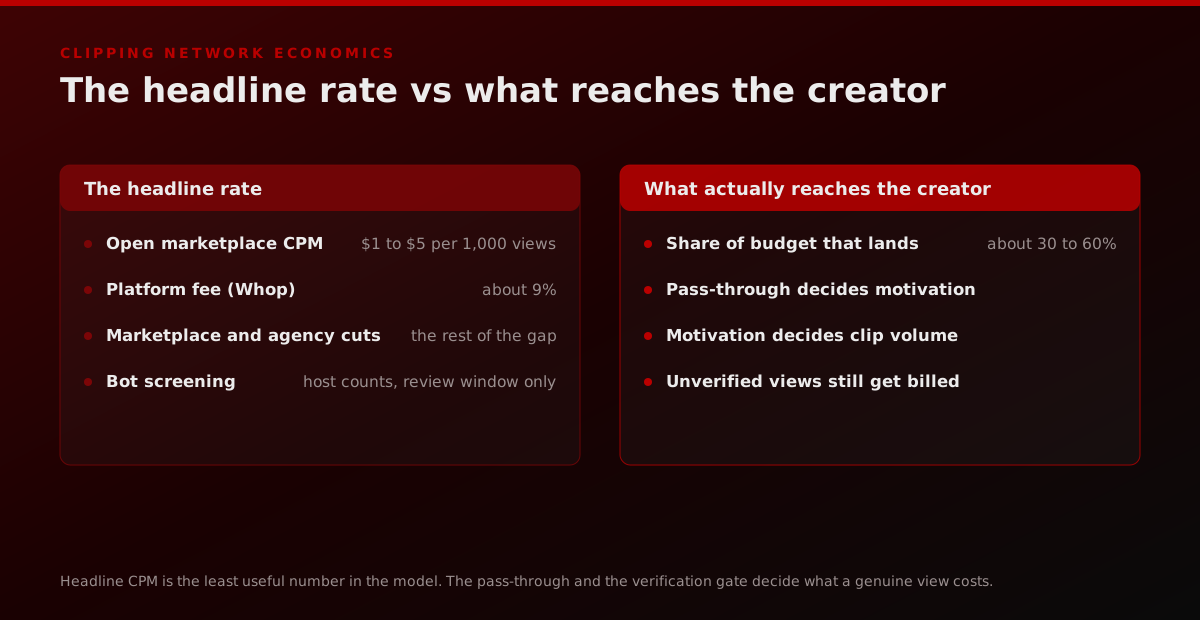
The headline pay-per-view rate is the least useful number in the model. Open bounty boards and self-serve dashboards commonly bill $1 to $5 per 1,000 views, but a platform fee (Whop takes about 9 percent) plus bounty board and agency cuts mean only about 30 to 60 percent of the budget actually reaches the creator account. That pass-through decides how motivated your clippers stay, which decides how many clips keep getting posted. The other gap is verification: most bounty boards report views straight from the host platform and lean on a short brand review window to catch fraud, with no in-house bot-detection layer. So a brand can pay a low CPM and still overpay per genuine view, because it is buying an unaudited counter.
Start from the transcript, not the timeline, and keep only moments that stand on their own. A clippable moment makes sense without the minutes around it: a specific claim, a number, a contrarian take, a story with a turn, or a sharp answer to a question your audience already asks. Read the transcript, mark each candidate with a timestamp and a one-line hook, and rank it on two tests. Would a stranger understand it in the first two seconds, and would your buyer care. A one-hour interview holds dozens of candidates, and the audit's job is to throw most of them away. Put the audit in a shared log the whole roster works from. Each row carries the timestamp, the hook line, the narrative beat it serves and the platforms it suits. Clippers then cut from the log instead of hunting through footage, which stops five people cutting the same moment and mines the back catalog in order rather than at random. The log also becomes the record of which beats performed, and the next brief is written from it.
Because every feed holds back a clip that looks imported. Platform-native means vertical 9:16, captions burned in for people watching on mute, the hook in the first one to two seconds, text kept inside the safe zone the app's buttons leave clear, and no watermark from another app. Instagram has said it shows fewer Reels carrying another platform's watermark, so a TikTok export reposted to Reels starts behind. Length and framing differ by feed as well. YouTube Shorts and Instagram Reels now allow up to three minutes, but a clip earns its length only while retention holds, which for most brand moments is well under a minute. On X, a clip travels best when the post text above it states the claim, so it reads as a point rather than a teaser. Give every clipper a one-page platform spec inside the brief: aspect ratio, caption style, safe zone, target length, and what the first frame has to show.
It is cutting the same moment differently for each feed and posting it through accounts native to each one, instead of exporting one file everywhere. The same footage lands in front of several audiences with several ranking systems, and a moment that stalls on one feed often travels on another. One asset becomes a portfolio of bets rather than a single post. The cost is operational. Every platform you add multiplies edits, accounts, captions and reporting. Multi-platform beats single-platform when your buyer is spread across feeds and you have the source volume to feed them. A single platform wins when your buyer clearly lives in one place, or when the budget is small enough that spreading it thin leaves every feed under-tested. Start on the two platforms where your buyer already watches, prove the qualified-view rate there, then add the third.
TikTok, Instagram Reels, YouTube Shorts and X are the four core surfaces, with LinkedIn added when the buyer is a B2B team. Pick by where your buyer watches and where a clip can land in-region, not by which app is biggest. A consumer app chasing Southeast Asia and a developer tool chasing US engineers want different mixes, and the same clip can be a fit on one and noise on another. Geography matters as much as the app. Per our own campaign ledger, one 14-day FORKOFF run for a crypto-native consumer brand routed clips across India, Indonesia, Vietnam and the Philippines at the same time and cleared 4.2M qualified views, because the network had accounts with real audiences in each of those markets. Before you agree a geo target with any network, ask it to show where its accounts' audiences actually sit. A view outside the target region is reach you paid for and cannot use.
The four core platforms for a brand clipping network
| Platform | What a native clip needs | Best for |
|---|---|---|
| TikTok | 9:16, burned-in captions, hook in the first second | Consumer reach and trend-driven moments |
| Instagram Reels | 9:16, no other app's watermark, safe-zone text | Consumer brands and creator-led audiences |
| YouTube Shorts | 9:16, a clear payoff, a title that states the claim | Search-adjacent topics and long shelf life |
| X | The claim in the post text, the clip as proof | Tech, crypto and B2B founder audiences |
Add LinkedIn when the buyer is a B2B team. Start on the two platforms your buyer already watches and add the third once the qualified-view rate holds.
Clip farming is posting high volumes of clips through many accounts to harvest views, often from content the poster does not own. The term covers two different things. A brand network that clips footage it owns, edits every cut and discloses the paid relationship is distribution. An operation that re-uploads other people's shows unedited, or pads its counts with bots, is the version the platforms are shrinking. The platform rules point the same way. YouTube's reused content policy can remove monetisation from channels built on other people's footage, TikTok keeps unoriginal content out of the For You feed, and Meta said in July 2025 that it would cut reach for Facebook accounts that repeatedly repost others' content. A brand network stays on the right side with three habits: clip only source you own or have licensed, make every clip a real edit, and disclose the paid relationship. The rights detail is in who owns the clips from a clipping campaign.
Use a bounty board when you want cheap volume and can police it yourself, and a managed campaign when you want a result someone else is accountable for. On a bounty board such as Whop's Content Rewards, the brand posts a bounty with a rate per 1,000 views and a budget cap, any clipper can join, and the brand reviews the submissions. It is fast to start and open to anyone, which is both the strength and the weakness: you get breadth, and you inherit the screening. A managed campaign hands the roster, the brief, the review and the measurement to one operator. You give up some breadth and pay for the management, and in exchange the clippers are screened before they touch your footage and the view count is the operator's to defend. The deciding question is who catches the bad views. If your team has the hours to review every clip and sample its traffic, a bounty board can work. If it does not, the lower rate is buying a counter nobody checks.
Most campaign bounty boards pay clippers $1 to $5 per 1,000 views, according to Digiday, and CreatorDB's mid-2026 rate table puts typical Whop campaigns at $0.50 to $1.50 per 1,000 views and MrBeast's Vyro bounty board at $3. That is the clipper's side. The brand pays more, because the platform fee and any agency margin sit between the two, which is the pass-through gap described above. For a brand building a roster, the rate matters less than what it is paid against. A clipper paid per raw view earns the same from a bot as from a buyer. A clipper paid only on views that clear a gate earns nothing from bots or out-of-region traffic, so the roster sorts itself toward clippers whose audiences are real. FORKOFF pays its operators on qualified outcomes only, with zero charge to the brand for filtered views, and that one rule does more for network quality than any change to the rate.
A clipping network is only as good as the number you pay against. If billing is tied to the raw platform counter, every incentive in the roster points at volume, including bot traffic, view-farm sessions, and out-of-region reach that will never convert. Tying spend to a gated view flips that incentive. FORKOFF bills $0.0024 to $0.0038 per qualified view, where a view is billable only after passing four checks, and every accepted or rejected view is written to an append-only ledger with a reason code you can export as CSV or JSON. That ledger is what turns a legitimacy claim into something a finance review can read, and it is the single feature that separates a durable network from one that quietly pays for noise.
Clipping network models compared
| Model | How creators are paid | Typical rate | Verification |
|---|---|---|---|
| Open bounty board (Whop, Clipping.net) | Per 1,000 views, brand approves clips | $1 to $5 CPM | Host view counts plus a brand review window; no bot layer described |
| Self-serve dashboard (ClipAffiliates) | Per 1,000 views, you set the CPM | $1 to $5 CPM | Host-reported views; relies on your review window to catch fraud |
| Managed done-for-you (FindClout style) | Per 1,000 views across screened pages | Market CPM plus management | Screened roster, but still billed on host view counts |
| Managed qualified-view (FORKOFF) | Per gate-passing view | $0.0024 to $0.0038 per qualified view | Four-stage gate plus an exportable per-view audit ledger |
Headline CPM is the least useful number. After a platform fee (about 9 percent on Whop) plus bounty board and agency cuts, only about 30 to 60 percent of a budget reaches the creator, and a low raw CPM with no verification can cost more per genuine view than a qualified-view rate.
The instinct is to chase the biggest accounts, but a clipping network compounds on relevance. A clipper whose audience already matches your ICP produces clips that earn watched, in-region views, which are the only views that survive a qualification gate. Vet on prior qualified-view history where you can get it, on niche match, and on whether the clipper can cut to a brief. Follower count is a vanity input; the output that matters is whether the clip lands in front of a real human who fits the campaign.
Where a clipping budget actually goes
| Layer | Typical take | What it means for the network |
|---|---|---|
| Platform fee (e.g. Whop) | About 9 percent | Comes off the payable pool before any creator split |
| Bounty board and agency cuts | The remainder of the gap | Only about 30 to 60 percent of the headline budget lands with the creator |
| FORKOFF qualified-view model | Priced per gate-passing view | Spend maps to gate-cleared views, each logged in an exportable ledger |
Pass-through decides how motivated the roster stays, which decides how many clips keep getting posted. Billing on qualified views ties every dollar to a view a real human watched.
Choosing a clipping agency comes down to one test the sales page hides: can it prove the reach it sells is real. The category runs on three models, self-serve tools you operate yourself (about $15 to $100 a month), raw-CPM networks that bill every view that loaded (commonly $1 to $5 per 1,000 views), and managed agencies that run production and distribution for you. Six things decide the pick: how many creators the agency can activate and whether they are screened humans or burner accounts, whether it reports verified reach or a raw counter, whether pricing is public and tied to a result, whether posts come from real accounts that will not put your own at risk, whether its proven niche matches yours, and whether distribution genuinely happens rather than editing alone. FORKOFF answers all six the same way: every view clears a four-signal qualification gate (real human, in-region, traffic-valid, not a bot or farm) and is reported on an audit ledger at $0.0024 to $0.0038 per qualified view, the integrity layer behind a network that has processed 5B+ views.
Per our own campaign ledger, FORKOFF's publishable 14-day clipping campaigns in 2026 cleared between 3.7M and 5.8M qualified views each, for brands from a crypto exchange to a consumer mental health app, all billed at $0.0024 to $0.0038 per qualified view. FORKOFF clipping campaign ledger, 2026
Because most agencies report total views as a raw platform counter, and a raw counter includes bots, duplicates and out-of-region impressions that never reached a buyer. Search for a clipping agency and you get self-serve tools (OpusClip, Vizard, Klap) that you run yourself, raw-CPM networks that bill every view that loaded, and managed agencies that run production, a clipper roster, and distribution. Most of them compete on that one headline number. That is the trap. Two agencies can quote the same reach and deliver wildly different real audiences, and the invoice looks the same either way. The number that decides value is cost per qualified view, a view a genuine, in-region person actually saw, not a raw counter you cannot audit.

The one that covers the job you cannot do yourself. Clipping is sold five ways, and they are different purchases rather than better or worse versions of one product. An AI clipping tool such as OpusClip, Vizard or Klap cuts clips from your footage for about $15 to $100 a month, and you still post, distribute and protect the accounts. A freelance editor cuts to your taste, usually per clip or on a monthly retainer, and distribution is still yours. An open bounty board such as Whop Content Rewards lets any clipper claim a bounty at a rate per 1,000 views, commonly $1 to $5 according to Digiday, which buys breadth and leaves the screening to you. A raw-CPM managed network runs the roster and the posting and bills every view the platform counted. A managed qualified-view agency runs the same chain and bills only the views that clear a stated check. Work backwards from the bottleneck. If you lack edits, buy a tool or an editor. If you lack reach and have the hours to police it, try a bounty board. If you lack the hours, the choice is between the two managed models, and that turns on whether you want to pay for the counter or for the views behind it. The table below sets all five side by side.
The five ways to buy clipping
| Buying model | What you get | How it is priced | Who screens the views |
|---|---|---|---|
| AI clipping tool | Software that cuts clips from your footage | About $15 to $100 a month | Nobody, you post and distribute |
| Freelance editor | Clips cut to your taste | Per clip or a monthly retainer | Nobody, distribution is yours |
| Open bounty board | Bounties any clipper can claim | Commonly $1 to $5 per 1,000 views | You, during a review window |
| Raw-CPM managed network | Roster, posting and reporting run for you | Per 1,000 platform-counted views | Often nobody beyond the platform counter |
| Managed qualified-view agency | The same chain, billed on verified views | Per view that clears a stated check | The agency, with a per-view ledger |
Market price bands as of 2026; bounty board rates according to Digiday. FORKOFF is a managed qualified-view agency at $0.0024 to $0.0038 per qualified view.
Run any shortlist through six checks. One, how many creators can the agency activate, and are they screened humans or burner accounts. Two, does it report verified reach or a raw counter. Three, is pricing public and tied to a result rather than a number you only get on a call. Four, do posts come from real accounts that will not get your own flagged. Five, does its proven niche match yours. Six, does distribution genuinely happen, or does the engagement stop at editing. Run every name on your list through the same six, including the nine agencies compared here; the ones that answer the first two with silence have already answered the question.
Fit is proven by named work in your category, not by a reel from someone else's. The hooks, clippers and accounts that travel for a music release do not automatically travel for a fintech, a protocol or a B2B tool, and regulated categories add a compliance layer most entertainment shops have never handled. Ask three things. Which campaigns have you run in my category, and what did each one deliver on a qualified count. Do your clippers' audiences sit in my target regions, shown as account-level data rather than a claim. And who on your side has handled compliance review in a category like mine. A shop that answers with views from an unrelated vertical is telling you it would be learning on your budget. Fit can be broad when it is real. Per our own campaign ledger, FORKOFF's publishable 14-day clipping campaigns in 2026 cleared between 3.7M and 5.8M qualified views each, for brands ranging from a crypto exchange and a fintech infrastructure company to a consumer mental health app, a music creation platform and an autonomous drone maker. The common thread is not the vertical. It is the same four-check gate on every view, which is what lets one network serve buyers who look nothing alike.
Ask to see them working, not described. Brand safety in clipping has four layers, and each one should have an owner and an artifact you can inspect before launch. The brief: an approved-claims list, banned topics, competitor and adjacency rules, and the exact disclosure each post carries. The review step: who approves a clip before it posts or scales, and how fast a rejected clip comes down. The accounts: real creator accounts with clean history, never bought or burner accounts that can drag your brand into a platform enforcement sweep. And the traffic: a screening layer that keeps bot and farm views off the bill, because inflated numbers under your brand's name are a reputational risk as well as a cost. Then read the contract terms that back the controls: who owns the edits, how takedowns are handled and how fast, what happens to unspent budget, whether you can export the per-clip and per-view record, and how either side can exit. Regulated categories need one more line, a compliance sign-off before anything posts. The rights side is covered in who owns the clips from a clipping campaign.
A locked brief, approved first clips and a live view of the numbers, in that order. Day one is the handoff: source footage or feed access, brand guidelines, the approved-claims list, geo targets and the counter you agreed to be billed on. The agency should come back with a written brief for its clippers and a timestamped list of the moments it plans to cut, so you can strike anything off-message before a clipper touches it. The first clips should reach you for approval within days, and the review loop you agree now sets the pace for the whole campaign, so decide who approves on your side and how fast. By the end of the first week you should be able to see which clips posted where, how many views each one has, and how many of those cleared verification. If you are still waiting for a login or a first report at that point, raise it then rather than at the end of the campaign.
Days to start, about two weeks to judge. A managed network with an existing roster can go live quickly; FORKOFF's stated window is under 48 hours from the intake call to the first tracked clip. Early performance shows within the first week, and a fair read needs the full campaign window, because clips keep earning views after they post and the roster needs a few cycles to learn which moments travel. FORKOFF's publishable clipping campaigns each ran 14 days. The management behind that timeline is what you are paying an agency for. Expect a kickoff that locks the brief and geo targets, clipper activation against the brief, a review on every clip before it scales, a daily read of which clips and accounts are earning qualified views, re-weighting toward what works, payouts against the agreed counter, and a closing report you can reconcile. Ask any agency to walk you through its first week day by day. If the answer is a launch date and a final report with nothing in between, the campaign is running unmanaged. Be wary of anyone who promises results in hours or guarantees a view total before seeing your footage. Fast setup is a real advantage. A guaranteed outcome on clips nobody has cut yet is a sales line.
Five answers mean you walk away. A guaranteed view total before anyone has seen your footage, because nobody can promise reach on clips that do not exist yet. A price you only get after a call, with no unit attached. No answer, or a vague one, on how views are verified and what happens to the ones that fail. Proof only from categories nothing like yours. And no per-clip record, just screenshots of platform dashboards that cannot be reconciled with anything. Watch the process as well as the answers. An agency that pushes for a long commitment before a test, cannot name who reviews clips, or goes quiet when you ask for a redacted sample report is showing you how the campaign will run. One red flag is a reason to slow down and ask again. Two is a reason to walk.
On three numbers from the first campaign, read against what you were quoted. Did the qualified count land where the agency said it would. Did the cost per qualified view hold. And did anything downstream move, signups, branded search or inbound, in the window after the clips ran. Scale when all three hold and the per-clip record shows the views spread across many clips and accounts rather than one outlier. Revise when the reach was real and the outcome did not move: the message, the moments or the landing path is the problem, and more volume would buy a bigger version of the same result. Stop when the count misses, the cost drifts, or the agency cannot show you the record behind its numbers. Write those thresholds down before the campaign starts. A decision rule agreed in advance is hard to argue with, and one invented after the report lands tends to agree with the report. For a first test, how to test a clipping agency before committing covers how to structure a capped first campaign so the first commitment stays small.
FORKOFF is built on the verification half the category skips. Every view clears a four-signal qualification gate (real human, in-region, traffic-valid, not a bot or farm) and is reported on an exportable audit ledger at $0.0024 to $0.0038 per qualified view, so the bill maps to reach a real person saw rather than a raw counter. The clipper network is screened and cross-vertical, the posting comes from real accounts, and the engagement runs the full chain from clipper briefs and QA to distribution, not editing alone. Operators are paid on qualified outcomes only, with zero charge to the brand for filtered views. That integrity layer is the same one behind a network that has processed 5B+ views, and it is the direct answer to every one of the six checks a buyer should be running.
What to check before you sign a clipping agency
| Criterion | A partner worth signing | A view-count vendor |
|---|---|---|
| Network | Screened, real creators you can size and screen | A big headline number, no screening detail |
| Reporting | Verified, gate-passing reach on an audit ledger | A raw platform counter with bots and duplicates |
| Pricing | Public rate tied to a verified result | Quote only on a sales call, per raw view |
| Brand safety | Real creator accounts, low flag risk | Bot or burner accounts that risk your own |
| Niche fit | Named work in your category and channel | A generic reel from an unrelated vertical |
| Distribution | Runs briefs, QA, payouts, and posting | Hands back clips, no distribution |
Model bands (about $15 to $100 a month for self-serve tools, $1 to $5 per 1,000 raw views for CPM networks) are 2026 market figures, not FORKOFF numbers, and they price the tool or the raw view, never the verified reach. The checks that decide results, verified reporting and distribution, are the ones the sticker price never covers.
A shortlist scorecard
| Criterion | Full marks | Walk away if |
|---|---|---|
| Verified reporting | Per-view ledger with reasons for rejected views | Only a platform screenshot |
| Pricing | Public rate tied to a verified unit | A price only after a call, per raw view |
| Network | Screened clippers with audience data by region | A headline number and no detail |
| Brand safety | Approved-claims list, clip review, disclosure | Burner or bought accounts |
| Niche fit | Named campaigns in your category | Only work from unrelated verticals |
| Distribution | Runs briefs, QA, payouts and posting | Hands back edited files only |
| Exit terms | Capped first campaign, exportable records | Annual lock-in before any test |
Score each agency on every row before comparing prices. One walk-away answer outweighs any number of full marks.
Clipping is a distribution model. A long piece of content, a podcast, a livestream, a keynote, or a founder video, is cut into short vertical clips, and those clips are posted across many creator accounts to earn reach on short-form feeds like TikTok, Instagram Reels, YouTube Shorts, and X. The work is not editing alone. It is editing plus distribution: sourcing the clippable moments, cutting them native to each platform, and getting them posted at volume through real accounts. Short-form video is the format audiences watch most, and HubSpot's marketers rank it the highest-return format on social, which is why brands run clipping programs instead of leaning on one hero video. The number that matters is not clips produced or raw views counted. It is qualified views: reach a real, in-region person actually watched. FORKOFF has processed 5B+ views on that qualified-view standard, billing on views that clear a four-signal gate and land on an exportable audit ledger.
The common misread is that clipping means making short videos. Editing is the visible part, but the value sits in the distribution: a network of real accounts that can post the same moment across many feeds at once, plus the reporting that proves the reach was real. A brand can edit a hundred clips in-house and still get no reach if it has nowhere to post them at volume. That is why clipping is run as a managed channel rather than a one-off editing job, and why the reporting standard matters as much as the cut. The unit a buyer should ask about is cost per qualified view, not clips delivered.
A raw view counter includes bots, duplicates, and out-of-region impressions, so two clipping programs can report the same headline number while one reached real people and the other reached scripts. A qualified view is one that cleared a check: a real human, in the target region, on valid traffic, not a bot or a farm. Comparing programs on qualified views, rather than a raw counter, is the only way to know what a reported number is worth. FORKOFF bills on that gate and logs every accepted and rejected view with a reason code on an exportable ledger, the standard behind 5B+ processed views.
The clipping pipeline, stage by stage
| Stage | What happens | What a buyer should check |
|---|---|---|
| Source | Long-form content is chosen for its clippable moments | Is there enough catalog to sustain volume |
| Cut | Moments are edited native to each short-form feed | Do clips read as native, with a first-second hook |
| Distribute | Clips post at volume across many real creator accounts | Real screened accounts, not burner or bot accounts |
| Measure | Reach is reported as raw views or qualified views | Qualified, in-region, human-verified views only |
| Prove | Accepted and rejected views are logged with reasons | An exportable per-view audit ledger |
FORKOFF reports qualified views that clear a four-signal gate (real human, in-region, traffic-valid, not a bot or farm) on an exportable ledger, the standard behind 5B+ processed views.
In a standard clipping campaign the brand keeps ownership of the source content it supplies, and each clipper owns the specific edit they publish on their own account unless the agreement assigns those edits to the brand. The clips are derivative works of your footage, so the underlying copyright plus any music, brand marks, or third-party footage inside a clip still carry their original rights and their own takedown risk. That is where most disputes begin: a clipper drops a trending song over your moment, the platform's automated copyright system flags it, and the clip is muted or pulled, or a rights holder claims footage that was never cleared for redistribution. A clean clipping campaign settles four things in writing before a single clip posts: who owns the edits, which source material is cleared to redistribute, what audio and footage clippers may use, and who handles takedowns. FORKOFF runs paid clipping on cleared source content with usage terms defined per campaign and a ledger that records where every clip ran.
Per our own campaign ledger, a 14-day FORKOFF clipping run for a sports betting brand in Ireland and the EU cleared 3.8M qualified views, with every view run through a four-check gate and rejected views logged and never billed. FORKOFF clipping campaign ledger, Q3 2026
The brand owns the source, the clipper owns the edit unless it is assigned, and everything a clipper adds on top keeps its own rights. The brand grants a limited license for the campaign to clip and distribute its footage, which is why you keep control of your own content even after a network of clippers has posted it. The clipper owns the specific edit they made, absent an assignment clause, exactly as any creator owns their post, so if you want to run those clips as paid ads or on your own channels you have to license or assign them back. One drafting trap is worth knowing. Do not rely on a work made for hire line alone for freelance clippers. In the US that label only covers specific categories of commissioned work and needs a signed agreement, so an explicit assignment or licence-back clause is the safer route. For the model itself, start with what a clipping campaign is; the rights only make sense once the mechanics do.
In what gets dropped into the clip, not in who owns the edit. A trending song triggers an automated copyright claim and the clip is muted or pulled. Unlicensed movie or brand footage inside a clip invites a claim from its owner. A guest who never agreed to promotional clips can ask for them to come down. These are the exact questions real creators ask: a widely upvoted r/Twitch thread asks how to revoke someone's permission to clip a channel, and an r/NewTubers thread asks how channels use movie clips without copyright issues. The fix is boring and effective. Cleared or platform-safe audio only, no unlicensed third-party footage, and releases that cover promotional clips, all set before launch. On TikTok, a post marked as branded content is limited to the Commercial Music Library, which removes most trending-song risk by design.
Usually not: in a network model the clips post on the clippers' accounts, and the brand owns the footage but not those accounts or their followers. That is the trade a clipping campaign makes. You borrow audiences that already exist instead of building one from zero, and in exchange the posting accounts belong to the people who run them. Three consequences belong in the agreement. First, what happens to live clips when the campaign ends: they stay up, come down, or stay up without further promotion. Second, whether the brand may repost the best performers on its own channels, which needs the licence-back covered above. Third, if you want accounts the brand controls, that is a different product, dedicated brand accounts built around your content, and it is priced as such. Ask a provider which of the two you are buying before you compare quotes.
Clippers are paid per view, per clip or per qualified outcome, and payment alone does not transfer ownership of the edit unless the agreement says it does. Most open bounty boards pay clippers $1 to $5 per 1,000 views, according to Digiday's reporting on the clip economy, capped at a campaign budget. Managed networks pay their own clippers out of the brand's rate. The rights question hides in the rejected clips. If a clip fails verification and is never paid for, the clipper still owns that edit, and the agreement should say whether it may stay live. FORKOFF bills brands $0.0024 to $0.0038 per qualified view and pays its operators on qualified outcomes only, with zero charge for filtered views, so the ledger already separates paid clips from unpaid ones. That makes the licence-back clause easy to scope: it attaches to the clips that were paid for.
A paid clip is an advertisement, and in the US the FTC's Endorsement Guides expect the paid relationship to be disclosed clearly on the post itself. The platforms build this in: TikTok has a branded content toggle, Instagram and Facebook carry a Paid partnership label, and YouTube has an includes paid promotion setting. In the UK, the ASA expects an Ad label on paid social posts. A clip that hides the deal is a risk to the brand, not only to the clipper. Platform originality rules sit alongside disclosure. YouTube's reused content rules can cost a channel its monetisation, TikTok keeps unoriginal content out of the For You feed, and Meta said in July 2025 that it would cut reach for accounts that repeatedly repost other people's content. A campaign that re-uploads raw footage instead of editing it is exposed to all three. Real networks edit every clip into something new.
Disclosure and originality rules by platform
| Platform | How a paid clip is disclosed | Originality rule that applies |
|---|---|---|
| TikTok | Branded content toggle on the post | Unoriginal content kept out of the For You feed |
| Instagram and Facebook | Paid partnership label | Reach cut for accounts that repost others' content |
| YouTube Shorts | Includes paid promotion setting | Reused content rules can remove monetisation |
| X | A clear paid tag such as #ad in the post | Spam and duplicate-content rules |
Platform settings as of 2026. US disclosure follows the FTC Endorsement Guides; in the UK the ASA expects an Ad label on paid social posts.
Yes, because regulated categories add advertising rules on top of copyright and disclosure. Gambling ads in the UK fall under strict CAP rules on appeal to under-18s, US sportsbook advertising varies by state, and in the UK every cryptoasset promotion has had to comply with the FCA's financial promotions regime since October 2023. A clip is an ad under all of these, even when it looks like organic content. In practice that means a narrower brief: approved claims only, no odds or return promises a compliance team has not signed off, age-appropriate accounts, and geo routing that keeps clips out of markets where the product cannot be advertised. Per our own campaign ledger, a 14-day FORKOFF run for a sports betting brand in Ireland and the EU cleared 3.8M qualified views, with every view through the four-check gate and rejected views logged and never billed. The ledger is what lets a compliance team see where each paid view came from.
The direction is reversed. In a UGC deal the creator makes new content featuring themselves, and the brand licenses usage rights in, typically for organic posting, paid ads or whitelisting for a fixed term. In a clipping deal the brand already owns the footage and licenses it out to clippers, who re-cut it and post it on their accounts. So the clauses differ. A UGC contract centres on usage term, paid media rights and the creator's likeness. A clipping agreement centres on the source licence, the edit, audio and takedowns. A brand that buys both should not copy one contract into the other: a UGC usage window says nothing about who owns a clipper's edit, and a clipping licence says nothing about running a creator's face in a paid ad. If you are weighing the two channels, start with how to choose a UGC agency.
Six clauses, and they fit on one page. The source licence: what footage is cleared, for which platforms, for how long. The edit: whether finished clips are assigned or licensed back to the brand, and for which uses. Audio and footage: cleared or platform-safe audio only, no unlicensed third-party material. People: confirmation that guest and speaker releases cover promotional clips. Takedowns: a named owner and a response window. And the end of the campaign: whether clips stay live, come down, or stay up unpromoted. A provider that has run real campaigns will have a standard version of each and will tell you where it bends. One that has to draft them from scratch after you ask is telling you something about how many campaigns it has run.
An agency that has run real campaigns has already met these disputes and will tell you, unprompted, who owns the edits and what audio clippers may use. One that cannot is either new or careless with your brand's exposure. This is part of the same screening checklist that separates a real distribution partner from a view-count vendor, covered in how to choose a clipping agency. FORKOFF runs paid clipping on cleared source content, defines usage terms per campaign, and logs where every clip ran in the same exportable ledger it bills its qualified views on, so the rights position is documented rather than assumed.
Lost distribution, not a fee: a claim takes a working asset offline. A clip that is muted loses the hook that made it perform, and a clip that is pulled loses the reach it had already earned, sometimes for days while a dispute resolves. Avoiding it is cheap by comparison: restrict clippers to cleared or platform-safe audio, forbid unlicensed third-party footage, and name upfront who responds to a claim and how fast. That is why a campaign built on qualified, audited delivery, the model behind what cost per qualified view means, also has the paper trail to show which clips ran where if a claim ever needs answering.
The rights to settle before a clipping campaign
| What to settle | Default position | What to put in writing |
|---|---|---|
| Source content | Brand owns it; clipping is a limited license | Brand retains source rights and grants a license to clip and distribute |
| The edit | Clipper owns their edit unless assigned | Assign or license the finished clips back to the brand for reuse |
| Music | The song's rights holder controls it | Cleared or platform-safe audio only, no trending-song risk |
| Third-party footage | The original rights holder controls it | No unlicensed footage from other brands or creators |
| People on camera | Each person controls their likeness | Guest and speaker releases that cover promotional clips |
| Takedowns | Nobody owns it, by default | A named owner and a response window for any claim |
| Campaign end | Clips stay live on clipper accounts | Stay up, come down, or stay up unpromoted |
Rights and permissions are the least-covered part of the clipping category despite driving real creator questions, from music claims to revoking clip permissions.
Outcome pricing means you buy a delivered result rather than a block of time. It is common in channels where the result is countable and attributable, and rare everywhere else, which is why most agencies still sell retainers. FORKOFF prices its clipping work at $0.0024 to $0.0038 per qualified view, where a view is billed only after it clears a defined check. The model works where the unit is measurable and fails where it is not.
Per our own qualified-view ledger, a 14-day campaign for a sports-betting brand delivered 3.8M+ qualified views billed at $0.0024 to $0.0038 each, and every view that failed one of the four checks was logged and never billed. FORKOFF clipping rate card and qualified-view ledger
The blocker is rarely appetite, it is measurement. An agency can only sell an outcome it can count, attribute and afford to miss on, and most marketing work fails at least one of those tests. Brand work fails attribution, because the effect is real and diffuse. Early-stage demand generation often fails counting, because the sales cycle is longer than the contract. Anything requiring the client to act, such as following up on a lead, fails affordability, because the agency carries a risk it does not control. What remains is a narrower set of channels where a unit is countable, attributable to the work, and produced in enough volume that one bad month does not sink the agency. That is why outcome pricing clusters in performance media, affiliate, and volume content channels rather than spreading evenly across the category.
Two agencies can quote the same number and mean very different things, and the difference is entirely in the definition. Cost per view means nothing until you know which views count. A platform-reported view includes autoplay, bots and impressions that never resolved into a person watching. A qualified view is one that survived a check applied before billing, which moves the cost of failed traffic onto the agency. FORKOFF prices at $0.0024 to $0.0038 per qualified view and bills only views that pass all four checks, and the second figure is what makes the first one meaningful. When you compare quotes, normalise the definitions first and the prices second. A cheaper number against a looser definition is the more expensive deal, and it will not look that way until you reconcile the first invoice. Per our own qualified-view ledger, that is how it ran on a 14-day campaign for a sports-betting brand: 3.8M+ qualified views billed at $0.0024 to $0.0038 each, roughly $2.40 to $3.80 per thousand verified views against a $4 to $8 CPM for short-form paid reach, with every rejected view logged and never charged.
They are not equivalent and the differences decide who carries risk. Pure outcome pricing bills per delivered unit with no floor, which puts the risk entirely on the agency and is rare because few can absorb it. Hybrid pricing pairs a reduced base with a per unit rate above a threshold, which is the most common honest version and is a genuine risk share. Retainer plus bonus keeps a full retainer and adds an upside payment, which is a retainer with extra steps, because the agency's downside is unchanged. All three get described with the same vocabulary in a pitch. The question that separates them is simple and worth asking directly: if we deliver nothing this month, what do we invoice? An answer that is not materially lower than the good month means the label is decorative.
Three pricing shapes, and who carries the risk
| Shape | What you pay in a bad month | Who carries delivery risk | Where it fits |
|---|---|---|---|
| Pure outcome | Close to nothing | The agency | Countable, attributable, high volume units |
| Hybrid base plus per unit | A reduced base | Shared | Most real performance work |
| Retainer plus bonus | The full retainer | The client | Presented as performance, is not |
| Straight retainer | The full retainer | The client | Brand, positioning, regulated work |
The diagnostic question for any of these is what the invoice reads in a month where nothing was delivered.
It should not be forced onto work it does not fit, and an agency that offers it for everything is telling you something. Positioning, messaging and category creation have no countable unit on a monthly cadence, and inventing one produces a proxy that gets gamed by whoever is measured on it. Anything where quality and volume trade off directly is a bad fit, because a per unit price rewards volume and the client absorbs the quality loss. Highly regulated categories are a bad fit because the review step dominates the cost and is not proportional to output. In those cases a retainer is the honest instrument and the right control is a defined scope with a review cadence, not a metric nobody believes. Choosing the wrong model is worse than paying more under the right one.
Put the quotes into one unit before you compare anything. Take the same forecast volume, apply each agency's definition and rate, and compute total cost at that volume rather than comparing headline rates. Then run it again at half the volume and at double, because the models cross over and the crossover point is usually inside the range you might plausibly land in. Ask each agency what happens at each of those three volumes, and whether there is a floor or a cap. Finally, ask what evidence you will receive: a per unit ledger you can audit against your own analytics is a different product from a monthly summary slide, and the difference matters most in the month something goes wrong. If the ledger is not a deliverable, the outcome is not really the thing being sold.
A clipping network is a managed pool of short-form editors and distribution accounts that cuts one long-form asset into many clips and posts them under a single brief. Scale is how these networks get compared, and a raw view total is the weakest version of it, because a platform-reported view includes autoplay, sub-second impressions and repeat surfaces that never resolved into a person watching. FORKOFF has processed more than 5 billion views through its clipping network and bills only qualified views, and the second fact is what makes the first one mean anything. When a network quotes a number in the billions, the useful question is which counter produced it.
Per our own campaign ledger, a single 14-day FORKOFF clipping run for a crypto-native consumer brand across India, Indonesia, Vietnam and the Philippines cleared 4.2M qualified views at $0.0024 to $0.0038 per qualified view, on a network that has processed more than 5 billion views. FORKOFF clipping campaign ledger, Q1 2026
It proves volume of distribution, and nothing else on its own. A network that has moved billions of views has demonstrably run a lot of clips through a lot of accounts, which tells you it can absorb your volume and has survived platform enforcement long enough to accumulate the total. That is genuinely worth knowing, because a network too small to absorb a launch will quietly throttle it. What the number does not prove is quality of reach, relevance to your buyer, or whether any of it converted. Those are separate claims that need separate evidence, and a network that answers all four questions with the same headline figure is answering only the first one. Read a scale claim as a capacity statement. Then ask the capacity question that follows it: how much of that volume was produced in the last ninety days, on the platforms you care about, in a category adjacent to yours. A five-year cumulative total spread across categories you will never touch is a weaker signal than a smaller number produced last quarter in your own vertical.
Big enough that a billion views is no longer a rare number. CreatorDB counted the clips posted around the top streamers over 30 days to August 26, 2026 and found 9,941 clips from 1,820 distinct clipper accounts generating just under two billion views. One streamer's clip ecosystem alone did 1.08 billion tagged YouTube views in that window, from 1,087 different accounts. The same report says Whop moves about $40,000 a day to clippers, and Tether put $200 million into Whop at a $1.6 billion valuation in February 2026. The money on the brand side is real too. An industry CEO quoted in Wikipedia's entry on clipping puts a full brand campaign at $25,000 to $100,000, and Digiday reported that one investment app had spent over $12,000 on clipping within months of a single bounty board opening clipping campaigns. For a buyer, the takeaway is that a cumulative billions figure separates a network from a hobbyist, and it stops separating networks from each other. Per our own campaign ledger, one 14-day FORKOFF run for a crypto-native consumer brand across India, Indonesia, Vietnam and the Philippines cleared 4.2M qualified views, and that is the shape of number worth asking every network for: a dated, single-campaign, qualified count.
One of three, and they are not interchangeable. A platform-reported view is whatever the platform decided to call a view, which on most short-form surfaces includes autoplay and impressions under two seconds. A network-reported view is a sum the network chose to compute, useful for comparing that network against itself over time and close to useless for comparing two networks. A qualified view is one that passed a stated check before it entered the count, which is the only one of the three that can carry a price without inviting a dispute. FORKOFF prices clipping at $0.0024 to $0.0038 per qualified view and runs a four-stage qualification gate before a view is billable: real human, in-region, traffic-valid, not bot or farm. Every billed view has cleared all four checks, and rejected views are logged and never billed. Whether a specific network uses a stricter or looser rule matters less than whether it states the rule at all. An unstated rule is the one that gets adjusted after the invoice.
Four layers, and the structure decides whether the scale is real or borrowed. A network has an editor pool that cuts the long-form asset, a distribution layer of accounts that post the cuts, a brief that keeps the output on message, and a measurement layer that counts what happened. Weakness in any one of those shows up as a different failure. A thin editor pool produces clips that all look the same and burn the source material in a week. A distribution layer built on accounts with no standing audience produces posts nobody sees, which still count as posts. A loose brief produces clips that perform and say the wrong thing about the product. Ask which of those four layers the network operates itself and which it subcontracts. Every subcontracted layer is a place where your brief can be diluted and your measurement can lose its chain of custody. The networks that can show a per-clip record usually run their own measurement layer, and that is not a coincidence.
Through one of five payout models, and the model tells you what the clipper is optimising for. On an open bounty board, a brand posts a bounty and any clipper can claim it, earning a fixed rate per 1,000 views up to a budget cap. On direct payroll, a streamer or brand pays a crew of clippers it recruited itself. In a managed network, the agency pays its own screened clippers out of the brand's rate and decides which clips qualify. In affiliate clipping, the clipper earns a commission on sales the clip drives. And on platform creator funds, the clipper is paid by the platform for views on their own account. The buyer's question is simple. If the clipper is paid on raw views, every incentive in the system points at a bigger counter, including the ones you would rather not pay for. If the clipper is paid only on views that clear a gate, the incentive points at real watched reach. FORKOFF pays its operators on qualified outcomes only, with zero charge to the brand for filtered views, which puts the clipper and the brand on the same side of the ledger.
How clippers get paid, and what each model rewards
| Payout model | Who pays the clipper | Typical market rate | What the clipper optimises |
|---|---|---|---|
| Open bounty board bounty | The brand, via the bounty board | $0.20 to $6 per 1,000 views | Raw views up to the budget cap |
| Direct payroll | The streamer or brand | $40 to $50 per 100,000 views | Volume on one creator's content |
| Managed network | The agency, from the brand's rate | Set by the network | Whatever the network's counter rewards |
| Affiliate clipping | The brand, per sale | Commission per sale | Clicks and conversions |
| Platform creator fund | The platform | Program rates vary | Views on the clipper's own account |
Market rates as of 2026, according to Digiday, Wikipedia's clipping entry and CreatorDB's clip economy report. A managed network that pays clippers only on qualified views, as FORKOFF does, aligns the clipper with the brand.
Most campaign bounty boards pay clippers $1 to $5 per 1,000 views, according to both Digiday and Wikipedia's entry on clipping, with some paying as little as $0.20. CreatorDB's mid-2026 rate table puts typical Whop campaigns at $0.50 to $1.50 per 1,000 views, MrBeast's Vyro bounty board at $3 per 1,000, and one streamer's direct crew at $40 to $50 per 100,000 views. At the top end, one clipper told Digiday he had made roughly $60,000 in seven months. Those rates matter to a brand for one reason: they set the floor under any network's price. A network charging a raw $2 to $5 CPM is passing most of that straight to clippers, which leaves little margin for screening, so the screening is usually what gets cut. A qualified-view price works differently, because the network only earns on views that survive the gate. Ask any network what it pays clippers and on which counter, and compare the answer to what it charges you.
It moved distribution off the creator's own channel and onto a rented network of accounts the creator does not own. Wikipedia's entry on clipping cites The Economist reporting in 2006 that over 90% of clips on YouTube were published by amateurs. Twenty years later the same activity is a paid supply chain, and the clip channels around a large streamer can out-draw the streamer's own channel. Three effects follow for anyone buying reach. First, audience is now measured in clip views across thousands of accounts rather than subscribers on one, so the measurement belongs to whoever runs the network. Second, the talent's message is re-cut by people it never briefed, which is why a brief and a review step matter more than they did when the creator posted everything personally. Third, the same shift that made reach cheap made fake reach cheap, because a view on an account nobody audits is easy to manufacture. That is why the counter, not the total, is the claim to check.
Clipping is legal when the clipper has the rights to the source content, and it is a copyright problem when they do not. A brand campaign is the clean case: the brand owns its podcast, keynote or founder interview and licenses the network to cut and post it for the campaign. Streamers who pay clippers grant the same permission informally. Re-cutting someone else's show without permission is not covered just because the clip is short, and a takedown can remove the clip and put the account at risk. Two more rules sit on top of copyright. Platforms police reused content, and YouTube's monetisation policy and TikTok's originality guidelines both penalise unedited reposts, which is why real networks edit rather than re-upload. And in the US, the FTC's endorsement guides expect a paid post to disclose the paid relationship. Before you sign, get the licence grant in writing, ask how the network handles disclosure, and read who owns the clips from a clipping campaign.
Four questions settle it, and they take about ten minutes. First, which counter produced the headline number, and what is the same campaign worth under the other two. A network that can answer this immediately has the data. Second, what is the qualification rule, stated as a sentence rather than a category. Third, what did the last ninety days look like on the two platforms you actually care about, expressed as clips posted rather than views accumulated, because clips posted is the number that is hard to inflate. Fourth, what does the reporting artifact look like, and can you see a redacted sample from a real campaign before you sign. A sample ledger is the single most informative thing a network can hand you, because it shows the granularity, the fields, and whether the reconciliation you plan to run is even possible. If three of those four get a confident answer and the fourth gets a slide deck, you have learned something useful about the fourth.
Three view counters, and what each one is worth
| Counter | What it counts | Who produces it | What it is good for |
|---|---|---|---|
| Platform-reported | Autoplay, sub-second impressions, repeat surfaces | The platform | An upper bound, never a bill |
| Network-reported | Whatever the network chose to sum | The network | Comparing one network against itself |
| Qualified | Views that cleared a stated check before counting | The network, auditable per clip | Pricing and reconciliation |
| Your own analytics | Sessions and conversions that arrived | You | Deciding whether any of it worked |
Two scale claims are only comparable when both name the counter behind them.
When its scale exceeds what you need, because past that point size starts working against you. A very large network is optimised for throughput, which means your brief competes with everyone else's for editor attention and your feedback loop is longer. If your asset library is small, or your category needs editors who understand it, or your compliance review is heavy, a smaller network that gives the work to three named editors will produce better clips than a large one that gives it to thirty anonymous ones. The same is true when your bottleneck is not distribution at all. If clips are already going out and nothing is converting, more reach buys you a bigger version of the same result, and the honest fix is upstream in the message or the offer. Match the network to the constraint you actually have. A capacity claim answers a capacity question, and most engagements that go wrong were never short of capacity.
No, not directly, and any agency that claims otherwise is selling you a number it cannot back. A clipping campaign is priced and measured as a reach unit: FORKOFF bills $0.0024 to $0.0038 per qualified view (CPQV), a view that clears a four-stage gate (real human, in-region, traffic-valid, not bot or farm) across a network that has processed 5B+ views. That gate proves the view is real. It does not prove the person who watched it later signed up, because clipping has no checkout to instrument the way a paid search ad does. What is measurable is the platform split: clicks and click-through rate on a distinct tracked link for each dedicated brand profile, the actual deliverable of a first campaign. Whether that click becomes a customer is owned by your own funnel, tracked in your own analytics. The honest move is to separate the two out loud, then run the arithmetic in your own unit, CAC or ROAS, before you spend, using the quoted CPM and your existing conversion rate.
FORKOFF's qualified-view gate has processed 5B+ views, the same ledger every CPQV campaign is billed against. FORKOFF Clipping service terms
Every buyer comparing clipping to a paid channel they already measure, Meta ROAS, a fixed CPA, an iOS CAC, asks the same question: can you connect a view to a sale. The honest answer is that clipping was never built to answer it directly, because it has no checkout to instrument the way a search or social ad does. The better question is whether the reach it buys is real, and then whether your own funnel converts what reaches it, two separate facts a single number cannot carry. Conflating them is how a buyer ends up judging a reach product against a conversion benchmark it was never priced against, and rejecting a channel that might be working exactly as designed.
FORKOFF measures qualified views (the CPQV gate: real human, in-region, traffic-valid, not bot or farm) and clicks and click-through rate per platform, tracked through a distinct link on each dedicated brand profile. That platform split is the real deliverable of a first campaign, and it is often decisive on its own, a channel with a genuinely low click-through rate is a signal to reallocate before the campaign runs its course. FORKOFF does not measure what happens after the click: your signup form, your checkout, your sales call. That boundary is a property of what cost per qualified view means, not a gap in the tooling, and your own analytics is the correct system of record for it.
Take three numbers you already have: your CAC or ROAS floor, your site's existing conversion rate from a cold visit, and the CPM quoted for the campaign. Multiply the CPM by the views needed to reach 1,000 conversions at your current rate, and compare that to what you already pay for a conversion through a channel you trust. If clipping's implied cost per conversion beats your paid-channel floor even at a conservative conversion rate, the reach is worth buying regardless of whether any single view can be traced to a name. If it does not, that is the honest answer before a dollar is spent, which is the entire point of asking the question before committing to a retainer rather than after.
Reach pricing vs conversion pricing, side by side
| Clipping (CPQV) | Founder Funnel (outcome) | |
|---|---|---|
| Unit priced | Per qualified view | Per booked qualified call |
| What it proves | The view was real, human, in-region | The call happened and was qualified |
| What it does not prove | Whether the viewer converted | Reach beyond the funnel itself |
| Best fit | Building reach and awareness at scale | Buying a specific, measurable conversion |
Testing a clipping agency means buying one capped first campaign, with written success criteria and full access to the per-view record, before you sign any retainer. Start at the cheap end of the clipping ladder, logo or dynamic-logo placement over clip volume the network already produces, because it shows whether the network's views are real at the lowest cost. Agree three things in writing first: what counts as a billable view, what the campaign has to deliver for you to continue, and what happens to budget that is not spent. Then judge the result on the ledger, not the pitch: a per-view audit trail, real human, in-region, traffic-valid, not bot or farm, that you can sample yourself. FORKOFF bills only views that clear that four-check gate, at $0.0024 to $0.0038 per qualified view, so filtered views cost nothing and a first campaign is a test by construction. FORKOFF's entry is Clipping Foundation, from $3,500 per campaign with a three-campaign minimum, and a campaign that misses its committed qualified-view volume is not billed for the gap.
Per our own campaign ledger, one 14-day FORKOFF clipping campaign for a US fintech infrastructure company cleared 4.9M qualified views at $0.0024 to $0.0038 per qualified view, with every view run through a four-check gate and rejected views never billed. FORKOFF clipping campaign ledger, Q3 2026
Because the buyers who ask for a test have usually been burned by a report nobody could check. They are not negotiating the rate. They are asking how much they lose if the views turn out not to be real, and a discount does not answer that question. Two things do. The first is a first commitment small enough to survive being wrong: one capped campaign, not a retainer. The second is a billing rule that does not charge for views that fail verification, so the risk of fake reach sits with the agency rather than the buyer. FORKOFF does both: Clipping Foundation is a defined three-campaign entry where a missed qualified-view commitment is not billed, and the second rule is the default. A view is billable only after it clears four checks, rejected views are logged with a reason and never billed, and the operators who post the clips are paid on qualified outcomes only. Put both together and the first campaign stops being a leap of faith and becomes a measurement.
A brand hands over long-form footage, a network of clippers cuts it into short native clips, the clips post on the clippers' accounts across TikTok, Reels, Shorts and X, and the brand pays for the views those clips earn. What you are testing is every link in that chain: the quality of the cuts, the reach of the accounts, and the honesty of the count. How you test depends on how the campaign is sold. On an open bounty board such as Whop's Content Rewards, the brand posts a bounty with a rate per 1,000 views, any clipper can join, and the brand reviews submissions. A test there measures your own review capacity as much as the clippers, because the screening is yours. In a managed campaign, one operator runs the roster, the brief, the review and the measurement, and the test measures that operator. Both are fair purchases. Just know which one you are testing, because a bounty board that fails your test may have failed on your review hours, and a managed campaign that fails has failed on its own.
Three content signals, each priced differently, plus the line between an agency and an editor. Logo and dynamic-logo placement rides clip volume the network already produces and is the cheapest per view, built for maximum reach per dollar. Clip production from operator accounts cuts your own long-form into clips posted from accounts the network runs, which sits in the middle. Dedicated brand accounts are content built entirely around your brand on accounts that exist for it, the most expensive per view and the lowest in volume, bought for control rather than reach. A clipping agency is also different from hiring a video editor. An editor hands you files. An agency hands you distribution: the accounts, the posting, the review and the count. A test of an agency is a test of that distribution, so judge it on where the clips went and who watched them, not on how good the edits looked. Start the test at the cheap end of the ladder. It is the fastest, lowest-risk way to see whether the qualification gate and the reporting hold up, before you spend on the more expensive, more brand-specific signal.
The three clipping content signals
| Signal | Price per view | What it rides | Best fit |
|---|---|---|---|
| Logo / dynamic logo | Lowest on the ladder | Existing clip volume the network already produces | Maximum reach per dollar, brand awareness |
| Clip production from operator accounts | Mid-ladder | Your long-form, cut and posted from network accounts | A middle step between reach and brand control |
| Dedicated brand accounts | Highest per view, lowest volume | Content built entirely around your brand | Brand-specific narrative and the most control |
In one of four ways, and the pricing model decides what a test can prove. A flat fee or retainer buys effort, so many clips or so many accounts for a month, with views as a hoped-for side effect, which makes a test hard to judge because nothing was promised. A per-clip price buys output, and tells you about the editing rather than the reach. A raw CPM, the most common managed model, buys platform-counted views at a rate per 1,000, so a test measures the counter rather than the audience. A qualified-view rate buys views that cleared a stated check, which is the only one of the four where the test result and the bill are the same number. Normalise every quote before you compare. Take the raw-CPM rate, estimate how much of the count would survive a real check, and divide: a low raw CPM carrying heavy bot or out-of-region traffic can cost more per real view than a higher qualified rate. FORKOFF's rate is $0.0024 to $0.0038 per qualified view, roughly $2.40 to $3.80 per 1,000 views that cleared the gate. The CPQV calculator runs that comparison for any quote you hold.
A first-campaign test plan
| Term | Agree before launch | Read after the window |
|---|---|---|
| Budget | A fixed cap, no automatic renewal | Spend against the cap |
| Window | A fixed campaign length | Views accumulated inside the window |
| Billable view | The check a view must clear | Pass and fail counts, with reasons |
| Pass mark | Qualified views, cost per qualified view, one downstream number | Each number against its threshold |
| Unspent budget | Roll over, return, or a named fallback | What happened to the balance |
| Records | Exportable per-clip and per-view ledger | A sample you checked on the platforms |
| Exit | Ends cleanly after the campaign | Scale, revise or stop |
Set every threshold before the first clip posts. A pass mark written after the report lands tends to agree with the report.
It means each counted view passed a stated check before it entered the count, and that you can see which views failed and why. Without the second half, verified is a label rather than a measurement. FORKOFF's check has four parts: real human, in-region, traffic-valid, not bot or farm. Every view runs the gate, and rejected views are logged and never billed. Whatever the agency's rule, the record behind it should carry, for every clip, the post URL, the platform, the posting account, the time, the view count, the regional split and the pass or fail result with a reason. Test it the way an auditor would. Pick a sample of clips from the record and open each one on the platform: the post should exist on the named account and its public count should be at or above the count in the record. Compare the regional split against your target markets. Check that the rejected views have reasons rather than a single blanket figure. If the sample holds, the ledger is real. If the agency cannot give you a record to sample, you have learned the most important thing a test can teach you, before spending a cent on scale.
Six terms, and the test campaign is the cheapest moment to get them right. A fixed pilot rather than a monthly minimum, so the first spend has a ceiling. A rolling or campaign-by-campaign term rather than an annual one, so a failed test ends cleanly. A rule for unspent budget, covered below. An under-delivery clause that says what happens if the agreed qualified count is missed. A rate that holds for the first scale-up, so a good test is not repriced the week after. And audit rights: the per-view record, exportable, during the campaign and after it. Add the rights clauses while you are there: you keep your source footage, the agency's clippers get a licence to cut and post it, and the edits are licensed back to you if you want to reuse the best ones. Who owns the clips from a clipping campaign covers that side in full. An agency that will not put these in writing for a small first campaign is unlikely to be easier to pin down on a large one.
It depends on the billing model, and it should never depend on goodwill. On a raw-CPM campaign the budget is usually spent in full, because every view the platform counted is billable. On a bounty board bounty, the platform's own terms decide what happens to an unused balance, so read them before you fund the bounty. On a campaign billed only on qualified views, you are charged for views that cleared the gate, so the bill can come in under the cap if the network falls short. Whatever the model, write the rule down before launch: whether unspent budget rolls into the next campaign, is returned, or is spent on a named fallback such as a different content signal. Also agree when the campaign counts as finished, because clips keep earning views after the window closes and both sides need to know which views are in the bill. A test with an unwritten unspent-budget rule has an outcome nobody can calculate in advance, which defeats the point of a test.
Reposting other people's footage without meaningful edits runs against the major platforms' originality rules, and a test is where you find out whether an agency does it. YouTube's reused content policy can remove monetisation from channels built on other people's footage, TikTok keeps unoriginal content out of the For You feed, and Meta said in July 2025 that it would cut reach for Facebook accounts that repeatedly repost others' content. The brand risk is real even when the footage is yours. Clips posted from fresh, low-history accounts in bulk can trip spam and inauthentic-behaviour enforcement, and a sweep can take your campaign down with it. So check the accounts during the test: do they have posting history and real engagement from before your campaign, are the clips real edits rather than raw re-uploads, and does each post carry the paid disclosure the platform expects. An agency that runs a clean test on accounts with history is showing you how it will run at scale.
Most campaign bounty boards pay clippers $1 to $5 per 1,000 views, according to Digiday, and CreatorDB's mid-2026 rate table puts typical Whop campaigns at $0.50 to $1.50 per 1,000 views. Ask any agency you test what it pays its clippers and on which counter, because the answer tells you two things the pitch will not. The first is margin. If the brand rate is close to what clippers earn, there is little left for screening and review, and those are what get cut. The second is incentive. A clipper paid per raw view earns the same from a bot as from a buyer, so a raw-view payout invites inflated counts. A clipper paid only on views that clear a gate earns nothing from bots or out-of-region traffic. FORKOFF pays its operators on qualified outcomes only, with zero charge to the brand for filtered views, which is why the count it bills and the count its clippers are paid on are the same number.
Three things decide whether to continue. First, did the qualified-view count clear the pass mark you set before launch, and is the per-view audit trail, real human, in-region, traffic-valid, not bot or farm, something you could sample independently. Second, does the reporting show a platform and regional breakdown rather than a single topline number, and did anything downstream move, since attribution back to revenue is a separate question the first campaign is not built to answer in full. Third, what would the rate be at the next signal up, operator accounts or dedicated brand accounts, before you agree to scale, because the signals are priced differently and buy different things. A 14-day window is enough to read all three. Per our own campaign ledger, one 14-day FORKOFF clipping campaign for a US fintech infrastructure company cleared 4.9M qualified views, every one of them through the four-check gate. Two weeks is long enough for clips to accumulate real views and for the network to re-weight toward what works, and short enough that a failed test costs little.
One step at a time, with the thresholds carried forward. If the test passed, scale the signal that worked before adding a new one, at a rate agreed before the test ended. If the reach was real and nothing downstream moved, revise the moments, the message or the landing path before buying more volume, because more reach would buy a bigger version of the same result. If the count missed or the record would not reconcile, stop, and keep the ledger as the evidence for why. Keep the test's discipline in the retainer: the same billable-view definition, the same access to the per-view record, a review point at the end of every campaign window, and an exit that does not require an annual notice period. A retainer that drops any of those is a different product from the one you tested. How to choose a clipping agency covers the wider shortlist checks if the test sent you back to the market.
As Featured In
Full press shelf






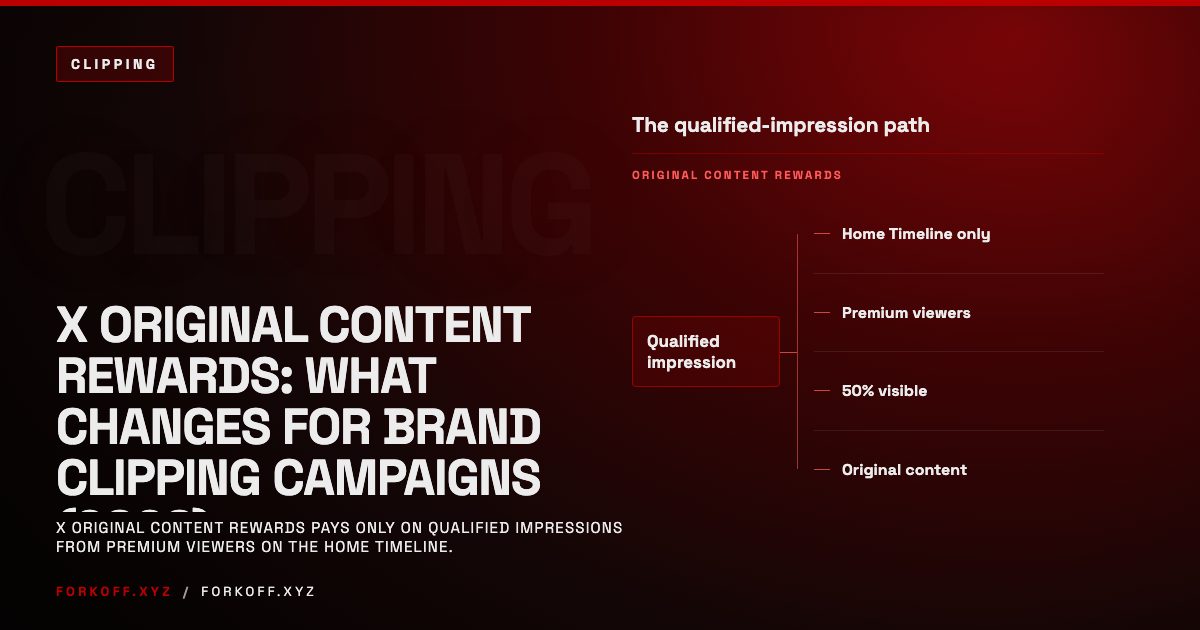
X swapped Creator Revenue Sharing for Original Content Rewards, so recycled-clip payouts are gone. What brands running clipping campaigns change now.
 Read
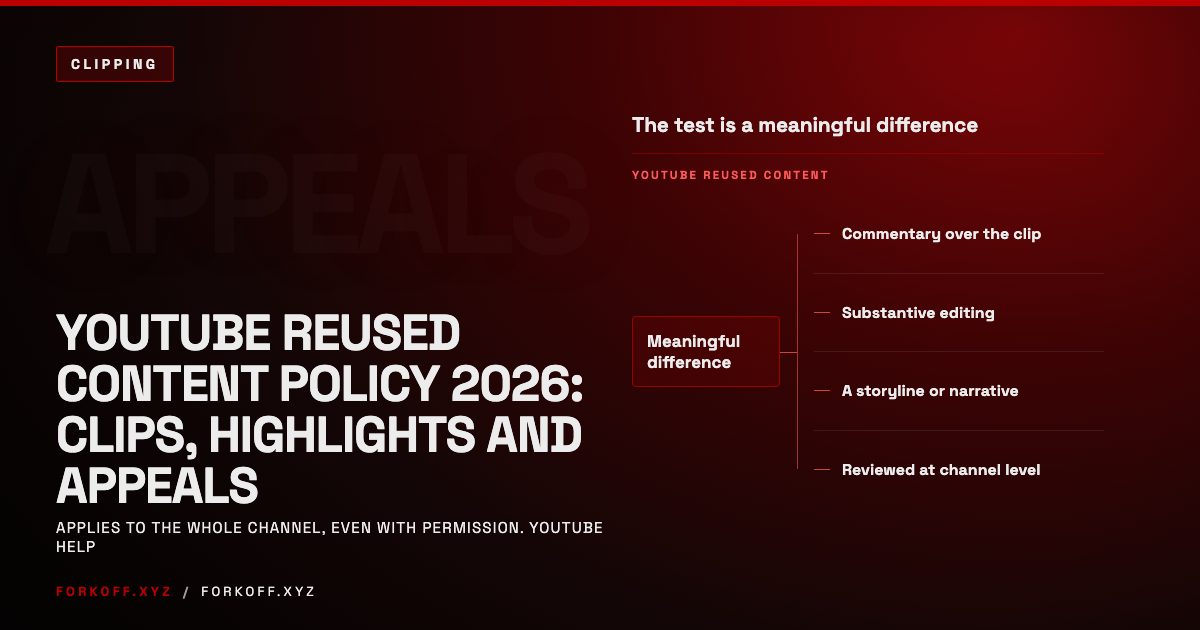
What YouTube's reused content policy actually says, how it treats clips, stream re-uploads and compilations, how to appeal, and how brand clipping stays clean.
Read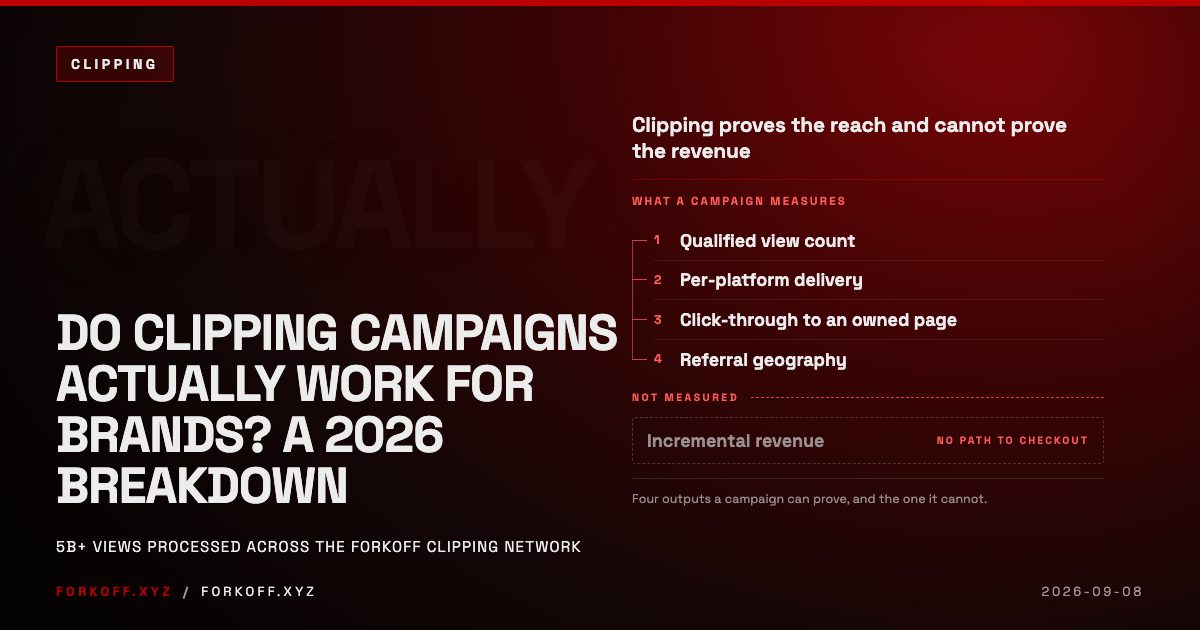
Clipping campaigns buy reach at a low unit price and cannot prove revenue. The 2026 breakdown of CPM by content signal, attribution and vendor diligence.
Read