


01
Ad networks
count impressions
Ad networks count impressions. You pay every time a view is delivered, even when nobody watches. Reach is measured. Whether anyone cared is not.
Pay for ads that never get watched.
Brands pay an average of $0.003 per qualified view. verified watch-time, valid traffic, geo-routed delivery. If it doesn't qualify, it doesn't count.
Agencies sell effort. Marketplaces sell volume. FORKOFF sells qualified outcomes.
Clipping is not editing. It is distribution infrastructure.
Three content signals price on an inverting ladder: the more brand-dedicated the account, the higher the CPM and the lower the volume. Editing is the cheapest, most replaceable step in the chain. The infrastructure, vetted clippers, qualification pipeline, and distribution across five platforms, is what a brand is actually buying.
A clipping agency is a managed service that recruits, briefs, and directs short-form editors, called clippers, who cut long-form content into platform-native clips, then reports on the results. Clipping pricing runs three ways: flat retainers, raw-view marketplaces, and outcome pricing. FORKOFF prices on outcomes at an average of $0.003 per qualified view, counting a view only after a four-stage gate checks watch-time, policy, geo, and traffic validity. The network has processed 5B+ views this way.
A clipping campaign is a managed program where a brand briefs a roster of clippers to cut long-form content into platform-native short clips, then pays only for the views that pass qualification. FORKOFF runs the whole campaign: brief, clipper vetting, episode-level direction, moderation, and settlement. The difference from a self-serve tool or a raw-view marketplace is the unit you pay for. FORKOFF bills the campaign on qualified views at an average of $0.003 each, so a clipping campaign budget maps to verified watch-time and valid traffic, not impressions a dashboard inflated.
Clipping pipeline
3 moments marked
1:47:32
the cold-open answer
the contrarian take
the one-line proof
Hook in frame one, captions burned in, sized 9:16
Qualified views
896,000
At $0.003
$2,688
Paid on qualified views, not on hours edited
Clipping is how FORKOFF delivers content distribution at scale. Brands buying managed campaigns start at for brands buying clipping; estimate a budget with the CPQV calculator.
Cost per qualified view, or CPQV, is the price a brand pays for one view that passes every qualification check in the campaign brief. It is the honest unit of clipping campaign cost, because it strips out the views a raw-view count would have billed you for. Across FORKOFF campaigns the average lands near $0.003 per qualified view. The figure moves with platform mix, geo targeting, and how strict the brief sets watch-time and traffic-validity thresholds, but the unit never changes: you pay for views that qualified, and the verified proof shows the ones that did not.
The full per-platform CPQV spread, sample window, and exclusion-rate methodology are published in the FORKOFF CPQV benchmark. Compare that against a per-raw-view marketplace, which bills every view that loaded, and per-seat clipping software, which charges a flat subscription no matter how the views perform; the AI tools themselves are benchmarked head to head in the OpusClip vs Vizard comparison, and the model contrast is laid out in the pricing table further down this page. A one-paragraph definition lives at what is cost per qualified view.
Two numbers on this page do two different jobs. One is what you buy. The other is what our campaigns have measured. Reading the second as the first is the fastest way to size a campaign wrong, so here is each one and what it is for.
The entry price, what you buy
from $3,500
The FORKOFF entry buy is Clipping Foundation: from $3,500, across three campaigns. It is the smallest managed engagement we run and the figure to plan against. Where you land above it follows scope, geo, and the volume you want.
The measured rate, what campaigns delivered
$0.003 per qualified view
This is an average FORKOFF has measured across its own managed campaigns, inside a spread of $0.0024 to $0.0038. It is first-party evidence from 5B+ views processed, and it moves with platform mix, geo targeting, and how strict the brief sets watch-time. Read it as a reference for what efficient looks like on this model.
The measured rate is proof, not a published unit to multiply a view target by. Do that arithmetic and you get a number, not a quote. Bring the outcome you want and the scope lands on the call. The per-platform spread and exclusion-rate methodology behind the measured rate are published in the FORKOFF CPQV benchmark.
The clip economy is the market that formed when brands realized short clips, not polished long-form, drive most of the attention on TikTok, Reels, Shorts, and X. Clippers cut moments from podcasts, streams, and launches, post them at volume, and get paid on performance. The model went mainstream when large content owners started paying clippers directly, which pushed the question every brand now asks: which of these views are real. The clip economy rewards volume, so it also produces inflated view counts. Paying per qualified view is how a brand stays in the clip economy without paying for the noise it generates.
FORKOFF wrote up the moment the clip economy crossed into nine-figure budgets in the clip economy, explained, and broke down a real campaign in the clipping campaign cost case study. The same question drives our research: FORKOFF forensically analyzed 30 high-profile launches and found 67% carried a paid or amplified reach signature, in the Launch Authenticity Report 2026. Brands standing up their own roster can follow how to build a brand clipping network. For a launch specifically, FORKOFF produces the launch video and clips it into launch-day distribution, so the film and the amplification ship from one team. Where the long-form the clips are cut from is a recurring show rather than a one-off launch, the upstream engagement is podcast marketing services, which owns the strategy, the record, and the distribution the clip cadence then runs on.
A clipping agency costs whatever its pricing unit makes you pay for. FORKOFF prices managed clipping on qualified views rather than a flat retainer or raw-view count, billing an average of $0.003 per qualified view, so the budget tracks verified watch-time and valid traffic instead of impressions a dashboard inflated. The total moves with platform mix, geo targeting, and how strict the brief sets watch-time and traffic-validity thresholds, but the unit never changes.
Estimate a budget against your own view target with the CPQV calculator, or see the model contrast against per-raw-view marketplaces and per-seat software in the agency vs marketplace explainer. Weighing named managed networks? See the full nine-agency ranking in the best clipping agency comparison, or read the clipping culture alternatives breakdown. Comparing against self-serve software instead? The 10 OpusClip alternatives ranking sorts tools and managed shops on how much of the chain each one owns. The brief answer to how much a clipping agency costs sets out the pricing units side by side. The model question underneath it, why a few agencies bill per delivered outcome while most bill a monthly retainer, is answered at agencies that price on outcomes instead of retainers. The six checks that separate a real distribution partner from a good-looking landing page are laid out in how to choose a clipping agency. Every short question we get asked about clipping, pricing, usage rights and attribution is answered in one place in the answers library.
A clipping agency is worth it for a brand that wants short-form output at volume without building an in-house editing team and without paying for views that never qualified. The managed model handles brief creation, clipper vetting, episode-level direction, moderation, and per-view reporting, which is the work that decides whether a clip program produces real watch-time or just an inflated view count. FORKOFF has processed 5B+ views through this model at a 99.71% sustained legitimacy rate, and excludes every view that fails a qualification check with a written reason code, so the brand only pays for traffic that passed.
Brands buying managed campaigns start at for brands buying clipping; the per-view methodology is published in the qualified views methodology. SaaS teams weighing a clipping agency for SaaS launches can scope the brief at clipping for SaaS brands. Vetting trust before budget? Are clipping agencies legit answers that question directly.
An AI clipping agency is a managed team that uses AI clipping tools to cut long-form content at volume, then adds a human qualification layer on top so a brand pays only for views that pass. It sits between two other options. A clipping platform, or clipping software, is self-serve: you upload a video and the tool returns clips, but nobody vets the output or the views behind them. A raw-view clipper agency or marketplace pays clippers on every view a dashboard reports, qualified or not. FORKOFF runs as a managed AI clipping agency: AI tooling handles the cutting speed, and a four-stage qualification gate decides which views count, at an average of $0.003 per qualified view. The network has processed 5B+ views this way at a 99.71% sustained legitimacy rate.
Picking the best clipping platform for your team comes down to whether you want to run the work yourself or hand it to an agency. Self-serve tools are compared head to head in the OpusClip vs Vizard comparison and the 10 OpusClip alternatives ranking. Managed clipping agencies are ranked in the best clipping agency comparison. If you already run in-house clippers, FORKOFF can layer its qualification engine over your existing roster, so you keep the team and add the proof.
Clipping is not a side tactic anymore. Short-form video is the format buyers watch and the format marketers say returns the most, and the creator economy behind it is now a hundreds-of-billions market. Here is the sourced picture behind the managed clipping motion on this page, every figure from a named source with the year it was reported.
The creator economy was a roughly 250 billion dollar total addressable market in 2023 and is projected to nearly double to about 480 billion dollars by 2027. (Goldman Sachs, 2023)
There are an estimated 50 million creators worldwide, a base expected to grow at a 10 to 20 percent compound annual growth rate over five years, with short-form video monetization named as a primary driver. (Goldman Sachs, 2023)
United States creator advertising spend more than doubled from 13.9 billion dollars in 2021 to 29.5 billion dollars in 2024, and is projected to reach 37 billion dollars in 2025, growing about four times faster than the total media industry. (IAB, 2025)
Short-form video returns the highest ROI of any content format and ranks first for lead generation and engagement, and marketers said they planned to invest in it more than any other media format. (HubSpot 2024 Video Marketing Report, 2024)
YouTube Shorts averages more than 70 billion daily views, up from about 30 billion in 2021, one of the fastest-growing formats in the platform's history. (YouTube, 2024)
FORKOFF has processed 5B+ views through its managed clipping network at a 99.71 percent sustained non-bot legitimacy rate, billing an average of $0.003 per qualified view, with every rejected view logged and excluded from spend. (FORKOFF, 2026)
FORKOFF has processed more than 5 billion qualified views through a four-stage qualification gate that checks watch-duration, platform policy, geo consistency, and traffic validity on every view, holding a 99.71% sustained non-bot legitimacy rate on the views that counted, at an average of $0.003 per qualified view. Every rejected view is logged with a written reason code and excluded from billing.
Source, FORKOFF first-party data: Clipping CPQV benchmark and qualified-views methodology.
Four platforms, one campaign. FORKOFF's clipper pool ships your content to TikTok, Instagram, YouTube and X. every clip routed to the surface where it earns the qualified view.
count impressions
Ad networks count impressions. You pay every time a view is delivered, even when nobody watches. Reach is measured. Whether anyone cared is not.
Pay for ads that never get watched.
count raw views
Self-serve clippers count raw views. The number includes scroll-by views, bot traffic, geo-mismatched audiences, and sub-second exposures. Low rate-card price, but the number is a vibe. not a receipt.
Pay for views that never qualify.
counts qualified views
FORKOFF counts qualified views. Every view passes four checks. watch duration, policy compliance, geo consistency, traffic validity. before it counts toward a brand's spend or a clipper's payout. The receipt is auditable. The CPV is real.
Pay only on outcomes.
A view is qualified only when all four checks pass. If any layer rejects it, the view is logged, attributed to a reason code, and excluded from both spend and payout. 99.71% of views on the ledger have cleared all four.
① WATCH
Duration meets the threshold
TikTok 1.5s baseline · YouTube 30% retention · Instagram Reels 2s baseline. Threshold is set in the brief.
Disputed claims, restricted categories, and policy edges get rejected with a written reason. Never silently filtered.
Views from non-target countries are logged but never counted. Spillover happens only when the brand authorizes it.
Datacenter UAs, viewing patterns, and post-campaign cohorts reviewed. Multi-layer because a single check is gameable.
99.71% legitimacy is not a marketing claim. It is the rate measured after every layer has run. Brands never pay for filtered traffic. Clippers flagged in any layer are removed and excluded from payout, with a written reason.
Clipper identity verification, account age, platform history, cross-platform graph signals. Filters bad actors before they get in the door.
5.3M passed
4-layer funnel
Brief intake on day 1. Geo-routed clipper pool live within 48 hours. Auto-settled payouts once moderation clears. Every step on the same audit-ready ledger.
A campaign with a reason to run.
Targeted clippers, not random ones.
Every clip, every reason.
Real-time outcomes, auto-settle.
Enter your budget, platform mix, and qualified-view threshold to see the CPQV a clipping campaign would target. It is the same math FORKOFF prices clipping work against, so you walk into the brief knowing what efficient looks like.
Fourteen days, paid only on qualified views, no minimum term. It is the cheapest way to see the shape of the data before committing to a campaign, and the fastest way to find out whether your footage clips well.
Side-by-side against the platforms in market today. Categories chosen by buyer-team request. not picked to flatter us.
| Feature | FORKOFF Clippingoperator-grade | OpusClipself-serve SaaS | Whop / Hoodpayclipper marketplace | Vizard / Klapself-serve SaaS |
|---|---|---|---|---|
| Counts qualified views (4 checks) | ||||
| Geo-routing | partial | |||
| Moderation pipeline | ||||
| Anti-bot ledger | partial | |||
| Visible payout math (before accept) | ||||
| Pricing model | Per QV ($0.003) | Per raw view | Per raw view | SaaS monthly |
| Best for | B2C + crypto brands | Solo clippers | Clipper marketplaces | Solo clippers |
Honest framing: each platform is best for a different buyer. We name who.
Full buyer's matrix on forkoff.xyz/blogBring your target geo and the monthly view volume you want. You get the qualified-view rate on the call, not a proposal a week later.
Brand anonymized at NDA request · numbers verified by FORKOFF qualification ledger
Each engagement below names the company, the window the work ran in, and the numbers it returned. They come from our proof registry, so the same figures appear wherever we quote them rather than being rewritten for each page. Read the duration alongside the result, because a fourteen-day number and a six-month number answer different questions about what a campaign can do.
14 days, Q1 2026
qualified views
qualification rate
legitimacy
cost per qualified view
14 days, Q3 2026
qualified views
qualification rate
legitimacy
cost per qualified view
14 days, Q3 2026
qualified views
qualification rate
legitimacy
cost per qualified view
Walk through what numbers like these would look like for your business.
13 active days of distribution. 1.19 million views. 27 new paid subscribers at $50 a month. And 83% of the prior month's subscribers kept paying on top of that. This is a subscriber acquisition engine, not a one-time promotion.
Crypto Lark
YouTube Creator, The Inner Circle, Lark Davis · The Inner Circle
Finance approved the spend the day we showed them the cohort report. A screenshot of views is not attribution. A per-view audit ledger with reason codes is.
Marketing director
Marketing Director, DePIN Protocol
Submitted Tuesday. Earned Friday. The payout math was exactly what they showed me before I accepted the brief. I have run three campaigns now. Same experience each time.
Clipper
Clipper, TikTok · India + SEA
US-only mode was underperforming. We opened India and Southeast Asia in the routing. Same budget, 4.2 million qualified views over 14 days. The CPV came in at a third of what we had been paying.
Head of campaigns
Head of Campaigns, Crypto consumer brand
Clip economy is moving toward outcome-priced. We pay for verified attention now, not raw impressions. Anything else is selling air.
Brandon Olsen
Crypto-native brand, ops lead
Spent $40K on a clipping campaign last quarter. Dashboard reported 80M views. Real qualified watch-time was closer to 6M. The industry needs a real standard.
Ava Sterling
Agency, paid social strategist
If your clipping spend isn't gated by a watch threshold + geo + bot check, you're funding inventory the platforms throw away. Burned us once, never again.
Felix Ortega
B2C founder, Series A
Best campaign we ran this year: paid per qualified view, not per raw view. Same budget, 3.4× more retained attention. The unit of account matters.
Grace Park
Token launch, growth PM
Our agency report shows 12M views. Internal mixpanel pulled in 3.1M sessions. The gap is real and growing. Anyone using a third-party qualified-view ledger?
Paraphrased, r/marketing
Burned $80K on a pure-volume campaign last quarter. Looked clean on the dashboard. Three weeks later we're chasing reasons. Anyone running on per-qualified-view pricing yet?
Paraphrased, r/cryptocurrency
Switched off the random-pool platforms last month. Hate the lottery. Got onto a managed network where eligibility is in writing before I accept. CPM math is clearer, payouts auto-settle. Glad to take less for clarity.
Paraphrased, r/CreatorEconomy
We design the brief with you, run a 14-day micro-campaign, and report qualified outcomes against your CPV target. If qualified views fall below the agreed floor, the unspent budget is refunded. Operational fee disclosed in advance.
| ▸ TikTok | 5K+ followers OR a 90-day verified track record |
|---|---|
| 3K+ followers · last-30d engagement ≥ 3% | |
| ▸ YouTube Shorts | 5K subscribers OR 50K shorts-views in 30 days |
| ▸ YouTube long-form | 2K subscribers · ≥ 25% retention on a clip ≥ 60s |
| ▸ X / Twitter | 2K followers · video-history present |
| 5K page followers |
Eligibility is platform-specific because qualification math is platform-specific. Fit, quality, and verifiable performance matter more than raw follower count.
Payout = (Qualified Views ÷ 1,000) × Campaign Rate
ex: 20,000 qualified views @ $3 CPM = $60
A view that passes four checks set by the campaign brief: watch duration, policy compliance, geo consistency, and traffic validity. If any layer rejects it, the view is logged with a reason code and excluded from both spend and payout.
Most campaigns go live within 24-48 hours of brief acceptance.
Yes. Start on the cheapest content signal, logo placement over existing volume, before committing to dedicated brand accounts at 12-20x that rate. The Clipping Foundation pilot goes entirely to clippers with no management fee, targeting 1-1.2M qualified views across 50-60 accounts.
Instagram, TikTok, YouTube (Shorts and long-form), X, and Facebook.
OpusClip and Vizard are self-serve clipping SaaS. Whop and Hoodpay are clipper marketplaces that count raw views. FORKOFF Clipping is managed and counts only qualified views: every view filtered through four checks before it counts.
No. Fit, quality, and verifiable performance matter more than raw follower count.
Every rejection includes a reason code: policy issue, brief mismatch, format mismatch, or invalid traffic signals.
Payout equals qualified views divided by 1,000, times the campaign CPM rate. Rates are visible before brief acceptance.
Yes. FORKOFF Clipping can run a managed campaign on a brand's existing clipper roster, with the qualification engine and reporting layered on top.
It depends on the tier. On the clipper-network model, the clipper owns the account and the brand rents the reach. On the dedicated brand-account tier, accounts are created for that brand rather than drawn from shared inventory, so ownership and any handover terms belong there. We say up front which model a given quote is for.
On the mass clipper-network signal, a clip lands on someone else's page alongside whatever else that page posts, so we cannot guarantee adjacency. The dedicated brand-account tier is built for exactly this: every neighbouring post on that account is also the brand's own, which is total adjacency control by construction and part of why that tier carries a higher CPM.
Filtered traffic is logged with a reason code and excluded from spend. Brands never pay for traffic that fails any qualification check.
Yes. Every campaign produces an audit-ready CSV/JSON export with per-view reason codes.
FORKOFF is a managed AI clipping agency, not a self-serve clipping platform. Self-serve platforms and clipping software return clips and leave verification to you. FORKOFF uses AI clipping tools for speed, then runs a four-stage qualification gate so a brand pays only for views that pass, at an average of $0.003 per qualified view.
Run measurable clipping campaigns priced on qualified views only. 14-day sandbox available. paid only on qualified views, refund the rest.
Are you a clipper? Join the networkRegion hubs, conversion pSEO grids, podcast verticals, ICP pages, free tools, and the vs/alternatives compare matrix. Every link goes to a real page on this domain.
Region + platform
12 pagesMatch clippers and brands by geography and platform. Each hub ranks for the geo + platform head term.
Source → destination
15 pagespSEO grid covering every realistic source platform paired with every realistic destination short-form surface.
Content + podcast
13 pagesPodcast clipping vertical pages and the top-of-funnel compare hubs that capture "best clipping software" SERP intent.
Content type
Compare hubs
Clippers + Brands
12 pagesClippers in the network on one side, brand verticals buying clipping on the other. Each ICP ranks for the bottom-funnel head term.
Clippers
Brand verticals
Launch + tools
16 pagesLaunch-shaped scenarios for AI, SaaS, dev tools, fintech, gaming and crypto. Plus the free calculators clippers + brands use before brief acceptance.
Launch + use-case
Free FORKOFF tools
First-party research
FORKOFF vs vendors
19 pagesHead-to-head with every named competitor in the clipping category. Pricing and review teardowns for the four most-searched vendors.
vs comparisons
Pricing + review teardowns
Need a page that isn't in the grid?
Custom landing page for your campaign scenario.
If your scenario doesn't map to one of the 86 pages above, FORKOFF can scope a custom landing page for your campaign before brief acceptance.
As Featured In
Full press shelf







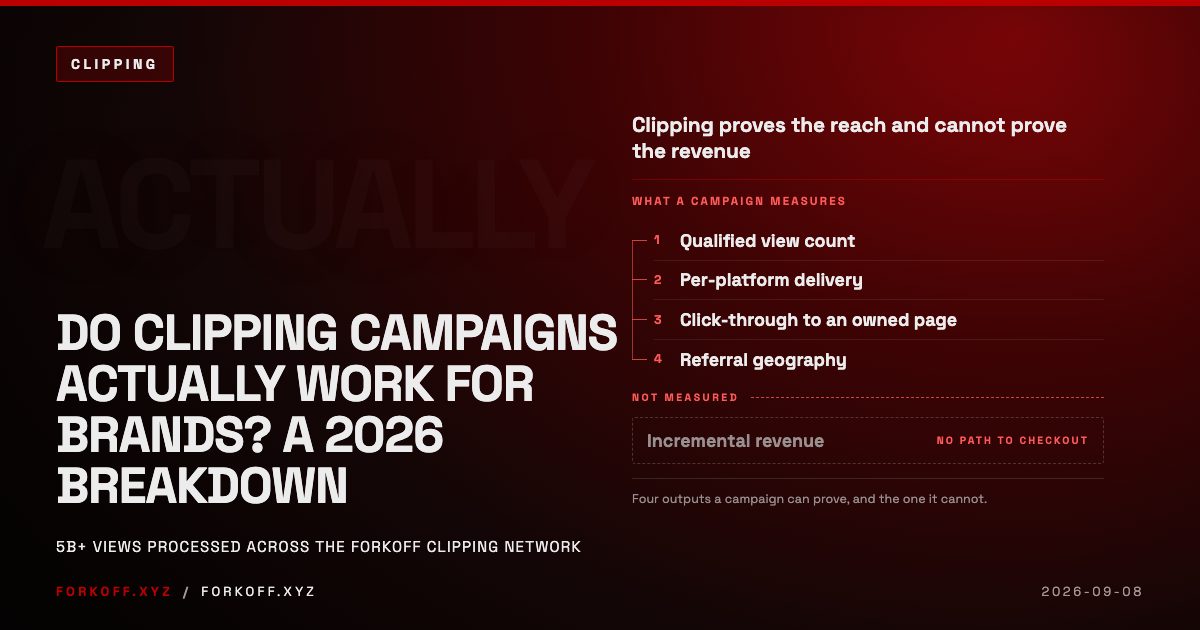
Clipping campaigns buy reach at a low unit price and cannot prove revenue. The 2026 breakdown of CPM by content signal, attribution and vendor diligence.
 Read
Read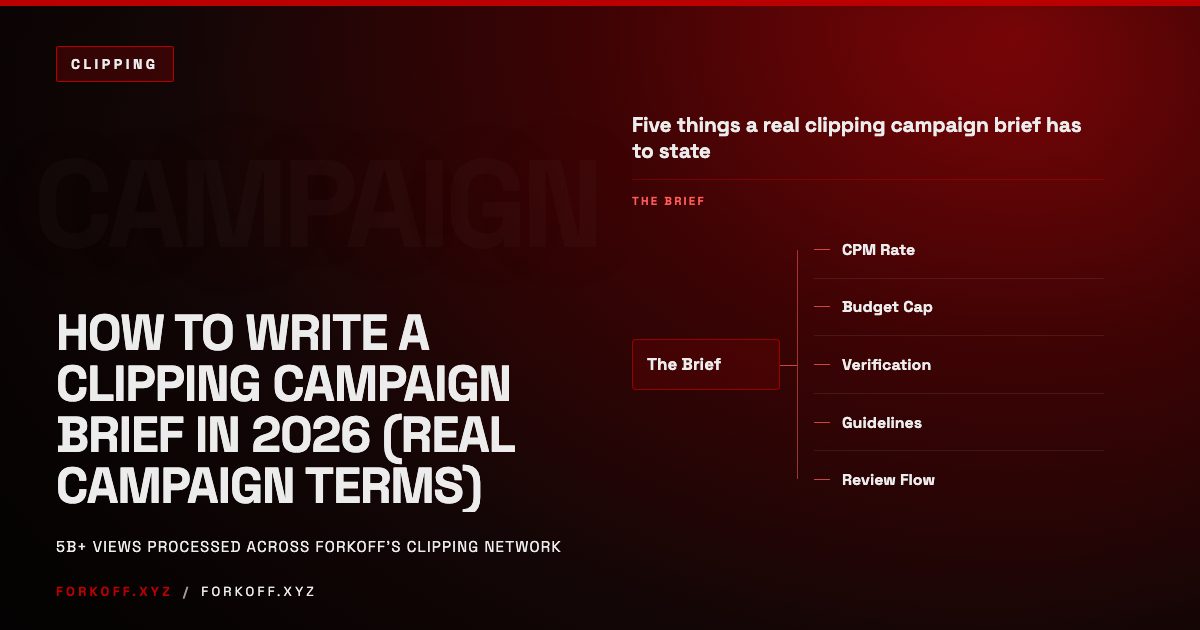
A clipping campaign brief sets the CPM, budget cap, submission rules, and review flow that decide whether a campaign gets quality clips or wasted budget.
Read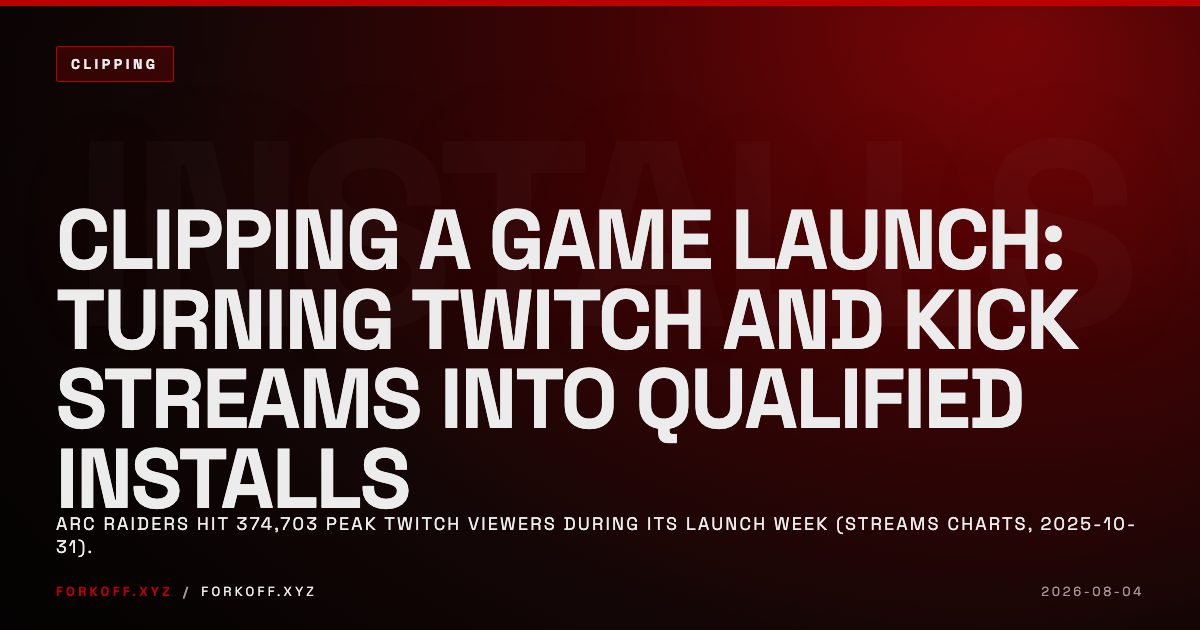
A launch-week playbook for clipping Twitch and Kick streams into qualified installs, with Drops mechanics, wishlist math, and a 7-day production calendar.
Read